Author Archive for InvestMacro – Page 160

Is Bill Gates Right On Energy Investing?

By OilPrice.com

Not long ago, Bill Gates offered some investment advice. That, in itself, constitutes news, but the content and the reactions make up a more interesting story.

Gates told the Financial Times, in essence, that investors who want to do something about climate change should stop making up lists of companies they do not want in their portfolios based on involvement in fossil fuel production or use. They should, instead, invest in disruptive technologies that will provide actual solutions to climate change.

Environmental-social-governance (ESG) investors have pushed back on this position partly on moral grounds. But there are economic reasons as well. Their withdrawal of capital, and demand that banks not finance fossil fuel projects limits the pool of capital available to fossil fuel companies, which raises their cost of capital. And their insistence that fossil fuel companies more explicitly lay out risks to shareholders sets on notice fiduciary investors, who do not want to have to explain, afterwards why they made an investment in disregard of warnings. But the actions of ESG investors are essentially negative, and possibly of limited effectiveness, given the huge cash flows that oil companies generate. The oil companies can continue to do what they always did. And the capital market boycotts do not create solutions.

Okay, easy advice for Bill Gates to give, because he and his fellow billionaires have the money and contacts to acquire interests in those disruptive technology companies before they go public. The rest of us don’t. We will, as consumers, pay for the new technologies that will make the original investors richer.

Some energy experts have said, don’t worry, the big energy firms will make those investments, and they have the money to do it. In truth, some giant energy firms have looked into doing so. Royal Dutch Shell, for instance, set up a team of executives to figure out how. They immediately ran into the problem. Shell is the biggest dividend payer in the world. It wants to maintain that dividend of $16 billion per year. The bulk of cash flow comes from the oil and gas business. It has invested in natural gas (lower carbon content than oil or coal) in windmills, in hydrogen energy, but all this green investing, no matter the prospects, cannot generate enough cash to pay that dividend. Shell will not make the Schumpeterian move, to dump the old business before it is too late, and go whole hog into the new. Shell cannot afford to be disruptive. Somebody else will have to do it. In that respect, Bill Gates is right.

Presumably the market will (eventually) furnish the capital needed to decarbonize the economy, but, so far, venture capitalists seem more interested in disrupting the taxi, restaurant, scooters and office space industry. They pour billions into those ventures. Meanwhile, the climate continues to warm.

We would suggest an alternative to waiting for the Silicon Valley crowd to come to our salvation. One that takes into account the need to secure public backing for the required social and economic changes. We believe that the nation needs one or several publicly sponsored energy and climate funds, similar in ways to Comsat, a government sponsored but privately financed and managed corporation that first launched our communications satellites. Anyone could buy a share in the new telecommunications technology. Why not something similar for climate change? Maybe allow payroll deductions for small investors or state-sponsored funds for local projects. Climate change mitigation efforts will succeed only if the public buys into the concept. And giving the public a chance to buy in, literally, might hasten the process.

So back to Bill Gates’ advice. Great idea. And, as the old saying goes, “What is sauce for the goose is sauce for the gander.” So why can’t the rest of us invest along with Bill?

Link to article: https://oilprice.com/Energy/Energy-General/Is-Bill-Gates-Right-On-Energy-Investing.html

By Leonard Hyman and William Tilles


US Stock Markets Trade Sideways – Waiting on News/Guidance.

By TheTechnicalTraders.com

Our researchers believe the global concerns centered around Banking and Debt within the Emerging Markets and Asia/Europe are very likely to become major issues over the next 3+ months.  These potentially dangerous issues could have far-reaching pricing ramifications for almost all of the world’s financial markets.  This weekend, we received first-hand information from an associate in Hong Kong about banks limiting ATM withdrawals and very limited transportation services.  Our source stated the biggest issue was the lack of transportation right now.

We also followed the news of the Bank collapse in India this weekend and the aftermath for Indian banking customers – PMC Bank

Many of you remember how the US credit crisis event started in a similar manner.  First, it is news of a few select financial institutions or lenders that are in trouble.  This sends a shock-wave throughout the populous – they react by becoming more “protectionist” in their actions.  Sometimes, small bank runs can happen as consumers want to have more cash on hand instead of “in the bank”.  Next, the local economic metrics start to fall – almost like a self-fulfilling nightmare, the consumers, acting to protect their interests and assets, are now pushing the local economy over the edge and the banks, possibly, over the breaking point in terms of Non-Performing Loans.

This time, as we have detailed in our previous research posts, we believe the crux of the credit problems is related to how emerging markets and foreign markets took advantage of the cheap US dollar between 2011 and 2015.  At that time, it was cheaper for banks to borrow the US Dollar than it was for them to borrow money from their own local central banks.  Thus, many went out seeking to borrow as much US Dollar as they could because it provided an opportunity to save on interest fees.  Now, as the global economy continues to contract in a “stagflation” type of manner, it becomes even harder for many of these firms, banks, and individuals to service their debt.

We believe the global markets and the US stock market are waiting for news before initiating any new price trends.  We believe the recent US manufacturing number is indicative of the type of economic output values we can expect over the next 30+ days.  Unless the US Christmas season starts off with a big spending spree or the US/China trade issue is resolved and settled within 30+ days, we believe the markets will continue to search for and identify “true price value” by seeking out true support before attempting to move higher again.

Our morning coffee video analysis recap is the one thing… that single investment that’s going to turn into the greatest thing you’ve ever made for your trading and investment accounts.

S&P 500 Daily Chart

This ES Daily chart highlights the recent resistance, triple-top formation, near 3025.  It is clearly obvious that this 3025 level is a very strong price resistance level.  Below this ceiling, we have multiple support levels to watch.  2875 is highlighted in MAGENTA and is one that we believe is the most critical right now.  Below that, the Moving Average level, currently at 2845, could also provide some support.  Below these two, we suspect the 2700 level is the only level of support left before we could experience a much bigger price breakdown.

Dow Jones Daily Chart

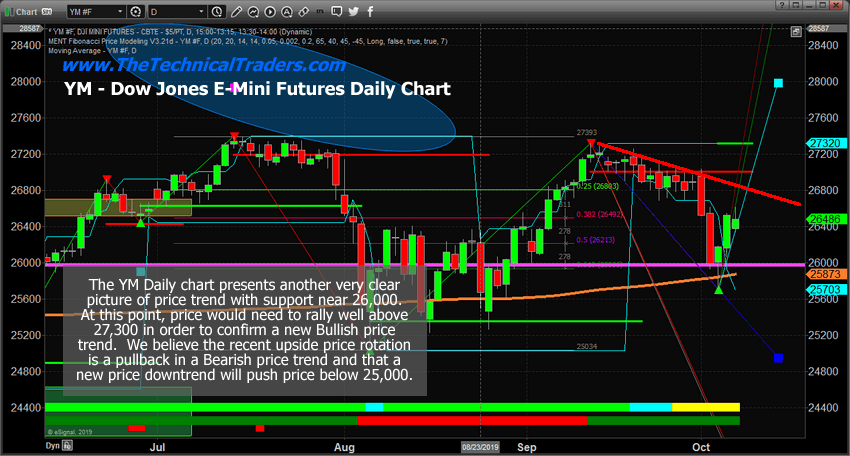
This YM Daily chart sets up a similar type of price pattern.  In fact, they are almost identical.  Again, the current downside price rotation has already established new recent price lows.  The RED resistance channel we drew across the tops should provide some real level of a price ceiling within this trend.  Our concern is that price will attempt a further breakdown without any positive news to extend a positive perspective for the US markets future.  There is just too much uncertainty in the world for investors to have the confidence to push prices higher.  The most logical transition would be for price to “reset” by rotating lower, finding true price value levels and establishing a new price bottom to begin a new rally from.

Dow Jones 2-Week Chart

This 2-Weekly YM Chart highlights exactly why we believe skilled technical traders need to be cautious right now and why having a very skilled team of researchers is important.  This is not the time to go ALL-IN on any trades.  This is not the time to roll your retirement account into HIGH-RISK funds.  We suggest being very cautious at the moment and to prepare for any downside rotation by scaling back your trading account to 70 to 80% CASH.  Deploying only about 20 to 25% into the markets right now.

Concluding Thoughts:

It is funny how real traders understand the value of having a skilled team of dedicated technical and fundamental researchers assisting them at times like this.  While other people freak out and turn into “super protectionist traders”.  The reality of these types of markets is that they are the best markets for traders.  Price swings are larger, opportunities are setting up nearly everywhere and skilled traders can attempt to make 45%, 65%, 85% or more within a very short time-frame.  Not like the regular market moves of 3~5% annually in the SPY.  This is the time when you want to become more attentive and active in the markets – with the right team.

Opportunities are setting up EVERYWHERE and will continue to present very clear trade setups over the next 16+ months.

As a technical analysis and trader since 1997, I have been through a few bull/bear market cycles. I believe I have a good pulse on the market and timing key turning points for both short-term swing trading and long-term investment capital. The opportunities are massive/life-changing if handled properly.

Be sure to ride my coattails as I navigate these financial markets and build wealth while others lose nearly everything they own during the next financial crisis.

I can tell you that huge moves are about to start unfolding not only in metals, or stocks but globally and some of these supercycles are going to last years. My simple technical trading strategy using ETFs will allow you to follow the markets closely and trade with it so you never get caught on the wrong side of the market with big losses.

Chris Vermeulen
TheTechnicalTraders.com

NOTICE: Our free research does not constitute a trade recommendation or solicitation for our readers to take any action regarding this research.  It is provided for educational purposes only.  Our research team produces these research articles to share information with our followers/readers in an effort to try to keep you well informed.  Visit our web site to learn how to take advantage of our members-only research and trading signals.


EURUSD: expect movements between 1.0958 and 1.1000

By Alpari.com

On Monday the 7th of October, trading on the EURUSD pair closed 0.06% down. The rate jumped to 1.1001 during the European session before slipping to 1.0969 during the US session. These fluctuations were brought about by weak German data, comments from Neil Kashkari, and uncertainty over US-Chinese trade talks.

The factory orders index in Germany dropped by 0.6% against a forecast of -0.3%. There’s an increased likelihood of the German economy going into recession.

Minneapolis Fed President Neil Kashkari said that the Fed should continue to slash interest rates. This is a necessary measure to prevent risks to the economy and to grow wages. The next FOMC meeting is at the end of the month.

Negotiators began talks on the 7th of October ahead of the meeting between the Chinese Vice Premier and US Trade Representative, which is planned for Thursday. Reuters has reported that these talks are taking place amid a tense atmosphere, with neither side showing signs of compromise.

Day’s news (GMT+3):

  • 7:10 UK: BoE’s Governor Carney speech.
  • 15:15 Canada: housing starts (Sep).
  • 15:30 Canada: building permits (Aug).
  • 15:30 US: PPI (Sep).
  • 21:30 US: Fed’s Chair Powell speech.
  • 23:30 US: API weekly crude oil stock (4 Oct).

EURUSD H1Current situation:

The pair reached its predicted target, only after a drop below the trend line. We allowed for a false breakout given the upcoming talks as well as the disappointing German data.

This week, attention is turned towards the publication of the FOMC minutes and the trade talks between the US and China (10th and 11th of October). US trade advisor Larry Kudlow has hinted that the two sides may make some progress during the negotiation process.

At the time of writing, the euro is trading at 1.0981. The pair is currently around the balance line. The formation from 1.0999 (03/10) has a bearish feel to it, but since geopolitics are currently taking centre stage, the pair could exit the 1.0958 – 1.1000 range in any direction. It’s better to look at making trades at the boundaries of this channel. With the pair trading in the middle of the channel, there are high stop levels and a higher risk of triggering them.

By Alpari.com

What is Web Scraping?

By Zac Clancy for Kite.com

Table of Contents

  • Introducing web scraping
  • Some use cases of web scraping
  • How does it work?
  • Robots.txt
  • A simple example
  • Working with HTML
  • Data processing
  • Next steps

Introducing web scraping

Simply put, web scraping is one of the tools developers use to gather and analyze information from the Internet.

Some websites and platforms offer application programming interfaces (APIs) which we can use to access information in a structured way, but others might not. While APIs are certainly becoming the standard way of interacting with today’s popular platforms, we don’t always have this luxury when interacting with most of the websites on the internet.

Rather than reading data from standard API responses, we’ll need to find the data ourselves by reading the website’s pages and feeds.

Some use cases of web scraping

The World Wide Web was born in 1989 and web scraping and crawling entered the conversation not long after in 1993.

Before scraping, search engines were compiled lists of links collected by the website administrator, and arranged into a long list of links somewhere on their website. The first web scraper and crawler, the World Wide Web Wanderer, were created to follow all these indexes and links to try and determine how big the internet was.

It wasn’t long after this that developers started using crawlers and scrapers to create crawler-based search engines that didn’t require human assistance. These crawlers would simply follow links that would come across each page and save information about the page. Since the web is a collaborative effort, the crawler could easily and infinitely follow embedded links on websites to other platforms, and the process would continue forever.

Nowadays, web scraping has its place in nearly every industry. In newsrooms, web scrapers are used to pull in information and trends from thousands of different internet platforms in real time.

Spending a little too much on Amazon this month? Websites exist that will let you know, and, in most cases, will do so by using web scraping to access that specific information on your behalf.

Machine learning and artificial intelligence companies are scraping billions of social media posts to better learn how we communicate online.

So how does it work?

The process a developer builds for web scraping looks a lot like the process a user takes with a browser:

  1. A URL is given to the program.
  2. The program downloads the response from the URL.
  3. The program processes the downloaded file depending on data required.
  4. The program starts over at with a new URL

The nitty gritty comes in steps 3 and, in which data is processed and the program determines how to continue (or if it should at all). For Google’s crawlers, step 3 likely includes collecting all URL links on the page so that the web scraper has a list of places to begin checking next. This is recursiveby design and allows Google to efficiently follow paths and discover new content.

There are many heavily used, well built libraries for reading and working with the downloaded HTML response. In the Ruby ecosystem Nokogiri is the standard for parsing HTML. For Python, BeautifulSoup has been the standard for 15 years. These libraries provide simple ways for us to interact with the HTML from our own programs.

These code libraries will accept the page source as text, and a parser for handling the content of the text. They’ll return helper functions and attributes which we can use to navigate through our HTML structure in predictable ways and find the values we’re looking to extract.

Scraping projects involve a good amount of time spent analyzing a web site’s HTML for classes or identifiers, which we can use to find information on the page. Using the HTML below we can begin to imagine a strategy to extract product information from the table below using the HTML elements with the classes products and product.

<table class="products">
  <tr class="product">...</tr>
  <tr class="product">...</tr>
</table>

In the wild, HTML isn’t always as pretty and predictable. Part of the web scraping process is learning about your data and where it lives on the pages as you go along. Some websites go to great lengths to prevent web scraping, some aren’t built with scraping in mind, and others just have complicated user interfaces which our crawlers will need to navigate through.

Robots.txt

While not an enforced standard, it’s been common since the early days of web scraping to check for the existence and contents of a robots.txt file on each site before scraping its content. This file can be used to define inclusion and exclusion rules that web scrapers and crawlers should follow while crawling the site. You can check out Facebook’s robots.txt file for a robust example: this file is always located at /robots.txt so that scrapers and crawlers can always look for it in the same spot. Additionally, GitHub’s robots.txt, and Twitter’s are good examples.

An example robots.txt file prohibits web scraping and crawling would look like the below:
User-agent: *
Disallow: /

The User-agent: * section is for all web scrapers and crawlers. In Facebook’s, we see that they set User-agent to be more explicit and have sections for Googlebot, Applebot, and others.

The Disallow: / line informs web scrapers and crawlers who observe the robots.txt file that they aren’t permitted to visit any pages on this site. Conversely, if this line read Allow: /, web scrapers and crawlers would be allowed to visit any page on the website.

The robots.txt file can also be a good place to learn information about the website’s architecture and structure. Reading where our scraping tools are allowed to go – and not allowed to go – can help inform us on sections of the website we perhaps didn’t know existed, or may not have thought to look at.

If you’re running a website or platform it’s important to know that this file isn’t always respected by every web crawler and scraper. Larger properties like Google, Facebook, and Twitter respect these guidelines with their crawlers and information scrapers, but since robots.txt is considered a best practice rather than an enforceable standard, you may see different results from different parties. It’s also important not to disclose private information which you wouldn’t want to become public knowledge, like an admin panel on /admin or something like that.

A simple example

To illustrate this, we’ll use Python plus the BeautifulSoup and Requests libraries.

import requests
from bs4 import BeautifulSoup

page = requests.get('https://google.com')
soup = BeautifulSoup(page.text, 'html.parser')

We’ll go through this line-by-line:

page = requests.get('https://google.com')

This uses the requests library to make a request to https://google.com and return the response.

soup = BeautifulSoup(page.text, 'html.parser')

The requests library assigns the text of our response to an attribute called text which we use to give BeautifulSoup our HTML content. We also tell BeautifulSoup to use Python 3’s built-in HTML parser html.parser.

Now that BeautifulSoup has parsed our HTML text into an object that we can interact with, we can begin to see how information may be extracted.

paragraphs = soup.find_all('p')

Using find_all we can tell BeautifulSoup to only return HTML paragraphs <p> from the document.

If we were looking for a div with a specific ID (#content) in the HTML we could do that in a few different ways:

element = soup.select('#content')
# or
element = soup.find_all('div', id='content')
# or
element = soup.find(id='content')

In the Google scenario from above, we can imagine that they have a function that does something similar to grab all the links off of the page for further processing:

links = soup.find_all('a', href=True)

The above snippet will return all of the <a> elements from the HTML which are acting as links to other pages or websites. Most large-scale web scraping implementations will use a function like this to capture local links on the page, outbound links off the page, and then determine some priority for the links’ further processing.

Working with HTML

The most difficult aspect of web scraping is analyzing and learning the underlying HTML of the sites you’ll be scraping. If an HTML element has a consistent ID or set of classes, then we should be able to work with it fairly easily, we can just select it using our HTML parsing library (Nokogiri, BeautifulSoup, etc). If the element on the page doesn’t have consistent classes or identifiers, we’ll need to access it using a different selector.

Imagine our HTML page contains the following table which we’d like to extract product information from:

NAME

CATEGORY

PRICE

ShirtAthletic$19.99
JacketOutdoor$124.99

BeautifulSoup allows us to parse tables and other complex elements fairly simply. Let’s look at how we’d read the table’s rows in Python:

# Find all the HTML tables on the page
tables = soup.find_all('table')

# Loop through all of the tables
for table in tables:
	# Access the table's body
	table_body = table.find('tbody')
	# Grab the rows from the table body
	rows = table_body.find_all('tr')

	# Loop through the rows
	for row in rows:
    	    # Extract each HTML column from the row
    	    columns = row.find_all('td')

    	    # Loop through the columns
    	    for column in columns:
        	  # Print the column value
        	  print(column.text)

The above code snippet would print Shirt, followed by Athletic, and then $19.99 before continuing on to the next table row. While simple, this example illustrates one of the many strategies a developer might take for retrieving data from different HTML elements on a page.

Data processing

Researching and inspecting the websites you’ll be scraping for data is a crucial component to each project. We’ll generally have a model that we’re trying to fill with data for each page. If we were scraping restaurant websites we’d probably want to make sure we’re collecting the name, address, and the hours of operation at least, with other fields being added as we’re able to find the information. You’ll begin to notice that some websites are much easier to scrape for data than others – some are even defensive against it!

Once you’ve got your data in hand there are a number of different options for handling, presenting, and accessing that data. In many cases you’ll probably want to handle the data yourself, but there’s a slew of services offered for many use cases by various platforms and companies.

  • Search indexing: Looking to store the text contents of websites and easily search? Algolia and Elasticsearch are good for that.
  • Text analysis: Want to extract people, places, money and other entities from the text? Maybe spaCy or Google’s Natural Language API are for you.
  • Maps and location data: If you’ve collected some addresses or landmarks, you can use OpenStreetMap or MapBox to bring that location data to life.
  • Push notifications: If you want to get a text message when your web crawler finds a specific result, check out Twilio or Pusher.

Next steps

In this post, we learned about the basics of web scraping and looked at some simplistic crawling examples which helped demonstrate how we can interact with HTML pages from our own code. Ruby’s Nokogiri, Python’s BeautifulSoup, and JavaScript’s Nightmare are powerful tools to begin learning web scraping with. These libraries are relatively simple to start with, but offer powerful interfaces to begin to extend in more advanced use cases.

Moving forward from this post, try to create a simple web scraper of your own! You could potentially write a simple script that reads a tweet from a URL and prints the tweet text into your terminal. With some practice, you’ll be analyzing HTML on all the websites you visit, learning its structure, and understanding how you’d navigate its elements with a web scraper.
This article originally appeared on Kite.com (Reprinted with permission)


Forex Technical Analysis & Forecast 07.10.2019 (EURUSD, GBPUSD, USDCHF, USDJPY, AUDUSD, USDRUB, USDCAD, GOLD, BRENT, BTCUSD)

Article By RoboForex.com

EURUSD, “Euro vs US Dollar”

EURUSD is consolidating around 1.0971. Possibly, today the pair may break this level to the downside to reach the target at 1.0950. If this level is broken as well, the instrument may continue trading inside the downtrend with the first target at 1.0903.

EURUSD
Risk Warning: the result of previous trading operations do not guarantee the same results in the future

GBPUSD, “Great Britain Pound vs US Dollar”

GBPUSD has finished the first descending impulse at 1.2277; right now, it is correction with the target at 1.2355. After that, the instrument may start the second impulse to break 1.2266 and then continue trading downwards with the second target at 1.2197.

GBPUSD
Risk Warning: the result of previous trading operations do not guarantee the same results in the future

USDCHF, “US Dollar vs Swiss Franc”

After completing the descending correction at 0.9933, USDCHF has formed the ascending impulse towards 0.9966. Possibly, the pair may start a new decline to reach 0.9940, thus forming a new consolidation range. If later the price breaks this range to the upside at 0.9966, the instrument may start a new growth with the first target at 0.9988.

USDCHF
Risk Warning: the result of previous trading operations do not guarantee the same results in the future

USDJPY, “US Dollar vs Japanese Yen”

USDJPY is moving upwards to reach 107.17. Later, the market may start a new correction towards 106.80 and then form one more ascending structure with the first target at 108.00.

USDJPY
Risk Warning: the result of previous trading operations do not guarantee the same results in the future

AUDUSD, “Australian Dollar vs US Dollar”

AUDUSD has reached the target of the second ascending impulse; right now, it is correcting with the target at 0.6731 at least. After that, the instrument may continue trading upwards with the first target at 0.6794.

AUDUSD
Risk Warning: the result of previous trading operations do not guarantee the same results in the future

USDRUB, “US Dollar vs Russian Ruble”

USDRUB has reached 64.60; Today, the pair may start another correction with the target at 65.04. Later, the market may continue trading inside the downtrend with the first target at 64.50.

USDRUB
Risk Warning: the result of previous trading operations do not guarantee the same results in the future

USDCAD, “US Dollar vs Canadian Dollar”

USDCAD is consolidating around 1.3321. Possibly, today the pair may fall towards 1.3295 to finish the correction. After that, the instrument may form one more ascending structure with the target at 1.3373.

USDCAD
Risk Warning: the result of previous trading operations do not guarantee the same results in the future

XAUUSD, “Gold vs US Dollar”

Gold has completed the first descending impulse along with the correction. Today, the pair may form the second descending impulse to break 1495.70 and then continue trading downwards with the second target at 1478.60.

GOLD
Risk Warning: the result of previous trading operations do not guarantee the same results in the future

BRENT

Brent is forming the first ascending impulse towards 60.25. Later, the market may start a new correction to reach 58.50 and then form one more ascending structure to break 61.22. After that, the instrument may continue trading upwards with the second target at 64.05.

BRENT
Risk Warning: the result of previous trading operations do not guarantee the same results in the future

BTCUSD, “Bitcoin vs US Dollar”

BTCUSD has completed the correction by reaching 7800.00. Today, the pair may start another growth towards 7940.00 and then form a new descending structure to reach 78500.00, thus forming a consolidation range. If later the price breaks this range to the upside, the instrument may resume trading upwards with the target at 8125.00; if to the downside at 1.3200 – continue the downtrend towards 7647.00.

BITCOIN

Article By RoboForex.com

Attention!
Forecasts presented in this section only reflect the author’s private opinion and should not be considered as guidance for trading. RoboForex LP bears no responsibility for trading results based on trading recommendations described in these analytical reviews.

Fibonacci Retracements Analysis 07.10.2019 (GOLD, USDCHF)

Article By RoboForex.com

XAUUSD, “Gold vs US Dollar”

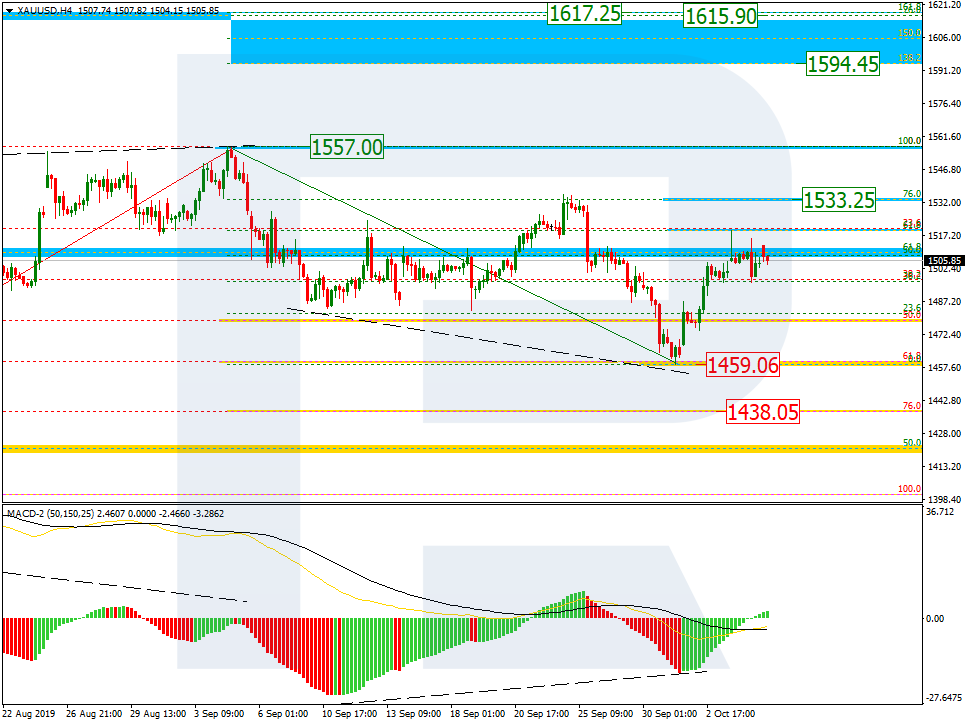
As we can see in the H4 chart, the convergence made the pair complete the descending correction at 61.8% fibo and start a new growth, which has already reached 61.8% fibo. The next upside targets may be 76.0% fibo at 1533.25 and the high at 1557.00. If XAUUSD breaks the high, the instrument may continue growing towards the post-correctional extension area between 138.2% and 161.8% fibo at 1594.45 and 1617.25 respectively.

GOLD_H4
Risk Warning: the result of previous trading operations do not guarantee the same results in the future

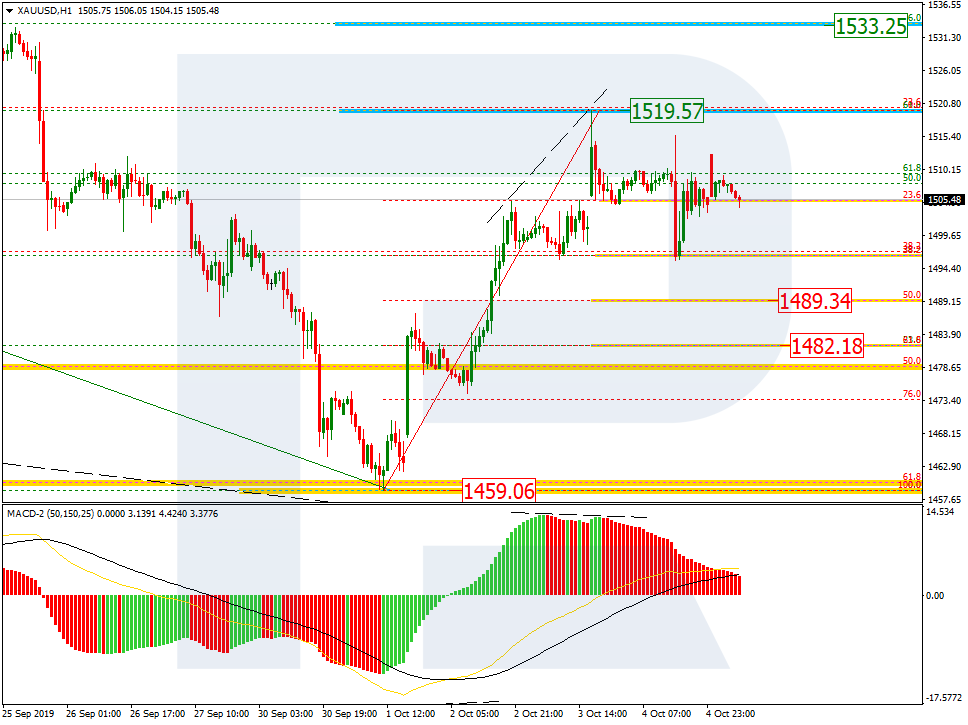
In the H1 chart, we can see a short-term pullback, which has already reached 38.2% fibo and may yet continue towards 50.0% and 61.8% fibo at 1489.34 and 1482.18 respectively. The resistance is the high at 1519.57.

GOLD_H1
Risk Warning: the result of previous trading operations do not guarantee the same results in the future

USDCHF, “US Dollar vs Swiss Franc”

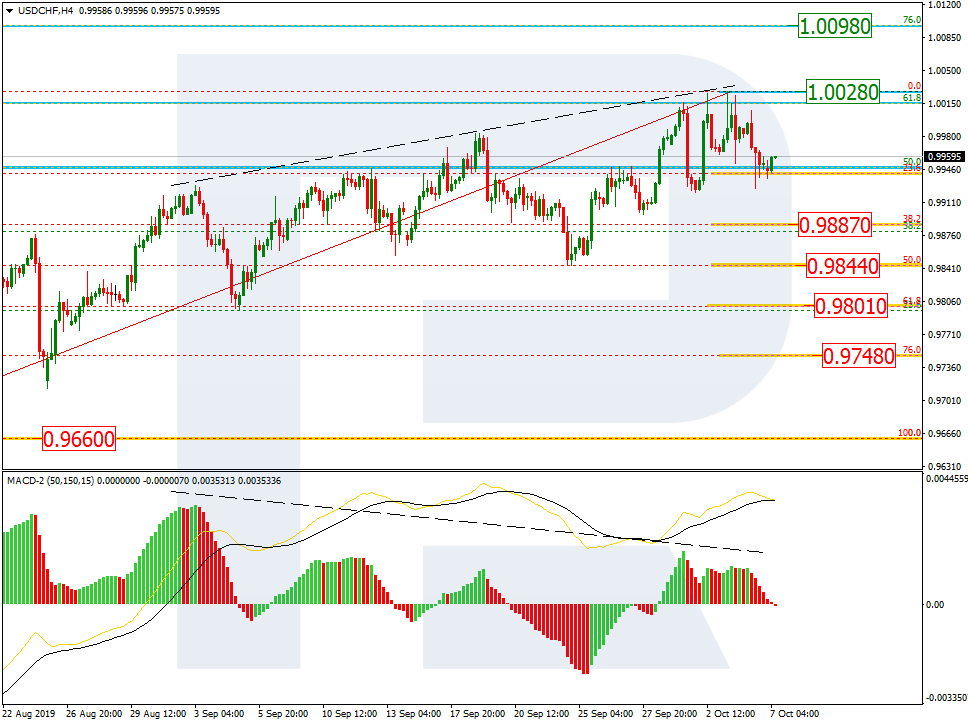
As we can see in the H4 chart, the divergence made the pair finish the ascending tendency at 61.8% fibo. However, if the price breaks the high at 1.0028, the tendency may yet continue to reach 76.0% fibo at 1.0098. Still, the divergence indicates a new decline in the first place, which has already reached 23.6% fibo. The next downside targets may be 38.2%, 50.0%, 61.8%, and 76.0% fibo at 0.9887, 0.9844, 0.9801, and 0.9748 respectively.

USDCHF_H4
Risk Warning: the result of previous trading operations do not guarantee the same results in the future

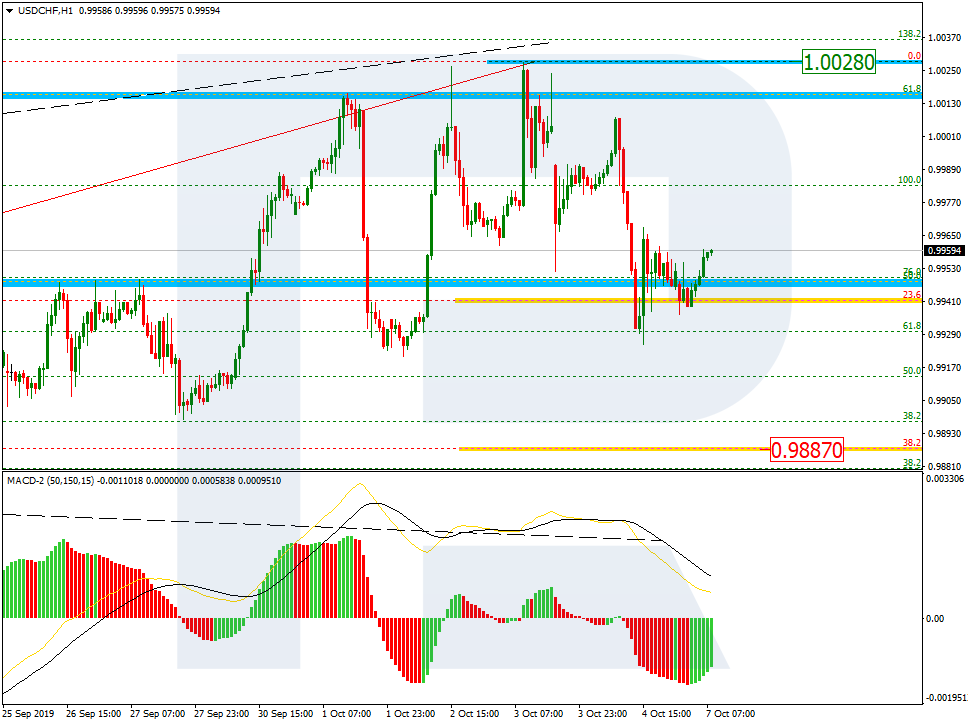
In the H1 chart, after completing the descending impulse, the pair is still testing 23.6% fibo. The next downside target is 38.2% fibo at 0.9887.

USDCHF_H1

Article By RoboForex.com

Attention!
Forecasts presented in this section only reflect the author’s private opinion and should not be considered as guidance for trading. RoboForex LP bears no responsibility for trading results based on trading recommendations described in these analytical reviews.

The Analytical Overview of the Main Currency Pairs on 2019.10.07

by JustForex

The EUR/USD currency pair

Technical indicators of the currency pair:
  • Prev Open: 1.09638
  • Open: 1.09789
  • % chg. over the last day: +0.05
  • Day’s range: 1.09726 – 1.09899
  • 52 wk range: 1.0884 – 1.1623

The EUR/USD currency pair has stabilized. A trading instrument is consolidating. There is no defined trend. EUR/USD quotes test local support and resistance levels at 1.09650 and 1.09900, respectively. On Friday, the US published a rather weak report on the US labor market in September. Investors continue to monitor the progress of trade negotiations between Washington and Beijing. We do not exclude further growth of the EUR/USD currency pair. Positions must be opened from key levels.

Today, the publication of important economic releases is not planned. We recommend that you pay attention to the speech of the head of the Fed.

EUR/USD

The price fixed above 50 MA and 100 MA, which signals the strength of buyers.

The MACD histogram is in the positive zone, but below the signal line, which gives a weak signal to buy EUR/USD.

The Stochastic Oscillator is in the neutral zone, the %K line is below the %D line, which indicates a bearish sentiment.

Trading recommendations
  • Support levels: 1.09650, 1.09400, 1.09050
  • Resistance levels: 1.09900, 1.10250

If the price consolidates above 1.09900, expect further growth toward 1.10200-1.10400.

Alternatively, the quotes could drop toward 1.09400-1.09200.

The GBP/USD currency pair

Technical indicators of the currency pair:
  • Prev Open: 1.23288
  • Open: 1.23030
  • % chg. over the last day: -0.15
  • Day’s range: 1.23030 – 1.23367
  • 52 wk range: 1.1995 – 1.3385

An ambiguous technical picture has developed on the GBP/USD currency pair. Sterling is currently consolidating. The key support and resistance levels are: 1.22850 and 1.23400, respectively. Last week, British Prime Minister Boris Johnson submitted to the European Union the final proposal for the country’s withdrawal from the bloc. We recommend that you keep track of current information on this issue. Positions must be opened from key levels.

The Economic News Feed for 07.10.2019 is not planned.

GBP/USD

Indicators do not give accurate signals: the price crossed 50 MA and 100 MA.

The MACD histogram is near the 0 mark. There are no signals at the moment.

The Stochastic Oscillator is in the neutral zone, the %K line is below the %D line, which indicates a bearish sentiment.

Trading recommendations
  • Support levels: 1.22850, 1.22450, 1.22100
  • Resistance levels: 1.23400, 1.23800, 1.24150

If the price consolidates above 1.23400, expect further growth toward 1.23800-1.24100.

Alternatively, the quotes could decrease toward 1.22500-1.22200.

The USD/CAD currency pair

Technical indicators of the currency pair:
  • Prev Open: 1.33330
  • Open: 1.33224
  • % chg. over the last day: -0.16
  • Day’s range: 1.33043 – 1.33272
  • 52 wk range: 1.2727 – 1.3664

The USD/CAD currency pair continues to trade in a flat. The technical picture is ambiguous. At the moment, the support and resistance levels can be distinguished at 1.33000 and 1.33400. Participants in financial markets expect additional drivers. A trading instrument has the potential for further growth. We recommend that you pay attention to the dynamics of prices of “black gold”. Positions must be opened from key levels.

The Economic News Feed for 07.10.2019 is calm.

USD/CAD

Indicators do not give accurate signals, the price crossed 50 MA.

The MACD histogram is near the 0 mark.

The Stochastic Oscillator is near the overbought zone, the %K line is above the %D line, which gives a weak signal to buy USD/CAD.

Trading recommendations
  • Support levels: 1.33000, 1.32800, 1.32550
  • Resistance levels: 1.33400, 1.33700

If the price consolidates above 1.33400, expect further growth toward 1.33700-1.33900.

Alternatively, the quotes could decrease toward 1.32800-1.32600.

The USD/JPY currency pair

Technical indicators of the currency pair:
  • Prev Open: 106.913
  • Open: 106.637
  • % chg. over the last day: -0.16
  • Day’s range: 106.652 – 106.905
  • 52 wk range: 104.97 – 114.56

The USD/JPY currency pair stabilized after a sharp fall last week. At the moment, the trading instrument is in lateral movement. USD/JPY quotes are testing the key support and resistance levels: 106.600 and 107.000, respectively. In the near future, technical correction is not ruled out. We recommend that you pay attention to the dynamics of the yield of US government securities. Positions must be opened from key levels.

The Economic News Feed for 07.10.2019 is calm.

USD/JPY

Indicators do not give accurate signals: the price crossed 50 MA.

The MACD histogram is near 0. There are no signals at the moment.

The Stochastic Oscillator is in the overbought zone, the %K line began to cross the %D line. There are no signals at the moment.

Trading recommendations
  • Support levels: 106.600, 106.300
  • Resistance levels: 107.000, 107.300, 107.650

If the price consolidates below 106.600, expect quotes to fall toward 106.300-106.000.

Alternatively, the quotes could correct toward 107.300-107.500.

by JustForex

Euro Is Up for Further Growth

By Dmitriy Gurkovskiy, Chief Analyst at RoboForex

Early in another October week, EUR/USD is consolidating at 1.0983, but may yet continue growing.

Former European Central bankers have published a memorandum on the ECB monetary policy where they attacked it and said it was “based on the wrong diagnosis and risks eroding its independence”. Former policymakers believe that in case of the Euro Area economy and the ECB, the interest rates, as a control and management tool, have become more irrelevant recently, while the risks have grown a lot. In their opinion, the longer the regulator continues its ultra-loose rates policy, the higher the probability that it will fail.

Of course, this opinion pretty much has the right to exist. It appears that the ECB was too late to respond to the inflation decline and missed the right moment to do avoid it. At the same time, it’s difficult to agree that the low rates policy won’t work, because in this case, the banking system will “reboot” itself.

Last Friday, the USA published several reports on the labor market. The Unemployment Rate wasn’t expected to change, but it dropped significantly in September, from 3.7% to 3.5%, the lowest level over the last 50 years. The Average Hourly Earnings remained unchanged, although it was expected to add 0.3% m/m, and that put the pressure on the USD. The Non-Farm Employment Change was 136K in September against the expected reading of 145K. By the way, the August number was revised upwards, up to 168K.

In the H4 chart, EUR/USD has completed the ascending wave, which may be considered as a correction of the previous descending wave; right now, it is trading to rebound from 1.0997 to the downside. One can see the first descending impulse along with the correction. At the moment, the pair is forming the second impulse with the target at 1.0950. after breaking this level, the price may continue trading inside the downtrend with the first target at 1.0903. However, this scenario may no longer be valid if the price steadily grows to break 1.0998. In this case, the pair may choose an alternative scenario to extend the correction towards 1.1004. From the technical point of view, this scenario is confirmed by MACD Oscillator: its signal line is moving high above 0. Basically, the line is expected to fall towards 0. Later, it may break this level and boost the decline.

As we can see in the H1 chart, EUR/USD is consolidating above 1.0970. According to the main scenario, the price is expected to trade inside the downtrend. After breaking 1.0970, the pair may continue falling towards 1.0950. And that’s just a half of this descending wave. After a slight consolidation, the instrument may resume falling to reach 1.0903. However, this scenario may no longer be valid if the price steadily grows to break 1.0998. In this case, the instrument may choose an alternative scenario, which implies extending the ascending wave towards 1.1000. From the technical point of view, this scenario is confirmed by Stochastic Oscillator: its signal line is moving inside the “oversold area”, thus indicating further consolidation and growth towards 50. Still, if later the line rebounds from 50, the current downtrend may get faster.

Disclaimer

Any predictions contained herein are based on the authors’ particular opinion. This analysis shall not be treated as trading advice. RoboForex shall not be held liable for the results of the trades arising from relying upon trading recommendations and reviews contained herein.


Today the First Round of Negotiations Between Washington and Beijing Will Start. Investors Assess the US Labor Market Report

by JustForex

The US dollar has become stable against a basket of major currencies. The dollar index (#DX) closed Friday’s trading session in the negative zone (-0.05%). The US has published rather weak labor market data for September. Thus, the number of people employed in the nonfarm sector of the country grew only by 136K, while experts forecasted an increase by 140K. Average hourly earnings (YoY) rose in September by 2.9% instead of 3.2%. However, the unemployment rate fell to 3.5% from 3.7%.

The trade conflict between the US and China has come to the fore again. Today, the first round of negotiations in Washington, which will last two days, will start. Most experts believe that the deal is hardly to be concluded. Investors also continue to monitor the situation concerning Brexit. Last week, British Prime Minister, Boris Johnson, submitted to the European Union the final proposal for the country’s exit from the bloc. We recommend following current information on these issues.

The “black gold” prices continue to recover after a significant drop last week. At the moment, futures for the WTI crude oil are testing the $53.00 mark per barrel.

Market Indicators

On Friday, there was the bullish sentiment in the US stock markets: #SPY (+1.35%), #DIA (+1.39%), #QQQ (+1.47%).

The 10-year US government bonds yield is at the level of 1.52-1.53%.

The Economic News Feed for 07.10.2019:
  • Today, the publication of important economic news is not expected. We recommend paying attention to the speech by the Fed Chairman Powell.

by JustForex

DAX30 CFD about to see a short-term relief rally back above 12,000?

By Admiral Markets

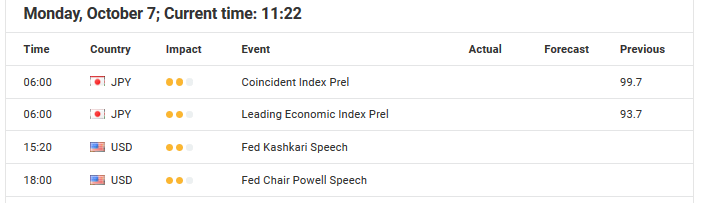
Source: Economic Events October 7, 2019 – Admiral Markets’ Forex Calendar

As we begin the trading week with a thin economic calendar, we want to mainly focus on the technical side in the DAX30 CFD.

After the latest US economic indications with the ISM Manufacturing and ISM Non-Manufacturing data disappointing the market participants, and last Friday’s Non-Farm Payroll coming in mixed, bearish fuel drove price action in equities and in the DAX30 over the last few days. As such, the mode just looks quite stretched on the downside and chances are increased to see a short-term bounce.

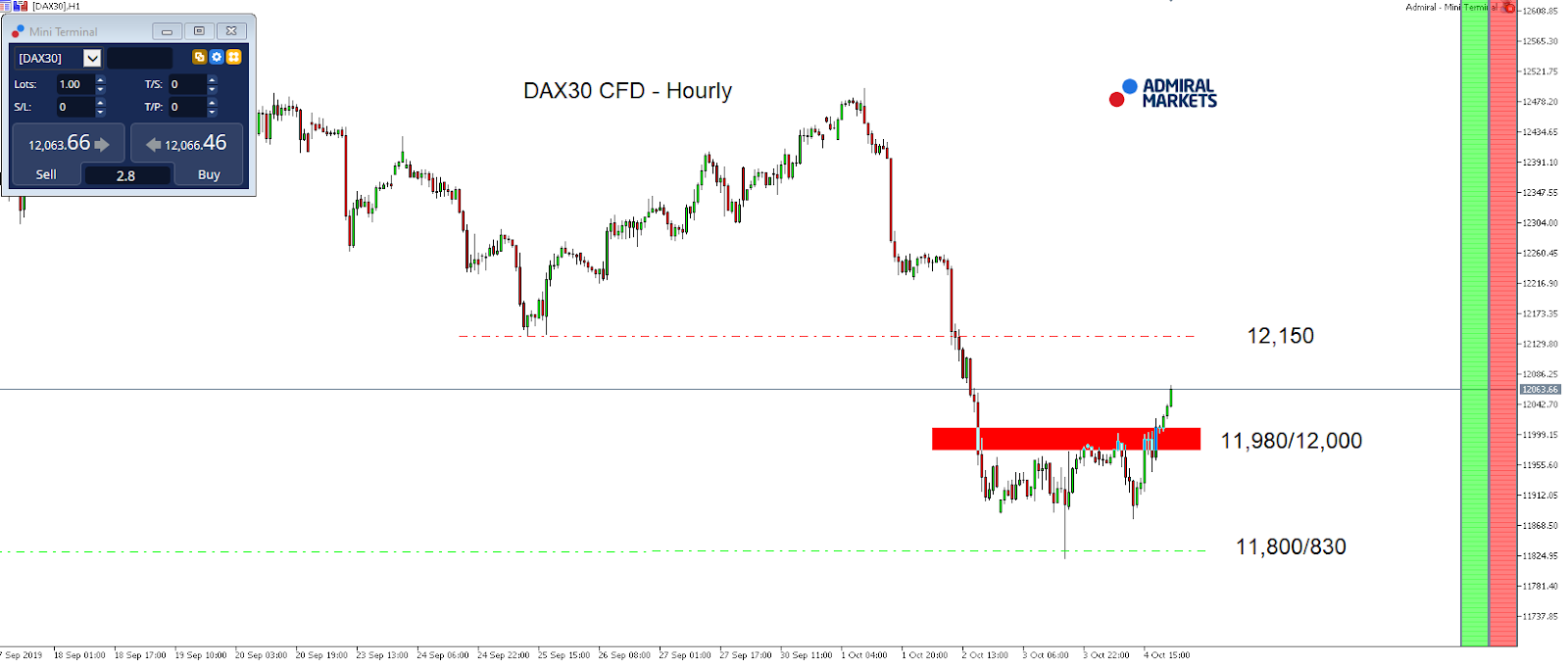
We already saw such a bounce into the weekly close and the 12,000 point mark being re-captured, but the question is whether this move can be considered sustainable. If so, a deeper correction up to 12,150 points becomes a serious option.

If, on the other hand, bears take over control again into the start of the week, a re-test of the pre-weekly lows around 11,800/830 points seems likely. A sustainable break below would level the path down to 11,500 points in the days to come:

Source: Admiral Markets MT5 with MT5-SE Add-on DAX30 CFD Hourly chart (between September 16, 2019 to October 4, 2019). Accessed: October 4, 2019 at 10:00pm GMT

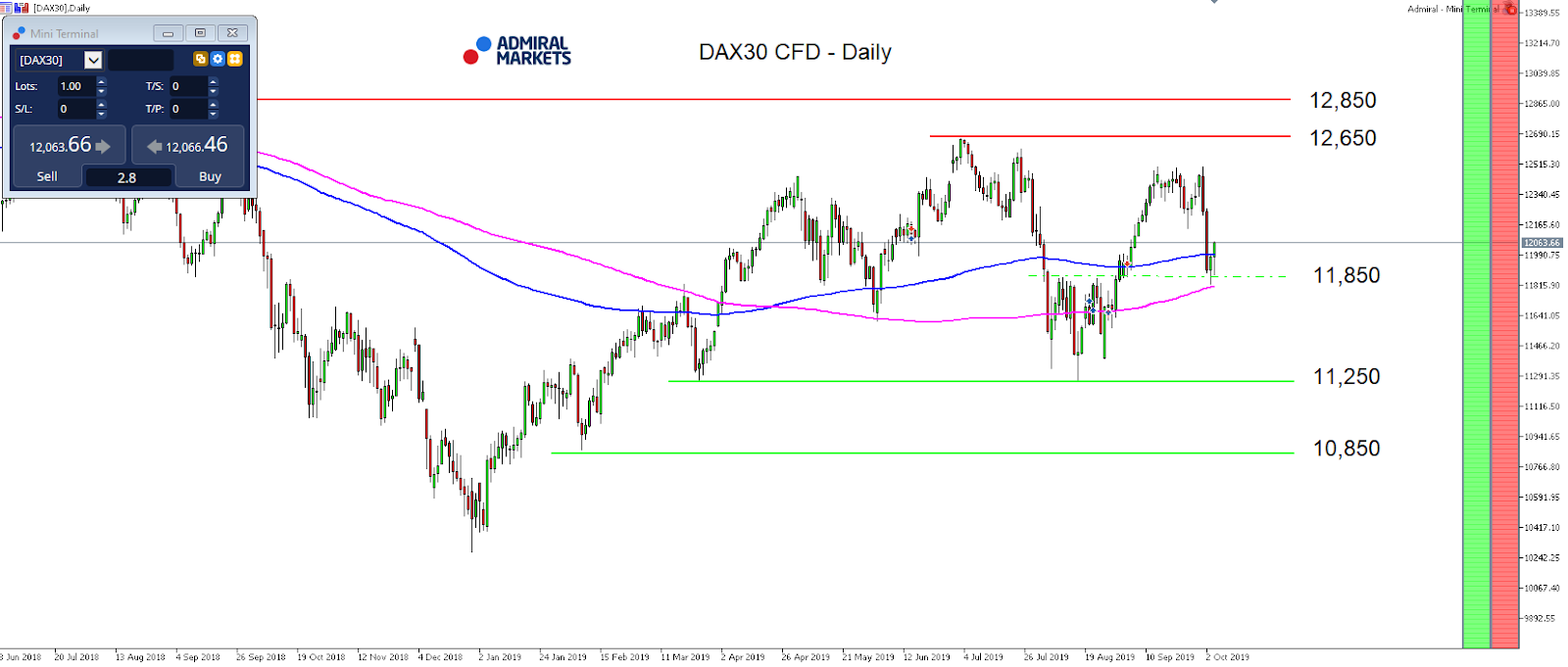
Source: Admiral Markets MT5 with MT5-SE Add-on DAX30 CFD Daily chart (between June 28, 2018, to October 4, 2019). Accessed: October 4, 2019, at 10:00pm GMT – Please note: Past performance is not a reliable indicator of future results, or future performance.

In 2014, the value of the DAX30 CFD increased by 2.65%, in 2015, it increased by 9.56%, in 2016, it increased by 6.87%, in 2017, it increased by 12.51%, in 2018, it fell by 18.26%, meaning that after five years, it was up by 10.5%.

Discover the world’s #1 multi-asset platform

Admiral Markets offers professional traders the ability to trade with a custom, upgraded version of MetaTrader 5, allowing you to experience trading at a significantly higher, more rewarding level. Experience benefits such as the addition of the Market Heat Map, so you can compare various currency pairs to see which ones might be lucrative investments, access real-time trading data, and so much more. Click the banner below to start your FREE download of MT5 Supreme Edition!

Download MetaTrader 5 and begin trading today!

Disclaimer: The given data provides additional information regarding all analysis, estimates, prognosis, forecasts or other similar assessments or information (hereinafter “Analysis”) published on the website of Admiral Markets. Before making any investment decisions please pay close attention to the following:

  1. This is a marketing communication. The analysis is published for informative purposes only and are in no way to be construed as investment advice or recommendation. It has not been prepared in accordance with legal requirements designed to promote the independence of investment research, and that it is not subject to any prohibition on dealing ahead of the dissemination of investment research.
  2. Any investment decision is made by each client alone whereas Admiral Markets shall not be responsible for any loss or damage arising from any such decision, whether or not based on the Analysis.
  3. Each of the Analysis is prepared by an independent analyst (Jens Klatt, Professional Trader and Analyst, hereinafter “Author”) based on the Author’s personal estimations.
  4. To ensure that the interests of the clients would be protected and objectivity of the Analysis would not be damaged Admiral Markets has established relevant internal procedures for prevention and management of conflicts of interest.
  5. Whilst every reasonable effort is taken to ensure that all sources of the Analysis are reliable and that all information is presented, as much as possible, in an understandable, timely, precise and complete manner, Admiral Markets does not guarantee the accuracy or completeness of any information contained within the Analysis. The presented figures refer that refer to any past performance is not a reliable indicator of future results.
  6. The contents of the Analysis should not be construed as an express or implied promise, guarantee or implication by Admiral Markets that the client shall profit from the strategies therein or that losses in connection therewith may or shall be limited.
  7. Any kind of previous or modeled performance of financial instruments indicated within the Publication should not be construed as an express or implied promise, guarantee or implication by Admiral Markets for any future performance. The value of the financial instrument may both increase and decrease and the preservation of the asset value is not guaranteed.
  8. The projections included in the Analysis may be subject to additional fees, taxes or other charges, depending on the subject of the Publication. The price list applicable to the services provided by Admiral Markets is publicly available from the website of Admiral Markets.

Leveraged products (including contracts for difference) are speculative in nature and may result in losses or profit. Before you start trading, you should make sure that you understand all the risks.

By Admiral Markets