Author Archive for InvestMacro – Page 146

The Analytical Overview of the Main Currency Pairs on 2019.11.01

by JustForex

The EUR/USD currency pair

Technical indicators of the currency pair:
  • Prev Open: 1.11528
  • Open: 1.11517
  • % chg. over the last day: +0.06
  • Day’s range: 1.11487 – 1.11688
  • 52 wk range: 1.0884 – 1.1623

Majors have stabilized. Investors took a wait-and-see approach before the publication of the US labor market report for October, which could have a significant impact on the further rate of adjustment of the Fed’s monetary policy. Recent economic releases from the United States have been mixed. Experts expect a deterioration in key indicators of the labor market. At the moment, the local support and resistance levels on the EUR/USD currency pair are 1.11400 and 1.11750. We recommend opening positions from these marks.

The Economic News Feed for 01.11.2019:

  • – Labour Market Report (US) – 14:30 (GMT+2:00);
  • – Manufacturing PMI by ISM (US) – 16:00 (GMT+2:00);
EUR/USD

The price fixed above 50 MA and 100 MA, which signals the power of buyers.

The MACD histogram is in the positive zone, but below the signal line, which gives a weak signal to buy EUR/USD.

The Stochastic Oscillator is in the neutral zone, the %K line is below the %D line, which indicates a bearish sentiment.

Trading recommendations
  • Support levels: 1.11400, 1.11150, 1.10950
  • Resistance levels: 1.11750, 1.12000

If the price consolidates above 1.11750, expect further growth toward 1.12200-1.12400.

Alternatively, the quotes could decrease toward 1.11200-1.11000.

The GBP/USD currency pair

Technical indicators of the currency pair:
  • Prev Open: 1.29021
  • Open: 1.29292
  • % chg. over the last day: +0.28
  • Day’s range: 1.29239 – 1.29727
  • 52 wk range: 1.1959 – 1.3385

At the moment, the GBP/USD currency pair is consolidating near key extremes. Sterling is testing the offer area 1.29750-1.30150. Round level 1.29000 is the immediate support. The focus is on the US labor market report. We also recommend keeping track of current information on the Brexit issue. In the near future, technical correction of GBP / USD quotes after a protracted rally is not ruled out. Open positions from key levels.

At 11:30 (GMT+2:00), the UK will publish the PMI in manufacturing sector.

GBP/USD

The price fixed above 50 MA and 100 MA, which signals the power of buyers.

The MACD histogram is in the positive zone, but below the signal line, which gives a weak signal to buy GBP/USD.

The Stochastic Oscillator is in the neutral zone, the %K line crossed the %D line. There are no signals at the moment.

Trading recommendations
  • Support levels: 1.29000, 1.28400, 1.28000
  • Resistance levels: 1.29750, 1.30150, 1.30500

If the price consolidates above 1.29750, expect further growth toward 1.30250-1.30400.

Alternatively, the quotes could decrease toward 1.28500-1.28300.

The USD/CAD currency pair

Technical indicators of the currency pair:
  • Prev Open: 1.31610
  • Open: 1.31648
  • % chg. over the last day: +0.08
  • Day’s range: 1.31411 – 1.31734
  • 52 wk range: 1.2727 – 1.3664

The USD/CAD currency pair has stabilized after a sharp rally since the beginning of this week. CAD is currently consolidating. USD/CAD quotes test local support and resistance levels: 1.31400 and 1.31750, respectively. A trading instrument has the potential for further growth. Today, participants in financial markets will evaluate labor statistics from the United States. We also recommend paying attention to the dynamics of oil quotes. Open positions from key levels.

The Economic News Feed for 01.11.2019 is calm.

USD/CAD

Indicators do not give accurate signals, the price crossed 50 MA.

The MACD histogram is close to 0.

The Stochastic Oscillator is in the neutral zone, the %K line crossed the %D line. There are no signals at the moment.

Trading recommendations
  • Support levels: 1.31400, 1.31000, 1.30750
  • Resistance levels: 1.31750, 1.32000, 1.32350

If the price consolidates above 1.31750, expect further growth toward 1.32200-1.32400.

Alternatively, the quotes could correct toward 1.31000.

The USD/JPY currency pair

Technical indicators of the currency pair:
  • Prev Open: 108.849
  • Open: 108.018
  • % chg. over the last day: -0.77
  • Day’s range: 107.886 – 108.057
  • 52 wk range: 104.97 – 114.56

Aggressive sales are observed on the USD/JPY currency pair. Yesterday, the drop in quotes exceeded 80 points. The trading instrument has set new local lows. At the moment, the currency of the “safe haven” is consolidating in the range 107.900-108.150. We are expecting important economic releases from the USA. We also recommend that you keep track of up-to-date information regarding the settlement of the trade conflict between Washington and Beijing. Open positions from the key levels.

The news background on the Japanese economy is calm.

USD/JPY

Indicators point to the strength of sellers: the price has fixed below 50 MA and 100 MA.

The MACD histogram is in the negative zone, but above the signal line, which gives a weak signal to sell USD/JPY.

The Stochastic Oscillator is in the neutral zone, the %K line is below the %D line, which indicates a bearish sentiment.

Trading recommendations
  • Support levels: 107.900, 107.600, 107.350
  • Resistance levels: 108.150, 108.300, 108.600

If the price consolidates below 107.900, expect a further drop toward 107.600-107.400.

Alternatively, the quotes could grow toward 108.400-108.600.

by JustForex

After the FED: USDJPY with bearish price action driven by weak ISM data?

By Admiral Markets

USDJPY Economic Event

Source: Economic Events 01 November 2019 – Admiral Markets’ Forex Calendar

Today, our main focus is the yield-sensitive USDJPY and the Non-Farm Payrolls, including the ISM Manufacturing data set.

After the FED cut rates by 25 basis points on Wednesday without delivering any significant further impulses or signs in regards to future monetary policy steps, today it will be interesting to see what the next economic data sets like the NFPs and the ISM Manufacturing data deliver.

This is especially true since the FED removed in her statement the sentence “Will Act As Appropriate” and replaced it with a more data-dependent one “Will Monitor Implications of Incoming Information for the economic outlook as it assesses the appropriate path of the target range for the fed funds rate”.

So, if the ISM data continues to trend lower and result in rising recession fears (for September, the ISM Manufacturing dropped to 47.8, the steepest contraction in the manufacturing sector since June 2009), expectations of another rate cut by the FED in December could see a significant push higher, resulting in the US dollar facing heavier selling pressure into the weekly close.

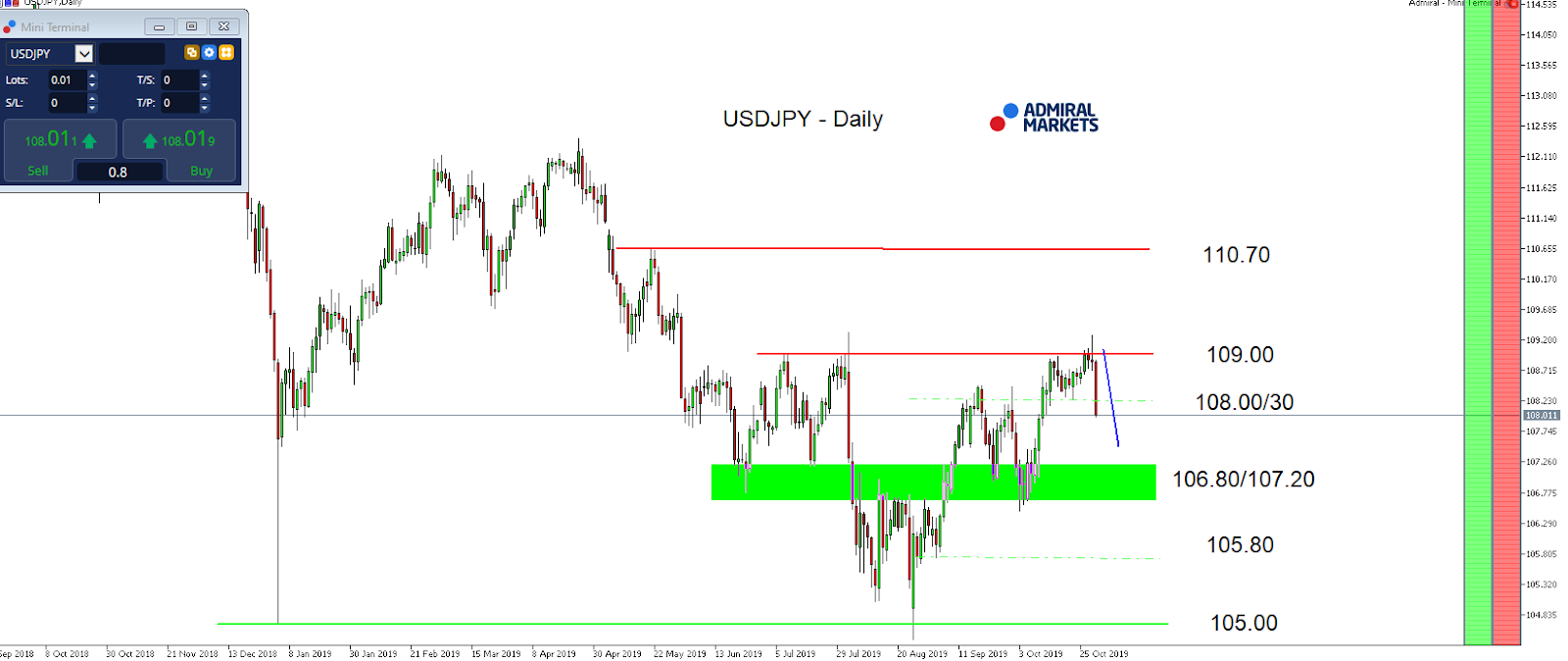
The technical relevant and, in our opinion, make-or-break level in the USDJPY can be found in the region around 108.00/30. A sustainable break below activates 106.80/107.00 as a next target on the downside.

On the other hand: better than expected NFPs and ISM Manufacturing data could lead to some USD stabilisation. And an increasing risk-on approach among market participants and resulting JPY selling could result in another attack of the region around 109.00, even though chances of a sustainable break higher remain low in our opinion, especially after the sharp drop on Thursday.

USDJPY Daily chart

Source: Admiral Markets MT5 with MT5SE Add-on USDJPY Daily chart (between 14 September 2018 to 31 October 2019). Accessed: 31 October 2019 at 10:00 PM GMT

Please note: Past performance is not a reliable indicator of future results, or future performance.

In 2014, the value of USDJPY increased by 13.7%, in 2015, it increased by 0.5%, in 2016 it fell by 2.8%, in 2017 it fell by 3.6%, in 2018 it fell by 2.7%, meaning that after five years, it was up by 4.1%.

Trade With MetaTrader 5

Disclaimer: The given data provides additional information regarding all analysis, estimates, prognosis, forecasts or other similar assessments or information (hereinafter “Analysis”) published on the website of Admiral Markets. Before making any investment decisions please pay close attention to the following:

  1. This is a marketing communication. The analysis is published for informative purposes only and are in no way to be construed as investment advice or recommendation. It has not been prepared in accordance with legal requirements designed to promote the independence of investment research, and that it is not subject to any prohibition on dealing ahead of the dissemination of investment research.
  2. Any investment decision is made by each client alone whereas Admiral Markets shall not be responsible for any loss or damage arising from any such decision, whether or not based on the Analysis.
  3. Each of the Analysis is prepared by an independent analyst (Jens Klatt, Professional Trader and Analyst, hereinafter “Author”) based on the Author’s personal estimations.
  4. To ensure that the interests of the clients would be protected and objectivity of the Analysis would not be damaged Admiral Markets has established relevant internal procedures for prevention and management of conflicts of interest.
  5. Whilst every reasonable effort is taken to ensure that all sources of the Analysis are reliable and that all information is presented, as much as possible, in an understandable, timely, precise and complete manner, Admiral Markets does not guarantee the accuracy or completeness of any information contained within the Analysis. The presented figures refer that refer to any past performance is not a reliable indicator of future results.
  6. The contents of the Analysis should not be construed as an express or implied promise, guarantee or implication by Admiral Markets that the client shall profit from the strategies therein or that losses in connection therewith may or shall be limited.
  7. Any kind of previous or modeled performance of financial instruments indicated within the Publication should not be construed as an express or implied promise, guarantee or implication by Admiral Markets for any future performance. The value of the financial instrument may both increase and decrease and the preservation of the asset value is not guaranteed.
  8. The projections included in the Analysis may be subject to additional fees, taxes or other charges, depending on the subject of the Publication. The price list applicable to the services provided by Admiral Markets is publicly available from the website of Admiral Markets.
  9. Leveraged products (including contracts for difference) are speculative in nature and may result in losses or profit. Before you start trading, you should make sure that you understand all the risks.

By Admiral Markets

The Dollar Index Has Become Stable. We Expect Labor Statistics from the US

by JustForex

Yesterday, the US dollar fell against a basket of currency majors. The dollar index (#DX) closed the trading session in the red zone (-0.34%). It became known that China was doubtful of a trade agreement achievement between the US and China. Chinese authorities have accused the US President Donald Trump of being too impulsive and believe that he could back down at the last moment. Also, the US currency is under pressure since the United States House of Representatives approved a public hearing regarding Donald Trump’s impeachment yesterday. The next stage in consideration of illegal cases of the US President was approved.

At the moment, the greenback has become stable. Investors have taken a wait-and-see attitude before the publication of the US labor market report for October. Experts forecast deterioration in key indicators. We recommend paying attention to the difference between actual and forecasted values. These statistics may have a significant impact on the Fed’s views on further monetary policy adjustment.

The “black gold” prices have been growing. Currently, futures for the WTI crude oil are testing the $54.40 mark per barrel.

Market Indicators

Yesterday, there was a variety of trends in the US stock markets: #SPY (-0.27%), #DIA (-0.46%), #QQQ (+0.05%).

The 10-year US government bonds yield has declined significantly. At the moment, the indicator is at the level of 1.69-1.70%.

The Economic News Feed for 01.11.2019:
  • – Manufacturing PMI in the UK at 11:30 (GMT+2:00);
  • – Report on the labor market in the US at 14:30 (GMT+2:00);
  • – ISM manufacturing PMI in the US at 16:00 (GMT+2:00).

by JustForex

EURUSD: bulls nervous ahead of the NFP

By Alpari.com

On Thursday the 31st of October, trading on the euro closed at the same level as it opened at the beginning of the Asian session. During trading in Europe, the EURUSD pair dropped from its high of 1.1176 to the lows of 1.1130. This decline came as a result of technical factors, as well as reduced demand for risky assets amid fresh doubts over a trade deal being reached between the USD and China. From the low of 1.1132, the pair recovered to 1.1151.

Day’s news (GMT+3):

  • 12:30 UK: Markit manufacturing PMI (Oct).
  • 15:30 US: nonfarm payrolls (Oct), average hourly earnings (Oct).
  • 16:45 US: Markit manufacturing PMI (Oct).
  • 17:00 US: ISM manufacturing PMI (Oct).

EURUSD H1Current situation:

Yesterday’s expectations were met in full. The pair hit fresh highs before dropping to 1.1132.

At the time of writing, the euro is trading at 1.1160. All eyes are now on the US jobs market. Projections show 89k new jobs created outside the agricultural sector, and unemployment rising to 3.6%.

In the Asian session, the EURUSD is rising slightly. The pair usually trades within a narrow range ahead of such important news. We expect the pair to drop to 1.1150 ahead of the payrolls report. What happens after the report is too unpredictable, so the forecast on the chart only goes as far as 15:30 (GMT+3).

By Alpari.com

How Trump Tariff Wars Worsen US Trade Deficit

By Dan Steinbock    

Since 2018, Trump’s trade wars have made US trade deficit only worse, while hurting the poorest economies the most and penalizing global prospects.

According to the new IMF outlook, global growth is forecast at 3.0% for 2019. That’s the lowest since the global crisis of 2008-9. The decline is largely due to the US tariff wars, which have contributed to the projected slowdown in the US and China.

Due to the global slowdown, world growth prospects now hover at levels where they were last amid the darkest moments of 2008/9.

Trump tariffs widen US trade deficit

Recently, international media reported that, in August, the politically sensitive US goods trade deficit with China decreased 3.1% to $32 billion relative to previous month. Yet, US trade deficit actually widened to almost $55 billion in August. While exports rose 0.2%, imports increased more than twice as fast at 0.5%.

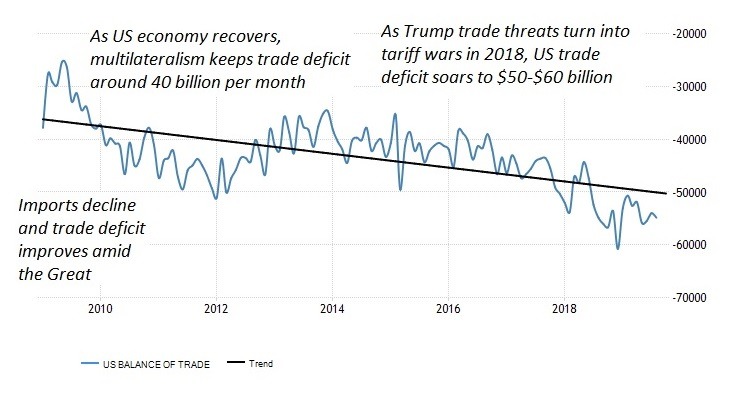
Unfortunately, monthly data does not reflect secular trends and overall deficit trend matters. In longer view, US trade deficit improved during the Great Recession, when imports declined. As the economy recovered in the early 2010s, multilateralism still kept trade deficit around $40 billion per month.

The change came when President Trump’s trade threats turned into tariff wars in 2018. Since then, the trade deficit has been around $50 to $60 billion per month, while the trend line (in black) suggests progressive deterioration (Figure 1).

Figure 1 The Widening of US Trade Deficit

Data from U.S. Bureau of Economic Analysis (BEA)

What about China’s trade surplus? In September, Chinese exports declined 3.2% over a year earlier, which the White House’s trade hawks saw as progress. Nevertheless, imports to China plunged more than twice as fast at 8.5%. That’s what happens in times of trade friction and uncertainty; import growth declines.

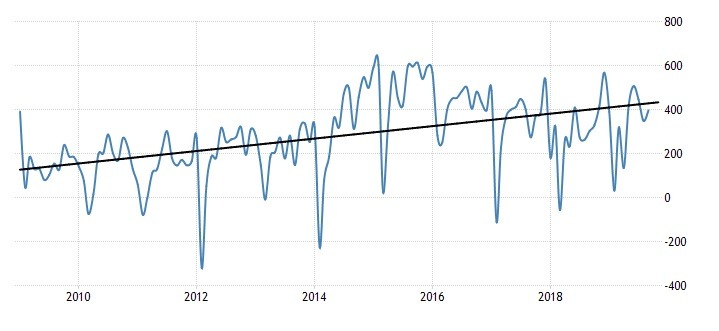
The net effect? China’s trade surplus actually widened to $40 billion in September. In the long view, the trend line (in black) the relative strength of the trade surplus, even amid the US tariffs (Figure 2).

Figure 2 China’s Trade Surplus

Data from China’s General Administration of Customs (in CNY)

The bottom line? The Trump tariff wars are working – if the strategic objective is to further weaken the US trade deficit and to deepen trade friction with China and other trading nations particularly in developing Asia.

How US tariffs hurt most the poorest economies

Worse, the Trump tariff wars are harming the most the poorest economies. In the postwar era, Washington’s trade, investment and financial ties broadened and deepened mainly with other major advanced economies in Western Europe and Japan. The postwar economic miracles of these rich economies did not support the rise of the Third World – developing Asia, Africa, Middle East and Latin America.

In the past decade or two, China’s economic ties have broadened and deepened dramatically not just with major advanced economies, but particularly with emerging and developing world regions. Moreover, the One Belt and Road (BRI) initiative seeks purposefully to accelerate modernization in poorer economies in which industrialization was never completed or has barely begun.

The implication is critical. Since China’s contribution to the rise of the poorer economies is now vital, any collateral damage that US tariff wars affect in China, whether directly through trade and investment abroad or indirectly through the reduction Chinese output potential, will harm disproportionately the poorest economies in the world – through their external trade ties and multiplier effects in their domestic economies.

The longer the US tariff wars prevail, the broader the collateral damage will be in emerging and developing economies.

Diminished global prospects

In 2008-9, the global crisis was contained by massive fiscal stimulus packages, ultra-low rates and, when that proved inadequate, rounds of quantitative easing.

Now, a decade after the crisis, central banks’ rates remain ultra-low and most continue asset purchases, whereas soaring debt levels limit new fiscal injections.

The IMF projects growth to pick up to 3.4% in 2020. That, however, is predicated on improvements in a number of emerging economies in Latin America, the Middle East and developing Europe, which would require a trade recovery. And the latter is not likely as long as the misguided US tariff wars prevail.

The Trump administration’s tariff wars are the worst policy mistake in the postwar era. They will improve neither US trade balance nor global economic prospects. They have already made both worse.

About the Author:

Dr. Dan Steinbock is an internationally recognized strategist of the multipolar world and the founder of Difference Group. He has served at the India, China and America Institute (US), the Shanghai Institutes for International Studies (China) and the EU Center (Singapore). For more, see https://www.differencegroup.net/   

A shorter version of the commentary was released by China Daily on October 31, 2019


What Has Freaked Out The US Fed?

By TheTechnicalTraders.com

The US Fed cut rates again by 25 basis points, the third time this year. Prior to the start of 2019, the US Fed gave guidance that 3 to 4 more rate increases were planned for 2019.  What the heck happened to the US Fed and what has them so freaked out that they completely changed direction on their expectations for the US and Global economy so quickly?

It is painfully obvious to anyone paying attention that the US Fed expected the many years of near-zero interest rates between 2009 and 2015 to act as a fuel for future growth.  The problem was that no real growth materialized until just before the 2016 US Presidential elections – and even that was relatively muted.  The US Dollar had continued to rally from July 2011 lows well into the 2016 election date.  The expectations for the US economy hinged on who won the election.  After President Trump won, the markets started an immediate rally expecting business-friendly policies and government.

The US Fed had only risen rates to a level of 0.41% FFR by the date of the 2016 elections – basically nothing.  After the US presidential election, the US Fed raised rates continually for a total of a 600% rate increase from the November 2016 election date rates.  Rates peaked near 2.40% – more than 2400% from the lowest rate levels in 2014/2015.

Our researchers believe the overnight Repo shortages are a very clear sign that US and foreign markets may be trapped in a US dollar shortage and completely over-leveraged in risky debt that may be hanging just overhead for all of us.  The US Fed’s ZIRP policy created a massive debt/credit expansion in foreign markets where one could borrow US Dollars for 0%, deploy that capital in foreign markets that were generating 6% to 15% or more over very short terms (12 to 24 months) and as long as the US Dollar did not increase in value dramatically and/or the foreign local currencies did not collapse – it was easy to see how one could take advantage of this situation – possibly too easy.

Dollar Index Weekly Chart Trend

But what happened in 2013/2013 that may have caught everyone by surprise?  The US Dollar had risen enough to start to raise some eyebrows before 2013.  Near the middle of 2014, right before China initiated capital controls, the US Dollar started a rally that ran nearly 18% into 2016.  This rally, disrupted the US Dollar carry trade and created a real concern for traders if foreign currencies and/or economies started collapsing.  As long as that did not happen, then these borrowers could manage the debt and risk.  If this collapse did happen, then the entire house of cards may start to collapse and the foundations may be shaken.

Long Term Fed Rate Trends

The US Fed, in 2015/2016, initiated a rate increase process expecting the strength of the US Dollar to help carry the moderate rate increases and help to propel new US growth.  President Trump winning the 2016 elections added to growth expectations as the US stock market rallied to new all-time highs in 2017 while the US Dollar slid from early 2017 highs and rotated lower.  The US Fed continued a constant rate increase policy all the way through this rotation, while China and other foreign markets began to rotate, and while the US stock market rotated lower in February 2018.

More Recent Fed Funds Rate Trend

One really has to question what is now causing the US Fed to be much more cautious throughout 2019 and why the sudden change in expected rate policy?  Has something changed across global banking that we are unaware of?  Has a risk level intensified that we are not noticing?  A 2400% rate increase from near ZERO rates in unprecedented – HISTORIC.  Our own modeling systems suggested the US Fed had raised rates well beyond upper boundary levels in 2018 when they crossed above the 1.75% & 2.0% levels.  Maybe the US Fed is reading our research and following our modeling system’s expectations?  Or maybe the US Fed has identified some risk factors that they are trying to contain and prevent – like the overnight Repo issues recently?

Either way, this move by the US Fed to move interest rates lower 12+ months before a US Presidential election should be a fairly clear warning that the Fed believes the next few months/years of trading may be far more volatile than we can imagine.  The three rate decreases indicate the Fed was nearly a full 1% above rate levels that believe to be efficient for the markets – Yikes!

Daily Transportation Index Chart

The Transportation Index rotated downward nearly 2% today after our warning of a classic Japanese Candlestick top formation.  This Index typically leads the markets as it is a future measure of economic activity.  Further downside price activity in the TRAN would indicate that traders believe the US and global economy is going to continue to weaken.  A couple of days ago we talked about the transports sector topping and we nailed this week’s pullback/top yet again.

We believe the only thing driving the US stock market higher at this time is a capital shift initiated by foreign investors seeking safety and security away from local currencies and local stock markets as they continue to pour capital into the US markets.

Concluding Analysis

It’s like we are living on the edge right now.  Unless consumers decide to become very active in the US economy and a renewed growth spurt takes place over the next 12+ months, prior to the US Presidential election, the markets will likely become more and more volatile and the potential for very big price swings.  The way the US political fight is shaping up, we can’t see any real certainty or calm in the markets other than foreign investors stuffing money into the US markets trying to avoid risks from their local markets/currencies.

Now is the time to understand risks and play it safe.  The US Fed is moving rates lower for a reason and that reason is most likely fear of some risk contagion that we are unaware of at the moment.  The end of 2019 is almost certain to be much more volatile than one can imagine.  Be prepared.

I urge you visit my Wealth Building Newsletter and if you like what I offer, join me with the 1-year subscription to lock in the lowest rate possible and ride my coattails as I navigate these financial markets and build wealth while others lose nearly everything they own during the next financial crisis. Join Now and Get a Free 1oz Silver Bar!

Chris Vermeulen

TheTechnicalTraders.com


Ichimoku Cloud Analysis 31.10.2019 (AUDUSD, NZDUSD, USDCAD)

Article By RoboForex.com

AUDUSD, “Australian Dollar vs US Dollar”

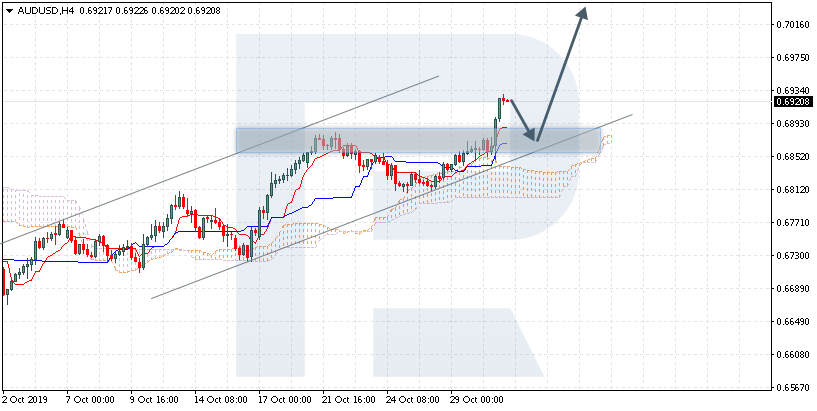
AUDUSD is trading at 0.6920; the instrument is moving above Ichimoku Cloud, thus indicating an ascending tendency. The markets could indicate that the price may test Tenkan-Sen and Kijun-Sen at 0.6885 and then resume moving upwards to reach 0.7015. Another signal to confirm further ascending movement is the price’s rebounding from the rising channel’s downside border. However, the scenario that implies further growth may be canceled if the price breaks the cloud’s downside border and fixes below 0.6775. In this case, the pair may continue falling towards 0.6685.

AUDUSD
Risk Warning: the result of previous trading operations do not guarantee the same results in the future

NZDUSD, “New Zealand Dollar vs US Dollar”

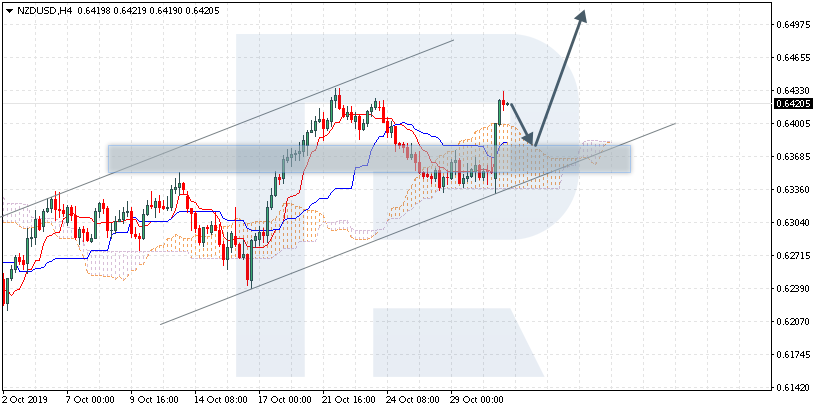
NZDUSD is trading at 0.6420; the instrument is moving above Ichimoku Cloud, thus indicating an ascending tendency. The markets could indicate that the price may test the cloud’s upside border at 0.6385 and then resume moving upwards to reach 0.6505. Another signal to confirm further ascending movement is the price’s rebounding from the support level. However, the scenario that implies further growth may be canceled if the price breaks the cloud’s downside border and fixes below 0.6320. In this case, the pair may continue falling towards 0.6235.

NZDUSD
Risk Warning: the result of previous trading operations do not guarantee the same results in the future

USDCAD, “US Dollar vs Canadian Dollar”

USDCAD is trading at 1.3156; the instrument is moving above Ichimoku Cloud, thus indicating an ascending tendency. The markets could indicate that the price may test Tenkan-Sen and Kijun-Sen at 1.3135 and then resume moving upwards to reach 1.3285. Another signal to confirm further ascending movement is the price’s rebounding from the support level. However, the scenario that implies further growth may be canceled if the price breaks the cloud’s downside border and fixes below 1.3040. In this case, the pair may continue falling towards 1.2935. After breaking the descending channel’s upside border and fixing above 1.3220, the price may continue moving upwards.

USDCAD

Article By RoboForex.com

Attention!
Forecasts presented in this section only reflect the author’s private opinion and should not be considered as guidance for trading. RoboForex LP bears no responsibility for trading results based on trading recommendations described in these analytical reviews.

Murrey Math Lines 31.10.2019 (USDCHF, GOLD)

Article By RoboForex.com

USDCHF, “US Dollar vs Swiss Franc”

As we can see in the H4 chart, USDCHF is still consolidating between 5/8 and 3/8. In this case, the price is expected to test 3/8, rebound from it, and then resume growing to reach the resistance at 5/8. However, this scenario may no longer be valid if the price breaks 3/8 to the downside. After that, the instrument may continue falling towards 1/8.

USDCHF_H4
Risk Warning: the result of previous trading operations do not guarantee the same results in the future

In the M15 chart, the pair may break the upside line of the VoltyChannel indicator and, as a result, move upwards to reach 5/8 from the H4 chart.

USDCHF_M15
Risk Warning: the result of previous trading operations do not guarantee the same results in the future

XAUUSD, “Gold vs US Dollar”

As we can see in the H4 chart, XAUUSD is still consolidating. In this case, the price is expected to rebound from 4/8 and then resume falling to reach the support at 2/8. However, this scenario may no longer be valid if the price breaks 4/8 to the upside. After that, the instrument may continue growing towards the resistance at 5/8.

GOLD_H4
Risk Warning: the result of previous trading operations do not guarantee the same results in the future

In the M15 chart, the pair may break the downside line of the VoltyChannel indicator and, as a result, continue its decline.

GOLD_M15

Article By RoboForex.com

Attention!
Forecasts presented in this section only reflect the author’s private opinion and should not be considered as guidance for trading. RoboForex LP bears no responsibility for trading results based on trading recommendations described in these analytical reviews.

The Analytical Overview of the Main Currency Pairs on 2019.10.31

by JustForex

The EUR/USD currency pair

Technical indicators of the currency pair:
  • Prev Open: 1.11127
  • Open: 1.11528
  • % chg. over the last day: +0.36
  • Day’s range: 1.11524 – 1.11705
  • 52 wk range: 1.0884 – 1.1623

Yesterday, the USD weakened against a basket of world currencies. EUR/USD quotes rose by more than 50 points and approached monthly highs. The Fed, as expected, lowered its key interest rate range by 25 basis points to 1.50-1.75%. The regulator is concerned about the uncertain economic situation in the country. The central bank pointed out that further adjustments to monetary policy would depend on future reports. At the moment, the EUR/USD currency pair is consolidating in the range of 1.11500-1.11700. We recommend opening positions from these marks. Today, investors will evaluate a number of important economic releases.

The Economic News Feed for 31.10.2019:

  • – Inflation Report (EU) – 12:00 (GMT+3:00);
  • – GDP Report (EU) – 12:00 (GMT+3:00);
  • – Personal Expenses Report (EU) – 14:30 (GMT+3:00);
  • – Initial Jobless Claims (EU) – 14:30 (GMT+3:00);
EUR/USD

The price fixed above 50 MA and 100 MA, which signals the power of buyers.

The MACD histogram is in the positive zone and above the signal line, which gives a strong signal to buy EUR/USD.

The Stochastic Oscillator is in the neutral zone, the %K line is below the %D line, which indicates a bearish sentiment.

Trading recommendations
  • Support levels: 1.11500, 1.11200, 1.11000
  • Resistance levels: 1.11700, 1.12000

If the price consolidates above 1.11700, expect further growth toward 1.12000-1.12200.

Alternatively, expect the quotes to fall toward 1.11300-1.11100.

The GBP/USD currency pair

Technical indicators of the currency pair:
  • Prev Open: 1.28656
  • Open: 1.29021
  • % chg. over the last day: +0.26
  • Day’s range: 1.29001 – 1.29346
  • 52 wk range: 1.1959 – 1.3385

The GBP/USD currency pair has moved up. During yesterday’s and today’s trading, the growth of quotations exceeded 60 points. At the moment, the local support and resistance levels are 1.29000 and 1.29350, respectively. Market participants expect up-to-date information on Brexit. Today we recommend paying attention to the news background on the US economy. Open positions from key levels.

The Economic News Feed for 31.10.2019 is calm.

GBP/USD

The price fixed above 50 MA and 100 MA, which signals the power of buyers.

The MACD histogram is in the positive zone and above the signal line, which gives a strong signal to buy GBP/USD.

The Stochastic Oscillator is in the neutral zone, the %K line is below the %D line, which indicates a bearish sentiment.

Trading recommendations
  • Support levels: 1.29000, 1.28450, 1.28000
  • Resistance levels: 1.29350, 1.29700, 1.30000

If the price consolidates above 1.29350, expect further growth of GBP/USD quotes toward 1.29700-1.30000.

Alternatively, the quotes could descend toward 1.28600-1.28400.

The USD/CAD currency pair

Technical indicators of the currency pair:
  • Prev Open: 1.30871
  • Open: 1.31610
  • % chg. over the last day: +0.58
  • Day’s range: 1.31487 – 1.31725
  • 52 wk range: 1.2727 – 1.3664

Yesterday, aggressive purchases were observed on the USD/CAD currency pair. Quotation growth exceeded 100 points. The trading instrument reached a round level of 1.32000. The Bank of Canada, as expected, kept the basic parameters of monetary policy at the same level. At the same time, the regulator worsened the forecast for GDP growth and inflation in the country. Looney is currently consolidating in the range 1.31450-1.31700. USD / CAD quotes have the potential for further growth. Open positions from the key levels.

At 14:30 (GMT+2:00) expect a report on the GDP of Canada.

USD/CAD

The price fixed above 50 MA and 100 MA, which signals the power of buyers.

The MACD histogram is in the positive zone, but below the signal line, which gives a weak signal to buy USD/CAD.

The Stochastic Oscillator is in the neutral zone, the %K line crossed the %D line. There are no signals at the moment.

Trading recommendations
  • Support levels: 1.31450, 1.31200, 1.31000
  • Resistance levels: 1.31700, 1.32000

If the price consolidates above 1.31700, expect further growth toward 1.32000-1.32300.

Alternatively, the quotes could decrease toward 1.31200-1.31000.

The USD/JPY currency pair

Technical indicators of the currency pair:
  • Prev Open: 108.866
  • Open: 108.849
  • % chg. over the last day: -0.09
  • Day’s range: 108.584 – 108.879
  • 52 wk range: 104.97 – 114.56

USD/JPY went down. The trading tool has updated local lows. At the moment, the USD/JPY currency pair is consolidating near the support level of 108.600. 108.800 is already a mirror resistance. Today we recommend paying attention to economic releases, as well as the dynamics of the yield of US government bonds. USD/JPY quotes have the potential to further decline. Open positions from key levels.

The Bank of Japan, as expected, kept the basic parameters of monetary policy unchanged. The regulator plans to keep interest rates at current levels until the spring of 2020.

USD/JPY

Indicators do not give accurate signals: 50 MA began to cross 100 MA.

The MACD histogram is in the negative zone, indicating a bearish sentiment.

The Stochastic Oscillator is in the neutral zone, the %K line is above the %D line, which gives a signal to buy USD/JPY.

Trading recommendations
  • Support levels: 108.600, 108.450, 108.300
  • Resistance levels: 108.800, 109.000

If the price consolidates below 108.600, expect the quote to drop toward 108.400-108.200.

Alternatively, the quotes could grow toward 109.000-109.200.

by JustForex

EURUSD: markets starting to prepare for the NFP

By Alpari.com

On Wednesday the 30th of October, trading on the euro closed 0.36% up. Volatility was very high during the US session. It initially rose following the release of GDP data for Q3, which at 1.9% year-on-year was higher than expected. The pair then shot up over rumours that the US-China would be delayed and then aw Jerome Powell took the stage.

Chile has cancelled the upcoming APEC summit over internal unrest. This has been planned for November, where leaders from the US and China were expected to convene and finalise a trade deal. The news took its toll on risky assets.

The Fed lowered the Federal Funds Rate by 0.25% to 1.50 – 1.75%. The US dollar reacted with a modest rise since the rate slash had already been factored in by the market with a 95% certainty. During Fed Chair Jerome Powell’s speech, the dollar lost ground on all fronts. He hinted that there would be a pause following the third rate reduction of 2019. The euro jumped from 1.1080 to 1.1171 (+91 pips).

Day’s news (GMT+3):

  • 13:00 Eurozone: GDP (Q3), CPI (Oct), unemployment rate (Sep).
  • 15:30 Canada: GDP (Aug).
  • 15:30 US: personal income (Sep), personal spending (Sep), initial jobless claims (25 Oct).
  • 16:45 US: Chicago PMI (Oct).
  • 18:30 Switzerland: SNB’s Chair Jordan speech.

EURUSD H1Current situation:

At the time of writing, the euro is trading at 1.1158. The US has calmed investor fears by reassuring everyone that the timetable for finalising a deal with Chine remains the same. News of the summit being cancelled shouldn’t trigger a retreat towards safe haven assets. Nevertheless, we expect to see a downwards correction on the euro today.

Today we expect to see a rise to the 90th degree at 1.1178 followed by a rebound downwards. There are some slight divergences between the 15 and 60-minute timeframes, so the drop will take place after 1.1071 is tested.

The pair recovered by 90 pips in the US session. This is quite a big move for the euro, so without any additional impetus, this growth is unlikely to continue. Don’t forget that US GDP came out higher than expected. The NFP report comes out on Friday, for which preparations are essential. At 13:00 (EET) today, the Eurozone will release its GDP figures. This should provide further direction for our pair.

By Alpari.com