Author Archive for InvestMacro – Page 141

Toward a Diverging BRIC Future

By Dan Steinbock

Two decades ago, the BRIC economies were projected to surpass the advanced G6 economies by the early 2030s. Today, the huge potential of the BRICs prevails, but the pace has slowed and country trajectories have diverged. China and India are on track, Brazil and Russia are not, thanks to geopolitics.

In the early 2000s, Goldman Sachs projected that the four largest emerging economies – Brazil, Russia, India and China, or the BRICs – would surpass the major advanced economies by the early 2030s.

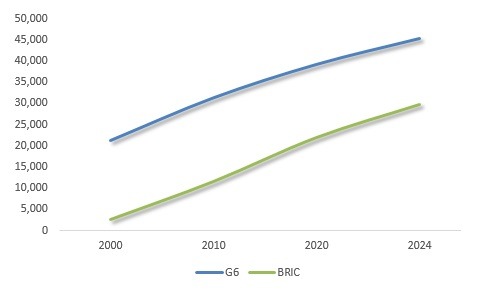
When the first BRICS Summit took place in Yekaterinburg, Russia in 2009, the combined economic power of the BRIC countries amounted to barely 12 percent of the collective economic power of the major advanced economies, the Group of Six (G6); the US, Western Europe (Germany, UK, France, Italy), and Japan.

At the time, the US economy was some 2.5 times bigger than that of China but amid the worst asset-bubble burst since the Great Depression. Japan, the world’s second-largest economy, was coping with a second lost decade. Chancellor Merkel’s Germany and President Sarkozy’s France still led the ailing Europe, where the global recession would soon morph into a series of sovereign debt crises. In Brazil, President Lula drove a dramatic growth catch-up, while reducing historical income polarization. In Manmohan Singh’s India, growth was accelerating. In Russia, President Putin had multiplied the size of the economy by more than five-fold in one decade, thanks to rising energy prices.

But where are the BRICs today?

Projected Versus Actual Growth

To gain a better understanding of what has happened in the past two decades, let’s compare Goldman Sachs’s original BRIC projections in the 2000s, which rested on the economic development in the 1980s and 1990s, with the actual BRIC prospects today, which are the net effect of the past two decades.

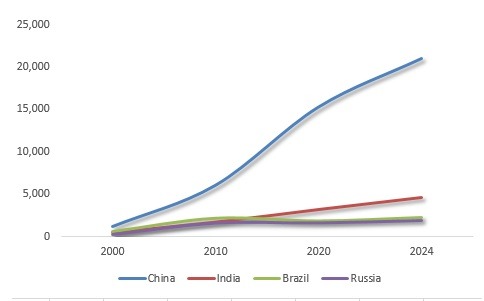
What Goldman Sachs projected was a dramatic expansion of China whose GDP was anticipated to grow more than 14-fold between 2000 and 2025. At the same time, India’s economy would increase by almost tenfold and was projected to grow relatively faster than China in the late 2010s. Brazil was expected to expand fivefold and Russia more than tenfold. In light of the fact that, in the same time period, the US, the largest advanced economy, was projected to expand more than twofold, these were stunning projections indicating solid catch-up growth in the largest emerging economies.

So what happened? Here’s the bottom line: If peaceful conditions prevail and trade protectionism can be kept in check, China could deliver more than expected, while India is on track as well. However, the potential of Brazil and Russia, respectively, has been undermined by geopolitics (Figure 1).

Figure 1 Expansion by BRIC Economies, 2000-2024
Sources: IMF; Difference Group.

After China joined the World Trade Organization (WTO) in 2001, its economic expansion intensified dramatically, fueled by the export-led growth model. Since the early 2010s, that model has been morphing toward consumption and innovation. By the mid-2020s – again, assuming peaceful conditions and managed trade tensions – China’s economy could expand more than 17 times, relative to its size in 2000. It is set to surpass the size of the US economy in the 2030s, which may well be the key to the Obama military pivot to Asia in the early 2010s and to Trump tariff wars more recently.

While India’s growth trajectory has periodically slipped, it has been pushed harder by Prime Minister Narendra Modi, despite recent growth pains. If things go right, India’s economy could expand the projected tenfold by the mid-2020s. New Delhi is engaged in a cautious balancing act between economic development and rising prosperity, which is what the country needs, and geopolitics and rearmament, which is what Washington would prefer.

Under President Lula’s leadership, Brazil’s GDP grew even faster than expected by the original BRIC projection. But since the mid-2010s, the contested impeachment of President Rousseff and particularly the imprisonment of Lula, Brazil’s growth trajectory has plunged. The geopolitical soft coup, which critics claim paved the way to radical right’s President Bolsonaro and the dreams of a new military dictatorship, could result in a lost decade. By the mid-2020s, Brazil’s GDP may reach the level where it first was at the end of the Lula era, already in the early 2010s.

Instead of being almost a fifth of the US GDP by the mid-2020s, Brazil’s economy may prove to be less than 9 percent of the US (over half smaller than originally projected). The dreams of tens of millions of Brazilians of a better future have been undermined.

In Russia, President Putin was able to reverse the economy’s drastic fall in the 1990s and restore the growth trajectory in the 2000s, when Russian economic prospects were in line with the BRIC projections. As Stephen F. Cohen has argued, Washington initiated a “new Cold War” against Russia before the 2008 global crisis. Due to the continued softness in oil prices and particularly the still ongoing sanctions, the Russian economy could have been almost a fifth of the U.S. economy by 2025. Thanks to the new Cold War, the Russian economy could prove to be less than a tenth of the US GDP in the period. Thanks to the new Cold War, Russian economy could prove to be less than a tenth of the US GDP in the period.

Russian economy could increase by six to seven times, but it cannot deliver its full potential.

BRICs positioned to surpass G6 in early 2030s

The peak of the advanced economies’ global power was in the 1980s and ‘90s. In 2000, the economies of the major advanced nations of the “West,” as reflected by the G6, were still almost ten times bigger than the BRICs. But increasing debt, military overstretch and aging populations have hit hard the advanced West.

In 2010, the BRICs accounted for more than a third of the G6; and in the mid-2020s, that figure will be two-thirds of G6. The original Goldman Sachs projections suggested the BRICs would catch up with G6 by the late 2020s. Thanks to geopolitical interventions, the actual convergence is likely to take a 5-10 years longer (Figure 2).

Figure 2 G6 Economies and the BRICs’ Catch-Up, 2000-2024
Sources: IMF; Difference Group.

Of course, if the six G6 countries would be compared with the six largest emerging economies – not just the four BRICs – Indonesia and Mexico could be added to the group. In that case, convergence would happen a few years earlier.

As International Monetary Fund reported in 2007, the large emerging economies have fueled global economic prospects since the 2000s. Recent efforts to undermine their economic potential reflect efforts at destabilization and regime change, critics argue.  In the absence of significant policy U-turn, collateral damage is spreading.

As US pivot to Asia is promoting competition rather than cooperation, the economic promise of the Asian Century is threatened. The Trump tariff wars have played a key role in the plunge of world trade, the fall of world investment and rising migration barriers, which have caused the number of the globally displaced to soar to more than 70 million; far higher than they were after World War II. At the same time, global economic prospects continue to diminish in a way that could push major advanced economies into secular stagnation earlier than anticipated.

Spearheading the world’s largest emerging and developing economies, China, India, Brazil and Russia together pace global economic prospects. And as they go, so will the world economy.

About the Author:

Dr. Dan Steinbock is the founder of Difference Group and has served as research director at the India, China and America Institute (USA) and visiting fellow at the Shanghai Institutes for International Studies (China) and the EU Center (Singapore). For more, see http://www.differencegroup.net/

The original commentary was released by China-US Focus on November 10, 2019.


Welcome to the Zombie-land Of Investing – Part II

By TheTechnicalTraders.com

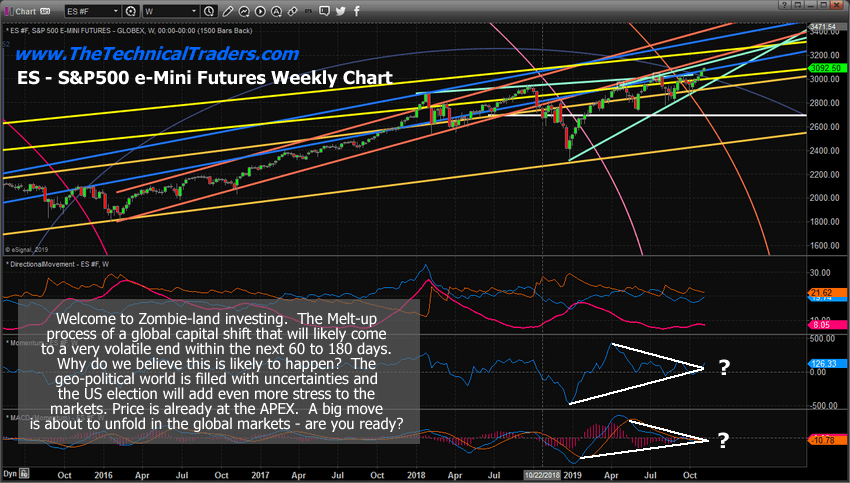
In Part I of this research post, we highlight how the ES and Gold reacted 24+ months prior to the 2007-08 market peak and subsequent collapse in 2008-09.  The point we were trying to push out to our followers was that the current US stock market indexes are acting in a very similar formation within a very mature uptrend cycle.

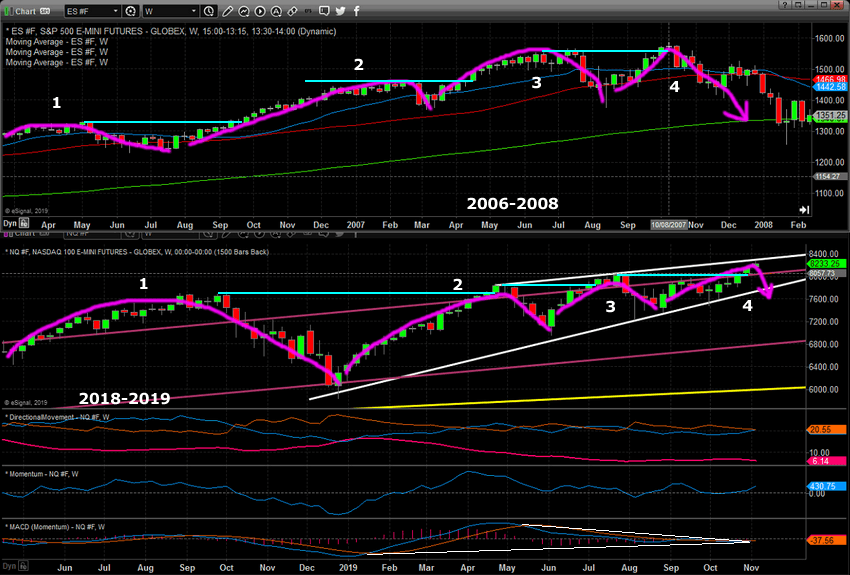
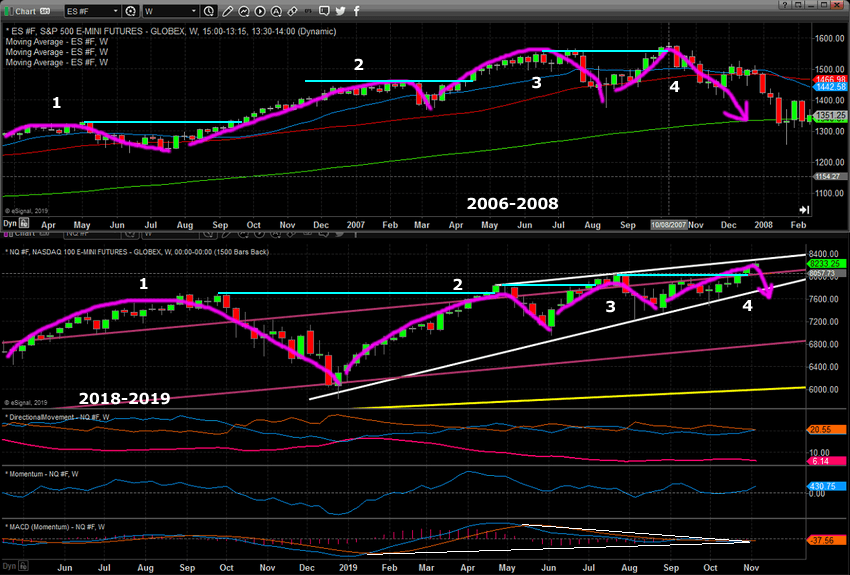
We ended Part I with this chart, below, comparing 2006-08 with 2018-19.  Our intent was to highlight the new price high similarities as well as the price rotation similarities between the two critical peaks in market price. We are terming the current market a “Zombie-land” because it appears global investors are somewhat brain-dead as to the total risks that are setting up in the global markets right now. But, wait before you continue reading make sure to opt-in to our free market trend signals newsletter.

Forward guidance is waning. Earning expectations are decreasing.  Debt levels are skyrocketing all over the planet.  Global banks are continuing to move into more Quantitative Easing measures to attempt to spark growth.  The equity markets are 9+ years into a rally while the global central banks are 10+ years into some form of continued QE efforts.  Global economic data suggests a moderate downturn in economic activity and growth for many foreign nations.  We believe the next crisis will not originate in the US, but from outside the US.  We believe the risks associated with the massive debt levels in the foreign markets will be the reason for another price decline.  Quite possibly, a commodity price collapse (think OIL) will become the catalyst for this event.

If Oil were to fall below $45…

If Oil were to fall below $45 (eventually possibly flirting with the $30 price level) as our predictive modeling suggests, then we believe many foreign nations will suddenly become serious risk factor related to debt/credit and could potentially create a domino-process where the US/Global markets collapse on this new risk factor. Our last predictive model signal was for natural gas and we just close out the trade locking in 19% profits this week.

Is 2007 setting up all over again?

But what if this is 2007 setting up all over again?  Take a look at the ES chart above – where a peak setup in May/June 2007, followed by a deep price correction.  Follow that price move even further to see how price rallied to a new all-time high throughout July, August and most of September before setting up in a deeper price rotation in late September and carrying forward into October.  Now, take a look at this current ES Weekly chart to see if there is any similarity between them.

Gold up 50% From Its Lows Already

Gold has already rallied nearly 49% from the 2015 lows and the recent price rotation is somewhat similar to what happened to Gold in 2006-2007.  The extended base that set up between 2017 and 2018 could be interpreted as a similar type of base that set up in 2006-07.  The current rally is somewhat similar to what happened in late 2007 and early 2008 when the US stock market began to collapse volatility expanded in a strong uptrend which was followed by a moderate price retracement before Gold began a rally totaling more than 250% from the base/bottom.  Is this setup happening again right now?

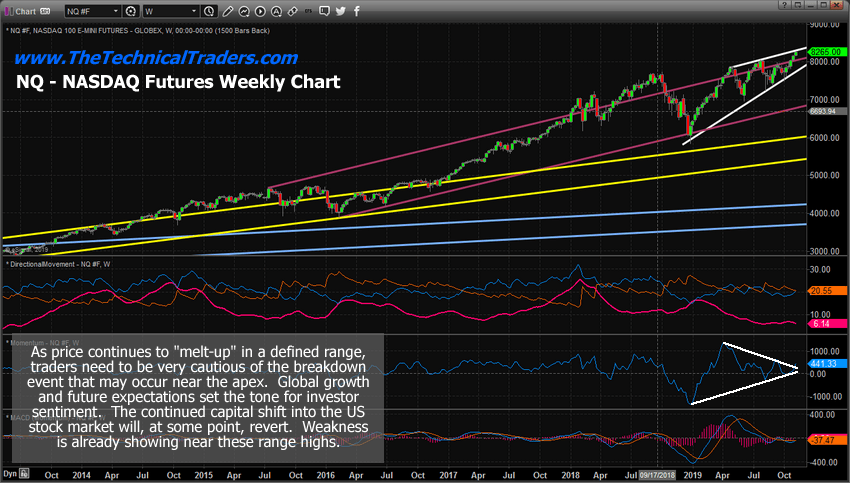
Weekly NQ chart shows the extended melt-up

This Weekly NQ chart shows the extended melt-up that is taking place after the October to December deep price rotation that took place in 2018.  We believe this deep price rotation is similar to the deep price rotation that happened between July and September 2007.  The subsequent “melt-up” process is a function of the “zombie-land” function of price and bias.  Investors chase after security and returns by pushing the price higher and higher when fundamentals and expectations don’t align with these expectations.  This same type of “zombie-land melt-up” happened in 2007 as well.

We understand the implications of this research post and want to warn all of our followers they need to be extremely cautious of the current market setup.  Even though the US stock market may continue an upside bias within a melt-up process, we believe there are very strong underlying risks in the markets that could prompt a very deep price correction.

The US Fed is not lowering rates because …

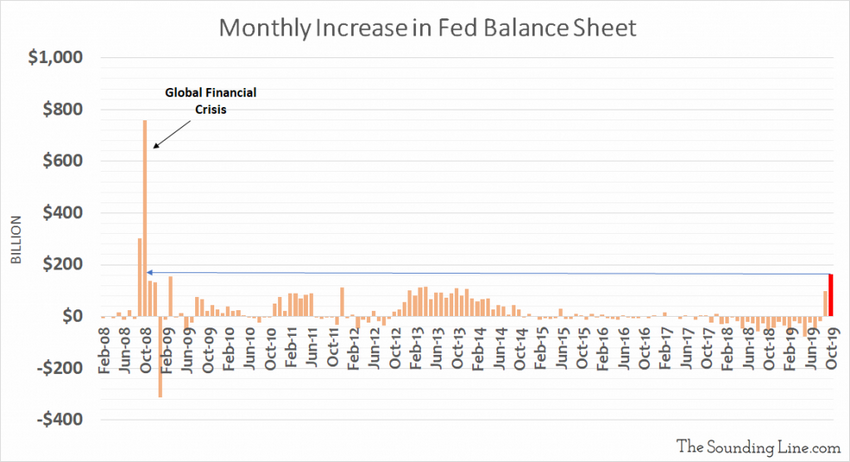
The US Fed is not lowering rates because of market strength and super strong forward guidance.  They are lowering rates because they believe risks exist in the debt/credit market and are trying to stay ahead of a big problem – a potentially very big problem.  The overnight REPO market has been a topic for our researchers for the past 45+ days as this temporary institutional debt tool has exploded recently.  Now, the US Fed has actively decreased rates and has begun acquiring more debt on its balance sheet.. hmm.  That seems strangely similar to another credit/debt crisis event.

(source: https://thesoundingline.com/october-saw-the-largest-increase-in-feds-balance-sheet-since-the-financial-crisis/)

We know many of our followers may consider this just another warning from a bunch of doom-sayers again.  We’re not wishing for this outcome – trust us.  We simply look at the technical data, determine a probable outcome and present our findings to our followers to try to keep them informed.

Too many similarities are starting to align to make this just some strange coincidence.  Too many unknowns and uncertainties are aligning just 12 months before a US presidential election cycle.  It seems strangely familiar to us that these same types of price events are unfolding now.  If there is no correlation then we’ll likely be incorrect in our analysis.  But if we are right and there is a major price reversion event setting up, we think it is wise to alert as many of our friends as possible.

Keep reading our research because our proprietary tools have been nailing all of these price targets and move many months in advance.

I urge you visit my ETF Wealth Building Newsletter and if you like what I offer, join me with the 1-year subscription to lock in the lowest rate possible and ride my coattails as I navigate these financial market and build wealth while others lose nearly everything they own during the next financial crisis. Join Now and Get a Free 1oz Silver Bar!

As a technical analysis and trader since 1997, I have been through a few bull/bear market cycles. I believe I have a good pulse on the market and timing key turning points for both short-term swing trading and long-term investment capital. The opportunities are massive/life-changing if handled properly.

Chris Vermeulen – TheTechnicalTraders.com


Double 11 Record Sales Signal Strength of Chinese Consumption

By Dan Steinbock    

On Monday, Alibaba’s Single’s Day broke all records. Chinese consumption and ecommerce signal not just continued resilience but evident strength.

By 5 pm on Monday Alibaba Group had already broken last year’s record of $31 billion. And at midnight, the new record soared to $38.3 billion – 25 percent higher than last year.

Despite the continuing – and misleading – international headlines about China’s “slowing economy” and “consumption collapse,” Alibaba’s 11th Single’s Day gala alone generated more revenues than US Black Friday and Cyber Monday combined.

Alibaba’s Singles’ Day shopping festival is not just the world’s largest of its kind. It is a vital barometer of Chinese consumption amid the US tariff wars.

Double 11 Is Regionalizing and Internationalizing

According to Alibaba, more than 200,000 brands participated in the 11th Singles D – ay promotion – or the “Double 11” as it is popularly known – with 1 million new products being offered and over 500 million users forecast to spend; that’s 100 million more than last year.

This year Alibaba deployed its highly popular online shopping platforms, Tmall and Taobao, but also business-to-business ecommerce platforms, like AliExpress, and Lazada, the shopping site favored in Southeast Asia. As business began, the top regions in mainland in terms of transactions were Guangdong, Zhejiang, Jiangsu, Shanghai and Shandong. However, Alibaba is also tapping regional, even international consumers.

In the early hours, the most active overseas buyers included Hong Kong, the US, Australia and Japan. Even before the festival on Monday, some 64 brands, such as Apple, Lancome, Dyson and L’Oreal, garnered millions of dollars in Alibaba pre-orders, with Estée Lauder garnering a record $143 million.

Double 11 is now a big win-win opportunity not just for China but for international exporters from advanced and developing countries alike.

Ecom Success Reflects Chinese Cost-Efficiency, Innovation

In China, ecommerce explosion began in the mid-2010s. But as business has mobilized in the past half a decade, transactions occur smoothly with smartphones and volumes are soaring.

Today Chinese consumers use smartphones to browse top online shopping sites, such as Alibaba’s Taobao.com, and submit orders. It is the net effect of 15-20 years of innovation by Chinese smartphones, mobile operators and ecommerce giants.

In the early 2000s, NTT DoCoMo probably had the best mobile services, but since the Japanese operator failed to internationalize, it lost its edge. The Finnish Nokia developed popular 2G, even 3G services, but moved too slowly into smartphones.

That’s how Apple’s iPhone captured the early lead in smartphones. Yet, it could not respond to a new generation of Chinese smartphones by Huawei and its peers – Xiaomi, Vivo, and Oppo – which now dominate 75 percent of the global smartphone market and are more cost-efficient and more innovative. Nor could the US companies, despite their early lead in the fixed-line Internet, match the co-innovation of Chinese operators and ecommerce giants, such as Alibaba.

That’s why Chinese pioneers are already launching 5G services, while pioneering 6G platforms. And that’s also why the White House keeps resorting to anti-competitive means seeking to undermine Huawei’s legitimate success.

Explosion of Chinese online consumption

Through the 16 months of US tariffs, international headlines have predicted doom and gloom in China. And yet, Chinese industrial production picked up in September, despite reduced export growth. Third-quarter data reflected resilience of consumption. And while US trade wars have made consumers cost-conscious, retail sales climbed to 7.8 percent, thanks to slate of policy supports.

Alibaba’s success and the new Double 11 record mimic the broader consumption trends in China. The same goes for urbanization. As the growth momentum in the mainland has been shifting from the coastal first-tier cities to lower-tiered cities, gains in purchasing power in small-and-medium size cities drove Double 11 sales.

When Alibaba’s ecommerce gala began on Monday, the China International Import Expo (CIIE) had just ended in Shanghai. In that bonanza, the value of intended deals exceeded $71 billion, up 23 percent from the first expo in 2018 – mimicking Alibaba’s sales triumph.

The Double 11 and Shanghai CIIE records and the consumption data in the past few quarters offer abundant evidence that Chinese consumption is far more resilient and stronger than ideological eadlines in the West presume.

About the Author:

The author is the founder of Difference Group. He has served at the India, China and America Institute (US), Shanghai Institutes for International Studies (China) and the EU Center (Singapore).   


Consumer Confidence Peak = Peak in S&P 500? 1 Sector Poised to Benefit

By Paul Farrugia, First Macro Capital

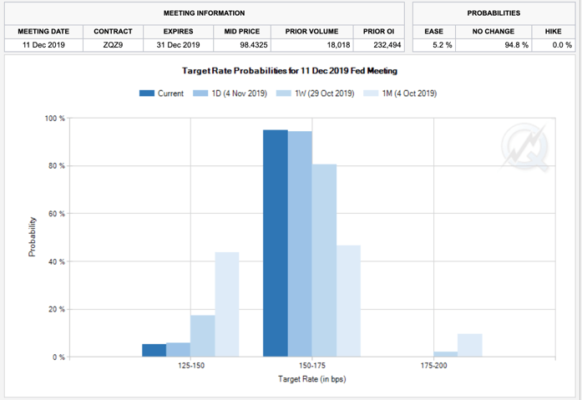
Since the most recent rate cut, we have seen the probability of further interest rates cuts by the US Federal Reserve swing from almost a 50% chance of further rate cuts in December, now to a 5.2% chance of further rate cuts from the Fed. Essentially the market is pricing in no further rate cuts. What does it mean for the yield curve? What does it mean for gold, gold stocks, and the S&P 500?

Consumer Confidence – Rates  – Unemployment

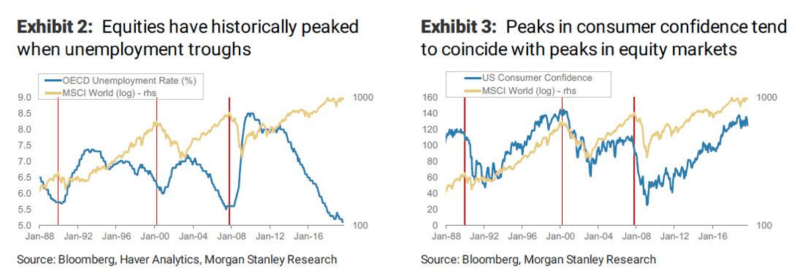
Once Consumer confidence peaks, we get further rate cuts, and then unemployment rises. What does consumer confidence tell us about the market?

All Eyes on the Consumer

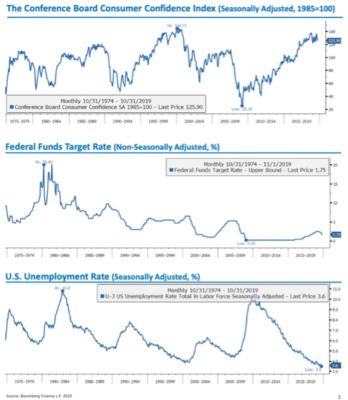
When we look at the Conference Board Consumer Confidence Index, it commonly PEAKS, when the stock market is peaking, and then in the following weeks and months, as the unemployment rate is troughing, we begin to see the unemployment rate start to accelerate.

Hotel Industry

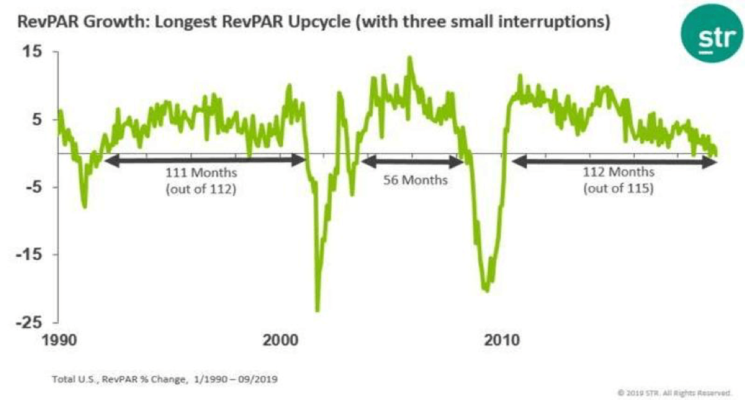
Let’s look at one key leading indicator in the hotel industry that reflects spending by both consumers and businesses. “As HotelNewsNow reports, In September, US hotels recorded the second monthly revenue-per-available-room decline of 2019, declining by 0.3%, as average daily rates increased by 0.6%, but that was not enough to overcome the 0.9% occupancy decline.” Occupancy in the US has declined for three of the past 4 months. Is the hotel demand highlighting further slowdown in consumer spending?

FED RATE CUT, YIELD CURVE, and GOLD

Historically once the Fed rate cuts enough to fix the yield curve from being inverted to no longer being inverted, just like in 2001 and 2007, we saw a recession in the following months ahead. We don’t think this recession will be as severe as 2008 because we don’t want to get caught up with anchoring to the most recent recession. Gold has outperformed the S&P 500 when the US 10 Year minus the US 3-month was no longer inverted because of the fed cutting interesting rates. Now we are back to where we were in 2001 and 2008, with our preference to be overweight gold relative to the S&P 500. Gold in these environments relative to the S&P 500, is poised to outperform.


Gold or Gold Stocks

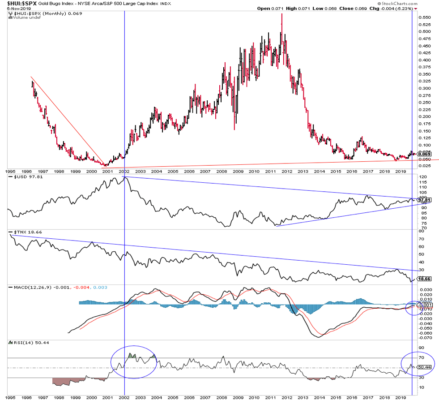
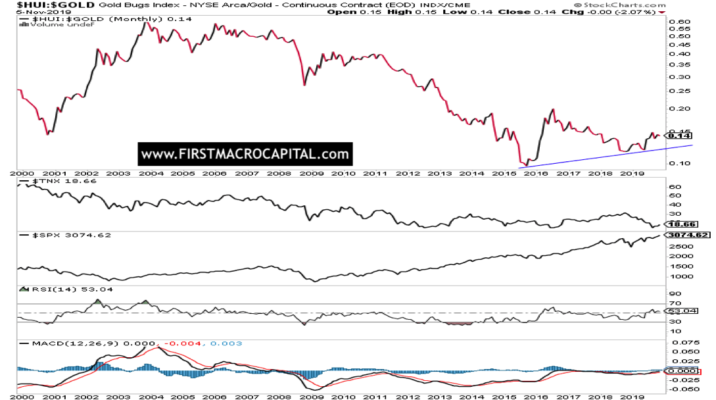
What about gold versus gold stocks? Depending on your time horizon, gold stocks are positioned to outperform gold in the coming years. That being said, in the near-term gold stocks may be impacted if the entire market sells off, but we would expect them to bottom much earlier than the S&P 500 as the materials sector tends to outperform in the early stages of the new business cycle. Gold and gold stocks will bounce around, with gyrations. The bottom is in for gold stocks relative to gold when the ratio bottomed in 2016. For the long-term investor, holding on here is most important to generate multi-bagger opportunities.

Gold Stocks vs S&P 500

Important, the US Dollar peaked in 2002, resulting in gold stocks outperforming S&P 500 in the coming 12-18months. Gold stocks are back to their 2002 lows versus the S&P 500, and if you are willing to take a 12-18 month view, it looks increasingly probable that gold stocks will outperform the S&P 500 as gold stocks head higher and the S&P 500 falls. The US dollar weakens and the rotation out of tech (largest sector of S&P 500) into commodity stocks. The world is presenting a gift to investors and those looking for new asymmetric opportunities. 

“You can hate if you want to, but you’ll be with me in time” – Rev. Run

Get the exact checklist that

Paul Farrugia, BCom. Paul is the President & CEO of First Macro Capital. He helps his clients take advantage of cycle opportunities across all sectors and asset classes, for the long-term. He provides a checklist to find winning gold and silver mining producer stocks, to take advantage of the commodity cycle.

Disclaimer:

The information contained herein is obtained from sources believed to be reliable, but its accuracy cannot be guaranteed. It is not designed to meet your financial situation – we are not investment advisors, nor do we give personalized investment advice. The opinions expressed herein are those of the publisher and are subject to change without notice. It may become outdated, and there is no obligation to update any such information.


How Technology Is Helping To Transform The Business Lending Space

Over recent months global economic and political uncertainty have led many lenders to reduce the availability of finance for businesses, which could spell disaster for the global economic market. Challenges such as Donald Trump and his potential impeachment, Brexit and the UK’s pending election and other global social and political issues are causing financial institutions to become more reticent about the money they lend, particularly to small businesses. This reduction in lending is despite the fact that there is a definite increase in the number of businesses looking to borrow money.

Some areas of the business finance market, such as asset finance, have actually seen growth over recent months despite these challenges. For those markets that are struggling to gain financing, growth is often slow as entrepreneurs struggle to find loans to fund their ambitions and existing businesses find themselves without the capital to expand.

In such times many companies and innovators look towards alternative forms of financing, but economic uncertainty causes issues with these also. The entire lending space is struggling, with major blows such as the collapse of payday lending giant QuickQuid causing ripples throughout the market, and as such even alternative lending options are harder for businesses to access in this climate.

There are some signs that the future will be brighter, with a new SME Charter seeing banks and other lenders pledging to support UK businesses through Brexit, but despite this many companies are still facing a struggle to obtain the finance they need. It can be tough for companies of all sizes to gain greater funding, and without money they can struggle to grow and even close down.

For those businesses struggling to find finance, technology is the key to overcoming the challenges the lending industry currently poses. Platforms like Become offer an alternative way to accesses finance by bringing lenders and businesses together so that they can negotiate loans that will suit both parties. Evidence suggests that half of small businesses do not access funding solutions, and platforms such as this could provide an alternative way for them to find, understand and access the funding they need.

Another technological solution that has the potential to support growing companies is Trade Ledger, which recently completed a funding round of its own in order to expand and attempt to reduce the time-to-cash from the business finance industry average of 90 days to a mere 4 minutes. This pioneering solution digitalises business finance and uses cutting-edge technology to bypass old-fashioned legacy banking systems and provide swift support to borrowers.

In all, with the future of the global political space uncertain, more SMEs and lenders should use funding technology to stimulate economic growth. Technology has the potential to offer businesses access to the funding they need, as well as offering lenders the chance to easily find the perfect companies to invest in, and as such it is the perfect tool for improving the global financial outlook over the coming years.

By Taylor Wilman


British Pound boost as hung parliament and Corbyn risks reduce on Farage-Johnson pact

By George Prior

The pound will receive a welcome boost after Nigel Farage’s Brexit Party will not be pitted against the ruling Conservatives in almost 320 seats in next month’s election, affirms the boss of one of the world’s largest independent financial organizations.

The upbeat message from Nigel Green, founder and CEO of deVere Group comes as the Brexit Party’s leader Nigel Farage will stand aside in all 317 seats won by the Conservatives in the 2017 general election, fighting only seats held by other parties in the December 12 general election.

Mr Green notes: “Nigel Farage has given the Prime Minister a massive boost in the election as he stands down candidates from his Brexit Party.

“In turn, this will give a welcome boost to the Brexit-battered pound, which has consistently been something of a Brexit bellwether.”

He continues: “The move reduces the likelihood of another hung parliament, which would have led to more parliamentary paralysis and more crippling delays on Brexit.

“All of this would have generated yet more, intensified uncertainty – something financial markets loathe.  This is why the pound has jumped on the news of the informal Johnson-Farage pact.

“Looking ahead, a Conservative majority would give the government the enhanced ability to move on with the Brexit process.

“Wealth, jobs and opportunity-generating businesses – both in the UK and internationally – have been crying out for certainty. There is the hope a majority government could lift the fog of Brexit that’s been hampering investment and confidence.

“Should a Conservative majority be returned next month, I believe that the pound will reach $1.35.”

Mr Green goes on to add: “The pound will also be given a boost as the agreement is a serious hammer blow for Jeremy Corbyn’s Labour party.

“His anti-business rhetoric, and high tax and low-profit policies would lead to considerable and sustained selling of the pound.”

Last week, the deVere CEO noted: “I believe we can realistically expect a Corbyn government would trigger an exodus of the country’s most successful and wealthiest individuals who contribute significantly both directly and indirectly to the British economy.”

Nigel Green concludes: “Sterling’s outlook will become increasingly bullish over the next few weeks if the Conservatives continue to do well in the polls in the run-up to the election.”

About:

deVere Group is one of the world’s largest independent advisors of specialist global financial solutions to international, local mass affluent, and high-net-worth clients.  It has a network of more than 70 offices across the world, over 80,000 clients and $12bn under advisement


Forex Technical Analysis & Forecast 11.11.2019 (EURUSD, GBPUSD, USDCHF, USDJPY, AUDUSD, USDRUB, USDCAD, GOLD, BRENT, BTCUSD)

Article By RoboForex.com

EURUSD, “Euro vs US Dollar”

EURUSD has reached the downside target. Today, the pair may grow towards 1.1038 and then resume falling to reach 1.1027. After that, the instrument may start a new growth with the first target at 1.1058.

EURUSD
Risk Warning: the result of previous trading operations do not guarantee the same results in the future

GBPUSD, “Great Britain Pound vs US Dollar”

GBPUSD has completed the ascending impulse; right no, it is correcting to reach 1.2781. Later, the market may resume trading upwards with the first target at 1.2820.

GBPUSD
Risk Warning: the result of previous trading operations do not guarantee the same results in the future

USDCHF, “US Dollar vs Swiss Franc”

USDCHF is trading downwards to reach 0.9933. After that, the instrument may start another growth towards 0.9955 and the form a new descending structure with the first target at 0.9888.

USDCHF
Risk Warning: the result of previous trading operations do not guarantee the same results in the future

USDJPY, “US Dollar vs Japanese Yen”

USDJPY has finished another descending impulse along with the correction; right now, it is forming the second impulse to reach 108.68. Alter, the market may form one more ascending structure towards 109.06 and then trade downwards with the first target at 108.64.

USDJPY
Risk Warning: the result of previous trading operations do not guarantee the same results in the future

AUDUSD, “Australian Dollar vs US Dollar”

AUDUSD is forming another correctional wave with the short-term target at 0.6846. After that, the instrument may start a new growth towards 0.6888 and then resume trading downwards to reach 0.6840.

AUDUSD
Risk Warning: the result of previous trading operations do not guarantee the same results in the future

USDRUB, “US Dollar vs Russian Ruble”

USDRUB is consolidating around 63.75. Possibly, today the pair may form one more ascending structure to reach 64.04 and then fall towards 63.81. Later, the market may resume trading upwards with the target at 64.31.

USDRUB
Risk Warning: the result of previous trading operations do not guarantee the same results in the future

USDCAD, “US Dollar vs Canadian Dollar”

USDCAD has completed the ascending wave at 1.3233; right now, it is consolidating near the highs. Possibly, the pair may expand the range towards 1.3238 and then continue trading downwards with the target at 1.3170, at least.

USDCAD
Risk Warning: the result of previous trading operations do not guarantee the same results in the future

XAUUSD, “Gold vs US Dollar”

Gold is moving downwards to reach 1454.08. Later, the market may start a new correction towards 1474.44 and then continue falling with the target at 1447.00.

GOLD
Risk Warning: the result of previous trading operations do not guarantee the same results in the future

BRENT

Brent is moving downwards. Possibly, today the pair may form the fifth wave of Flag pattern; the target is at 60.60. After that, the instrument may resume trading upwards with the first target at 62.10.

BRENT
Risk Warning: the result of previous trading operations do not guarantee the same results in the future

BTCUSD, “Bitcoin vs US Dollar”

BTCUSD is growing towards 9275.00. Later, the market may form a new descending structure to reach 8050.00, thus completing the correction. After that, the instrument may start a new growth towards 9300.00.

BTCUSD

Article By RoboForex.com

Attention!
Forecasts presented in this section only reflect the author’s private opinion and should not be considered as guidance for trading. RoboForex LP bears no responsibility for trading results based on trading recommendations described in these analytical reviews.

Welcome to the Zombie-land Of Investing – Part I

By TheTechnicalTraders.com

This current market environment is very reminiscent of the 2006-08 market environment where price rotated into weakness on technicals and continued to establish new all-time price highs in the process – creating what we are calling a “zombie-land melt-up”.  This very dangerous price action is indicative of money chasing a falling trend.  Where technicals and fundamentals are suggesting that price is actually weakening quite substantial, yet the process of price exploration is continually biased towards the upside as investors continue to pile onto the back of the beast expecting a further melt-up.

Let’s take a look at what happened to the ES and Gold in 2006 and 2007. But, wait before you continue reading make sure to opt-in to our free market trend signals newsletter.

SP500 Weekly Index Chart in 2006-2007

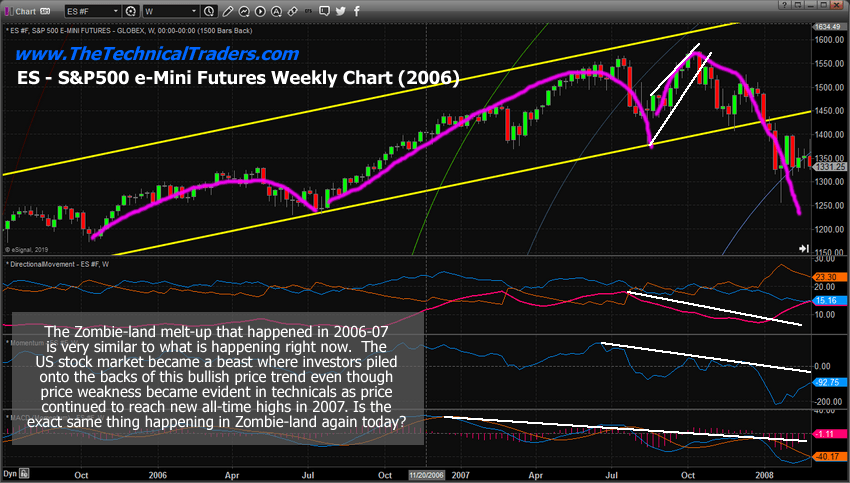
First, we’ll start with the ES (S&P 500 E-mini futures contract).  Pay attention to the MAGENTA arcs we’ve drawn on this chart that highlight the continued new highs reached throughout 2006 and 2007.  Pay attention to the price rotation and volatility that started to happen near the absolute peak in July and October 2007 – just before the massive price collapse began.  Notice how the technical indicators had been suggesting that price was weakening quite extensively since the beginning of 2007 and more aggressively after July 2007.  Pay very close attention to the last peak on this chart and how a very deep price correction setup a new price high in a very tight FLAG formation just before the breakdown event.

Price Of Gold Weekly Chart in 2006-2007

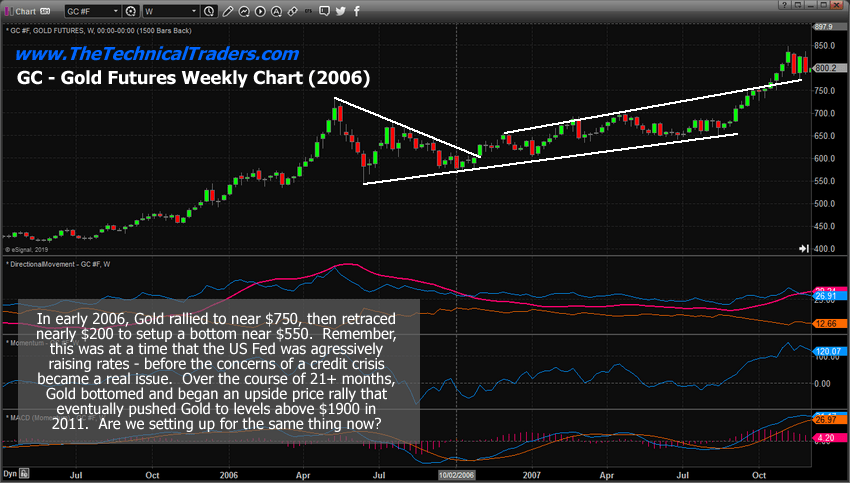
This Gold chart from the same time period highlights how Gold anticipated the market weakness by rallying up to a level near $750 in May 2016 – then retraced nearly $200 before forming a lengthy price bottom/base.  Gold, acting as a safe-haven for investors, rallied almost 94% in the 24 months prior to this peak in 2006.  It rallied another 256% (at the ultimate peak) from the low point established in June 2006.  The process of this rally was an extended base/bottom in Gold between the base/bottom in 2006 and the renewed uptrend that started just before the end of 2007 (just before the markets started crashing).

Compare SP500 Index 2006-07 to 2018-19

We believe the current uptrend in the US stock market is acting in a very similar price formation to what we’ve highlighted in the 2006-07 market “zombie-land melt-up”.  We believe that investors are piling into the US stock market when price weakness is clearly being illustrated by the technical and fundamental data.  We believe a capital shift has continued to pile money into the US stock market as foreign investors pile onto the backs of other investors seeking safety and security within a stronger US economy.

Concluding Thoughts:

We believe the current Zombie-land market is anticipating a price roll-over event (reversion) and that technical and fundamental data supports this analysis.  We believe the credit/debt expansion of the past 8+ years has fueled a massive bubble that may result in a deep price correction if given the right circumstances and events.  We believe this upside price move in the US markets, which are setting up near the exact same time-frame as the 2008 price collapse, maybe a very stern warning for traders and investors – BE PREPARED.

In Part II of this research post, we’ll highlight the similarities setting up in the current market “Zombie-land” and what happened in 2006~2008.  The expansion of the credit market over the past 8+ years has been extensive throughout the globe.  The biggest difference this time is that risk may come from foreign markets vs. from within the US.

Keep reading our research because our proprietary tools have been nailing all of these price targets and move many months in advance.

I urge you visit my ETF Wealth Building Newsletter and if you like what I offer, join me with the 1-year subscription to lock in the lowest rate possible and ride my coattails as I navigate these financial market and build wealth while others lose nearly everything they own during the next financial crisis. Join Now and Get a Free 1oz Silver Bar!

As a technical analysis and trader since 1997, I have been through a few bull/bear market cycles. I believe I have a good pulse on the market and timing key turning points for both short-term swing trading and long-term investment capital. The opportunities are massive/life-changing if handled properly.

Chris Vermeulen – TheTechnicalTraders.com

Fibonacci Retracements Analysis 11.11.2019 (GOLD, USDCHF)

Article By RoboForex.com

XAUUSD, “Gold vs US Dollar”

As we can see in the daily chart, after finally breaking the sideways channel to the downside and retesting 61.8% fibo, the pair has updated the low. The next downside targets are 76.0% fibo at 1438.05 and the fractal low at 1400.49. The descending MACD indicator confirms further decline.

GOLD_D1
Risk Warning: the result of previous trading operations do not guarantee the same results in the future

In the H1 chart, there is a convergence on MACD, which may indicate a short-term pullback. the targets of this possible correction may be 23.6%, 38.2%, and 50.0% fibo at 1470.28, 1479.00, and 1486.08 respectively.

GOLD_H1
Risk Warning: the result of previous trading operations do not guarantee the same results in the future

USDCHF, “US Dollar vs Swiss Franc”

As we can see in the daily chart, after failing to break the fractal low, the pair started another ascending impulse, which has already broken the local high. In this case, USDCHF is expected to grow towards the high at 1.0028, break it, and then continue trading upwards to reach long-term 76.0% fibo at 1.0098. However, if the market fails to break the high, the instrument may resume moving to the downside and reach 61.8% and 76.0% fibo at 0.9800 and 0.9748 respectively.

USDCHF_D1
Risk Warning: the result of previous trading operations do not guarantee the same results in the future

In the H1 chart, there is a divergence on MACD, which may indicate a possible pullback. The downside correctional targets may be 23.6%, 38.2%, and 50.0% fibo at 0.9949, 0.9929, and 0.9914 respectively. The resistance is the high at 0.9979.

USDCHF_H1

Article By RoboForex.com

Attention!
Forecasts presented in this section only reflect the author’s private opinion and should not be considered as guidance for trading. RoboForex LP bears no responsibility for trading results based on trading recommendations described in these analytical reviews.

Mutual Cancellation of China-US Tariffs Is Open to Question

by JustForex

Last week, the US dollar strengthened significantly against a basket of world currencies. The dollar index (#DX) closed in the green zone. At the moment, the greenback is moving away from local highs. The US currency is under pressure due to statements by US President Donald Trump that he does not intend to cancel tariffs for China so far. It should be recalled that according to reports by Chinese and American officials, the parties agreed on the mutual cancellation of the earlier imposed tariffs. However, after the statements by US President, it is not clear whether the parties can agree and conclude an agreement. According to Trump, no final decision has been made. Tomorrow, the President of the United States will speak at the Economic Club of New York and is likely to put a little more clarity.

Investors will also follow important economic data from the UK and the US this week. On Wednesday and Thursday, November 13-14, Fed Chairman Powell will speak. Financial market participants expect the head of the Fed to announce once again that no further monetary easing is planned.

The “black gold” prices are declining. At the moment, futures for the WTI crude oil are testing the $56.50 mark per barrel.

Market Indicators

On Friday, there was the bullish sentiment in the US stock markets: #SPY (+0.25%), #DIA (+0.01%), #QQQ (+0.40%).

The 10-year US government bonds yield has updated local highs. At the moment, the indicator is at the level of 1.93-1.94%.

The Economic News Feed for 11.11.2019:
  • – GDP data in the UK at 11:30 (GMT+2:00);
  • – Manufacturing production in the UK at 11:30 (GMT+2:00).

by JustForex