Author Archive for InvestMacro – Page 139

Reserve Bank of Australia cuts rates to 0.25% will the AUD take a hit?

By ForexNewsNow

The Reserve Bank of Australia has decided to cut interest rates all the way down to 0.25% in anticipation of a very complicated 2020 up ahead. The cuts will materialize in the middle of 2020 in order to accomodate not only the heavy expenditures during Christmas 2019 but to also prepare the consumers for another one in 2020.

Overall, the government is starting to prepare for the worst. Considering all of the indicators that we’ve seen coming from Australia, the preparations are definitely not misplaced. The interest rate cuts are mostly designed to keep the Australian economy floating for the year to come. According to experts, should the rates not had been implemented, it was likely that the economy would take a back turn.

Most consumers are not too worried about the rate cuts, but every firm that has been dealing with some kind of business in Australia could start reconsidering their involvement in the economy. As for the FX brokerages that are dotting Australia left right and center, it’s likely that most of them will start distancing themselves from the AUD/USD pair for now.

What indicators caused such a decision?

Indicators would mostly revolve around the real estate industry, unemployment rates in Australia, wages failing to keep up with inflation and overall price increases for daily necessities and various other factors contributing to the extreme pressure on the Australian economy.

According to experts, if prices continue to rise so quickly, both for the consumers and the employers, it’s very likely that the unemployment range in Australia will each 5.5% in 2020, which will be an unacceptable precedent for not only the ruling party but the local population as well.

Most of the previous attempts at stabilizing the economy were due to paying off as many debts as possible, which is very reminiscent of the population’s situation as well. For once, it seems that the majority of the Aussie population alongside its government are facing the same issues. Paired up with the increase of wages over time, it seems that these Aussie video poker games are starting to catch up to the players as slightly over a billion AUD is currently owed to large gaming companies in the country.

Considering the rate cuts that were just agreed upon, it’s likely that those gaming companies will start pressuring their consumers even more to retrieve as much capital as possible.

Retail stores are also anticipating a very disappointing Christmas this year as well. Considering the failure of wages to keep up with inflation, or simply to remain effective in paying for daily necessities, it’s very likely that the majority of Australian families are going to be having a modest Christmas this year and in 2020 as well.

With so many negative news coming out about the future of the Australian economy, it’s only reasonable to believe that the AUD will take a major hit relative to the USD. Despite Trump’s questionable foreign policies, the US economy has remained relatively firm. Therefore, tripping in front of a stable currency is going to affect the AUD very negatively. Add to that the gas of the interest rate cuts and we get a disastrous situation for every AUD trader.

Hope for improvement?

The rate cuts are definitely not something to rely on 100%, it’s just a temporary fix which has been mentioned by multiple experts as well. The real issue that Australia is facing right now is the failure to increase wages, which directly indicates the failure of most of its private companies failing to grow.

It’s easily understandable as well. Billions lost due to the US-China trade war has drastically affected the Australian economy. Considering the droughts and natural disasters that have been plaguing the country have had serious issues with its agricultural sector, and therefore most of its exports.

The Climate Change issue has been tampering with the country’s biggest mining industries as well. Overall, the issues keep on piling on top of each other, and there’s no interest rate cut that could help the economy emerge from such a tsunami of negativity.

By ForexNewsNow

What happens To The Global Economy If Oil Collapses Below $40 – Part I

By TheTechnicalTraders.com

Currently, commodity prices are the cheapest they’ve been in over 40 years compared to equity prices.  US Equities have continued to rise over the past 7+ years due to a number of external processes.  QE1, 2, 3, and Fed Debt Purchases Share Buy-Backs and creative credit facilities.  Only recently have investors really started to pile into the US stock market (see charts below). Global investors were very cautious throughout the rally from 2011 to 2016.  In fact, the amount of capital invested within the US money market accounts was relatively flat throughout that entire time.

It was only after the 2016 US presidential election that investors really began to have confidence in the global economy and started piling into the US stock market and money market accounts.  This was also after the time that Oil began to collapse (2014~16) as well as the deflation of Emerging Markets rallies.  With all this new money having entered the global markets and equities being extremely overbought currently, what would happen is Oil collapsed below $40 and the global economic outlook soured headed into the 2020 US presidential election?

On July 10, 2019, we authored a research article using our ADL predictive modeling for Oil.  At that time, we predicted Oil would fall in August, recover in September and October, then collapse to near $42 (or lower) in November and December.  You can read our followup to this article here.

Currently, Oil has followed our ADL predictive modeling relatively closely over the past few months.  Although the attack in Saudi Arabia sent prices skyrocketing in mid-September, Crude price has generally stayed within our expected ranges and has recently settled near $55.  If you notice the two GREEN BARS on the chart, above, September and October price expectations suggested price settling near $54 and 59 throughout those two months.  Now, with November upon us, the ADL predictive modeling system is suggesting Oil prices will collapse from levels near $58 to levels near $40 – a massive 31% price collapse.  In reality, the price could fall below on a deeper price decline event.

This Crude Oil chart highlights what we believe may happen in Oil over the next few weeks and months – where price may collapse below $40.  Yet, we started asking another question..  What happens to the global economy if Oil prices collapse below $40 before the end of 2019?  What happens to the nations that depend on exported Oil income and to central bank functions within the economy?

When we start to understand the correlation between the price of Oil and the expectations throughout the global market, we must immediately focus on the income expectations of nations that rely on oil as the main source of income.  If our ADL predictions are correct, Oil will begin to plunge to levels near $40 (possibly below $40) over the next 3~4 months.  How will foreign nations react to this loss of income and who are the most dependent nations on Oil revenues.

Oil-producing nations vary in scale across the world, yet the United States, Saudi Arabia and Russia are the largest producers.  Nations that are the most dependent on Oil revenues are some of the smaller, less mature economies of the world.  Should the supply of oil stay relatively consistent across the globe while an extended economic contraction continues, we must begin to question the sustainability of various nations in terms of oil revenues.

For many of these nations, the income from Oil exports make up more than 15% of their annual GDP – in some cases, with Brunei, Kuwait, Libya, the Republic of Congo, Saudi Arabia and Singapore, oil revenues make up more than 30% of GDP.  How would a dramatic decrease in oil prices act as an economic destabilization event for these nations? Could they survive the event?

If the price of oil were to fall to $40 from current levels (near $67), this would represent a 40%+ price decline.  Oil revenues for all nations would likely collapse by similar amounts.  Nations that are most dependent on oil revenues would be hardest hit and this decrease in national revenue would likely increase strains on future operations, debt/credit as well as potentially create massive social unrest and strife.

If our ADL predictive modeling system is accurate and oil prices collapse to near $40, the economic, social and future strains this creates for many nations become even more severe – at a time when an economic contraction is taking place.  This type of commodity price collapse could lead the world into a chaotic economic mess if it is prolonged.

In Part II of this article, we’ll explore the ramifications of this potential oil price collapse across the global stock market and other factors that may be setting up to drive a period of uncertainty and volatility within the global markets.

Opportunities are all around us.  Using the right tools to identify the true technical cycles, price cycles, and trading setup can help to eliminate risks and hone into more profitable trades.  It is almost impossible to time market tops and bottoms accurately, yet, as you can see from our work above, we have tools that can help us see into the future and help to predict when major price peaks and valleys should form.  Using a tool like this to help you determine when the real opportunity exists and when to time your trades will only improve your market insights and trading results….

As a technical analysis and trader since 1997, I have been through a few bull/bear market cycles. I believe I have a good pulse on the market and timing key turning points for both short-term swing trading and long-term investment capital. The opportunities are massive/life-changing if handled properly.

Chris Vermeulen – TheTechnicalTraders.com

Japanese Candlesticks Analysis 14.11.2019 (USDCAD, AUDUSD)

Article By RoboForex.com

USDCAD, “US Dollar vs Canadian Dollar”

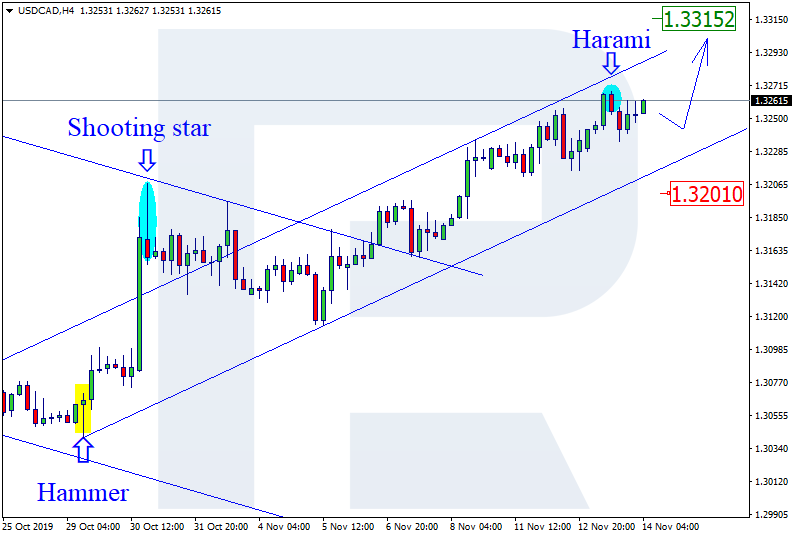
As we can see in the H4 chart, after breaking the descending channel’s upside border, USDCAD continues moving upwards. Right now, the pair is starting to form a new rising channel with Harami pattern close to its upside border. Within the given scenario, the price has formed a slight correction after reversing and in the future may continue growing towards 1.3315. However, we shouldn’t ignore an alternative scenario, according to which the instrument may continue falling towards 1.3201.

USDCAD
Risk Warning: the result of previous trading operations do not guarantee the same results in the future

AUDUSD, “Australian Dollar vs US Dollar”

As we can see in the H4 chart, after breaking the rising channel’s downside border, AUDUSD has formed Hammer reversal pattern close to the support level. At the moment, the pair is reversing. Judging by the previous movements, we may assume that the price may return to the channel and grow towards 0.6923. However, we shouldn’t ignore an alternative scenario, which implies that the instrument may resume falling to reach 0.6763.

AUDUSD
Risk Warning: the result of previous trading operations do not guarantee the same results in the future

Article By RoboForex.com

Attention!
Forecasts presented in this section only reflect the author’s private opinion and should not be considered as guidance for trading. RoboForex LP bears no responsibility for trading results based on trading recommendations described in these analytical reviews.

Ichimoku Cloud Analysis 14.11.2019 (AUDUSD, NZDUSD, USDCAD)

Article By RoboForex.com

AUDUSD, “Australian Dollar vs US Dollar”

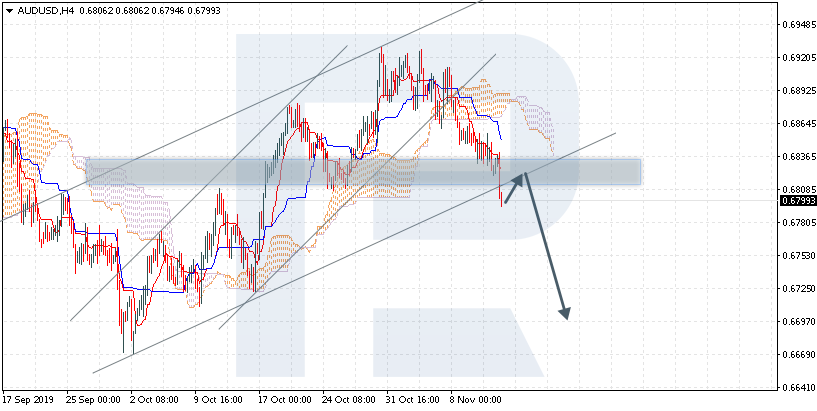
AUDUSD is trading at 0.6799; the instrument is moving below Ichimoku Cloud, thus indicating a descending tendency. The markets could indicate that the price may test Tenkan-Sen and Kijun-Sen at 0.6810 and then resume moving downwards to reach 0.6695. Another signal to confirm further descending movement is the price’s rebounding from the rising channel’s downside border. However, the scenario that implies further decline may be canceled if the price breaks the cloud’s upside border and fixes above 0.6905. In this case, the pair may continue growing towards 0.6995.

AUDUSD
Risk Warning: the result of previous trading operations do not guarantee the same results in the future

NZDUSD, “New Zealand Dollar vs US Dollar”

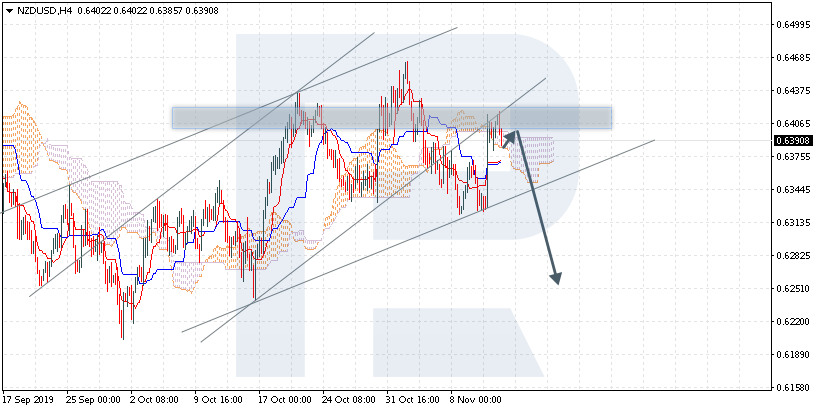
NZDUSD is trading at 0.6390; the instrument is moving inside Ichimoku Cloud, thus indicating a sideways tendency. The markets could indicate that the price may test the cloud’s upside border at 0.6395 and then resume moving downwards to reach 0.6250. Another signal to confirm further descending movement is the price’s rebounding from the resistance level. However, the scenario that implies further decline may be canceled if the price breaks the cloud’s upside border and fixes above 0.6425. In this case, the pair may continue growing towards 0.6505. After breaking the rising channel’s downside border and fixing below 0.6305, the price may continue moving downwards.

NZDUSD
Risk Warning: the result of previous trading operations do not guarantee the same results in the future

USDCAD, “US Dollar vs Canadian Dollar”

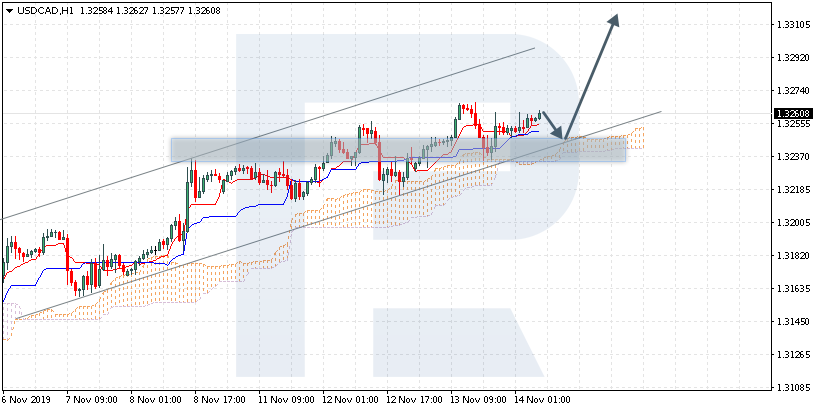
USDCAD is trading at 1.3260; the instrument is moving above Ichimoku Cloud, thus indicating an ascending tendency. The markets could indicate that the price may test the cloud’s upside border at 1.3245 and then resume moving upwards to reach 1.3315. Another signal to confirm further ascending movement is the price’s rebounding from the support level. However, the scenario that implies further growth may be canceled if the price breaks the cloud’s downside border and fixes below 1.320. In this case, the pair may continue falling towards 1.3135.

USDCAD

Article By RoboForex.com

Attention!
Forecasts presented in this section only reflect the author’s private opinion and should not be considered as guidance for trading. RoboForex LP bears no responsibility for trading results based on trading recommendations described in these analytical reviews.

Agreement Between the US and China Is Open to Question Again

Article By RoboForex.com

The US dollar strengthened slightly against a basket of currency majors. The dollar index (#DX) closed yesterday’s trading session in the green zone (+0.08%). The speech by Fed Chairman Powell supported the US currency. According to the official’s speech to Congress, the economy is now on the right track and the Fed’s monetary policy corresponds to current indicators.

The US currency is under pressure due to uncertainty in China-US trade relations. The parties still can’t resolve some important issues. So, Beijing refuses to indicate the exact amount of agricultural goods in the agreement that it undertakes to buy. Earlier, US President Donald Trump announced that China intended to purchase agricultural products worth up to $50 billion a year to resolve the trade dispute. China is afraid that the agreement will be more beneficial for the US than for China, so the country does not want to be at a disadvantage. It is also unknown to what extent Washington will cancel previously imposed duties on Chinese goods.

Today, during the Asian trading session, weak economic data have been published in Japan and China. Thus, Japan’s GDP (YoY) (Q3) grew only by 0.2% instead of the expected growth by 0.8%. Japan’s GDP (q/q) (Q3) increased by 0.1% instead of 0.2%. Industrial production (YoY) grew by 4.7% in October instead of 5.4%.

The “black gold” prices have been growing. Currently, futures for the WTI crude oil are testing the $57.60 mark per barrel. At 18:00 (GMT+2:00), a report on US crude oil inventories will be published.

Market Indicators

Yesterday, there was the bullish sentiment in the US stock markets: #SPY (+0.03%), #DIA (+0.27%), #QQQ (+0.02%).

The 10-year US government bonds yield has been declining. At the moment, the indicator is at the level of 1.84-1.85%.

The Economic News Feed for 14.11.2019:
  • – Retail sales in the UK at 11:30 (GMT+2:00);
  • – Initial jobless claims in the US at 15:30 (GMT+2:00);
  • – US producer price index at 15:30 (GMT+2:00).


We also recommend paying attention to the speeches by the head of the Fed and FOMC representatives.

Article By RoboForex.com

Attention!
Forecasts presented in this section only reflect the author’s private opinion and should not be considered as guidance for trading. RoboForex LP bears no responsibility for trading results based on trading recommendations described in these analytical reviews.

The Analytical Overview of the Main Currency Pairs on 2019.11.14

by JustForex

The EUR/USD currency pair

Technical indicators of the currency pair:
  • Prev Open: 1.10089
  • Open: 1.10063
  • % chg. over the last day: -0.02
  • Day’s range: 1.09956 – 1.10110
  • 52 wk range: 1.0884 – 1.1623

The EUR/USD currency pair continues to show negative dynamics. EUR/USD quotes again updated local lows. The trading instrument is currently consolidating. The local support and resistance levels are: 1.09900 and 1.10150, respectively. Investors continue to monitor the trade conflict between the US and China. According to media reports, trade negotiations between Washington and Beijing stalled over the purchase of agricultural products. Today we expect important economic reports from the USA. We recommend opening positions from key levels.

The Economic News Feed for 14.11.2019:

  • – Preliminary report on GDP (EU) – 12:00 (GMT+2:00);
  • – Initial Jobless Claims (EU) – 15:30 (GMT+2:00);
  • – Manufacturer’s Price Index (US) – 15:30 (GMT+2:00);

We also recommend paying attention to the speeches of the head of the Fed and representatives of the FOMC.

Germany published optimistic data on the country’s GDP for the third quarter.

EUR/USD

Indicators point to the power of sellers: the price has fixed below 50 MA and 100 MA.

The MACD histogram is in the negative zone and continues to decline, which indicates a bearish sentiment.

The Stochastic Oscillator has reached the oversold zone, the %K line is below the %D line, which gives a weak signal to sell EUR / USD.

Trading recommendations
  • Support levels: 1.09900, 1.09500
  • Resistance levels: 1.10250, 1.10400, 1.10600

If the price consolidates below 1.09900, expect the quotes to sell toward 1.09600-1.09400.

Alternatively, the quotes could grow toward 1.09600-1.09400.

The GBP/USD currency pair

Technical indicators of the currency pair:
  • Prev Open: 1.28488
  • Open: 1.28526
  • % chg. over the last day: +0.07
  • Day’s range: 1.28250 – 1.28572
  • 52 wk range: 1.1959 – 1.3385

The GBP/USD currency pair continues to consolidate. Unidirectional trends are not observed. Sterling tests local support and resistance levels: 1.28200 and 1.28550, respectively. Market participants expect up-to-date information regarding the Brexit process. Today, investors will evaluate important statistics from the UK and the USA. The trading instrument can recover. Open positions from key levels.

At 11:30 (GMT+2:00), expect a report on retail sales in the UK.

GBP/USD

Indicators do not give accurate signals: the price crossed 50 MA and 100 MA.

The MACD histogram has started to decline, which indicates a bearish mood.

The Stochastic Oscillator is in the oversold zone, the %K line crossed the %D line. There are no signals at the moment.

Trading recommendations
  • Support levels: 1.28200, 1.27900, 1.27700
  • Resistance levels: 1.28550, 1.28800, 1.29000

If the price consolidates above 1.28550, expect the quotes to rise toward 1.28800-1.29000.

Alternatively, expect the quotes to descend toward 1.27900-1.27700.

The USD/CAD currency pair

Technical indicators of the currency pair:
  • Prev Open: 1.32319
  • Open: 1.32518
  • % chg. over the last day: +0.15
  • Day’s range: 1.32485 – 1.32630
  • 52 wk range: 1.2727 – 1.3664

On the USD/CAD currency pair, a bullish sentiment still prevails. CAD is currently consolidating near monthly highs. The key support and resistance levels are 1.32350 and 1.32650, respectively. The trading instrument has the potential for further growth. We are expecting important economic releases from the USA. We also recommend paying attention to the dynamics of oil quotes. Open positions from key levels.

The Economic News Feed for 14.11.2019 is calm.

USD/CAD

The price fixed above 50 MA and 100 MA, which signals the strength of buyers.

The MACD histogram is in the positive zone and above the signal line, which gives a strong signal to buy USD/CAD.

The Stochastic Oscillator is in the neutral zone, the %K line is below the %D line, which indicates a bearish sentiment.

Trading recommendations
  • Support levels: 1.32350, 1.32150, 1.31900
  • Resistance levels: 1.32650, 1.33000

If the price consolidates above 1.32650, expect further growth toward 1.33000.

Alternatively, the quotes can descend toward 1.32150-1.32000.

The USD/JPY currency pair

Technical indicators of the currency pair:
  • Prev Open: 109.002
  • Open: 108.833
  • % chg. over the last day: -0.20
  • Day’s range: 108.627 – 108.863
  • 52 wk range: 104.97 – 114.56

The USD/ PY currency pair went down. The trading tool has updated local lows. Demand for safe haven currencies resumed amid uncertainty in trade negotiations between Washington and Beijing, as well as a new wave of protests in Hong Kong. At the moment, USD/JPY quotes are consolidating in the range of 108.650-108.900. The yen has the potential for further growth relative to the USD. Today we recommend paying attention to the news background from the USA. Positions must be opened from key levels.

During the Asian trading session, Japan published a weak GDP report.

USD/JPY

The price fixed below 50 MA and 100 MA, which signals the strength of sellers.

The MACD histogram is in the negative zone and continues to decline, which indicates a bearish sentiment.

The Stochastic Oscillator is in the neutral zone, the %K line is above the %D line, which gives a signal to buy USD/JPY.

Trading recommendations
  • Support levels: 108.650, 108.500, 108.300
  • Resistance levels: 108.900, 109.150, 109.300

If the price consolidates below 108.650, expect the quotes to descend toward 108.200.

Alternatively, the quotes could grow toward 109.150-109.300.

by JustForex

EURUSD: The euro continues to slide

By Alpari.com

On Wednesday the 13th of November, the EURUSD pair finished down – all attempts made by bulls to develop a corrective movement failed. At the end of trading, the euro had fallen to 1.0995, amid a general strengthening of the US dollar.

The US dollar was stable on Wednesday after the Consumer Price Index results for October were unexpectedly higher than forecasted, with Fed Chairman Jerome Powell going on to speak positively about the state of the US economy.

Day’s news (GMT +3):

10:00 Germany: Gross Domestic Product (QoQ) (Q3).

10:30 Switzerland: Producer and Import Prices (MoM) (Oct).

10:45 France: Consumer Price Index (EU norm) (MoM) (Oct).

12:30 UK: Retail Sales (MoM) (Oct).

13:00 Eurozone: Gross Domestic Product s.a. (QoQ) (Q3).

16:30 Canada: New Housing Price Index (MoM) (Sep).

16:30 USA: Initial Jobless Claims (Nov 8).

18:30 USA: EIA Natural Gas Storage Change (Nov 8).

141119 H1

Current situation:

Yesterday’s expectations came true. The EURUSD pair fell to 1.0995. At the time of writing, the euro is valued at 1.1005. Technically, the pair has long been ready for an upwards correction, with bulls kept in check by the background goings-on across the Eurozone and the United States.

Two supports can be identified below 1.10 – 1.0986 and 1.0964. We predict further decline to 1.0964, from where a price rebound is certainly possible. The forecast for further decline will expire when the daily candlestick closes above 1.1020.

By Alpari.com

How to Use Price Cycles and Profit as a Swing Trader – SPX, Bonds, Gold, Nat Gas

By TheTechnicalTraders.com

News does drive certain market events and we understand how certain traders rely on news or interest rates to bias their positions and trades.  As technical analysis purists, so to say, we believe the price operates within pure constructs of price rotation theory, trend theory, technical indicator theory, and price cycles.  We’ve found that technical analysis distills many news items into pure technical trading signals that we can use to profit from market swings.

Price is the ultimate indicator in our view.  Price determines current trends, support/resistance levels/channels, past price peaks and troughs and much more.  When we apply our proprietary price modeling and price cycle tools, we can gain a very clear picture of what price may attempt to do in the near future and even as far as a few months into the future.  Price, as the ultimate indicator, truly is the mathematical core element of all future price activity, trends, and reversions. Before you continue reading make sure to opt-in to our free market trend signals newsletter.

We have been using cycles since 2011 and have developed multiple proprietary price modeling tools over the past 5+ years that assist us in finding and timing great trades.  Most of what we have learned over the past 8+ years is refined into “experience and skill”.  When you follow the markets every day – every hour, for the past 8+ years and see various types of price and technical indicator setups and reactions, you learn to hone into certain setups that have proven to be highly accurate trading triggers.

Our research team had dedicated thousands of hours to develop the tremendous skills and experience to be able to produce accurate cycles, and to also interpret them, which is what we specialize in doing. Determining which cycles to trade may look simple, yet they are far from easy to trade without the setups and price rotation signals.

We use a blend of the top 4 active price cycles in the market which updates daily. This data allows us to know where future price is likely to move over the next few days and weeks.  Within this article, we’ll show you some of our proprietary price cycles and modeling tools to show you how we run some of our specialized trading tools.

SP500 Daily Chart – Predicted Price Movement

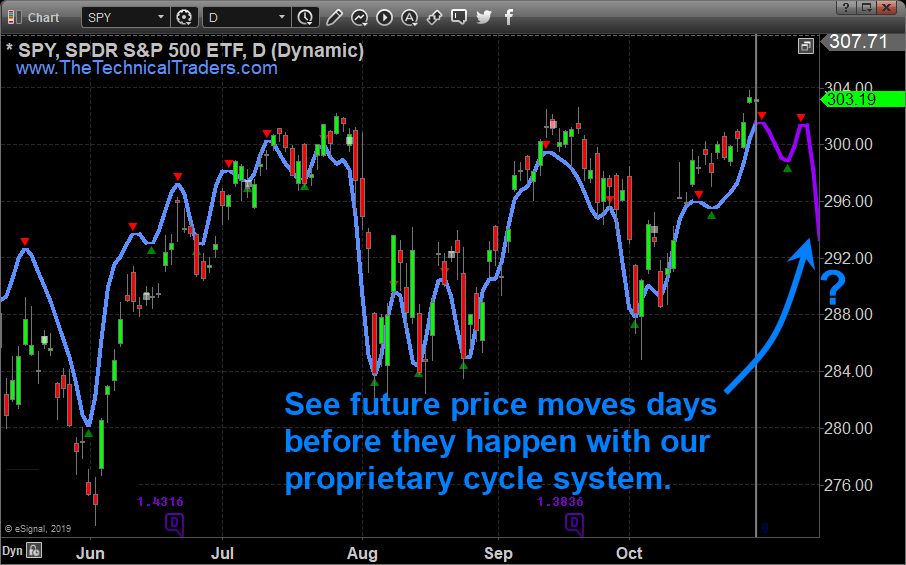
This SPY chart highlights the short-term price cycle modeling system where you can see how price reacted in alignment with our proprietary cycle tool.  If you look into the future, you can see that our proprietary price cycle tool is predicting the SPY may cycle into a potential double-top type of formation before cycling lower approximately 8+ days into the future.  One thing to remember is these cycle levels do not predict price target levels.  Don’t look at this chart and the cycle tool lines as price objectives – they are just trending bias levels scaled from 0 to 100 – just like a SINE WAVE.  Ideally, in order to identify price targets, we must fall back to technical price theory and Fibonacci price theory in order to identify target price objectives for the top formation and the potential downside price trend in the future.

Bonds Daily Chart – Predicted Price Movement

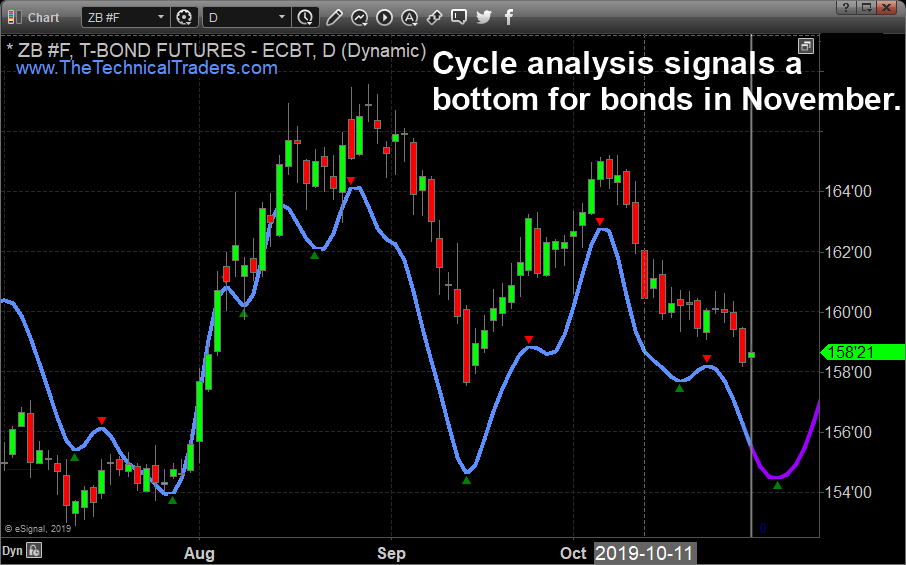
This BOND Daily chart highlights a different type of price cycle – a momentum base/bottom type of setup.  You can see from our proprietary cycle tool lines on the chart how price movement has aligned almost perfectly with the cycle forecast.  Also, please notice how the price has moved beyond cycle highs and lows at times.  This relates to the fact that we discussed above – that cycles do not predict price objectives.  On this chart, a longer-term momentum base/bottom setup appears to be forming over the next 8+ days where the Bonds may begin a new upside price trend after the base/bottom forms.  This would indicate that we should be looking for opportunities and price triggers that set up after the bottom has setup – not before.  If we time our entry properly, we may negate any real risk for a trade with Bonds.

Gold Miners Daily Chart – Predicted Price Movement

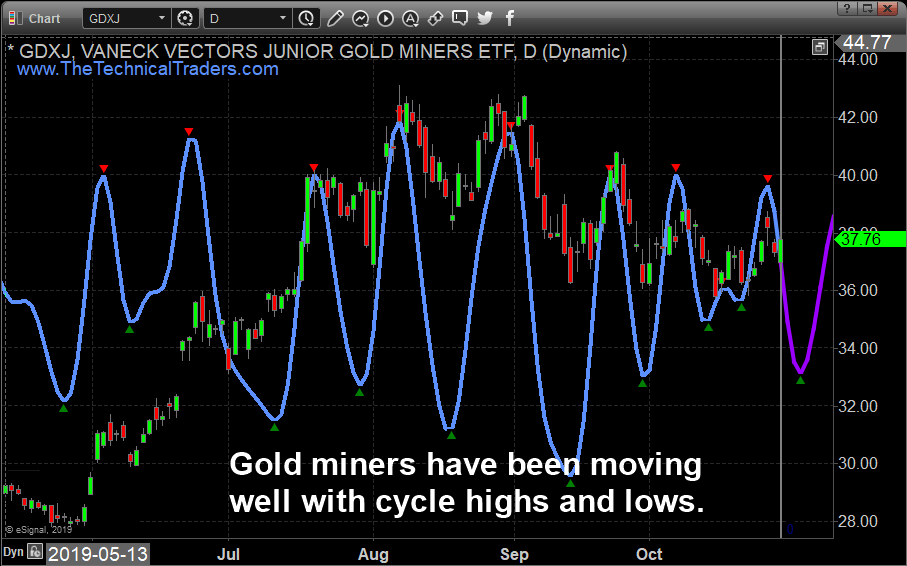
This Daily GDXJ chart almost perfectly highlights how the cycles do not align with real price objectives.  Throughout most of this chart, you can see the cycle levels rotate higher and lower near the extremes while price rotated in a much more narrow range.  Still, pay attention to how our proprietary cycle tool nailed nearly every rotation in price.  The range of the cycle lines is indicative of the scale and scope of the total cycle event.  Bigger cycle ranges suggest deeper, more volatile price trending events.

Notice how the current cycle ranges are much more narrow than the previous cycle ranges?  This suggests the current price cycle event may be more muted and smaller in volatility than previous price cycle ranges.

Our proprietary price cycle tool is suggesting that GDXJ will rotate lower to setup a moderate-term price bottom before attempting to move higher over the next 8 to 10+ days.  The upside price cycle may be rather muted as well – possibly only targeting recent price peaks near $40~42.

Natural Gas Daily Chart – Predicted Price Movement

As you can see our past cycle analysis has been extremely accurate. In, fact natural gas can provide some of the largest and quickest gains out of all asset classes we cover. In August we traded natural gas for a quick 24% profit, and in October we have already locked in 15% again.  Our remaining position in Natural Gas is up even more after this incredible upside move predicted by our cycle tool.

This chart presents a very good example of how our proprietary cycle tool can align with price perfectly at times.  In this example, the expected cycle ranges, which highlight the intensity and potential volatility of the price trends, aligned almost perfectly with the real price action.  Currently, the cycle tool is predicting a moderate price rotation in Natural Gas before a further upside price move hits.

I can tell you that huge moves are about to start unfolding not only in metals, or stocks but globally and some of these super-cycles are going to last years. A gentleman by the name of Brad Matheny goes into great detail with his simple to understand charts and guide about this. His financial market research is one of a kind and a real eye-opener. PDF guide: 2020 Cycles – The Greatest Opportunity Of Your Lifetime

Concluding Thoughts:

Opportunities are all around us.  Using the right tools to identify the true technical cycles, price cycles, and trading setup can help to eliminate risks and hone into more profitable trades.  It is almost impossible to time market tops and bottoms accurately, yet, as you can see from our work above, we have tools that can help us see into the future and help to predict when major price peaks and valleys may form.  Using a tool like this to help you determine when the real opportunity exists and when to time your trades will only improve your market insights and trading results….

As a technical analysis and trader since 1997, I have been through a few bull/bear market cycles. I believe I have a good pulse on the market and timing key turning points for both short-term swing trading and long-term investment capital. The opportunities are massive/life-changing if handled properly.

Chris Vermeulen – TheTechnicalTraders.com

The EIA Is Grossly Overestimating U.S. Shale

By OilPrice.com

The prevailing wisdom that sees explosive and long-term potential for U.S. shale may rest on some faulty and overly-optimistic assumptions, according to a new report.

Forecasts from the U.S. Energy Information Administration (EIA), along with those from its Paris-based counterpart, the International Energy

Agency (IEA), are often cited as the gold standard for energy outlooks. Businesses and governments often refer to these forecasts for long-term investments and policy planning.

In that context, it is important to know if the figures are accurate, to the extent that anyone can accurately forecast precise figures decades into the future.

A new report from the Post Carbon Institute asserts that the EIA’s reference case for production forecasts through 2050 “are extremely optimistic for the most part, and therefore highly unlikely to be realized.”

The U.S. has more than doubled oil production over the past decade, and at roughly 12.5 million barrels per day (mb/d), the U.S is the largest producer in the world. That is largely the result of a massive scaling-up of output in places like the Bakken, the Permian and the Eagle Ford. Conventional wisdom suggests the output will steadily rise for years to come.

It is worth reiterating that after an initial burst of production, shale wells decline rapidly, often 75 to 90 percent within just a few years. Growing output requires constant drilling. Also, the quality of shale reserves vary widely, with the “sweet spots” typically comprising only 20 percent or less of an overall shale play, J. David Hughes writes in the Post Carbon Institute report.

After oil prices collapsed in 2014, shale companies rushed to take advantage of the sweet spots. That allowed the industry to focus on the most profitable wells first, cut costs and scale up production. But it also pushed off a problem for another day. “Sweet spots will inevitably become saturated with wells, and drilling outside of sweet spots will require higher rates of drilling and capital investment to maintain production, along with higher commodity prices to justify them,” Hughes says in his PCI report.

In addition, this form of “high-grading” does allow for rapid extraction, but it doesn’t necessarily mean that more oil is ultimately going to be recovered when all is said and done.

The same might be true for all of the highly-touted productivity gains, Hughes says. The industry has boosted productivity by drilling longer laterals, intensifying the use of water and frac sand, as well as increasing the number of fracking stages. These productivity improvements are “undeniable,” Hughes writes.

However, the “limits of technology and exploiting sweet spots are becoming evident, however, as in some plays new wells are exhibiting lower productivities,” Hughes says. “More aggressive technology, coupled with longer horizontal laterals, allows each well to drain more reservoir area, but reduces the number of drilling locations and therefore does not necessarily increase the total recovery from a play—it just allows the resource to be recovered more quickly.”

Already, some shale plays have seen production plateau while others are in decline.

In short, Hughes says that of the 13 major shale plays analyzed in the PCI report, the EIA has “extremely optimistic” outlooks for nine of them. Of the remaining four, three of them are “highly optimistic,” and only one – the Woodford Play in Oklahoma – is ranked as “moderately optimistic.”

He notes that in some instances, the EIA’s forecasts are so optimistic that the production volumes exceed the agency’s own estimates for proven reserves plus unproven reserves. The EIA also assumes that every last drop of proven reserves is produced, along with a high percentage of unproven reserves by 2050.

“Although the ‘shale revolution’ has provided a reprieve from what just 15 years ago was thought to be a terminal decline in oil and gas production in the U.S.,” Hughes writes, “this reprieve is temporary, and the U.S. would be well advised to plan for much-reduced shale oil and gas production in the long term.”

Regardless of the geology, climate policy and waning investor interest will likely result in a lot of oil being left in the ground. Hughes says that the EIA’s figures are optimistic, even without considering any mandates to cut greenhouse gas emissions. “If U.S. energy policy actually reflected the need to mitigate climate change…the EIA’s forecasts for tight oil and shale gas production through 2050 make even less sense.”

Link to article: https://oilprice.com/Energy/Crude-Oil/The-EIA-Is-Grossly-Overestimating-US-Shale.html

By Nick Cunningham of Oilprice.com


Forex Technical Analysis & Forecast 13.11.2019 (EURUSD, GBPUSD, USDCHF, USDJPY, AUDUSD, USDRUB, USDCAD, GOLD, BRENT, BTCUSD)

Article By RoboForex.com

EURUSD, “Euro vs US Dollar”

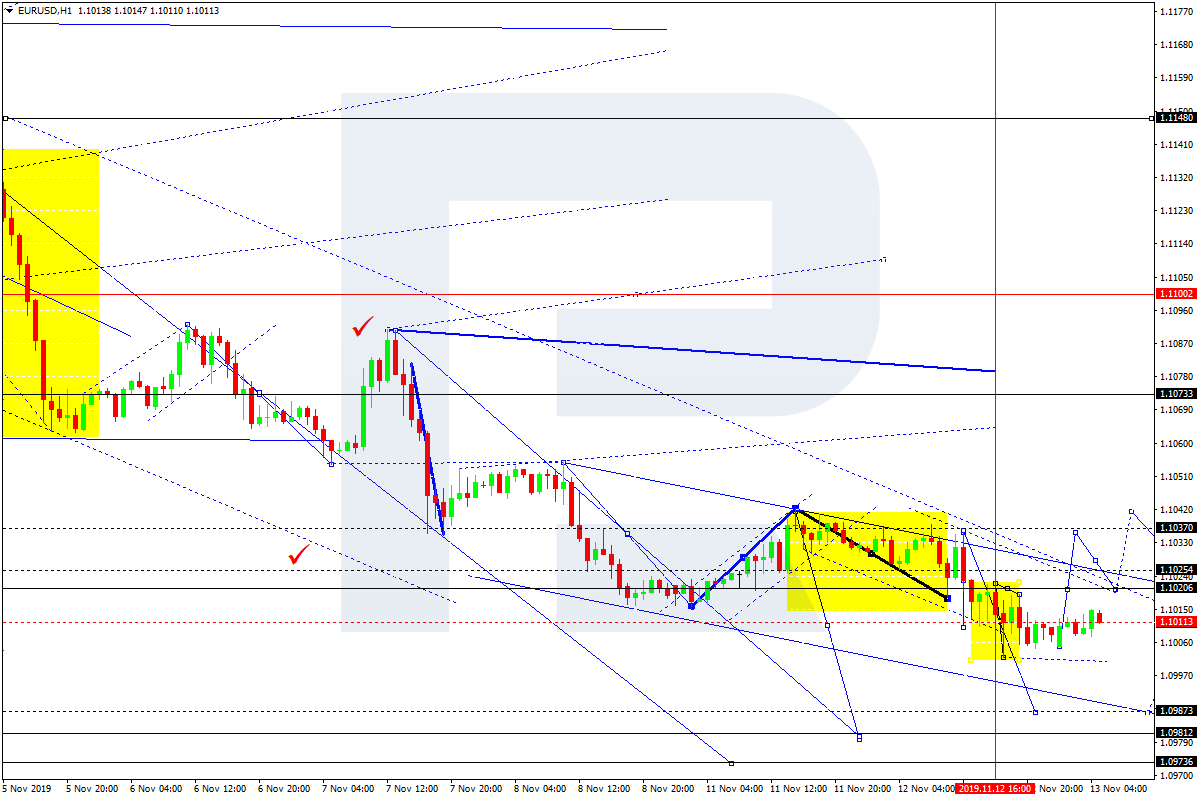
After failing to break the descending channel, EURUSD has updated the low and may later continue the current wave to the downside; right now, it is consolidating around 1.1011. If later the price breaks this range to the upside at 1.1020, the market may resume moving upwards to reach 1.1044; if to the downside at 1.1000 – start a new decline with the target at 1.0988.

EURUSD
Risk Warning: the result of previous trading operations do not guarantee the same results in the future

GBPUSD, “Great Britain Pound vs US Dollar”

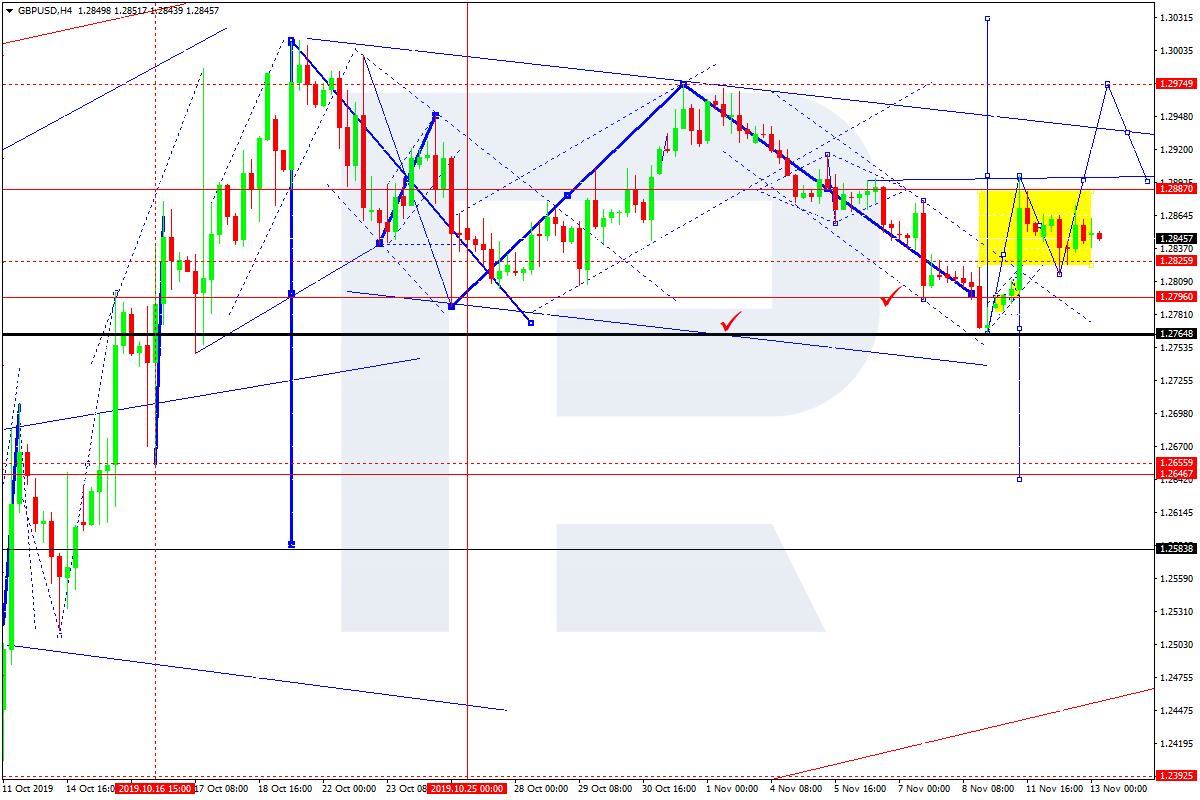
GBPUSD has completed the descending structure at 1.2815, thus forming a new consolidation range. If later the price breaks this range to the downside, the market may continue moving downwards to reach 1.2766; if to the upside – start another growth with the target at 1.2970.

GBPUSD
Risk Warning: the result of previous trading operations do not guarantee the same results in the future

USDCHF, “US Dollar vs Swiss Franc”

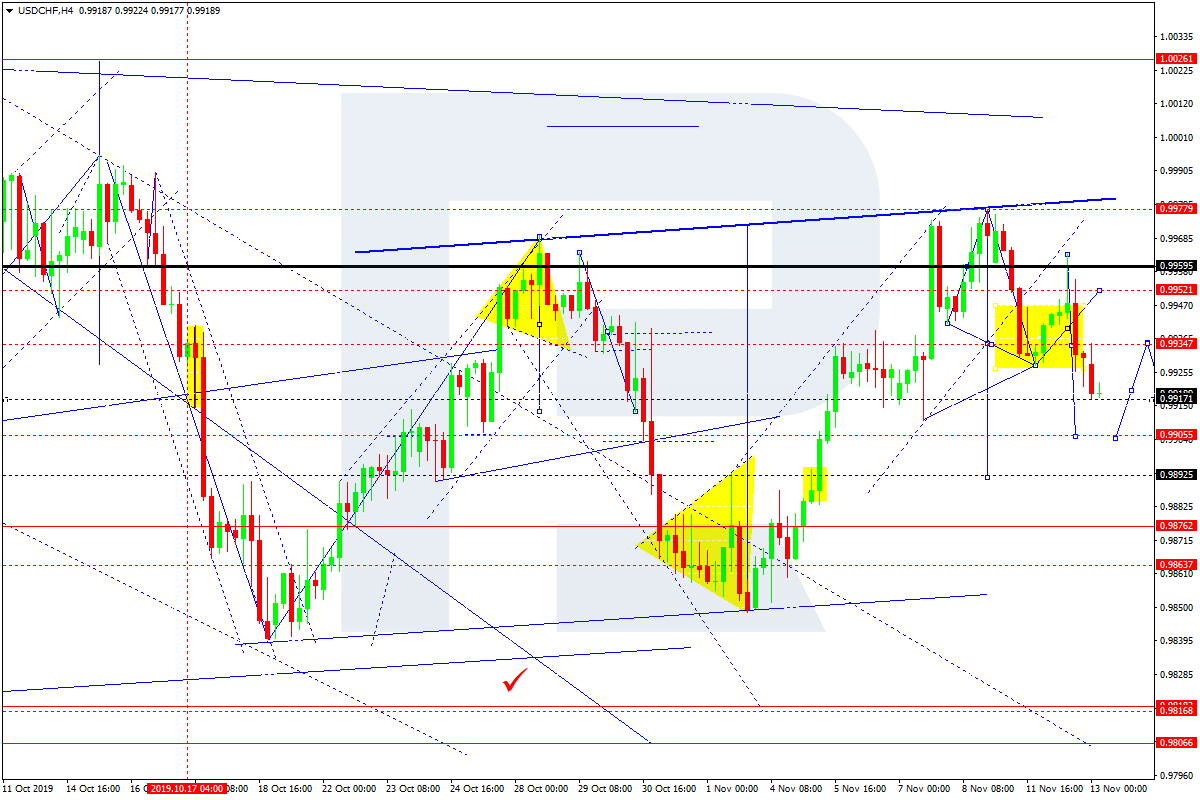
USDCHF has broken 0.9950; right now, it continues forming the second descending impulse with the target at 0.9905. Later, the market may start a new correction to reach 0.9950 and then resume trading downwards with the first target at 0.9892.

USDCHF
Risk Warning: the result of previous trading operations do not guarantee the same results in the future

USDJPY, “US Dollar vs Japanese Yen”

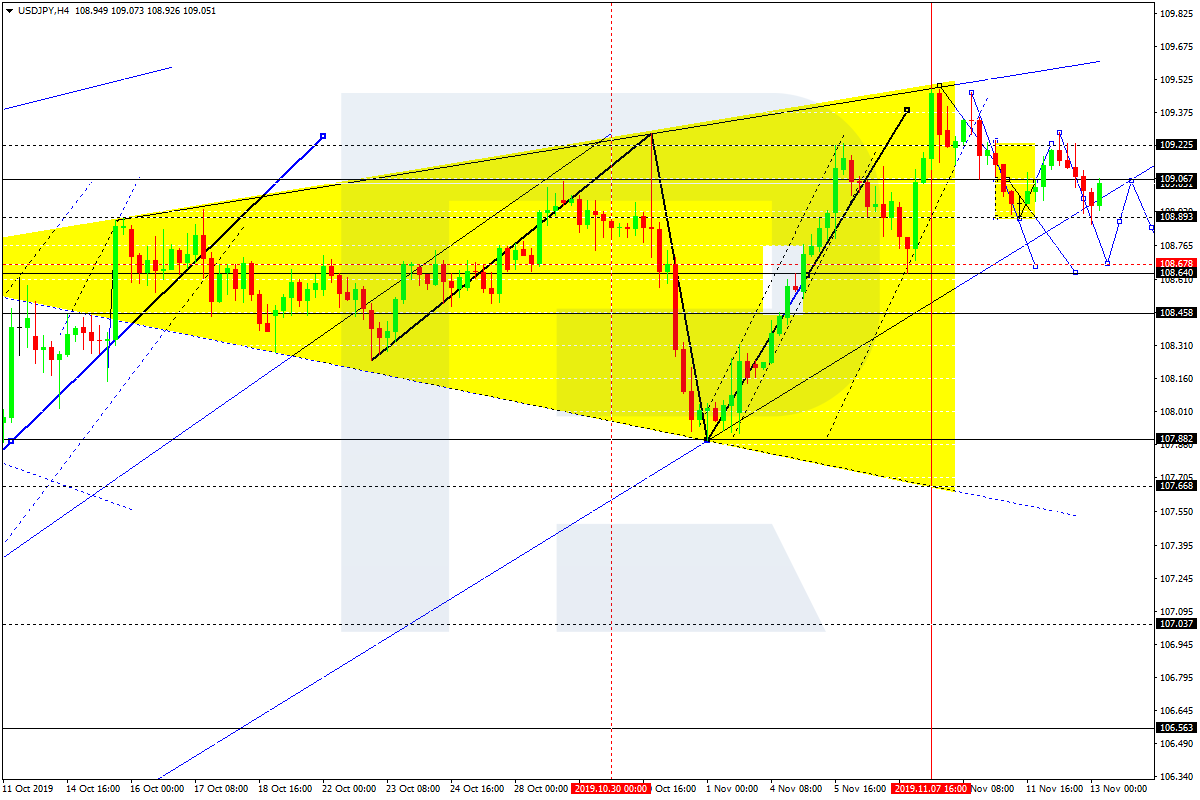
USDJPY continues consolidating around 109.06. Possibly, today the pair may fall to reach 108.67. Alter, the market may form one more ascending structure to return to 109.06 and then trade downwards with the target at 108.64.

USDJPY
Risk Warning: the result of previous trading operations do not guarantee the same results in the future

AUDUSD, “Australian Dollar vs US Dollar”

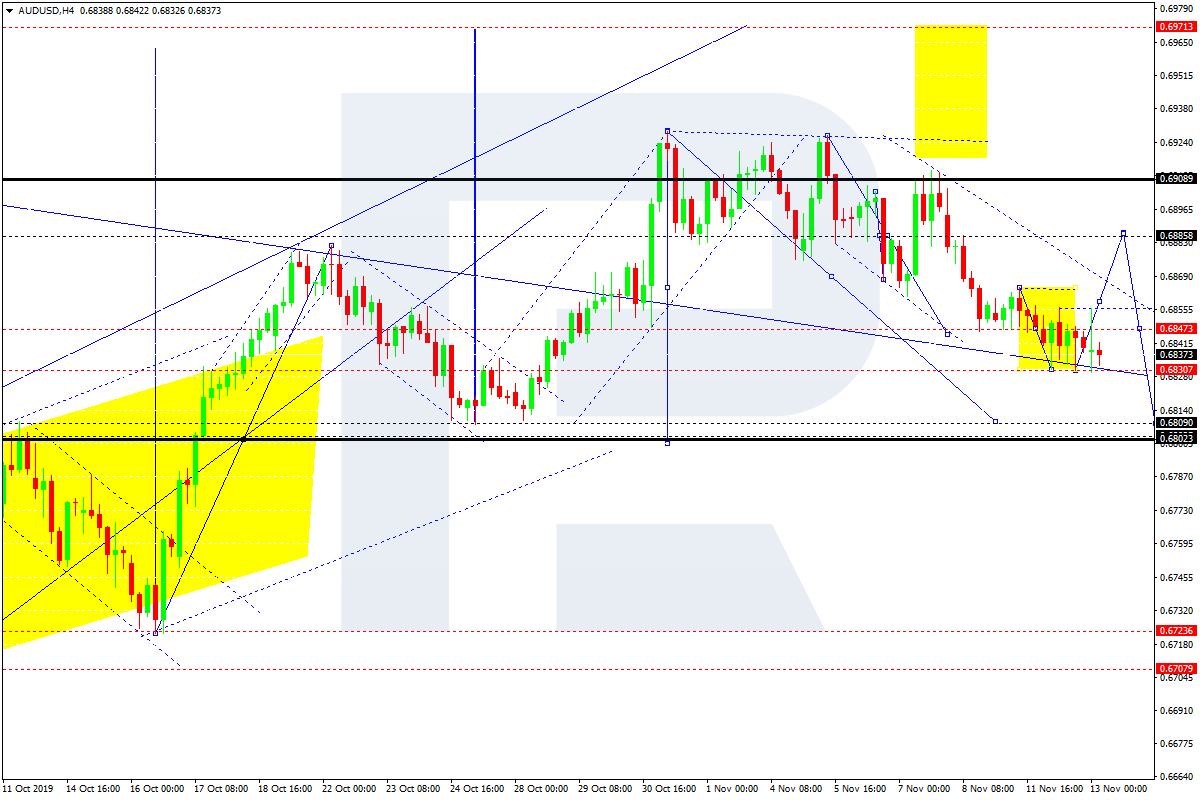
AUDUSD is still consolidating near the lows. Today, the pair may form one more ascending structure towards 0.6886 and then resume trading downwards to reach 0.6800.

AUDUSD
Risk Warning: the result of previous trading operations do not guarantee the same results in the future

USDRUB, “US Dollar vs Russian Ruble”

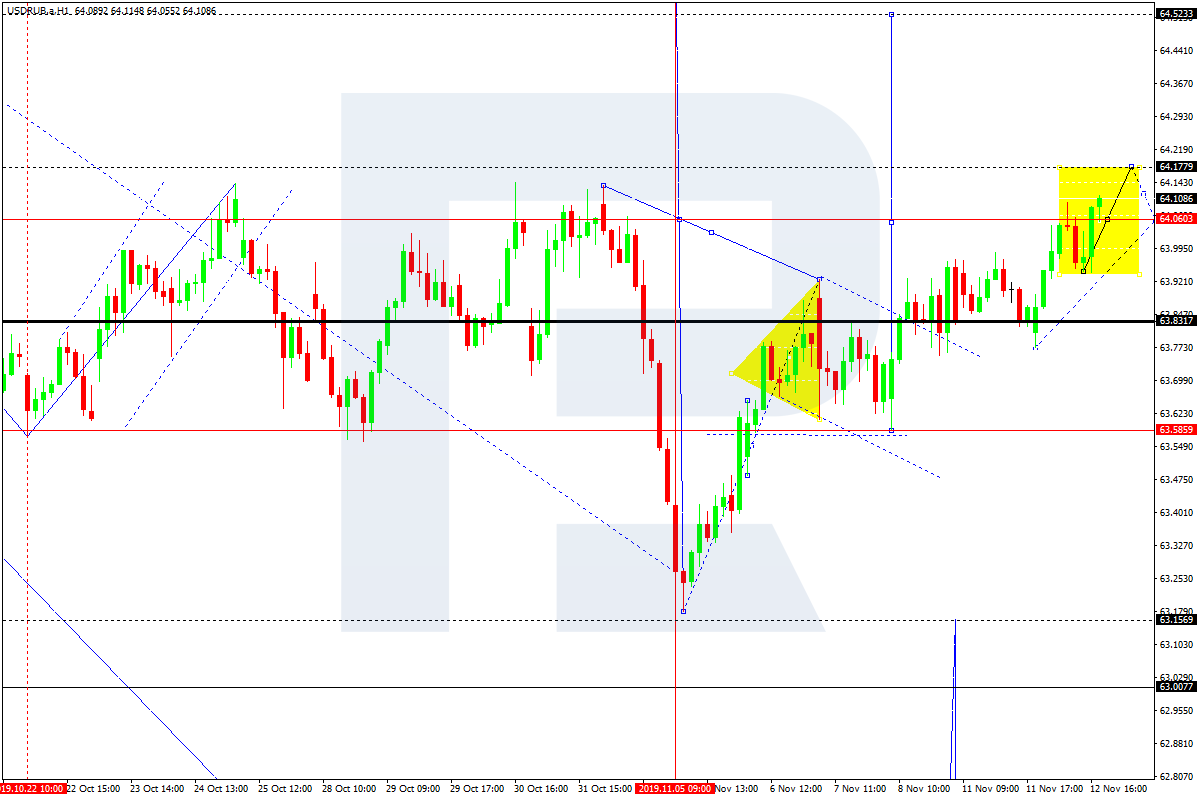
USDRUB is moving upwards; it has almost broken 64.04 to the upside. Possibly, today the pair may grow to reach 64.18 and then form a new descending structure towards 64.06. Later, the market may resume trading upwards with the target at 64.34.

USDRUB
Risk Warning: the result of previous trading operations do not guarantee the same results in the future

USDCAD, “US Dollar vs Canadian Dollar”

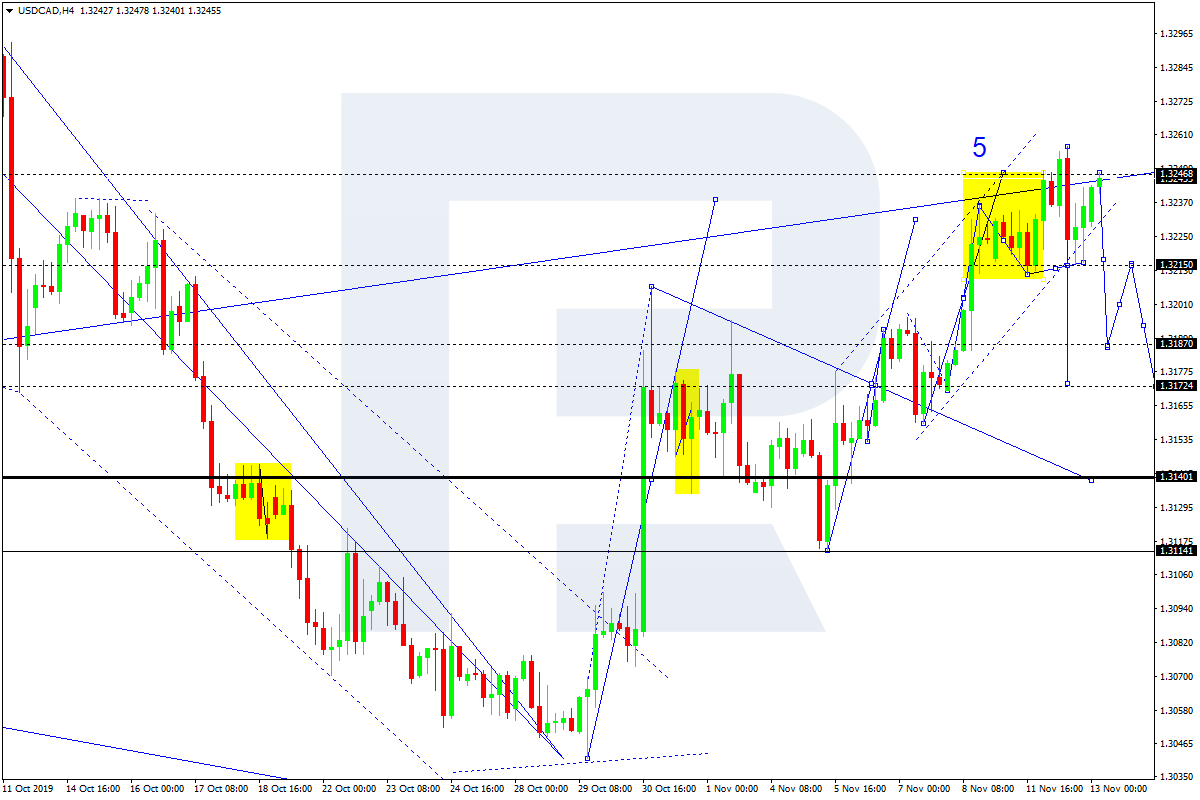
USDCAD has completed the descending impulse towards 1.3215 along with the correction at 1.3247. According to the main scenario, the price is expected to break this range downwards and start a new decline with the target at 1.3172.

USDCAD
Risk Warning: the result of previous trading operations do not guarantee the same results in the future

XAUUSD, “Gold vs US Dollar”

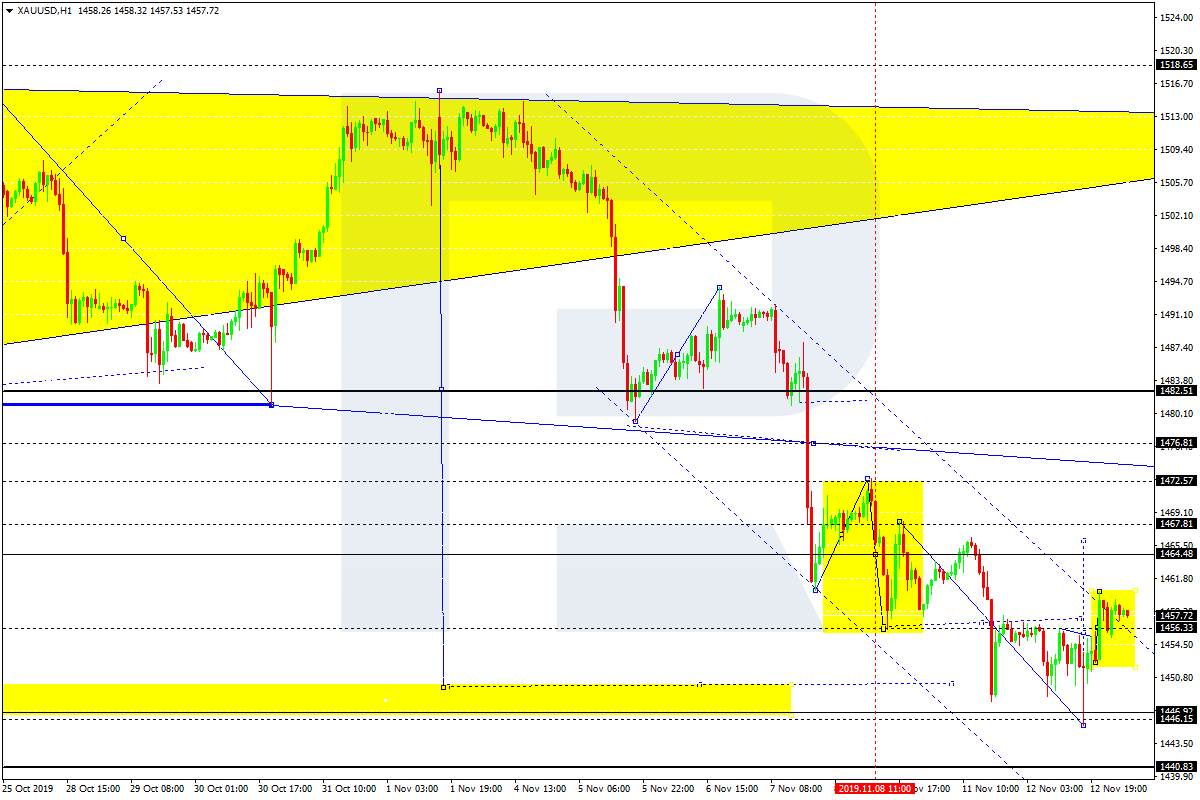
Gold has expanded the range towards 1445.55; right now, it is moving upwards to reach 1464.50. Later, the market may form a new descending structure with the target at 1440.84 and then resume growing towards 1482.50.

GOLD
Risk Warning: the result of previous trading operations do not guarantee the same results in the future

BRENT

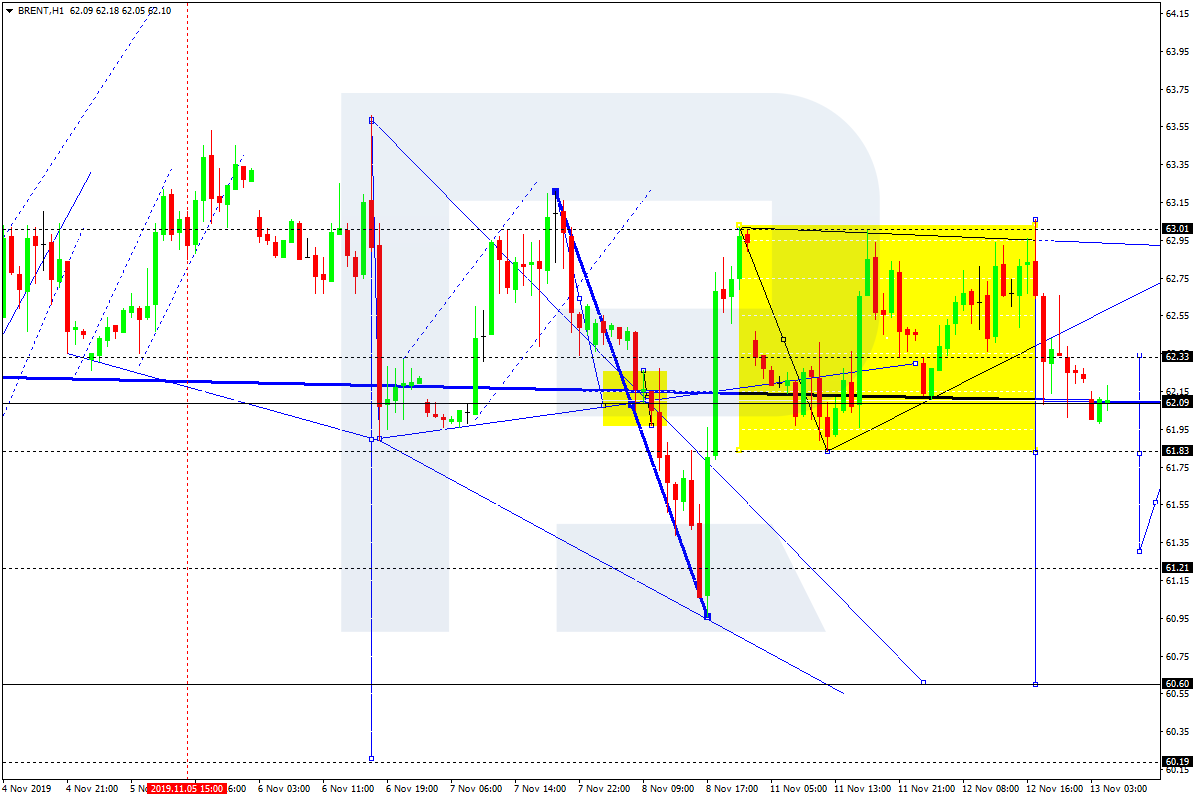
Brent has reached the upside border of the range once again; right now, it is moving downwards. Possibly, the pair may break 62.10 and then continue falling with the target at 60.60. After that, the instrument may form one more ascending structure towards 64.40.

BRENT
Risk Warning: the result of previous trading operations do not guarantee the same results in the future

BTCUSD, “Bitcoin vs US Dollar”

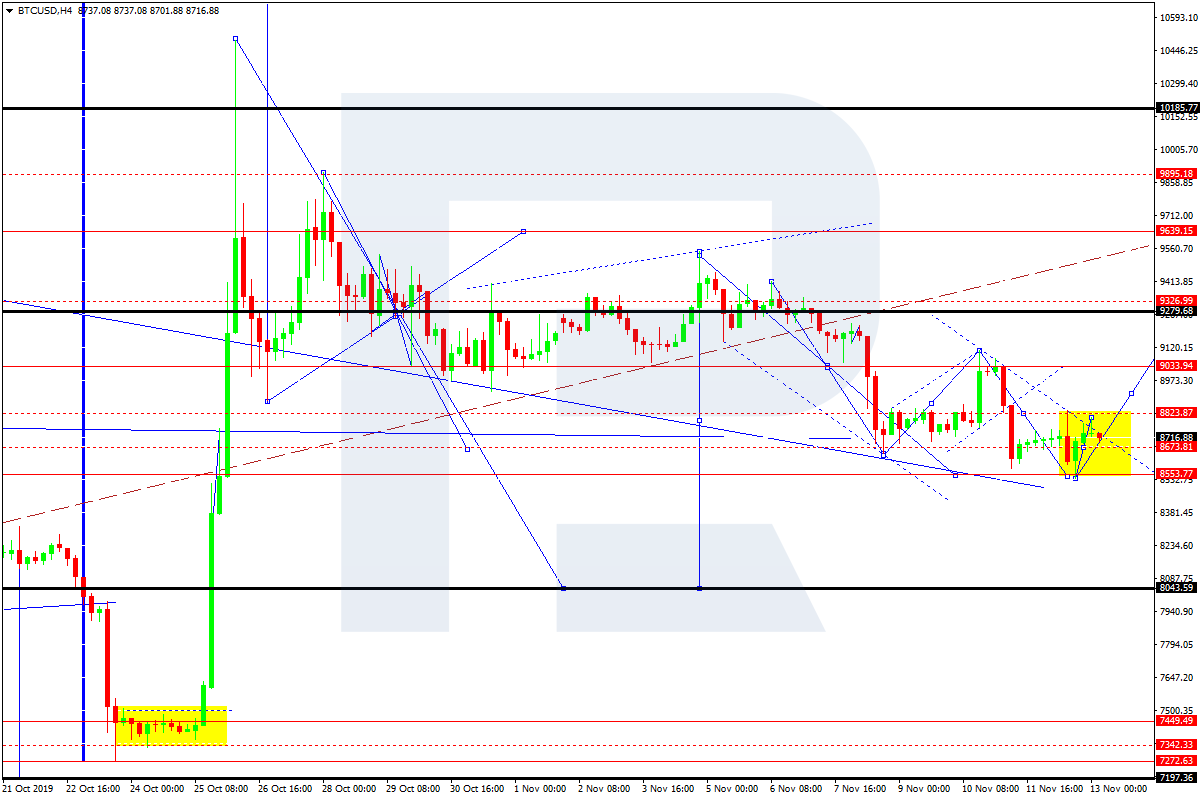
After reaching 8535.00, BTCUSD has completed the ascending structure at 8806.00, thus forming a new consolidation range. If later the price breaks this range to the upside, the market may continue the correction to reach 9300.00; if to the downside – resume trading inside the downtrend with the target at 8050.00.

BITCOIN
Risk Warning: the result of previous trading operations do not guarantee the same results in the future

Article By RoboForex.com

Attention!
Forecasts presented in this section only reflect the author’s private opinion and should not be considered as guidance for trading. RoboForex LP bears no responsibility for trading results based on trading recommendations described in these analytical reviews.