Author Archive for InvestMacro – Page 133

Gold bulls still waiting for their chance, push it back above 1,500 USD

By Admiral Markets

Source: Economic Events November 27, 2019 – Admiral Markets’ Forex Calendar

Over the last few days, the technical picture in Gold hasn’t significantly changed: after the push below 1,500 USD, mainly driven by the sharp rise in 10-year US-Treasury yields at the start of November, the rest of the week with Thanksgiving and Black Friday should present themselves with overall low volatility.

Still, today we could probably some stronger moves, especially with the GDP Growth Rate at 1330 GMT and its second estimate.

The first estimate beat market expectations of 1.6 percent, following a 2 percent expansion, so a positive surprise should be priced in, while a disappointing reading could result in a positive push for the precious metal.

In general, and from a fundamental perspective, the outlook for Gold remains positive in our opinion.

With the Fed’s balance sheet expanding at a faster rate than during QE1, QE2 or QE3, 10-year US-Treasury yields losing their bullish momentum of the first two weeks of November and rumours making rounds that the mood in Beijing about a trade deal is rather pessimistic (=tensions between the US and China rising again), while into the yearly close a known bullish seasonal window opens, Gold bulls are most likely already champing at the bit, at least behind closed doors.

While technically, our picture switches to Long again with Gold breaking back above 1,520 USD which would level the path up to the current yearly highs around 1,557 USD, a first bullish sign in the lower time-frames (H1) is already sent with Gold recapturing 1,490/495 USD:

Source: Admiral Markets MT5 with MT5-SE Add-on Gold Daily chart (between August 28, 2018, to November 26, 2019). Accessed: November 26, 2019, at 10:00pm GMT – Please note: Past performance is not a reliable indicator of future results, or future performance.

In 2014, the value of Gold fell by 1.7%, in 2015, it fell by 10.4%, in 2016, it increased by 8.1%, in 2017, it increased by 13.1%, in 2018, it fell by 1.6%, meaning that after five years, it was up by 6.4%.

Discover the world’s #1 multi-asset platform

Admiral Markets offers professional traders the ability to trade with a custom, upgraded version of MetaTrader 5, allowing you to experience trading at a significantly higher, more rewarding level. Experience benefits such as the addition of the Market Heat Map, so you can compare various currency pairs to see which ones might be lucrative investments, access real-time trading data, and so much more. Click the banner below to start your FREE download of MT5 Supreme Edition!

Download MetaTrader 5 and begin trading today!

Disclaimer: The given data provides additional information regarding all analysis, estimates, prognosis, forecasts or other similar assessments or information (hereinafter “Analysis”) published on the website of Admiral Markets. Before making any investment decisions please pay close attention to the following:

  1. This is a marketing communication. The analysis is published for informative purposes only and are in no way to be construed as investment advice or recommendation. It has not been prepared in accordance with legal requirements designed to promote the independence of investment research, and that it is not subject to any prohibition on dealing ahead of the dissemination of investment research.
  2. Any investment decision is made by each client alone whereas Admiral Markets shall not be responsible for any loss or damage arising from any such decision, whether or not based on the Analysis.
  3. Each of the Analysis is prepared by an independent analyst (Jens Klatt, Professional Trader and Analyst, hereinafter “Author”) based on the Author’s personal estimations.
  4. To ensure that the interests of the clients would be protected and objectivity of the Analysis would not be damaged Admiral Markets has established relevant internal procedures for prevention and management of conflicts of interest.
  5. Whilst every reasonable effort is taken to ensure that all sources of the Analysis are reliable and that all information is presented, as much as possible, in an understandable, timely, precise and complete manner, Admiral Markets does not guarantee the accuracy or completeness of any information contained within the Analysis. The presented figures refer that refer to any past performance is not a reliable indicator of future results.
  6. The contents of the Analysis should not be construed as an express or implied promise, guarantee or implication by Admiral Markets that the client shall profit from the strategies therein or that losses in connection therewith may or shall be limited.
  7. Any kind of previous or modeled performance of financial instruments indicated within the Publication should not be construed as an express or implied promise, guarantee or implication by Admiral Markets for any future performance. The value of the financial instrument may both increase and decrease and the preservation of the asset value is not guaranteed.
  8. The projections included in the Analysis may be subject to additional fees, taxes or other charges, depending on the subject of the Publication. The price list applicable to the services provided by Admiral Markets is publicly available from the website of Admiral Markets.
  9. Leveraged products (including contracts for difference) are speculative in nature and may result in losses or profit. Before you start trading, you should make sure that you understand all the risks.

By Admiral Markets

EURUSD: bears set up to test 1.10

By Alpari.com

On Tuesday the 26th of November, the euro was slightly up at the close of trading. The value of the euro spent the whole day in a sideways trend. On the one hand, the euro supported the EURGBP cross, but on the other hand, the strengthening US dollar put it under pressure.

The cross currency gained value, amid a weakening pound. According to the results of the latest political poll in the UK, the advantage held by the Conservative Party ahead of the General Election has decreased.

Representatives of the United States and China said that the trade agreement negotiations are approaching a conclusion. Major US stock indices continued to rise and reached new highs.

Day’s news (GMT +3):

  • 16:30 USA: Gross Domestic Product Annualized (Q3), Durable Goods Orders (Oct), Continuing Jobless Claims (Nov 15).
  • 18:00 USA: Pending Home Sales (MoM) (Oct), Personal Spending (Oct).
  • 18:30 USA: EIA Crude Oil Stocks Change (Nov 22)
  • 22:00 USA: Fed’s Beige Book.

271119

Current situation:

During the day, the EURUSD pair was caught in a sideways trend. The price did not reach the calculated level of 1.0990. At the time of writing, the euro is worth 1.1008. We still expect a weakening of the single currency against the US dollar, and as a result, we will not be making any changes to our forecast.

This week is “shortened” due to Thanksgiving taking place in the US on Thursday, therefore, with a decrease in liquidity, sharp fluctuations are possible, as is a fall in value below 1.0990. At 16:30, the report on US GDP for the third quarter will be published. This is the second assessment, so we shouldn’t be expecting any strong reactions to it. An exception would be serious deviations from the previous value.

By Alpari.com

Range-Bound Into The End Of 2019?

By TheTechnicalTraders.com

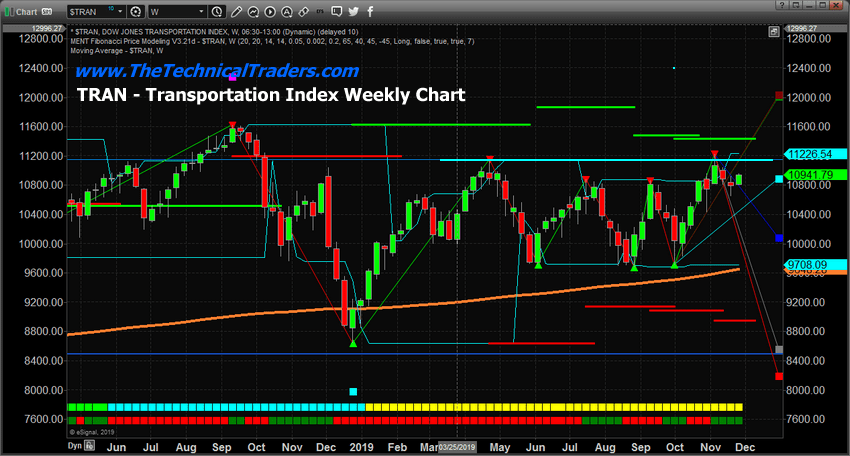
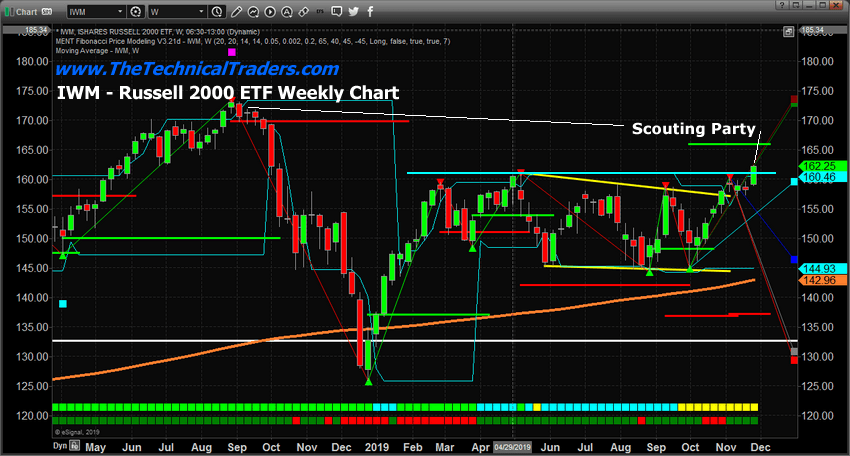
Two of our favorite charts for following the US markets are suggesting the markets are range bound headed into the end of 2019.  The news may continue to push the price higher as the overall bias has continued to be to the upside.  Yet, our Fibonacci predictive modeling system is suggesting the current price trend has begun a “scouting party” type of move which may end in a moderate price correction fairly quickly.

IWM Russell 2K Stock Index Chart

Our Adaptive Fibonacci price modeling system is capable of learning from past price activity and attempts to present key price data and trigger levels that are important for future trending.  The GREEN and RED horizontal lines on the right edge of this chart shows where the TRIGGER LEVELS are for the Fibonacci system.  The bullish trigger level (GREEN) is 2.5% above the current price levels.  The bearish trigger level (RED) is nearly 16% below the current price level.  This suggests that price would have to target either of these levels to establish a new price trend, or continue rotating within these levels to setup new minor peaks and valleys in the price – thus creating revised TRIGGER LEVELS. Get my updates by joining my free trend signals email list.

What we find interesting is the current “scouting party” type of rally that is taking place on the right edge of this chart.  This upside price move is above historical resistance (the CYAN LINE) and appears to be an attempt to test the support levels above the $160.50 level.

If the price is successful in establishing support above this level, a new bullish trend may begin.  If not, the price will rotate lower and potentially begin a new bearish price trend.  Remember, the downside Bearish Trigger level is 16% below the current price – so that the downside move could be quite dramatic.

Transportation Index Weekly Chart

This TRAN Weekly chart highlights a similar range-bound price setup where the bullish and bearish Fibonacci TRIGGER LEVELS are well above/below the current price.  The upside Bullish Trigger Level is 4.15% above the current TRAN price level – thus price would have to rally at least 4.5% higher to qualify as a breach of this Bullish Trigger Level and qualify as a potential new bullish trend.  The Bearish Trigger Level is near 18.4% below the current price level – thus the price would have to fall 18.5% from current levels to breach this Bearish Trigger Level and to qualify as a new Bearish Trend.

Where does this leave us headed into the end of 2019?  Our researchers believe the Santa Rally that most traders expect maybe more like a lump of coal in 2019.  We don’t expect any big breakout rally to happen over the next 35+ days and we don’t expect a massive 40% price correction either.  Our Fibonacci price modeling system is suggesting that any rotation within this 20% price range would be considered “absolutely normal” given the ranges that have been set up over the past 2+ years.

Last week we share these charts on the VIX that paint a clear picture of what is likely to unfold in the next week. This current week is one of the strongest months of the year so

Therefore, the downside price move of 6 to 12% would be completely normal.  And the upside move of 2~3% from current levels would be completely normal.  Any price rotation within the GREEN/RED Fibonacci triggers levels would be considered “normal price rotation” given the established price ranges, peaks and valleys.

We’ve been saying for months, 2019 and 2020 are certainly going to be interesting years for traders.  We believe any price rotation or breakout could lead to a wide range of price rotation that may shock skilled technical traders.  At this point, a 22%+ “normal” price range has setup in the markets.  Prices could rotate within this range and “not really go anywhere” in technical terms.

I want to wish everyone a Happy Thanksgiving and if you find this type of analysis interesting be sure to visit my website and sign up to get both my swing trade and investing ETF trade signals at 41% discount, plus a free bar of silver or gold with my Black Friday Offer Today! Visit: www.TheTechnicalTraders.com

Chris Vermeulen

TheTechnicalTraders.com

Ichimoku Cloud Analysis 26.11.2019 (AUDUSD, NZDUSD, USDCAD)

Article By RoboForex.com

AUDUSD, “Australian Dollar vs US Dollar”

AUDUSD is trading at 0.6780; the instrument is moving below Ichimoku Cloud, thus indicating a descending tendency. The markets could indicate that the price may test the cloud’s downside border at 0.6790 and then resume moving downwards to reach 0.6670. Another signal to confirm further descending movement is the price’s rebounding from the resistance level. However, the scenario that implies further decline may be canceled if the price breaks the cloud’s upside border and fixes above 0.6845. In this case, the pair may continue growing towards 0.6935.

AUDUSD
Risk Warning: the result of previous trading operations do not guarantee the same results in the future

NZDUSD, “New Zealand Dollar vs US Dollar”

NZDUSD is trading at 0.6420; the instrument is moving above Ichimoku Cloud, thus indicating an ascending tendency. The markets could indicate that the price may test the cloud’s downside border at 0.6385 and then resume moving upwards to reach 0.6535. Another signal to confirm further ascending movement is the price’s rebounding from the rising channel’s downside border. However, the scenario that implies further growth may be canceled if the price breaks the cloud’s downside border and fixes below 0.6345. In this case, the pair may continue falling towards 0.6265.

NZDUSD
Risk Warning: the result of previous trading operations do not guarantee the same results in the future

USDCAD, “US Dollar vs Canadian Dollar”

USDCAD is trading at 1.3309; the instrument is moving above Ichimoku Cloud, thus indicating an ascending tendency. The markets could indicate that the price may test the cloud’s upside border at 1.3275 and then resume moving upwards to reach 1.3445. Another signal to confirm further ascending movement is the price’s rebounding from the rising channel’s downside border. However, the scenario that implies further growth may be canceled if the price breaks the cloud’s downside border and fixes below 1.3215. In this case, the pair may continue falling towards 1.3130.

USDCAD

Article By RoboForex.com

Attention!
Forecasts presented in this section only reflect the author’s private opinion and should not be considered as guidance for trading. RoboForex LP bears no responsibility for trading results based on trading recommendations described in these analytical reviews.

Preconditions for BRIC-style growth in PH

By Dan Steinbock

In the postwar and post-Cold War era, the Philippines could have been an economic success story. Yet, the opportunity was missed between the mid-’60s and mid-2010s. In the Duterte era, the country is back on track, but BRIC-style growth is needed to overcome the legacy of past policy mistakes.

In the postwar era, the Philippines was one of the expected economic success stories in Southeast Asia. The country was positioned for rapid growth.

Or so it was thought.

Dreams of economic success, realities of stagnation

In 1950, Philippine living standards, as reflected by per capita incomes, were only a third lower than in Malaysia, the leading Southeast Asian economy (present-day Singapore excluded). In Indonesia and Thailand, those standards were still 20% behind, while Vietnam and Laos trailed 30% to 40% behind Filipinos.

In the mid-1960s, following the terms of Roxas, Quirino, Magsaysay, Garcia and Macapagal, living standards in the Philippines were only 10% less than in Malaysia, while Thailand still trailed behind, whereas Vietnam had fallen further behind, due to the decolonization struggle against France and the United States.

Despite challenges, the Philippines was catching up with regional leaders until the ‘60s.

When the Marcos era ended in 1986, living standards in Malaysia and Thailand continued to rise. However, Filipino per capita incomes were now 50% lower than in Malaysia and 25% lower than in Thailand; even behind those in Indonesia. Vietnamese living standards had plunged 50% lower than those in the Philippines, but that was due to a devastating war with the U.S.

What followed was a quarter of a century of the People Power Revolution. The assumption was that democratic rule – under Corazon Aquino, Ramos, Estrada, and Arroyo– would spark a dramatic comeback. Yet in 2008, at the eve of the global financial crisis, living standards in Philippines had fallen even further behind Malaysia (-72%), Thailand (-66%) and Indonesia (-34%), even behind Vietnam.

Here’s the irony: When Philippines began its democratic experiment, Vietnam launched Chinese-style economic reforms. The outcome? Philippines stagnated even further, while Vietnam grew in leaps. In some two decades, Vietnam’s GDP almost tripled, whereas that of the Philippines increased only by 50%.

In the Benigno Aquino III era, Philippine living standards remained more than 70% behind those in Malaysia, 54% behind Thailand and 34% after Indonesia. Despite the rhetoric, the period failed to change the course (Figure 1).

Figure 1 ASEAN and Philippine Per Capita Incomes (excl. Singapore), 1950-2008*

Source: Maddison Database; Difference Group

Half a century of missed opportunities

What the Duterte government is now trying to cope with is not just half a century of missed opportunities, but the consequent legacies, particularly corruption.

Here’s one example: Not so long ago, inflation concerns were still fueled by the supply abuses and hoarding of rice and the consequent destabilized prices (rice smuggling soared already in the Benigno Aquino III era). Today, the government must try to contain corruption in the local rice industry, which is one of the goals of the Rice Tariffication Law, while protecting the welfare of local farmers who are struggling with volumes of imported grains.

After the 2016 election triumph, the Duterte government has fought hard to focus on its “Build, Build, Build” investment program, which is what the country has needed ever since World War II. Yet, the implementation has suffered from domestic politics, particularly the (very costly) budget debacle in the spring.

Nevertheless, the government has been able to re-energize Philippine modernization and catch-up growth, thanks to its domestic investment drive and the recalibration of Philippine foreign affairs, which has fueled Chinese investment in the country.

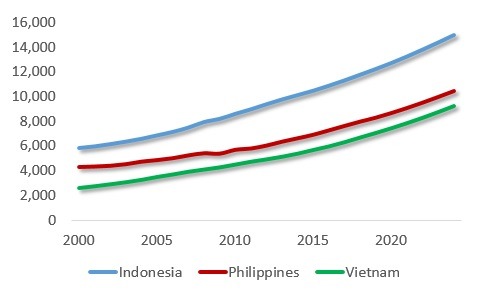
To gain a better understanding of the stakes, let’s compare Goldman Sachs’s original BRIC projections in the 2000s with the actual BRIC prospects today. Assuming peaceful conditions and managed trade tensions, it now seems that between 2000 and 2024, Vietnam would grow fastest (compound annual growth rate at 5.8%), followed by Indonesia (4.2%) and Philippines (4.0%).

If the Duterte government can complete its investment program by 2022 and if the subsequent government will continue to focus on economic development, the country could grow its GDP seven to eightfold by 2025; more than originally projected. Vietnamese living standards would almost quadruple, while those in Indonesia would nearly triple. In the Philippines, living standards would increase 2.5-times (Figure 2).

Figure 2 Indonesia, Philippines and Vietnam: GDP Per Capita 2000-2024

Source: IMF; Difference Group

Preconditions for BRIC-style expansion

Here are some necessary preconditions to achieve Philippine BRIC-like growth in the early 2020s. First, policy mistakes – such as the past budget debacle – are not acceptable anymore. In view of people’s livelihood, such mistakes represent a legally-sanctioned way to penalize living standards in the future.

Second, prosperity cannot be created without stability at home. And the current stability will erode, if the country will face new waves of terrorism, or if economic development fails to accelerate in Mindanao.

A refocused struggle against drugs and corruption should prevail. Even if prosperity can be created, corruption will reduce its benefits. Between 2003 and 2014, the Philippines lost $10 billion in illicit financial flows annually. Tax evasion costs the country $7.4 billion annually; 2.7% of its GDP. Efforts at progressive taxation are elusive as long as the country ranks at par with Haiti and Morocco in tax evasion.

Fourth, as the country moves toward an upper-middle income status, inclusive growth is vital. For decades, exporting people rather than goods and services has been used to offset inadequate job creation. Now BRIC-like growth must increasingly benefit many rather than few – and that means more affordable education, broader welfare and rapid progress in the eradication of poverty.

Prosperity cannot be created without peace and stability in the region. One of President Duterte’s greatest achievements has been his willingness to recalibrate Philippine foreign policy between the U.S. and China. No foreign power should have bases in the Philippines, or rotation arrangements that achieve similar objectives without actual presence. Otherwise Philippines risks being perceived as the proxy of foreign powers that have their own interests in the region.

Sixth, the Philippines needs to further strengthen its economic, political and defense ties with ASEAN nations. Regional mass fosters international bargaining power.

BRIC-style growth is not easy. But when it is successful, it can significantly reduce the weight of past policy mistakes – such as the decades of missed opportunities in the pre-Duterte era.

About the Author:

Dr. Dan Steinbock is an internationally recognized strategist of the multipolar world and the founder of Difference Group. He has served at the India, China and America Institute (US), the Shanghai Institutes for International Studies (China) and the EU Center (Singapore). For more, see https://www.differencegroup.net/   

The original commentary was published by The Manila Times on November 25, 2019


Japanese Candlesticks Analysis 26.11.2019 (GOLD, NZDUSD)

Article By RoboForex.com

XAUUSD, “Gold vs US Dollar”

As we can see in the H4 chart, the ascending tendency continues. By now, XAUUSD has completed several reversal patterns, including Hammer, close to the support level. At the moment, the pair is reversing and may later grow towards 1475.50. At the same time, we shouldn’t exclude an opposite scenario, which implies that the instrument may continue falling towards 1445.50.

XAUUSD
Risk Warning: the result of previous trading operations do not guarantee the same results in the future

NZDUSD, “New Zealand vs. US Dollar”

As we can see in the H4 chart, the ascending tendency continues. After forming several reversal patterns, including Doji, near the support level, NZDUSD has reversed; right now, it is moving in the middle of the channel. Later, the market may complete another slight correction, which may later be followed by further growth to reach 0.6455. At the same time, one shouldn’t exclude an opposite scenario, according to which the instrument may fall towards 0.6385 and test the channel’s downside border.

NZDUSD

Article By RoboForex.com

Attention!
Forecasts presented in this section only reflect the author’s private opinion and should not be considered as guidance for trading. RoboForex LP bears no responsibility for trading results based on trading recommendations described in these analytical reviews.

The Analytical Overview of the Main Currency Pairs on 2019.11.26

by JustForex

The EUR/USD currency pair

Technical indicators of the currency pair:
  • Prev Open: 1.10157
  • Open: 1.10129
  • % chg. over the last day: -0.11
  • Day’s range: 1.10127 – 1.10167
  • 52 wk range: 1.0884 – 1.1623

The EUR/USD currency pair is in a flat. The local support and resistance levels are 1.10050 and 1.10300, respectively. Investors expect additional drivers. The spotlight is on the US deal with China. It became known that Vice Premier of the State Council of the PRC Liu He, US Trade Representative Robert Lighthizer and US Treasury Secretary Steve Mnuchin reached an agreement on solving the problems during a telephone conversation. Open positions from these levels.

The Economic News Feed for 26.11.2019:

  • – CB Consumer Confidence Index (US) – 17:00 (GMT+2:00).
  • – Primary Real Estate Sales (US) – 00:00 (GMT+2:00);
EUR/USD

The price fixed below 50 MA and 100 MA, which signals the strength of sellers.

The MACD histogram is in the negative zone, but above the signal line, which gives a weak signal to sell EUR/USD.

The Stochastic Oscillator is in the neutral zone, the %K line crosses the %D line. There are no signals at the moment.

Trading recommendations
  • Support levels: 1.10050, 1.09900
  • Resistance levels: 1.10300, 1.10550, 1.10800

f the price consolidates above1.10300, expect the quotes to rise toward 1.10550-1.10700.

Alternatively, the quotes could descend toward 1.09800-1.09600.

The GBP/USD currency pair

Technical indicators of the currency pair:
  • Prev Open: 1.28515
  • Open: 1.28982
  • % chg. over the last day: +0.35
  • Day’s range: 1.28668 – 1.28824
  • 52 wk range: 1.1959 – 1.3385

Yesterday, the GBP/USD currency pair began to win some losses back. The British pound has moved to growth. However, today GBP/USD quotes are again falling. The technical pattern is ambiguous, investors expect additional drivers. At the moment, the trading instrument is testing the support level of 1.28700. The key resistance level is 1.29000. Open positions from them.

The Economic News Feed for 26.11.2019 is calm.

GBP/USD

Indicators do not give accurate signals: the price is trading between 50 MA and 100 MA.

The MACD histogram is close to 0.

The Stochastic Oscillator is near the oversold zone, the %K line crosses the %D line. There are no signals at this time.

Trading recommendations
  • Support levels: 1.28700, 1.28400, 1.28100
  • Resistance levels: 1.29000, 1.29250, 1.29550

If the price consolidates above 1.29000, expect the quotes to rise toward 1.29250-1.29550.

Alternatively, the quotes could descend toward 1.28400-1.28100.

The USD/CAD currency pair

Technical indicators of the currency pair:
  • Prev Open: 1.32828
  • Open: 1.32954
  • % chg. over the last day: -0.17
  • Day’s range: 1.32698 – 1.32882
  • 52 wk range: 1.2727 – 1.3664

The USD/CAD currency pair is still being traded in a flat. There is no defined trend. The local support and resistance levels are 1.33000 and 1.33200, respectively. USD demand is recovering due to news of the likely conclusion of the first stage of the US-China agreement. We expect the release of important statistics. Open positions from key levels.

The Economic News Feed for 26.11.2019 is calm.

USD/CAD

Indicators point to a bullish sentiment: the price is trading above 50 MA and 100 MA.

The MACD histogram is in the positive zone and continues to rise, which gives a strong signal to buy USD/CAD.

The Stochastic Oscillator is in the neutral zone, the %K line crossed the %D line. There are no signals at the moment.

Trading recommendations
  • Support levels: 1.33000, 1.32800, 1.32600
  • Resistance levels: 1.33200, 1.33350

If the price consolidates above 1.33200, expect the quotes to rise toward 1.33350-1.33500.

Alternatively, the quotes can descend toward 1.32800-1.32600.

The USD/JPY currency pair

Technical indicators of the currency pair:
  • Prev Open: 108.660
  • Open: 108.923
  • % chg. over the last day: +0.25
  • Day’s range: 108.879 – 108.965
  • 52 wk range: 104.97 – 114.56

During yesterday’s trading, bullish sentiment was observed on the USD/JPY currency pair. The trading tool has updated local highs. At the moment, USD/JPY quotes are consolidating in the range of 108.850-109.100. Demand for safe haven currencies has weakened against the backdrop of the prospects for resolving a trade conflict between Washington and Beijing. We recommend you to pay attention to the dynamics of yield on US government bonds. Open positions from key levels.

The Economic News Feed for 26.11.2019 is calm.

USD/JPY

Indicators point toward a bullish sentiment: the price is trading above 50 MA and 100 MA.

The MACD histogram is in the positive zone, but below the signal line, which gives a weak signal to buy USD/JPY.

The Stochastic Oscillator is in the oversold zone, the %K line crosses the %D line. There are no signals.

Trading recommendations
  • Support levels: 108.850, 108.650, 108.450
  • Resistance levels: 109.100, 109.300

If the price consolidates above 109.100, expect the quotes to rise toward 109.300-109.500.

Alternatively, the quotes could descend toward 108.650-108.450.

by JustForex

Trade Negotiations between the US and China Are in the Focus of Attention

by JustForex

During yesterday’s trading, the US dollar strengthened slightly against a basket of currency majors. The dollar index (#DX) closed in the green zone (+0.06%). Trade negotiations between the US and China are still in the focus of attention. It became known that Chinese Vice Premier Liu He, US Trade Representative Robert Lighthizer and US Secretary of the Treasury Steven Mnuchin reached an agreement on resolving core issues. These events caused a decrease in demand for safe haven currencies. We recommend following the current information.

Fed Chairman Jerome Powell said the regulator planned to keep interest rates unchanged. It should be recalled that this year the Central Bank reduced the range of key interest rates three times. At the moment, the indicator is at the level of 1.50%-1.75%. British Prime Minister Boris Johnson promised to submit a Brexit deal to Parliament before Christmas. Today, financial market participants will assess important economic releases from the US.

There is the bullish sentiment in the “black gold” market. Currently, futures for the WTI crude oil are testing the $58.05 mark per barrel.

Market Indicators

Yesterday, the major US stock indices closed in the positive zone: #SPY (+0.78%), #DIA (+0.70%), #QQQ (+1.18%).

The 10-year US government bonds yield has been declining. At the moment, the indicator is at the level of 1.74-1.75%.

The Economic News Feed for 26.11.2019:
  • – CB consumer confidence index in the US at 17:00 (GMT+2:00).
  • – New home sales in the US at 17:00 (GMT+2:00).

by JustForex

The Most Bitcoin-Friendly European Countries

By Michael Kuchar

Every country in the world has their own opinion when it comes to cryptocurrencies. Some countries have wholeheartedly accepted blockchain technology and cryptocurrencies, while others shun it. India for example, has banned the use of cryptocurrencies altogether! There are some countries which happily embrace Bitcoin, and recognize the many benefits it can bring, while others are not ready to adapt the cryptocurrency yet (or probably never!). Bitcoin is the most popular cryptocurrency out there, and there is no question that its popularity will continue to grow with time.

Funnily enough, 10,000 Bitcoins were worth the equivalent of two Papa John’s pizza on the 22nd of May, 2010, and Bitcoin is worth $7,118 as of the 25h of November, 2019! If we look at Europe as a continent, several European countries have adopted Bitcoin, and Europe has a positive approach overall, when it comes to Bitcoin and the possible Bitcoin revolution that might come with it. In fact, several Governments have legalized Bitcoin and other cryptocurrencies. Which are the most Bitcoin-friendly European countries though? Let’s find out!

  1. Malta

Known as the ‘Mecca of Gambling’, no wonder Malta has emerged as the most Bitcoin-friendly European country! It makes perfect sense, as Bitcoin, and other cryptocurrencies are making an impact in the gambling sector. Malta has emerged as one of the most progressive cryptocurrency countries in Europe, and hosts several blockchain-related events, and summits. Malta has formed the Malta Digital Innovation Authority (MDIA), to welcome blockchain and cryptocurrency businesses to the fore – to setup projects and establishments in Malta.

  1. Estonia

The home of the popular app Skype, Estonia is a Northern European country that embraced Bitcoin much earlier than several other countries in Europe. The Government of Estonia is a keen supporter of Bitcoin, and its applications, as well as blockchain technology as a whole. As blockchain technology is expanding to several sectors, including health and tourism, the Government of Estonia wants to use Bitcoin to their advantage – in health care and banking.

In fact, Estonia also plans on developing their own cryptocurrency in the future, as is the case with some other countries around the world. In a practical move to say the least, and profits obtained on Bitcoin in Estonia are taxable. This essentially means that these deductions are pumped back into the Government.

  1. Switzerland

Switzerland too, has fully embraced blockchain technology, cryptocurrencies, and foremost, Bitcoin. As Switzerland is not a part of the European Union, it gives them an edge over other countries. The Government is pro-Bitcoin, and this has led to some dubbing the country ‘CryptoValley’. Several top blockchain and Bitcoin companies find their home in the beautiful country of Switzerland. The country is also a haven for traders, if they are willing to pay capital gains tax that is (another smart strategic move!). Do not forget to gorge on Swiss chocolate when you are in Switzerland!

  1. Belarus

Belarus as a country are big believers in cryptocurrencies, blockchain technology, and most importantly, Bitcoin. They legalized Bitcoin and some other cryptocurrencies in 2017, when Bitcoin peaked in price and popularity. The step was taken by the President of Belarus, Alexander Lukashenko, and it has paid dividends. Proving to have been a right move, Belarus openly encourages cryptocurrency-based businesses to set up camp in Belarus, and start/expand their businesses.

What’s more, unlike some other countries mentioned on this list, mining, trading and capital gains are tax-free until 2023! Belarus presents the perfect opportunity to pitch up in the country, if you own a cryptocurrency-based business, or plan on starting one soon. This also sets it up nicely to be placed higher on the list, in years to come.

  1. Slovenia

Slovenia is a Central European country, which is home to several respected Bitcoin exchanges. Its exchanges have put it on the radar of many cryptocurrency enthusiasts and experts. In fact, a town in Slovenia called Krani, is home to the world’s first Bitcoin monument, such is the Bitcoin frenzy in Slovenia. This goes on to show how appreciated the coin is in the country, and its acceptance. The Government has been pushing on the message that they are Bitcoin-friendly, since 2017. Slovenia is open to welcoming cryptocurrency start-ups and cryptocurrency-based businesses. Slovenia aims at being a blockchain leader, and they are certainly on the right track.

Conclusion on the most bitcoin-friendly European countries

Bitcoin is more likely than not to be accepted in a whole host of other European countries in years to come. Once touted as a bubble which will not survive the trial time presents, blockchain technology has stood tall, with Bitcoin standing as its proudest exponent. As of now, the above mentioned countries are the most Bitcoin-friendly European countries, but I wouldn’t bet on this remaining the same in the future! With the rise in blockchain powered movements and projects, like a Veganism-based ecosystem, expect more countries to jump aboard the cryptocurrency wagon.

About the Author:

Michael is an experienced financial trader using Forex, Commodities and Cryptocurrencies. In addition to trading, he runs businesses, trains traders and develops trading technology products. His other passions are boxing and traveling.

EURUSD: heightened risk of falling below 1.10

By Alpari.com

On Monday the 25th of November, the euro finished five points down come the end of trading. The single currency was pushed down to the 1.10 mark by a buoyant GBP. At the end of the day, the GBPUSD pair finished up by 70 points. The driving force behind the pound’s strength has been the positive news coming out of Westminster as regards the upcoming UK General Election. The Conservatives are confidently ahead in the latest polls, and this helps to reduce feelings of uncertainty towards the future within the industry.

Monday was a slow day, as underlined by yesterday’s relatively scarce economic calendar. As a result, the consolidation range moved from 1.1023 to 1.1010. With that said, let’s move on to the technical analysis.

Day’s news (GMT+3):

  • 12:30 UK: BBA Loans for House Purchase (Oct).
  • 16:30 USA: Advance Goods Trade Balance (Oct).
  • 17:00 USA: S&P/Case-Shiller US Home Price Index (Sep).
  • 21:00 USA: Fed’s Brainard Discusses Policy Framework Review, U.S. to Sell 2-Year FRNs Reopening, U.S. to Sell 5-Year Notes.

Рис. 1Current situation:

Our expectations for the “Monday vs. Friday” movement failed to materialise. The latest political news out of the UK increased interest in the British pound. As a result of these events, the single currency found itself under pressure and trades passed under the 67th degree marker (Gann level).

Improved US-China relations brought an upturn in market sentiment in both the stock markets, and in pairs containing risky assets. The “bullish” mood did not alter the EURUSD pair’s technical picture, which remained “bearish“.

How should you act in this situation? Well, if you do not understand what is happening on the market, then reduce the risk factor of your transactions, or wait for another market situation to arise.

The price is below the balance line (LB), which goes through 1.1029. If a channel is constructed by correction, then its upper line meets the LB at 1.1030. Since the stochastic on 4H and 8H is looking up, we can allow a breakthrough to the LB. Disagreements between timeframes (TF) are set to be a key factor today. The older the TF, the stronger the effect.

But, also bear in mind that changes in the younger TFs also influence the situation with the older TFs. For example, if negative changes take place at the cellular level, then most likely your condition and mood will change for the worse, due to poor health. Since the stochastic on the hourly TF is on top, we might even dare to consider a fall to 1.0990 – the bottom line of the channel.

By Alpari.com