Author Archive for InvestMacro – Page 106

Gold stays strong , keeping an eye on 1,600 USD

By Admiral Markets

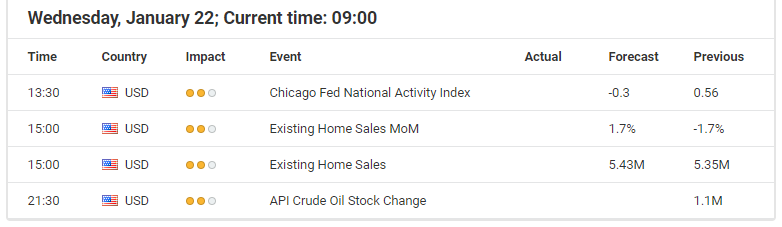
Source: Economic Events 22 January 2020 – Admiral Markets’ Forex Calendar

Over the past few days, Gold stabilised around the yearly highs of 1,550 USD. Chances therefore seem good that the precious metal will continue with its bullish trend in the days and weeks to come.

This is despite US inflation coming in at 2.3% year-on-year in December 2019 (its highest level since October 2018), and the latest Housing Starts numbers also coming in at their highest level since December 2006.
If today’s Existing Home Sales do not follow the positive tendency of the Housing Starts, Gold could see the beginning of another push up to 1,600 USD.

This bias is also supported by Gold being about to enter another bullish seasonal window on Friday. After Silver, which is highly positive correlated to Gold, entered a bullish seasonal window last week on Monday, Gold enters one between the January 24 and February 4.

The seasonal bullish pattern developed over the last 20 years with Gold seeing an average gain of 23.50 USD for 15 of the past 20 years. In the remaining five years, it dropped on average only 11.73 USD, while the maximum loss of the pattern was 23.90 USD and the maximum drawdown being 26.05 USD.

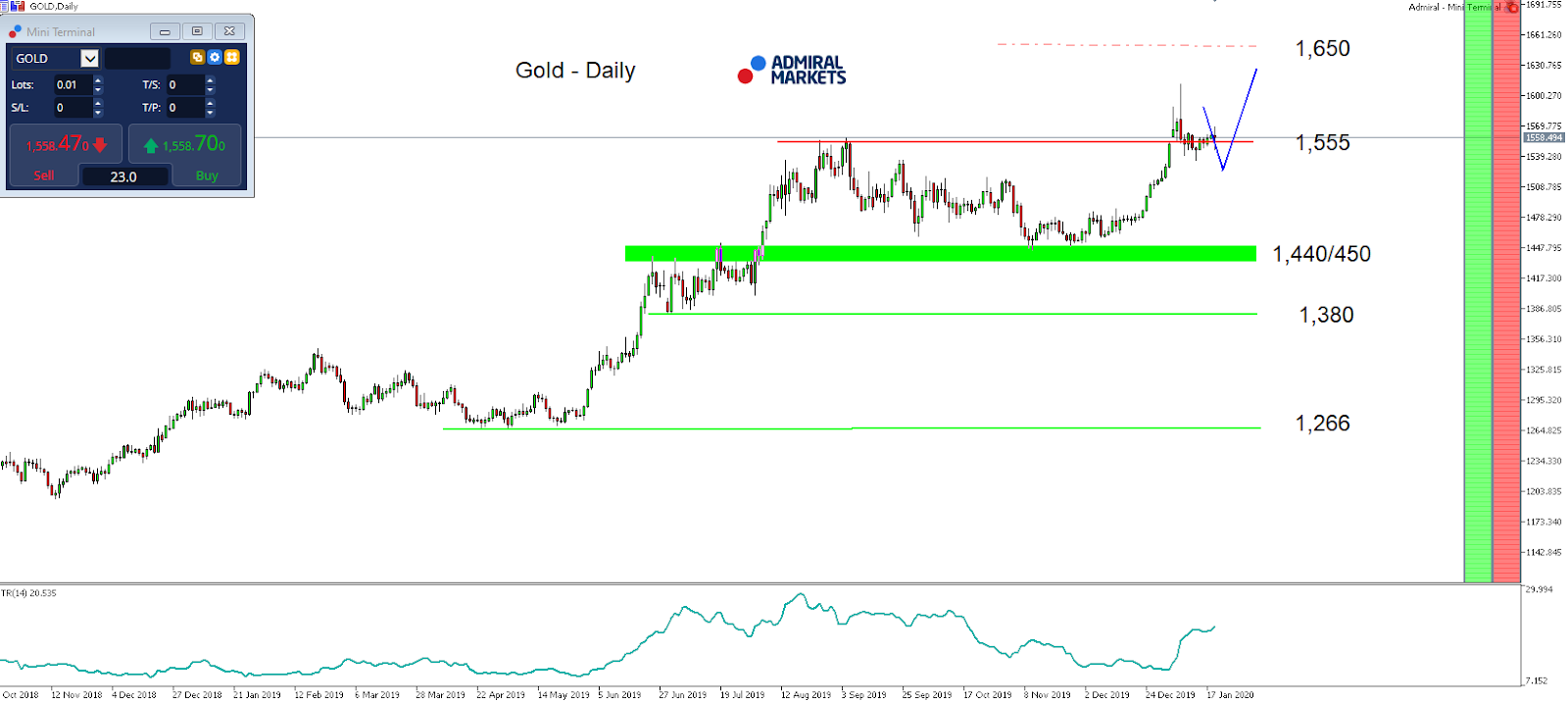
Technically, Gold stays bullish on a daily time frame as long as we trade above 1,440/450 USD, with the potential next target on the upside being found in the region around 1,650/700 USD.

Source: Admiral Markets MT5 with MT5SE Add-on Gold Daily chart (between 19 October 2018 to 21 January 2020). Accessed: 21 January 2020 at 10:00 PM GMT

Please note: Past performance is not a reliable indicator of future results, or future performance.

In 2015, the value of Gold fell by 10.4%, in 2016 it increased by 8.1%, in 2017 it increased by 13.1%, in 2018, it fell by 1.6%, in 2019, it increased by 18.9%, meaning that after five years, it was up by 28%.

the ultimate trading analytics portal

Disclaimer: The given data provides additional information regarding all analysis, estimates, prognosis, forecasts or other similar assessments or information (hereinafter “Analysis”) published on the website of Admiral Markets. Before making any investment decisions please pay close attention to the following:

  1. This is a marketing communication. The analysis is published for informative purposes only and are in no way to be construed as investment advice or recommendation. It has not been prepared in accordance with legal requirements designed to promote the independence of investment research, and that it is not subject to any prohibition on dealing ahead of the dissemination of investment research.
  2. Any investment decision is made by each client alone whereas Admiral Markets shall not be responsible for any loss or damage arising from any such decision, whether or not based on the Analysis.
  3. Each of the Analysis is prepared by an independent analyst (Jens Klatt, Professional Trader and Analyst, hereinafter “Author”) based on the Author’s personal estimations.
  4. To ensure that the interests of the clients would be protected and objectivity of the Analysis would not be damaged Admiral Markets has established relevant internal procedures for prevention and management of conflicts of interest.
  5. Whilst every reasonable effort is taken to ensure that all sources of the Analysis are reliable and that all information is presented, as much as possible, in an understandable, timely, precise and complete manner, Admiral Markets does not guarantee the accuracy or completeness of any information contained within the Analysis. The presented figures refer that refer to any past performance is not a reliable indicator of future results.
  6. The contents of the Analysis should not be construed as an express or implied promise, guarantee or implication by Admiral Markets that the client shall profit from the strategies therein or that losses in connection therewith may or shall be limited.
  7. Any kind of previous or modeled performance of financial instruments indicated within the Publication should not be construed as an express or implied promise, guarantee or implication by Admiral Markets for any future performance. The value of the financial instrument may both increase and decrease and the preservation of the asset value is not guaranteed.
  8. The projections included in the Analysis may be subject to additional fees, taxes or other charges, depending on the subject of the Publication. The price list applicable to the services provided by Admiral Markets is publicly available from the website of Admiral Markets.
  9. Leveraged products (including contracts for difference) are speculative in nature and may result in losses or profit. Before you start trading, you should make sure that you understand all the risks.

By Admiral Markets

EURUSD: euro hovering above bottom line of the channel

By Alpari.com

On Tuesday, January 21, the euro was down at close. By the end of trading, the euro lost all the profits it had gained from the release of favourable European data. A sharp reversal could be caused by increased demand for defensive assets and a general decline in global stock indexes.

Indexes fell on the back of the news concerning the discovery of a new deadly virus in China, from which nine people have already died. According to the latest data from 13 Chinese provinces, 440 cases of viral infection have been detected. Cases have also been identified in South Korea, Thailand, Japan and the United States.

The current situation has made investors recall the years 2002-2003, when a pandemic killed almost 800 people. According to WHO, the number of victims of the Ebola virus amounted to more than 21,086, with several thousand people dying as a result of the infection. We do not remember markets reacting like this to viruses. There can only be one answer here, someone wants to receive a large order for the creation of a vaccine.

Today’s events (GMT+3):

  • 12:30 UK: Public Sector Net Borrowing (Dec).
  • 13:00 UK: CBI Industrial Trends Survey – Orders (MoM) (Jan).
  • 16:30 Canada: BoC Consumer Price Index Core (YoY) (Dec).
  • 17:00 USA: Housing Price Index (MoM) (Nov).
  • 18:00 Canada: BoC Interest Rate Decision, Bank of Canada Monetary Policy Report.
  • 18:00 USA: Existing Home Sales (MoM) (Dec)
  • 19:15 Canada: BoC Press Conference.

Рис. 1Current situation:

Yesterday, bulls did not reach the calculated target – the ambient background being a stronger reason than technical factors. At the time of writing, the euro is worth 1.1077. Bears have been strengthening their position since the Asian session. Today we have one scenario – a price recovery to the balance line (lB is now at 1.1092). If the price leaves the channel, then the 1.1066 level (at the 90th degree) should be kept as a target. We believe this price model to be unsuccessful for the continuation of the fall of the EURUSD pair.

By Alpari.com

Junior Gold Miners Setting Up For Another Rally

By TheTechnicalTraders.com

Our recent research suggests the US stock market may be entering a period of volatility that may include a broad market rotation/reversion event.  We believe this volatility event could begin to happen anytime over the next 10 to 30+ days.  The rally in the US stock market ending 2019 and carrying into 2020 appears to be setting up a “rally to a peak” type of price pattern. Please take a minute to review the following articles we’ve posted recently about this topic and how it relates to opportunities in Metals/Miners.

January 20, 2020: Q4 EARNINGS SETUP THE RALLY TO THE PEAK

January 15, 2020: SHIFTING UNDERCURRENTS IN THE US STOCK MARKET

The potential for a volatility spike resulting from a price peak formation (see the January 20, 2020 article above), could setup a moderately broad downside price reversion event that may prompt a 5% to 8%+ downside price correction.  If that happens, as we expect, over the next 5 to 10+ trading days, then precious metals and miners should explode to the upside as a “risk-on” trade moves capital into the metals market.

We believe the Miners (both Gold and Silver) are setting up for an explosive upside price move over the next 60+ days.  The reality of the global markets is that it appears to be setting up in a very similar manner to what happened in the late 1990s.  The rally in Rhodium, Palladium and Platinum are similar to the rally that took place in the late 1990s – just before the real explosion in Gold and Silver began in 2003-04.  The rally in Gold and Silver took place after a collapse event in 2000-2001 and setup a massive upside price event for Precious Metals and Miners.  You can read more of our research below.

January 16, 2020: PLATINUM BREAKS $1000 ON BIG RALLY AND WHAT IS NEXT

December 30, 2019: METALS & MINERS PREPARE FOR AN EARLY 2020 LIFTOFF

GDXJ 10 Minute Chart (1 Month Data View)

If we start with the shortest time frame analysis of the gold miners you can see a lot of measured moves based on technical analysis that has taken place in the last month of trading and it’s not far from over based on this chart.

Daily GDXJ Chart

The setup in GDXJ is that Junior Gold Miners should move 15% to 25% higher over the next 30+ days on a price reversion event in the US stock market.  We believe the upside target for GDXJ is $46 to $51 from the current levels near $41.50.  After a brief pause near $50, GDXJ should attempt another rally to levels above $65 to $70 sometime near June~August 2020.

Weekly GDXJ Chart

This Weekly GDXJ chart highlights what we believe will happen over the next 6+ months.  The opportunity for skilled traders at this level is incredible.  Support near $35.50 has recently been retested and held.  Any entry below the $40 level is an incredible opportunity to catch this upside price move.

Concluding Thoughts:

We believe the US stock market will enter a period of volatility over the next 30~60+ days and that volatility will push metals and miners higher into this next wave of advancement.  Be prepared for Silver and Silver Miners to rally more than Gold/Gold Miners (potentially).  We’ve highlighted how Silver tends to rally a few months behind Gold when a Risk-On trade sets up.

As a technical analysis and trader since 1997 I have been through a few bull/bear market cycles, I have a good pulse on the market and timing key turning points for both short-term swing trading and long-term investment capital. The opportunities are massive/life-changing if handled properly.

2020 is going to be full of incredible trading opportunities for skilled traders.  We’ve already set up a number of active trading triggers for our members to profit from the early moves in 2020.  This Gold Miners trade is an incredible opportunity for anyone skilled enough to take advantage of it. Visit Technical Traders Ltd. to learn how we can help you find and execute better trades in 2020.

Join my Wealth Building Newsletter if you like what you read here and ride my coattails as I navigate these financial markets and build wealth while others lose nearly everything they own.

Chris Vermeulen

TheTechnicalTraders.com


Is Europe Sleep-Walking into a Diplomatic Disaster with Iran?

By Dan Steinbock

Iran charges Brussels for serving US interests in the Middle East. The accusations are the net effect of Europe’s failure to protect the nuclear deal, amid Trump’s auto tariff threat. US credibility in the region has plunged. Brussels should avoid following in the footprints.

During remarks at a GOP fundraising event on the weekend, President Trump bragged he assassinated “two for the price of one.” The reference was to the January 3 drone assassination of Iran’s top commander, Major General Qasem Soleiman, and the Iraqi militia leader Abu Mahdi al-Muhandis.

In turn, Iran’s Foreign Minister Mohammad Javad Zarif says Europeans “sold out” the nuclear deal under Trump’s auto tariff threat. Unfortunately, Zarif has a point.

Decades of foreign interventions

Iran’s struggle for existential survival intensified in the early 1950s, when the country’s democratically-elected liberal prime minister Mohammad Mosaddegh was overthrown in a coup by US and British secret services. Mossadegh wanted to use Iran’s oil for country’s economic development, whereas Washington and London wanted to control oil and geopolitics in the region.

What followed was quarter of a century of Shah’s “modernization,” which benefited the royal family, its brutal security apparatus Savak, a circle of oligarchs, and a small urban middle class, but not the overwhelming majority of Iranian people.

The economic polarization and brutal terror led to the Shah’s escape and the Islamic Revolution in 1979. In an effort to weaken Iran and replace its leadership, the West supported Saddam Hussein’s Iraq in the subsequent Iran-Iraq War that cost Iran an estimated $627 billion and Iraq more than $560 billion, respectively. Some 500,000 Iraqi and Iranian soldiers lost their lives, in addition to tens of thousands of civilians.

That paved way to the Persian Gulf War in the early ‘90s, and the misdirected Iraq War in the early 2000s. Meanwhile, several rounds of economic sanctions, which devastated Iran’s economy, were enacted by Washington and its allies against Tehran between 1979 and 2015.

After years of diplomacy, a comprehensive nuclear accord (JCPOA, July 2015) was achieved between Iran and the five permanent members of the UN Security Council -China, France, Russia, UK, and the US – plus Germany and the European Union (EU). Under the deal, Iran agreed to eliminate its stockpile of medium-enriched uranium. In return, it finally got relief from US, UN and multilateral sanctions.

After stabilization, Iran’s oil exports returned to pre-sanctions levels, boosting 7% growth in 2016. Broadening to the non-oil sector, real GDP growth was projected to rise toward 4.5% over the medium-term.

But then came the Trump U-turn. In May 2018, the White House had the US withdraw from the JCPOA deal setting an illicit precedent. Brussels was shocked, but the White House’s actions did not come out of the blue.

How JCPOA and EU firms in Iran were undermined

Before the US exit from the JCPOA, EU leaders still stressed the importance of the full implementation of the nuclear deal. As the Trump administration began its exit, French President Emmanuel Macron warned that “the nuclear non-proliferation regime is at stake.” Germany’s Foreign Minister Heiko Maas argued that the JCPOA “makes the world safer.” UK Foreign Minister Boris Johnson pledged the “UK remains strongly committed to the JCPOA.” And the top EU diplomat Federica Mogherini promised the EU will remain committed to the deal.

But as the Trump administration proved unlikely to change its stance, a subtle shift ensued. Now Macron said that “we will work collectively on a broader framework, covering nuclear activity, the post-2025 period, ballistic activity, and stability in the Middle East, notably Syria, Yemen and Iraq.” The idea became to “redefine” the EU approach by leaving the JCPOA intact, but coupling the deal with new and broader conditions, which would undermine the deal, however.

Brussels hoped to reason with the Democratic Congress but that proved naive. After the 2016 US election, it was the Congress with its Democratic majority – not Trump – that paved the way for a U-turn. Following the House of Representatives, the Senate unanimously extended the Iran Sanctions Act for a decade. President Obama’s legacy deal was shot down fast as most Democrats reversed their Iran stances.

To neutralize European opposition, the Trump administration targeted European businesses that had done business in and with Iran since the Iran deal. It also pledged to extend sanctions over to companies that represented other JCPOA parties – China, France, Russia, UK, Germany and the EU – thus raising risks to their US access. As Treasury Secretary Steven Mnuchin put it at the time, European-Iran business agreements will be voided as “the existing licenses will be revoked.”

Along with Renault, PSA Peugeot Citroen and Sanofi, French companies had huge stakes in the Iran deal, thanks to the Airbus contract to provide Iran Air 100 airplanes for $21 billion and the oil giant Total’s $2 billion deal to develop the South Pars oil field. Some 120 German companies, including Volkswagen and Siemens, operated in Iran and another 10,000 did business with Iran. Royal Dutch Shell discovered it, too, would be adversely affected. In particular, economic pressure threatened Iran’s largest oil importers, such as China, South Korea, Turkey, Japan, Italy and India.

US pressure outweighed efforts to sustain European credibility.

JCPOA under the Trump attack

Russia and China were expected to stay behind the Iran nuclear deal. The real question was whether the EU Big Three – Germany, France, the UK – would defend it. In January 2019, after lingering talks, the three did create INSTEX, a special mechanism to salvage the JCPOA by helping EU companies do business with Iran and facilitate non-dollar transactions to bypass and avoid breaking US sanctions.

In late 2019, six European countries -both neutral states, such as Finland and Sweden, and NATO countries like Belgium, Denmark, Netherlands, and Norway -joined the INSTEX attaching “the utmost importance to the preservation and full implementation of the JCPOA by all parties involved.” In Brussels, the chatter was that other European countries had expressed interest in joining the mechanism.

However, Brussels urged Iran to return to full compliance with the terms of the JCPOA. It also expressed readiness to consider the JCPOA’s dispute resolution clause, which allows previous UN sanctions to be re-imposed on Iran without a vote in the UN Security Council (to neutralize opposition by Russia and China).

Iran and its supporters argued the trigger mechanism was illegal as long as Europe failed to fulfill its obligations under the nuclear deal. Yet, while European powers pledged to continue to trade with and in Iran, large corporations began to exit the country. More recently, from January to the end of October 2019, the volume of trade between the EU and Iran has plunged 75% year-on year. In the period, European exports to Iran fell by 53% compared with the same period in 2018, while Iranian exports to Europe slumped by 94%.

Worse, there have been reportedly “no transactions” through the INSTEX so far. And as Washington is effectively threatening to sanction anyone using the mechanism, Brussels is not seen to defend the JCPOA. That’s why Iran’s supreme leader Ayatollah Seyyed Ali Khamenei has expressed mistrust of European powers charging them for acting as if they are “lowly and US servants.”

Khameini is pushing Iran to rely more on its domestic capacities and to look to the East to defend its economy.

Toward diplomatic disaster

Iran has proved right about Trump’s trade threat to Europe over Iran policy. In mid-January, German defense minister Annegret Kramp-Karrenbauer was asked about an article in the Washington Post that claimed Trump had secretly warned France, Germany and the UK the US would impose a “25% tariffs on European cars” if the EU Big Three did not activate the JCPOA’s dispute mechanism.

The net effect is a huge double standard that now threatens to erode Europe’s credibility as a presumably independent international actor. Compliance with the Trump tariffs will only encourage more misguided trade policies.

Reportedly, the Trump assassination of Soleimani had nothing to do with the alleged “imminent attacks.” Rather, according to Iraq’s Prime Minister Adil Abdul-Mahdi, Soleimani was on a peace mission. Abdul-Mahdi was to meet the Iranian commander to discuss a diplomatic rapprochement Iraq was brokering between Iran and Saudi Arabia.

Such de-escalation would have been very much in line with European hopes in the region, whereas the US reportedly has its own long-term interests in Iran and Iraq. The two countries hold some of the world’s largest deposits of proved oil and natural gas reserves. Combined, those reserves are bigger than those of Venezuela, which has the world’s largest proved reserves.

Iranians feel strongly that oil and geopolitics are the real reasons for decades of foreign interventions. As the conflict in Libya shows, such efforts tend to result in regime change, institutional fragmentation and proxy wars in which “Europe stands to lose the most,” as Italy’s Foreign Minister Luigi Di Maio recently put it.

As a result of US offensives and EU’s reluctant compliance, the Middle East is coping with the most dangerous escalation in decades. The international implications could prove even worse. If the status quo is permitted to still deteriorate, a global contraction could ensue in the coming months.

About the Author:

Dr. Dan Steinbock is an internationally recognized strategist of the multipolar world and the founder of Difference Group. He has served at the India, China and America Institute (USA), Shanghai Institutes for International Studies (China) and the EU Center (Singapore). For more, see https://www.differencegroup.net

The original commentary was published by The European Financial Review on Jan 21, 2020; the print version will follow soon.
 

Davos 2020: Greta Thunberg is saving the planet AND reshaping the global investment industry

By George Prior

Greta Thunberg is not just helping to save the planet – she is reshaping the global investment industry, says the boss of one of the world’s largest independent financial advisory organizations.

The comments from Nigel Green, the chief executive and founder of deVere Group, which operates in 100 countries worldwide, come as the high-profile young Swedish environmental activist urged political and business leaders and the media at the World Economic Forum in Davos to heed the science as she warned time was running out to tackle global warming.

She said: “With today’s emissions levels, the remaining budget is gone in less than eight years. These aren’t anyone’s views, this is the science,” Thunberg said, citing a 2018 Intergovernmental Panel on Climate Change (IPCC) report. “I know you don’t want to report this or talk about this but I will keep repeating the numbers until you do.”

Her comments at the elite meeting in the Swiss mountain town came just before U.S. President Donald Trump – a global warming sceptic – was due to make a keynote address.

deVere CEO Nigel Green affirms: “Greta’s message is a consistent one, one based on science and fact, and one that is likely to hit home with millennials and Gen Z.

“Typically, these generations – those born from the early 1980s onwards – seem to ‘get’ the climate emergency we’re facing, and the urgency with which it needs to be tackled, far better than older generations.

“This is why it is crucial that she was at Davos in order to drive her message through to the political and business leaders who can actually do something about it right now.”

He continues: “These younger generations who will listen to the message and warnings of Greta Thunberg, amongst others, are going to be the beneficiaries of the biggest-ever generational transfer of wealth – likely to be around $30trn – over the next few years.

“They will also hold the balance of political and social influence.

“With their socially responsible awareness, plus their new wealth and power, we can expect them to put Environmental Social and Governance (ESG) issues at the centre of their investment decisions.

“Therefore, Greta Thunberg is not just helping to save the planet – she is reshaping the global investment industry because financial institutions, companies and agencies will need to decisively shift their priorities to match those of millennials and Gen Z.”

According to a new global survey carried out by deVere Group, some 77% of millennials cite Environmental, Social and Governance (ESG) investing as their top priority when considering investment opportunities.

The global poll of 1,125 people was carried out by deVere Group, one of the world’s largest independent financial services and advisory organisations, across the UK, Western Europe, the Middle East, Africa, North America, Australia, India, ASEAN and East Asia.

Nigel Green, noted: “This survey underscores that whilst traditional factors – such as anticipated returns (10%), past performance (7%), risk tolerance (4%) and tactical allocation (2%) – are important factors in millennial respondents’ investment decision-making, they are no longer enough.”

Of Davos 2020, the deVere boss concludes: “In many ways, Millennials and Gen Z ‘have got this’; they’re with Greta. Now it is time for the global investment industry to play catch-up. And quickly.”

About:

deVere Group is one of the world’s largest independent advisors of specialist global financial solutions to international, local mass affluent, and high-net-worth clients.  It has a network of more than 70 offices across the world, over 80,000 clients and $12bn under advisement


Davos 2020: delegates at World Economic Forum urged to commit to fintech

By George Prior

Davos delegates urgently need to make a big, bold commitment this year to fintech, affirms the CEO of one of the world’s largest independent financial services and advisory organisations.

The rallying call from Nigel Green, founder and chief executive of deVere Group, comes as world leaders, CEOs, academics, influencers and celebrities head to the Swiss mountain resort of Davos for the 50th annual World Economic Forum (WEF), starting on Tuesday.

Mr Green comments: “As it celebrates its landmark 50th year, the World Economic Forum 2020 has the opportunity to champion and enhance the transformation of business, which has been dubbed the ‘Fourth Industrial Revolution.’

“We’re living through a pivotal moment in history in which increased and advancing technology is monumentally and profoundly changing the way we live, do business, and interact with one another.”

He continues: “We can clearly see seismic shifts happening in the financial services industry – a sector trade and commerce is deeply reliant upon.

“The vast majority of this change is being driven by financial technology, or ‘fintech.’  Mobile banking and investment apps, peer-to-peer lending, cryptocurrencies like Bitcoin, robo-advisers, and crowdfunding are all part of this fundamental shake-up of the space.”

Mr Green goes on to add: “The momentum and energy of this evolution now needs to be harnessed by delegates in Davos.

“They need to commit to fintech by using their time, energy and resources for its research and development for three principal, positive reasons.

“First, it benefits society. Fintech can speed up the pace of global financial inclusion. It can provide access to financial services for millions of people who live in remote areas and/or who might normally not be able to use financial services because of historical biases of traditional financial companies. Helping individuals, firms and organisations successfully manage, save and invest can only result in better, stronger and more stable communities for us all.

“Second, fintech offers companies the opportunity to be agile, to diversify, to cut costs, and to meet regulatory requirements all whilst improving the client experience. This will help them thrive in rapidly challenging times of change and disruption.

“And third, the revolution is happening with or without them. As consumers, we increasingly want all our financial services needs to be dealt with online and/or on their mobile devices. We demand personal service and instant access anywhere and at any time. This trend is only set to grow as we all become increasingly dependent on tech.”

The deVere CEO concludes: “Davos 2020 is the ideal forum in which to unite the best political and business leaders to galvanise the positive potential of the fintech revolution.

“With a slowing global economy, it is an opportunity that the world cannot afford to miss.”

About:

deVere Group is one of the world’s largest independent advisors of specialist global financial solutions to international, local mass affluent, and high-net-worth clients.  It has a network of more than 70 offices across the world, over 80,000 clients and $12bn under advisement


Ichimoku Cloud Analysis 21.01.2020 (AUDUSD, NZDUSD, USDCAD)

Article By RoboForex.com

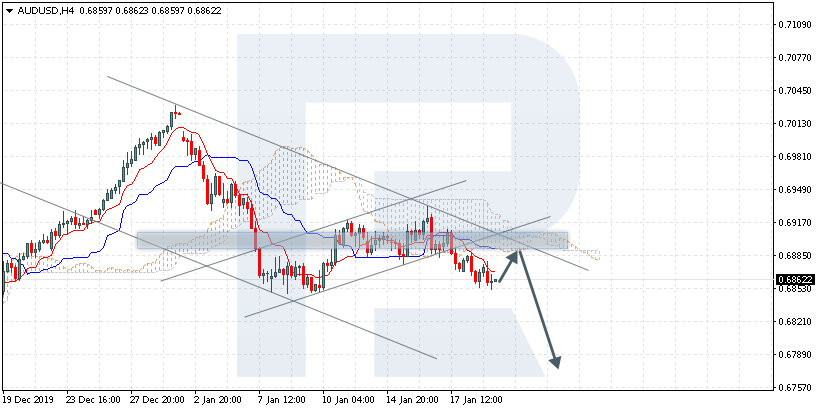
AUDUSD, “Australian Dollar vs US Dollar”

AUDUSD is trading at 0.6862; the instrument is moving below Ichimoku Cloud, thus indicating a descending tendency. The markets could indicate that the price may test the cloud’s downside border at 0.6885 and then resume moving downwards to reach 0.6770. Another signal to confirm further descending movement is the price’s rebounding from the descending channel’s upside border. However, the scenario that implies further decline may be canceled if the price breaks the cloud’s upside border and fixes above 0.6935. In this case, the pair may continue growing towards 0.7005.

AUDUSD
Risk Warning: the result of previous trading operations do not guarantee the same results in the future

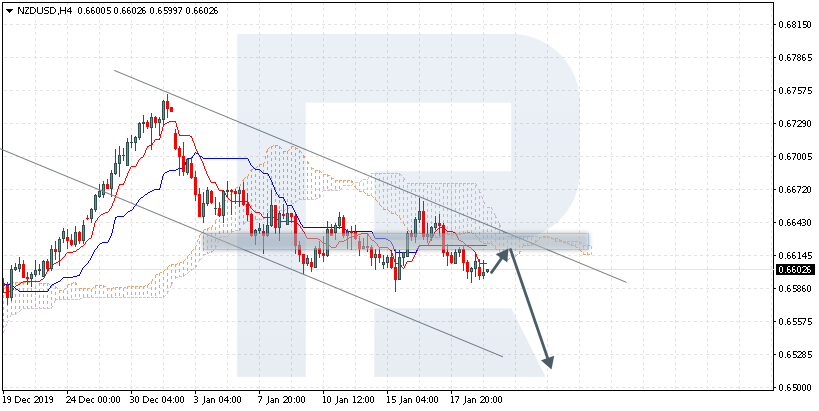
NZDUSD, “New Zealand Dollar vs US Dollar”

NZDUSD is trading at 0.6602; the instrument is moving below Ichimoku Cloud, thus indicating a descending tendency. The markets could indicate that the price may test the cloud’s downside border at 0.6615 and then resume moving downwards to reach 0.6520. Another signal to confirm further descending movement is the price’s rebounding from the resistance level. However, the scenario that implies further decline may be canceled if the price breaks the cloud’s upside border and fixes above 0.6655. In this case, the pair may continue growing towards 0.6775.

NZDUSD
Risk Warning: the result of previous trading operations do not guarantee the same results in the future

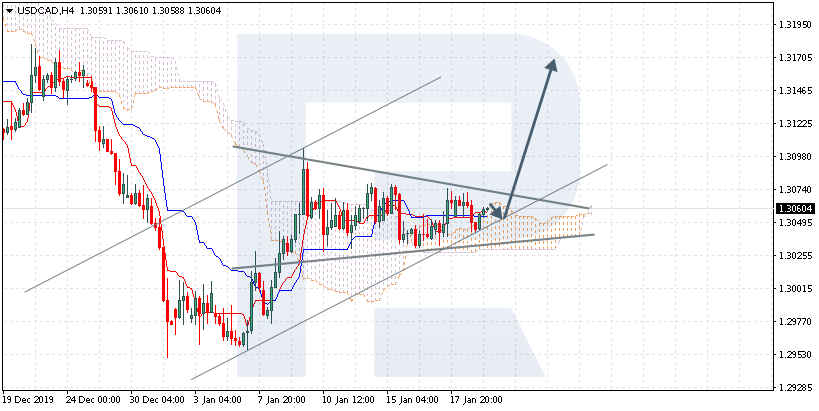
USDCAD, “US Dollar vs Canadian Dollar”

USDCAD is trading at 1.3060; the instrument is moving above Ichimoku Cloud, thus indicating an ascending tendency. The markets could indicate that the price may test the cloud’s upside border at 1.3050 and then resume moving upwards to reach 1.3170. Another signal to confirm further ascending movement is the price’s rebounding from the rising channel’s downside border. However, the scenario that implies further growth may be canceled if the price breaks the cloud’s downside border and fixes below 1.3010. In this case, the pair may continue falling towards 1.2945. After breaking Triangle’s upside border and fixing above 1.3090, the price may continue moving upwards.

USDCAD

Article By RoboForex.com

Attention!
Forecasts presented in this section only reflect the author’s private opinion and should not be considered as guidance for trading. RoboForex LP bears no responsibility for trading results based on trading recommendations described in these analytical reviews.

Japanese Candlesticks Analysis 21.01.2020 (GOLD, NZDUSD)

Article By RoboForex.com

XAUUSD, “Gold vs US Dollar”

As we can see in the H4 chart, the sideways movement within the ascending tendency continues. By now, XAUUSD has completed several Doji patterns. At the moment, the pair is reversing and may later reach 1540.00. After that, the price may continue growing towards 1600.00. However, one shouldn’t ignore another scenario, according to which the instrument may continue the ascending tendency towards 1540.00 without any corrections.

GOLD
Risk Warning: the result of previous trading operations do not guarantee the same results in the future

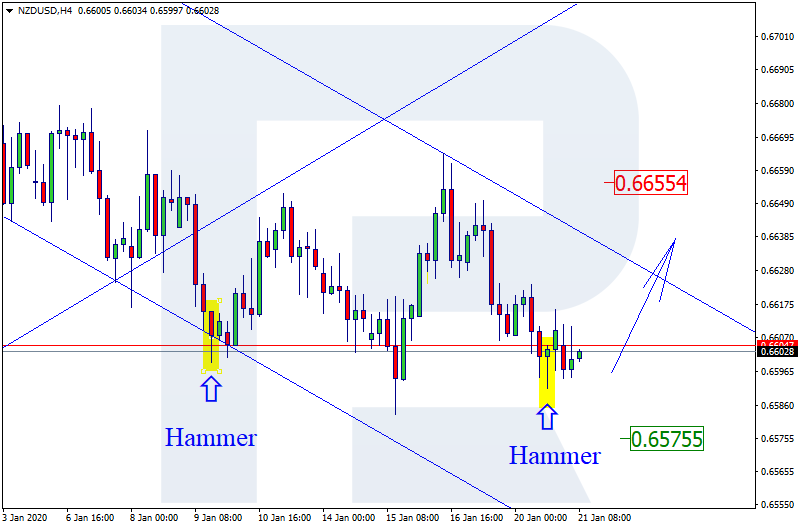
NZDUSD, “New Zealand vs. US Dollar”

As we can see in the H4 chart, the pair continues forming near the support level, where it has formed several reversal patterns, including Hammer. At the moment, NZDUSD is expected to reverse. The closest upside target may be at 0.6655. At the same time, one shouldn’t exclude an opposite scenario, according to which the instrument may fall to reach 0.6575.

NZDUSD

Article By RoboForex.com

Attention!
Forecasts presented in this section only reflect the author’s private opinion and should not be considered as guidance for trading. RoboForex LP bears no responsibility for trading results based on trading recommendations described in these analytical reviews.

The Bank of Japan Has Kept the Key Marks of Monetary Policy. Dollar Index Is Consolidating

by JustForex

The US currency has not changed a lot relative to the basket of major currencies. The dollar index (#DX) is testing local extremes. Yesterday, the US financial markets were closed due to Martin Luther King Day.

The Japanese yen strengthened against the US dollar. As expected, the Bank of Japan kept the ultra-easy monetary policy marks. The interest rate remained unchanged at -0.10%. The regulator also said that government financial incentives will help to somewhat accelerate the economic growth in the country. The regulator expects that in the current fiscal year, GDP growth will be 0.8%, while previously it was expected that the figure would be 0.6%. Next year, an increase by 0.9% is expected compared with the previous estimate of 0.7%.

Chinese yuan has been declining. The country’s National Health Commission has confirmed that two cases of the disease in Guangdong Province of China were caused by human-to-human transmission. The outbreak occurred just before the Chinese New Year, the peak travel season.

The “black gold” prices are reducing. Currently, futures for the WTI crude oil are testing the $58.00 mark per barrel.

Market Indicators

Yesterday, the US stock market was closed due to the holiday.

The 10-year US government bonds yield has declined. At the moment, the indicator is at the level of 1.79-1.80%.

The Economic News Feed for 21.01.2020:
  • – Data on the UK labor market at 11:30 (GMT+2:00);
  • – German ZEW economic sentiment index at 12:00 (GMT+2:00).

by JustForex

The Analytical Overview of the Main Currency Pairs on 2020.01.21

by JustForex

The EUR/USD currency pair

Technical indicators of the currency pair:
  • Prev Open: 1.10905
  • Open: 1.10939
  • % chg. over the last day: +0.01
  • Day’s range: 1.10889 – 1.10994
  • 52 wk range: 1.0879 – 1.1572

The EUR/USD currency pair stabilized after a sharp decline at the end of last week. At the moment, the trading instrument is in lateral movement. Unidirectional trends are not observed. EUR / USD quotes test local support and resistance levels: 1.10800 and 1.11000, respectively. Participants in financial markets expect additional drivers. The demand for greenback is still at a fairly high level. We recommend opening positions from key levels.

At 12:00 (GMT+2: 00), Germany will publish the ZEW economic sentiment indices.

EUR/USD

Indicators do not give accurate signals: the price crossed 50 MA.

The MACD histogram is near the 0 mark.

The Stochastic Oscillator is near the overbought zone, the %K line crossed the %D line. There are no signals at the moment.

Trading recommendations
  • Support levels: 1.10800, 1.10500
  • Resistance levels: 1.11000, 1.11200, 1.11450

If the price consolidates below 1.10800, expect a further descend toward 1.10500-1.10300.

Alternatively, the quotes could recover toward 1.11200-1.11400.

The GBP/USD currency pair

Technical indicators of the currency pair:
  • Prev Open: 1.29928
  • Open: 1.30076
  • % chg. over the last day: +0.02
  • Day’s range: 1.29956 – 1.30216
  • 52 wk range: 1.1959 – 1.3516

GBP/USD quotes retreated from local lows. The pound is currently consolidating. The local support and resistance levels are 1.29900 and 1.30200, respectively. The current technical picture signals a further correction of the GBP/USD currency pair. Investors expect important statistics on the UK economy. Open positions be opened from key levels.

At 11:30 (GMT+2:00) a report on the UK labor market will be published.

GBP/USD

Indicators do not give accurate signals: the price crossed 50 MA.

The MACD histogram is near the 0 mark.

The Stochastic Oscillator is near the overbought zone, the% K line crossed the% D line. There are no signals at the moment.

Trading recommendations
  • Support levels: 1.29900, 1.29600
  • Resistance levels: 1.30200, 1.30550, 1.31000

If the price consolidates above 1.30200, expect the quotes to rise toward 1.30500-1.30800.

Alternatively, the quotes could descend toward 1.29600-1.29400.

The USD/CAD currency pair

Technical indicators of the currency pair:
  • Prev Open: 1.30579
  • Open: 1.30474
  • % chg. over the last day: -0.15
  • Day’s range: 1.30446 – 1.30658
  • 52 wk range: 1.2949 – 1.3566

CAD is still trading in a protracted flat. Unidirectional trends are not observed. At the moment, the following key support and resistance levels can be identified: 1.30450 and 1.30750, respectively. USD/CAD quotes have a potential for recovery. We recommend you to pay attention to the dynamics of prices of black gold. Open positions from key levels.

At 15:30 (GMT + 2: 00), a report on sales in Canada’s manufacturing sector will be published.

USD/CAD

Indicatorsdo not give accurate signals: the price crossed 50 MA and 100 MA.

The MACD histogram is near the 0 mark.

The Stochastic Oscillator is near the overbought zone, the %K line crossed the %D line. There are no signals at the moment.

Trading recommendations
  • Support levels: 1.30450, 1.30300, 1.30200
  • Resistance levels: 1.30750, 1.31000

If the price consolidates above 1.30750, expect the quotes to rise toward 1.31000-1.31300.

Alternatively, the quotes could descend toward 1.30200-1.30000.

The USD/JPY currency pair

Technical indicators of the currency pair:
  • Prev Open: 110.077
  • Open: 110.176
  • % chg. over the last day: +0.04
  • Day’s range: 109.887 – 110.221
  • 52 wk range: 104.45 – 113.53

The USD/JPY currency pair went down. A trading instrument has the potential for further correction after a protracted rally. At the moment, the key range is 109.850-110.300. The Bank of Japan, as expected, kept the basic parameters of monetary policy unchanged. The regulator published optimistic forecasts for the country’s GDP. We recommend that you pay attention to the dynamics of yield on US government bonds. Open positions from key levels.

USD/JPY

Indicators of accurate signals do not give: the price crossed 50 MA and 100 MA.

The MACD histogram is in the negative zone, which indicates a bearish mood.

The Stochastic Oscillator is in the oversold zone, the% K line crossed the% D line. There are no signals at the moment.

Trading recommendations
  • Support levels: 109.850, 109.650, 109.350
  • Resistance levels: 110.300, 110.600

If the price consolidates below 109.850, expect a correction toward 109.500-109.200.

Alternatively, the quotes could grow toward 110.500-110.700.

by JustForex