Market Review 9.5.12

Source: ForexYard

printprofile

Riskier currencies and commodities fell once again during Asian trading, as investors continue to react to Greek and French elections held last weekend. The EUR/USD dropped as low as 1.2964, close to a three-month low. Crude oil fell to $96.26 a barrel.

Main News for Today

US Crude Oil Inventories- 14:30 GMT
• Crude oil stockpiles have increased dramatically in recent weeks, signaling decreased demand in the world’s biggest oil consuming country
• Should today’s figure come in above the forecasted 2.0M, the price of oil could fall further during the afternoon session

Read more forex news on our forex blog

Forex Market Analysis provided by ForexYard.

© 2006 by FxYard Ltd

Disclaimer: Trading Foreign Exchange carries a high level of risk and may not be suitable for all investors. There is a possibility that you could sustain a loss of all of your investment and therefore you should not invest money that you cannot afford to lose. You should be aware of all the risks associated with Foreign Exchange trading.

Strong dollar inflows in global uncertainty

By TraderVox.com

Tradervox (Dublin) – Risk aversion has grappled the global financial markets sending the growth related currencies and the Euro to the bearish zone. The major indices in the Europe and the Asia are also in the red with a sharp selling seen in the Greek and the French markets. The major gainers today are the US dollar and the Japanese yen. The commodity space remains red with a sharp fall in the crude prices. The selling in the crude began early in the week with the major suppliers citing that the crude supply is going to rise on increased production and yesterdays reports of US crude inventories adding more capacity.

 The safe haven gold which saw huge demand in the past during uncertain times is continuing its bearish rally which started last month. This has raised the prospects of the dollar as a safe haven and the dollar index is at monthly highs of 79.60

The dollar has seen significant inflows from the opening trades of the week on the back of the Greek and the French election results. The Greek elections have brought anti austerity parties to power. This has led to speculation regarding the willingness of the future Greek government to implement tough austerity measures for the country to get the next tranche of aid from IMF and the EU. This has raised the probability of a Greek exit and has fuelled concerns of a major global economic crisis worse than the one in 2008 due to the collapse of the US investment bank giant Lehman Brothers.

Another concern in the Europe is the end of the Merkozy era. German Chancellor Angela Merkel and the French President Nicolas Sarkozy were the key promoters of austerity measures in the Europe. The new French president François Hollande is in favor of growth initiatives rather than austerity measures. This has raised doubts over the future of the fiscal measures agreed earlier on the austerity plan.

The dollar is posting gains against major pairs except the Japanese yen. The inflows can be attributed to the safe haven flows into US treasury notes, the US dollar and the also the US growth story which is showing signs of slow recovery with declining unemployment rate and improving GDP numbers.

Disclaimer
Tradervox.com is not giving advice nor is qualified or licensed to provide financial advice. You must seek guidance from your personal advisors before acting on this information. While we try to ensure that all of the information provided on this website is kept up-to-date and accurate we accept no responsibility for any use made of the information provided. Opinions expressed at Tradervox.com are those of the individual authors and do not necessarily represent the opinion of Tradervox.com or its management. 

Article provided by TraderVox.com
Tradervox.com is a Forex News Portal that provides real-time news and analysis relating to the Currency Markets.
News and analysis are produced throughout the day by our in-house staff.
Follow us on twitter: www.twitter.com/tradervox

Why Europe Will Ditch Green Energy

By MoneyMorning.com.au

You may think Europe is the last place you should invest.

If you think that, you’re wrong.

The European economy is in a huge hole and there’s only one way to get out of it…

In fact, in the latest Australian Small-Cap Investigator, we argue that some of 2012′s biggest gains could come from Europe. And one industry in particular…

Japan’s Green Energy Lesson for Europe

But before we head back to Europe, let’s make a quick stop in Japan.

This week Japan switched off its last nuclear reactor. Before last year’s earthquake and tsunami, nuclear power accounted for about 15% of Japan’s electricity generation…

share of total electricity in Japan

Source: Forbes

Most of the rest was from coal, oil and natural gas (about 70%). Green energy (solar and wind power) made up just 1%…and that’s after a 295% increase from the year before!

The reason we mention Japan is this: it has no natural resources. It doesn’t have coal, oil or natural gas deposits. And there isn’t a uranium mine in sight.

If ever a country needed to secure a domestic energy supply, it’s Japan.

And yet, here’s Masayuki Naoshima, vice president of the Japanese parliament’s upper house telling the Sydney Morning Herald, ‘Australia is one of the most important countries for Japan in terms of natural resources supply.’

What about wind, wave and solar energy?

Not a peep.

Japan is one of the world’s most advanced countries, and it has been for more than 50 years. And yet Japanese boffins and firms still haven’t come up with a home-grown and self-sufficient green energy supply.

Japan realises – and Europe will too – that it needs to look elsewhere…

The European Energy Frontier

While Japan has all but ignored green energy, Europe has thrown billions of euros at it. But our bet is the outcome will be the same – rejection of green energy. Like Japan, Europe will turn back to fossil fuels. In particular, natural gas. Except Europe has one up over Japan.

Where Japan is barren of natural resources, Europe is rich with them. As the Economist noted last November:

‘The old continent has nearly as much technically recoverable shale gas (natural gas trapped in shale formations) as America. Europe’s reserves are 639 trillion cubic feet [tcf], compared with America’s 862 [trillion cubic feet], according to America’s Energy Information Administration…’

Shale gas has transformed US energy supply. Less than 10 years ago the US had an energy crisis. Today, oil giant BP says the US will be energy independent and a net exporter of gas by 2030.

But what about Europe? Right now, it’s going through an energy crisis. Unless it does something, things will only get worse.

A recent report by the European Union highlights the problem facing Europe:

‘The security of the EU’s primary energy supplies may be threatened if a high proportion of imports are concentrated among relatively few partners. Close to four fifths (79.1%) of the EU-27′s imports of natural gas in 2009 came from Russia, Norway or Algeria…’

How is this possible when Europeans have 639 tcf of natural gas right under their feet?

The answer is the Western fad for green energy. The belief that wind and solar power can supply energy to 300 million Europeans.

The truth is that it can’t.

That’s why we’re backing Europe to ditch green energy, and instead drill for the 639 tcf of shale gas under European soil.

Of course, this won’t happen overnight. It will take a long time. But that hasn’t stopped a bunch of entrepreneurial firms having a crack at it now.

And as we see it, even though investing in Europe may seem scary, taking a punt when all seems lost is one of the best ways to snag a high-risk and high-reward return.

This morning, clogging the international headlines are stories on Spanish bank bailouts, Greek debt woes and French elections. All seems lost in Europe.

And that’s exactly why we say that you should take a punt on it now.

Cheers.
Kris.

Related Articles

The Conference of the Year “After America” DVD

Why You MUST Speculate

Disruptive Technology Stocks For Smart Small-Cap Investors


Why Europe Will Ditch Green Energy

Not So Austere After All

By MoneyMorning.com.au

‘Did you see the French election results?’

‘What does this mean for Europe?’

‘The socialists are in charge. They’ll spend and spend and Europe will get into even more trouble.’

Those are just some of the comments fired at your editor over the past three days.

What was our reply? Simply this: Hollande or Sarkozy, socialist or non-socialist, it won’t make a difference.

The markets are worried a socialist president will go on a spending spree. That he’ll rack up more public debt, and blow out the budget deficit even more.

It would – they say – be the end of French and European austerity.

Well, let’s get something straight.

First, here’s the Macquarie Dictionary definition of austere:

‘Austere, adj. 1. Harsh in manner; stern in appearance; forbidding. 2. Severe in disciplining or restraining oneself; morally strict. 3. Grave; sober; serious. 4. Severely simple; without ornament…’

Now, think about this. The 2012 Index of Economic Freedom says that last year French government spending was 56.2% of French gross domestic product (GDP).

Put another way, for every euro spent in France, the government spends 56.2 cents.

So it’s not true to say the new socialist president will throw out austerity. The truth is that France was never austere under Sarkozy.

It was spend, spend and more spend.

And France isn’t alone. The Economist published this chart in 2010 using forecast figures for future years…

government spending chart

Source: Economist

We’ve placed dots where each government’s spending is in 2012 as a percent of GDP.

As you can see, in each case government spending is at least the same today as it was in 2009. (Remember, the shaded area shows forecasts made in 2009 and 2010.)

The fact is Governments only pretend to implement austerity. In reality, they’re spending more tax money and going further into debt.

Yesterday the Age headlined, ‘Swan’s song to be in the key of austerity.’

The story went on, ‘Wayne Swan will be hoping his austerity budget gets a better reception than the Greek budget did.’

Good old austere Australia.

Trouble is, as Alan Kohler points out over at Business Spectator, ‘According to Budget Paper No.2 – Budget Measures, ‘expense measures’ in this budget actually increase spending by $201.2 million.’

And based on the budget estimates printed in today’s Australian Financial Review (AFR), the 2012-13 budget expenditure will be $376.3 billion. That’s $2.6 billion more than the estimate for this year.

And $30.2bn more than the government spent in 2010-2011.

Not so austere after all.

Cheers.
Kris.

Related Articles

The Conference of the Year “After America” DVD

Why You MUST Speculate

Disruptive Technology Stocks For Smart Small-Cap Investors


Not So Austere After All

What the European Elections Mean for the Euro

By MoneyMorning.com.au

Politics holds the key to the euro’s future.

The euro is a political construct, not an economic one. As it stands, the euro cannot function in the long term, from an economic point of view. The various countries involved are too different.

So the main thing holding the euro together so far is that European voters, by and large, still want it. Voters might be angry at Germany, or angry at their own leaders, or angry at eurocrats in general.

But they don’t yet blame the currency for their woes.

This could be the year that all that changes…

Forget Growth Versus Austerity

Forget all the stuff about austerity versus growth. It’s good column fodder for economists, but it doesn’t get us any closer to understanding what will happen on the ground.

The austerity mob argues that countries need to do what it takes to pay back their debts. Instinctively, this feels like the ‘right’ decision. Most of the time, if you’ve spent too much money, then yes, cutting back for a while and rebuilding your savings is the smart thing to do.

But there comes a point where the hole you’ve dug is simply too big. That’s when your creditors need to share the pain. People seem to forget that when a lender writes a cheque, they’re taking a risk. If they haven’t assessed that person’s credit risk correctly, then the rules of capitalism dictate that they should lose some or all of that money.

So austerity without explicit default cannot work.

The growth mob, on the other hand, seem to think that you can borrow and spend with impunity. This is wrong, and they know it. What the growth guys are really arguing is that Germany should take the leash off the European Central Bank (ECB).

If the ECB is allowed to print money, then Greece and all the other countries can service their debts the easy way – the Anglo-Saxon way, in fact. Over time, these economies will recover.

It does mean that you confiscate money from savers across the eurozone in the form of inflation. It also means that you are implicitly defaulting – you are repaying your debts with devalued currency.

And it creates moral hazard – neither countries nor lenders have any incentive to change their behaviour if they believe that there is always a bail-out at the end of the road.

So these are the choices: an implicit default or an explicit default. In an implicit default, German taxpayers agree to stand behind other nations’ debts (in the form of ECB money-printing, or a common eurozone bond issue – it all boils down to the same thing). That leads to a weaker euro.

In an explicit default, Greece tells its remaining creditors (the ones it hasn’t already defaulted on) that it can’t repay them.

Trouble is, any eurozone country that unilaterally decides not to pay its debts would be stiffing other eurozone countries too. In particular, a whole lot of Greek debt is held by other European banks, as well as the ECB. That’s why it would be hard to default, and also to stay in the euro.

So an explicit default by Greece (or any other country for that matter), involves leaving the euro and going back to the drachma.

So What’s the European Endgame?

Which of these routes will be chosen all comes down to the voters. So what have they said?

The key country is Germany, of course. And they have no intention of budging. As Reuters reports, Volker Kauder, one of Angela Merkel’s ‘closest allies’, said: ‘Germany could end up paying for the Socialist victory in France with more guarantees, more money. And that is not acceptable. Germany is not here to finance French election promises.’

Merkel is only reflecting the desires of her population. So while Francois Hollande can talk about growth all he wants, the best he’s likely to get is some sort of fudged ‘growth pact’ that is all words and no action. That won’t please the French people. But they’re not at the stage where they are ready to jack in the whole euro project as yet.

The Greeks, on the other hand…

In essence, the outcome of the Greek election was a mass vote for ‘anything but this’. Greeks voted for Communists, Neo-Nazis, and all the colours of the political rainbow in between. Putting a coalition together from that lot is going to be tough. In fact, it seems likely that there’ll be another election in June. Although, chances are, that would result in an even more polarised result.

Citigroup reckons that there’s now a 75% chance of Greece leaving the euro by the end of 2013. That seems more than reasonable. The question is, how much damage could it do?

Private debt holders have already had their holdings written down substantially. So it’s hard to believe that losing the rest would deliver a knock-out blow to the global financial system.

However, it would still be incredibly messy. This is the best solution for the Greeks. But it would also get the markets watching for the next candidate to leave – probably Portugal.

The one thing that a Greek exit might do, is shock the rest of the eurozone into deciding that defaulting via money-printing is the best way to go.

John Stepek
Editor, MoneyWeek (UK)

Publisher’s Note: This is an edited version of an article that first appeared in MoneyWeek (UK).

From the Archives…

Why China’s New Consumer Economy Won’t Give You the Trade of the Decade
2012-05-04 – Kris Sayce

Why China Could Be The Next Destination For the Financial Crisis
2012-05-03 – Merryn Somerset Webb

How Did We Get It So Wrong on Australian Housing?
2012-05-02 – Kris Sayce

This Indicator Shows the Copper Price Could Be Set to Soar
2012-05-01 – Dr. Alex Cowie

How Gold Nanoparticles Will Create A New Kind of Gold Rush
2012-04-30 – Michael Robinson


What the European Elections Mean for the Euro

Derivative Manipulation Hits the Crude Oil Market

By MoneyMorning.com.au

Friday, the price of West Texas Intermediate (WTI) crude oil, the benchmark oil contract traded on the NYMEX, fell 4% ($4.14). The one-day decline is the steepest since WTI fell 5.1% ($5.12) on January 3.

The other major benchmark, London-set Brent, also was hit, but less significantly, falling 2.6%. It was the largest Brent decline since a 4.6% dive on December 14.

However, the Brent-WTI spread is now increasing again. As of the close on Friday, the spread as a percentage of the WTI price (the better way of looking at it) stood at 14.9%, the highest differential in more than two weeks.

Two important questions follow.


First, why did this happen? Second, what is that spread again telling us?

The answers will surprise you.

Roll Out the Usual Suspects

As crude oil prices fell, TV pundits immediately paraded the usual suspects. They cited disappointing U.S. job figures, renewed concerns over European debt in general, and the Spanish situation in particular, while so-called “analysts” clamoured over a possible double-dip recession.

These concerns are not new, nor are they revelations.

Plus, the essential reasons why the oil price should be moving in the opposite direction – namely up – haven’t gone anywhere. The constriction produced by supply/demand considerations remain, and the insufficient volume available to meet unexpected demand surges and the geopolitical environment – especially the impending European boycott of Iranian crude oil imports – remain in full force.

The overall market dynamics still point strongly to a rise in oil price.

Yet the overall movement of crude oil futures has remained peculiarly restrained. In fact, WTI has given back 6.1% in the past week, and some 2.7% for the month.

Here’s what’s really happening…

Preparing for the Next Crude Oil Price Rise

The real reason we have witnessed a retreat in crude oil pricing has little to do with the condition of the market or the actual demand for product. It is the result of a classic yo-yo short in anticipation of a major advance in the oil price.

In other words, some very large traders in oil futures contracts – the so-called “paper-barrel” speculators of future actual consignments of oil (or “wet barrels”) – are manipulating a short-term cut in price after establishing a position that will profit with the price going down.

This amounts to a “put” clone resulting in an exaggerated decline in the crude oil pricing level, usually orchestrated on a five-day pricing spread introduced by a sequenced derivative move on the futures contract itself.

The trader profits when the price goes down by exercising the “put” to sell options on the futures contract at a higher strike price than that provided by the market by redeeming the derivative.

Of course, when that happens, the market price will increase. The trader then profits again by having derivatives on the increasing price already in place.

The price is manipulated just like a yo-yo moving up and down. Now the manoeuvre is only doable during periods of lower-than-average futures contract volume and a narrow period in which the price is not likely to spike because of outside developments (for example, natural disasters, a rapid escalation in hostilities, blockage of transit, collapse in production, and so on).

It becomes less useful when the market indicators themselves are decidedly moving up. The approach succeeds by wider market perceptions, not fact. It ends when the actual pricing dynamics take over. In between, a few traders make some bucks by manipulating the margins.

There will be little opportunity for this device to operate again as we move into the summer volatility.

The Iranian Embargo Looms

As for the second question, that widening Brent-WTI spread is signaling a renewed concern about the real market impact coming from the EU-Iranian embargo and the increasing inability of other producers to make up the difference over the long term.

Saudi Arabia has agreed to cover the initial shortfalls to the most highly vulnerable European importers – Greece, Spain, and Italy. But that additional volume will not guarantee price moving forward. And it will also result in both price increases and market dislocations in other regions relying on Saudi exports – Asia especially and, in particular, India.

Spain attempted to secure additional oil from Nigeria but was told the African producer could not cover additional needs resulting from the embargo. Russia may benefit in the near term, but that will certainly increase prices paid by Europe.

All of this is reflected first in Brent because it is the benchmark most impacted by these developments. However, it will be translated into rising WTI prices as well, since the price in the U.S. is still reflective of the price in Europe due to imports.

The increasing spread, therefore, tells what is really going to happen.

Crude oil is going up.

Despite what a few very large short artists will pull off now and then in the hazy funny paper world of exotic derivatives.

Dr. Kent Moors
Contributing Editor, Money Morning

Publisher’s Note: This article originally appeared in Energy & Oil Investor

From the Archives…

Why China’s New Consumer Economy Won’t Give You the Trade of the Decade
2012-05-04 – Kris Sayce

Why China Could Be The Next Destination For the Financial Crisis
2012-05-03 – Merryn Somerset Webb

How Did We Get It So Wrong on Australian Housing?
2012-05-02 – Kris Sayce

This Indicator Shows the Copper Price Could Be Set to Soar
2012-05-01 – Dr. Alex Cowie

How Gold Nanoparticles Will Create A New Kind of Gold Rush
2012-04-30 – Michael Robinson


Derivative Manipulation Hits the Crude Oil Market

USDJPY moves sideways between 79.63 and 80.61

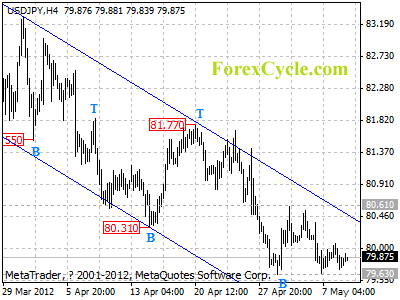
USDJPY moves sideways in a narrow range between 79.63 and 80.61. Resistance remains at the upper line of the price channel on 4-hour chart. As long as the channel resistance holds, downtrend could be expected to resume, and another fall towards 79.00 is possible after consolidation. On the other side, a clear break above the upper border of the channel will indicate that the downward movement from 84.17 has completed at 79.63 already, then the following upward movement could bring price to 83.00 zone.

usdjpy

Daily Forex Analysis

Uranium Stocks Set to Double?

Article by Investment U

Not many markets have been written off by investors more than uranium since last March.

Understandably, the Fukushima incident left a bad taste in everyone’s mouth. Countries such as Germany and Japan claim they’re done with nuclear power altogether.

But surprisingly there’s been a buzz recently in my inbox about a potential rebound in the uranium market.

My interest was piqued, but I wanted to dig a little deeper into the story. So I dialed up two of the smartest people I know on the subject to get their take – Global Resource Investments CEO and legendary contrarian Rick Rule and Investment U’s own commodity and resource expert Matthew Carr.

And after talking to them, it’s my belief that we’re finally at a bottom in the uranium market. There’s even reason to believe in a potential double over the next two years.

Below I’ll discuss an easy way to capitalize on the rebound. But first I’ll share what I learned about the uranium market from Matt and Rick.

Matthew Carr: “A Potential Double in Two Years”

“Few people are excited about uranium right now. And that’s understandable after the Fukushima disaster last year,” Matt told me. “It jolted the entire uranium market. Here’s the thing though: You can earn yourself a double investing now in uranium. But it’s not going to be overnight.”

Matt told me he sees Japan using more LNG for the near future. And for him it’s too early to tell if Japan will ever go back to nuclear. But he obviously sees strength in the uranium market over the long term.

“Fact is, there’s a supply deficit coming. We’re going to go from $52 a pound to $70 and $80. A lot of people aren’t going to jump in until we hit $70… That’s silly,” he said. “Ultimately, I think two years from now – and maybe sooner if the market heats up quicker than expected – you’ll pat yourself on the back for acting on this one. It’s just a game of patience. Bide your time. Build your positions. The price of uranium will continue to slowly tick higher, and so will uranium stocks.”

And when I contacted Rick, I heard more of the same…

Rick Rule: “Uranium Will Be With Us for Some Time”

“As a consequence of the disaster in Japan, the uranium industry got really, really, really trounced,” he told me. “There has been a snap-back in the uranium industry, but I think it has some to go.”

It was easy for me to understand that poor public perception hurt the demand for nuclear power and ultimately uranium. But I didn’t even think about the supply side of the equation. After all, Japan had to do something with all that extra uranium it had lying around…

“It’s worthy to note that the spot price of uranium has fallen from about $70 to $52,” Rick said. “That’s solely as a consequence of the Japanese selling on the spot market uranium that they previously had in inventory.”

But despite the negative public perception and news that countries like Germany are discarding nuclear altogether, Rick doesn’t see it going anywhere for some time…

“The world is also saying, as a consequence of Fukushima, that we need to rely less and less on nuclear power. But that isn’t what’s happening on the ground,” he said. “Many parts of the world, including ironically Japan, are or will be investing heavily in nuclear power on a going forward basis for a very simple reason – when people hit a switch they want the lights to go on. Without nuclear power in some places, it doesn’t happen.”

For places like Japan, Korea, Taiwan, or Singapore, to name a few, there are truly limited options. These densely populated areas have high energy consumption with limited natural resources. So according to Rick, fuel density is crucial for fuel security.

“In Japan they can and do store five or six years of uranium. That’s because in the face of something like the Arab oil embargo that happened in 1973, they’re bulletproof,” he said. “There is no other energy source that a place like Korea or Taiwan or Japan can store like that. Imagine trying to store six years’ worth of hydroelectric, it doesn’t work. Imagine trying to store coal or natural gas or oil. The density of uranium lends it to very, very, very secure base load power. And as a consequence of that, uranium will be with us for some time.”

And the facts seem to support Rick’s observations. The United States and Europe may be shunning nuclear power, but not the rest of the world. According to the World Nuclear Association, 60 nuclear plants are currently under construction, 150 are in the works and 340 are in various stages of proposal.

And although it’s hard to imagine Japan going back to nuclear anytime soon, there are some interesting reasons to think they may eventually go back to more nuclear power.

According to figures from the Japanese Atomic Industry Forum, Japan faces a 12% shortage of electricity this summer. Meanwhile additional fossil fuel imports are costing it about $40 billion – or $333 per person, per year – while its carbon emissions are roughly 14% above 1990 levels.

An Easy Way to Play

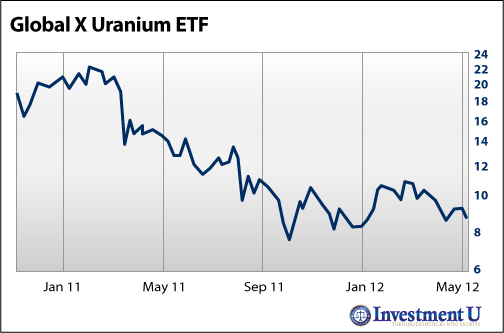
Looking at the graph below, you can see the Global X Uranium ETF (NYSE: URA) was trading in the $20 range just before Fukushima. Since then, it’s been on a fairly steady decline, currently trading around $8.50 a share…

Uranium Stocks Set to Double?

The main holding, about 20%, for URA is the largest pure play in uranium mining, Cameco Corp. (NYSE: CCJ). But Global X adds some diversification for U.S. investors with some smaller miners that are only traded on the TSX.

Keep in mind that URA is a completely speculative recommendation. You shouldn’t invest any more than 1% of your portfolio and we always recommend a 25% trailing stop with any investment.

But if you share my view after hearing what some industry heavy hitters are saying, you’ll want to take a long look at this and other individual uranium plays.

Good Investing,

Justin Dove

Article by Investment U

The Greek and French Elections in a Nutshell

Article by Investment U

The Greek and French Elections in a Nutshell

These recent elections are just one more reminder to use extreme caution before investing anywhere in Europe.

Greece and France had elections over the weekend, and the results don’t appear to favor business, either individually or for the larger Eurozone.

Over the last few years, the Greek people have rioted enough to make it very clear how much they value their government-supported lifestyles. Every time the International Monetary Fund (IMF) demanded the ailing economy institute austerity measures and President Karolos Papoulias agreed, the Greeks would immediately get up in arms.

So it’s no surprise they decided to shake up their current power structure as soon as they got the chance to. And maybe it shouldn’t even be that shocking how they ended up electing both left- and right-wing extremists, including Neo-Nazis, for various government positions.

Scary, yes. Shocking? Not so much.

Then there’s France, which didn’t care for its own leaders’ attempts to balance the bank. Given the choice between President Nicholas Sarkozy and someone who promised to pander to them more often, they easily chose the latter.

That’s not to say that either Papoulias or Sarkozy were perfect politicians – because they certainly weren’t. But as Christian Science Monitor writer Stefan Karlsson explains, in both cases, “a majority of voters decided to throw out the incompetent incumbents and instead go for the even crazier opposition.”

Karlsson even goes so far to compare the current situation to “the incompetent and corrupt Weimar German establishment,” which lost in 1932 to the National Socialist German Worker’s Party – better known as the Nazi regime.

European Economics in a Nutshell

Only time will tell if Karlsson’s comparison is extreme or not. But what investors have to understand right now is that these European election results likely solve absolutely nothing.

In fact, they’re likely to make them that much worse.

Some economic analysts are currently claiming that neither Greece nor France’s individual actions matter much on a global scale, since the Eurozone’s fate rests solely in the hands of international organizations, like the IMF. But that’s an extremely simplistic conclusion to reach on an extremely complicated matter.

Like it or not, each country in the Eurozone is painfully interlocked with the next, while still existing as its own separate entity. They all have their own governments, economies and citizens, but they share the same currency, which makes things extremely complicated.

It puts weaker countries like Greece into positions of power they’re not strong enough to hold. They can run their economies into the ground – as many of them seem intent on doing – leaving their stronger allies with little choice but to rescue them.

Either that or let their shared euro severely devalue.

The way the Eurozone is organized, there’s no way around it: Whatever decisions Greek politicians make will somehow affect Germany, just like French decisions to focus on spending over saving will come back to bite everyone else.

That’s what sharing a currency usually means.

European History in a Nutshell

The fact that the countries in the Eurozone have long and complicated histories together doesn’t help the economic situation much, either.

Each has gone to war with the other repeatedly over the centuries, which has resulted in a lot of long-lasting hard feelings all around. Consequently (though perhaps not logically), their natural inclination isn’t necessarily to help each other out, even if it makes perfect sense to do so.

Then there’s the issue that most of Europe has been practicing dangerous economic policies for decades, fooling around with various levels of socialist policies that have left their citizens dependent on now badly insolvent governments. And when the people keep electing politicians set on continuing those strategies – like they just did in France and Greece – it makes the problem that much more complicated and long-lasting.

There’s only so much supporting a government can do before it implodes. But that doesn’t seem to deter either Greece or France at all, judging by their voting results.

If the countries in the Eurozone don’t get their act together soon, investors may be better served staying away for a very long time. And even if they do start to make positive changes, it’s still going be a convoluted mess, probably for years.

These recent elections are just one more reminder to use extreme caution before investing anywhere in Europe.

Good Investing,

Jeannette Di Louie

Article by Investment U

Silver Falls to Lowest Since January, China and India Could Offer “Key Support” for Gold

London Gold Market Report
from Ben Traynor
BullionVault
Tuesday 8 May 2012, 07:45 EDT

WHOLESALE MARKET gold prices fell to $1625 an ounce during Tuesday morning’s London trading – their lowest level in over a fortnight – as stocks and commodities also ticked lower and the Dollar extended recent gains, with markets still digesting the weekend’s French and Greek election results.

“Support [for gold] is at $1625, where we have seen very good support since early April,” says the latest technical analysis from bullion bank Scotia Mocatta.

Silver prices meantime fell to $29.55 per ounce – their lowest level since mid-January.

A day earlier, gold prices traded lower on Monday, while the Euro fell to a 3-month low against the Dollar.

“It is a much more hazardous [gold] environment at the moment because of the downside risks to Euro/Dollar,” says Michael Lewis, chief commodity strategist at Deutsche Bank.

“One of the supportive factors [is] we’ve already seen quite a dramatic scaling-back in speculative length in gold over the last few months, so that might reduce the positioning risk for the market, but it is definitely going to be an environment where gold is going to struggle.”

In New York, the difference between bullish and bearish gold futures and options contracts held by noncommercial traders on the Comex – the so-called speculative net long – rose 5.7% in the week ended last Tuesday, according to data from the Commodity Futures Trading Commission.

“Despite the improvement, net speculative length remains relatively weak…signaling a continued lack of confidence,” says Standard Bank commodities strategist Marc Ground.

“While investors are not overtly bullish, short positioning is also relatively low, a mildly encouraging sign that investors appear cautious of running too short.”

“Gold eased on Monday,” adds a note from Swiss precious metals group MKS, “after French and Greek elections that reflected strong anti-austerity feelings raised concerns over European ability to battle its debt crisis, knocking [the Euro] down.”

Newly-elected French president Francois Hollande is due to visit Berlin one week from today, where German chancellor Angela Merkel says she will welcome him “with open arms”,  according to press reports.

Merkel added however that there will be no renegotiation of reform measures such as the Fiscal Stability Treaty, which aims to reduce Eurozone government debt-to-GDP ratios.

During his campaign, Hollande said that is “is not for Germany to decide for the rest of Europe”, and called for pro-growth policies as well as a change in the rules governing interventions by the European Central Bank.

Europe needs “to strike a balance” between austerity and growth said Olli Rehn, European Commissioner for economic and monetary affairs, said in a speech on Saturday, ahead of the French election result.

“We need to further boost investment to supplement the other policies of our growth agenda,” he said.

Rehn added that the European Investment Bank – which makes loans to businesses on behalf of the European Union – should have its capital increased.

“Countries need to keep a steady hand on the wheel,” said International Monetary Fund managing director Christine Lagarde Monday.

“If growth is worse than expected, they should stick to announced fiscal measures, rather than announced fiscal targets…in other words, they should not fight any fall in tax revenues or rise in spending caused solely because the economy weakens.”

Greece meantime faces the prospect of fresh elections after Sunday’s poll failed to deliver a majority for the incumbent coalition, made up of the New Democracy party and Pasok, both of which publicly support the EU/IMF bailout deal.

Former Greek finance minister Evangelos Venizelos has said the terms of Greece’s bailout should be renegotiated, and spending cuts spread over three years rather than two.

Over in Spain, the government is reportedly preparing to bail out Bankia, the banking group created at the end of 2010 by the merger of seven smaller banks which were struggling with bad property loans. One Spanish newspaper reports the bailout could be around €7 billion – on top of the €4.5 billion Bankia received from the government shortly after it was set up.

India’s finance minister Pranab Mukherjee announced Monday that the government is withdrawing the 1% excise duty on all precious metal jewelry, branded or unbranded. The withdrawal is effective from March 17 – the day after Mukherjee’s Union Budget in which he extended the tax to unbranded jewelry.

Many Indian gold dealers closed down for three weeks in protest following the Budget, which also saw import duties on gold doubled – a policy that remains in place.

“People who were on the sidelines will come back to the market,” says Prithviraj Kothari, president of the Bombay Bullion Association.

“Jewelry demand will improve in the coming weeks…it’s a good move by the government.”

In China, imports of gold bullion from Hong Kong – widely regarded as a proxy for overall Chinese gold imports – rose 59% month-on-month in March to nearly 63 tonnes, according to official Hong Kong government data.

The volume of gold heading the other way, however, also rose to just under 25 tonnes, leaving net exports at a little over 38 tonnes.

“Rising prosperity levels among the population coupled with tighter laws governing property speculation are likely to contribute to sustained high demand for gold in China,” says a note from Commerzbank.

“Above all, Chinese gold demand should lend key support to the price of gold during the course of the year.”

“China’s strong demand for bullion may help support gold prices at lower levels,” adds James Steel, commodity analyst at HSBC in New York.

“A recovery in Indian gold demand should [also] be an important factor in support of gold prices.”

At the annual Berkshire Hathaway shareholders’ meeting, attended this year by U2 frontman Bono, legendary investor Warren Buffett repeated his regular advice not to buy gold – a sentiment echoed by his number two Charlie Munger and Microsoft founder Bill Gates.

Ben Traynor
BullionVault

Gold value calculator   |   Buy gold online at live prices

Editor of Gold News, the analysis and investment research site from world-leading gold ownership service BullionVault, Ben Traynor was formerly editor of the Fleet Street Letter, the UK’s longest-running investment letter. A Cambridge economics graduate, he is a professional writer and editor with a specialist interest in monetary economics.

(c) BullionVault 2011

Please Note: This article is to inform your thinking, not lead it. Only you can decide the best place for your money, and any decision you make will put your money at risk. Information or data included here may have already been overtaken by events – and must be verified elsewhere – should you choose to act on it.