Why a Greek Exit From the Eurozone Could Be Great News For Markets

By MoneyMorning.com.au

Greece is looking likely to leave the eurozone

The mood music is turning against Greece.

When the eurozone crisis first kicked off, the idea of letting Greece leave the eurozone (or ejecting it), was unthinkable.

European leaders weren’t allowed to speak of such things, for fear that those nasty speculators in the financial markets would get the wrong idea.


Now the gloves are off. The head of the left-wing party that came second in the weekend’s Greek election is declaring that the austerity programme needs to be ripped up.

In response, the European Central Bank has politely but firmly said: ‘drop dead’ (or words to that effect).

An exit for Greece is starting to look more likely than not. With the stock index at a 20-year low, investors certainly seem to be pricing in a return to the drachma. So what would it mean?

A Greek Exit From the Eurozone
is Probable, Rather Than Possible

Of all the British newspapers, it’s probably safe to say that the FT most accurately reflects the way of thinking in Europe. It’s certainly not a euro-sceptic paper, so it has no vested interest in presenting things in a more negative light than is warranted.

So it’s striking that an editorial in this paper warns Greece that it’s on its own.

‘The European Union (EU) has gone as far as it can in seeking to help Greece. If there is not the political will in Athens to do what is necessary to preserve membership of the euro, it is pointless to continue.

‘Europe must prepare for an exit from the eurozone that has become probable rather than possible.’

Here’s the situation. In February, Greece agreed a €174bn bail-out deal with the EU and the International Monetary Fund. Part of the deal was that the country would undertake various reforms. These reforms need to be passed by the end of next month before Greece can get at the money.

Of course, the problem is that there is no Greek parliament right now. It looks like no one will be able to put together a coalition. As a result, there’ll be a second election.

Will the result be any different? Possibly. Perhaps the hard-line stance being talked up by the rest of Europe will encourage the Greeks to think again. But equally, the Greeks might end up voting even more decisively against the rest of Europe.

The country is fed up with austerity. And there are too many vested interests who don’t want the status quo to change. Alexis Tsipras, head of the second-placed Syriza party is playing a smart game. He’s standing up and denouncing ‘barbarous’ austerity, and getting the people riled up for the second round of elections. If he plays it right, then this round of populist campaigning might even boost his support sufficiently to get in next time.

A Greek Exit From the Eurozone
Could Be Just What Europe Needs

A Greek exit doesn’t need to be a disaster. If handled correctly, it could be just the thing that Europe needs to nail the crisis once and for all.

On the same day that Greece exits the euro, you let the ECB open the floodgates. The ECB promises to print what it needs to cap the yields on all European government debt, as long as member countries abide by the rules of their various reform packages.

It all comes down to how the Germans react. But if you throw Greece to the wolves to encourage the others, that should pacify the German voters’ thirst for perceived fair treatment.

Leaving the euro is definitely the best thing that could happen to Greece. A return to the drachma would allow the country to re-price itself rapidly. Ditching its debts would mean it could focus on growth.

And the country can continue to avoid reform and be run by insiders, for insiders, if that’s the sort of society it prefers, without being judged by its fellow Europeans.

Under this scenario, assuming the ECB money-printing was seen to be unlimited, then stocks would surge. The trashiest ones would surge the most. The euro wouldn’t do so well of course.

Any other global stocks you hold just now, not to mention gold, would also be buoyed by an inflationary solution to the euro crisis.

Then Again, A Greek Exit From the Eurozone
Might Also Be a Total Disaster

Of course, that’s the optimistic view. What are the other options? Firstly, Greece could be allowed to stay in Europe and renegotiate its bailout deal. But even if that happens, it’s only a matter of time before it breaks down. Greece is in too deep a hole to repay its debts. So a renegotiation – unless it also involves wholesale money printing, in which case just refer back to the scenario above – would simply lead to more of the same, further down the line.

Secondly, Greece could leave, but without any proper backstop in place to prevent the chaos from spreading. If that happened, you’d probably see bond yields spike across Europe. Portugal would come under severe pressure, and Spain’s economy and Italy’s wouldn’t be far behind. Chances are banking stocks in particular, and shares in general would collapse.

That would almost certainly encourage some form of money printing by the Federal Reserve and the Bank of England. And the ECB might be allowed to follow suit if things got that drastic. But there’d also be a much greater chance of things spiralling to the point where the euro’s continued existence in any form would be questionable.

That’s one of those ‘too grim to contemplate’ outcomes. It makes me think that ultimately, the ECB printing is still the most likely option.

John Stepek
Editor, MoneyWeek (UK)

Publisher’s Note: This article originally appeared in MoneyWeek (UK)

From the Archives…

Why China’s New Consumer Economy Won’t Give You the Trade of the Decade
2012-05-04 – Kris Sayce

Why China Could Be The Next Destination For the Financial Crisis
2012-05-03 – Merryn Somerset Webb

How Did We Get It So Wrong on Australian Housing?
2012-05-02 – Kris Sayce

This Indicator Shows the Copper Price Could Be Set to Soar
2012-05-01 – Dr. Alex Cowie

How Gold Nanoparticles Will Create A New Kind of Gold Rush
2012-04-30 – Michael Robinson


Why a Greek Exit From the Eurozone Could Be Great News For Markets
The Great Push North for Arctic Oil Continues

By MoneyMorning.com.au

The search for oil in the Arctic Circle – on ‘the roof of the world’ got more serious.

Over the weekend, Norway’s Statoil ASA (NYSE:STO) signed a massive exploration deal with Russian behemoth Rosneft in a venture that may require more than $100 billion in investment over the next few decades.

Specifically, the company is aiming to help Rosneft develop untapped oil resources in the Arctic, as Moscow struggles to gain a competitive advantage given declining conventional oil and gas production in Eastern Siberia.

The deal highlights a number of key issues for both companies and for Moscow moving forward.

For Russia, some of its most mature conventional oil basins are declining in output rapidly, at a pace that could reach 8% a year within this decade. With production waning and concerns about long-term supplies accelerating, Russia has no choice but to venture into the north.

But they know that they cannot make this push alone.

Such a radical change in procurement is technologically sensitive… and very expensive. Moscow needs outside investment and the most advanced technology to push into the hostile, energy-rich environments of the vast Arctic and East Siberian basins.

At the same time, Statoil has been scrambling to find new ways to get more involved in this push north. In recent months, oil giants Exxon Mobil Corp. (NYSE: XOM) and Italy’s Eni SpA (NYSE:E) had been very active in working with Moscow to develop in these oil-rich environments.

In the wake of Russia’s slumping reserves and production in Siberia, the Kremlin has been looking for ways to incentivize producers to help Rosneft replace waning production. Tax breaks have been one way, but companies also want a little bit of insurance when they work with Moscow.

The major question, of course, is this: How can shareholders know that Moscow won’t expropriate any major resource finds, should the exploration deal succeed?

The answer is “hostage taking.”

Taking Oil Hostages in the Arctic


A key feature of this Statoil deal is a strategy known as “hostage taking.” And it says a lot about the future of energy production and the cooperation required between multinationals and political leaders.

Statoil and Exxon (in their respective deals) are convinced they can protect themselves against the risk of having any major reserve discoveries expropriated by Moscow.

Both deals allow Rosneft to buy stakes in Statoil and Exxon-led exploration projects in the Arctic and elsewhere in the world. By encouraging greater exploration project cooperation around the globe, the companies are better able to reassure their individual shareholders.

This requires a lot of trust.

The real risk here comes if Statoil-led projects fail to produce any significant resource discoveries, while the Rosneft-led projects lead to massive reservoir finds. In that case, the hostages have no value.

But even if Rosneft were able to “freeze” Statoil out of the Arctic find, there’s one major problem. The Russian behemoth is in no position to actually produce the resources itself, given the lack of technological expertise and ongoing capital concerns.

So the Statoil-Rosneft agreement is yet another massive deal that we’ve seen develop in the Arctic with a sound economic and political risk strategy to boot.

Just last month, Exxon and Rosneft agreed to begin finalizing their initial $3.2 billion Arctic deal that would require about $200 billion for joint projects in the next decade alone, and the development of 10 ice-proof platforms for the Kara Sea that would cost about $15 billion each.

That deal was the latest in a string that included Royal Dutch Shell’s icebreaker contracts with Finnish suppliers, and TNK-BP’s joint ventures in the Yamal-Nenets region of Russia.

These deals point out the obvious. The Arctic is the last great frontier of energy production in the world.

The U.S. Energy Information Administration reports that as much as 22% of the world’s undiscovered oil and up to 30% of its natural gas could be in the Arctic Circle alone.

But none of this exploration and production will be cheap, which can only mean one thing.

Higher prices.

Unconventional Oil Sources Needed, Moving Forward


Oil prices have retreated right now to 2012 lows, while retail investors panic.

Concerns about Greece, Spain, and Italy are wearing down investor confidence. Meanwhile, the Iranian embargo looms large for July 1. The Saudis have guaranteed to meet the supply these three countries will lose, but they aren’t going to guarantee the price.

The world, whether in a recession or in high times, still runs on oil. And the bottom line is that cheap, conventional sources are declining rapidly, while the influx of unconventional projects continue to ramp up. We’ll see greater interest in Arctic oil production and greater cooperation between multinationals and governments in the coming months and years.

Multinational corporations don’t enter the most hostile environments engineers have ever seen because they enjoy the challenge. They are doing so for profits, and because they are quite aware that the cost of energy in the future and the ongoing political stakes around the world require development of these resources.

The costs will be much higher to produce, the technological complications will accelerate, and political tensions can create significant setbacks.

But, over time, the investment opportunities and profits will be greater than ever.

James Baldwin

Contributing Writer, Money Morning

Publisher’s Note: This article originally appeared in Energy & Oil Investor

From the Archives…

Why China’s New Consumer Economy Won’t Give You the Trade of the Decade

2012-05-04 – Kris Sayce

Why China Could Be The Next Destination For the Financial Crisis

2012-05-03 – Merryn Somerset Webb

How Did We Get It So Wrong on Australian Housing?

2012-05-02 – Kris Sayce

This Indicator Shows the Copper Price Could Be Set to Soar

2012-05-01 – Dr. Alex Cowie

How Gold Nanoparticles Will Create A New Kind of Gold Rush

2012-04-30 – Michael Robinson

For editorial enquiries and feedback, email [email protected]


The Great Push North for Arctic Oil Continues

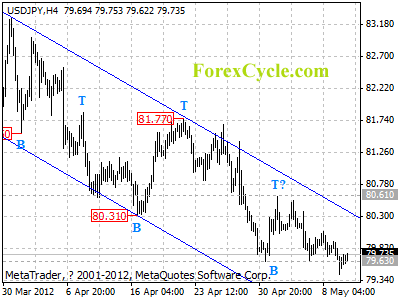
USDJPY breaks below 79.63 previous low

USDJPY breaks below 79.63 previous low and reaches as low as 79.43, suggesting that a downtrend from 84.17 has resumed. Further decline could be expected in a couple of days, and next target would be at 79.00 area. Key resistance remains at the upper line of the price channel on 4-hour chart, only a clear break above the channel resistance could signal completion of the downtrend.

usdjpy

Daily Forex Forecast

Beware of Chasing High Dividend Yields

By The Sizemore Letter

What’s the easiest way to find a stock with a 10% dividend yield?

Find a stock yielding 5% and watch its price get cut in half.

I say this mostly in jest, but this is precisely what happened to investors in RadioShack (NYSE:$RSH), the iconic electronics and gadgets chain still found in most American shopping malls.  At time of writing, RadioShack yields 9.8%, and this is after the company already slashed its dividend.

Given that it is paying out substantially more than it earns, RadioShack will almost certainly further reduce or eliminate its dividend in the coming quarters.  The company barely earns a profit, and it faces a war of attrition it can’t win against larger “big box” rivals like Best Buy (NYSE:$BBY) and Wal-Mart (NYSE:$WMT) and from internet retailers like Amazon (Nasdaq:$AMZN).

In a race with no winners, it will be interesting to watch what falls faster, RadioShack’s price or its dividend.

I’ll quit beating up on RadioShack.  In fact, I wouldn’t be surprised to see the company enjoy a nice rally in the months ahead.  No one can argue that RadioShack is not cheap; the stock trades for 0.67 time book value and a shocking 0.11 times sales.  Almost incredibly the stock currently sells for less than the value of its cash in the bank, $4.97 vs. $5.70.  (Before you value investors start licking your chops, keep in mind that RadioShack has substantial debts against that cash; as of year end, the company had $1.4 billion in debts vs. a little under a billion in cash and receivables.)

The stock could also benefit from a dead-cat bounce.  With the short interest in the stock currently more than seven times the average daily trading volume, it could benefit from a short-covering rally if nothing else.

But that is exactly how investors should view RadioShack—as a potential short-term trade and nothing more.  It should certainly not be considered a long-term income play, as that 9.8% yield can disappear overnight.

This brings me to the point of this article: an investor should never chase a high dividend yield.

Exceptionally high dividend yields generally mean one of two things:

  1. The dividend is expected to be the only source of return, and investors should not anticipate much in the way of capital gains.
  2. The dividend is at serious risk of getting cut and the market has already priced the stock accordingly.

The first category is not all bad, so long as investors understand this going into the trade.  Many popular investments such as mortgage REITS would fall under this category.  Annaly Capital (NYSE:$NLY) and Chimera Investment Corp (NY6SE:$CIM) both currently yield in excess of 13%.  The dividends are by no means stable, however, and the payout will almost certainly fall when the Fed eventually raises rates.

Tobacco companies have enjoyed phenomenal returns of late and have been the Sizemore Investment Letter’s best-performing investment theme over the past year (see “Tobacco Stocks Still Smokin’”), but they too should be considered zero-capital-gains investments over the longer term. Investors can profit quite handsomely from the reinvestment of dividends and from share buybacks, but this is a sector in long-term terminal decline.

It is the second category where investors tend to get themselves in trouble, both in the stock investing and bond investing.  Alas, your humble correspondent was one of the hapless souls who bought shares of Thornburg Mortgage in 2008 because it had a yield of over 10% and a “solid” portfolio of super-prime jumbo mortgages.  That 10% yield didn’t get me very far when the company filed for bankruptcy. How many other investors were seduced by the 20-30% yields offered on General Motors bonds around that same time?  Again, we know how that worked out.

Investors can avoid these traps by setting reasonable expectations.  If a yield seems too high to be true, it probably is.  Roll up your sleeves, take a look at the company’s financials, and make that judgment call with a sober mind.

Income seekers currently have their pick of the litter of safe, moderately high-yielding stocks with room for dividend growth and price appreciation.  As an asset class, master limited partnerships are attractively priced, and several—including Williams Partners (NYSE:$WPZ) and Kinder Morgan Energy Partners (NYSE:$KMP)—yield over 5%.

REITS are more expensive as an asset class, buy here too there are bargains to be found.  National Retail Properties (NYSE:$NNN) and Realty Income Corp (NYSE:$O) yield 5.7% and 4.5%, respectively, and consider both to be safe.

Investors willing to accept modest risk of a temporary dividend cut should consider Spain’s Telefonica (NYSE:$TEF).  Telefonica currently yields over 10%, and its share price has taken a beating along with the rest of the Spanish stock market.  I consider a dividend cut to be unlikely, though the Board may opt to conserve cash if the European capital markets seize up again.  Still, any cut in this case would be temporary, and I expect the dividend to be substantially higher 3-5 years from now.  Unlike, say, RadioShack, Telefonica has a healthy business with excellent long-term prospects, particularly in Latin America.  Use any weakness as a buying opportunity.

Disclosures: KMP, NNN, O and TEF are all holdings of Sizemore Capital’s Dividend Growth Portfolio.

“Bearish” Gold Hits 4-Month Low as Markets Fear Greek “Knock-On Effects”

London Gold Market Report
from Ben Traynor
BullionVault
Wednesday 9 May 2012, 08:00 EDT

SPOT MARKET gold bullion prices fell to their lowest level in four months during Wednesday morning’s London trading, hitting $1581 an ounce – 3.7% down on the week so far – while European stock markets and commodities also fell and US Treasuries gained, with Greek uncertainty continuing to cast a shadow.

A day earlier, gold fell below $1600 for the first time since early January.

“Gold seemed to know only one direction today – down,” says Tuesday’s note from Swiss precious metals group MKS.

“The bearish close opens up a full retracement to the December low of $1522,” adds the latest technical analysis from bullion bank Scotia Mocatta.

Silver bullion fell to $28.69 per ounce – also a four-month low, and 5.6% down on last week’s close.

On the currency markets, the Euro failed to regain $1.30, after falling back through that level yesterday having breached it on Monday for the first time since February.

Sterling meantime hit its highest level since August 2009 on a trade-weighted basis. The stronger Pound saw Sterling gold prices drop to £982 per ounce on Wednesday, their lowest level since last July.

On the New York Comex, open interest in gold futures trading rose to the equivalent of 1312.5 tonnes yesterday – up 2.4% on Tuesday last week – though it remains broadly in the middle of its range for the last five years.

It will not be known however what proportion of these positions were long and short until the Commodity Futures Trading Commission publishes its weekly Commitments of Traders report on Friday.

The volume of gold bullion held by the world’s biggest gold ETF, SPDR Gold Trust (GLD), remained unchanged Tuesday from a day earlier at just under 1275 tonnes.

GLD volumes did though spike higher yesterday, more than doubling from a day earlier to 17.8 million shares – although Monday’s volume was towards the lower end of the recent range.

The largest volume for GLD trading this year was 44 million on February 29, when gold fell $100 an ounce following Federal Reserve chairman Ben Bernanke’s appearance before Congress.

Alexis Tsipras , the leader of Greece’s left wing Syriza, which came second in Sunday’s election, will continue his efforts to form a government today, according to press reports.

The mandate to form a government passed to Tsipras after first-placed New Democracy was unable to form a coalition. The Syriza leader has outline a five-point plan which includes cancelling the terms of Greece’s bailout, suspending service payments on public debt, and investigating Greece’s banking sector.

“Voters [on Sunday] rejected the barbarous policies in the bailout deal,” said Tsipras Tuesday.

“They abandoned the parties that support it, effectively abolishing plans for [public sector] sackings and additional spending cuts…the popular verdict clearly renders the bailout deal invalid.”

Tsipras is today due to meet the leaders of New Democracy and third-placed Pasok – former coalition partners that backed Greece’s latest bailout and who both saw their shares of the vote fall on Sunday.

Many analysts, however, say they do not believe Tsipras will gain the agreements he needs to form a government.

“Mr. Tsipras asked me to put my signature to the destruction of Greece,” said New Democracy leader Antonis Samaras on Tuesday.

“I will not do this. The country cannot afford to play with fire.”

Should Tsipras fail to form a government, the mandate would pass to former Greek finance minister and Pasok leader Evangelos Venizelos.

“The Greek people asked for two things,” said Venizelos Tuesday.

“For Greece to stay safely in Europe and the Euro and at the same time to seek the best possible change in [bailout] terms so that citizens and growth can be helped.”

“Greece needs to be aware,” warned European Central Bank executive board member Joerg Asmussen Tuesday, “that there is no alternative to the agreed reform program if it wants to remain a member of the Eurozone.”

“A Greek return to the polls in mid-June looks increasingly likely,” says Malcolm Barr, London-based economist at JPMorgan Chase.

“There is little doubt that the drop in support for New Democracy and Pasok has raised the probability of an eventual Euro exit.”

“Greece in itself isn’t a big issue,” adds Adrian Cattley, European equity strategist at Citi.
“What does matter of course is the knock-on effects and contagion fears and what that would mean for the wider market.”

Here in the UK, prime minister David Cameron described the Euro as “a project in transition” in a newspaper interview published Wednesday.

“There’s nowhere in the world that has a single currency without having more of a single government,” said Cameron, although he added that “all these countries have to make their own choices” and that the Eurozone project “could go in a number of different ways”.

Spain’s government will tell the country’s banks to set aside an additional €35 billion as provision against loans made to the construction sector, newswire Reuters reports.

Ratings agency Moody’s meantime will begin cutting the credit ratings of over 100 banks this month, which could increase their funding costs and force them to reduce lending, according to Bloomberg.

China meantime has been buying oil from Iran and paying with Yuan and gold bullion, according to the Wall Street Journal.

Ben Traynor
BullionVault

Gold value calculator   |   Buy gold online at live prices

Editor of Gold News, the analysis and investment research site from world-leading gold ownership service BullionVault, Ben Traynor was formerly editor of the Fleet Street Letter, the UK’s longest-running investment letter. A Cambridge economics graduate, he is a professional writer and editor with a specialist interest in monetary economics.

(c) BullionVault 2011

Please Note: This article is to inform your thinking, not lead it. Only you can decide the best place for your money, and any decision you make will put your money at risk. Information or data included here may have already been overtaken by events – and must be verified elsewhere – should you choose to act on it.


Finding the Best Cheap Stocks to Buy

Article by Investment U

Finding the Best Cheap Stocks to Buy in 2012

"Testing undervalued, cheap stocks based on price-to-cash flow also turned out a stellar outcome, beating the market by 749%."

My mother believes shopping is a sport. If it were, there’s no doubt she would be a world champion. I’d say an Olympic gold medalist, but she lost her amateur status years ago.

When my mom shops, she’s not satisfied unless she’s getting top merchandise for at least 40% off.

And like a hunter who can’t wait to brag about the 12-point buck he took, my mother will tell anyone who’ll listen about the $300 sweater she got for $80. But unlike the tales of hunters and fishermen, when it comes to my mom and shopping, the big one doesn’t get away.

Everyone loves a bargain. But some people are willing to work harder to get it. Investors are like shoppers. Some will stand in line to buy the latest hot Apple product (or stock), while others will wait patiently until the product or stock they want goes on sale.

When investors look for cheap stocks, they often concentrate on the price-to-earnings ratio, or P/E. The P/E is simply the price per share divided by the past year’s earnings per share.

So in the case of Intel (Nasdaq: INTC), for example, the company earned $2.36 per share in the last 12 months. The current share price is $27.69. Divide $27.69 by $2.36 and you get a P/E of 11.7.

You can use that number to compare it to the P/E of the S&P 500 (15.3), its industry average (15.4), its historical average (17.1), or other specific stocks in its sector, to get an idea of whether the stock is cheap or pricey.

Analysts also look at forward price to earnings, which divides the price by the consensus analyst estimate for the next year. In Intel’s case, analysts project earnings of $2.49 per share in 2012, giving it a forward P/E of 11.1.

Methods Better Than P/E…

But I believe investors pay too much attention to earnings and not enough to cash flow. You can also obtain a company’s valuation based on price to cash flow and, like P/E, compare it to industry averages, the S&P 500, etc.

Other popular valuation metrics include price to sales (P/S), which is the share price divided by revenue per share. If revenue per share isn’t readily available, all you do is divide the last 12 months’ sales and divide by the number of shares.

Price to book value (P/B) is also a popular tool. Book value is the value of the assets investors would get if the company were liquidated. Book value is simply shareholders’ equity (found on the balance sheet) divided by the number of shares outstanding.

Which one is more important when it comes to price performance?

Let’s take a look at each. I ran a stock screen and a corresponding backtest to measure the performance of all stocks whose valuation in each of those four metrics (separately) was below the average of its industry.

Over the past 10 years, if you bought every company (that was profitable) trading below its industry’s average price-to-earnings ratio and held the stock for one year, you’d have outperformed the S&P 500 by 218%. In only two out of the 10 years would that formula have underperformed the market – and not by much.

A recent example is Apache Corporation (NYSE: APA), trading at 7.8 times earnings versus the average insurer at 17.8.

Price-to-Cash Flow

Testing undervalued, cheap stocks based on price-to-cash flow also turned out a stellar outcome, beating the market by 749%. It underperformed the market in three out of 10 years, but the worst year was only by 3.15%. Conversely, in six of the seven years it beat the market it did so by double digits, several times by 50% or higher.

Sprint Nextel (NYSE: S) currently trades at just 1.9 times cash flow, which is dirt cheap, even in its industry, which only trades at an average of 4.6 times cash flow, compared to the S&P 500, which is valued at 9.1 times cash flow.

Price-to-Book Value

The results were even better on stocks trading at a lower price-to-book value than their industry average. Over the 10-year period, those stocks climbed 2,193% versus the 13% of the S&P 500. These stocks beat the market every year, including by over 100% in 2009 and 2010. A current example is NVIDIA Corporation (Nasdaq: NVDA), which trades at 1.8 times its book value, versus its industry average of 2.8.

Price-to-Sales Ratio

When I ran the backtest using companies whose price-to-sales ratio was below the industry average, something incredible happened. A $1,000 investment in 2001 turned into $286,535! While the same amount invested in the S&P 500 was worth $1,130.

The screen beat the S&P 500 in every year. But what was really interesting was that in 2003 and 2009, years in which the overall market recovered from steep sell-offs, the low P/S stocks went nuts. They outperformed the S&P 500 by 232% in 2003 and 745% in 2009.

Keep in mind, this involved owning a few thousand stocks, so this isn’t easily copied in real life, but it might give you a starting point the next time we start to come out of a nasty bear market.

Symantec (Nasdaq: SYMC) is a current example, trading at just 1.8 times sales versus its peers’ average of 3.8 times sales.

You obviously don’t want to run a screen, throw a dart at the list and buy a stock. You want to dig a little deeper. But by knowing which types of stocks tend to outperform the market, you increase your chances of getting a bargain that you’ll be as happy with as my mother is with a $400 designer jacket that she got for $35 (true story).

Good Investing,

Marc Lichtenfeld

Article by Investment U

Dólar Mantém Baixa em Relação ao JPY

By TraderVox.com

O dólar se manteve abaixo do valor psicologicamente significativo de 80.00 em relação ao iene ao longo da sessão de trade de ontem, já que os investidores mantiveram a tendência de baixa da moeda, em razão dos fracos dados do relatório da Folha de Pagamento não Agrícola dos EUA da semana passada.

Após subir para 80.01 durante a noite, o USD/JPY caiu cerca de 30 pips e subsequentemente passou a maior parte do dia em torno de 79.80. A moeda-verde teve mais sorte em relação ao dólar canadense ao longo do curso do dia. O USD/CAD subiu quase 50 pips durante a sessão europeia, atingindo por fim a alta de 0.9978.

Por hoje, notícias lentas significam que qualquer movimento no dólar provavelmente será resultado de pronunciamentos feitos na zona do euro. Devido às incertezas políticas na Grécia, os investidores continuam mantendo a tendência de baixa do euro. Qualquer notícia negativa extra, proveniente da Grécia, que seja divulgada hoje, pode fazer com que os investidores mantenham a aversão ao risco, o que pode derrubar o dólar em relação ao JPY.

No decorrer da semana, os investidores deverão lembrar de prestar atenção ao discurso do presidente do Fed, Bernanke, na quinta-feira. O pronunciamento pode incluir dicas a respeito da possibilidade de uma nova rodada de flexibilização quantitativa nos EUA, o que pode gerar volatilidade no dólar.

Article provided by TraderVox.com
Tradervox.com is a Forex News Portal that provides real-time news and analysis relating to the Currency Markets.
News and analysis are produced throughout the day by our in-house staff.
Follow us on twitter: www.twitter.com/tradervox

Slow News Day May Lead to Further Euro Losses

Source: ForexYard

The euro remained relatively unchanged vs. its main rivals throughout the European session yesterday, as political uncertainty in the euro-zone kept the currency near its recent lows. After dropping as low as 1.3000 during early morning trading, the EUR/USD spent most of the day trading around 1.3010. Turning to today, a slow news day may lead to low liquidity in the marketplace. Traders will want to note that a low liquidity environment can often lead to unexpected price shifts for seemingly no reason. Given the euro’s recent bearish trend, the possibility for further downward movement for the common currency exists.

Economic News

USD – Dollar Remains Bearish vs. JPY

The US dollar remained below the psychologically significant 80.00 level vs. the Japanese yen throughout yesterday’s trading session, as investors remain bearish toward the currency following last week’s poor US Non-Farm Payrolls figure. After climbing as high as 80.01 during overnight trading, the USD/JPY dropped over 30 pips and subsequently spent much of the day trading around 79.80. The greenback had more luck against the Canadian dollar over the course of the day. The USD/CAD was up close to 50 pips during the European session, eventually reaching as high as 0.9978.

Turning to today, a slow news day means that any dollar movement will likely be a result of announcements out of the euro-zone. Given the current political uncertainty in Greece, investors continue to remain bearish toward the euro. Should any additional negative news out of Greece be released today, investors may remain risk averse which could bring the dollar lower against the JPY. Later in the week, traders will want to remember to pay attention to a speech from Fed Chairman Bernanke on Thursday. The speech could include clues regarding a possible new round of quantitative easing in the US, which could create dollar volatility.

EUR – Political Uncertainty Continues to Weigh Down on Euro

The inability of Greece’s biggest political parties to form a parliamentary majority raised the prospects that there will be another round of elections in the country next month. The news generated additional concerns among investors about the prospects of euro-zone economic growth, which subsequently kept the euro near its recent lows throughout trading yesterday. While the EUR/JPY advanced some 30 pips earlier in the day, it quickly gave back its gains and spent the majority of the day trading around the 103.80 level. Similarly, the EUR/USD reversed slight upward movement it saw during the morning session to spend most of the day trading around the 1.3010 level.

Turning to today, traders will want to monitor any developments out of the euro-zone, particularly with regards to the political situation in Greece. Any indications that Greece will move away from the fiscal austerity measures it promised to undertake could result in further euro losses. Additionally, investor concerns regarding France’s new government could cause the euro to extend its bearish trend. The French President is known to differ with Germany regarding the best way toward euro-zone economic growth. Any signs of a future conflict may lead to additional risk aversion in the marketplace.

AUD – Risk Aversion Leads to Additional Aussie Losses

Ongoing concerns regarding the political situation in the euro-zone caused investors to abandon riskier assets during yesterday’s trading session, resulting in losses for the Australian dollar. The AUD/USD fell over 90 pips during European trading, reaching as low as 1.0101. Against the Japanese yen, the aussie dropped over 95 pips, reaching as low as 80.59 during the afternoon session.

Turning to today, the AUD may continue to drop depending on any announcements out of the euro-zone. Should investors determine that new governments in Greece and France will conflict with other euro-zone countries regarding the best way toward euro-zone economic growth, riskier currencies like the Aussie may extend their bearish trends.

Crude Oil – US Crude Inventories May Bring Oil Down Further

Crude oil dropped over $1 a barrel during trading yesterday, as risk aversion continued to dominate market sentiment following poor US and euro-zone news. After peaking at $97.90 during the overnight session, the commodity proceeded to fall throughout the day, eventually dropping as low as $96.53 during mid-day trading.

Turning to today, traders will want to pay careful attention to the US Crude Oil Inventories figure, scheduled to be released at 14:30 GMT. A steadily increasing level of US stockpiles has been interpreted as a sign of declining demand in the US, the world’s largest oil consuming country. Should today’s news come in above 2.0M, the price of oil may fall further during the afternoon session.

Technical News

EUR/USD

The Williams Percent Range on the weekly chart has dropped into oversold territory, indicating that this pair could see upward movement in the coming days. Furthermore, the MACD/OsMA on the same chart appears to be forming a bullish cross. Traders will want to keep an eye on this pair, as it could stage an upward correction in the near future.

GBP/USD

A bearish cross has formed on the weekly chart’s Slow Stochastic, in a sign that downward movement could occur for this pair. In addition, another bearish cross on the daily chart’s MACD/OsMA is providing further evidence of an impending correction. Traders may want to go short in their positions.

USD/JPY

Most long term technical indicators place this pair in neutral territory, meaning that no definitive trend can be predicted at this time. The one exception is the weekly chart’s MACD/OsMA, which has formed a bearish cross. Traders will want to keep an eye on some of the other indicators on the weekly chart for signs of an impending downward correction.

USD/CHF

The Williams Percent Range on the weekly chart has crossed over into overbought territory, indicating that this pair could see downward movement in the near future. Furthermore, the Relative Strength Index (RSI) on the same chart is moving upward and appears poised to cross into the overbought zone as well. Traders will want to keep an eye on the RSI. If it crosses above 70, it may be a good time to open short positions.

The Wild Card

AUD/JPY

A bullish cross on the daily chart’s Slow Stochastic indicates that this pair could see upward movement in the near future. The Relative Strength Index on the same chart has dropped into oversold territory, giving further support to the theory of an impending upward correction. Forex traders may want to go long in their positions.

Forex Market Analysis provided by ForexYard.

© 2006 by FxYard Ltd

Disclaimer: Trading Foreign Exchange carries a high level of risk and may not be suitable for all investors. There is a possibility that you could sustain a loss of all of your investment and therefore you should not invest money that you cannot afford to lose. You should be aware of all the risks associated with Foreign Exchange trading.


Mid Day EUR/USD Technical Analysis

By TraderVox.com

Tradervox (Dublin) – The US Dollar index is trading at monthly highs of 79.93. The dollar opened the day in tight trading lingering around the 80 mark which served as a strong resistance. Moving into the day the dollar fell on the better than expected German trade balance data to find support at 79.87. The dollar then saw a sharp bullish correction to 79.93.The dollar likely to hold onto to the 79 level due to high risk sentiment preventing any downside movement. Any upside movement will face strong resistance at 80 levels, a level which the dollar will it difficult to break as the fears of another round of quantitative easing are looming around after last week’s weak Non Farm Pay Rolls data.

The EUR USD is currently trading in tight markets with bearish sentiments dominating. The bearish trend is not very strong and there is no sufficient volatility to cause to a major sell off in the EUR USD pair. The 10 day moving average and the 20 day moving average are showing sharp bearish divergences while the RSI is lingering at levels near to the oversold region. This oversold criterion and the presence of many long EUR/USD barrier options at around the 1.29 level is supporting the pair and helping it to hold onto to the 1.29 level.

The pair is currently trading at 1.2977 levels and any upside movements in the pair is likely to be limited by the strong resistance at 1.2994. To the downside the support first support lies at 1.2962 and a selling here would drive the pair to 1.29471, the low of January 25th.

Moving onto the longer time frame, the EUR USD bears are very strong supported by impressive volatility numbers. This will likely see the EUR/USD see a sharp drop in value to touch 1.288 levels in the coming weeks.

The economic calendar has not charted out any major market moving events for the day and this will further help the Euro to hold onto the 1.297 to 12.96 levels as the pair moves into the US session.

Disclaimer
Tradervox.com is not giving advice nor is qualified or licensed to provide financial advice. You must seek guidance from your personal advisors before acting on this information. While we try to ensure that all of the information provided on this website is kept up-to-date and accurate we accept no responsibility for any use made of the information provided. Opinions expressed at Tradervox.com are those of the individual authors and do not necessarily represent the opinion of Tradervox.com or its management. 

Article provided by TraderVox.com
Tradervox.com is a Forex News Portal that provides real-time news and analysis relating to the Currency Markets.
News and analysis are produced throughout the day by our in-house staff.
Follow us on twitter: www.twitter.com/tradervox