Market Review 15.5.12

Source: ForexYard

printprofile

The euro dropped to a fresh four-month low in overnight trading as investors remain concerned about Greece’s prospects for staying in the euro-zone. The US dollar saw a slight upward correction against the yen, but was unable to advance above 80.00.

Main News for Today

German ZEW Economic Sentiment-09:00 GMT
• Forecasted to come in at 19.1, slightly below last month’s figure
• If it comes in at or above expectations, the euro could see temporary gains against USD, JPY
US Core CPI, Core Retail Sales, Retail Sales-12:30 GMT
• Investors will be closely watching all three of these indicators
• If they come in below expected levels, it will likely raise fears that the Fed will initiate a new round of quantitative easing which could result in heavy dollar losses against yen
• Any better than expected results could help the dollar recoup losses against JPY

Read more forex news on our forex blog

Forex Market Analysis provided by ForexYard.

© 2006 by FxYard Ltd

Disclaimer: Trading Foreign Exchange carries a high level of risk and may not be suitable for all investors. There is a possibility that you could sustain a loss of all of your investment and therefore you should not invest money that you cannot afford to lose. You should be aware of all the risks associated with Foreign Exchange trading.

Euro Rallies after German GDP

By TraderVox.com

Tradervox (Dublin) – The 17-nation currency has been on the low for the third week now; however, the German GDP which came in better than the market was expected helped the euro to pare some of the losses it had incurred due to political situation in Europe. The euro has rebounded from almost a four-month low after German GDP report was released.

The euro had earlier declined against the dollar and the yen as concerns that Greece will exit from the 17-nation trading bloc increased as finance ministers met for the second time to discuss the issue. However, the demand for the dollar was also limited as the market awaits the Federal Reserve Minutes tomorrow.

A report from Germany showed the gross domestic product for the country grew by 0.5 percent in the last quarter from the previous three months ending December 2011 when it declined by 0.2 percent. Economists had predicted a growth of 0.1 percent in the GDP. The report has led to the increase of the euro against major currencies, and analysts have associated the recent buying of the euro as a result of the report from Germany.

The euro gained 0.2 percent against the dollar to trade at $1.2847 at the start of London session. Earlier, the 17-nation currency had dropped to its weakest since January 18 to trade at $1.2814. Against the Japanese currency, the euro gained 0.2 percent from a February 16 low of 102.23 to trade at 102.61. The yen dropped marginally against the greenback trading at 79.88 yen from 79.85 it had registered earlier.

Euro’s gain is limited by the continuing turmoil in the euro-zone as major pro-austerity governments are being replaced by anti-austerity governments in the region. The new French President Francois Hollande has vowed to fight austerity measures, while in Greece, the President is holding meeting with political leaders to ensure that a government of national unity is formed to avoid going into another poll.

Disclaimer
Tradervox.com is not giving advice nor is qualified or licensed to provide financial advice. You must seek guidance from your personal advisors before acting on this information. While we try to ensure that all of the information provided on this website is kept up-to-date and accurate we accept no responsibility for any use made of the information provided. Opinions expressed at Tradervox.com are those of the individual authors and do not necessarily represent the opinion of Tradervox.com or its management. 

Article provided by TraderVox.com
Tradervox.com is a Forex News Portal that provides real-time news and analysis relating to the Currency Markets.
News and analysis are produced throughout the day by our in-house staff.
Follow us on twitter: www.twitter.com/tradervox

APPEA – Day One at the Oil & Gas Show: Sand Dunes, Scuba Diving and Camels

By MoneyMorning.com.au

Over the last six months, energy stocks have been some of the best performers in the stock market.

With good reason – global energy demand is set to keep soaring.

As I mentioned in yesterday’s Money Morning, the International energy Agency (IEA) estimates global energy demand will increase by ONE THIRD in the next 25 years.

So to get the ‘good oil’ on the oil and gas sector, I’m in Adelaide to join 3000 other delegates for the Australian Petroleum Production and Exploration Association (APPEA) annual conference.

It’s a pretty heavyweight conference…

We heard from the International Energy Agency (IEA).

Federal and State politicians have weighed in.

Plus, we’ve seen the top executives from global oil companies like Total, and big Aussie firms like Woodside and BHP Billiton Petroleum. But yesterday’s highlights were just as much about what wasn’t said as about what was said, as I’ll explain now…

The Bureau of Resources and Energy Economics talked bullishly about China’s demand for natural gas. Unconventional gas has had a lot of focus, with very interesting talks from Clough Ltd [ASX: CLO], Wood Mackenzie and more from Total S.A. [NYSE: TOT].

All this info means there is a great deal to take in and think about.

After a long day of furious note taking, my brain seized up and it was time for a few medicinal cold ones to help process it all.

So, how would I sum up the first day?

In reflection, the speech from the Saudi Arabian oil minister, Ali Ai-Naimi, should have been a highlight of the first day.

As the most senior executive person in the world’s largest oil exporter, he’s the world’s most important ‘oil-man’. The auditorium was packed, and I was looking forward to his talk. This should have been the meatiest speech of all.

But it was as meaty as a veggie burger.

Saudi Arabia ‘Optimistic’ About New Oil Finds

The big-man was funnier than I expected, but he didn’t give much away at all.

He warmed up with a few gags about how he felt right at home in Australia because of the sand dunes, scuba diving and camels.

Great – but let’s get to business. So when he got talking about the importance of geopolitics of the energy revolution, I thought things were about to get interesting. Would he reveal his views on Iran…maybe Syria…what about China and India?

No luck.

All we got were clichés on the benefits of developing good trade ties with Australia. Nothing on US sanctions squeezing Iranian production. Not a bean on India buying Iran’s oil with gold. And silence on the threat of a potential blockade of the Persian Gulf.

Ali Ai-Naimi also spent a surprising amount of time talking up renewable energy. I thought this was an oil and gas conference? I guess he has to earn the requisite number of politically correct points in public, seeing as his nation is indirectly responsible for a large chunk of the world’s CO2 emissions.

But what about how Saudi Arabia planned to raise its production levels?

The Saudis forever talk about increasing production. They claim they have spare capacity of a few million barrels a day. When the world uses around 90 million barrels a day, that much spare capacity would really take the heat out of the oil price.

But, for all the talk, it’s never happened. How can we believe they have this spare capacity? And how do they plan to increase production from ageing oil fields in the future?

This was the good part of the speech. We heard how Saudi Arabia is investing in technological improvements. They have increased their brain trust by employing three times as many scientists, and have increased collaboration with Australian Universities. They have new seismic data and other geophysical information. That could bear fruit in the long-term.

But what about now?

Here’s what al Naimi said:

‘We are targeting the discovery of significant additional oil resources within the Kingdom… We have also initiated a program to explore frontier areas within Saudi Arabia, including the Red Sea. And while are in the early stages of exploration and evaluation, we are optimistic about the potential for significant discoveries’

Optimistic? That’s nice.

Optimism doesn’t guarantee results. For some time, I’ve been ‘optimistic’ that Port Phillip Publishing will give Keira Knightley a job as a secretary…but it’s yet to happen.

Anyway, one part of the plan to increase output could work. Using recent improvements in production technology, the Saudis aim to increase production by ‘…Increasing aggregate recovery in our major producing fields from the current 50% average to 70%’.

The technological improvements in recent years are astonishing, and could breathe new life into old fields.

The catch is that the methods are usually significantly more expensive. This may be why Saudi Arabia increased the oil price ‘target’ to $100 a barrel back in January. Or that could have just been due to the increased fiscal cost of pacifying Saudi citizens during the Arab Spring.

All up, I had expected much more from Ai-Naimi, the ‘Central banker of Oil’. But clearly he was here as a diplomat, creating relationships – and not controversy.

So, what about the rest of the day?

30 Years of Energy Growth

Fortunately, it was as meaty as it gets, and I got what I came here for. The meat and potatoes were the expert’s views on the exciting future of unconventional energy, and Australia’s place in what could be the biggest money-spinner and job-creator in the resources sector for the next 30 years or more.

To begin the day there were a few mandatory pot shots fired between the politicians and everyone else.

The politicians talked up how incredibly well Australia could do from the energy boom, while everyone else was saying that this boom depends squarely on the politicians creating a stable regime.

In the words of APPEA’s Chairman, David Knox:

‘…I’m talking about the need for a stable fiscal and regulatory environment. Governments need to mindful of not just their capacity to facilitate investment growth, but also their capacity to impede it…[they] need to be conscious that projects are competing for investment dollars globally… My message to the Australian Government is: Do not create uncertainty.

It takes me back to those heady early days of the mining tax debate. Politicians’ eyes lighting up with dollar signs, while those living in the real world reminded them it’s only fair that investors ask for fiscal stability when they’re stumping up a few hundred billion dollars.

We’ve seen all this before. But what I didn’t see coming was Minister for Resources and Energy, Martin Ferguson, agreeing. He conceded tax changes and uncertainty are no good for the energy sector, and warned the cabinet against fiscal instability. Who would have thought?

The Managing Director and CEO of Woodside, Peter Coleman, also made the same point about having a stable and competitive fiscal regime.

A good example of how governments can impede growth is that Australia is the second most expensive producer of LNG.

This is partly because of higher labour costs due to a skill shortage, which could be fixed with changes to immigration policy. Production costs are also higher as Aussie States have different safety standards, so companies in two states have to jump through twice as many legal hoops, causing unnecessary extra costs without making anything safer.

Aussie LNG Imports to Rise 460%

Woodside celebrated its first LNG shipment from its Pluto project this year. Coleman pointed out the timing was auspicious – it is 70 years exactly since its namesake, the ‘Pluto’ pipeline, was built across the English Channel in total secrecy. This carried oil to Allied troops in Europe. In the words of General Patton: ‘My men can eat their belts…but my tanks gotta have gas.’

Today it’s Asia that’s ‘gotta have gas’. 17 LNG receiving terminals are being built across Asia, and 18 more are planned for construction before 2020. Asia is the greatest source of LNG demand, though globally demand is expected to increase around 5% a year for the rest of this decade. Where’s it all going to come from?

There are a few LNG producers globally, with Qatar the biggest, but Australia has a chance of becoming the largest. Pluto has just come on line, but there are another eight huge projects in the wings, including Gorgon, Browse, Ichthys, Gladstone and others.

Cristophe de Margerie, the Chairman and CEO of Total pointed out that Australia currently produces 25 million tonnes a year. By 2018, this could increase to 80 million tonnes a year. Going out to 2024 it could be more like 140 million tonnes.

That’s if everything goes to plan of course – but when does that ever happen?

Finally, the biggest buzzword at the conference is ‘Shale’.

There have been some excellent presentations on ‘shale gas‘ and ‘shale oil’. Technological advances have opened up energy resources that simply weren’t there 7 years ago.

Shale is completely rewriting the energy landscape in terms of new suppliers, new markets and commodity prices. But I’ll save that for tomorrow.

This morning’s presentations are about to kick off and are titled ‘making the unconventional conventional’, so it’s time to knock back a few more coffees and get the notepad out.

I’ll be back tomorrow.

Dr. Alex Cowie
Editor, Diggers and Drillers

Related Articles

The Conference of the Year “After America” DVD

The Great Push North for Arctic Oil Continues

Why Europe Will Ditch Green Energy


APPEA – Day One at the Oil & Gas Show: Sand Dunes, Scuba Diving and Camels

Oil and the Death of Greece

By MoneyMorning.com.au

As the Eurozone continues to show weakness, events in Greece may accelerate the situation. The downward movement in oil prices in both London and on the NYMEX testifies to the rising concern.


The aftermath of the Greek elections propelled the new radical left party SYRIZA into the limelight as the second strongest party in the country. Given the adamant refusal by SYRIZA leadership to accept bailout reforms, the party’s new brokering position means the crisis will continue.

Bitter austerity measures await the formation of a coalition government, since no party received a majority of the seats in parliament from the vote. The coalition is supported by both the New Democracy and socialist PASOK parties, which have taken turns ruling Greece for nearly four decades.

But the surprise showing of SYRIZA has thrown the possibility of an accord into disarray.

At best, this means a further delay and likely a new election.

On the other hand, Greece has little time left. Any further delay in forming a government, with no guarantee that a very angry population will vote any differently the next time around, puts the next tranche of the European Union bailout package in jeopardy.

It is now more likely that Greece will leave (or be pushed out of) the Eurozone, casting a greater uncertainty on both the currency and the southern tier of countries still in the zone.

What Then?

Spain is the current focus of concern, but Italy is also exhibiting renewed weakness.

Unlike Greece, Spain and Italy have debt problems that dwarf the ability of any Brussels-led support package. These economies are simply too large to be “rescued” from the outside.

The concerns over contagion, therefore, may actually expedite a Greek departure earlier than most thought possible.

Including me.

It is true that any members leaving the Eurozone will have a negative effect upon currency strength and economic prospects. It is also unclear how the Greek departure will aid in shoring up either Spain or Italy. The problems in each of these economies are endemic; they are not primarily a result of “spillovers” from the situation in Greece.

All of which means, to borrow a phrase from former U.S. Secretary of Defense Donald Rumsfeld, there are a series of “known unknowns” now facing the E.U. The credit and banking problems are essentially the “known” part of this equation. The extent of the fallout on the euro as a whole is the massive “unknown” flowing through the calculations.

This is accentuated by recent developments in the two major economies using the euro -Germany and France. No rescue package for any E.U. member is possible without the leadership of these two dominant European economies. To date, Paris has emphasized protecting its suspect banking sector, while Berlin has a strong political undercurrent demanding additional protection of German production and trade.

However, the recent French elections, in which a socialist has been elected president, and indications surfacing that the German economy may be facing a slowdown, will put continued support of a “bailout for austerity” approach to Greece in question.

Thus far, both major nations have led the E.U.-Greek approach, strongly arguing that the preservation of the euro demands it. The dramatic political events unfolding in Athens are rapidly undermining that support.

And this has impacted on the price of oil.

The Oil Market: Like 2008?

The only way oil prices are coming down is by the advance of pressures outside (exogenous to, as the analysts say) the oil market itself.

This is what happened in 2008. The rise in crude and the corresponding spike in the cost of oil products like gasoline, diesel, and heating oil retreated only when the full weight of the subprime mortgage-induced credit freeze hit.

Overall demand dried up as the ensuing recession hit.

We are seeing a similar short-term pullback in prices as concerns over falling demand levels parallel the European confusion.

Yet this time there are three important differences.

First, the American economy is largely insulating itself from what happens on the continent (assuming the JP Morgans of the world can oversee their traders).

Second, oil demand continues in those parts of the world that actually determine the pricing level. As I have said a number of times before, these are not North America, Western Europe or the developed (OECD) countries. This is based on developing and accelerating new economies elsewhere.

There is also a third factor of some importance.

The 2008 collapse and resulting worldwide recession centred on dollar-denominated assets, the assets basic to the global network of trade, cross-border capital flows, and wealth.

Not so this time around.

The current situation tends to benefit the value of the dollar against the euro. With virtually all international oil trades in dollars, that does mean prices may stabilize for a time. But it also means the concentrated asset wealth in those oil transactions will increase.

And despite the events in Europe, the ultimate value of oil contracts will increase as well – especially in a market where the essential rise in demand is occurring in those regions of the world not directly impacted by the euro zone problems.

So, farewell Greece, good luck, Spain.

Once the dust settles, oil holdings will continue to exhibit significant value gains moving forward.

Dr. Kent Moors
Contributing Editor, Money Morning

Publisher’s Note: This article originally appeared in Energy & Oil Investor

From the Archives…

What Newton Knew About House Prices …That the IMF Should
2012-05-11 – Kris Sayce

Why a Greek Exit From the Eurozone Could Be Great News For Markets
2012-05-10 – John Stepek

Why Europe Will Ditch Green Energy
2012-05-09 – Kris Sayce

Why It’s Time to Buy Gold
2012-05-08 – Dr. Alex Cowie

Why You Should Be Watching Japan’s Economy
2012-04-07 – Dan Denning


Oil and the Death of Greece

The Case for Higher Gold Prices

By MoneyMorning.com.au

Gold prices had gold bugs giddy in the fall of 2011. In September, the luminous yellow metal touched an intraday high of $1,920 a troy ounce, putting the precious metal up roughly 35% for the year.

At the time it seemed like investors, traders and even the guy at the corner store were all buying, hoarding, and lusting for gold.

But the stellar gains were short lived, and by the end of the year gold prices had fallen by nearly 20%.

Part of the striking decline in gold was due to the fact that the “smart” money that had once been amongst gold’s biggest cheerleaders, sold it.

Some booked profits, some sold it to reflect gains in portfolios, others were forced to sell to meet margin requirements, and others wanted to start the New Year with a clean slate.

Gold Prices in 2012

Enter 2012, and gold prices enjoyed a lustrous January, rising some 10%, helped in particular by Chinese New Year celebrations.

Gold has since languished as investors became more willing to take on added risk, delving more into equities. While gold prices foundered, the Dow rose 8% in the first quarter, the S&P 500 gained 12%, and the Nasdaq enjoyed a nearly 19% gain.

And more recently, not even gold’s best friend, Federal Reserve Chairman Ben Bernanke, offered up much help.

Following the commencement of the two-day FOMC meeting, gold experienced a volatile day, but managed to end virtually flat from the previous trading session. The Fed left interest rates steady and extinguished hopes for immediate further monetary loosening measures.

Without a promise of more quantitative easing, long gold holders headed for the exits.

Nonetheless, many sophisticated gold traders are poised to pounce on gold with every dip.

Among them is the storied and accomplished commodities investor Jim Rogers.

Best known for calling the commodities rally in 1999, Rogers recently said, “If there is a shock to the system, such as a eurozone country like Spain going bankrupt, then everything will go down, and I hope I am smart or alert enough to buy more gold at that point.”

The renowned investor also added that if India, the world’s largest bullion buyer, implemented another tax increase on gold imports, it would pave the way for a smart entry point for investors, since it would limit the country’s input to the gold market. The Indian government hiked the tax level for gold bars, coins and platinum to 4% in March, up from 2% in January.

Meanwhile, Rogers is mildly bullish about economic conditions in the United States for 2012, noting that because we are in an election year, the government is pulling out all the stops to boost the U.S. economy for at least two years.

So, Rogers is positioning his portfolio by stocking up on commodities, including gold. He explains that if economies do recuperate and prosper, they are going to need more commodities.

Conversely, Rogers says that if growth wanes and a recession looms, he wants to have a stash of commodities because of the flood of money-printing that is bound to follow.

Either way, Rogers likes gold.

That is not to say that gold is bulletproof. In fact, Rogers says a gold price correction could happen sooner rather than later, and the downside is $1,200-$1,300 a troy ounce.

Investors may be wise to watch for and seize upon any sell-offs in gold.

The Power of Gold

Of course, there are myriad reasons to be enamored by the precious metal.

As the World Gold Council notes:

  • Gold is one of the few financial assets that does not rely on an issuer’s promise to pay.
  • It offers investors insurance against extreme movements in the value of other asset classes.
  • It provides a portfolio with diversification, adding protection against fluctuations in the value of one single asset or group of assets.
  • It acts as a hedge against inflation because it retains its purchasing power.
  • It is held as a hedge against currency fluctuations.
  • The demand for gold has shown sustained growth in recent years and the supply/demand ratio has positioned the yellow metal for its most positive outlook in over a quarter century.

And as more and more people become disenchanted with paper currency as a store of value, gold prices promise to rise.

Diane Alter
Contributing Writer, Money Morning (USA)

Publisher’s Note: This article originally appeared in Money Morning (USA)

From the Archives…

What Newton Knew About House Prices …That the IMF Should
2012-05-11 – Kris Sayce

Why a Greek Exit From the Eurozone Could Be Great News For Markets
2012-05-10 – John Stepek

Why Europe Will Ditch Green Energy
2012-05-09 – Kris Sayce

Why It’s Time to Buy Gold
2012-05-08 – Dr. Alex Cowie

Why You Should Be Watching Japan’s Economy
2012-04-07 – Dan Denning


The Case for Higher Gold Prices

USDJPY pulls back from channel border

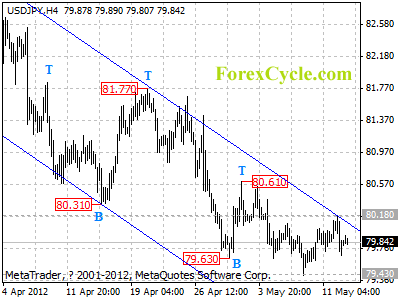
After touching the upper line of the price channel on 4-hour chart, USDJPY pulls back from 80.18. The fall could possibly be resumption of the downtrend from 84.17 (Mar 15 high), further decline towards 78.00 would likely be seen over the next several days. Resistance remains at the upper line of the channel, only a clear break above the channel resistance could signal completion of the downtrend.

usdjpy

Forex Signals

Emerging Market Bonds: Less Risk Than You Think

Article by Investment U

Emerging Market Bonds: Less Risk Than You ThinkOne new option to note, iShares invests in an index of dollar bonds based on the J.P. Morgan USD Emerging Markets Bond Fund (NYSE: EMB).


One question on many investors’ minds right now is how to beat inflation. U.S. Treasuries and certificates of deposit obviously can’t cut it right now…

There’s a simple reason investors are flocking to the dividend market – savers don’t want to lose their purchasing power.

But lately there’s been a new trend for yield chasers overseas and it may be less risky than you think. Returns over inflation look very attractive right now. For the first quarter for 2012, the average emerging bond fund tracked by Morningstar returned 7%, versus 0.3% for the Barclays Capital U.S. Aggregate Bond Index.

But Why Emerging Market Debt?

Some fund companies offer two types of emerging market bond funds: those that invest mainly in bonds issued in U.S. dollars and those that invest mainly in bonds issued in local currencies.

Dollar-denominated foreign bonds have been on the rise and they attract those who are a little hesitant about currency risk.

Because of lower borrowing costs, companies from nations such as Brazil, Russia and Indonesia are diving into the U.S. debt market.

This is a good thing for potential investors in the market. Emerging market firms issued a record $75 billion in dollar-denominated bonds in the first quarter, a 40% spike over the same period last year.

The extra bonds out there have given investors a way to get higher yields than what’s available at home. The “yield chasers” have pumped in $14 billion into emerging markets bond funds in the first quarter, the most since the third quarter of 2010.

Emerging Market Companies Are Maturing

Have corporate bonds in emerging markets become fashionable because of a herd mentality? Or have we here stateside gotten over our developed country bias?

Bonds have been proven to add true diversification to portfolios. Also, bond issuers – countries and companies – in developing markets are maturing. By some measures, their bonds look more attractive than those of the developed world.

In a March research paper, Christopher B. Philips and colleagues in Vanguard’s Investment Strategy Group found that a well-diversified portfolio that includes an allocation to hedged international bonds may could help get rid of overall portfolio volatility.

The study showed that investors could benefit from allocating at least 20 to 40% of their fixed-income holdings to international bonds. Emerging market bonds could be part of that allocation for risk-tolerant investors, Mr. Philips said.

What scared a lot of investors from international bonds are interest rate risk, shady political regimes and policies, and the economies of many different markets. Mr. Philips’ team found that the things driving international bond prices are relatively uncorrelated to those same things in the United States. That’s key as a diversification benefit.

What You Need to Weigh

Things you need to be wary of overseas:

  • We may have more bonds out there, but a lot of money managers are buying them up quickly. It may be too quickly. Yields on emerging market corporate bonds have fallen 1.5 percentage points since October, according to J.P. Morgan data.
  • This is a new market. There’s a short time frame for evaluating these types of bonds with their U.S. counterparts.

Some things that may allow you to overcome your concerns:

  • Developing countries are expected to expand 5.75% through next year. That’s almost four times the growth projected for the developed world, the International Monetary Fund says.
  • The payout on the J.P. Morgan Corporate Emerging Market Bond Index Broad Diversified, which has an average triple-B credit rating, currently averages 5.6%. That’s 1.1 percentage points above similar rated U.S. corporate bonds.

Among funds tracked by Morningstar, there are no index mutual funds for emerging-market bonds yet. Index ETFs investing in emerging market bonds are available, but as we’ve written many times before, watch out for leveraged bond funds. One new option to note, iShares invests in an index of dollar bonds based on the J.P. Morgan USD Emerging Markets Bond Fund (NYSE: EMB).

Good Investing,

Jason Jenkins

Article by Investment U

How to Instantly Diversify Your Portfolio By 70%

Article by Investment U

How to Instantly Diversify Your Portfolio By 70%

In order to have a truly diversified portfolio, you must include a healthy dose of foreign investments.

Imagine if throughout your working career you only did what you were supposed to 30% of the time.

Would you have been showered with raises, bonuses and praise? Or do you think you would’ve been left underpaid, unappreciated and unsuccessful?

The likely outcome is the latter. It’s obvious.

Yet many investors don’t realize they’re making a similar mistake when it comes to their financial portfolio.

That is, they’re only doing 30% of the “work” necessary to get the most out of their investments.

How are they doing this?

By simply ignoring companies that operate outside of the United States. Let me show you what I mean…

It’s a Global World… and It’s Not Going Away

According to The World Bank, the U.S. accounts for 30% of the world’s total equity market cap.

Granted, that’s a huge chunk for any one nation.

But it also means 70% of the all the publicly traded opportunities around the world are found outside of America.

And that’s not all…

  • The growth rate in emerging markets is about four times faster than that of the United States.
  • By 2030, 93% of the world’s middle class will reside in emerging nations.
  • According to Ameriprise Financial, emerging market stocks returned more than 13% a year over the past decade, compared with less than 1% for U.S. stocks.

The point is: In order to have a truly diversified portfolio, you must include a healthy dose of foreign investments.

At Investment U, our Asset Allocation Model suggests dedicating 30% of your total portfolio to foreign stocks.

So where can you look for great opportunities to profit?

One place to consider – that isn’t on everyone’s radar yet – is one of Latin America’s fastest-growing global markets.

I’m talking about Colombia…

The Next “It” Emerging Market

Believe it or not, after years of drug violence, The World Bank says Colombia is the most secure country in all of Latin America to do business.

In fact, foreign investment has more than quadrupled there since 2002. It even hit a record all-time high in January. And it looks like this is just going to be the very beginning…

On Thursday, Colombia and China reached an agreement that will bolster its exports of coal and oil to Asia.

If you didn’t know, Colombia is already the third largest exporter of oil to America.

Now that it’s going to start increasing its role in Asia, too, oil companies in Colombia are propped to enjoy a long period of prosperity.

Investors can take advantage of this enormous opportunity by investing in a company like Ecopetrol S.A. (NYSE: EC).

Ecopetrol is Colombia’s largest oil and gas company. With a market cap of $113 billion, it conveniently trades directly on the NYSE. It even has a solid dividend yield of 3.3%.

What’s more, the company is currently experiencing quarterly revenue growth of 25%. It’s operating and profit margins are sitting pretty at 24% and 37% respectively. And its stock price has been on a tear… up 45% so far this year.

But no matter whether you’re into opportunities in South America, Asia, or anywhere else, just remember to expose your portfolio to emerging markets and foreign investments.

You won’t regret it.

Good Investing,

Mike Kapsch

Article by Investment U

Preferred Stock Investing: The Income Alternative You Haven’t Considered

Article by Investment U

Preferred Stock Investing: The Income Alternative You Haven’t ConsideredThe benefits of preferred shares is that you get a good yield, a more secure position than common stock holders and, in these uncertain times, less risk.

Perhaps the most pressing request I hear from investors these days is for an investment with a decent yield and not much risk.

Unfortunately, it doesn’t exist. High-yield stocks can tank. High-yield bonds carry default risk. Even conservative utility stocks can get socked in the stomach by higher inflation or interest rates.

There are, however, several solutions. You can own individual bonds so your expenses are lower and you’re assured of getting your principal back at maturity (provided, of course, you don’t plunk for the really junky stuff). You can diversify among high-yield stocks, accepting that you’re going to experience higher volatility than a bond portfolio.

But you should also consider something else: Preferred shares with their current 6% to 7% average yields.

Preferred shares are hybrid securities with the properties of both stocks and bonds. They generally carry no voting rights but have a dividend that has priority over the common stock. (Hence the “preferred” label.) And, like common stock dividends, preferred dividends are taxed at the favorable 15% maximum tax rate (although that may end come January 1 if President Obama and his fellow Democrats have their way).

The benefits of preferred shares is that you get a good yield, a more secure position than common stock holders and, in these uncertain times, less risk.

Of course, preferreds still fell in the recent financial crisis. But they dropped only two-thirds as much as the S&P 500. They also rebounded more strongly during the recovery.

For instance, the largest preferred stock ETF, the $8.5-billion S&P U.S. Preferred Stock Index (NYSE: PFF), returned 22% annualized over the three years through April, boosted by its high yield and heavy tilt toward the recovering financial services sector. That is more than two percentage points better than the S&P 500 over the period, and more than five points above the average high-yield bond fund, according to Morningstar.

But understand the downside, too. Like bonds, preferreds are interest-rate sensitive. When rates go up, prices go down. Unlike bonds, however, these securities will either never mature or may not for as many as 50 years. So if interest rates rise, the preferred investor could be stuck with lower-valued paper that a corporate issuer may never redeem.

At the same time, there’s limited upside potential with preferreds because the issuer typically has certain redemption rights. These generally include a “call” provision, where the issuer can buy out shareholders at face value after five years from the issue date.

There is also credit risk. Troubled companies can suspend preferred dividend payments. And while preferred stock is senior to common stock in a corporate bankruptcy, they’re subordinate to bonds in terms of rights to the assets of the company. (Preferred shareholders generally get nothing in a liquidation.)

Still, preferreds offer you higher-than-average yields, less volatility than common stocks and good diversification. In concert with a laddered bond portfolio and a high-quality stock portfolio, they make sense.

Preferreds aren’t a cure-all. Just an income alternative you may never have considered – and one component of a well-diversified portfolio.

Good Investing,

Alexander Green

Editor’s Note: In today’s edition of the Investment U Plus Alex recommends three simple options for investors looking to diversify with preferred shares.

For more information on how to gain access to Investment U Plus and get premium recommendations within each Investment U Daily article, click here.

Article by Investment U

Investing in the Philippines (EPHE, PHI)

Article by Investment U

These Two Philippine OTC Stocks Should Be on Your Radar

You should be able to do better than the Philippines ETF (NYSE: EPHE) if you can pick the companies growing revenue and profits the fastest.

Last week, a crack reporter for a leading investment newspaper asked me the following question:

“What’s the economic significance/implication of a country having a young population?”

I had to think quite a bit before responding. You often read about the connection between demography and investing. Gurus like Harry Dent focus almost exclusively on demographic trends to make their market calls.

In brief, here’s my take on how a youthful population can affect the potential for economic growth of a country. More importantly for investors, what companies will likely prosper with this demographic wind at their back?

  • Younger people are just at the beginning of their consumer and investor life cycle – great fuel for upward growth of consumer spending in many areas over a long period of time.
  • A younger population means lower healthcare and other government retirement benefits – greatly relieving pressure on national budgets.
  • Younger people get married and have kids – this means a population growth spurt – a key part of the formula for economic growth and a sign of confidence in the future.

But I caution that having a youthful population is far from an automatic success formula. A country needs to have basic institutions in place, such as rule of law and an independent judiciary, good primary education and an open market economy.

Need proof? Many of the poorest countries in the world have a young population, but are mired in war, political instability and corruption. Mali, for example, has 47% of its population under the age of 14.

Growing Faster

It’s interesting though to see that younger countries do seem to be growing faster. I don’t want to bury you in numbers, but let me give you some data points.

While America has 20% of its population under the age of 14, the Philippines tops the list at 34.6%. For Peru, it’s 28.5%, Columbia 26.7%, India 27.3%, Mexico 28.2% and Vietnam 25.2%. For China, it’s a surprising low of 17.6%, and Russia comes in at only 15.2%.

On the other side of the equation, the percentage of citizens over the age of 65 is highest in Japan at 22.9%, while it’s 13% in America, 6.6% in Mexico, 6% in Indonesia, 5.5% in Vietnam and only 4.3% in the Philippines.

The Philippines looks like a clear winner on both ends of the age game.

But the critical question for investors is to think through what areas will benefit most from these demographic trends. A growing population and families at the beginning of their consumer life cycle means higher demand for things like food, drugs, consumer banking services like mortgages, cellphones, oil and energy, waste management, autos and motorcycles, construction and housing.

The Republic of the Philippines

As an example, let’s take a look at the winner of the demographic derby, the Republic of the Philippines. For some time, the Philippines, a country of 100 million, has been a bit of a laggard in Asia, though lately its prospects are brightening. The country is now a net creditor and its budget deficit has dropped to 2% of its GDP. Infrastructure is improving and the political situation seems to stabilizing, and the Philippines’ banking system is the healthiest in Southeast Asia.

All this good news has sparked Manila’s stock market. It was the world’s seventh-best performer in 2011 and, so far in 2012, the Philippines ETF (NYSE: EPHE) is up 25.9%.

iShares MSCI Philippines Index (EPHE)

You should be able to do better than this basket of stocks if you can pick the companies growing revenue and profits the fastest. Some may think that stock picking is an afterthought after identifying a promising trend or market, but it’s by far the most important decision.

For the Philippines, here’s the challenge: there’s only one Philippine stock trading on the NYSE – Philippine Long Distance (NYSE: PHI). And while it offers a nice dividend, the stock seems rather expensive to me and growth is slowing.

There are also 12 “pink-sheet blue-chip” Philippine stocks that trade over the counter, but the liquidity for them is very poor.

If you have a brokerage account that allows you to invest in the Philippine market though, here are a few companies I like in particular:

  • San Miguel Corp, which is not only the dominant (founded in 1890) brewer in the Philippines and many parts of Asia, but is active in food, beverages, power, mining and banking. Drinking beer (before graduating to fine wine or a martini) seems a perfect fit with youthful population.
  • Another good match is SM Investments Corp. Founded in 1960, the company is at the sweet spot of shopping mall development, retail, financial services, real estate development and tourism, hotels and conventions businesses in the Philippines. During the first quarter, revenue was up 16% and net income up 13% year over year. SM Investments is the top holding (8.2%) of EPHE.

For many of you, EPHE is the best fit, but don’t forget your trailing sell stop since there can always be some profit-taking from time to time.

Good Investing,

Carl Delfeld

Article by Investment U