Get in Early to Shale Gas

By MoneyMorning.com.au

One of the buzzwords at this week’s Australian Petroleum Producer and Explorer Association (APPEA) conference is ‘Shale’.

And specifically, shale gas.

If you’re not familiar with it, shale gas is gas that’s trapped within deep shale rock formations. Until recently, it was almost impossible to recover this gas.

But technological advances mean natural gas companies can now access this gas. To the extent that it’s now revolutionizing the energy world right before your eyes.

The US Shale Gas Story

Nowhere has it had a bigger impact than in the United States. Less than 10 years ago, the US faced an energy crisis. Today they have more natural gas than they know what to do with.

Based on what I’ve heard this week at the ‘oil and gas show’, Australia has a chance to follow the same path. And that could be great news for you, if you get in early…

Shale gas already makes up 30% of the US gas supply. By the end of the decade, it could reach 50%.

The rapid success of shale gas exploration and production means cheap natural gas for the US. Really cheap!

Just four years ago, gas was USD$14 per million British thermal units (mmBtu). Last month, it fell below USD$2 mmBtu. This cheap energy can make life tough for the producers, but is a gift for the US economy.

The benefits go beyond affordable heating, transport, and more competitive manufacturing. It also creates jobs.

According to J. Michael Jaeger, the CEO of BHP Billiton Petroleum, ‘the unconventional energy sector has been responsible for 600,000 new jobs in recent years, and this is set to increase to 850,000.’

And by his estimates, the sector adds USD$100 billion to the US economy each year.

But this American energy revolution didn’t come easy.

In North America between 2008 and 2011, explorers drilled 15,000 shale gas wells. That takes a lot of investment, a lot of time and a lot of risk.

Abundant Shale Gas Basins

But, as you can see on the map below, you’ll find shale basins all over the world. Canada, Brazil, Argentina, South Africa, Europe, China, and of course…Australia.
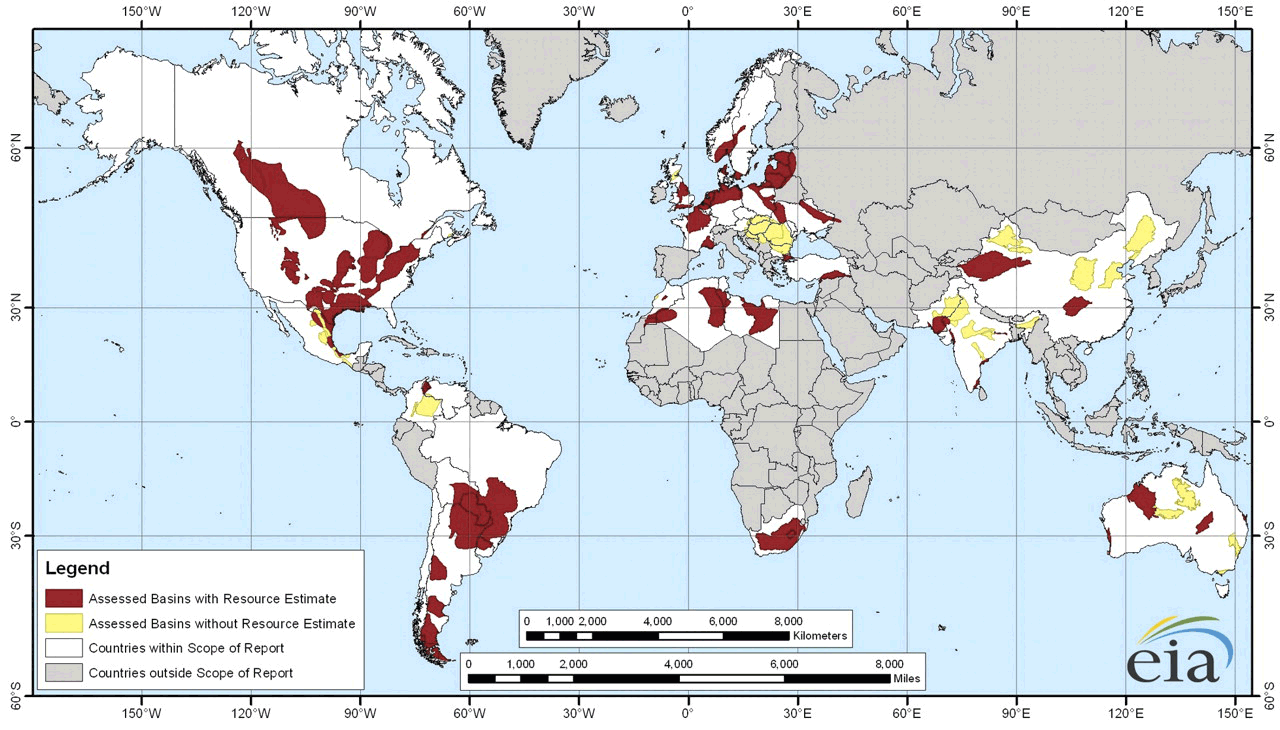
Shale gas regions are not hard to find

Shale gas regions
Source: EIA

But in the time the North Americans drilled 15,000 wells and ensured cheap gas for decades to come, how much progress has the rest of the world made?

Less than 100 wells drilled.

So Australia has a lot of catching up to do. But it’s making tracks.

The Australian Shale Gas Story – Still in Early Stages

The market has embraced the shale story. Aussie shale stocks like Buru Energy (ASX: BRU) have gone up eight–fold in the last two years.

It’s an exciting start, but there’s still a long way to go for the Aussie shale industry.

And the best time to get in is before the industry becomes mainstream…before local explorers have drilled 15,000 wells.

My old pal, Australian Wealth Gameplan editor, Dan Denning knows this. Dan first wrote about shale gas in 2005.

This is what he wrote at the time:

‘If the U.S. government is eventually going to pump billions of dollars into the development of the shale industry, with the goal of national energy independence, I want to figure out who’s going to benefit the most…

‘…I’d rather be ahead than behind on the shale curve.’

He was ahead of the curve. Back then, the US produced less than two billion cubic feet (bcf) of shale gas per day.

This year the US is set to produce nearly 25 bcf of shale gas per day.

And last year he tipped a handful of Aussie stocks that he thought would benefit from the Aussie shale gas story.

But the real billion–dollar–question is, can we recreate North America’s success with shale gas, here in Australia?

We have the potential, but there are some big differences between Australia and the US.

Shale Gas With an Oil Kicker?

Research and Consulting Service, Wood Mackenzie, asked this question at the conference this week. The good news is they reckon it can be done.

The bad news is a number of stars need to align first.

First, explorers need to do much more drilling to see if the geology is right, and whether it’s possible to produce natural gas commercially.

Then there’s the issue of support services. It’s still a new game here, and, unlike in other resources sectors, we don’t have all the players, expertise and equipment to get the job done.

Remote locations, and the wet season, add an extra challenge.

We also need to ask the question — does Australia even need shale gas?

We have plenty of conventional natural gas already. Then we have the Coal Seam Gas industry, which is still growing, and now meets 40% of East Coast Australia’s natural gas needs. And, as I mentioned yesterday, the LNG industry is already set to triple production in the next six years.

So where does shale gas fit in to the Australian energy mix?

As with everything, it depends on the production cost. If it’s cheap enough, Australia can enjoy even more affordable natural gas, and could turn it into another export revenue stream.

But shale gas isn’t the only opportunity. The real money–spinner could be in ‘shale oil‘.

Shale Oil – ‘Liquid Rich’

They call shale ‘liquids rich’ when it contains oil. Oil is more profitable, and easier to export. Finding it in Aussie shale plays could help kick–start the development of a profitable Aussie shale industry.

The biggest opportunities for shale oil are in the Canning, Cooper and Georgina basins. They each have ‘liquids’ potential, but so far no–one has struck shale oil yet, only shale gas.

There’s a lot of Australian shale exploration planned this year. Joint ventures between small Aussie companies and giant overseas firms are drilling the better–known ‘Canning basin’ in WA and ‘Cooper Basin’ in South East QLD.

Drilling and hydraulic fracturing (fracking) is also taking place in the Georgina Basin in the Northern Territory, Gippsland in Victoria, and Galilee Basin in Queensland.

Back when the US shale boom was at this early stage, land was cheap.

Today, US shale acreage valuations are through the roof. Early investors in the right projects scored big.

This is probably why you see big players like Mitsubishi (TYO: 8058), BG Group (LON: BG), ConocoPhillips (NYSE: COP) and Hess Corp. (NYSE: HES) moving in early on the Aussie shale gas story.

And ConocoPhillips for one says it wants more.

With big companies getting in at the ground floor — and with so much focus on the sector at Australia’s largest oil and gas conference — it already looks like the shale sector is set to be Australia’s next resources boom.

Dr. Alex Cowie
Editor, Diggers and Drillers

Related Articles

The Conference of the Year "After America" DVD

APPEA – Day One at the Oil & Gas Show: Sand Dunes, Scuba Diving and Camels

Why Europe Will Ditch Green Energy


Get in Early to Shale Gas

How Central Banks Are Delivering A Financial Repression

By MoneyMorning.com.au

Imagine you are one of two people playing Monopoly. While you follow the rules religiously, the other player, who also happens to be the banker, does not.

He routinely appropriates properties. If he doesn’t like the score on the dice, he simply changes them. He continually takes as much money from the bank as he likes. Whenever the rules don’t suit he arbitrarily alters them in his favour.

Oh, and he hates to lose. Rather than concede defeat, he is perfectly willing to set fire to the table.

Imagine no longer. This is the state of the financial markets. You are playing against the world’s central banks.

For some time now, the Financial Times has been running articles (under the inauspicious label of ‘Collateral Damage’) discussing the merits or demerits of central banking. Only one contributor, Ron Paul, has challenged the status quo:

"[W]hile socialism and centralised economic planning have largely been rejected by free–market economists, the myth persists that central banks are a necessary component of market economies."

Every other contributor thus far has sought to defend central banking as a necessary part of the system… a view that seems categorically embraced by most people. In browsing through the comments of Dr. Paul’s FT article, for example, one reader posted:

"The problem with blindly accepting Dr Paul’s diagnosis is that he lacks the necessary qualifications to make a diagnosis. Would you trust a medical diagnosis made by Ben Bernanke, Mario Draghi or Mervyn King?"

No, I wouldn’t. But I wouldn’t trust an economic diagnosis from any of those individuals either. Given their track records, why would anyone?

No Central Banks

Getting rid of central banks (over time, let us be realistic) would have several effects.

First, it would require insolvent commercial or investment banks to fail properly, as opposed to feeding off the blood of taxpayers indefinitely.

As an example, lest anyone regard the $2 billion loss recently announced by JP Morgan as comparatively trivial, it should perhaps be seen in the context of the same bank’s overall derivatives exposure, which is shown graphically below.

JP Morgan’s total derivatives exposure stands at $70.1 trillion, or roughly the same size as the entire world economy. Each of the $1 trillion towers in the image is double–stacked to a height of 930 feet (283 meters).

Second, eliminating central banks would require governments to balance their books, no longer able to monetize the debt through its relations with the central banker.

Third, asset prices would revert to being determined by the market, and not by unelected economists serving the interests of bankers and politicians.

As this is clearly not going to happen anytime soon, most investment managers seem content to embrace the system and continue playing the cards they’ve been dealt.

To give you an example, the FT reported that, last year, US pension funds for the very first time put more of their assets into bonds as opposed to equities.

Like many investors, these fund managers fail to understand the risks they’re running and seem to have accepted the convention that nothing could possibly go wrong while central bankers are in charge.

Yet with Treasury yields as low as they are, this is unlikely to end well. The chart below shows the impact on investors who purchased British Gilts during the stagflation suffered in the UK during the 1970s.

Real UK Gilt Losses (Jan73 – Dec 07)

Investors who bought conventional Gilts in 1973 had to wait for 12 years to earn a positive real return on their investment. And this is exactly the sort of financial repression we have to look forward to under the current system controlled by the political and central banking elite.

Tim Price
Contributing Editor, Money Morning

Publisher’s Note: This article originally appeared in Sovereign Man: Notes From the Field

From the Archives…

What Newton Knew About House Prices …That the IMF Should
2012–05–11 – Kris Sayce

Why a Greek Exit From the Eurozone Could Be Great News For Markets
2012–05–10 – John Stepek

Why Europe Will Ditch Green Energy
2012–05–09 – Kris Sayce

Why It’s Time to Buy Gold
2012–05–08 – Dr. Alex Cowie

Why You Should Be Watching Japan’s Economy
2012–04–07 – Dan Denning

For editorial enquiries and feedback, email [email protected]


How Central Banks Are Delivering A Financial Repression

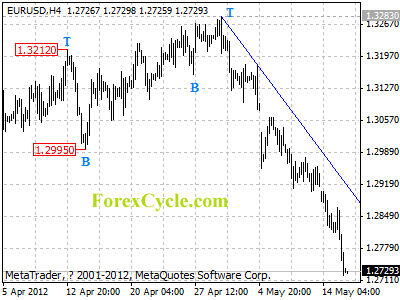
EURUSD’s downward movement extends to 1.2722

EURUSD’s downward movement from 1.3283 extends to as low as 1.2722. Further decline could be seen after a minor consolidation, and next target would be at 1.2650 area. Resistance is at 1.2800, followed by the downward trend line on 4-hour chart, only a clear break above the trend line resistance could signal completion of the downtrend.

eurusd

Daily Forex Analysis

Charles Sizemore in The Wall Street Journal’s SmartMoney

By The Sizemore Letter

Charles Sizemore gave his views on the market’s recent volatility to SmartMoney’s Quentin Fottrell:

Including today, stocks have fallen 8 days out of the last 9 – with last week the Dow posting its worst five-day stretch in five months… Financial advisers say the latest worries among investors makes sense. “The past 5 years of volatility has shattered confidence in the markets,” says Charles Sizemore, a financial adviser in Dallas, Texas, “and with the steady stream of gloomy news coming out of Europe, sentiment has only gotten worse.” Trading volume has been abnormally low for last year as many investors move to the “perceived safety of bonds from the perceived riskiness of stocks,” he says.

Still, many advisers are trying to prevent clients from selling, pointing out that broader economic trends favor stocks. For example, consumer confidence in May rose to the highest level in 4 years, according to Thomson Reuters/University of Michigan preliminary index. Meanwhile, labor’s share of income in the U.S. — in other words, corporate profits — is at an historic low, which Glenn Guard, director of investment management at Alexandria, Va.-based Campbell Wealth Management, says suggests that corporations have strong balance sheets and have the ability to hire. “We’re going to see a de-coupling of the economies in the U.S. and Europe,” with the U.S. markets outperforming in the near future.

In fact, some see the latest market drop as buying opportunity. Guard suggests “high quality, global dividend-paying stocks” such as Procter & Gamble (PG). “They’re selling Tide detergent to the Chinese and Crest toothpaste to the Brazilians,” he says. Sizemore also favors dividend-payers currently trading at low prices relative to earnings, including Microsoft (MSFT), Intel (INTC) and Johnson & Johnson (JNJ).


To view to full article, click here.

EUR/USD continues the downtrend, looking at 1.2700 next

The Euro continues to get sold off heavily again in today’s forex trading as Greece talks for a unity government collapsed today. Greece will now have to hold new elections and their is loud speculation of the Greeks leaving the euro currency.

The EUR/USD fell to the lowest level since the middle of January and looks to test 1.2700 soon. The low for the year was registered on January 13th at 1.2623.

EURO US Dollar


$1522 “Next Target for Gold”, But Dealers in Asia See “Sudden Surge” in Physical Bullion Demand

London Gold Market Report
from Ben Traynor
BullionVault
Tuesday 15 May 2012, 07:30 EDT

WHOLESALE MARKET gold bullion prices dipped below $1550 an ounce for the first time since December on Tuesday – a fall of 7% since the start of this month – before regaining some ground by lunchtime in London.

“The bear channel support had been at $1581,” say technical analysts at Scotia Mocatta, the bullion banking division of Bank of Nova Scotia.

“The next target is a full retracement to December’s low of $1522 and there does not appear to be much standing in the way.”

“Gold bugs[are] hiding deep in their gold caves pondering why gold isn’t rallying in spite of [the] sharp spike in risk-off sentiment,” said NYU professor Nouriel Roubini on Monday via the medium of Twitter.

Asian dealers however report a pickup in physical gold bullion demand.

“At the moment supply is a bit tight for immediate delivery,” one Singapore dealer tells news agency Reuters.

“Refiners can’t deliver immediate gold because there’s a sudden surge in demand. We’re seeing demand from India, Thailand and Indonesia.”

Silver bullion meantime dipped below $28 per ounce for the first time since January 1 on Tuesday, before bouncing slightly, while European stock markets also regained some ground after Monday’s heavy losses. Commodities were broadly flat on the day, while major government bond prices eased.

The president of Greece is today expected to ask politicians to agree to the formation of a technocrat government, as the stalemate following last week’s election continues. The left-wing Syriza, which came second in the election and currently leads opinion polls, has indicated its opposition to the proposal.

“We don’t want to consent to any kind of bailout policies, even if they are implemented by non-political personalities,” said Panos Skourletis, spokesman for Syriza, referring to austerity measures such as public spending cuts, agreed by Greece’s previous government as part of its bailout package.

Any Greek government “would have to stand by the [austerity] program,” said Jean-Claude Juncker, Luxembourg prime minister and chairman of the Eurogroup of single currency finance ministers, speaking on Monday.

“If there are dramatic changes in circumstances, we wouldn’t close ourselves off to a debate over extending the deadlines.”

“The Euro breakup story is gathering steam again,” says Marchel Alexandrovich, London-based senior European economist at Jefferies International.

“If Greece were to ever exit the Euro, no amount of reassuring comments will convince investors that other countries won’t soon follow.”

Greece has meantime said it will meet €430 million in bond payments due today, Reuters reports.
Ratings agency Moody’s announced Monday that it has downgraded 26 Italian financial institutions. Over in Spain, yields on 10-Year Spanish government bonds remained above 6% on Tuesday, a day after hitting their highest levels since November.

“It’s looking alarming right now,” says Luke Spajic, senior fund manager at world’s largest bond fund Pimco.

“The market is effectively trying to price in a disorderly exit for Greece.”

In contrast with Spanish bonds, yields on 10-Year German bunds sank to record lows Monday, hitting 1.43%. Germany’s economy meantime grew 1.7% in the year to the first quarter of 2012 – up from 1.5% annual growth to Q4 2011 – according to provisional estimates published Tuesday.

Growth in the Eurozone as a whole was flat, showing 0.0% year-on-year GDP gain in Q1 – down from 0.7% to the previous quarter – Tuesday’s provisional estimates show.

Germany’s Federal Court of Audit is to report to the Bundestag its objections to the way the nation’s gold bullion is stored, the Wall Street Journal reports. The Court is expected to ask the Bundesbank to check that gold stored abroad is still there, the WSJ adds.

Over in India, “gold smuggling has increased drastically because of the increasing value of the metal,” Indian customs commissioner PM Salim told Indian press Tuesday.

“Most of the money used in gold smuggling is hawala money,” added another customs officer, referring to transfers of wealth that occur outside traditional channels so as to avoid leaving a trail.
“If people buy the metal from here, they will have to show the purchase, but if gold is bought from outside, they can pay hard cash and not pay any tax to the government.”

India’s government has twice this year doubled the import duty on gold bullion, as well as proposing to extend gold jewelry sale taxes. The latter measure was dropped following a three-week long protest by Indian gold jewelers.

Ben Traynor
BullionVault

Gold value calculator   |   Buy gold online at live prices

Editor of Gold News, the analysis and investment research site from world-leading gold ownership service BullionVault, Ben Traynor was formerly editor of the Fleet Street Letter, the UK’s longest-running investment letter. A Cambridge economics graduate, he is a professional writer and editor with a specialist interest in monetary economics.

(c) BullionVault 2011

Please Note: This article is to inform your thinking, not lead it. Only you can decide the best place for your money, and any decision you make will put your money at risk. Information or data included here may have already been overtaken by events – and must be verified elsewhere – should you choose to act on it.


King to Explain Halting Bond Purchases Move

By TraderVox.com

​Tradervox (Dublin) – Mervyn King, the Bank of England Governor is expected to present a report explaining the BOE’s move of halting the bond purchases made six days ago despite the grim economic outlook for Europe. The Bank of England governor is expected to present economic forecasts at a press conference.

England economy has shown some signs of recovery, but the current turmoil in Europe has led to the pound increasing by 4 percent in the first quarter of the year. Economists have warned that king must be careful not to fuel further strengthening of the pound which would be detrimental for the economy as it would hurt exports.

The BOE decided on May 10 to hold its target for bond purchases at $524 billion ending the second round of quantitative easing which was started in October. The Governor is also expected to publish the inflation rate report, growth report, and consumer price forecasts tomorrow in London. According to Jens Larsen, an economist in London at Royal Bank of Canada, the move by the BOE is a dovish one with a background of a disappointing growth and worsening of European crisis while on the other hand, then strong pound shows traders willingness to buy UK assets.

Alan Clarke of Scotiabank in London has suggested that king will steer clear of comments that may cause another rally by the pound. The monetary policy officials decided to hold the bond purchases kitty as they forecasted a increase in inflation if they were to increase the QE package.  

The pound has increased against all 16 major currencies this year, with a 4.5 percent increase against the euro. Further increase of the pound against the euro is set to hurt the UK exports to euro zone which buys more than half the country’s exports.

Disclaimer
Tradervox.com is not giving advice nor is qualified or licensed to provide financial advice. You must seek guidance from your personal advisors before acting on this information. While we try to ensure that all of the information provided on this website is kept up-to-date and accurate we accept no responsibility for any use made of the information provided. Opinions expressed at Tradervox.com are those of the individual authors and do not necessarily represent the opinion of Tradervox.com or its management. 

Article provided by TraderVox.com
Tradervox.com is a Forex News Portal that provides real-time news and analysis relating to the Currency Markets.
News and analysis are produced throughout the day by our in-house staff.
Follow us on twitter: www.twitter.com/tradervox

South Pacific Dollars Up From 5-Month Low

By TraderVox.com

Tradervox (Dublin) – The Australian and New Zealand dollars have gained against the yen and the dollar as major technical indicators showed that the recent decline have been excessive. The two south pacific dollars had declined as concerns that Greece might be forced to leave the euro gained momentum after political leaders in Greece failed to come to a consensus regarding the formation of unity government.

This has caused traders to avoid riskier assets, hence lowering the demand for Aussie and Kiwi. The Australian bonds have also rallied after the release of the Reserve Bank Meeting minutes where the bank decided to reduce interest rate by 0.5 percent.

Recently, the Australian and the New Zealand dollars have been on the decline due to political turmoil in Greece. Greece president Karolos Papoulias is expected to hold another meeting with opposition leaders as he seeks to form unity government. The political situation in Greece is expected to delay efforts aimed at achieve austerity measures that were set during the international rescue of Greece. If leaders do not agree on terms of formation of government, the country may face another election.

According to Sean Callow who is a Senior currency strategist at Westpac Banking Corp. in Sydney, traders are confused on how the Euro zone will solve the current issues and the negative sentiments from the region are spilling over to the south pacific currencies as they are commodity related currencies. Euro zone crisis is affecting risk appetite in the market hence affecting the demand for Aussie and kiwi.

After technical indicators showed that the recent decline in Aussie and Kiwi is excessive, the Australian dollar increased by 0.4 percent against the greenback to trade at 99.93 US cents; the currency had earlier reached 99.45 cents, which is the lowest it has been since December 20. Against the Japanese yen, the Australian dollar rose by 0.4 percent to trade at 79.83 yen.  its counterpart, the New Zealand dollar, rose by 0.3 percent against the dollar to trade at 77.86 US cents but it had earlier touched 77.52 cents which is the weakest since December 30. The Kiwi gained 0.3 percent against the yen to trade at 62.18 yen.

Disclaimer
Tradervox.com is not giving advice nor is qualified or licensed to provide financial advice. You must seek guidance from your personal advisors before acting on this information. While we try to ensure that all of the information provided on this website is kept up-to-date and accurate we accept no responsibility for any use made of the information provided. Opinions expressed at Tradervox.com are those of the individual authors and do not necessarily represent the opinion of Tradervox.com or its management. 

Article provided by TraderVox.com
Tradervox.com is a Forex News Portal that provides real-time news and analysis relating to the Currency Markets.
News and analysis are produced throughout the day by our in-house staff.
Follow us on twitter: www.twitter.com/tradervox

EUR/USD Hits 4-Month Low

Source: ForexYard

The euro continued to tumble throughout yesterday’s trading session as investors grew more concerned regarding the impact of a possible new Greek election next month. The EUR/USD fell close to 70 pips during European trading, reaching as low as 1.2829. Today, traders will want to pay attention to several potentially significant market events. At 9:00 GMT, the German ZEW Economic Sentiment figure may be able to help the euro recover some of its recent losses if it comes in above analyst forecasts. In addition, the US Core CPI, Core Retail Sales and Retail Sales figures, all scheduled for 12:30 GMT, could lead to market volatility for USD pairs. Should any of the news come in above expectations, the greenback could move up against the JPY.

Economic News

USD – US Retail Sales Data Set to Generate Volatility

The US dollar saw significant gains against its higher-yielding currency rivals yesterday, as investor concerns regarding the political situation in Greece and Germany led to risk aversion in the marketplace. In addition to the EUR/USD dropping to a four-month low, the greenback also extended its recent gains against the Australian and New Zealand dollars. The AUD/USD fell below the 1.0000 level for the first time since last December during the early morning session. The pair fell as low as 0.9961 before stabilizing. The NZD/USD tumbled close to 60 pips, reaching as low as 0.7763 before staging a slight upward correction during the afternoon session.

Turning to today, USD traders will want to pay attention to the results of the US Retail Sales and Core Retail Sales figures, scheduled to be released at 12:30 GMT. Both indicators are forecasted to come in significantly below last month’s figures, which if true, may lead to investor concerns that the US economic recovery is slowing down and cause the dollar to fall against the Japanese yen. At the same time, with the euro-zone political and economic situation still dominating the news, the dollar may be able to extend its gains against the euro during today’s trading session.

EUR – Poor Industrial Production Figure Causes Euro to Slide

The euro took additional losses against its main currency rivals during yesterday’s trading session following the release of a disappointing euro-zone industrial production figure. The figure came in at -0.3%, well below the 0.5% result analysts had been predicting. Following the news, the euro dropped over 40 pips against the US dollar, eventually hitting a new four-month low. Against the British pound, the euro dropped close to 50 pips, eventually reaching as low as 0.7983 during the afternoon session.

Today, euro traders will want to pay attention to the German ZEW Economic Sentiment figure at 9:00 GMT. As the biggest economy in the euro-zone, indicators out of Germany tend to have a significant impact on euro pairs. Should the figure come in above the forecasted 19.1, the common currency may be able to stage a mild recovery during the European session. Furthermore, if any of today’s news out of the US comes in below expectations, the euro could see bullish movement against the US dollar.

JPY – Risk Aversion Boosts Yen

The Japanese yen maintained its upward momentum vs. the euro and US dollar in trading yesterday as investors flocked to safe-haven assets amid political instability in the euro-zone. The EUR/JPY fell close to 100 pips during European trading, reaching as low as 102.20. After slight upward movement during the overnight session, the USD/JPY once again turned bearish, dropping 50 pips before stabilizing around the 79.70 level.

Turning to today, traders will want to monitor news out of the euro-zone and US. With investors still focused on the political instability in Greece, the yen could see additional gains if any additional negative news out of the euro-zone is released today. Furthermore, the US Retail Sales and Core Retail Sales are forecasted to come in below last month’s figures, which if true, could help the yen against the dollar.

Crude Oil – Crude Oil Drops Below $94 a Barrel

Crude oil took additional losses in trading yesterday, as investors continue to flee riskier assets due to negative euro-zone news. Fears that the political situation in Greece will result in new elections next month was the main reason for risk aversion in the marketplace. As a result, the price of oil fell over $2 a barrel during European trading, reaching $93.61, a new low for 2012.

Turning to today, analysts are warning that the price of oil could fall further unless some form of stability returns to Europe. Investors are all but certain that Greece will need to hold a new election in June, which increases the chance that the country will eventually leave the euro-zone. That being said, should the German ZEW Economic Sentiment figure come in above expectations, risk taking could return to the marketplace which could help oil recoup some of its losses.

Technical News

EUR/USD

The weekly chart’s Williams Percent Range has dropped into oversold territory, indicating that this pair could see upward movement in the coming days. This theory is supported by a bullish cross on the daily chart’s Slow Stochastic. Opening long positions may be a wise choice for this pair.

GBP/USD

The Bollinger Bands on the daily chart are narrowing, indicating that this pair could see a major shift in price in the near future. That being said, most other long term technical indicators are not providing clear signs as to what direction the shift will be. Taking a wait and see approach may be the best choice for this pair.

USD/JPY

A bullish cross on the weekly chart’s Slow Stochastic points to a possible upward correction in the coming days. This theory is supported by a bullish cross on the daily chart’s MACD/OsMA. This may be a good time for traders to open long positions.

USD/CHF

The Relative Strength Index on the daily chart is approaching the overbought zone, indicating that this pair could see downward movement in the near future. Additionally, the Williams Percent Range on the weekly chart has crossed above the -20 line. Traders may want to go short in their positions ahead of a possible bearish correction.

The Wild Card

USD/ZAR

The daily chart’s Slow Stochastic has formed a bearish cross, indicating that this pair could see downward movement in the near future. Furthermore, the Relative Strength Index on the same chart has crossed into overbought territory. Forex traders may want to open short positions ahead of a possible downward correction.

Forex Market Analysis provided by ForexYard.

© 2006 by FxYard Ltd

Disclaimer: Trading Foreign Exchange carries a high level of risk and may not be suitable for all investors. There is a possibility that you could sustain a loss of all of your investment and therefore you should not invest money that you cannot afford to lose. You should be aware of all the risks associated with Foreign Exchange trading.