The Senior Strategist: Growth uncertainty and debt nervousness makes a bad cocktail

The month of May was very bad for equities. Policy action is needed in order to stop the financial turbulence.

The european debt crisis and the growth uncertainty are still the dominating themes, but a very weak US Jobrapport also takes a lot of focus.

Senior Strategist Ib Fredslund Madsen outlines the most important economic themes and events for the week ahead.

Legal information

Video by http://en.jyskebank.tv/


Trading Strategies: Playing Europe in the Near Term

By The Sizemore Letter

The most annoying thing about old Wall Street adages like “Sell in May, go away” is that once in a while, they are actually true.

Sure, most of the time it makes sense to be invested during the summer months.  If history is any guide, they are more likely to be positive than negative.  But in recent years, the summer months have been choppy and volatile and investors would have been well-served to, as the saying goes, sell in May.

This year, “sell in April” might have been better advice.  After a monster first-quarter rally, fears of a Eurozone meltdown have caused the market to give back most of its gains.

But is the pervasive fear justified?  And could Europe really be headed for a 2008-caliber meltdown?

The short answer is “no,” though this requires a little explaining.

What happened in 2008 was the modern-day equivalent of an old-fashioned bank run, a crisis of confidence.  When Lehman’s counterparties lost faith in the bank’s abilities to honor its commitments, it set into motion a chain of events that would have taken down virtually every major global bank had the Fed not stepped in and made emergency liquidity available.

The ECB learned a thing or two from watching the Fed improvise.  There would be no “Lehman Brothers moment” in Europe.  Bank failures, if they were to happen, would be orderly.  This is what prompted the ECB’s LTRO program, which European banks used to borrow over a €1 trillion.  The ECB also proved itself willing to stabilize the Spanish and Italian bond markets with aggressive open-market operations when needed.

But what about Greece?

What about it.  By the time this article goes to press, Greece might have already defaulted and been booted out of the Eurozone.  And if not, it will be only a matter of time.

The standard line on Greece is that its default will create a market crisis that will cause the rest of the Eurozone problem states to fall like dominoes.  Well, this could be the case.  But if so, it would be the most anticipated crash in history.  And highly-anticipated market events have a funny way of not happening.

Given the absolute carnage in European stock markets, I have a hard time believing that most of the selling hasn’t already been done.  A “Grexit” might prove to be a non-factor or, in true contrarian fashion, actually cause world markets to rally.

Still, I admit that I’ve consistently underestimated the severity of the European sovereign debt crisis, and I have to accept that my premise—that cooler heads will prevail and that Germany and the ECB will do what needs to be done to avert catastrophe—may prove to be far too optimistic.  This could get a lot worse  before it gets better if investors’ worst fears turn into a self-fulfilling prophecy.

With all of this said, how should investors position their portfolios this summer?

In my view, the market looks like a coiled spring ready to pop.  The combination of excessive bearishness among investors, cheap pricing across most sectors, and a lack of attractive investment alternatives makes me believe that we’re in the midst of a fantastic buying opportunity.

But given the nagging possibility of a deep market swoon, it also makes sense to keep a little more cash on hand than usual.

I would be comfortable with a portfolio that is about 75% invested in high-quality, dividend-paying stocks.  As a nice rule of thumb, I’d like to see companies that have raised their dividends for a minimum of 5-10 consecutive years.

My reasoning here is easy enough to understand.  A company that was able to raise its dividend throughout the turmoil of the past 5 years is a company you know can survive Armageddon because frankly, it already has.

For a good fishing pond of high-quality dividend payers, check out the holdings of the Vanguard Dividend Appreciation ETF (NYSE:$VIG).  It’s loaded with blue chips like Wal-Mart (NYSE:$WMT), Coca-Cola (NYSE:$KO) and McDonalds (NYSE:$MCD) among many other household names.

If the market turns around as I expect, VIG should enjoy roughly the same upside as the broader S&P 500.  But if I’m wrong and the market takes a swan dive, you can at least rest easy knowing that you’re holding a portfolio of stocks that will almost certainly continue to raise their dividends in the years ahead. And you’ll enjoy a cash return that is better than what you would have gotten had you left your funds in Treasuries or in the bank.

And for the roughly 25% you hold in cash, I have a few recommendations for that as well.

In a recent article (See “How to Invest for a European Armageddon”), I suggested selling out-of-the-money puts on some of Europe’s battered blue chips.  But if this is too complicated, simply dripping into high-quality names on dips will work nearly as well.  I mentioned Spanish-listed Telefonica (NYSE: $TEF) and Banco Santander (NYSE:$STD) and I continue to view both as attractive today.

Disclosures: Sizemore Capital is long VIG, WMT and TEF.

This article first appeared on MarketWatch as part of the Trading Strategies series.

Disappointing Non-Farm Payrolls Sends USD Tumbling

Source: ForexYard

The USD tumbled vs. its main currency rivals on Friday, following the release of a worse than expected Non-Farm Payrolls figure which showed that the US only added 69K jobs in May. Analysts had been forecasting the figure to come in around 150K. Turning to this week, traders will want to monitor any US news, including Tuesday’s ISM Non-Manufacturing PMI and Friday’s Trade Balance figure. Any worse than expected data may lead to fears that the Fed will initiate a new round of quantitative easing, which could result in the dollar extending its recent losses.

Economic News

USD – Dollar May Extend Losses This Week

The US dollar fell against virtually all of its currency rivals during evening trading on Friday, following a significantly worse than expected Non-Farm Payrolls figure. In addition, the US unemployment rate increased from 8.1% to 8.2%. The USD/JPY fell close to 50 pips, reaching as low as 77.65 after the news was released. The pair was able to stage a mild upward correction before finishing out the week at 77.97. After weeks of bearish movement, the EUR/USD was able to capitalize on the US news. The pair went up over 100 pips by the end of the day and closed out the week at 1.2427.

Turning to this week, the dollar could see further losses if investors determine that the Fed is getting ready to initiate another round of quantitative easing to stimulate growth in the US economy. Traders will want to pay attention to potentially significant US indicators, including Tuesday’s ISM Non-Manufacturing PMI. Additionally, a speech from Fed Chairman Bernanke on Thursday may contain information regarding any new policies the Fed plans on using to grow the economy.

EUR – Euro Sees Gains Following US News

After several weeks of downward movement, the euro was able to capitalize on disappointing US news Friday to finish the week on a positive note. Against the JPY, the common currency was up well over 100 pips during mid-day trading. The pair peaked at 97.49 before staging a downward correction to close out the week at 96.90. Against the British pound, the euro moved up more than 70 pips over the course of the day. The pair eventually closed out the week at 0.8091, just below its high of 0.8095.

This week, analysts are warning that the euro’s bullish trend may be short lived, as investors are still preoccupied with Spain’s debt crisis and the upcoming Greek elections. In addition, the euro could come under renewed pressure following Wednesday’s Minimum Bid Rate and subsequent ECB Press Conference. While no changes to euro-zone interest rates are forecasted to occur, investors will be paying close attention to the press conference for clues as to any future plans to stimulate growth in the region.

AUD – Aussie Gains on USD, JPY to Finish Week

The Australian dollar saw gains against its safe-haven rivals following disappointing economic data out of the US on Friday. The AUD/USD moved up around 110 pips during mid-day trading, eventually reaching as high as 0.9722 before staging a correction to close out the week at 0.9698. Against the JPY, the aussie traded as high as 76.09 before moving downward to finish the week at 75.61.

Turning to this week, the aussie not be able to maintain its recent gains if global economic data continues to come in below expectations. Traders will want to monitor developments out of the euro-zone, specifically with regards to the current economic and political problems in Spain and Greece. Should any negative news be released, investors may shift their funds back to safe-havens, which could result in the AUD returning to a bearish trend.

Crude Oil – Crude Oil Falls to 8-Month Low amid Poor Global Data

Fears of a slowdown in the global economy sent the price of crude oil tumbling to an eight-month low on Friday. A worse than expected Chinese Manufacturing PMI combined with a disappointing US employment statistic led to fears that global demand for oil will continue to drop. As a result, the price of crude fell over $3 a barrel to close out the week at $83.23.

Turning to this week, traders will want to pay attention to news out of both the euro-zone and US for clues as to where the price of oil will go. Any additional disappointing data could result in oil extending its bearish trend. Furthermore, any signs that the Fed is getting ready for a new round of quantitative easing in the US could weigh down on oil.

Technical News

EUR/USD

The Williams Percent Range on the weekly chart is in the oversold zone, indicating that this pair could see upward movement in the coming days. This theory is supported by the Slow Stochastic on the same chart, which has formed a bullish cross. Going long may be the wise choice for this pair.

GBP/USD

In a sign that this pair could see an upward correction in the near future, the Relative Strength Index on the daily chart has dropped into oversold territory. Furthermore, the Williams Percent Range on the weekly chart is currently at the -90 level. Opening long positions may be a good idea for this pair.

USD/JPY

While the Williams Percent Range on the weekly chart is pointing to a possible upward correction in the coming days, most other long term technical indicators are in neutral territory. Traders may want to take a wait and see approach for this pair, as a clearer picture may present itself shortly.

USD/CHF

The Relative Strength Index on the weekly chart is approaching the overbought zone, indicating that this pair could see a downward correction in the near future. Additionally, the Slow Stochastic on the same chart appears to be forming a bearish cross. Traders will want to monitor these two indicators, as they may point to an impending downward correction.

The Wild Card

GBP/NZD

The Bollinger Bands on the daily chart are narrowing, indicating that this pair could see a price shift in the near future. Furthermore, in a sign that the shift could be upward, the Slow Stochastic on the same chart has formed a bullish cross. This may be a good time for forex traders to open long positions ahead of a possible upward correction.

Forex Market Analysis provided by ForexYard.

© 2006 by FxYard Ltd

Disclaimer: Trading Foreign Exchange carries a high level of risk and may not be suitable for all investors. There is a possibility that you could sustain a loss of all of your investment and therefore you should not invest money that you cannot afford to lose. You should be aware of all the risks associated with Foreign Exchange trading.


How to Make Money in the Stock Market Weighing Machine

Article by Investment U

How to Make Money in the Stock Market

These companies are likely to thrive – and deliver exceptional returns – to investors who are able to take the broader view, learn from the past and act unemotionally.

During a radio interview last week, I was asked by the host to explain how Europe’s fiscal problems will play out and the likely impact on the U.S. stock market.

This question is a fine example of why I don’t do many media interviews and why it’s largely a waste of your time to listen to most of the pundits who grant them.

The Eurozone is a mess. That much is clear. But as I told the audience, no one knows how the weak sisters in Europe will resolve their fiscal problems. (Although it’s bound to be instructive for everyone watching.) No one knows what the ultimate fate of the euro will be. No one knows what the fallout will be in world financial markets. And to the extent that someone is confident that they do know, history shows they are very likely to be wrong. Billionaire Ken Fisher doesn’t call the stock market “The Great Humiliator” for nothing.

Europe’s banking and public debt troubles – and their negative ramifications – have dominated world headlines for months. Only a rank novice (or a perpetual gloom-and-doomer, of which there are many) can believe these developments aren’t currently discounted in global stock and bond prices. That doesn’t mean financial markets won’t go lower. They might. And perhaps they will.

But they can also rally from here. Those who say they can’t imagine how are admittedly suffering from a poverty of the imagination – and I’ll bet took no advantage of fire-sale prices during the recent financial crisis (or even the mini-meltdown last fall).

Share Prices Ultimately Follow Just One Thing…

I’ve said it before but it bears saying again. Economies and world stock markets are affected by the complex interplay of government policies, geopolitical tensions (and war), economic growth, interest rates, inflation, commodity prices, currency values, human psychology (particularly fear and greed), consumer confidence, capital flows, pending elections and potential legislation governing everything from tax rates to corporate regulations.

If you really believe you have all these things figured out, you probably shouldn’t be investing your own money.

But here’s something you can take to the bank: Share prices follow earnings. I challenge you to look back through history and pinpoint even a single public company that increased its profits quarter after quarter, year after year, and the stock didn’t tag along.

As Warren Buffett’s mentor Benjamin Graham famously said, “In the short term, the market is a voting machine, but in the long term it is a weighing machine.” What it weighs, of course, is corporate profits. A company’s true value will in the long run be reflected in its stock price. Bank on it.

If you understand this, you recognize that the current market is handing you a boatload of opportunities. It may not feel that way, but that’s how it always works. You pay a premium to invest in stocks when the outlook is rosy and investors are complacent. The real bargains appear only when there is trouble on the horizon and skepticism is high. (It’s too bad that millions recognize this only in hindsight.)

Right now you should be searching for solid, recession-resistant companies with double-digit sales growth, sustainable profit margins, high returns on equity, and quarterly profits that are likely to surprise on the upside in the weeks ahead.

These companies are likely to thrive – and deliver exceptional returns – to investors who are able to take the broader view, learn from the past and act unemotionally.

Good Investing,

Alexander Green

Article by Investment U

Everybody’s Standing in Line to Short Facebook

Article by Investment U

Everybody's Standing in Line to Short Facebook

Facebook (Nasdaq: FB) in the present has a lot of unknown variables. And for the short term – and may be a little bit longer – expect nothing but the unexpected.

You can’t say I didn’t tell you so…

But just as many of us suspected, Facebook (Nasdaq: FB) shares started their second full week of trading with another flop. They fell 9.6% to close at $28.84 on Tuesday – the first day of options trading in the stock.

In fact, just about everything that could go wrong did…

Let’s summarize what happened in the first seven days of trading:

  1. Before the IPO, Mark Zuckerberg seemed disinterested in the road shows.
  2. The social network got burned by glitches in the Nasdaq Stock Market’s trading system. That’s called irony. It set back the debut of the shares by more than a half hour.
  3. Did Morgan Stanley show preferential treatment to certain clients? A court will now decide that…
  4. Facebook and its investment bank underwriters are now in the middle of lawsuits over allegations on how information about slowing revenue growth was shared with potential investors ahead of the IPO. At the moment, three lawsuits have been filed over the IPO.
  5. Lately, investors aren’t too thrilled about rumors that the company is looking at buying Norwegian Web browser developer Opera Software. The price tag is reported to be in the neighborhood of about $1 billion. That’s just around what they paid for mobile photo-sharing service Instagram a month and a half ago. Opera lags behind Chrome, Internet Explorer, Firefox and even Safari by a wide margin. We just aren’t sure if that’s smart…

The Biggest Loser…

In terms of market capitalization, Facebook has been the biggest loser since its debut among the companies in the Russell 1000 Index, according to Bespoke Investment Group.

The total loss by close on Tuesday is $21.8 billion in market value. That makes Dell’s decline of $3.6 billion look like lunch money.

To be fair to Facebook, newly listed issues usually have a lot more ups and downs in general, but where it stands in comparison raises eyebrows.

Setting Records for Activity

Kick a dog when he’s down. Or bet heavily that their stock is going to drop with options buying. Remember, investing in options is betting on the direction of a stock in the market. Option activity this past Tuesday soared on Facebook setting a record for any option making its debut, according to data provider Trade Alert.

The largest option trades bet on Facebook where obviously “puts” – which means that investors expect the stock to continue to fall. The biggest trade used puts believing Facebook to slip to $25 a share by mid-July.

So, all this option activity was not looked at fondly for the stock. The shares’ decline, analysts said, was partly due to pressure from “short” sellers, who sell stock they don’t own with hopes of replacing it later at a cheaper price. Take note: Market makers probably were selling Facebook stock short as they sold puts. Selling stock “short” offers protection if market makers have to buy stock from those who have bought puts.

Naysayers accounted for most of the activity, but there was volume the other way, too. It was all across the board. Some investors saw the stock jumping to $65 a share by January 2014. Others were so bearish they had the social network down to $16 a share by December.

The Deal Going Forward

Laura Martin, an analyst with Needham & Co., said Facebook’s shares were seeing downward pressure, as Tuesday was the first day of option trading involving the stock.

“I think Facebook will be a very volatile stock for the next several months,” Martin said. “Right now, the arguments on both sides [of Facebook] are many, and that leads to greater volatility.”

Facebook in the present has a lot of unknown variables. And for the short term – and may be a little bit longer – expect nothing but the unexpected.

Good Investing,

Jason Jenkins

Article by Investment U

Next Week’s Technical Forecast For Major Pairs

By TraderVox.com

Tradervox (Dublin) – Most commodity related currencies have continued to decline amid the Europe crisis as safe haven currencies continue to surge. The Greek polls were an important event that gave some hope for the decline pound but talks of Greek exit have overshadowed any positive report from the region. Further, the serious problems in Spain are continuing to push down risk appetite as safe haven demand increases. Here is an analysis of major crosses in the market.

EUR/USD: the pair has so far fallen to almost two-year low due to the crisis in Europe. The pair opened the week with little room for change but Greece and Spain turmoil pushed the cross down. Some of the reports expected to affect the cross next week include the Sentix Investor Confidence and the Producer Price Index. We expect the currency to start the week on a low and we have a bearish outlook for the cross next week.

GBP/USD: the pound has continued to drop against the dollar but it is poised to finish the week on a high. The cross opened the week at 1.5811 but it is now trading at 1.5509 after dropping considerably during the week. Some of the events that will affect the cross include BRC Retail Sales Monitor and the PMI Construction reports. We might see the cross improving over the next week and our outlook is bullish for the cross.

USD/JPY: this is a pair of safe haven currencies which has remained stable over the week but the cross is set to close the week on a low as Japanese yen increased to the highest in three months. Some events that will affect this cross include the unemployment rate report, Nonfarm Payroll figure and ISM Non-Manufacturing report. This pair is poised to remain neutral over the course of next week.

USD/CHF: the cross opened the week on a high but it has remained neutral for the most of the week. Some of the events that will affect the cross include the Swiss Unemployment Rate report, consumer price index, and jobless claims in US. We are expecting the cross to be bullish over the next week.

Disclaimer
Tradervox.com is not giving advice nor is qualified or licensed to provide financial advice. You must seek guidance from your personal advisors before acting on this information. While we try to ensure that all of the information provided on this website is kept up-to-date and accurate we accept no responsibility for any use made of the information provided. Opinions expressed at Tradervox.com are those of the individual authors and do not necessarily represent the opinion of Tradervox.com

or its management. 

Article provided by TraderVox.com
Tradervox.com is a Forex News Portal that provides real-time news and analysis relating to the Currency Markets.
News and analysis are produced throughout the day by our in-house staff.
Follow us on twitter: www.twitter.com/tradervox

Optimism over global recovery evaporates, emerging economies bright spot – BIS

By Central Bank News
A brief spurt of optimism over the global economic recovery has now evaporated and volatility has returned to financial markets as investors question the prospects for economic growth, the Bank for International Settlements said.

    “Investors are having doubts about everything: About growth, about the financial health of sovereigns and about political stability,” said Stephen Cecchetti, economic adviser to the Swiss-based BIS, known as the central bankers’ bank.

    “News on economic growth has been disappointing not only in the euro area, but also in the United States and in emerging market economies,” he told reporters in a telephone briefing as the BIS released its latest quarterly review.

    Stock markets tumbled on Friday as data showed that the pace of U.S. employment growth weakened, output from China’s factories slowed and Europe’s manufacturing sector continued to contract.

    But emerging economies, the engines of global growth in recent years, could provide a beacon of hope for some of Europe’s beleaguered countries, such as Greece and Spain.

    “There is good news here, emerging market economies used to have problems similar to those of the euro area periphery today; that is they had a lack of credibility that often forced them to tighten policies during downswings, thus putting further pressure on output, Cecchetti said.

    Over the last decade many emerging economies have been able to carry out more mature fiscal and monetary policies that helped cushion downturns, similar to the more advanced economies, helping stabilize the global economy, the BIS said.

    In it’s review — which shows that cross-border lending fell in the final 2011 quarter as euro area banks continued to retrench — BIS also looked at the countercyclical policies of emerging markets, the changing role of the offshore Chinese renminbi market and the threats from the growth of central bank balance sheets in emerging Asian economies.

    Cross-border lending by major international banks recorded its largest decline in the fourth quarter of 2011 since the final quarter of 2008, following the collapse of Lehman Brothers, BIS said.

    The decrease of $799 billion, or 2.5 percent, was driven mainly by a $637 billion fall in interbank lending as international banks cut back in their lending to euro area banks.

    But even though market conditions remain difficult for a number of banks from Southern Europe, it is a far cry from 2008 when major banking relationships collapsed and central banks scrambled to prevent markets from freezing up.

    Following the European Central Bank’s long-term financing operations in December, which restored confidence and helped avert a bank funding crises, Europe’s banks returned to the markets.

    In the first quarter of 2012, global gross issuance of international debt securities rose 40 percent to $2.5 trillion, the strongest since the second quarter of 2008, with European borrowers the most active.

     The BIS review covers the three months from March through May, a period that started out on an optimistic note following the ECB’s move and positive U.S. economic news.

    But optimism in financial markets began to evaporate in the second half of March as it became clear that monetary policy alone would not solve the euro area’s debt problems. The first signs of weaker economic data from the US and China also cast doubts over the strength of the global economic recovery, prompting investors to reconsider the strength of growth in emerging markets.

    With government debt continuing to expand in most advanced economies, BIS’ Cecchetti called on politicians to get to the root of the problems and tackle such thorny issues as unfunded social insurance schemes and healthcare.

    “The challenges that we are facing are structural and require structural solutions. Short-term fixes will not work unless authorities address the underlying problems and the various problems are intertwined. For example, the solvency of banks and sovereigns are closely linked, so they need to be addressed simultaneously,” he said.

Europe Reaching the Boiling Point: How to Invest

By The Sizemore Letter

“Sell in May, go away” would have been good advice in 2012, although “Sell in March” would have been better. For a year that started with one of the best first quarters in history, the second quarter has proven to be something of a disappointment.

On the first trading day of June, the U.S. averages had their worst performance of 2012, pushing the Dow Industrials into negative territory for the year. The S&P 500 is still positive for the year…albeit barely.

Interestingly, Spanish stocks—which have been at the center of the European financial crisis that has been roiling the markets—finished the day roughly flat. Sizemore Capital continues to allocate funds to select Spanish stocks, and the relative calm in the Spanish market gives us hope that much of the selling there has already been done. Spain is home to some of the world’s finest multi-national companies, and the state of crisis has created absolute steals that we may not see again in our lifetimes.

The Sizemore Investment Letter Portfolio holds positions in Telefonica (NYSE:$TEF) and Banco Santander (NYSE:$STD) and has additionally sold out-of-the-money puts on both. (See “How to Keep Your Cool While Investing in Europe” for more details on our put strategy.) Additionally, the Tactical ETF Portfolio holds a position in the iShares MSCI Spain Index ETF (NYSE:$EWP).

More than even bad news, markets hate uncertainty. And the uncertainly about the Eurozone’s future has wreaked absolute havoc on Spanish and European shares.

Spain’s effective nationalization of the ailing Bankia—the country’s third largest bank by deposits—had precisely the opposite effect of what you might have expected. Rather than cheer the fact that the Spanish government is taking the crisis seriously, it simply raised new questions about the Spanish state’s ability to afford the bailout of its banking sector.

The way forward is becoming increasingly obvious. As The Economist wrote this week, “Spain’s problem is one of misdiagnosis.”

The focus of the Spanish government and of the broader European Union (and particularly Germany) has been austerity. The thinking is that budget deficits must be slashed in order to restore investor confidence. The case of the United States—where both debts and deficits are higher than in many of the EU’s problem states—proves that this is not entirely true. After all, the yield on the 10-year Treasury note recently hit levels not seen since World War II.

As The Economist continues,

“This fiscal focus gets things exactly backwards. Spain’s poor public finances, unlike those of Greece, are a symptom rather than the cause of the country’s economic woes. Before the crisis Spain was well within the euro zone’s fiscal rules. Even now its government debt, at around 70% of GDP, is lower than Germany’s.”

In Spain, it is all about the banks. Outside of Santandar and Banco Bilbao Vizcaya Argentaria (NYSE:$BBVA), Spain’s banks are by and large insolvent and in need of recapitalization.

Again, using The Economist’s figures, a recapitalization of €100 billion would be roughly 10% of Spain’s GDP. Borrowing this amount would still leave Spain safely below the debt-to-GDP levels of the United States, but the country would have to pay punishingly high rates of interest given current market conditions.

On a side note, the Financial Times estimates the cost of a banking bailout to be much smaller. The FT points out that roughly 11% of Spanish bank loans are non-performing, which is less than half the level of Ireland, the country whose predicament most closely matches that of Spain. At 350% of GDP, Spain’s banking assets are large by world standards, but again, less than half the levels of Ireland.

What is the most likely solution? The budding consensus would seem to be using EU rescue funds to inject capital into the banks directly, which Spain is now advocating.

Currently, this is not legal under EU rules. But as the last year and half of on-again / off-again crisis has proven, EU rules are a bit of a work in process.

In any event, the next week promises to be anything if not interesting. Mariano Rajoy, Spain’s prime minister, publicly announced support for EU oversight of national budgets, apparently in an attempt to sweet talk German chancellor Angela Merkel. Separately, the European Central Bank indicated over the weekend that it was “prepared” to intervene with bond purchases or additional bank assistance if needed. And encouragingly, late last week, the EU announced that it would be lenient in allowing Spain another year to get its budget deficits under control.

What does all of this mean to us as investors? In investing, as in many of life’s endeavors, it is always darkest just before the light. And it would appear that we’re starting to see a sunrise in Europe. Sizemore Capital will look for opportunities in the weeks ahead to profit from the resolution of Europe’s crisis.

 This article was originally published as Sizemore Capital’s monthly market commentary for Covestor.

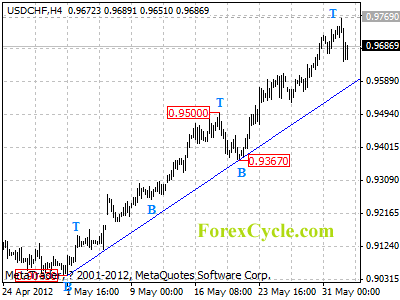
USDCHF has formed a cycle top at 0.9769

USDCHF has formed a cycle top at 0.9769 on 4-hour chart. Key support is a the upward trend line from 0.9043 to 0.9367, as long as the trend line support holds, the fall from 0.9769 is treated as consolidation of the uptrend, and one more rise towards 1.0000 is still possible. On the downside, a clear break below the trend line could indicate that the uptrend has completed at 0.9769 already, then the following downward movement could bring price back to 0.9200 zone.

usdchf

Forex Technical Analysis

BIS WARNS OF RISKS FROM ASIA’S LARGE FOREIGN RESERVES

By Central Bank News
The rapid expansion of foreign reserves, mainly U.S. dollars, by central banks in emerging Asian economies raises the risk of inflation, financial instability and market distortions, a study by the BIS said.

    Following the financial crises in the late 1990s, many Asian central banks bolstered their foreign exchange reserves to ward off future runs on their currencies. The combined balance sheets of nine Asian central banks, including China, ballooned to $6.4 trillion in 2011 from $1.1 trillion in 2001.

     So far, the rapid rise in foreign reserves has not triggered any instability, but the Bank for International Settlements warned that the risk to financial stability must not be underestimated.

    “The rapid expansion of central bank balance sheets arising from many years of foreign exchange reserve accumulation in emerging Asia is raising concerns about inflation, financial instability and financial market distortions,” the BIS said, calling on governments and central banks to consider altering their policies.

     “The approach to exchange rate management by countries in emerging Asia is a critical factor, and various reform efforts are currently being considered. Although such efforts are largely driven by the implications of exchange rate management for global imbalances and growth, the risks associated with the size and structure of central bank balance sheets should not be overlooked,” BIS said.