With Falling Australian House Prices We Should Sue the Bankers

By MoneyMorning.com.au

Kris is at home today. He claims to be taking care of a ‘sick nipper’, but we all know that he’s actually busy framing the front page of the weekend edition of the Financial Review. That’s because it features a chart of Australia’s falling house prices. Remember that such an event was once considered a ‘virtual impossibility’.

‘This transition involved lower interest rates, better-anchored inflation expectations, and increased availability of housing credit. Without some reversal of these structural changes – which is a virtual impossibility – we do not expect Australian housing prices to fall.’ – Paul Bloxham, chief economist, HSBC (formerly at the RBA)

Oops.

What’s surprising is that the housing spruikers were allowed to say things like that. Kris can’t tell his Australian Small-Cap Investigator subscribers that ‘it’s a virtual impossibility’ his beloved small-cap stocks will fall. The regulators would be up in arms. And yet the big banks came up with ridiculous ways to fool you into buying a house and paying them interest. Here’s ANZ’s chart of how house prices are meant to work:

How House Prices Are Supposed to Work

How House Prices Are Supposed to Work

Source: ANZ

Notice how falling house prices show up nowhere in the chart? The Financial Review’s house price chart, which tracks actual prices, looks a little different. It shows falling house prices. Melbourne is down almost 9% in the past year! So will the banks be sued for misleading borrowers about the most important decision of their lives? Pah.

(Kris tells us he sent an email to the ANZ economics department last week asking if they could model a similar chart showing falling house prices. Unsurprisingly, they haven’t replied yet.)

The Downward Slope of Australian House Prices

Not that you should worry too much about all this. The Financial Review’s headline below the chart of falling house prices is optimistic. Don’t worry – the RBA’s rate cuts will save us all… Yeah right. What concerns you more? A 9% fall in your house price or a 25 basis point cut on your mortgage? And with the house price drop ‘accelerating, confounding Reserve Bank of Australia suggestions that they are stabilising,’ why wouldn’t you sell?

At least the editors of the Financial Review’s Life and Leisure magazine are on the ball. Their front page headline says ‘The Only Way is Down’. Whether they’re talking about house prices, the stock market or skiing in North America, they’re right. Given the background image of the magazine’s cover, it’s skiing that they’re referring to. But still, at least they can admit that what goes up must come down.

So what now? Is it time to buy? How will the Australian economy handle falling house prices? (Remember that America’s collapse began with falling house prices and Spain’s real estate bubble is the gorilla in the European room too.)

If you heeded Kris’ warnings about the housing bubble, congratulations. If you’re licking your lips at the thought of finally buying a house at far lower prices, there are some things you should know.

First of all, prices may have much further to go. On the downside of course. And they might not rediscover their uptrending ways for quite some time. That’s because assets that experience a bubble tend to find it very difficult to reinflate. It’s kind of like trying to blow up a balloon that popped. It just makes a rude noise.

Not that housing need be a bad buy forever. Remember though, that your time horizon for buying a house will need to be long. That’s because capital gains could be hard to come by. So, here’s our advice on the matter: the purchase of a house will have to be justified on other grounds. Don’t expect capital gains. Instead do the math on saving yourself the cost of renting, earning a good return on investment from the rental income, or the emotional pleasure of living in a house you own.

All of those are important factors you should be weighing up when buying a home, but that got lost amongst the capital gains frenzy of the past few years. We’re back to reality. Reality isn’t good or bad, it’s just real. Housing will become a place to live again, rather than something to speculate with.

Then again, we may be completely wrong about that. Maybe the new normal won’t be so normal. Maybe interest rates in Australia will be absurdly low, but people will be too scared to buy a house for fear of further price declines. That would make housing quite a profitable opportunity in terms of yield and price.

So for those of you looking for a place to live, patience is a virtue. For those of you looking for a bargain, patience is even more of a virtue.

Don’t Care About House Prices?

There’s also good news for those who aren’t interested in buying a house. That’s because Australian house prices are what explains the ridiculously high cost of living in Australia. So all sorts of costs might come down alongside house prices.

What kind of costs? Well, if shop rents fall, so will the price of their goods. If restaurant rents fall, so will the price of their beer. If office space becomes cheaper, financial newsletters will…

Ok, so you get the idea. The question is whether your wealth falls more or less than prices do. Actually, the question is how do you invest to make sure your wealth falls less than the cost of living does?

We summarised the investing strategies you should weigh up in the last weekend edition of The Daily Reckoning, the sister publication of Money Morning.

Nick Hubble
Editor, Money Morning

Related Articles

Market Pullback Exposes Five Stocks to Buy

The Slow Death of Australian House Prices

How Bad Monetary Policy Will End the Welfare State


With Falling Australian House Prices We Should Sue the Bankers

Why the Chinese Economy is On the Slide

By MoneyMorning.com.au

If you followed the old stock market adage this year, and sold in May and went away, you probably feel rather relieved.

May was an awful month for stock markets, and most other ‘risk-on’ assets. Crude oil saw its worst monthly drop since 2008.

The main reason for the big drop this month is pretty clear – the eurozone crisis has managed to snowball yet again.

The bad news is that this time round, any sort of temporary eurozone resolution will be overshadowed by another looming nasty – China’s slowing economy

Why China’s Economy Will Disappoint the Bulls

Growth in China’s manufacturing sector is slowing rapidly, according to official data. In May, the purchasing managers’ index hit a five-month low, worse than analysts had expected. A separate survey sponsored by HSBC – which pays more attention to smaller companies than the official measure – suggests it is already shrinking.

The response from the China bulls is that China will launch another stimulus of some sort to save the Chinese economy. The idea is that China’s leaders have so much power at their fingertips, that they can effectively make the Chinese economy do whatever they want it to.

Here’s a quote from Zhang Liqun, an economist with a Chinese government think tank. ‘Pre-emptive, targeted fine-tuning of macroeconomic policy has already started, especially with a series of measures to stabilise investment. As that impact is felt, the economy will stabilise,’ he tells the FT.

As we’ve noted before, this is just the same sort of reassuring waffle that we heard before the subprime crash. It’s not a million miles away from the sort of statements about Greece that we got used to seeing from eurozone officials in recent years either.

Why are intelligent investors willing to believe that China’s officials can succeed where others have failed?

Investment Stories Die Hard

As with most things, it’s all about the money. Fund managers have stories to sell. ‘You should buy stocks. You should buy my fund.’ It’s hard to make a pitch for stocks if there isn’t a cheerful story around to back up your bullish argument. So you’ve got to find one.

‘Yes, Europe is self-destructing. Yes, US growth is fragile, and stocks aren’t massively cheap. But don’t worry, because we’ve got China and Asia and all the other emerging markets. Their consumers will pick up the slack from the rest of the world. Western companies will have vast new markets to profit from. So all will be well.’

It’s a compelling story. But it’s just not that simple. As Matthew O’Brien points out in The Atlantic, government officials have admitted that banks might miss their lending target for 2012. How can this be? After all, ‘China still has a state capitalist model. The government sets targets for loans, and the banks have – until now – hit them.’

The Chinese Property Market

The problem is ‘a simple lack of demand.’ This in turn, is a side-effect of falling house prices. As O’Brien puts it, ‘popping a housing bubble – which is what China is trying to do – is usually an economic death sentence.’ The problem is that when prices fall, borrowers end up “underwater” (in other words, the collateral is no longer worth as much as the loan secured against it).

‘Underwater borrowers don’t want to borrow more until their balance sheets are right-side up, even at zero rates. That’s what happened to Japan in the 1990s. It’s what happened to [the US] in 2008.’

Some people argue that the property bubble will only affect wealthier Chinese people. Or that the Chinese don’t over-stretch themselves in the same way that Western homebuyers do.

Even if this were true – anecdotal evidence suggests that in fact Chinese people borrow plenty of money to buy property, just not through official channels – it misses the point.

Chinese Economic Growth

The key thing driving Chinese economic growth for years has been fixed asset investment – building stuff, in other words. As Patrick Chovanec points out on his blog, fixed asset investment accounts for over half of China’s GDP growth. And property investment accounts for a substantial chunk of this.

If property investment continues at the same pace as last year – in other words, if developers build as much property as they did in 2011 – ‘it could shave as much as 2.6 percentage points off real GDP growth.’

Of course, given that developers have already built too many properties, and demand is dropping off, chances are they’ll build less. And that could have a huge impact on Chinese growth. A drop of 10% in property investment ‘could bring GDP growth down to 5.3%.’

That kind of figure would really spook markets.

So What Should You Do Now?

The pattern in recent years has been that Europe has a crisis, it does something to temporarily relieve it, and markets bounce back.

The eurozone crisis is rapidly reaching another of those ‘something must be done’ points. European officials would clearly rather wait until after the Greek elections this month, crossing their fingers that a pro-austerity party will get in. But there’s no guarantee they won’t be forced to act before then.

Trouble is, any relief rally will rapidly collide with evidence that China’s economy is on the slide. So I’m not convinced that any ‘risk-on’ rally will have much staying power.

The only solution is to stay defensive for now.

John Stepek
Contributing Editor, Money Morning

Publisher’s Note: This article originally appeared in MoneyWeek (UK)

From the Archives…

How Bad Monetary Policy Will End the Welfare State
2012-06-01 – Dan Denning

The Setting Sun of the Japanese Economy
2012-05-31 – Greg Canavan

The US Dollar – The “Strongest of the Weak”
2012-05-30 – Kris Sayce

Europe’s Energy Resource Puzzle
2012-05-29 – Kris Sayce

The Market Has Crashed, But This Graphite Stock Has More Than Doubled
2012-05-28 – Dr. Alex Cowie


Why the Chinese Economy is On the Slide

Best Investment Strategies For the Times Ahead

By MoneyMorning.com.au

If you think that investing in times like these is difficult, you’re right. Recognising that these events happen regularly is a helpful step to sorting out your investment strategy. Do you simply wait for a lost decade to pass by before jumping into the stock market again? Is your money safe in a financial system with more than a quadrillion dollars’ worth of derivatives outstanding? Is your retirement dependent on government welfare in the midst of a sovereign debt crises?

You only have to ask yourself these kinds of questions occasionally. But when these times do come, if you have the discipline to carry out the right investment strategy you will be much better off.

But what sort of investment strategy do you use? What’s worked in the past?

Our regular haunt at the Daily Reckoninggold – is top dog. But it’s also expensive these days. It would do well in a crisis, but it might not trend up like it has done over the last ten years. It’s still insurance against the fallibility of the political and financial system, but it doesn’t necessarily look like it has a good return baked in regardless.

So you should own some gold, but there may be better options when it comes to investing in the face of global instability.

Investment Strategy Number One

Australian Small-Cap Investigator (ASI) Kris Sayce likes to take big punts with small stakes. He reckons that certain stocks don’t really care about what the wider market or economy is doing. At least, that’s not what matters relative to the opportunity the stocks represent. Kris uncovers stories that could provide triple digit gains. Usually they involve some sort of creative destruction – where a new idea destroys an old industry or way of doing things and replaces it with something better.

The best thing about small cap speculation, apart from the returns, is that it’s a positive and hopeful experience. You don’t spend your time worrying about what the economy or ASX200 is doing. You spend your time anticipating and hoping for a whopping gain from a great business. That makes it fun.

It’s not a small-cap investor’s job to spend time lamenting the living standards of Europe. Because it doesn’t matter what Greece is doing when there are companies out there with disruptive technologies, resource opportunities and revolutionary business models – all of which add up to stock market gains.

This might be a pretty good strategy for part of your wealth in times like these. Even if you do care and worry about the big investment trends, why not try investing in assets that don’t rely on a growing economy?

Investment Strategy Number Two

Maybe you think you’ve got the world figured out. If you know exactly how the Eurozone mess will play out, how America will overcome its debt and how China will deal with its slowdown, you might want to invest in the assets that will benefit from your predictions. This is the world of macro investing. Exchange Traded Funds (ETFs) are a great weapon of choice for the macro investor. On the ASX you can find an agriculture ETF to profit from a global food shortage, currency ETFs to profit from currency wars, government bond ETFs to profit from falling interest rates, and emerging market ETFs to profit from the few booming economies left in the world.

It’s important to know the merits of ETF investing. There’s plenty of counterparty risk investing in this way. Can you be sure of what those ETFs are really up to?

Investment Strategy Number Three

If you’re sceptical about the world of finance and like things a little more clear cut, it might be a good idea to invest in the tangible things of the world – resources. Diggers and Drillers editor Dr. Alex Cowie uncovers the ASX’s best resource stocks. And many of them are aimed directly at defending against the economic trends of today – money printing and low interest rates. Recently, one of Alex’s tips was ‘the best performing stock on the market’ for the week. If you’re interested in tangible resource investments, Diggers and Drillers may be the place to start.

Remember, most companies sell an idea. A movie, fashionable clothes or financial services to make people richer… These ideas can disappear or change very quickly, along with the business selling them. But the likes of molybdenum and beryllium are very real. Not to mention copper, iron ore and so on. Investing in something tangible means stability in the face of instability. If the price of iron ore falls, is the iron ore changing or is the value of money changing? We’re not so sure about the answer, especially when central banks are willing to print money the way they do these days. But over the long term we’ll take the iron ore over paper money.

Investment Strategy Number Four

There’s one more strategy you should know about. Income investing is our favourite way of dealing with a dodgy economic environment and the poor capital gains that go with it. In the long run, it’s by far the most reliable and profitable investment strategy. But it’s got some major short term drawbacks. First of all, it’s not very sexy. The payoffs take a long time to appear.

But when they do, they are very sexy. At the After America conference we gave listeners a quick example of a way to generate 4000% dividends – turning a $10,000 investment into a $400,000 annual income stream after 15 years of patience. The example was based on a real stock and its real historical performance. But slightly more realistic assumptions for the same stock’s next 15 years came out at a 100% dividend, returning $10,000 each year to the patient buyer. Imagine raking in predictable triple digit returns every year, while your friends manage it only occasionally, when they’re lucky.

But which stocks could possibly hand out that kind of performance? We’re narrowing down our shortlist. We’ll keep you posted.

Nick Hubble
Contributing Editor, Money Morning

Publisher’s Note: This is an extract from an article that originally appeared in The Daily Reckoning Australia.

From the Archives…

How Bad Monetary Policy Will End the Welfare State
2012-06-01 – Dan Denning

The Setting Sun of the Japanese Economy
2012-05-31 – Greg Canavan

The US Dollar – The “Strongest of the Weak”
2012-05-30 – Kris Sayce

Europe’s Energy Resource Puzzle
2012-05-29 – Kris Sayce

The Market Has Crashed, But This Graphite Stock Has More Than Doubled
2012-05-28 – Dr. Alex Cowie


Best Investment Strategies For the Times Ahead

Market Review 5.6.12

Source: ForexYard

printprofile

The euro continued its upward movement in overnight trading, eventually reaching a one-week high against the US dollar. Today, traders will want to pay attention to the results of the G7 meetings, as they are expected to focus on the euro-zone debt crisis. Any positive developments could help the euro extend its recent bullish trend.

Main News for Today

US ISM Non-Manufacturing PMI-14:00
• Following last week’s disappointing Non-Farm Payrolls, investors will be watching this indicator closely
• Should it come in below expectations, it may lead to fears that the Fed will initiate a new round of quantitative easing, which could cause the dollar to extend its recent losses.

Read more forex news on our forex blog

Forex Market Analysis provided by ForexYard.

© 2006 by FxYard Ltd

Disclaimer: Trading Foreign Exchange carries a high level of risk and may not be suitable for all investors. There is a possibility that you could sustain a loss of all of your investment and therefore you should not invest money that you cannot afford to lose. You should be aware of all the risks associated with Foreign Exchange trading.

Reports of Nabucco Pipeline’s Death are Exaggerated

The refining director at BP caused a stir last week in Berlin when he was interpreted as saying the full version of the Nabucco natural gas pipeline was no longer an option for the consortium working in the Shah Deniz natural gas field in Azerbaijan. Wire services had reported that his statements meant Nabucco was effectively dead despite years of political maneuvering. Not so, said the European Commission, and several other players involved in the 2,149-mile project. It makes sexy headlines to sink a $10 billion ship, but there are plenty of reserves to keep Nabucco at least on standby.

By mid-May, proposals for Nabucco West, a smaller version of the original proposal, and the South East Europe Pipeline were sitting on the desk of BP’s offices in Azerbaijan. By next month, the BP-led consortium managing the second phase of the Shah Deniz natural gas field in the Caspian Sea is expected to pick one of them.

Last week, Iain Conn, chief executive officer for refining and marketing at BP, told an audience at an energy forum in Berlin that his company was examining several options to transport an estimated 10 billion cubic meters of natural gas per year to European markets. This would come from Shah Deniz 2 by 2017 to the tune of $40 billion. This natural gas designation means the so-called Southern Corridor, a network of natural gas transit projects, must be built to accommodate that volume. Any network within that corridor, he said, “must” be considered on its basis for future expansion.

The partners involved at Shah Deniz have already selected the Trans-Adriatic Pipeline for the southern route to Italy. This, he said, meant the planned Interconnector Turkey-Greece-Italy project was off the table and had “no possibility” to move forward. For markets in southeastern and central Europe, Conn said the group was examining SEEP and Nabucco West. Both had submitted their proposals to the BP-led consortium in Baku by mid-May and a decision is expected soon. SEEP, he said, was backed by Shah Deniz partners in coordination with the Bulgarian, Hungarian and Romanian governments. It meets the expansion requirement, he said, because it could be scaled up as more natural gas becomes available. Nabucco West, meanwhile, was submitted by the Nabucco international consortium based on work carried out for the original pipeline planned form the Georgia to European markets.

Does that mean Nabucco “Classic” is dead? According to some, it does. Most pipeline wonks already consider the greater Nabucco to be a thing of the past. In 2009, when Turkey, along with Romania, Bulgaria, Hungary and Austria, signed an intergovernmental agreement to build the entire pipeline, Ankara hailed it as a “historic moment.” But even then, most analysts were concerned about where the gas would come from for the pipeline. So far, Iraq, Azerbaijan and a variety of others are listed as possible suppliers for the full-scale project.

Alexandros Petersen, an adviser with the European Energy Security Initiative at the Woodrow Wilson International Center for Scholars, told me that whatever happens, it’s important to keep interest going for all of the projects involved in the Southern Corridor.

“It won’t be over once one pipeline is built,” he said.

Rumors of Nabucco’s demise are somewhat exaggerated. It’s not necessarily dead, just in hibernation.

Source: http://oilprice.com/Energy/Natural-Gas/Reports-of-Nabucco-Pipelines-Death-are-Exaggerated.html

By. Daniel Graeber of Oilprice.com


The Banking Plan That Could Be A Game-Changer for Gold

By MoneyMorning.com.au

Gold soared 4.1% on Friday – its biggest one-day jump in about 10 months.

This massive move in gold was on the back of a lousy US jobs report. I mean really lousy. Just four months ago, the US economy created 243,000 new jobs in a month. This has fallen steadily to the current pace of just 69,000.

In a country of 311 million people, 69,000 jobs don’t even touch the sides. So the unemployment rate actually climbed for the first time in a year, creeping back up to 8.2%.

Traders took one look at all this, and decided that the US Federal Reserve will have no choice but to print more money. Gold rose the last two times the US Federal Reserve did this (QE and QE2), so traders loaded up on gold in a big way to profit.

The trouble is, there’s a much bigger reason to own gold. And it could be the game-changer that sends the gold price soaring

As you may know, I’ve been more bullish about gold than most in recent years, and I still like gold long-term.

But I think the markets are getting tunnel vision over the prospect of QE3, as if it was the only thing that mattered to the gold price.

Missing the Big Picture on the Gold Price

Gold did indeed soar 70% during the first dose of QE.

But like most drugs, its effect fades with repeat use.

The fact is that during the eight months of QE2, the gold price rose just 15%.

Seeing as the US gold price rose an average of 17% a year for the last ten years anyway, QE2 hardly even pushed gold above its yearly average.

So, should we get excited about what QE3 will do to the gold price?

Judging by the trend so far, maybe not.

But it depends on what the Fed has in store. Will they go guns blazing, and announce the mother of all printing programs? And how will they execute the program? The Fed meets on the 19-20 June, so we may not have a long wait to find out.

All year, we have seen gold rise and fall on the back of speculation about QE3. The gold price has twitched on every data release from the States. Every public word from the Fed’s Chairman, and his board members, has been analysed to speculate on what their real intentions have been.

There has been so much speculation about QE3, that the market has missed the bigger picture.

Even on last Friday’s massive jump, gold is still 4% beneath its 200-day moving average (the red line below). It’s barely back up to the 50-day moving average (blue line). The 50-day is well under the 200-day, which itself is rolling over. It’s not the rosiest gold chart I’ve ever seen.

The Gold Price – 6 Months and No Progress

Gold - 6 Months and No Progress

Source: Stockcharts

More QE from the Fed could give gold a bit of zip, but it would really just be the icing on the cake.

What we really need is solid buying on the gold market.

The Hole Appearing in Gold Demand

But one of the engines of gold demand has recently started spluttering – India.

Last year India imported about 1,000 tonnes of gold – about 40% of global gold mine production. This year imports have fallen out of bed. The Bombay Bullion Association’s (BBA) own report says imports could halve this year, which would be around 500 tonnes.

I reckon they’re dreaming. Media reports suggest imports were just 15 tonnes in April. At that speed, India would import just 170 tonnes this year. That would leave 830 tonnes up for grabs. That’s a lot of gold. Any takers?

The general idea is that China will come to the rescue. We have seen some incredible jumps in Chinese imports. I feared it may slow down in April, but it soared to 67.4 tonnes.

Last year China imported 380 tonnes of gold. To mop up 500 tonnes of slack the BBA forecasts, keeping Chinese and Indian imports steady as a whole, China would have to import at least 880 tonnes this year. That’s an average of 73 tonnes a month.

That’s quite a pace, and Chinese imports between Jan and Feb were well below that.

It’s possible, and time will tell. For now, analysts interviewed by Reuters reckon China’s gold imports will be closer to 500 tonnes this year. Not that they can see into the future better than anyone else, but if they are right, there will be plenty of slack in the gold market. And that translates to more weak prices.

It’s not all bad news.

There is something on the horizon for gold potentially more important than any of this.

The Game-Changer for Gold

The Basel Committee of Bank supervision, who dream up the rules that govern banks, are looking at turning gold into a ‘Tier One’ asset.

This means the banks can carry gold as capital at 100% of its market value – instead of the current 50%.

This gives gold a huge increase in status, and effectively turns it back into money at the top level. It would also give the banks a strong reason to hold gold.

Consider that banks hold around $5 TRILLION in Tier One capital today.

Just 2.4% of this capital would absorb the ENTIRE annual output of annual gold mine production.

That’s a pretty incredible thought.

Gold turning into a Tier One asset would be a total game changer. If the bankers were incentivized to transfer even a fraction of the Tier One assets into gold, we wouldn’t need to pay much attention to Indian import levels!

A quick look through which countries are on the Basel Committee, and amongst it you will see many of the central banks from countries that are behind most of the recent buying; countries like Russia, Mexico, Turkey, and China. Note that China’s central bank buys plenty of gold – but they only report it every 5 years or so.

Other countries on the committee are those that already hold the world’s largest holdings like the US, Germany, and France.

To top it off, the Basel Committee is based in Switzerland, which has one of the largest gold bullion stashes of all countries!

You can see the committee countries all have good reason to improve the status for gold to a Tier One asset. And even more reason for the price to rise much, much higher once they are all set.

There hasn’t been much mainstream press about this – banking regulations hardly make the sexiest copy.

But if the Basel Committee gets this done, it will be the biggest reason to buy gold in years.

Dr. Alex Cowie
Editor, Diggers & Drillers

Related Articles

Market Pullback Exposes Five Stocks to Buy

The US Dollar – The “Strongest of the Weak”

Good For Gold Prices: Commodities are Wounded, But Far From Dead


The Banking Plan That Could Be A Game-Changer for Gold

Inside JPMorgan’s Magical Fun Palace

By MoneyMorning.com.au

The financial system wasn’t fixed after 2008, and it won’t be fixed anytime soon.

The unexpected $2 billion – or is it $5 billion? – loss incurred by JPMorgan Chase (NYSE:JPM) “whale” trader Bruno Iksil shows only too clearly the flaws in Dodd-Frank and other regulatory activity.

Big banks are still taking risks they simply don’t understand. Worse, there’s no reason to believe the regulators understand them, either.

While the banks do employ “quant” mathematicians to analyze risk, the problem is the quants are also paid to help maximize the profits from the banks’ trading desks.

Not only is this a bit of a conflict, but they are working off a market model that has failed repeatedly in the past.

It’s a dangerous mix for investors and taxpayers alike.

The Failed Trade at JPMorgan

JPM’s trade that failed had been to build up a major bullish position on corporate debt defaults – in other words, betting there wouldn’t be many of them.

In a sensible financial system JPM would do this simply by going out and lending lots of money to corporations, or by buying their bonds.

However, according to The Wall Street Journal, in the magical fun palace of today’s trading room, JPM achieved this instead by buying an obscure credit derivatives index known as CDX.NA.IG.9.

The key is that this is a “mature” index. Conceived of 10 years ago, the index JPM bought only had 5 years of life remaining.

In other words, not only did JPM use this foolish roundabout as a way to take a position on credit, but it did so through an old index, which could be expected to be less liquid than a newer index that attracted the most trading volume.

Then sharks began to circle.

Naturally, hedge funds spotted the unusual trading patterns and price anomalies in CDX.NA.IG.9, and piled in to take advantage of JPM’s eventual need to unwind these trades.

That’s one of the problems with trading that is distinct from a long-term investment; eventually you have to unwind the position.

Whereas you can hold a bond to maturity and a stock forever, collecting dividends, instruments such as credit default swaps, let alone indexes on credit default swaps, have to be sold as well as bought.

JPM’s loss on this position was originally estimated at $2 billion, but is now admitted to have the potential to rise to $5 billion or more.

You can expect all of the hedge funds that bought contrary positions will extract their “pound of flesh” in the unwinding process.

Perhaps the most disquieting aspect of this fiasco is that no laws appear to have been broken.

It was not a case of a “rogue trader” hiding his positions from the risk management system. The risk management system simply failed altogether.

JPMorgan’s Risk Management

There appear to have been two problems with JPM’s risk management.

First, it assumed that two quite different instruments “hedged” each other, so that large balancing positions could be taken out on both without great risk.

Second, it relied on the obsolete and theoretically unsound “Value at Risk” (VaR) metric to measure its overall exposure.

VaR was already discredited by its complete failure to control risk in the 2008 collapse, when securitized mortgage debts behaved completely differently from what the model predicted.

As early as August 2007, Goldman Sachs CFO David Viniar said the market was experiencing “25-standard-deviation days” one after another.

That statement in itself should have been sufficient to discredit the VaR system. Under its assumptions, such days should have a near-zero probability of occurring in the entire history of the universe.

But the reality is that financial markets are not “Gaussian” in the technical term, or even close.

Extreme outcomes are much more likely than predicted by Gaussian models like VaR, and highly leveraged positions can lose much more money than predicted by a VaR system.

The fact that JPM was still using the discredited VaR indicates that its top management did not understand how to manage risk, or indeed what the risks in exotic derivative products were.

Maybe the bank’s quants understood the risks that were being run. But if so, they didn’t speak out, since they wanted to keep their jobs and not offend the politically powerful top traders like “the Whale.”

There is one conclusion to be drawn from this.

Since the big banks don’t understand what risks they are running, and it’s quite clear that regulators don’t understand them either, the only solution for institutions “too big to fail” is to restrict what they can do.

Bonds, stocks, forward foreign exchange and maybe simple interest rate swaps traded on an exchange should be the limit.

Anything more exotic should be left to the hedge funds, which should be allowed to go bust without any disgraceful bailouts like that of Long-Term Capital Management in 1998 – which was in retrospect a major cause of the 2008 debacle.

Martin Hutchinson
Contributing Editor, Money Morning

Publisher’s Note: This is an edited version of an article that first appeared in Money Morning (USA)

From the Archives…

How Bad Monetary Policy Will End the Welfare State
2012-06-01 – Dan Denning

The Setting Sun of the Japanese Economy
2012-05-31 – Greg Canavan

The US Dollar – The “Strongest of the Weak”
2012-05-30 – Kris Sayce

Europe’s Energy Resource Puzzle
2012-05-29 – Kris Sayce

The Market Has Crashed, But This Graphite Stock Has More Than Doubled
2012-05-28 – Dr. Alex Cowie


Inside JPMorgan’s Magical Fun Palace

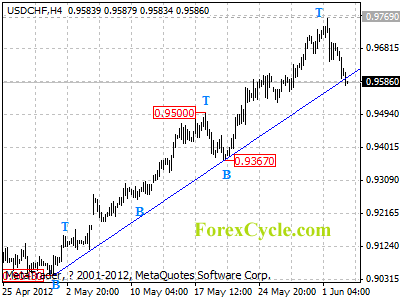
USDCHF breaks below the upward trend line

USDCHF breaks below the upward trend line from 0.9043 to 0.9367, suggesting lengthier consolidation of the uptrend from 0.9043 is underway. Range trading between 0.9500 and 0.9769 would likely be seen over the next several days. The uptrend could be expected to resume after consolidation, as long as 0.9500 support holds, one more rise towards 1.0000 is still possible. Key resistance is at 0.9769, a break above this level will signal resumption of the uptrend.

usdchf

Forex Signals

Monday Mayhem Chart and Live Video Analysis

By Chris Vermeulen, TradersVideoPlaybook.com

This week should be just exciting with the markets reaching extreme levels for bonds, gold, SP500, and oil. This morning’s video covers it in detail.

Pre-Market Analysis Points:
–    US dollar index in consolidation and also forming a mini head and shoulders pattern which if the neckline is broken points to lower prices for the dollar that may last 1-2 sessions.

–    Gold and silver are both trading at resistance levels and are headline driven at this point. Anything could happen going forward so I remain on the side for now.

–    Oil continues to show weakness but is now trading within a major support level. I am keeping my eye on the intraday charts for a reversal pattern to play a bounce/rally this week.

–    Bonds continue to rise with record low yields… This shows there is real panic fear in the market and lower prices may continue for another week or two.

–    The volatility index while elevated is still overall trading low. This means more downside is possible investors and baby boomers start to roll more of their money out of stocks and into bonds.

–    SP500 sold down another 1% in futures trading after the closing bell which was very bearish. This morning we have seen the dollar index pullback and that has allowed the SP500 to recover the 1% post market drop on Friday.

Those of you short the SP500 with me should tighten your stops incase there is a sharp rebound in the market. The position is up over 9.5% in less than 5 days and I want to lock in a good chunk of that with a stop at this mornings high in the market or your low for your inverse fund depending on what you are trading :)

After Friday’s weakness in stocks and commodities we continue to see that fear and selling pressure carry over into this week. European markets are trading lower by 1 – 2% and I fell the US market will naturally want to follow them down. Currently the US market is only down 0.5% so it is possible we see another 1 – 1.5% drop within the next 24 hours.

JP Morgan and Facebook continue to make new lows and that is putting some drag on the market. I think the biggest drag at the moment are the transportation stocks with that sector down over 2.2% today because of the weakening economic outlook from last weeks terrible data out of the United States.

The selling taking place does look and feel as though there is power behind as investors around the globe are slowly moving to cash and hedge funds will be forced to liquidate positions to pay back their clients. Both of these things have a grinding effect and may last for a week or longer with any bounce getting sold into.

Gold and silver are starting to pullback a little and I will keep an eye on the price and volume incase it gives us a signal as to what is next.

Below is a chart of what I feel may take place at any time now so you are mentally prepared.

Test drive our video analysis and trade idea service for only $1 – www.TradersVideoPlaybook.com

Chris Vermeulen


The Better Part of Foreign Investment in India

In the last few years India has witnessed a major change in its economic environment, on the back of foreign investments into India. The huge foreign capital investments have bought India considerable financial benefit. Markets are expanding in India, trade policies are being liberalized and there had been further development in technology and telecommunication as well. After China, India is now growing in popularity with a huge amount of foreign capital coming in. Foreign investors are putting in money in fields like telecommunication, infrastructure, computer hardware and software, information technology and hospitality.

Investors from abroad have been providing huge financial help to companies, corporations, business and organizations and here lies the significance of foreign direct investments (FDI) in India. India is growing in opportunities because of huge foreign investment. There are some automatic routes for making the investment and one can even invest through several processes undertaken by the Government. One can go for several joint ventures if one wants to be an effective direct foreign investor. One can really make a favorable fortune if one invests in sectors like real estate education, biotechnology, alternative energy sectors and other specialized fields.

With the route of foreign investments into India, companies can start a new venture and at the same time opt for business expansion. Thus, this is a better way to start and grow big at the same time. There are several advantages of a direct foreign investment in India. Wages in India are cheap and this is the reason more number of people would want to start here.

There are special investment privileges being offered at the place and this is the reason the concept of FDI in India is gaining immense popularity. Moreover, the investors would get a tariff-free access to the Indian markets and this is a real advantage for them. The investors can even enjoy tax exemptions at the place and this is the reason investors would want to put in money at the place more than once.

When talking about foreign investments into India one may focus on other aspects as well. With the entry of huge capital, there are industries in India which have been breathing fresh lease of life. They were at the verge of being extinct and due to the efforts of some foreign investors they have gained life once again. In fact, the legal aspects in India are quite flexible for foreign investors to operate and this is the reason it has been possible for people to make a fortune in this part of the world. Moreover, as India is rich in human resource, so starting anything new seldom faces hindrance over here. Therefore, with right training and correct infrastructure India will continue to be a favorite to the investors involved in legitimate investments.

About the Author

Harjeet is an Indian – born mass-market novelist, who covers the world internet related topics . He writes columns and articles for various websites and internet journals in the domain of Investments and Investing in India.