By Central Bank News
ECB holds rate steady at 1 percent, acknowledges growing risks
Have Gold, Silver, & Mining Stocks Bottomed?
On Friday, the price action in gold caught the attention of most market participants as gold put in a monster move to the upside in light of risk assets such as the S&P 500 selling off sharply. In fact, gold futures rallied nearly $58 per troy ounce on Friday (+3.71%) while the S&P 500 Index sold off over 32 handles (-2.46%).
Monday saw some profit taking in gold and silver futures as Friday’s monster gains had to be digested. Short term traders were locking in profits, but overall the price action remains quite bullish at the moment. The gold miners remained extremely strong into the bell on Monday as buyers bid up prices in the afternoon to push them nearly 1.65% higher for the trading session.
Long time readers understand that I am a gold bull in the longer-term and have been for quite some time. Unlike some gold bugs, I will discuss the downside in precious metals from time to time even though it generally fills up my email inbox with some rather rude and hate-filled emails.
My view of gold and silver is that they are senior currencies. With that being said, I monitor the value of gold in U.S. Dollars and recognize that a stronger U.S. Dollar in the longer-term is not necessarily bullish for gold. Yes both gold and the Dollar can rally together, but mutualistic price action generally does not last for long periods of time.
Obviously I monitor the price action of the U.S. Dollar Index futures on a regular basis to help me gauge when the Dollar is at key turning points regarding price action. Back on May 5th I penned an article titled “The Dollar & Gold have Eyes on Europe” where the following chart and statements were made:
“The key level to watch is the 80.76 price level on the U.S. Dollar Index futures. If that level gets taken out, the Dollar could extend to recent highs and beyond should the situation in Europe begin to unravel.”
A few weeks have passed since I posited that chart and statement to readers and time has proven my analysis wise. On May 14th the U.S. Dollar took out the overhead resistance at the 80.76 price level and has since worked even higher taking out the resistance level around the 82 price point.
In the same article, I discussed my expectations for gold prices in the intermediate term as quoted from the gold chart below:
“My expectation is that we may test the key support area [1,550 – Gold Spot Price] one more time, but price will likely breakout to the upside when this pattern is finally triggered.”
The gold futures weekly chart shown below illustrates how we tested the key support level as discussed above and a major bounce to the upside appears to be unfolding.
While we could see some short-term consolidation, I continue to believe that gold prices are likely to climb higher. In addition to the safe haven status, should an all-out currency crisis begin to unravel in Europe, gold and silver will be viewed as safe havens to protect European citizens’ and corporations’ wealth against a faltering Euro.
In fact, all ways out for Europe are positives for precious metals. If a currency crisis takes place and countries default, money will pour into gold and silver as Europeans attempt to protect their purchasing power.
However, politicians are not going to allow governments to default without a fight. Instead I suspect more and more pressure will be placed on the European Central Bank (ECB) to print piles of Euros. Both outcomes are bullish for gold and silver in the intermediate to longer-term time frames. In fact, the fundamental case for gold seemingly continues to build as central banks around the world print vast sums of money and multiple currency crisis scenarios are likely to transpire.
Silver has actually outperformed gold recently during this selloff. Unlike gold, silver did not quite test the recent support zone. In light of this divergence, I would not rule out the potential for one more move lower in gold and silver that might trigger stops on the other side of key support.
I do believe that probabilities favor that we have bottomed in precious metals, but there is always a chance of one last push lower to shake out weak bulls. The weekly chart of silver futures is shown below.
The weekly chart of silver futures shown above demonstrates how silver outperformed gold on the recent selloff as silver failed to test key support. However, gold has started to show out performance to the upside which is most obvious when comparing the strength seen on Friday.
While both gold and silver appear likely to have formed a major bottom or are in the process of forming a major bottom, I continue to believe that gold miners are offering more potential upside. The gold miners have been absolutely crushed the past few months.
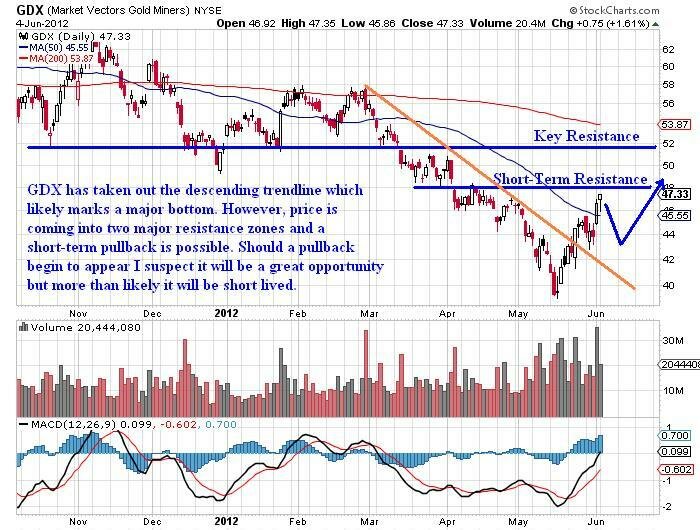
Back on February 29th of this year, the Market Vectors Gold Miner’s ETF (GDX) made a high of $57.91 / share that day. The most recent low which occurred on May 16th saw GDX trade as low as $39.08 / share. The move over the course of only a few short months produced a loss over 32% for investors that held an unhedged position.
From a fundamental standpoint, valuations have become close to levels not seen since the lows which formed during the financial crisis in 2008 and 2009. However, an excerpt from James Turk’s analysis which recently was published in “Things That Make You Go Hmmm” by Grant Williams is certainly worthy of discussion.
Turk produced the following 30 year chart which depicts the amount of gold in grams and ounces required in order to purchase 1 unit of the gold mining index (XAU). The gold mining index is very similar to the HUI Gold Bugs Index or the Market Vectors Miners ETF (GDX).
The following quote comes from James Turk where he references the chart shown above:
“I want readers to take a look at the following 30 year chart which I believe is the most important and extraordinary chart for 2012. It presents the XAU Gold Mining Index measured in terms of gold, not dollars. We’re making history here. Gold stocks have never been this undervalued before.”
The chart above speaks for itself. Long-term investors looking for deep value should look no further than the gold miners for opportunities. In the past 30 years, they have never been this cheap relative to the price of gold.
Obviously gold miners have rebounded sharply from their recent lows the past few weeks. In the longer term they are still extremely oversold, but in the short run a pullback to back test a variety of key support levels may be warranted.
Should a pullback occur, I think it will likely mark an excellent buying opportunity in the intermediate to longer term. The daily chart of the Market Vectors Gold Miners ETF (GDX) is shown below.
GDX could very well power right on through the short-term resistance level, but I would be surprised if it could push through the intermediate term resistance near the 52 price level on its first attempt. A pullback here would be quite healthy, but Mr. Market may not offer that opportunity. Right now the gold miners clearly have a strong valuation argument to consider them at a value presently.
In addition, we are seeing the U.S. Dollar Index futures start to roll over while gold and silver futures are trying to form bottoms and build consolidation bases to move higher from. If this is a major top in the Dollar, then gold, silver, and gold miners are on sale as we speak. The next few months will tell the real story, but in the longer term this may go down as an unbelievable buying opportunity that most investors will miss entirely.
30 Day Membership for only $1 – www.TradersVideoPlaybook.com
This material should not be considered investment advice. J.W. Jones is not a registered investment advisor. Under no circumstances should any content from this article or the OptionsTradingSignals.com website be used or interpreted as a recommendation to buy or sell any type of security or commodity contract. This material is not a solicitation for a trading approach to financial markets. Any investment decisions must in all cases be made by the reader or by his or her registered investment advisor. This information is for educational purposes only.
“Bear Channel Broken” for Gold, But “Professional Traders Need to Come Back” as European Banking Problems Spread
London Gold Market Report
from Ben Traynor
BullionVault
Wednesday 6 June 2012, 08:50 EDT
U.S. DOLLAR gold prices climbed to a one-month high at $1640 an ounce ahead of Wednesday’s US session – a gain of more than 7% from May’s low – while stocks, commodities and the Euro also ticked higher and major government bond prices fell, with London markets open again after a two-day public holiday.
Silver prices climbed to over $29.50 an ounce – a 3.3% gain on the week so far, and a near 10% rise from last month’s low.
“[Gold] is consolidating last Friday’s aggressive move from $1546 to $1629,” says the latest technical analysis from bullion bank Scotia Mocatta.
Barclays Research meantime note that gold prices have broken above its “2012 bear channel”, adding that gold has hit “strong demand [in the] “1522-33 area” on downswings over the past 12 months.
“This week there will be plenty of opportunities for gold to either pass the safe haven test or reverse back into its old risk-on shell,” added a note from UBS this morning.
The European Central Bank announced its latest monetary policy decision on Wednesday, which saw the ECB leave its main interest rate on hold at 1%.
Following Wednesday’s ECB decision and press conference, the Bank of England makes its latest policy announcement on Thursday, shortly followed by US Federal Reserve chairman Ben Bernanke’s testimony to Congress.
When Bernanke appeared before Congress at the end of February, gold prices dropped $100 an ounce in less than an hour.
Back here in Europe, “the ECB might want to wait for further corroborating data to conclude that its second-half-of-the-year recovery expectations are challenged,” reckons Royal Bank of Scotland economist Silvio Peruzzo.
“The problem in the Eurozone,” adds Steve Barrow, currency analyst at Standard Bank in London, “much more than the US and UK, is that the banking sector is broken. As it fights for its survival, so credit growth to firms and individuals is sacrificed.”
“European institutions must open up and help us facilitate bank recapitalizations,” said Spanish Treasury minister Cristobal Montoro yesterday.
“The market is no longer open. The risk premium is telling us that Spain as a state has a problem accessing the market when we need to refinance our debt.”
Yields on 10-Year Spanish government bonds breached 6.7% last week, and despite easing since remain above 6%.
European leaders agreed last July that the European Financial Stability Facility, the Eurozone’s temporary bailout fund set up two years ago, should be able to make loans for the purposes of bank recapitalization, although such loans would go to sovereign governments rather than to banks directly.
Ratings agency Moody’s meantime cut its credit rating for six German banks on Wendesday, including Commerzbank, while it also cut its rating for the German arm of Italian bank UniCredit. Three Austrian banks also had their ratings cut.
“Today’s rating actions are driven by the increased risk of further shocks emanating from the Euro area debt crisis in combination with the banks’ limited loss-absorption capacity,” said a Moody’s statement.
The European Commission today announced its plans for a resolution regime to deal with failing banks, including “early supervisory intervention” and powers to sell all or parts of banks deemed to be failing.
In addition, the Commission states, “if market funding is not available…supplementary funding will be provided by resolution funds which will raise contributions from banks proportionate to their liabilities and risk profiles.”
Opposing the so-called banking union, one German politician today described it as “a new, admittedly creative, way to tap German solvency.”
“Our savers cannot be liable [for other countries’ banks],” added another, Michael Fuchs, who is a member of Chancellor Merkel’s CDU party.
Following a conference call on Tuesday, G7 leaders said they will coordinate their response to the Eurozone crisis.
“[They] said they will speed up their efforts to resolve those problems, which was encouraging to us,” said Japanese finance minister Jun Azumi, adding that “Japan is ready to provide support if there is anything we can do.”
The Bank of Japan was one of six central banks that took part in a coordinated action on November 30 last year, when the cost of overnight Dollar funding to banks was cut by 50 basis points (0.5 percentage points).
Despite the ongoing crisis, the Euro rallied this morning, at one point trading above $1.25, 1.7% up on last week’s two-year low.
Euro gold prices meantime hit their highest levels since the end of February, rising to €42,290 per kilogram (€1315 per ounce).
The gold price in Euros has only been higher than €42,000 kilograms on 36 previous trading days, first in September 2011 and then again in February of this year.
Over in the US, the so-called speculative net long position held by gold futures and options traders on the Comex fell just over 5% in the week ended last Tuesday, data published Friday by the Commodity Futures Trading Commission show.
The spec net long – defined as the difference between bullish and bearish contracts held by noncommercial traders, as opposed to industry players such as gold mining companies – fell by the equivalent of 17.2 tonnes of gold bullion, hitting its lowest level since December 2008.
Since last Tuesday, gold prices have rallied back above $1600 an ounce, following Friday’s disappointing nonfarm payrolls report.
“We are positive on gold,” says Nikos Kavalis, global banking and markets analyst at RBS.
“To regain traction [though], we need the professionals to go back in.”
Gold value calculator | Buy gold online at live prices
Editor of Gold News, the analysis and investment research site from world-leading gold ownership service BullionVault, Ben Traynor was formerly editor of the Fleet Street Letter, the UK’s longest-running investment letter. A Cambridge economics graduate, he is a professional writer and editor with a specialist interest in monetary economics.
(c) BullionVault 2011
Please Note: This article is to inform your thinking, not lead it. Only you can decide the best place for your money, and any decision you make will put your money at risk. Information or data included here may have already been overtaken by events – and must be verified elsewhere – should you choose to act on it.
Euro Up against Majors Before G7 Meeting
By TraderVox.com
Tradervox (Dublin) – The 17-nation currency was up against most majors yesterday before the G7 conference call meeting aimed at discussing the current debt crisis in the region. This has brought some risk appetite in the market with the current Asian currency surge leading to the strengthening of the Asia Pacific currencies.
Yesterday’s reduction in the interest rate by the Reserve Bank of Australia also caused the Australian dollar to increase against the US dollar and the euro. However, attention was given to the G7 talk held yesterday by seven finance ministers and central bank governors as they deliberated on the European crisis leading to euro advance.
Some currency strategists had indicated that the conference call would touch on the ongoing crisis, which increased investor confidence in the region leading some buying of the euro. According to Lee Wai Tuck who is a Currency Strategist at Forecast Pte in Singapore, this is set to bring short covering in the euro that is set to stop last week’s decline. Investors will, however, keep an eye on the proceeding and look for any new measures that might be suggested. Any new measure proposed from the G7 conference call meeting will end bets that the euro will continue to decline.
Prior to the meeting the 17-nation currency strengthened against the greenback by 0.2 percent to exchange at $1.2522 from the previous day close of $1.2499. The euro had fallen to new lows as crisis in Spain and Greece continued to escalate. The euro was also strong against the yen, adding 0.1 percent to trade at 98.06. The yen was little changed against its safe haven counterpart, the US dollar, exchanging at 78.32 yen per dollar.
It has been revealed that the G7 nations have been holding conference calls in preparation for the G20 meeting to be held later in the month. According to Canadian Finance Minister Jim Flaherty, the meetings were focusing on the European debt crisis.
Disclaimer
Tradervox.com is not giving advice nor is qualified or licensed to provide financial advice. You must seek guidance from your personal advisors before acting on this information. While we try to ensure that all of the information provided on this website is kept up-to-date and accurate we accept no responsibility for any use made of the information provided. Opinions expressed at Tradervox.com are those of the individual authors and do not necessarily represent the opinion of Tradervox.com or its management.
Article provided by TraderVox.com
Tradervox.com is a Forex News Portal that provides real-time news and analysis relating to the Currency Markets.
News and analysis are produced throughout the day by our in-house staff.
Follow us on twitter: www.twitter.com/tradervox
ForexCT’s Afternoon Market Thoughts for 6 June 2012
Video courtesy of ForexCT – A leading Australian forex broker, liscensed by the Australian Securities & Investments Commission, offers the MetaTrader4 and PROfit Platform to retail traders. Other services include Segregated Accounts, Trading workshops, Tutorials, and Commodities trading.
Spain Worries Cause Euro to Erase Gains
Source: ForexYard
The euro erased most of its recent gains in trading yesterday, as investors once again shifted their attention to Spain’s debt issues, which in turn led to risk aversion in the marketplace. Additionally, investors had little hope that a meeting among G7 ministers would lead to any breakthroughs in new way to stimulate growth in the euro-zone. Turning to today, traders will want to pay attention to the European Minimum Bid Rate and the subsequent ECB Press Conference. While no changes to euro-zone interest rates are expected to occur, the press conference may provide clues as to what the ECB plans to do to combat the region’s debt crisis.
Economic News
USD – USD Resumes Bearish Movement against JPY
After steadily increasing during the beginning of the week, the USD/JPY once again turned bearish during trading yesterday. Analysts attributed the dollar’s downward reversal to the perception among many investors that the US economic recovery has stalled following last week’s disappointing Non-Farm Payrolls figure. The USD/JPY dropped as low as 78.09 in the early morning session before staging a slight upward recovery to stabilize at 78.24. The news was not all bad for the dollar though. The EUR/USD once again turned downward yesterday, dropping over 100 pips to reach as low as 1.2409.
Taking a look at the rest of the week, dollar traders will want to pay close attention to a speech from Fed Chairman Bernanke on Thursday. Any signs that the Fed is planning on a new round of quantitative easing to help grow the US economy could weigh down on the dollar. That being said, Friday’s US Trade Balance is forecasted to have improved over last month’s figure. If true, the dollar may be able to recoup some of its recent losses against the yen.
EUR – Minimum Bid Rate Could Impact EUR
Fears’ regarding Spain’s banking sector as well as the possible impact of Greece’s upcoming election caused investors to revert back to safe-haven assets during trading yesterday. As a result, the euro fell against several of its main currency rivals, including the British pound and Japanese yen. The EUR/GBP dropped more than 50 pips over the course of the day, eventually reaching as low as 0.8087. Against the Japanese yen, the euro was down over 100 pips during early morning trading, eventually hitting 97.03 before staging an upward correction later in the day.
Turning to today, traders will want to pay attention to the European Minimum Bid Rate and ECB Press Conference, scheduled for 11:45 and 12:30 GMT, respectively. While most analysts are fairly certain that euro-zone interest rates will stay at 1.00%, the possibility exists that the ECB will lower rates as a way to stimulate growth in the region. Should this occur, the euro may drop against its safe-haven currency rivals during the afternoon session.
AUD – Aussie Sees Mixed Trading Day
The Australian dollar saw a mixed session yesterday against the USD and JPY. The AUD/USD fell from a high of 0.9801 during early morning trading, eventually reaching as low as 0.9708 before staging a slight upward correction. The pair was able to then stabilize at 0.9750. Against the yen, the AUD had more luck. After falling over 90 pips during the first part of the day, the AUD/JPY rebounded and eventually reversed all of its earlier losses by the end of European trading.
Turning to today, aussie traders will want to pay attention to news out of the euro-zone, as it is likely to dictate the level of risk appetite in the marketplace. If the ECB unveils any new strategies to stimulate economic growth in the euro-zone, the AUD may be able to rebound during afternoon trading. That being said, any additional negative European news could cause the AUD to turn bearish.
Crude Oil – Crude Oil Gives Back Some of its Earlier Gains
Crude oil gave back some of its gains from earlier in the week yesterday, as risk aversion in the marketplace due to worries that the global economic recovery is stalling drove the price of commodities downward. The price of crude fell from a high of $84.89 a barrel as low as $83.31 during mid-day trading.
Turning to today, traders will want to note this week’s US Crude Oil Inventories figure, set to be released as 14:30 GMT. Part of the reason the price of oil has fallen so much in recent weeks is because of record high crude stockpiles in the US, which investors take as a sign of decreased demand in the world’s largest oil consuming country. Should today’s figure again show US crude inventories increased, the price of oil could fall further.
Technical News
EUR/USD
The Williams Percent Range on the weekly chart is in the oversold zone, indicating that this pair could see upward movement in the coming days. This theory is supported by the Slow Stochastic on the same chart, which has formed a bullish cross. Going long may be the wise choice for this pair.
GBP/USD
In a sign that this pair could see an upward correction in the near future, the Relative Strength Index on the daily chart has dropped into oversold territory. Furthermore, the Williams Percent Range on the weekly chart is currently at the -90 level. Opening long positions may be a good idea for this pair.
USD/JPY
While the Williams Percent Range on the weekly chart is pointing to a possible upward correction in the coming days, most other long term technical indicators are in neutral territory. Traders may want to take a wait and see approach for this pair, as a clearer picture may present itself shortly.
USD/CHF
The Relative Strength Index on the weekly chart is approaching the overbought zone, indicating that this pair could see a downward correction in the near future. Additionally, the Slow Stochastic on the same chart appears to be forming a bearish cross. Traders will want to monitor these two indicators, as they may point to an impending downward correction.
The Wild Card
Dow Jones Industrials
The daily chart’s Slow Stochastic has formed a bullish cross, meaning that upward movement could be seen in the near future. This theory is supported by the same chart’s Williams Percent Range and Relative Strength Index, both of which are in oversold territory. Forex traders may want to go long in their positions ahead of a possible upward breach.
Forex Market Analysis provided by ForexYard.
© 2006 by FxYard Ltd
Disclaimer: Trading Foreign Exchange carries a high level of risk and may not be suitable for all investors. There is a possibility that you could sustain a loss of all of your investment and therefore you should not invest money that you cannot afford to lose. You should be aware of all the risks associated with Foreign Exchange trading.
Dollar and Yen Fall as G7 Meeting Concludes
By TraderVox.com
Tradervox (Dublin) – The G7 conference call meeting held yesterday concluded to lead a global coordinated effort to save Europe from the recent crisis that has sent almost eight nations in the region into recession. This has damped safe haven appetite in the market leading to the decline of the yen and dollar. The two safe haven currencies slid against most of the major currencies after the meeting. Further, the dollar index fell after Charles Evans, the Federal Reserve Bank of Chicago President, indicated that the US economy will require an extremely strong accommodation if it is to sail through the current looming crisis that may be instigated by euro area countries.
The yen lost for the third day against the euro after Japanese Finance Minister jun Azumi indicated that the government will take decisive measures to stop the recent strengthening. He further indicated that Japan would support euro area nations to solve the current crisis in the region. He urged euro area leaders to do more to address investors’ concerns about the finances in the region. The Australian currency continued with its gain after a report from the nation showed that the economy grew more than market expectation.
According to Azumi, the Group of Seven Finance Ministers and Central Bankers agreed to help Spain and Greece to restore their financial system into a sustainable level. This came a day before the European Central Bank policy makers meet today to decide on the region’s borrowing cost. It is expected that they will keep the current interest rate of 1 percent.
After the G7 meeting, the greenback dropped 0.4 percent against the euro to exchange at $1.2503 at the start of the London Session. However, the US dollar increased against the yen by 0.4 percent to trade at 79.08 yen per dollar. The yen declined by 0.9 percent against the euro to exchange at 98.93 yen per euro. The Aussie increased by 1.2 percent against the US dollar to trade at 98.54 US cents and added 1.7 percent against the yen to trade at 77.99 yen.
Disclaimer
Tradervox.com is not giving advice nor is qualified or licensed to provide financial advice. You must seek guidance from your personal advisors before acting on this information. While we try to ensure that all of the information provided on this website is kept up-to-date and accurate we accept no responsibility for any use made of the information provided. Opinions expressed at Tradervox.com are those of the individual authors and do not necessarily represent the opinion of Tradervox.com or its management.
Article provided by TraderVox.com
Tradervox.com is a Forex News Portal that provides real-time news and analysis relating to the Currency Markets.
News and analysis are produced throughout the day by our in-house staff.
Follow us on twitter: www.twitter.com/tradervox
Market Review 6.6.12
Source: ForexYard

Riskier currencies gained against their safe-haven rivals during overnight trading, following a better than expected Australian GDP figure. The EUR/USD reached as high as 1.2515 while the AUD/USD gained almost 100 pips to trade as high as 0.9861. Crude oil also benefited from risk taking in the marketplace and is now trading just below the $85 a barrel level.
Main News for Today
EUR Minimum Bid Rate- 11:45 GMT
• Although most analysts are predicting that the ECB will keep interest rates at their current 1%, some are forecasting that a rate cut could take place today
• If interest rates are cut, the euro, along with other riskier currencies, could see losses during afternoon trading
EUR ECB Press Conference-12:30 GMT
• Investors will be paying close attention to the press conference for clues as to any plans the ECB may have to stimulate growth in the euro-zone
• If no new initiatives are announced, the euro could see some bearish movement later in the day
Read more forex news on our forex blog
Forex Market Analysis provided by ForexYard.
© 2006 by FxYard Ltd
Disclaimer: Trading Foreign Exchange carries a high level of risk and may not be suitable for all investors. There is a possibility that you could sustain a loss of all of your investment and therefore you should not invest money that you cannot afford to lose. You should be aware of all the risks associated with Foreign Exchange trading.
How This Bear Market Could Last Another 18 Years… Just Like Japan’s
Yesterday, Bloomberg News reported:
‘Japan’s Topix Index (TPX) entered a bear market, with stocks plunging to a level not seen since 1983 as Europe’s debt crisis spurs a global flight from risk assets, driving up the yen and threatening exports…
‘In 1983, the Topix was in the sixth year of a 12-year advance that ended when an asset bubble burst, ushering in an era of deflation and economic stagnation. The gauge has lost 76 percent since peaking on Dec. 18, 1989.’
It has been a rough time for Japanese stock investors.
An entire generation of Japanese have lived through a bear market. Japanese investors who were 18 when they bought their first shares in 1989 are now 41 years old.
And so, as the Aussie market nears the end of its fifth year as a bear market, the question on every investor’s lips should be: Will Aussie stocks fall for another 18 years?
We’ll give you our take on it now…
Until recently, most people thought asset prices always went up.
This was mostly the view among stock and housing investors.
Why?
Because it was what they had seen during their lifetime. Even when house and stock prices fell, it wasn’t long before they recovered and went higher again.
Take the 1987 and 2001 stock market crashes. Or the early 1990s housing bust. Soon prices stopped falling, levelled off, and then soared higher.
What the Japanese Bear Market Tells Us
But as the Japanese experience shows, stock and housing prices don’t always go up, and they don’t always recover after a crash.
Look at that quote from Bloomberg again. The Topix Index ‘has lost 76 percent since peaking on Dec. 18, 1989′.
And the important thing is, if Japanese stock market history tells you anything, over time the impact of the crash gets worse, not better. As this chart of another Japanese index, the Nikkei 225 shows:

Following the 1989 peak, the index halved over the next four years. Then it steadied into a range, before continuing to fall.
The Japanese stock market is an important lesson for any investor about the impact of credit-fuelled bubbles. We won’t go into the history of the Japanese bubble, except to remind you of how the 3.41 km2 of land containing Tokyo’s Imperial Palace was valued at ‘more than all the real estate in California’ during the 1980s boom (Edward Jay Epstein, 2009).
What it tells you is that rather than stock and housing prices always going up (in the long run), they behave more like a bouncing ball.
In Japan during the 1980s, the credit-fuelled boom threw the ball high into the air. It began to fall in 1989. The ball hit the floor in the early 1990s…bounced until the mid-1990s…fell and hit the floor again by the mid-2000s…and so on.
You get the point.
But why should this happen? And what can it tell us about the future direction of the Aussie market?
Following Japan’s Bear Market Lead
The Japan experts will tell us Japan is unique. The usual spiel is that Japan owns all its own debt and so it’s different to the debt picture in the US, Europe and elsewhere.
Maybe that’s true. And maybe it isn’t. Or maybe Japan’s economy is just a few years ahead of the game. Consider these two charts from the latest Banque de France Financial Stability Review:
Right now, Japanese residents and the Bank of Japan hold 94% of all Japanese government debt.
Compare that to 52% of US government debt held by the Fed and private residents. In fact, US Fed and government (including government agencies) hold USD$6.328 trillion…about 40% of all US debt.
And according to a 28th March report by the Wall Street Journal, ‘The Federal Reserve is propping up the entire US economy by buying 61 percent of the government debt issued by the Treasury Department…’
The report concludes that this is ‘a trend that cannot last’.
But what if it can last?
What if the US Fed keeps buying US debt?
Who’s to say that in 10 or 15 years, US residents and the Fed won’t own 94% of all US debt?
It doesn’t seem likely now, but then, four years ago it didn’t seem likely that the US government would own 40% of its own debt today.
With so much money flowing into government coffers, investors need to face the facts: the era of financial asset growth is over.
No government will ever choose to cut spending. Remember that all the talk of austerity is false. Government spending in the US, UK and Australia will go up over the next few years…even though the politicians claim they’re making savage cuts.
(All they’re doing is cutting the spending growth rate, not the nominal rate. In other words, if the previous forecast was to grow government spending by 5% next year, but it only grows 4.5% they call it a spending cut…even though spending has risen.)
We’re afraid things are the same for Australia.
The Boom is Over, Get Used to a Long Bear Market
Australia has benefited from a decade of the China resources boom. But that boom is over. US and European private spending is falling. And as Europe and the US are China’s two biggest export markets, any problems in those economies will impact China…and therefore Australia.
That’s despite what the mainstream media told you when they claimed Europe is ‘so far away’. That growth was in Asia…where we are. That’s only true if Americans and Europeans kept spending.
The problem facing Australia over the next few years is the problem that the US and Europe face now. How to pay for an expensive welfare system when tax revenues fall?
The answer will be to look to Japan, Europe and the US… print more money and have the central bank buy the government’s debt.
Anyone who thinks Australia is different due to the lower levels of government debt is kidding themselves. It only takes a few years of budget deficits and suddenly the government and taxpayer are running just to stand still.
So, far from being an exception, Japan is more like the blue-print for governments and central bankers everywhere. Get ready for this bear market to last another 18 years…at least.
Cheers,
Kris.
Related Articles
Market Pullback Exposes Five Stocks to Buy
The US Dollar – The “Strongest of the Weak”
How Bad Monetary Policy Will End the Welfare State
How This Bear Market Could Last Another 18 Years… Just Like Japan’s
No Bull: Could the US 10-Year Treasury Note Yield Hit 1%?
In the wake of Friday’s disastrous jobs number, [US] 10-year Treasury Note yields finally fell through the 1.5% level, trading as low 1.44% on the day.
That plunge took many traders, talking heads and politicians by surprise.
Now that we’ve busted 1.5%, the next stop is 1%.
I can even see negative yields ahead, meaning that investors who buy US Treasuries will actually be paying the government to keep their money.
Why Bond Yields Will Continue to Fall
First off, 10-year yields dropping to 1% means several things:
- Bond prices go even higher. Rates and prices go in opposite directions. Therefore when you hear that yields are falling, this means that bonds are in rally mode.
- The world is more concerned with the return of its money than the return on its money. You can take your pick why. Personally I think it comes down to two things above all else: the looming disintegration of the Eurozone and the fact that our country is $212 trillion in the hole and warming up for another infantile debt ceiling debate instead of reining in spending.
- More stimulus. Probably in the form of a perverse worldwide effort coordinated by central bankers as part of the greatest Ponzi scheme in recorded history.
Zero Percent or Negative Yields – in the US of A?
Yes. Given the state of financial disarray in our world today, this is no longer just a probability. It’s moved into the “likely” category.
Remember your history:
- During the Great Depression, U.S. bonds traded at negative yields when investors didn’t trust the banking system or corporate bond markets.
- During the 1990s, Japanese Federal bonds went negative as investors sought safety above all else. I remember mouths agape all over the trading floors when it happened and people realized that the unthinkable had just become reality. The headlines here give me a terrible sense of déjà vu.
- In January of this year, Germany sold 3.9 billion euro worth of Federal German T-bills at -0.0122% yield, reinforcing the relative safety of German finances versus Greek and EU finances in general.
- Last week German, Danish and Swiss bills all traded at negative yields.
How Low Can Bond Yields Actually Go?….
I don’t know for sure but the bond markets on both sides of the Atlantic give us a pretty good idea at the moment.
Take German 10-year bonds, for example. They closed Friday at a yield of 1.17%.
When you subtract the 2% official inflation figure it suggests investors may be willing to accept negative real yields as low as -0.83%.
In the U.S., 10-year bonds recently closed at a 1.45% yield. Subtract our latest official inflation rate of 2.30% and that suggests investors may push yields all the way to -0.85%.
Shorter term investors may accept far less; perhaps yields in the negative 1%-3% range, which again implies that anybody who buys these things is willing to end up with less money at maturity than they started with when they bought the bond or t-bill.
Bonds are traditionally thought of as safe haven investments but at this stage of the game, they’re more like jet fuel in search of a match.
There’s a lot of talk about how rates can’t possibly go any lower.
Don’t “buy it” — Japanese 10-year bonds are at 0.82% while German 10-year bonds are at 1.21%.
Not only can rates go lower, but absent a comprehensive, practical solution to the world’s debt problems – like actually reining it in – we will get there.
Just remember you heard it here first when 10-year note yields hit 1%.
Keith Fitz-Gerald
Contributing Editor, Money Morning
Publisher’s Note: This is an edited version of an article that originally appeared in Money Morning (USA)
From the Archives…
How Bad Monetary Policy Will End the Welfare State
2012-06-01 – Dan Denning
The Setting Sun of the Japanese Economy
2012-05-31 – Greg Canavan
The US Dollar – The “Strongest of the Weak”
2012-05-30 – Kris Sayce
Europe’s Energy Resource Puzzle
2012-05-29 – Kris Sayce
The Market Has Crashed, But This Graphite Stock Has More Than Doubled
2012-05-28 – Dr. Alex Cowie