ECB Limited in Options, Says Draghi

By TraderVox.com

Tradervox (Dublin) – There was a sense of helplessness in the statement given by the European Central Bank President Mario Draghi as he stressed the limitations of the banks options. He indicated that the central bank can only use its monetary policy by cutting interest rates, which are already at a record low, bond-buying, and injection of liquidity in the market.

He stressed that the bank cannot make quantitative easing or cap bond yields in the region as he indicated that the bank is tasked with ensuring stable prices in the region. He left the ball squarely on the respective governments to ensure that measures suggested are implemented in order to curb the recent crisis.

The ECB decided to keep the interest rate at one percent, which is a record low; it also injected $1.2 trillion into the economy through its three-year loans to financial institutions in the region. Further, the bank also bought 212 billion euro of government debt hence it diminishing its capability to do more before respective governments in the region establish measures to curb respective problems. In his statement, ECB President Mario Draghi cast doubt on the effectiveness of cutting interest rate or flooding financial institutions with more liquidity before the reforms.

However, Draghi said that the central bank is ready to act should the crisis dampen the region’s economy further. Despite keeping the current interest rate, he said that there were some Governing Council members who wanted a rate reduction. He also added that there was no need for LTROs as the effect of the previous loans are yet to affect the market saying that some of the problems in the region are not monetary related.

The crisis in Spain is, however, escalating with Budget Minister Cristobal Montoro calling for outside help in recapitalizing banks in the country. Draghi has deny accusations that he is waiting for government to act before he can embark on using ECB policy tools.

Disclaimer
Tradervox.com is not giving advice nor is qualified or licensed to provide financial advice. You must seek guidance from your personal advisors before acting on this information. While we try to ensure that all of the information provided on this website is kept up-to-date and accurate we accept no responsibility for any use made of the information provided. Opinions expressed at Tradervox.com are those of the individual authors and do not necessarily represent the opinion of Tradervox.com or its management. 

Article provided by TraderVox.com
Tradervox.com is a Forex News Portal that provides real-time news and analysis relating to the Currency Markets.
News and analysis are produced throughout the day by our in-house staff.
Follow us on twitter: www.twitter.com/tradervox

How Gold as the Currency of First Resort Could Gain 196% by June 2018

By MoneyMorning.com.au

‘Gold remains the currency of last resort’ – Jeff Currie, Head of Commodity Research, Goldman Sachs

As a ‘last resort’ it’s not doing too badly.

Since the SPDR Gold Trust ETF [NYSE: GLD] first listed in the US in September 2004, gold has gained 250%.

During the same time the S&P 500 has gained 13.25%.

So we can only imagine what will happen to the gold price when it becomes the currency of first resort.


And that may not be far off if one commodities guru is right…

In Wednesday’s Money Morning, Diggers & Drillers editor, Dr. Alex Cowie revealed what could be the biggest game-changer for gold in recent history.

It’s got nothing to do with China.

It’s got nothing to do with India.

And it’s really not anything to do with the U.S. Federal Reserve.

He wrote:

‘The Basel Committee of Bank supervision, who dream up the rules that govern banks, are looking at turning gold into a “Tier One” asset.

‘This means the banks can carry gold as capital at 100% of its market value – instead of the current 50%.

‘This gives gold a huge increase in status, and effectively turns it back into money at the top level. It would also give the banks a strong reason to hold gold.’

This is about banks carrying gold on their balance sheet. While they can do that now, they can only carry 50% of the metal’s value towards their reserves.

If the proposed Basel plan goes ahead banks could carry gold at 100% of its market value.

If that happens, in one stroke it would put gold at the front of the queue. Gold would be the currency of first resort, rather than the last.

But aside from that, there’s perhaps an even bigger reason to own gold. And if we’re right, it could see the gold price hit $5,000 within the next six years…

Gold Doesn’t Change

One way of measuring the price of gold over time is to compare the gold price with GDP (gross domestic product).

It’s a handy guide because, as Warren Buffett says, gold ‘doesn’t do anything’. You pay someone to dig it from the ground and then you pay someone else to store it in a vault underground.

In other words, a bar of gold produced 200 years ago is no different today to what it was then.

And so, because gold doesn’t change you can measure other things, things that do change, in terms of gold.

One thing that changes all the time, from day to day, month to month and year to year, is GDP.

On a per person (per capita) basis, US GDP has gained from USD$47.61 in 1790 to USD$48,372 in 2011. At the same time, gold has gone from USD$19.39 per troy ounce to USD$1,600 in 2011.

And if you work out how many ounces of gold you could get per capita of GDP, you get the chart below:

Data Source: Measuring Worth (Note: logarithmic scale chart)

In 1791 you got 2.6 ounces of gold per capita of GDP.

From there the ratio hit a peak at 139 in 1970 before falling and peaking again at 132.4 in 2001.

Today, the gold-to-GDP ratio is 30.2. So, where is it heading next?

Stand By For An Inflationary Slowdown

If we accept that we’re living through an end-of-an-era credit bust we need to think about the impact this will have on GDP. In all likelihood it will mean GDP will fall as businesses and consumers borrow and spend less.

Unless you get an inflationary economic slowdown.

To a large degree, this is already happening. Governments have allowed central banks to cut interest rates to record lows. This has caused bond yields to crash (in one case, a 500-year low according to Dr. Cowie in his latest issue of Diggers & Drillers, due out this week).

Central banks have also printed trillions of dollars of new money. Yet none of it has sustained economic growth or kick-started another credit boom.

Proof of an inflationary slowdown is the fact that inflation-adjusted U.S. GDP per person has stood still since 2004.

The same is happening in Europe. Once the final benefits of the resources boom finish flowing through the economy, the same will happen here too.

(Forget yesterday’s bumper GDP number. That’s a lagging indicator from January to March. Remember, the market has only just found out that China and India are slowing faster than most people thought.)

That tells us to expect flat lining GDP worldwide as high taxes strangle the private sector. And that only more government spending on welfare and public works programs will prevent GDP falling.

But, because these aren’t productive spending measures, governments will struggle to meet spending commitments without increasing taxes or raising cash in another way. How?

Why Gold Could Gain 196% in Six Years

By printing more money of course.

And that means bad news for savers who will end up with a negative return on their cash. But it means better news for those with the foresight to buy gold.

So, where could the gold price head?

If we’re right and US GDP flat lines, our bet is you’ll see the gold price-to-GDP ratio fall to pre-credit boom levels of 10 or below.

And if that happens (assuming a US per capita GDP around USD$48,000-USD$50,000), you’re looking at a gold price over USD$4,800 per ounce…or a 196% gain from today’s price.

That’s assuming investors buy gold to protect their wealth against central bank inflation. And based on the long history of gold as the favoured safety spot for investors, we’d say the odds are pretty good.

If you think gold looks expensive at $1,600 an ounce, there’s a good chance that will look cheap compared to where it will be just a few years from now.

Especially when gold reclaims its place as the global currency of first resort.

Cheers,

Kris.
Related Articles

Market Pullback Exposes Five Stocks to Buy

The US Dollar – The “Strongest of the Weak”

How Bad Monetary Policy Will End the Welfare State


How Gold as the Currency of First Resort Could Gain 196% by June 2018

Why the U.S. Dollar is Really Rising

By MoneyMorning.com.au

By all accounts, the U.S. dollar should be the functional equivalent of a Zimbabwean bill.

The Fed has pumped trillions into the worldwide financial system as part of misguided stimulus efforts that should be incredibly inflationary.

Yet, instead of a disastrous repeat of the Weimar Republic, the U.S. dollar has strengthened considerably.


This despite rising unemployment, slowing economic growth and a debt debate that’s about to begin anew.

Since last July, the U.S. dollar has risen against all 16 major currencies while the Intercontinental Exchange Dollar Index is up 12%, according to Bloomberg.

In fact, the greenback is now higher than it was when the Fed engaged in Operation Twist in late 2011 as part of a plan to keep the dollar low by buying bonds.

So much for Club Fed’s plans…

As usual, they don’t really have a clue about how real money works — let alone why it flows and where it’s going.

Taking the Mystery Out of the U.S. Dollar

Here are the three reasons why the U.S. dollar is really rising:

1. Institutions are unloading gold to raise cash against anticipated margin calls, redemption requests, or both. They are parking that money in treasuries and in dollars, creating additional demand. There are simply more buyers than sellers at the moment, so prices for dollars and treasuries are rising. And not just by small amounts, either.

2. Institutional portfolio managers and traders are required to maintain specific classes of assets under very specific guidelines. These guidelines dictate everything from the amounts being held to the quality of specific investments.

Many, for example, are required to hold only AAA-rated bonds, or invest in stocks meeting certain income, asset size and volatility criteria.

Imagine you’re Jamie Dimon and you have to hold reserves against trading losses or you’re Mark Zuckerberg and you’ve got to build up a large legal settlement fund for the Facebook IPO.

Or, perhaps you’re Tim Cook of Apple and you’re sitting on $110 billion in cash for future investments.

Chances are you’re going to want to buy things that are as close to risk-free as possible to ensure your assets hold their value.

A year ago, you could choose from eight currencies in the G10 that met internationally accepted “risk-free” ratings criteria as measured by the cost of credit default swaps priced under 100 basis points.

Now, there are only five to choose from. A year from now, there might only be two or three.

In practical terms, what this means is that your capital, along with everyone else’s, is chasing a diminishing pool of high-quality, risk-free assets. So the prices for those risk-free assets — like the dollar and U.S. treasuries — are going to go up.

This is not unlike the last egg at the grocery store. If there are a 1,000 buyers and only one egg, the price of the egg skyrockets — like the dollar is now.

3. Bank demand for capital reserves is increasing markedly as they scramble to meet requirements set by the Bank for International Settlements in accordance with Basel III regulations. Created by the International Monetary Fund ostensibly to ensure adequate capital buffers in the event the stuff hits the proverbial fan, the requirements are causing banks to change the composition of the assets used to backstop their operations and to buy even more dollar-denominated assets. This, too, provides upward pricing pressure.

This is the law of unintended consequences at its very best.

While the IMF had its heart in the right place, the corresponding connections between the banks subjected to the Basel III requirements will increase the cost of capital, change funding patterns, and produce a migration of risk that wasn’t contemplated at the time the regulations were created.

Here’s why.

Banks make their money via the spread between income earned on their assets and the cost of their liabilities. Therefore, as banks reduce their debt to meet the new capital reserve requirements, the rules requiring a reduction in leverage ratios actually encourage greater risk taking.

Let me give you an example.

If I buy $1 billion in U.S. treasuries, I have to place them on my balance sheet and accept the corresponding reduction in the return on my equity and my borrowing capacity.

On the other hand, if I buy $1 billion in stinky sweatshirt swaps and I’m levered 10-1, I only have to reflect $100 million on my balance sheet.

This improves my return on equity and allows me to use the remaining $900 million to buy more stinky swaps, further increasing my equity efficiency.

Then there’s securitization.

Banks typically reduce exposure to specific loans, trades, borrowers or holdings by removing assets from the balance sheet. Doing so effectively releases regulatory capital which can then – ta da — be used to support additional loans and/or investments.

This increases equity efficiency even further. Never mind that it also exposes shareholders to true risk levels that remain off the books, invisible and at completely preposterous levels.

The Reserve Status of the U.S. Dollar

So where does that leave us?

There are a couple of things to consider.

As long as the overall deleveraging process continues, the relative scarcity of risk-free assets will increase. This suggests the dollar will rise further.

How much further is unknown, but the key event in an eventual dollar reversal will be either a complete recapitalization of the European banking system or additional stimulus in a concerted U.S./EU effort designed to stave off the day of reckoning.

It won’t work, but the illusion will hold for a while longer.

Speaking of illusions, if there is ever an argument as to why the USD will eventually lose its reserve status, this is it.

The gradual decomposition of quality assets all but guarantees that the few remaining viable currencies with risk-free status will have to band together in a last-ditch effort to maintain global liquidity.

My best guess at this point is that the basket of assets will eventually consist of a blend of currencies and hard assets.

I see that including the USD, the Japanese yen, Swiss francs, a neutered euro and Chinese yuan blended with gold and some form of oil-related instrument.

But there’s no question about it. Absent complete financial reform, each is badly flawed in one way or another – including the U.S. dollar.

Keith Fitz-Gerald
Contributing Editor, Money Morning

Publisher’s Note: This article originally appeared in Money Morning (USA)

From the Archives…

How Bad Monetary Policy Will End the Welfare State
2012-06-01 – Dan Denning

The Setting Sun of the Japanese Economy
2012-05-31 – Greg Canavan

The US Dollar – The “Strongest of the Weak”
2012-05-30 – Kris Sayce

Europe’s Energy Resource Puzzle
2012-05-29 – Kris Sayce

The Market Has Crashed, But This Graphite Stock Has More Than Doubled
2012-05-28 – Dr. Alex Cowie


Why the U.S. Dollar is Really Rising

17 Reasons Why China’s Economy is Heading For a Hard Landing

By MoneyMorning.com.au

Is China’s economy heading for a hard landing? We think so – which is why we think you should steer clear of everything from most industrial commodities to Asia-dependent luxury goods firms.


It is hard to tell much (except the general trend) from the official GDP numbers, so with this in mind, here’s a list of reasons to think that all is not well in the economy the bulls hope will be the financial saviour of the West.

1. The FT reports that Chinese buyers have deserted the Hong Kong art market. Six months ago, they accounted for around 44% of Sotheby’s sales. That is now down to more like 20-25%. Kevin Ching, chief executive of Sotheby’s Asia, noted that “there used to be five to six mainland Chinese individuals who would bid like crazy here, but they did not make any offer in spring sales.” Sotheby’s reported a net loss of $10.7m in the first quarter.

2. ICIS.com reports that demand for polyethylene, which has long been “a very reliable leading indicator for the economy”, is no longer rising but falling (down 6% overall).

3. The FT again – reporting that Chinese buyers have started to “defer raw material cargos” in a “hand to mouth” market. Traders are reporting requests that cargo deliveries be deferred, but also an increasing number of defaults.

4. The Purchasing Manager’s Index (PMI) is at a five-month low. Headline PMIs are also falling across the rest of Asia.

5. Electricity consumption is still up on last year, but it is now flat month on month this year.

6. The price of a bottle of Chateau Lafite is down 50% from its peak.

7. Rail cargo volumes are flatlining.

8. Cement demand fell in the first quarter.

9. The price of benchmark iron ore is down 9% from the end of last month.

10. Car sales are entirely flat (and fell slightly in the first few months of the year) and there are regular reports of prices being slashed. “The best scenario is for annual car sales to remain flat, even if the automakers try harder in the latter half,” said Zhang Xin, an analyst with Guotai Junan Securities Co (GJSZ) in Beijing.

11. Household consumption remains stuck at under 35% of GDP (still a record anywhere) making it pretty clear that there is not yet any real rebalancing from investment (around 50% of GDP) to consumption.

12. Graff diamonds has just pulled its Hong Kong IPO. It is the third company in a week to do so. The others? China Nonferrrous Mining Corp and China Yongda Automobiles Services.

13. In the first quarter of this year China’s state steel companies saw profits fall nearly 70% on a year earlier.

14. Bank lending is sharply down – total new bank loans were down 7.8% as of May 11 (year on year) and medium and long term loan volumes are 50% down on last year. The government has even conceded that the banks might miss their lending targets for this year.

15. Capital flight is rising fast. In January revenues at the casinos of Macau (this is the best way to move money out of China) were up 35%.

16. House prices in China saw their eighth consecutive monthly fall in May. In some areas of the market price falls of up to 65% are being reported, and even late last year falls of 25% in Shanghai were causing riots.

17. Stimulus. Given the levels of debt and overcapacity China is already saddled with it seems unlikely that the government would want to spend more if it was certain it was seeing nothing but a mild slowdown in growth. But the authorities have already given the go ahead to yet more infrastructure plans this week. Government spending in China was 27% higher in the first quarter of 2012 than 2011.

Merryn Somerset Webb
Contributing Editor, Money Morning

Publisher’s Note: This article originally appeared in MoneyWeek

From the Archives…

How Bad Monetary Policy Will End the Welfare State
2012-06-01 – Dan Denning

The Setting Sun of the Japanese Economy
2012-05-31 – Greg Canavan

The US Dollar – The “Strongest of the Weak”
2012-05-30 – Kris Sayce

Europe’s Energy Resource Puzzle
2012-05-29 – Kris Sayce

The Market Has Crashed, But This Graphite Stock Has More Than Doubled
2012-05-28 – Dr. Alex Cowie


17 Reasons Why China’s Economy is Heading For a Hard Landing

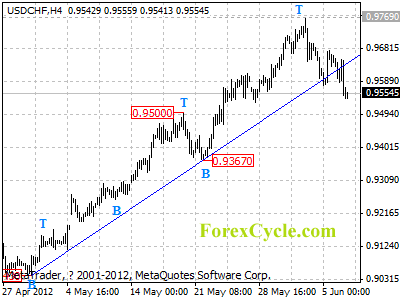
USDCHF’s fall extends to 0.9540

USDCHF’s fall from 0.9769 extends to as low as 0.9540. Deeper decline to test 0.9500 support would likely be seen later today, as long as this level holds, the fall is treated as consolidation of the uptrend from 0.9043, and one more rise towards 1.0000 is still possible after consolidation. However, a breakdown below 0.9500 will indicate that the uptrend from 0.9043 has completed at 0.99759 already, then the following downward movement could bring price back to 0.9200 zone.

usdchf

Forex Technical Analysis

The Coming Catastrophe in Government Bonds and Bond Funds

Article by Investment U

View the Investment U Video Archive

In focus this week: Why you should invest in gold, sell your government bonds and bond funds, and think twice about Chinese real estate.

Where Gold is Going

Gold will be back, count on it!

Buying by the central banks of Mexico, the Ukraine, the Philippines, and emerging countries is restoring faith in gold as the long-term safe haven trade.

According to the IMF, Mexico and Kazakhstan were active buyers in April, and the Philippines added a million ounces to its reserves in March.

Gold ran up 14.3% in the first three quarters of 2011 when its safe haven status was firmly established and Societe General’s metal analyst, Robin Bahr, said this week that it will follow the next risk off event, similar to the Lehman collapse. Greece is the most likely driver.

OCBC analyst Barnabas Gans sees $1,800 per ounce by the end of 2012. He sited a third round of quantitative easing by the U.S. as the catalyst for a return to gold.

The other factors driving gold’s next run is its correlation to copper prices. The correlation between gold and copper is seen as an indication of weakening economic conditions and it is currently at .5, up from .3 a year ago.

The Journal reported this week that the sell-off we have had for the past few months has been largely driven by fund selling, which could easily shift as the reality of Greece’s departure from the EU and the depths of Spain’s problems emerge.

The long and short of this one, look for increased buying by funds as the Greek and Spanish situations develop.

Government Bonds and Bond Funds: Run for the Hills

The Coming Catastrophe in Government Bonds and Bond Funds

Get out of your government bonds and bond funds now, now!

At some point it can’t be called investing anymore! I’m talking about how low the rates have dropped on government debt in the few remaining countries that have the confidence of the world, Germany and the U.S.

Last week the German government sold bonds to an overflowing crowd of buyers at 0% interest, 0%! Two-year notes that pay no interest!

Bond prices in Germany and the U.S. have been driven so high by the international flight to safety that you can’t call what’s going on investing, it’s parking or maybe idling. Why bother?

Thirty-year bonds, 30 years, that means if you invested in 1982 you’d be getting your money back this year, are paying 2% in German bonds. The U.S. isn’t much better at 2.84%.

Ten years are no better, in fact, if you caught a segment I did here a few months ago, I talked about a German bond auction that actually cost the investor a few cents per bond to own. They lost money on them.

That’s crazy enough, but here’s the real risk.All prices that run way, way up, government bonds in this case, will come way, way down. It’s just a matter of time before either interest rates run up or the confidence the world has in Germany and the U.S. slips maybe because of some black swan event, and when it does, these bonds will be as out of favor as bad head colds.

I have been pounding the table about this coming correction all year. It’s coming.

So where’s the safety? At this point I would describe government bonds in the U.S. and Germany as high risk.

If you could get 10% or more from them, there might be a case made for owning them now, you could collect 10% and ride out the price drop to maturity, but come on, 0% for two years. What does it take?

Maybe Oprah has to get on TV and talk about the real risk here. She seems to be the only person anyone listens to in this country.

Get out of your government bonds and bond funds now, now!

A China Insider Talks Property

An MIT grad who has spent one fourth of his life in China said in a recent Barron’s interview that he likes retail, internet companies, autos and real estate in China.

But, he is all about real estate!

Earl Yen, who spent years with Citigroup (NYSE: C) and Bear Sterns in Asia as an investment banker, says most people do not understand what’s happening in Chinese real estate and as a result developers are selling at a 40% to 50% discount.

According to Yen, there has been a broad negative brush stroke by western investors that has obscured the fact that there is real money on the line in Chinese home purchases; 30% down is required to buy as compared to the highly leveraged U.S. market.

And, there is real demand; 20 million people moved from farms to cities last year in China and they have to live somewhere.

Yen sees real estate turning around and that bodes well for the developers and furnishing companies.

He likes and owns Royale Furniture Holdings on the Hong Kong exchange. It’s a manufacturer and a retailer and has a very cheap PE of around 5 for 2012 earnings.

The real estate companies he likes are Shui On Land (272:HK) and Central China Real Estate (832:HK), both on the HK exchange, as well.

Shui On Land trades at only eight times 2012 earnings despite a 73% increase in revenues, and Central China Real Estate trades at a pitiful 4.1 times earnings at .67 book value.

China still is growing at about 8.1%, so don’t let all the bad news on the TV keep you out of this market.

The SITFA

This week, the slap-in-the-face award goes to a Japanese tech company, NecoMiMi. They, and several others, have developed software that literally allows the user to move objects with their brainwaves. You wear a headband that senses your brain activity and turns that into energy.

Other developers in this arena have used the software to suspend a ball in mid air using only thoughts and in games they have allowed the user to control the game with just his thoughts.

All this sounds really great until you get to the part where NecoMiMi developed a pair of ears the user wears that rise and fall based on the user’s level of concentration.

The best use put forward so far for this quantum leap in programming? Use the ears’ movement to express romantic interest in another game player.

Great! Now these games addicts, who already live on their consoles, don’t even have to get off their computers to find a mate.

We may be evolving into a bunch of keyboard/control stick dwelling extensions of our microprocessors.

Article by Investment U

Contrarian Investing in 2012: How to Buy Great Global Assets Really Cheap

Article by Investment U

Contrarian Investing in 2012

iShares Japan (NYSE: EWJ) hit a 52-week low Friday. Could this be the greatest contrarian investment of the year?

Japanese companies have a problem. Several of them, in fact.

Their nation’s fiscal situation, in many ways, is worse than that of Greece or Spain. (Debt as a percentage of GDP, for example, is more than 225%.) The Japanese economy is growing at an anemic 1% – and has been for decades. To top things off, the country’s population is not just aging, but dying off. That means less demand for everything from sushi to golf clubs to industrial equipment.

So what are Japanese companies doing about it? They’re diversifying outside their national border, buying up companies at fire-sale prices around the globe. And that’s creating an opportunity for investors like you.

For example, last week Japanese trading house Marubeni Corp. agreed to buy U.S. grain handles Gavilon Group LLC in a deal worth about $5.6 billion. Japan Tobacco Inc. offered to buy Belgian tobacco maker Gryson NV for $600 million. And Takeda Pharmaceutical said it would acquire a Brazilian drug maker for $246 million.

These aren’t isolated examples. With more than $34 billion in foreign investment this year, Japan is likely to exceed last year’s record $84 billion, a total that propelled the country to the number three spot in global deal rankings.

What’s going on here? After decades of frugality and debt-slashing following the 1980s asset bubble, Japanese firms are flush with cash, more than $2.6 trillion. That’s even more than U.S. corporations’ record $2.2 trillion in cash.

But aside from this treasure chest, the Japanese have a surging yen that gives them increased purchasing power around the world. With limited opportunities for growth at home, tons of cash and an appreciated currency, Japanese companies are in the midst of the biggest boom in overseas investment the country has ever seen.

But hold on… didn’t this end badly for the Japanese in the 1980s when they bought up trophy properties like Universal Studios, Rockefeller Center and the Pebble Beach Golf Course? Indeed, it did. Many of those purchases were both too rich and ill timed. But recent deals are taking place against a starkly different backdrop.

In previous mergers and acquisitions, Japanese companies often failed to do thorough due diligence or bargain hard enough. But not any more. M&A specialists routinely report that Japanese firms are executing deals quickly, efficiently and effectively. Unlike before, they aren’t reluctant to bargain hunt at auctions or make a hostile bid if friendly takeover offers are rebuffed.

Japanese firms are busy buying gas, oil and mining projects around the globe as global corporations struggle to lock up natural resources and get more control over operations. Japanese retailers are buying foreign firms to capture new markets. For example, toy maker Tomy Co. paid $640 million last year to buy the U.S. maker of Thomas the Tank Engine railroad sets. (They didn’t have much choice with birth rates went down sharply in Japan.) And Japanese drug maker Astellas recently paid $4 billion for OSI Pharmaceuticals in the United States.

What does this mean for you as an investor? Plenty. You now have the opportunity to buy dirt-cheap, cash-rich Japanese companies that are, in turn, buying up depressed and undervalued assets around the globe.

The easiest and most liquid way to play this is to invest in iShares Japan (NYSE: EWJ), a broad index of Japan’s leading companies.

Only contrarians need apply, however. Japan is cheap because the market is almost completely out of favor. The fund hit a 52-week low Friday.

Good Investing,

Alexander Green

Article by Investment U

Silica Sand Mining: Another Way to Play Cheap Natural Gas

Article by Investment U

Thanks to the shale gas boom in the United States, a special type of sand has become one of the most sought after commodities among energy companies.

And analysts are calling demand for it, “A modern day gold rush.”

In 2002, there were just 58 horizontal drill rigs in North America. Today, that number has skyrocketed to over 1,100 and growing.

If there’s one thing that has made America’s natural gas boom possible… it’s the eruption in hydraulic fracturing, or fracking.

To extract natural gas out of shale, miners use a fracking solution that contains water, various chemicals and sand.

Frac Sand: Not Your Average Pebbles

It doesn’t really matter where the water or chemicals come from. It does matter, however, where the sand comes from.

And the best sand is perfectly round white quartz sand that comes from a 500-million-year-old sandstone formation stretching across the Upper Midwest region of the United States.

It’s known as silica sand – or frac sand.

Today, nearly three-fourths of all the frac sand produced in America comes from this part of the country.

And since the shale gas boom began, there has been increasingly more and more of a shortage of frac sand among shale gas drillers.

Some energy companies like EOG Resources (NYSE: EOG) and Pioneer Natural Resources (NYSE: PXD) have even gone so far as to buy their own sand mines in the hopes of locking in long-term supplies.

One of the reasons behind this shortage is there simply aren’t enough railcars nationwide to deliver the sand to natural gas drillers.

Another problem is nobody could’ve expected such a huge jump in demand for silica sand.

So despite production doubling more than five times in the last decade, there still aren’t enough operating mines to keep up with demand.

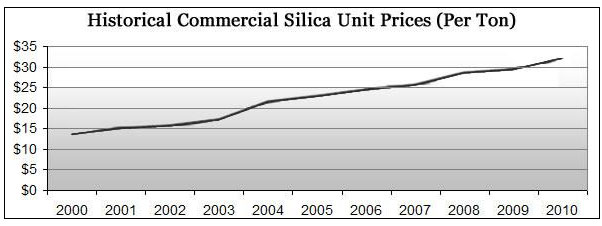
As a result, and as Reuters reports, “Those who have sand or access to sand can pretty much charge what they want for that sand.”

Below, you can see that’s exactly what companies have been doing.

Silica Sand Mining: Another Way to Play Cheap Natural Gas

These companies are obviously cashing in. But the problem for investors has been finding a way to take advantage of this development.

The top five sand-mining firms in the country have always been private firms. Yet earlier this year, one of these companies became the first publicly traded pure play industrial sand producer. And now it appears to be sitting at a pretty nice discount.

Introducing U.S. Silica Holdings

U.S. Silica Holdings (NYSE: SLCA) has been in business for over 100 years. But January was the first time it became a publicly traded company.

In the first quarter, SLCA reported record revenue and earnings, and also reaffirmed its guidance for the rest of 2012. For the rest of this year, the company expects to rake in just about $400 million. That’s up from $295 million in 2011.

Yet even though sales have grown rapidly and profit margins are widening, the company’s stock hasn’t headed in a similar direction.

Since its IPO, SLCA fell 31%.

However, it appears investors don’t understand the main reason behind its initial drop. The main culprit behind SLCA’s plunge is the fact that company executives cashed in on their holdings. In February, 45 million shares of the company were sold off by insiders.

Since then, SLCA has continued its decline. And now it appears to be oversold.

At the end of the day, U.S. Silica is growing four times faster than the rest of its peers. And it has a strong customer base with longtime clientele like Owens Corning (NYSE: OC), Halliburton (NYSE: HAL) and The Sherwin-Williams Company (NYSE: SHW), among others.

Lately, insiders have started changing their attitude, as well. They’ve purchased nearly 10,000 shares since early May.

Analysts at Dahlman Rose even increased their price target on shares of SLCA from $25.00 to $27.00, despite shares currently sitting at just about $11.

Right now, that’s a potential gain of 145%. If you ask me, that’s an opportunity worth looking into.

The Bottom Line

Companies that continually increase their earnings and revenue will eventually see their share prices head the same direction. It’s practically a physical law…

So if you’re expecting natural gas drilling to continue for many years to come, you’ll want to take a look at a company like U.S. Silica Holdings. It certainly looks to be a solid contrarian play and at a major discount with its recent sell-off.

Good Investing,

Mike Kapsch

Article by Investment U

The Scope of Foreign Direct Investment in India

The foreign direct investment into India is a process for facilitating people to invest in India. If you are really interested in doing business in India with the help of foreign capital then make sure that you are investing in the right source and you can do this in a number of ways. Even when India was going through tough times, it was still a good financial breeding ground for all foreign investors. They have never felt the pressure as their genre of investment has always been unleashed for the purpose of ushering more capital within the country.

There have been several Indian infrastructures who may have suffered in the field of production and manufacturing due to lack of essential capital. However, a good way for them to survive is by offering FDI equity to companies or individuals who would be interested in making huge capital investments. With overseas investors maintaining a sustained focus on investing in emerging markets such as India, the country continues to beget a good share of the world’s investment inflows, despite the dismal economic scenario as prevailing in Greece and other European countries.

Foreign direct investment in India is done in several ways. Investment can take place through effective financial collaborations. In this case the common interest is the yearly financial turn over and to make this work out two or more companies come in association and they share much in contributing towards a common financial consensus. The effort has to be there from both the ends, from the part of the investor and also from the part of the collaborator. When collaborating, you can keep the leadership factors aside and think about a healthy togetherness contributing towards a bigger financial platform.

As a way towards FDI equity is also a joint venture and a technical collaboration. Once the company delivers the plan of taking things technically ahead then other can contribute in a different way. It is more technical and less of financial collaboration.

Foreign direct investment in India is not permissible in all industrial sectors as it is not allowed in the domain of arms and ammunitions. You cannot invest in the field of atomic energy. You cannot invest anything related to railway and transport and you cannot even put your money in the field of coal and lignite. It is even not permissible to invest money in matters of metal mining. Thus, keeping aside these domains you still have a huge scope for investment.

About the Author

Harjeet is an Indian – born mass-market novelist, who covers the world internet related topics . He writes columns and articles for various websites and internet journals in the domain of Investments and Investing in India.


Loonie and Aussie Increase on Respective Central Bank Measures

By TraderVox.com

Tradervox (Dublin) – The recent risk aversion in the market seems to have loosened its grip as commodity currencies are showing some strength since the start of the month. The current surge of the Canadian and Australian dollar is as a result of measures by the respective central banks to use available resources to curb the effects of crisis in Europe. The Bank of Canada policy makers indicated that they may raise interest rates as domestic economy is within the projected range.

This led the strongest advance of the loonie from a six month low. On the other hand, after the RBA policy makers decided to lower the interest rates, the Aussie has gained against the yen and dollar as investors placed bets the euro will not decline. The Australian dollar rallied to its strongest in a week as the New Zealand currency increased against the yen as global stocks advanced. The Reserve Bank of Australia decided to cut interest rates by 0.25 percent to 3.5 to spur growth in the country’s economy.

Economists are predicting further reduction in the future as measures to protect the economy from the effects of euro area crisis. The market is also expecting a report from the central bank to show that the country’s gross domestic product grew by 3.3 percent in the first three months of the year. In Canada, loonie advanced against the US dollar after the BOC governor, Mark Carney, stated that the bank may withdraw from the current monetary policy increasing the demand for the loonie.

The loonie increased by 0.1 percent against the dollar to exchange at C$1.0381 per US dollar, it had fallen by 0.3 percent yesterday. The Australian dollar increased by 0.1 percent to 97.42 US cents by the end of trading yesterday in New York where it had touched 98.04 US cents the strongest it has been since May 30. The Aussie was up by 0.7 percent against the yen to trade at 76.72 yen.

Disclaimer
Tradervox.com is not giving advice nor is qualified or licensed to provide financial advice. You must seek guidance from your personal advisors before acting on this information. While we try to ensure that all of the information provided on this website is kept up-to-date and accurate we accept no responsibility for any use made of the information provided. Opinions expressed at Tradervox.com are those of the individual authors and do not necessarily represent the opinion of Tradervox.com or its management. 

Article provided by TraderVox.com
Tradervox.com is a Forex News Portal that provides real-time news and analysis relating to the Currency Markets.
News and analysis are produced throughout the day by our in-house staff.
Follow us on twitter: www.twitter.com/tradervox