Risk Aversion Returns to the Marketplace

Source: ForexYard

The euro saw significant gains when markets opened for the week, as news that a $125 billion bailout for Spanish banks was being put together generated risk taking in the marketplace. That being said, the upward movement proved to be short lived, and the common-currency gave back most of its gains against the US dollar and Japanese yen by mid-day trading. Today, it appears that announcements out of the euro-zone will once again be the main factor in determining what direction the markets take. Traders will want to pay attention to any news out of Italy, which is now being viewed as the next country that is vulnerable to the euro-zone debt crisis. Any negative news could drive the EUR lower.

Economic News

USD – Dollar Benefits from Fresh Euro-Zone Fears

After tumbling against several of its main currency rivals during Asian trading yesterday, the dollar was able to recoup most of its losses as fresh euro-zone debt fears caused investors to revert their funds back to safe-haven assets. The EUR/USD, which shot up over 100 pips when markets opened for the week, reached as high as 1.2667 before staging a downward reversal. The pair eventually fell as low as 1.2527 during mid-day trading. Against the Swiss franc, the dollar dropped as low as 0.9478 during the overnight session before staging a correction and moving up to the 0.9580 level.

Turning to today, a lack of significant US economic indicators means that any dollar movement is likely to result from news out of the euro-zone. Fears that Italy will be the next euro-zone country to be impacted by the region’s debt crisis may cause investors to continue shifting their funds to safe-haven currencies, which could help the dollar extend its bullish run. In addition, worries that the Spanish bailout will not be enough to help that country’s banking sector recover could also result in gains for the greenback.

EUR – Euro Reverses Gains against JPY

Optimism in the future prospects for the Spanish banking sector following the announcement of a $125 billion bailout package over the weekend, led to significant gains for the euro when markets opened for the week. That being said, the common-currency eventually fell as worries regarding the possible outcome of Greece’s election next week and the health of Italy’s economy led to risk aversion in the marketplace. The EUR/JPY fell over 130 pips during European trading, giving back all of its gains from the previous night. The pair reached as low as 99.41 before staging a slight upward correction and stabilizing at 99.80.

Turning to today, euro traders will want to monitor the latest announcements out of Greece and Spain. With Greece getting ready to hold elections on Sunday, it appears that any small piece of news out of the country has the potential to create euro volatility. Any signs that anti-austerity political parties could win next week may result in euro losses. Furthermore, any indication that the Spanish bailout is not enough to help its banking sector recover could cause the euro to drop once again against its safe-haven rivals.

AUD – Aussie Takes Slight Losses in European Trading

Better than expected Chinese economic indicators helped the Australian dollar rally against several of its main currency rivals during overnight trading yesterday. As Australia’s biggest trading partner, data out of China tends to have a significant impact on the aussie. The AUD/USD moved up close to 100 pips during Asian trading, reaching as high as 1.0007. That being said, the aussie was not able to maintain its bullish momentum, and proceeded to fall some 60 pips over the course of the day.

Today, any movement by the AUD is likely to be closely linked to risk sentiment among investors. Any positive news out of the euro-zone, particularly with regards to the upcoming Greek elections, could cause investors to shift their funds to higher-yielding assets, which would result in gains for the aussie.

Crude Oil – Oil Takes Significant Losses amid Euro-Zone Worries

Crude oil reversed its recent bullish streak during trading yesterday, as euro-zone worries once again caused investors to become worried that global demand for the commodity would drop. The price of crude fell more than $3 a barrel over the course of the day, eventually reaching as low as $83.41 during afternoon trading.

Turning to today, any negative news out of the euro-zone may drive the price of crude-oil lower if investors determine that the global economic recovery is slowing down as a result. That being said, if news out of Greece indicates that pro-austerity political parties could win next week’s elections, investors may revert their funds to riskier assets, which may help oil recover some of its recent losses.

Technical News

EUR/USD

Technical indicators on the weekly chart show that this pair is currently range trading, meaning that no defined long-term trend can be predicted at this time. That being said, the daily chart’s Williams Percent Range has crossed over into overbought territory. Traders may want to open short positions, as downward movement could be seen in the near future.

GBP/USD

A bullish cross has formed on the weekly chart’s Slow Stochastic, indicating that this pair could see upward movement in the coming days. In addition, the Bollinger Bands on the daily chart are beginning to narrow, meaning that a price shift could occur in the near future. Opening long positions may be the wise choice.

USD/JPY

While a bullish cross appears to be forming on the weekly chart’s Slow Stochastic, most other long-term indicators show that this pair is in neutral territory. Traders may want to take a wait and see approach, as a clearer trend is likely to present itself in the near future.

USD/CHF

Technical indicators are providing mixed signals for this pair. While the Williams Percent Range on the daily chart is in oversold territory, the weekly chart’s Slow Stochastic has formed a bearish cross. Traders will want to use a wait and see strategy for this pair.

The Wild Card

AUD/CHF

A bearish cross on the daily chart’s Slow Stochastic indicates that this pair could see downward movement in the near future. This theory is supported by the Williams Percent Range on the same chart, which has moved into overbought territory. Forex traders may want to go short in their positions ahead of a possible downward breach.

Forex Market Analysis provided by ForexYard.

© 2006 by FxYard Ltd

Disclaimer: Trading Foreign Exchange carries a high level of risk and may not be suitable for all investors. There is a possibility that you could sustain a loss of all of your investment and therefore you should not invest money that you cannot afford to lose. You should be aware of all the risks associated with Foreign Exchange trading.


Yen Falls on IMF Comments

By TraderVox.com

Tradervox (Dublin) – The IMF through the First Deputy Managing Director David Lipton has indicated that the yen have been moderated overvalued and there is need for intervention. This has caused the yen to drop against most of the 16 major currencies in the world as investors predict the BOJ is under pressure to make intervention to prevent the yen from strengthening further. The Japanese yen fell against the euro after a three day advance as the Dollar Index dropped after comments by Federal Reserve Bank of Chicago President’s said that he will support any measure intended to accelerate growth in the US economy.

According to David Forrester of Macquarie Bank Ltd, the IMF is showing its interest to see the BOJ make some intervention to curb the current rise in the yen. These comments have changed the yen trend as investors are now wary of the outcome of the meeting to be held from June 14-15 discussing the Japanese economy and measures to be taken to spur growth in the country.

The Japanese currency lost 0.5 percent against the euro to trade at 99.69 yen per euro at the start of trading in London. It had earlier advanced by as much as 0.4 percent before the IMF comments. Against the greenback, the yen dropped 0.3 percent to trade at 79.64 yen.

The Ministry of Finance and the Bank of Japan have intervened several times last year as the country tried to protect its export-led economic recovery from a strong yen. However, these measures were criticized by the US treasury department saying the intervention was unnecessary as the market conditions were orderly. A strong yen had forced many export related companies to make huge losses which would have led to joblessness if the government did not intervene. According to an IMF report the exchange rate have increased due to the safe haven demand causing the yen to be overvalued.

Disclaimer
Tradervox.com is not giving advice nor is qualified or licensed to provide financial advice. You must seek guidance from your personal advisors before acting on this information. While we try to ensure that all of the information provided on this website is kept up-to-date and accurate we accept no responsibility for any use made of the information provided. Opinions expressed at Tradervox.com are those of the individual authors and do not necessarily represent the opinion of Tradervox.com or its management. 

Article provided by TraderVox.com
Tradervox.com is a Forex News Portal that provides real-time news and analysis relating to the Currency Markets.
News and analysis are produced throughout the day by our in-house staff.
Follow us on twitter: www.twitter.com/tradervox

Market Review 12.6.12

Source: ForexYard

printprofile

Uncertainty regarding the terms of Spain’s bailout package combined with fears about Greece’s upcoming elections caused the euro to turn bearish against the USD and JPY yesterday. That being said, the common currency was able to stabilize in overnight trading. After falling as low as $81.03 yesterday, crude oil was able to stage a minor upward correction and is currently trading at $82.10.

Main News for Today

UK Manufacturing Production-08:30 GMT

• Forecasted to come in at 0.0%, well below last month’s figure
• If true, the GBP could reverse gains made in overnight trading against the USD and JPY

Read more forex news on our forex blog

Forex Market Analysis provided by ForexYard.

© 2006 by FxYard Ltd

Disclaimer: Trading Foreign Exchange carries a high level of risk and may not be suitable for all investors. There is a possibility that you could sustain a loss of all of your investment and therefore you should not invest money that you cannot afford to lose. You should be aware of all the risks associated with Foreign Exchange trading.

Market Review 21.6.12

Source: ForexYard

printprofile

Uncertainty regarding the terms of Spain’s bailout package combined with fears about Greece’s upcoming elections caused the euro to turn bearish against the USD and JPY yesterday. That being said, the common currency was able to stabilize in overnight trading. After falling as low as $81.03 yesterday, crude oil was able to stage a minor upward correction and is currently trading at $82.10.

Main News for Today

UK Manufacturing Production-08:30 GMT

• Forecasted to come in at 0.0%, well below last month’s figure
• If true, the GBP could reverse gains made in overnight trading against the USD and JPY

Read more forex news on our forex blog

Forex Market Analysis provided by ForexYard.

© 2006 by FxYard Ltd

Disclaimer: Trading Foreign Exchange carries a high level of risk and may not be suitable for all investors. There is a possibility that you could sustain a loss of all of your investment and therefore you should not invest money that you cannot afford to lose. You should be aware of all the risks associated with Foreign Exchange trading.

China’s Economic Data Statistics: Just Add Salt

By MoneyMorning.com.au

‘There are three kinds of lies…lies, damn lies, and government statistics’

We may need to update this famous quote, attributed to 19th century British Prime Minister, Benjamin Disraeli…

Because there’s a fourth kind of lie: ‘Chinese economic data statistics’ created by the Chinese government.

A chasm has grown between on-the-ground reports, and Chinese government statistics. Either professional findings are wrong, or China’s government is massaging the numbers. Take your pick.

Chinese Bank Lending Statistics


A few weeks ago we had a reliable report that Chinese bank lending had fallen off a cliff in the first half of May.

This was backed up by my contact at a major investment bank, whose colleagues had just spent a few weeks on the ground. Chinese businesses are nervous about China’s economy, so they aren’t borrowing.

They don’t care that the People’s Bank of China just cut rates for the first time in four years. The rate is irrelevant — they just don’t want to take on any debt when the Chinese economy is slowing down so rapidly.

So I expected the May bank lending number to be a doozy…

But last night it came in at 793 billion yuan.

That’s the third highest figure in the last 2 years.

Chinese banks – third strongest month of lending since start of 2010

Source: Tradingeconomics

That’s a huge amount of lending. It’s up 16.3% on last month. And you can see from the chart a continuation of the steady trend of increasing bank lending that we have seen in the last few years.

This is how the Chinese government likes to stimulate the economy. The banks are not responding to market forces — they are responding to instructions from the government.

If we are to believe these numbers…who’s borrowing this much?

Most of it seems to be the government’s pet infrastructure projects, such as expansion of the rail network, new power plants, irrigation projects and so on.

So much for China moving to a consumer-driven economy this year!

As long as the government needs to run around pulling on levers and pressing buttons to keep things ticking along, the private sector will be rightly nervous.

All that is happening is that the government is instructing the banks to lend, and the government is putting its pet projects forward for loans. There were rumours a few weeks ago of a two trillion yuan stimulus package, but this forced bank lending is just stimulus by another name.

Chinese Manufacturing Statistics…
A Dodgy Set of Numbers?


When it comes to dodgy Chinese statistics, China’s official Purchasing Manager’s Index (PMI) has been close to the top of the list. Since late last year, the Chinese government has told us that the PMI has been above the magic 50 level, suggesting Chinese manufacturing is on the up.

Fortunately, we also have an alternative number from HSBC, looking at roughly the same thing. Since the end of last year, in fact for the last 12 months, HSBC’s index has been going the other way.

HSBC (red) tells a different story to Chinese government (blue) about manufacturing

Source: Port Phillip Publishing

But after doing its own thing for six months, the China number came back to earth quite suddenly last month. This is a telling sign that the official China figures are a bit suss, and that HSBC have been getting it right all this time.

The bottom line is that the Chinese government’s economic data statistics should be taken with a pinch of salt. Or make it a bag, for good measure.

This makes things hard. China is still Australia’s biggest customer, and everything from commodity prices to the value of a dollar hang off what China is up to.

So what indicators are we supposed to use?

For one thing, it means reports from analysts and journalists on the ground in China are more valuable than ever.

But with statistics, we can really only use what we get.

You just have to read the data with a sceptical look on your face!

Dr. Alex Cowie

Editor, Diggers & Drillers

Related Articles

Market Pullback Exposes Five Stocks to Buy
How to Bet Against China’s ‘Ridiculous’ Economy
17 Reasons Why China’s Economy is Heading For a Hard Landing


China’s Economic Data Statistics: Just Add Salt

Accepting Failure A Key to Success in Business and Share Investing

By MoneyMorning.com.au

There was a great article recently in the Australian Financial Review on entrepreneurialism.

The article is titled, ‘Accepting failure on path to success’.

It pretty much sums up the attitude that entrepreneurs (and investors) need when making business and investment decisions.

The article notes:

‘[Aussie business] the Loop has embraced the idea of “fast failure” when adding new features to the website. “In the early days, for the features that we’d come up with, we’d spend a couple of months building them and then launch them…Some were hugely successful and some our users didn’t use at all. Now we launch very basic versions and if anyone is bothered to use them, then we build them out. It’s about learning as we go.’

The article goes on, ‘Andy Fallshaw is similarly a fan of the “fail small and often rather than big and infrequently” model.’

The message to takeaway is the idea that failure is OK. It’s much better to fail early in a bad business venture rather than stringing the idea out for years and still ending up as a failure.

Share traders take this approach all the time. They’re usually only in a position for a short period. If they get it wrong, they aim to get out quickly and try their luck with something else.

The reason for doing this is that most share traders use leverage (using, say, $5,000 to control a $20,000 position). If a share trader using this leverage sees their shares fall 10% it means they’ve lost $2,000 (10% of $20,000), rather than just $500 for someone not using leverage.

Leverage makes a big difference so it’s important to recognise this and manage your trades accordingly.

Small-cap investing is different. In most cases you shouldn’t and won’t be able to use leverage. That’s because most broking firms won’t lend money for punters to invest in these high-risk stocks.

But the idea of accepting failure is just the same. You won’t win with every small-cap stock you back. But because the possible returns are so big you don’t need every stock to be a winner.

The point is, with this type of share investing you must accept failure.  We know that can be a hard concept to grasp, but it’s important to understand that when you’re investing in speculative stocks they’re usually a long way from making money. There’s a lot that needs to go right in order for the stock price to go up.

But for those companies that do get it right (whether it’s through luck, skill or a combination of both) that’s when you can collect the big money-in-the-bank gains.

Kris Sayce

Editor, Australian Small-Cap Investigator

From the Archives…

Why You Should Wish For a Falling Market
2012-06-08 – Greg Canavan

Why the U.S. Dollar is Really Rising
2012-06-07 – Keith Fitz-Gerald

How This Bear Market Could Last Another 18 Years… Just Like Japan’s
2012-06-06 – Kris Sayce

The Banking Plan That Could Be A Game-Changer for Gold
2012-06-05 – Dr. Alex Cowie

Best Investment Strategies For the Times Ahead
2012-06-04 – Nick Hubble


Accepting Failure A Key to Success in Business and Share Investing

The Hidden Cost of the Spanish Bailout

By MoneyMorning.com.au

Another one bites the dust.

Portugal, Ireland and Greece have all accepted bailouts from the eurozone. Now Spain has followed in their footsteps.

A Spanish bailout would seek as much as €100bn from the eurozone’s rescue funds, to recapitalise Spain’s banks.

So what is the deal all about – and can it save the eurozone?

How a Property Bubble Ruined Spain

Spain’s economic problems are very similar to those of Ireland. Spain’s eurozone nightmare started as a private sector bubble, rather than a public sector spending binge.

Overly-low interest rates led to a huge property bubble in Spain. Prices rose too far and too fast. Builders were encouraged to build too many properties. So you ended up with the lethal combination of over-supply plus over-pricing. Then came the bust.

Unlike Ireland, Spain’s bubble took time to deflate, partly because its banks used various ‘extend and pretend’ tactics to conceal the level of carnage in the market. But with the economy weakening rapidly, the property market is following suit.

Most people didn’t believe Spanish banks were ever being realistic about the level of property-related losses on their balance sheets. And they were right. Last month’s bailout of Bankia, Spain’s fourth-largest bank, just proved it. And there are more problem banks where that came from.

So here’s the difficulty. The Spanish government needs to bail out Spain’s banks. But the Spanish government doesn’t have enough money to do that. It can’t borrow more on the market, because bond yields are already too high.

Up until now, Spain has tried to avoid requesting a bail-out from Europe. That’s because it doesn’t want to have the International Monetary Fund and the rest of Europe telling it what to do.

The deal now is that it will ask for the €100bn, but that it’s solely to recapitalise the banks. That means it won’t technically have to have the same levels of oversight as the bail-outs of Ireland, Greece and Portugal incurred.

Europe’s bailout funds will lend the Spanish government the money at low rates. This will then go into a specific fund created to recapitalise the banks (the Fund for Orderly Bank Restructuring, or FOBR).

The Big Problem With the Spanish Bailout

We’ll put aside the question of precisely where the money is going to come from for now. Italy, for example, will now have to guarantee 22% of the funds, which seems a stretch given the state that the country is in. I suspect they’ll find a way to fudge it somehow.

There’s a bigger, deeper structural problem with this way of bailing Spain out. The loan from the eurozone almost certainly (in practice, if not in theory) will jump the creditor queue. In other words, if the Spanish government ever runs out of money, then the European loan will get paid ahead of any private sector bondholder.

This is what happened with Greece. The private sector ended up taking huge ‘haircuts’, while the public sector (on paper at least) remained whole.

By bailing out the banks this way, not only does the Spanish government end up owing more money, private sector lenders have been pushed down the line for payback. In other words, lending to Spain has just become even more risky.

And by extension, so has every other European sovereign that might potentially need a bailout – Italy, for example. So the question is, why would any private sector investor in their right mind lend money to a troubled eurozone sovereign now?

I can’t think of a good answer. And that suggests that – without more action from Europe to prevent it – yields on European debt should rise even further.

John Stepek

Contributing Editor, Money Morning

Publisher’s Note: This article originally appeared in MoneyWeek (UK)

From the Archives…

Why You Should Wish For a Falling Market
2012-06-08 – Greg Canavan

Why the U.S. Dollar is Really Rising
2012-06-07 – Keith Fitz-Gerald

How This Bear Market Could Last Another 18 Years… Just Like Japan’s
2012-06-06 – Kris Sayce

The Banking Plan That Could Be A Game-Changer for Gold
2012-06-05 – Dr. Alex Cowie

Best Investment Strategies For the Times Ahead
2012-06-04 – Nick Hubble


The Hidden Cost of the Spanish Bailout

EURUSD pulls back from 1.2668

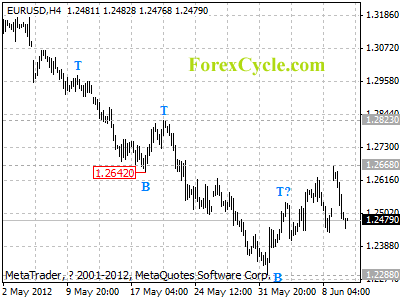
Being contained by 1.2670 resistance, EURUSD pulls back from 1.2668. Another rise to retest 1.2670 key resistance is still possible, a break above this level could indicate that the downtrend from 1.3283 has completed at 1.2288 already, then further rise to test to test 1.2823 resistance could be seen. Support is at 1.2410, a breakdown below this level will suggesting that sideways consolidation is underway, and the trading range would be between 1.2288 and 1.2668.

eurusd

Daily Forex Analysis

Central Bank News Link List – June 11, 2012

By Central Bank News

   Here’s today’s Central Bank News link list, click through if you missed the previous central bank news link list.  Remember, if you want to submit links for inclusion in the daily link list, just email them through to us or post them in the comments section below. 


Source:www.CentralBankNews.info

Listen: EWI’s Chief Analyst Hochberg Explains Recent Action in Stocks, U.S. Dollar and More

Listen to Hochberg explain the problems with using lagging economic indicators like earnings

By Elliott Wave International

EWI Chief Market Analyst Steven Hochberg talks with MarketWrap radio on May 10, 2012, about recent market action and where we are in the long-term trend, among many other topics.

Listen to Hochberg explain why using lagging economic indicators like earnings as a forecasting tool is like driving down the highway while looking in the rear-view mirror.

Enjoy this free audio clip — and then take advantage of a limited-time offer to learn even more about EWI’s big-picture forecast for U.S. and Europe (see offer details below).


When the markets were still going up at the beginning of 2012, were you warned that they would soon go down?Elliott Wave International has just made its May 2012 Elliott Wave Financial Forecast available FREE for a limited time. No one should invest a dime in U.S. or European markets until they read this 10-page report at least 3 times. With a $29 value, this single issue of the May 2012 Elliott Wave Financial Forecast will give you the complete big-picture forecast for U.S. and Europe — financially, economically and socially.

Get up to speed and ahead of the markets today. Download your free 10-page report now >>


This article was syndicated by Elliott Wave International and was originally published under the headline Listen: EWI’s Chief Analyst Hochberg Explains Recent Action in Stocks, U.S. Dollar and More. EWI is the world’s largest market forecasting firm. Its staff of full-time analysts led by Chartered Market Technician Robert Prechter provides 24-hour-a-day market analysis to institutional and private investors around the world.