Why Warren Buffett is Loading Up on Tungsten

By MoneyMorning.com.au

Warren Buffett is at it again.

Although he says he doesn’t want to own gold, the world’s most famous investor has taken a shine to what may be the most precious metal of the 21st century – tungsten.

Tungsten – element number 74 on the periodic table – is a super-hard metal used in everything from armour-piercing tank shells to wedding rings.

And the world is running out of it – fast.

That spells opportunity for savvy investors like Warren Buffett.

And it explains why IMC International Metalworking, part of Buffett’s Berkshire Hathaway (NYSE: BRK.A, NYSE: BRK.B) empire, recently invested $80 million in a tungsten mining project in South Korea. The deal gives Buffett a 25% stake in what used to be the most productive tungsten mine on the planet. IMC has also guaranteed to buy 90%-100% of all the shiny metal from Woulfe Mining Corp.’s (TXSV: WOF) Sangdong Mine.

Sangdong is expected to produce half of the world’s non-China tungsten and account for 7% to 10% of total global tungsten production when it reopens in 2013.

While the deal may come as a surprise to some, those in the know understand that Buffett just made another shrewd move to lock up supplies of a critical resource.

Tungsten – A Vital Part of Modern Life

Best known as the filament used in conventional light bulbs, tungsten is among the world’s hardest materials.

Its ability to withstand extreme heat – the grey metal is corrosion and fireproof – makes tungsten irreplaceable in a wide range of applications, including circular electric saws, drill bits for oil and gas exploration, and rocket engine nozzles.

But tungsten is more than just an extremely hard metal. Indeed, modern life virtually revolves around it and, in most cases, there is no substitute.

And now, high-tech industries are driving demand even higher.

Tungsten is vital to the manufacturing of electrodes used in solar panels and nuclear equipment. More importantly, it’s a vital component in the touch screens of smart phones and tablet devices now exploding in popularity around the world.

In fact, while global demand has grown at a pace of about 6% for years, miners will need to expand production from 68,000 metric tons in 2011 to 96,000 by 2016.

China Crimps Tungsten Supplies

The problem is that supplies of tungsten are desperately short.

That’s because China has more than 80% of the world’s supply and has shut down most of its exports by imposing quotas on foreign purchases.

In fact, China is now a net importer of tungsten and expects to use all of its supplies to support its own manufacturing firms.

That means the rest of the world is scrambling to find new resources and open new mines – a process that takes a minimum of three years.

Tungsten mines are also very difficult to operate, processing large amounts of material to harvest relatively small amounts of metal, according to the International Tungsten Industry Association.

In fact, there are no more than five mines supplying most of the world’s tungsten outside of China and Russia.

Consequently, tungsten was at the very top of the “endangered list,” in a recent British Geological Survey report on metals of economic value.

Both the U.S. and European Union have also recently classified tungsten as a critical strategic metal that needs to be stockpiled.

Meanwhile, tungsten prices have rocketed from about $180 three years ago to roughly $430 per metric ton today.

That leaves industries dependent on tungsten with limited options.

Most are simply hoping current miners will increase supplies as fast as possible to keep prices from spiralling out of control.

According to Money Morning (USA) Global Resources Specialist Peter Krauth, the shortage of tungsten may soon present investors with a great investment opportunity.

Don Miller
Contributing Writer, Money Morning

Publisher’s Note: This is an edited version of an article that originally appeared in Money Morning (USA)

From the Archives…

Why You Should Wish For a Falling Market
2012-06-08 – Greg Canavan

Why the U.S. Dollar is Really Rising
2012-06-07 – Keith Fitz-Gerald

How This Bear Market Could Last Another 18 Years… Just Like Japan’s
2012-06-06 – Kris Sayce

The Banking Plan That Could Be A Game-Changer for Gold
2012-06-05 – Dr. Alex Cowie

Best Investment Strategies For the Times Ahead
2012-06-04 – Nick Hubble


Why Warren Buffett is Loading Up on Tungsten

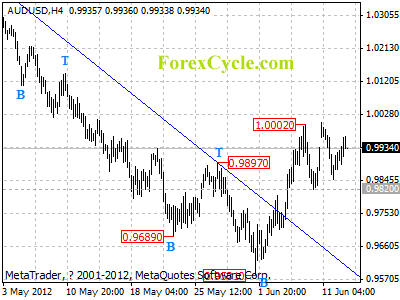
AUDUSD traded in a range between 0.9820 and 1.0007

AUDUSD traded in a range between 0.9820 and 1.0007 for several days. As long as 0.9820 support holds, the price action in the range is treated as consolidation of the uptrend from 0.9581, and further rise to 1.0100 could be expected after consolidation. On the other side, a breakdown below 0.9820 will suggest that lengthier consolidation of the uptrend is underway, then deeper decline to 0.9700 area could be seen.

audusd

Daily Forex Forecast

Why Natural Gas Could Displace Gasoline – An Interview with Raymond Learsy

By OilPrice.com

Massive natural gas discoveries along with new extraction techniques have led many to claim nat gas as the fuel of the future – which could ensure U.S. energy independence, reduce geopolitical risks, and help meet U.S. electricity demands for the next 575 years.

Yet why have we seen so many negative publications and reports? Does natural gas really have a place in our future and is it the golden chalice we have been led to believe?

To help us investigate these issues and others Oilprice.com was fortunate enough to have a chat with the well known author and energy trader Raymond Learsy who has recently released his latest book which takes a look at corruption within the oil sector: Oil and Finance: The Epic Corruption Continues.

In the Interview Raymond talks about the following:

  • Why Natural gas could displace gasoline
  • The top 3 forms of energy for national security
  • The New York Times Vendetta Against Natural Gas
  • Nuclear Energy’s place in America’s energy future
  • The future of Fracking
  • Why we can’t rely on coal for future power generation

Oilprice.com: What do you think is the link between say the New York Times and some of the concerns in the commodity market?

Raymond Learsy: Well, some of the reporting of the New York Times I feel is weighted too heavily on the fiction that surrounds the pricing of oil. I’ve written a number of posts, some of which are in my new book, some of which are in my previous book, that deal with the way the New York Times repeats without any serious, in-depth questioning the sort of general handouts of the oil industry and OPEC. For example, if Saudi Arabia says, “Oh, we’re having difficulty meeting current demands,” there’s no insightful discussion of what their potential is, how long they’ve been sitting on the fence before they expanded their production capability, etc., etc. It’s always taken at face value. And then, of course, you have this extraordinary series of articles that came forward earlier in 2011 about natural gas.

Oilprice.com: Yeah, I saw that at Huffington Post. I actually used that in one of my media classes.

Raymond Learsy: Did you?

Oilprice.com: Yes.

Raymond Learsy: Well, thank you. I’m flattered. This was unbelievable for a leading newspaper to really take on the mantle of yellow journalism and to attempt to defame a whole new vista and direction of energy and the potential of what natural gas holds to place it into question and, thereby make people less focused on it, taking it less seriously, when it is really the golden chalice that has been given to us to make the U.S. energy independent.

Oilprice.com: Okay.

Raymond Learsy: I’m just amazed at the kind of language they use and the way that they try to undermine the whole focus on the development of natural gas in this country and elsewhere. And that much of what had been written that placed the whole natural gas enterprise into doubt was based on exchanges of emails that were unattributed. In other words, we didn’t know who sent the emails.

Oilprice.com: Right.

Raymond Learsy: We had nothing but hearsay, and a very editorialized hearsay, supporting a particular pre-program point of view.

Oilprice.com: Well.

Raymond Learsy: I mean it was shocking.

Oilprice.com: Well, why do you feel that’s the case? I guess we could look at the New York Times as some kind of the benchmark for U.S. journalism. What is the motive? Or is it lazy journalism? Or something else? Why do you feel the media, the New York Times specifically, is offering a mischaracterization of the energy markets?

Raymond Learsy: Let me show you this. It is from a study that MIT made shortly after the New York Times articles and I don’t think it was specifically meant as a rebut to the New York Times, but it goes into a great deal of detail that natural gas will result in demand reduction and displacement of coal-fired power by a gas-fired generation. And because of its more limited CO2 emissions further de-carbonization of the energy sector will be required and natural gas provides a cost effective bridge to such a low carbon future. In other words, natural gas, the way it’s structured, it’s enormous availability (we are finding more and more of it since these articles have been written), and it’s extraordinary low cost, present a very real danger to other forms of hydrocarbons. And I don’t know quite what the New York Times’ love affair is with the oil industry, but their articles were something that placed the whole idea of natural gas as a substitute, not simply for coal, but eventually for transportation fuel replacing gasoline, into jeopardy.

It just bedazzles me because you have at the current price of natural gas, which is about two and a half dollars an MMBtu, right? We have crude oil selling today at $95 a barrel. A week ago it was $100 a barrel.

Oilprice.com: Yes.

Raymond Learsy: At $2.50 an MMBtu, the amount of energy that is delivered by that quotient of natural gas, the price of oil would have to be around fifteen dollars a barrel.

Oilprice.com: Okay.

Raymond Learsy: And so if we were able to convert our transportation fleet for the use of natural gas, which we have in plentiful supply in this country, we would no longer have to import crude oil, etc., and we would be in a position to displace gasoline. Instead the New York Times undermines and places into question the one solution and salvation that we have for true energy independence.

Oilprice.com: Okay. So, what about other renewable forms? I’ve had some discussions with some folks at Rand recently about converting from a highly carbon intensive economy to a low carbon economy and the conversation always winds up on things like infrastructure, on things like converting everything from petroleum to natural gas to wind. Where does that conversation factor into this conversation?

Raymond Learsy: Well, I mean, you have other alternatives. You have nuclear energy, but on the other hand you do have a situation where we have not built a nuclear facility since the 1970s and China is going to be building 25 nuclear facilities in the next 15 years. Now, the question needs to be asked seriously and analyzed seriously, who is going to be better off at the end of 15 years? We, without having built any, or the Chinese with having built 25?

Oilprice.com: Right.

Raymond Learsy: And can we build them safely? And can we solve the problems of waste disposal? Now the Russians have done that. The Russians are very extensive in their nuclear facilities and they moved all of their waste disposal up into the edge of the Arctic somewhere in one of the peninsulas bordering on the Arctic Sea. And it’s not only that, they’ve taken in waste disposal not only from their own plants but from other European plants such as France. Look at France, 80% of its electrical energy is generated, by nuclear power.

Oilprice.com: Right.

Raymond Learsy: So we are trailing the rest of the world in something at least, in a focus on nuclear energy. And then in terms of coal we have enormous reservoirs of coal, but on the other hand the carbon footprint of coal is far greater than that of natural gas.

Oilprice.com: Right.

Raymond Learsy: Basically on all these issues there are three items of focus; economy, national security and the environment. Natural gas gets top marks on all three. Coal gets top marks on two of three. Crude oil gets top marks on maybe one of three. And nuclear energy is still, we’re still debating how safe it is and how comfortable we are with it.

Oilprice.com: Right.

Raymond Learsy: And then of course we have alternatives; ethanol, bio fuels, hybrid cars, etc., etc., all of which could substantially reduce our consumption of fossil fuels. The carbon footprint of natural gas is far less than that of gasoline, significantly reducing the carbon footprint of our energy consumption.

Oilprice.com: Well, then what about the fracking debate? I know a couple weeks ago Sierra Club had filed a few suits with the Department of Energy, I believe, protesting liquefied natural gas export facilities planned for Louisiana ports on the premise that it’s going to lead to more fracking, which is the hot issue of today in terms of the new energy debate.

Raymond Learsy: Fracking is something that has to be studied and has to be mastered and I think the oil companies are not irresponsible, they’re not irresponsible entities. They fully understand their civic responsibilities and also their commercial and their legal responsibilities. They are beginning to take this problem and really work it through to the point where it is going to be as safe as it reasonably can be and then we have to consider is it safe enough?

I mean, with all of these problems the environmental groups look at them from one point of view only and what we need is leadership where all these things are taken into consideration; the economy, national security and the environment, and where the judgment is made based on the pros and cons of each of these energy sources. I don’t think that is really done, nor is it discussed in a lucid, candid way and with regard to natural gas. I mean, we are the beneficiaries of something we didn’t even know existed four or five years ago.

And the potential in terms of our economic development, in terms of our national security is enormous. The question is how much of a problem is it environmentally and can the oil companies really deal with it in such a way that it is minimal.

Oilprice.com: So, let’s take it a step further and kind of work our way back to the media argument because I think that there isn’t one; you can’t really have a motivating campaign on energy based on pragmatism. You need some level of excitability, and if you’re calling for elimination of this myopic debate on fracking, it doesn’t make for a sexy headline. It’s not as motivating as the doom and gloom of the Keystone/Nextel pipeline or ethylene glycol in your drinking water and people lighting their taps in their kitchen on fire because of the natural gas concerns. How does the public mentality figure into the conversation on natural gas?

Raymond Learsy: Well, I think the people have got to be made aware what the benefits are. You have something like the New York Times articles that I’m referring to which make virtually no reference to fracking. What they make reference to is loaded estimations of how much natural gas there is, inferring that they have been spiked by the oil companies and by the investors. It’s unbelievable some of the language that went into this and a year and a half later it’s been proven total consummate nonsense.

The amount of natural gas that is extant in this country has already been proven to be enough to last us a hundred years and we’ve just begun to scratch the surface on searching for it and on developing it. And it’s amazing, not only this country but China is becoming a major producer of shale gas, Europe and Poland have also had major finds of shale gas. All around the world shale gas seems to be the answer to energy dependency. What everybody should do is read the MIT study. Let me give you the details of it.

Oilprice.com: Right.

Raymond Learsy: You know, if they don’t want to order my book, they can order the MIT study which, If I had my druthers between ordering my book, which is called “Oil and Finance: The Epic Corruption Continues,” and this study, I would order the study. The future of natural gas which is an interdisciplinary MIT study and I’m sure it can be gotten from MIT. It’s called The Future of Natural Gas and it was published in June of ’11.

Oilprice.com: Okay.

Raymond Learsy: What it tells you is the dramatic potential of natural gas in terms of our energy consumption and usage. And it is done in great detail by a whole bevy of authorities who really spent time, effort and enormous amount of research in coming up with this, not like the New York Times.

Oilprice.com: Okay. So, just to wrap it up, I remember, and as I said at the beginning of our conversation, I had referenced your Huffington Post article from last year when we were debating, the responsibility of the news media. Now I remember shortly after that article came out, I think about two weeks later, the ombudsman, the public editor at the New York Times, refuted the original article. I’m sure very few people read that because it probably didn’t run as high profile as the previous story and I also…go ahead.

Raymond Learsy: The gas article in the New York Times was a front-page article and the public editor had his article on the second page of the Weekly Review section on Sunday.

Oilprice.com: Right.

Raymond Learsy: So, you’re right, I mean the perception of the public editor’s comments were, I’m sure, barely read by a handful of people.

Oilprice.com: Right. Then if I’m not mistaken, roughly a month later the New York State Legislature voted on fracking.

Raymond Learsy: Mm-hmm.

Oilprice.com: Is that correct to your knowledge?

Raymond Learsy: I don’t know if it was a month later or so.

Oilprice.com: Shortly after.

Raymond Learsy: They put it all on hold.

Oilprice.com: Now do you think that that had anything to do with the New York Times article?

Raymond Learsy: Well, I think, yeah, the New York Times article gave natural gas, shale natural gas, a very bad taste. I mean, it gave it the illusion of being in the hands of shysters and people who were simply, I mean there were comments with words like “it’s all about the money.” I mean the kind of language that was used was incredible and without very much substantiation.

And I’m sure people don’t follow these issues day to day and I’m sure it made it very easy rather than seeing natural gas as a source of economic energy for New York State. Not only energy but economic advancement, especially at a very difficult time in the economy. It was very easy to dismiss after the holy of holies, the New York Times, wrote about it in the manner that they did.

Oilprice.com: Good. So I mean what’s the final word on natural gas? We understand the perception that public reactions rise and fall with the sun, and it’s an excitable issue as it becomes a new issue as time goes on, you know, level heads sort of prevail. Where do you see the natural gas debate in say 2020?

Raymond Learsy: Well. I think people will be, in 2020, will be saying aren’t we fortunate to be the Saudi Arabia of natural gas and that we have been able to develop this natural resource, this American resource, safely, responsibly and it has enhanced the lives of almost every American. Natural gas is a feedstock for much of our chemical production. Natural gas has been an absolute shot in the arm to our steel industry; the piping and the new drilling equipment that is being used and produced. It has created, in places like North Dakota where you also have shale oil as well as shale gas, a boom.

There is massive employment, not unemployment, but employment to the point they can’t fill jobs in North Dakota and they can’t find a place to live, they can’t find apartments and they can’t find a place to stay. I mean, the boom there is staggering and that boom is going to spread around the United States, if it’s permitted to do so, if we have a coherent, intelligent and sensible discussion on this issue. And I think that the potential is so enormous that by 2020 the whole idea of energy independence will have been dissipated because of our resources in natural gas.

Raymond thank you for taking the time to speak with us.

Source: http://oilprice.com/Interviews/The-Future-of-Natural-Gas-An-Interview-with-Raymond-Learsy.html

By. Daniel Graeber of Oilprice.com
 

ECB calls for banking union to help end turbulence

By Central Bank News
    The euro area should start to create a banking union as part its monetary union to help put an end to the turbulence that has affected the 17-nations that share the euro currency, the European Central Bank said.
    In its bi-annual Financial Stability Review, the ECB called on member states to accelerate initiatives to strengthen the monetary union as fresh financial market pressures show there is no room for complacency in implementing changes. 
    “There is now a need to go beyond these areas and conceive a banking union as an integral counterpart of Monetary Union. Such an endeavour would clearly take time to implement and could require legal changes,” the ECB said.


    Banking union would achieve three critical objectives: Strengthen euro-wide supervision of banks and thus improve the conduct of monetary policy, break the linkage between banks and sovereigns by establishing a European deposit guarantee scheme and bank resolution arrangements, and lastly it would minimize the risk for taxpayers through contributions by the financial industry.
    The Review identified three key risks to financial stability: aggregation of the debt crises for euro area nations, lower bank profitability from weaker economic growth and an excessive pace of deleveraging of the banking sector.
    “There remains a clear need for a continued focus on tackling the root causes of the crisis, and a comprehensive response remains key to decisively ending a spiral of systemic risk augmentation,” the ECB said, calling for policy implantation in five areas:

  •     Action to ensure fiscal discipline and accelerate structural reforms for growth and employment.
  •     Effective use of the financial backstops to halt the downward spiral of self-fulfilling dynamics in the pernicious interplay between sovereign, banking and macroeconomic forces.
  •     Durable changes to banking models must complement temporary Eurosystem support and provide lasting funding certainty, to accompany the strengthening of the capital base of European banks in the first half of 2012.
  •     Continued progress is needed to eliminate political and economic uncertainty, not only to stem the forces of contagion but also to provide a more solid basis for markets to manage risk.
  •     Measures to strengthen economic and fiscal surveillance, and to enhance governance, must be taken and not remain contingent on market-driven pressure – thereby providing credible reassurance that the crisis that has engulfed the euro area over the last few years will never be permitted to recur.

www.CentralBankNews.info

Chicago Fed President to Support Stimulus Plans

By TraderVox.com

Tradervox (Dublin) – Charles Evans, the Chicago Federal Reserve Bank President said in an interview yesterday that he is supporting various measures that would spur job growth in the country. He said this to stress his commitment to support additional stimulus in the economy. Further, he indicated that he is in support of “any accommodative policy” that will spur growth and increase employment. He suggested that extending the Twist program, asset purchases, and mortgage-backed securities would be good for the nation’s economy. Evans is a non-voting member of the policy-setting Federal Open Market Committee which is due to meet next week to deliberate of the slowing job growth and the worsening debt crisis in Europe.

Evans called on the Fed to clarify its forward guidance advising the bank to commit to the current interest rate until unemployment rate reaches below 7 percent or inflation exceeds 3 percent. in their last meeting, the FOMC members resolved to keep the low interest rate until late 2014 as a way of reducing the high level of unemployment. The Fed is expected to give a revised growth, inflation and joblessness outlook on June 20. Evans projected that the growth in the next two years might reach 2.5 percent which he said it is much weaker than he would have liked.

In his interview, Charles Evans indicated that the numerous economic shocks from the euro area are providing difficulties, but said that he has no doubt the unemployment will reach below 7 percent. He said that the question is about when this will be achieved hence the need for the Fed to take a more accommodative monetary policy.

In a report, on June 1, the labor department showed that the US employers added the least jobs in a year in May. This has raised concerns that the US recovery is losing momentum. The Fed Vice Chairman Janet Yellen and San Francisco Fed President John Williams gave statements last week that showed a willingness to support stimulus program.

Disclaimer
Tradervox.com is not giving advice nor is qualified or licensed to provide financial advice. You must seek guidance from your personal advisors before acting on this information. While we try to ensure that all of the information provided on this website is kept up-to-date and accurate we accept no responsibility for any use made of the information provided. Opinions expressed at Tradervox.com are those of the individual authors and do not necessarily represent the opinion of Tradervox.com or its management. 

Article provided by TraderVox.com
Tradervox.com is a Forex News Portal that provides real-time news and analysis relating to the Currency Markets.
News and analysis are produced throughout the day by our in-house staff.
Follow us on twitter: www.twitter.com/tradervox

Do not Trade for the Money!

By Taro Hideyoshi

I have known some successful people and I used to wonder that why do they succeed? I have tried to find the answer. Then I have seen one thing that they have in common, they love what they do. Many of them even told that they cannot believe that they actually get paid for doing what they do. Many successful people will tell you that they would do what they do even if they were not paid at all.

So, I think I found the answer, SUCCESSFUL PEOPLE DON’T WORK FOR THE MONEY.

To be successful, you have to work hard and love what you are doing and the money will follow. You have to focus on work first and count the money later. Sometimes they do not even count it or do not even care how much they made. They just know that they have enough to allow them to do what they are doing.

In trading, the same thing is applied, you should love trading for its own sake not because of it can make money for you. Most individuals want to enter the trading world because they think that they can make a lot of money easily and quickly. Their goal is to make a lot of money fast. Hence, they come to seminar and keep searching for the holy grail in trading thinking that it can guarantee their profits. These type of traders do not want to learn the ins and outs of the trading business; they want the magic system that will get them the money. Ultimately, they are doomed to failure.

Let’s think, what may successful traders look like?

Successful trader will love being around traders, they may attend seminar and feel like their home since they love being around traders and talking with them. They talk to other traders not for finding trading tips and to know trading secret but for camaraderie. The successful will also love to learn new trading technology, analyze trading strategies and techniques. They love to spend their hours to monitor the overnight market information and check market’s news. They may even love their losing trades as the losing trades as the part of the game.

The successful traders love what they are doing. And as long as they can keep on trading, they will be happy. As Thomas A. Edison said, “I never did a day’s work in my life. It was all fun.”

About the Author

Taro has strong will to share his experiences to others who are living in hard economic times like these days and trying to survive in financial markets. So, he has written and published articles on subjects such as personal finance, investment and money management.

His articles could be found at the websites – eFinanceZine.com & MetaStockTradingSystem.com.


Gold Back Above $1600, Italy “May Also Need Rescuing”, Argentina Mulls New Dollar Debt Law

London Gold Market Report
from Ben Traynor
BullionVault
Tuesday 12 June 2012, 09:30 EDT

BULLION prices on the wholesale gold market rose back above $1600 an ounce shortly before Tuesday’s US trading, after failing to breach that level in the earlier Asian session, while European stock markets also ticked higher after a quiet morning’s trading.

A day earlier, gold briefly rose above $1600 on Monday following the news that Spain will borrow up to €100 billion to rescue its banks, but along with stocks and the Euro gold failed to hold those gains.

Silver prices meantime jumped to $28.94 per ounce, a 1.5% gain on the week so far, while commodity prices reversed earlier losses.

Earlier on Tuesday, Indian dealers reported flat trading, with one citing traditional gold buyers’ lack of spare cash.

“Farmers are not buying as it is their sowing time,” said Ketan Shroff, director at Pushpak Bullion, speaking to news agency Reuters.

Away from the gold market, Spanish 10-Year government bond yields rose to their highest level this month Tuesday morning, breaching 6.6%.

“There’s a risk that Spain may be downgraded,” reckons Alessandro Giansanti, senior rates strategist at ING in Amsterdam.

“There are still concerns about the seniority of the outstanding government debt after the bailout, and that means if you want to invest in the bond you need a higher risk premium to compensate.”

Ratings agency Moody’s last week set out a case for a possible Spanish downgrade as a result of any bailout, citing the experience of private sector bondholders who were obliged to take losses in Greece’s debt restructuring in March.

“The debts of Euro area sovereigns that are dependent upon funding support from official sources represent noninvestment grade risks,” said a Moody’s statement released Friday, the day before it was confirmed Spain would seek a rescue deal for its banks.

“Future support – particularly if likely to be needed for a sustained period – would likely be made conditional on loss sharing with private investors or in extremis withdrawn altogether.”

Elsewhere in Europe, yields on Italian 10-Year bonds hit five-month highs this morning.

“It may be that, given the high rates Italy pays to refinance on markets, they too will need support,” said Austrian finance minister Maria Fekter Monday night, although by Tuesday morning Fekter said she sees no sign that Italy will make a bailout request.

Every country in the European Union should agree to have their large banks supervised by a single cross-border supervisor, according to European Commission president Jose Manuel Barroso.

“There is now a much clearer awareness among European member states about the need to go further in terms of integration,” said Barroso Monday, in an interview with the Financial Times.

The Commission last week published plans for a so-called banking union, which would include pan-European deposit insurance, funded by participating banks, as well as greater supervision of banks across the 27-member EU.

Britain’s chancellor George Osborne however has said the UK will not be part of such an arrangement, while Germany’s central bank has also expressed opposition to the idea.

On the currency markets, the Euro hovered around $1.25 Tuesday morning, 1.7% up on the two-year low hit at the start of the month.

The gold price in Euros meantime spiked to €41,249 per kilo (€1283 per ounce), 0.8% up on where they started the week.

“Gold is going up, down or sideways dependent on what is going on in the Euro/Dollar rate,” reckons Nic Brown, head of commodities research at investment bank Natixis.

In Buenos Aires meantime Argentina’s president Cristina Kirchner has submitted draft legislation to enable US Dollar-denominated debts to be paid in Pesos, the Wall Street Journal reports.

“There is a lot of speculation about supposed plans to ‘Pesofy’ the economy,” says one Buenos Aires-based trader.

It is not clear whether the proposed legislation will be applied retroactively, or if it will apply to government debt. In August, Argentina is due to make a $2.2 billion payment on so-called Boden bonds, which were issued as part of its 2002 debt restructuring.

An unofficial exchange rate for so-called ‘Blue Dollars’ has emerged in Argentina. The government’s interior minister warned last week that discussing the unofficial rate was “an illegal act”.

Kirchner’s bill carries echoes of a move by Vietnam’s central bank last month to restrict lending in currencies other than the Dong. Vietnam, another country whose economy has seen so-called ‘Dollarization’, has also introduced various laws aimed at regulating its domestic gold market, including banning the use of gold as money.

Ben Traynor
BullionVault

Gold value calculator   |   Buy gold online at live prices

Editor of Gold News, the analysis and investment research site from world-leading gold ownership service BullionVault, Ben Traynor was formerly editor of the Fleet Street Letter, the UK’s longest-running investment letter. A Cambridge economics graduate, he is a professional writer and editor with a specialist interest in monetary economics.

(c) BullionVault 2011

Please Note: This article is to inform your thinking, not lead it. Only you can decide the best place for your money, and any decision you make will put your money at risk. Information or data included here may have already been overtaken by events – and must be verified elsewhere – should you choose to act on it.


Central Bank News Link List – June 12, 2012

By Central Bank News

   Here’s today’s Central Bank News link list, click through if you missed the previous central bank news link list.  Remember, if you want to submit links for inclusion in the daily link list, just email them through to us or post them in the comments section below. 

Source:www.CentralBankNews.info

Loonie Drops against Greenback on Europe Crisis

By TraderVox.com

Tradervox (Dublin) – The Canadian dollar had advanced to an almost three weeks high, but speculations of worsening European debt crisis has forced the loonie to drop against the US counterpart. After Spain requested for international bailout, analysts are concerned that the next nation in line will be Italy which has debt problems of its own.

The debt crisis in the region seems to be affecting more nations. Further, investors are wary of riskier assets as Greece enters its finals days to an election to be held on June 17. The demand for safe haven is creeping into the market, but the yen advance has been clipped by the sentiments from IMF that the currency has been “moderately overvalued.”

The Canadian dollar had increased against most majors as risk appetite gripped the market on Spanish bank bailout; however this did not last long enough and concerns about Italy have already started to affect the market. Further, Canada’s crude oil exports dropped by 1.7 percent while the standard & poor’s 500 Index declined by 1.3 percent. According to Steve Butler of Bank of Nova Scotia in Toronto said that investors fear the current aid to Spain will be another bad-aid European Governments are offering and it might not solve anything in the short term. The effect of this is being seen on the option traders’ trend that is becoming bearish on the Canadian dollar.

The Canadian dollar depreciated by 0.5 percent against the US dollar to trade at C$1.0317 per US dollar. The Canadian currency had touched C$1.0201 earlier in the day, which is the strongest it had been since May 22.

Technical indicators are showing that implied volatility on the loonie against the Greenback for the one-month options decreased on June 7 to the weakest level last registered on May 10. Implied volatility is used by traders to quote when setting option prices; it signals the prediction of currency swing pace.

Disclaimer
Tradervox.com is not giving advice nor is qualified or licensed to provide financial advice. You must seek guidance from your personal advisors before acting on this information. While we try to ensure that all of the information provided on this website is kept up-to-date and accurate we accept no responsibility for any use made of the information provided. Opinions expressed at Tradervox.com are those of the individual authors and do not necessarily represent the opinion of Tradervox.com or its management. 

Article provided by TraderVox.com
Tradervox.com is a Forex News Portal that provides real-time news and analysis relating to the Currency Markets.
News and analysis are produced throughout the day by our in-house staff.
Follow us on twitter: www.twitter.com/tradervox

Indonesia maintains policy rate at 5.75 pct

By Central Bank News
    The central bank of Indonesia kept its main policy rate, the BI rate, steady at 5.75 percent despite rising uncertainty in the global economy. Bank Indonesia said the current rate was consistent with its inflation forecast, which is expected to remain low and within its target range in 2012 and 2013.

    “Amid rising uncertainty in the global economy, Board of Governors views that the fundamental of Indonesia’s economy thus far, is well maintained,” Bank Indonesia said in a statement following a meeting of its Board of Governors.
    The bank expects Indonesia’s economy to expand between 6.3 and 6.7 percent this year although it admits that risks are tiled toward the downside. 
   Indonesia’s growth is mainly supported by domestic demand and private consumption and investments are expected to remain strong. Exports, however, are affected by weak world demand and lower commodity prices.
    “The prospect of global economy is still confronted with rising uncertainty and worsening crisis in Euro area, vulnerable US economic condition, and lower economic growth in China and India driven by crisis in Euro area,” the bank said.
    The next meeting by Bank Indonesia’s Board of Governors in on July 12.


    www.CentralBankNews.info