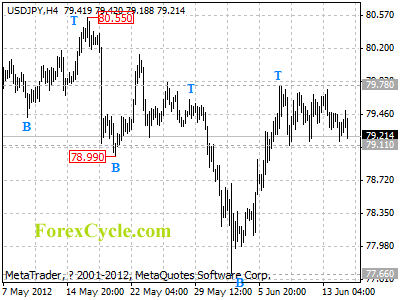
USDJPY stays in a narrow range between 79.11 and 79.78

USDJPY stays in a narrow range between 79.11 and 79.78. Initial support is located at 79.11, as long as this level holds, the sideways movement is treated as consolidation of the short term uptrend from 77.66, and another rise to test 80.61 key resistance could be expected. On the other side, a breakdown below 79.11 will indicate that a cycle top has been formed at 79.78 on 4-hour chart, then further decline to 78.00-78.50 area could be seen.

usdjpy

Daily Forex Forecast

EWI’s Famous FreeWeek is Here: 7 Days of FREE forecasts for DJIA, S&P 500 and NASDAQ!

Our friends at Elliott Wave International have just announced the beginning of their popular FreeWeek event, where they throw open the doors for you to test-drive some of their most popular premium services — at ZERO cost to you.

You can access all the charts, analysis, videos and forecasts from EWI’s trader-focused U.S Intraday Stocks Specialty Service right now through noon Eastern time Thursday, June 21. This service is valued at $199/month, but you can get it free for one week only!

There’s no question that volatility has consumed the market. The Dow lost all of its 2012 gains in May, only to bounce back and kickoff June with the best week of 2012.

EWI’s U.S. Intraday Stocks Specialty Service is designed to help you identify and act on opportunities in fast moving market conditions just like this.

During FreeWeek you’ll enjoy the subscriber experience and get 20+ intensive updates per trading session with unique analysis and forecasts for opportunities in the S&P 500, DJIA and NASDAQ. Stay ahead of the major moves in the U.S. stock market indexes during FreeWeek!

Learn more and get instant — and FREE — access to EWI’s FreeWeek of U.S Intraday stock market analysis and forecasts now — before the opportunity ends for good.

P.S. Read this immediately, before stocks drop another 10%. Investors should read it carefully at least three times before even thinking about touching their portfolios. Download the report now — it’s free only until June 14.

About the Publisher, Elliott Wave International
Founded in 1979 by Robert R. Prechter Jr., Elliott Wave International (EWI) is the world’s largest market forecasting firm. Its staff of full-time analysts provides 24-hour-a-day market analysis to institutional and private investors around the world.


Chile Central Bank keeps rate unchanged at 5 pct

By Central Bank News
    The Central Bank of Chile kept its benchmark interest rate unchanged at 5.0 percent for the fifth month running, despite weaker global growth and growing risk aversion in global financial markets.
   “Internationally, the financial and fiscal problems in the Eurozone continue to intensify, and uncertainty about their resolution has increased,” Banco Central de Chile said following a monthly meeting of its board.
    “Economic indicators in the United States, China and other emerging economies have been weaker than forecast by market consensus,” the bank said, noting that commodity prices, including copper, oil and foodstuffs, have continued falling.


    But domestic output and demand is expanding and the labour market remains tight. Inflation expectations remain close to the bank’s target, it said.

    Some economists are expecting Chile’s central bank to start easing monetary policy in coming months to help counter the effects of the global economic slowdown on the export-dependent country, the world’s largest copper exporter.
    The central bank’s board, which meets monthly, last cut its policy rate by 25 basis points in January. The bank targets the nominal interbank rate, known as the monetary policy rate TPM, through open market operations.
    Since 2007, the objective of Chile’s central bank is to maintain the annual inflation rate around three percent,  with a range of plus or minus one percentage point, over a two-year horizon.
www.CentralBankNews.info

Egypt keeps key rate steady at 9.25 pct

By Central Bank News
    The Central Bank of Egypt has kept its key overnight deposit rate unchanged at 9.25 percent and will introduce a 28-day repurchasing agreement (repo) starting next month.

    “Given the balance of risks surrounding the inflation and GDP outlooks and the uncertainty at this juncture, the MPC judges that the current key CBE rates are appropriate,” the CBE said in a statement following a meeting of its monetary policy committee.
    Although the headline consumer price index eased in May to an annual rate of 8.30 percent from 8.78 percent in the previous month, the bank said there were local supply bottlenecks that pose an upside risk to inflation.
    But there are also downside risks to economic growth from the challenges facing the euro area, the CBE said, adding that preliminary data shows that real GDP grew by 5.2 percent in 2011/2012 Q3, following feeble average growth rates of 0.35 percent in the first two quarters.
    
www.CentralBankNews.info


Iran Looks to China and Russia for Military Support as Pressure from the West Increases

Beset by rising rhetoric about a possible Israeli attack against its nuclear facilities, Iran is seeking full membership in the Shanghai Cooperation Organization as an additional layer of international diplomatic “life insurance.”  On 12 November 2011 Iranian Supreme National Security Council’s Secretary Assistant Ali Bageri said that Iran is seeking full membership in the SCO, upgrading its current observer status, telling journalists in Moscow, “We have already submitted a relevant application.”

Now, Iran has gotten an endorsement from the SCO about the unacceptability of force – sort of.

The leaders of SCO members China, Russia, Kazakhstan, Kyrgyzstan, Tajikistan, and Uzbekistan said in a joint statement signed at the end of a two-day summit on 7 June that “any attempts to solve the Iranian problem with force are unacceptable and could lead to unpredictable circumstances.”

Pretty impressive accomplishment, given that Iran currently only has “observer” status at the SCO.

The SCO, founded in Shanghai in 2001, currently consists of China, Kazakhstan, Kyrgyzstan, Russia, Tajikistan, and Uzbekistan while Iran, India, Mongolia and Pakistan have observer status. Decisions on SCO membership and observer status are made with the consensus of all member countries.

Iran first submitted an official application for SCO observer status on 25 February 2005. In March 2008 Iran then applied for upgrading its status to formally joining the organization.

Three years ago Moscow was much cooler to Tehran’s application. Russian Foreign Ministry Department for Information and Mass Media Deputy Director Andrei Krivtsov commented, “We do not accept any new members of SCO, as no country is seeking to extend the organization for the sake of extension itself. Any talk about an early admittance of Iran to SCO has no grounds.”

Iran now has a powerful ally in Russia, which earlier on 6 November 2011 hosted an SCO meeting in Saint Petersburg. The Russian government pushed for both Iran and India being allowed to join SCO. Then Prime Minister Vladimir Putin said, “Russia would welcome the positive review of applications to join our organization in one form or another from any interested nation.” NATO member Turkey also has “dialogue partner” status and has also requested full membership.

The ultimate purpose of the SCO remains a contentious issue between Russia and China however, as while Russia apparently hopes to build the SCO into a counterbalance against NATO, China views the SCO as primarily an economic union, where Beijing’s booming economy clearly gives it an edge over Russia in dealing with the SCO’s “junior members.”

Iran sees full SCO membership as a most valuable asset in its efforts to prevent encirclement by NATO and other U.S.-led entities, a position that Moscow can well understand.  In July 2011 Iranian Foreign Minister Ali Akbar Salehi during an interview with the Russian media described Iran as the “most significant neighbour” of Russia for standing in the way of the U.S.-led Western encirclement strategy.

Even without SCO membership however, Iran has brought the Russian Federation on board as opposing a military strike on Iran, as on 8 November 2011 Russian Federation Foreign Ministry  Lavrov commented,  “there is no military solution to the Iranian nuclear problem as there is no military solution to any other problem in the modern world.”

China is currently Iran’s largest oil export mark, and has steadfastly rejected sanctions. China continues to invest in an Iran steadily drained of Western investment and Iran is the fourth-largest recipient of Chinese non-bond investment, which a military strike would put at risk. Iranian SCO membership would place the Sino-Iranian relationship in a position to undermine U.S. attempts to isolate Iran.

Iran has another card up its sleeve for seeking military partners, the Collective Security Treaty Organization. The CSTO was established after the collapse of the USSR in December 1991 by a number of former Soviet republics. When Iran began seeking SCO membership it received a warmer welcome from CSTO, as on 18 May 2007 CSTO General Secretary Nikolai Bordyuzha said, “CSTO is an open organization. If Iran applies in accordance with our charter, we will consider the application.”

Iranian CSTO membership would strengthen its military alliances, as Article 4 of CSTO’s charter states, “In case an act of aggression is committed against any of the Member States all the others Member States will provide it with necessary assistance, including military one, as well as provide support with the means at their disposal in exercise of the right to collective defence in accordance with Article 51 of the UN Charter.”

Bolstering Iranian hopes, on 13 April 2011 Bordyuzha, while not mentioning Iran specifically, said that the CSTO is considering expanding the grouping.
Iran’s interest in joining the SCO and CSTO is lacking a crucial element – time. Neither Moscow nor Beijing are known for making snap decisions, with the result that Tehran may soon find itself overtaken by events. That said, having Russia and China in your corner arguing against military action is no small consideration, either in Tel Aviv or Washington.

So, where does the West go from here?

Did the SCO indicate that it would engage in conflict for Iran?

No.

But  Iran’s interest in CSTO and SCO are hardly a minor policy wonk exercise, as between Russia, Kazakhstan (both non-OPEC producers) and Iran, the trio account for nearly 20 percent of the world’s oil output, which could be offlined to the global community should it embark on “reckless adventureism,” to use a piquant Soviet term.

The phrase, “any attempts to solve the Iranian problem with force are unacceptable and could lead to unpredictable circumstances” was signed off by SCO members China, Russia, Kazakhstan, Kyrgyzstan, Tajikistan, and Uzbekistan should therefore factor into the considerations of those beating the drums for a military strike against Iran. Hardly insignificant, as the SCO statement was signed by all members.

Something for both Washington and Tel Aviv hawks to consider.

Source: http://oilprice.com/Geopolitics/International/Beleaguered-Iran-Seeks-Allies-in-Post-Soviet-Space.html

By. John C.K. Daly of Oilprice.com


Buy, Sell, Hold: What it Really Means

Article by Investment U

Buy, Sell, Hold: What it Really Means

Don’t be taken in when an analyst says, “Buy.” I’m certain they believe it, but there are other factors and conflicts you should be aware of.

In early May, I was intrigued when a few brokerage firms “initiated” coverage of Facebook with “Buy” ratings and price targets in the mid-$40 range – even before the stock was publicly traded. Now, if the stock were to trade near its $38 IPO price, is it still a “Buy” if it’s only going to get to the mid-40s?

Given the disappointing post-IPO performance of the stock and questions about what a particular analyst said or didn’t say to some clients, I thought it would be a good time to look at what makes a sell-side technology equity research analyst tick.

More importantly, how do they generate revenue for their firms?

For the most part, a technology equity analyst (which I have been for the past 14 years) is an honorable, hard-working person trying to make a decent living in a highly competitive environment where trading commissions are declining. But what you need to know is that, in most cases, the analyst isn’t compensated if they make you, John or Jane Q, money on stock picks.  From a purely economic standpoint, they simply don’t care.

Billy Crystal used to have a recurring skit when he was a regular on Saturday Night Live called Fernando’s Hideaway. That’s the one where he coined the phrase “You Look Mahvellous!” In the skit, he would frequently utter the saying, “It is better to look good than to feel good.”

For the typical sell-side analyst, it’s better to look good than to be good. It’s more important to be interesting than it is to be right.

My point is – don’t be taken in when an analyst says, “Buy.” I’m certain they believe it, but there are other factors and conflicts you should be aware of.

“Buy,” “Sell,” or “Hold”

To understand why, let’s review what an analyst does. The analyst works hard to produce a report, sometimes fairly detailed, sometimes with a unique perspective, sometimes merely updating investors on current events, but almost always with a “Buy,” “Hold,” or “Sell” recommendation attached to it.

This report is summarized in “The Morning Meeting,” where the analyst conveys the essence of the message to the sales force. The sales force then may ask questions of the analyst to better understand the message. Ultimately, the salesperson then gets on the phone to their clients to deliver the message – “we say ‘Buy’ XYZ today, and here’s why.”

In many cases, the top clients are the large mutual funds and hedge funds. Why? They’re the ones that pay the most commission dollars. If the portfolio manager at the fund finds the comment interesting, he may place a trade with the brokerage firm issuing the research report. And that is primarily how the cash register rings.

Now, please notice that I said “finds the comment interesting.” I did not say “finds the comment convincing.” Let’s look at why.

When asked what they value in sell-side research, portfolio managers typically point to “idea generation” and “access to management.”

They do not say, “We look for the best stock pickers.” There are two obvious reasons why they don’t say this.

  • First, if they admitted that they got their stock picks from listening to a sell-side analyst, they would be failing to justify their own existence.
  • Second, the sell-side analyst who truly is a great stock picker ends up on the buy side. That’s where the decisions are made, and that’s where a good stock picker is worth the most money.

So – whether it’s self-serving or not, the buy side will admit to paying little attention to whether an analyst has a “Buy” rating or not. They’re looking for the incremental things – is this analyst looking at something differently, have they spoken to somebody I haven’t that may have a particular insight, have they recently spent time with the management team?

Believe it or not, there’s nothing sinister in this. It’s just a natural result of the environment for an analyst. Just remember as an individual investor not to put too much value the next time you see a report stating an analyst rates a stock a “Buy,” “Hold,” or “Sell.”

In my next article, I’ll dig deeper into the four major reasons why sell-side analysts initiate more “Buy” ratings than “Sell” ratings.

Until then…

Good Investing,

Gary Spivak

Article by Investment U

Financial cycle peaks coincide with crises – BIS paper

By Central Bank News

    Peaks in financial cycles of 16 years and longer tend to coincide very closely with crises that cause serious economic damage and the virulence of these cycles has increased since the mid-1980s, according to a working paper by economists at the Bank for International Settlements.
    Prior to the global financial crises, economists typically focused on business cycles and believed that interest rates captured the interplay between the financial and real sides of an country’s economy. But the crises showed the failure of this understanding and the paper by the BIS economists is part of a wholesale rethink of the discipline of macroeconomics.
    The paper concludes that financial crises, or systemic banking crises, are linked to a policy regime of liberalizing the financial sector in an environment of monetary policy that is focused on price stability — a finding that has major policy implications.
    “And we note that the authorities should watch out for what we call the “unfinished recession” phenomenon. Policy responses that fail to take (medium-term) financial cycles into account can help contain recessions in the short run but at the expense of larger recessions down the road,” the paper said.
    For details, see the BIS working paper: “Characterising the financial cycle: don’t lose sight of the medium term!

www.CentralBankNews.info


Deloitte Supports RBA Decision to Cut Interest Rate

By TraderVox.com

Tradervox (Dublin) – A Deloitte Access Economics report released today indicated that the interest rate cut done by the Reserve Bank of Australia in the last eight months may be yielding fruits as it may boost consumer confidence. In the report, the company said that retail “gloom” may be receding after the 1.25 percent interest rate cut done in duration of 8 months.

The report also went ahead to explain that the interest rate cuts will provide substantial chunk of disposable income hence increasing consumer spending power which is good for the growing economy. The retail industry has been one of the worst hit by the current resource boom in the country and spending measure taken by the government including the payment for school-age children and welfare spending will provide “sugar hit” to the industry according to the report.

In a separate survey by Westpac Banking Corp, consumer confidence is dwindling while prices are declining with Myer Holding ltd, one of the nation’s largest department store, forecasting a 15 percent decline in income this year. The survey showed that households in Australia are saving more than two times their US counterparts. According to Deloitte, lower interest rate will go a long way in changing this scenario as households will have more to spend.

According to Deloitte report, the interest-rate cuts and the budget handouts will abet the retail sector giving it some upward momentum in the future. The report further showed that the real wages growth has picked up and it is expected to sustain growth in the retail sector.

Despite these positive remarks from Deloitte, the Australian currency dropped against the US counterpart as investors sought safe haven assets as Greece nears the voting day. The Aussie dropped by 0.3 percent to trade at 99.34 US cents and also dropped by the same margin against the yen to exchange at 78.96 yen.

Disclaimer
Tradervox.com is not giving advice nor is qualified or licensed to provide financial advice. You must seek guidance from your personal advisors before acting on this information. While we try to ensure that all of the information provided on this website is kept up-to-date and accurate we accept no responsibility for any use made of the information provided. Opinions expressed at Tradervox.com are those of the individual authors and do not necessarily represent the opinion of Tradervox.com or its management. 

Article provided by TraderVox.com
Tradervox.com is a Forex News Portal that provides real-time news and analysis relating to the Currency Markets.
News and analysis are produced throughout the day by our in-house staff.
Follow us on twitter: www.twitter.com/tradervox

Germany’s Bunds “Behaving More Like Peripheral Bonds” as Spain Yields Hit Fresh High, Gold Sets New Record in India

London Gold Market Report
from Ben Traynor
BullionVault
Thursday 14 June 2012, 09:00 EDT

WHOLESALE MARKET gold prices rose to $1627 an ounce shortly ahead of US trading on Thursday – their highest level so far this week – immediately following the publication of US economic data.

Silver prices by contrast continued to trade sideways, hovering around $29 an ounce – around 1.6% up on where they started the week.

US consumer price inflation fell to 1.7% last month – down from 2.3% in April – according to official figures published Thursday. This week’s initial jobless claims meantime were 386,000 higher than many analysts expected.

A day earlier, official data showed the producer price index, regarded by many as an indicator of commodity price inflation, fell 1.0% in May, while retail sales were down 0.2%.

The Federal Open Market Committee meets next Tuesday and Wednesday to decide on any changes to US monetary policy.

“Once there’s evidence that the policymakers on the monetary side are going to have to release stimulus, we should see rising interest in gold and silver,” said Jeremy Friesen, Hong Kong-based commodity strategist at Societe Generale, speaking before Thursday’s US data was released.

“We feel that [a third round of quantitative easing] is still unlikely at present,” counters Marc Ground, commodities strategist at Standard Bank, in a note this morning.

“The best prospect for Fed monetary accommodation coming from an extension or “Operation Twist” and perhaps pushing out their expectations of when rates would be hiked.”

Earlier on Thursday, gold prices traded within a $5 range around $1620 an ounce throughout London’s morning session, while stocks and commodities traded lower during following more negative ratings action in the Eurozone.

Ratings agency Moody’s last night cut its sovereign ratings for Spain and Cyprus. Spain was cut three notches to Baa3 – one notch above junk – while Cyprus fell further into junk territory when its rating was cut to Ba3.

“Moody’s believes that the debts of Euro area sovereigns that are fully dependent upon official sources to fund their borrowing requirements represent speculative-grade risk,” said a statement from the ratings agency.

The Eurogroup of single currency finance ministers confirmed on Saturday that Spain will borrow up to €100 billion from Eurozone rescue funds to finance its banking sector restructuring.

Spanish 10-Year bond yields this morning came within touching distance of the 7% mark, hitting a fresh Euro-era high at 6.998%.

Italy meantime successfully auctioned €4.5 billion in government bonds of varying maturities.
Borrowing costs however were higher than last month. The gross yield on three year bonds for example rose to 5.3%, up from 3.91% in May.

Yields on German government debt meantime continued their recent rise Thursday, breaching 1.5% – up from an all-time low of less than 1.13% at the start of the month.

“All eyes are on Germany,” Chancellor Angela Merkel told the German parliament this morning, adding that the Eurozone crisis is likely to dominate this weekend’s G20 summit.

“[But] Germany’s power is not infinite…We must all resist the temptation to finance growth again through new debt.”

“German bund yields [are this morning] behaving more like periphery bonds rather than a safe haven,” says a note from UBS, pointing out that German bond yields have been rising faster than those on UK government debt.

“Of course, it is too early to make any conclusions about German bonds losing their safe-haven value…but such a scenario, wherein bunds lose some of their safety appeal, would mean investors would be on the lookout for new ‘secure’ places to park their money, and given the much-reduced list of alternatives, gold would be one of the top options.”

Based on London Fix prices, the gold price in Euros rose to within 5% of its all-time high on Wednesday, dipping slightly to €1289 per ounce at this morning’s fixing.

On the currency markets, the Euro traded sideways Thursday morning around $1.256.

“The Euro has been relatively stable as we head into [this Sunday’s] Greek election and that will dictate market direction next week,” reckons Lee Hardman, currency economist at Bank of Tokyo-Mitsubishi.

“The situation in Europe,” Federal Reserve chairman Ben Bernanke told Congress last week, “poses significant risks to the US financial system and economy and must be monitored closely.”

“As always, the Federal Reserve remains prepared to take action as needed to protect the US financial system and economy in the event that financial stresses escalate.”

Bernanke is due to give a press conference next week following the FOMC meeting on Wednesday.

Switzerland’s central bank meantime repeated that it will buy “unlimited quantities” of foreign exchange in order to prevent the Swiss Franc rising above its peg to the Euro at SFr 1.20.

The Swiss National Bank today announced it is keeping its interest rate on hold at 0.0%.

“In the foreseeable future, there is no risk of inflation in Switzerland,” said a statement from the SNB.

Over in India, traditionally the world’s biggest source of private demand to buy gold, newspapers report gold prices in Delhi hit a new all-time high of Rs 30,550 per 10 grams Thursday, with some dealers citing buying by gold jewelers ahead of the upcoming marriage season.

Dealers elsewhere in Asia however reported “sluggish” demand, according to newswire Reuters.

“June is a quiet month for jewelers’ demand,” says Dick Poon, precious metals manager at bullion refiner Heraeus in Hong Kong, adding that investors are only buying gold “on dips”.

Ben Traynor
BullionVault

Gold value calculator   |   Buy gold online at live prices

Editor of Gold News, the analysis and investment research site from world-leading gold ownership service BullionVault, Ben Traynor was formerly editor of the Fleet Street Letter, the UK’s longest-running investment letter. A Cambridge economics graduate, he is a professional writer and editor with a specialist interest in monetary economics.

(c) BullionVault 2011

Please Note: This article is to inform your thinking, not lead it. Only you can decide the best place for your money, and any decision you make will put your money at risk. Information or data included here may have already been overtaken by events – and must be verified elsewhere – should you choose to act on it.
 

Central Bank News Link List – June 14, 2012

By Central Bank News
    Here’s today’s Central Bank News link list, click through if you missed the previous central bank news link list.  Remember, if you want to submit links for inclusion in the daily link list, just email them through to us or post them in the comments section below.