Indian central bank keeps rate, CRR unchanged

By Central Bank News
    The Reserve Bank of India is keeping its key repo rate and cash reserve ratio (CRR) unchanged, despite expectations for a cut, to dampen inflationary expectations despite the economic slowdown.
    Economist had expected the RBI to trim rates after growth in the fourth quarter dropped to a nine-year low. The RBI kept the policy repo rate at 8 percent and the CRR at 4.75 percent.
    The RBI acknowledged the pressure for it to lower rates, but said a “further reduction in the policy interest rate at this juncture, rather than supporting growth, could exacerbate inflationary pressures.”


    The RBI cut its repo rate by 50 points and the CRR by 1.25 percentage points in April,  a move the RBI described as “front loading the policy rate reduction.”
    The RBI said the debt problem in the euro area continues to weigh on the global economy, but if there was “an event shock, central banks in advanced economies will likely do another round of quantitative easing. This will have an adverse impact on growth and inflation in EDEs (emerging and developing economies), particularly oil importing countries such as India, through a possible rebound in commodity prices.”
    But the RBI is concerned about inflationary expectations after provisional data showed that inflation rose to 7.6 percent in May from 7.2 percent in April, mainly due to food and fuel prices.
    “Notwithstanding the moderation in core inflation, the persistence of overall inflation both at the wholesale and retail levels, in the face of significant growth slowdown, points to serious supply bottlenecks and sticky inflation expectations.”
    Click for full RBI statement.

Why Greece is Just a Side-Show to the Economies of Spain and Italy

By MoneyMorning.com.au

I came all too close to crashing my bike this morning.

This was all Greece’s fault of course.

I’ll explain… I was deep in thought over the Greek election as I rode my bike into work. After the last two years, I’ve got a bad case of ‘Greece fatigue’. Frankly, I’ve reached the point where I’d rather watch a 24-hour cooking/dancing/home-renovation reality-TV marathon instead of the latest comings and goings in Greece.


So as my mind wandered in search of what to say about Greece this morning, I almost cycled straight into the back of another cyclist.

A screech of tyres and a swerve, and I averted disaster (note to other rider – cycling at 5kph is slower than walking).

But while I managed to avoid the other cyclist, there’s no avoiding Greece…

This morning the ASX200 is up 60 points on the news that New Democracy (the good guys) pipped Syriza (the bad guys) to the post – 128 seats to 72 seats. Here’s the breakdown:

New Democracy received 29.53% of the vote, equivalent to 128 seats.
Syriza received 27.12% – 72 seats.
Pasok received 12.2% – 23 seats.
Independent Greeks received 7.56% – 20 seats.
Golden Dawn received 6.95% – 18 seats.
Democratic Left received 6.23% – 17 seats.
Greek Communist Party received 4.47% – 12 seats

But the bad news is that New Democracy now has just three days to negotiate a coalition if they want to have a workable majority. And seeing as all these parties loathe each other to the core, they’ve got their work cut out for them. You’d get more chance of consensus from a playground full of five year olds. And to think Greece was the birthplace of democracy…

The result?

Yet another week of market uncertainty thanks to the endless saga of Greece.

But my point this morning is this: it may be getting all the headlines, but Greece is really just a side show.

The market may have a misplaced rally on New Democracy’s ‘win’, but this is just a distraction.

The main event is taking place in the economies of Spain and Italy.

Crisis on the Med

Spanish economic growth has stalled. Its unemployment is 24.4%, which is even higher than Greece’s at 22.6%.

The difference is that Spain is Europe’s 4th largest economy. Spain is to Greece, what Australia is to Victoria.

And Spain is unravelling before your eyes. The 100 billion euros offered by the European Central Bank last week calmed the market for all of five minutes. Spanish 10-year bond yields are close to 7% again. If 6% is ‘code red’, then 7% is ‘code brown’.

As for Italy, according to the government everything is just peachy. They deny there is anything to worry about. But in the words of the character James Hacker, in the TV show Yes Minister, ‘Never believe anything until it’s officially denied’.

So, you know Italy will soon need a bailout when Prime Minister, Mario Monti, ‘forcefully denied’ the comments by Austria’s Finance Minister that Italy is next in line for a bailout. To then seal the deal, the Italian industry minister denied it as well.

The Italian 10-year yields are also well on their way to ‘code brown’ territory.

This is the world’s third biggest bond market (after the US’ and Japan’s). So a rising Italian yield is a big deal.

But it’s not just the bond yield telling us Italy is up the creek without a paddle. We just have to remind ourselves which country’s banks took up most of the 1 trillion euros of Long Term Financing Option (LTRO) loans earlier this year. Italy gobbled up all it could get, totalling more than 270 billion euros in total.

Is that the action of a confident banking sector..?

Italian banks took the most emergency LTRO loans

Italian banks took the most emergency LTRO loans

Source: FT

Where do the Economies of Italy and Spain Stand?

According to Magellan Asset Management, ‘Italy and Spain total sovereign funding is estimated at €421 billion for 2012 and €345 billion for 2013.

‘And Italy and Spain have funded around 41% of their 2012 requirement.’

These two countries are not even halfway to funding themselves for this year.

So while the news may be good for Greece, you can forget about it. Instead, keep an eye on the Spanish and Italian economies, which are rapidly heading for the mincer.

Instead of denying there are any problems, the Italian Prime Minister should be quoting Bon Jovi:

‘Whooah, we’re half way there
Livin on a prayer
Take my hand and we’ll make it – I swear
Livin on a prayer’

But don’t take my word for it, or Bon Jovi’s for that matter.

Look at the bond yields for other countries: the so-called safe havens of the US, German and French bonds. Recently they hit the following multi-century lows.

The US 10-year bond yield hit a 200-year low.

The German 10-year yield reached a 200-year low.

The French 10-year set a 260-year low.

These are incredible statistics. But the Dutch bond market takes the cake.

The Dutch 10-year yield got to a 500-year low!

When bonds start hitting half-millennium records, you know that all is not well…

These bonds are hitting record lows because some serious amounts of cash are being moved around the markets to prepare for Europe to unravel in the coming months.

But now these ‘lifeboats’ are full and there’s nowhere else for investors to go for safety. Or is there? More on that tomorrow.

Dr. Alex Cowie
Editor, Diggers & Drillers

Related Articles

Market Pullback Exposes Five Stocks to Buy

The Problem With the Spanish Bailout

There’s Good News and Better News for Gold Owners


Why Greece is Just a Side-Show to the Economies of Spain and Italy

Small-Cap Stocks – A Thrilling Risk

By MoneyMorning.com.au

‘We estimate that an area of just one square kilometer [0.39 square mile], surrounding one of the sampling sites, could provide one-fifth of the current annual world consumption of these elements.’ – Yasuhiro Kato, Tokyo University, The Wall Street Journal

We’ll come back to this quote in a moment.

But first…

Today, We’ll talk to you about risk and return.


If you want to be successful in this game and make a lot of money, it’s important you understand it. But it’s also important you understand what effects risk and return.

The payoff for taking a bigger risk is the chance for a greater reward. For adrenaline junkies, chess is a low-risk activity. It won’t get their blood pumping, but they’re also not likely to get injured.

On the other hand, sky diving is high risk. Jumping from a plane at 15,000 feet is sure to set anyone’s pulse going. But the flipside of the thrill is, when compared to chess, there’s a higher risk of an accident.

But some people take the risk because they enjoy the reward – the thrill…the rush.

Investing is similar. Stick your cash in the bank and you’ll get a nice 5-6% return. But you won’t get much – if any – excitement.

Small-Caps Stocks – High Risk, High Reward

The opposite of cash investing is small-cap stock investing. You can rack up gains of 50%, 100% or even 300% in a matter of months. That’s the reward. The risk is the price can zip all over the place – up 10% one day, down 5% another.

If you can handle that kind of action, then small-cap investing is for you.

But what’s that got to do with the quote at the top of this letter?

It’s an example of how the risk and reward for a stock can change overnight.

Take last year’s Japanese discovery of a new deposit of rare earths as an example. It could provide up to one-fifth of the current annual demand. There’s only one problem. The deposit is four kilometres below the Pacific ocean surface.

Last year, rare earths stocks were all the rage. We tipped a couple and investors made good returns. But when our trailing stop order was triggered, we sold out for gains of 192% and 130%.

But big price moves can have an interesting impact on investors. For instance, we tipped Lynas Corp [ASX: LYC] at 50 cents. We sold at $1.46.

Now, if an investor has a price target of $3 on the stock, buying at 50 cents is a great punt. The downside is only 50 cents per share…whereas the upside is $2.50 per share. In other words, the risk reward ratio is 1:5.

But if you buy at $1.46 and the price target is still $3 the risk reward is 1:1. You’re risking $1.50 to make $1.50. Don’t get us wrong, for some stocks that’s fine.

But for a high-risk play like rare earths, betting $1.50 to double your money isn’t great odds.

For the past three years or more, rare earths prices and stocks have traded on the basis of limited supply and China’s near-monopoly on the industry.

But then, out of nowhere a report reveals the discovery of a deep-sea rare earths deposit. So now investors think, “What will that do to the supply, demand and price of rare earths?”

Suddenly the idea of a Chinese stranglehold and ever-increasing rare earths prices doesn’t look so strong.

For prices to go higher the news has to be better and better each time. But with few exceptions, that’s not possible.

Buy Small-Cap Stocks Early

Buying small-cap growth stocks means getting in before other investors know about them.

While this is a high-risk strategy, in one way it’s less risky than buying late. Simply because by the time most investors find out about it, they’re buying into a rising stock and all the known good news is built into the stock price.

But once the momentum stops, it can be tough to get going again: the stock isn’t cheap anymore, so it’s less attractive to small-cap punters, and the momentum has gone so it’s not attractive to momentum investors.

The end result is the stock gets stuck in a trading range, waiting for more news to push the stock out of it.

That’s where rare earths stocks are now.

Right now, at current stock prices investors have seen it all before. It’s just not enough to convince new investors to pay these prices.

Of course, this isn’t unique to rare earths. We’re just using it as an example.

But eventually stock prices fall to a level where they are worth buying.

We’re now ready to take a punt on some beaten-down stocks…stocks we believe are trading at fair price, and where the risk/reward could see you make big triple-digit percentage gains, rather than small double-digit gains.

Kris Sayce
Editor, Australian Small-Cap Investigator

From the Archives…

The Problem With the Spanish Bailout
2012-06-15 – Keith Fitz-Gerald

Australian Housing – How to Avoid This Pauper’s Retirement Trap
2012-06-14 – Kris Sayce

Why Warren Buffett is Loading Up on Tungsten
2012-06-13 – Don Miller

China’s Economic Data Statistics: Just Add Salt
2012-06-12 – Dr. Alex Cowie

Why Graphite is One of the Few Places For Savvy Investors to Make Money
2012-06-11 – Dr. Alex Cowie


Small-Cap Stocks – A Thrilling Risk

The Clipped Wings Economy: How The German Eagle is Grounded With Debt

By MoneyMorning.com.au

One of the big lessons of the last four years is that state bailouts of banks and bondholders are a bad idea. They usually just make things worse.

All that happens is that the state takes the banks’ debts on to its own balance sheet. You then end up with a sovereign crisis instead of a banking one.

So far, that’s exactly what’s happened to Ireland and Spain. Dublin’s original decision to stand behind the debts of its six major banks seemed like a good way to stop a bank run at the time.

But it ended up wrecking the national finances, forcing the Irish to seek help from the European Union (EU) and the International Monetary Fund (IMF). Similarly, Spain’s decision to bail out its banks with money from the EU has pushed up both debt levels and bond yields.

Now the crisis may be entering a new phase. The new fear is that the German economy and other northern European countries will be made liable for the debts of their insolvent neighbours – the ‘periphery’ countries.

This would come about either through more Spanish-style deals, or through ‘Eurobonds’. Under the latter scheme, countries would be able to issue debt backed by all members. Both of these schemes would increase German exposure to troubled sovereigns.

The German Economy’s Bad Lending Decisions

In a sign that the market is starting to worry about this possibility, the yields on ten-year bunds (German government debt) have risen to 1.5% after falling to as low as 1.17% at the end of last month. The cost of default insurance also rose above 100 basis points at the end of last month, for the first time this year.

Does this mean that Germany’s economy is no longer a ‘safe haven’? Could Angela Merkel even end up begging for a bailout? And what does it mean for you?

It’s hard to feel sorry for Berlin. You can see why ordinary Germans might be annoyed about the idea of bailing out taxpayers (and non-taxpayers) in other countries.

But as we’ve pointed out, it was Germany’s Landesbanken, and other state banks, that made many of the worst lending decisions. German politicians knew this. Instead of dealing with their own banking sector, Germany then tried to get others to pay the bill, browbeating the Irish government (via the European Central Bank – ECB) into maintaining its bank guarantees.

After it was clear that this was not going to work, the German economy then threw good money after bad, with the Greek, and now Spanish, bailouts. If they default, the German state will be liable for its share of the losses on the EU loans.

Paranoia about inflation has also led the Bundesbank to push against interest rate cuts and money printing. This is despite the fact that the annual growth in the eurozone money supply is now only 2.5%.

Ironically, between 1974 and 1997 the Bundesbank had an explicit monetary target that required a much higher rate of growth. This means that Jens Weidmann is trying to get the ECB to be more German than the Germans.

The German Debt Load

The German economy can’t even live up to its own fiscal promises. Even though it has pushed austerity policies as the solution, in turn hammering growth in the eurozone, it is itself still running a deficit. Indeed, it recently admitted that it had missed its own targets for spending cuts.

As the main opposition party has put it: “Merkel dictates sweeping austerity to our European partners, but fails to save in her own budget.” If Berlin has to bail out its own banks, or if a fall in exports sends Germany’s economy into recession, you can expect this deficit to rise further.

This problem is being exacerbated by the challenge of dealing with public sector pensions. As we’ve pointed out, a Freiburg University study has estimated that while British public sector pension liabilities total 90% of GDP, Germany tops the league table with a whopping 360% of national income. This means that the real level of total German debt could be over five times greater than the 81.2% debt of GDP ratio that is usually used.

What does this mean for investors?

Even though a German default is still very unlikely, German debt is certainly not a risk-free investment. Even its relative status as one of the three ‘safe-haven’ sovereign investments (along with the UK and US) is under attack.

Matthew Partridge
Contributing Editor, Money Morning

Publisher’s Note: This article originally appeared in MoneyWeek (UK)

From the Archives…

The Problem With the Spanish Bailout
2012-06-15 – Keith Fitz-Gerald

Australian Housing – How to Avoid This Pauper’s Retirement Trap
2012-06-14 – Kris Sayce

Why Warren Buffett is Loading Up on Tungsten
2012-06-13 – Don Miller

China’s Economic Data Statistics: Just Add Salt
2012-06-12 – Dr. Alex Cowie

Why Graphite is One of the Few Places For Savvy Investors to Make Money
2012-06-11 – Dr. Alex Cowie


The Clipped Wings Economy: How The German Eagle is Grounded With Debt

USDCHF breaks below 0.9478 support

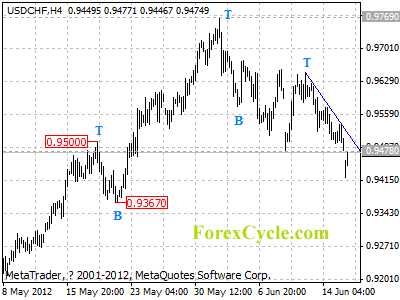
USDCHF breaks below 0.9478 support and reaches as low as 0.9421. Further decline could be expected after a minor consolidation, and next target would be at 0.9300 area. Initial resistance is at the downward trend line on 4-hour chart, as long as the trend line resistance holds, downtrend will continue.

usdchf

Daily Forex Analysis

Greece should remain in euro, respect commitments – G7

By Central Bank News

    STATEMENT ISSUED BY GROUP OF SEVEN (G7) FINANCE MINISTERS:
    “Leaders from the Group of 20, which includes the G7, meet today in Los Cabos, Mexico. Taking note of the Greek elections, we look forward to working with the next government of Greece, and believe that it is in all our interests for Greece to remain in the euro area while respecting its commitments.
    “We welcome the commitment of the euro area to work in partnership with the next Greek government to ensure they remain on the path to reform and sustainability within the euro area.”

S&P 500: Elliott Wave Forecasts, Simplified

Plus, your FREE opportunity to test-drive our intraday S&P forecasts for 1 full week — starting now

By Elliott Wave International

Here’s what Elliott wave analysis is all about: You study charts to find non-overlapping 5-wave moves (trend-defining) from overlapping 3-wave ones (corrective, countertrend).

With that in mind, please take a look at this chart of the S&P 500, which our U.S. Intraday Stocks Specialty Service (FreeWeek is on now) posted for subscribers at 9:37 AM today (June 14):

Immediately, you can see that the S&P 500 has been moving sideways in a choppy, overlapping manner. That’s the definition of a correction — i.e., that is NOT the trend. The trend, as the U.S. Intraday Stocks Specialty Service editor Tom Prindaville said in the morning market overview, was higher — at least in the short-term:

…sideways-to-up over the very near term will be expected. Simply put, overall higher near-term remains the intraday call — to complete a corrective second wave.

And here’s a chart of the S&P 500 at the close of the market that the Service posted at 3:34 PM on the same day:

To make this bullish forecast, the Service editor Tom Prindaville was simply following the Elliott wave model of market progression. The model called for a completion of the developing wave 2 — in this case, “higher near-term.”

Market corrections — the sideways, choppy moves you see in both charts above — are notoriously hard to forecast. And not every Elliott wave forecast works out. But you do get a real, practical roadmap of the expected market action.


WANT TO TRY ELLIOTT WAVE FORECASTS — FREE?

You can — now thru 12 noon on June 21

Try our U.S. Intraday Stocks Specialty Service forecasts of the S&P 500, DJIA and NASDAQ free for a week. No strings attached, no credit card required.

Get the details and instant, FREE online access now >>

This article was syndicated by Elliott Wave International and was originally published under the headline S&P 500: Elliott Wave Forecasts, Simplified. EWI is the world’s largest market forecasting firm. Its staff of full-time analysts led by Chartered Market Technician Robert Prechter provides 24-hour-a-day market analysis to institutional and private investors around the world.


Put Some Style in Your Portfolio With Zumiez (Nasdaq: ZUMZ)

Article by Investment U

Put Some Style in Your Portfolio With Zumiez (Nasdaq: ZUMZ)

Now the average, intelligent investor is probably about as familiar with niche retailer Zumiez, Inc. (Nasdaq: ZUMZ) as they are with the hoity toity Hermes Birkin…

Clint Eastwood’s daughter, Francesca Eastwood, recently hit the headlines when she took to Twitter and Facebook with an unusual “artistic” ploy. Accompanied by her photographer boyfriend, the reality TV star took a $100,000 Hermes Birkin handbag and completely trashed it.

Photographs are now circulating the web of Ms. Eastwood biting the bag, right before taking a chainsaw to the extremely expensive accessory and ultimately setting it on fire. All in the name of art. And publicity.

Fortunately, we here at Investment U have a much better way to combine money and fashion. And it has absolutely nothing to do with blowing $100,000 in the space of a minute.

Quite the opposite, actually.

Now the average, intelligent investor is probably about as familiar with niche retailer Zumiez, Inc. (Nasdaq: ZUMZ) as they are with the hoity toity Hermes Birkin, which Eastwood apparently thought so little of. And any average, intelligent investor who is might wonder how a company with as grungy a face as Zumiez could make enough money to stay afloat – much less reap any decent investment rewards.

But judging by Zumiez’s most recent quarterly results, grungy, head-scratching and downright dangerous can be an extremely profitable combination when managed properly.

“Hang Ten” With Zumiez and Make Some “Sick” Profits Along the Way

If Zumiez sounds like a crazy name, it’s largely because it appeals to an oftentimes irrational base: Adolescents who want to express themselves as individuals… just like all the rest of their peers.

A leading specialty retailer, it sells just about everything a teenager could want towards achieving that goal, from apparel to footwear to accessories. According to its company profile, Zumiez caters “to young men and women between the ages of 12 and 24 who seek popular brands representing a lifestyle centered on activities that include skateboarding, surfing, snowboarding, BMX and motocross.”

Or, translated into teenage speak: It attracts the skater-punk/extreme-sports crowd.

That faction of adolescent expression seems to be doing quite well for itself these days, even in the middle of a tough economy. Either that or mommy and daddy are doing quite well and don’t mind throwing some serious cash at their kids.

One way or the other though, Zumiez concluded an excellent first quarter on April 28.

Total net sales during the 13-week period increased 22.7% over the same time in 2011, jumping from $105.9 million to $129.9 million. But that’s nothing compared to the 140% leap its net income made over the same time…

For its first quarter in 2011, Zumiez recorded a net income of $1.9 million. This year, that number is up to $4.5 million.

With that said, CEO Rich Brooks clearly had every right to brag that he is “pleased to start the year off wish such strong performance.” Going forward, he says his “teams are energized and focused on carrying our current momentum into summer and position the company for a successful back half of the year.”

Zumiez Looks “Clean” Going Forward

There’s a reason that Zumiez has seen such positive growth over time, raking in a gross profit of $133 million from 2009 to 2010, over $167 million the following fiscal year, and $201-plus million this past cycle. Net income has, incidentally, seen similarly impressive advances.

So what’s the key to success?

Zumiez sets itself apart from the competition by not only selling what teenagers want, but offering an atmosphere that makes them literally feel at home.

Most of its 455 stores across the U.S. and Canada are equipped with couches and video game stations meant to lure youngsters in and keep them there, interacting with the staff, their friends and – obviously – the merchandise. And they’re easy to find considering the prime mall locations Zumiez actively seeks out: Right next to the food courts, movie theaters, and entertainment shops.

Set up so specifically, it’s difficult for the company’s targeted demographic not to take notice… exactly as planned.

That’s why it seems extremely probable that Zumiez has a lot more to offer in the future… Unlike Francesca Eastwood’s $100,000 bag.

Good Investing,

Jeannette Di Louie

Article by Investment U

Investing in Tungsten: The Little-Known Metal That’s Quietly Running the World

Article by Investment U

Investing in Tungsten

A little-discussed metal called tungsten is set to become one of the most sought-after commodities on Wall Street.

At Investment U, we’re not in the business of showing people how to make a quick buck.

Actually, I’d say we’re on the opposite end of the spectrum, as we relentlessly advise growing and protecting your wealth at a steady and safe rate. (For more see here, here, here, here and here.)

But that doesn’t mean you shouldn’t take advantage of a hot opportunity when you see one.

In fact, a little-discussed metal called tungsten is set to become one of the most sought-after commodities on Wall Street.

And a handful of junior mining stocks are poised to skyrocket as a result. This is because, as demand for tungsten is ramping higher around the world, supplies are dwindling even faster.

Warren Buffet is Leading the Charge

Now before we go any further, you should fully understand that junior mining stocks are risky investments.

Legendary investor Doug Casey calls them “the most volatile stocks on earth.”

But where there’s risk, there’s also potential reward. And junior miners can return some of the biggest profits known to man.

For example, since 2009, Detour Gold Corporation (TSX: DGC) has soared as much as 1,025%. And some companies, like ATAC Resources (TSX: ATC), have exploded well over 10,000% in the past.

Junior miners that mine and process tungsten may very well find themselves in a similar situation today.

And Warren Buffett agrees.

In February, Woulfe Mining (TSX: WOF) inked a deal with International Metalworking Companies, a Berkshire Hathaway (NYSE: BRK-A) owned holding company for metalworking products.

For a total of about $80 million, IMC agreed to buy a 25% stake in Woulfe’s Sandong mining project in South Korea, which was once the biggest tungsten-producing mine worldwide. By early 2013, once again, the mine is set to become the biggest producer when it reopens.

It’s estimated Sandong will account for 7% to 10% of total tungsten production at that time.

Buffett is seeing an enormous opportunity here.

As Woulfe Mining’s Nick Smith told Tungsten Investing News, “Without tungsten, Western manufacturing comes to an end.”

Today the metal is used in anything from light bulbs, to drill bits for oil and gas exploration, to solar panels, to smartphones, tablets and much more.

And what makes it unique is that it’s practically immune from corrosion and can withstand unbelievably high temperatures.

Nick Smith adds, “You are not working with steel without tungsten. There’s no global mining unless you have tungsten-tipped drills.”

In other words, even though supply of tungsten is tightening worldwide, there’s no material that can currently replace demand for it no matter how high prices go.

China currently hoards 80% of the world’s tungsten supply and expects to use all of it to support its own manufacturing industry.

This leaves little options for any company that’s dependent on tungsten for their own goods and services.

How to Play the Trend

While there’s really no “safe” pure play on tungsten right now, there are a number of junior mining stocks that could skyrocket as supplies continue constricting.

Among the top five I’m interested in are Playfair Mining (TSX: PLV), Malaga Inc. (TSX: MLG), Woulfe Mining (TSX: WOF), Happy Creek Minerals (TSX: HPY), and Largo Resources (TSX: LGV).

Just keep in mind, these companies are very small and subject to big price swings. So be sure to give your trailing stops enough room to handle a bumpy, yet potentially lucrative, ride.

Good Investing,

Mike Kapsch

Article by Investment U

Why You Shouldn’t Be Afraid to Buy Stocks Now, Part I

Article by Investment U

The headlines these days are filled with gloom…

The economy is sputtering. Consumer confidence is down. Unemployment is up. The Eurozone is coming apart at the seams. To top it off, federal, state and local government spending are sending us down the road to ruin. Who can buy stocks in this type of environment?

You can. And you’d be unwise to let anyone counsel you otherwise, even if stocks go lower before they go higher.

Here’s why…

Owning great companies is a smart move. (Notice I said great companies not small, unproven, or unprofitable companies.)

Most wealthy Americans achieved their affluence not by inheritance or real estate speculation but by starting and owning profitable businesses. And these folks can be thankful they weren’t deterred at the outset by naysayers and know-it-alls who tried to convince them the economy wasn’t right or their timing was wrong or whatever.

Of course, most of us don’t have the time, the investment capital, or the experience necessary to found and run a successful business. But we can buy shares of the greatest businesses in the world through the stock market.

And it’s easy. A click of the mouse – and a seven-dollar commission – and you’re in.

Another click – and another seven bucks – and you’re out. (Compare that to your typical real estate closing.) And if you buy publicly traded companies, as opposed to running your own private one, you don’t have to apply for loans, hire employees, grapple with an avalanche of federal regulations, pay expensive accountants and attorneys, or even show up for work. What’s not to like?

Of course, businesses can experience tough times. But they are adaptable. When sales take a downturn, they’ll cut expenses to the bone and lay off unnecessary personnel. They’ll refinance their debt at lower rates. They’ll tighten up the ship any and every way they can to make the business as lean as possible. And then when even slightly higher sales start to materialize, it will translate into a big jump in earnings. Those who are still trying to understand how the companies that make up the S&P 500 reported all-time record profits in each of the last 11 quarters might want to read this paragraph again.

Once you start thinking in terms of owning businesses – as opposed to predicting elections, economies, interest rates, currencies, commodities and equity markets – it’s clear how you should grow and protect your wealth. In fact, it’s more than a little ironic that the very people I hear telling investors not to buy stocks are – overwhelmingly – business owners themselves. Their business is advising other people not to buy businesses.

Seems odd, but I guess there’s good money in it.

Of course, even if you follow the basic principles of stock market investment – sticking to quality, diversifying widely and buying at reasonable prices – you can still experience losses. That’s normal. It shouldn’t come as a surprise and it shouldn’t deter you from investing in stocks.

Indeed, there are three ironclad strategies that every investor should follow to maximize his stock market profits while keeping any losses strictly limited. And those are exactly the subject of Monday’s column…

Good Investing,

Alexander Green

Editor’s Note: One of Alex’s favorite shortcuts to finding great businesses is finding CEOs and directors who are investing their own money back into the company in the form of stock purchases. And that’s exactly what’s been happening with today’s Investment U Plus pick.

And since we first mentioned the company back on May 14, its stock has steadily ticked higher – not to mention it sports a robust 8% yield.  For more information on how you can receive this and our other daily recommendations along with your Investment U issues for pennies a day, click here.

Article by Investment U