Why Liquefied Natural Gas Makes Australia The Next Energy Hotbed

By MoneyMorning.com.au

A recent report by Exxon Mobil Corp. (NYSE: XOM) predicts that while energy demand will remain essentially flat in developed economies, demand in emerging markets will rise by nearly 60%.

This growth is good news for natural gas, since the world increasingly favors lower-carbon energy sources. In fact, the International Energy Agency (IEA) predicts natural gas will surpass oil as the planet’s number one source of energy beginning in 2035.

What’s more, emerging economies are big importers of liquefied natural gas (LNG), the fuel’s most portable form. That’s why the world’s biggest oil and natural gas companies are placing huge bets that LNG is the “new oil.”

And most of their Monopoly-sized wagers are saying Australia’s the place to find it.

Here’s why Australia will be the globe’s next energy hotbed.

Australia’s $200 Billion LNG Bet

Australia’s vast resources along with its close proximity to fast-growing markets in Asia make it an ideal spot for big players looking to profit from the planet’s insatiable appetite for energy.

“Australia is superbly placed to benefit from growing world gas demand, particularly in the Asia-Pacific region,” Gavin Wendt, Founding Director and Senior Resources Analyst at MineLife told CNBC.

Now energy companies like Exxon and Chevron Corp. (NYSE: CVX) are reaching into the Outback and other remote parts of Australia to tap supplies of the world’s next great energy source.

Australia’s natural gas resources consist of about 390 trillion cubic feet of natural gas, which could double in size if exploration for shale gas is successful. So the majors are racing to drill wells and build pipelines in a mad dash to tap the trillions of cubic feet of natural gas that will be converted into LNG.

And even though the country has strong environmental regulations, its stable political and legal systems make it a user-friendly partner for investors.

Australia is currently the fourth-largest exporter of LNG in the world behind Qatar, Malaysia and Indonesia. But a wave of LNG projects worth almost $200 billion is set to lift Australia to the number one spot by the end of the decade.

Three large-scale LNG projects are expected to come online in the next five years that will produce almost 59 million metric tons annually – quadrupling Australia’s capacity to roughly 83 million metric tons.

The biggest projects also involve the construction of LNG terminals to feed Asia’s natural gas demand. Most of the natural gas will be converted to LNG and make its way to markets like China, South Korea and Japan.

The Natural Gas Companies Cashing in on Aussie LNG

Unlike oil, the price of natural gas is regional, not global.

So while a million BTU of natural gas in the United States is now below $2.00, a million BTU of LNG trades for over $9.00 in the United Kingdom and $15.00 in Japan.

Since it will be years before the U.S. will be ready to export LNG, Australian producers will have the Asian markets to themselves for a while.

That’s why the oil majors are venturing Down Under and betting billions on natural gas deals.

Investors should look for natural gas companies that are focused on coal seam gas, an unconventional fuel that’s become one of the world’s hottest energy plays.

One reason is that coal seam gas is cheaper to produce since the wells are shallower than shale and do not always need to be “fracked.”

More than $20 billion has been spent on these deals by companies including Royal Dutch Shell PLC (NYSE ADR: RDS) and ConocoPhillips (NYSE: COP). Just two weeks ago Exxon took a 10% stake in a coal seam deal worth roughly $15 billion.

Chevron has also teamed up with Exxon on a major stake in the $41 billion Gorgon gas project, the country’s largest natural gas resource.

The integrated oil majors are the types of companies that have the resources to develop these large scale projects.

But keep in mind these are long-term projects.

Rewards will only come to investors with the patience to hold the natural gas companies that are positioning to profit from Australia’s vast resources.

Don Miller
Contributing Writer, Money Morning

Publisher’s Note: This is an edited version of an article that first appeared in Money Morning (USA)

From the Archives…

The Problem With the Spanish Bailout
2012-06-15 – Keith Fitz-Gerald

Australian Housing – How to Avoid This Pauper’s Retirement Trap
2012-06-14 – Kris Sayce

Why Warren Buffett is Loading Up on Tungsten
2012-06-13 – Don Miller

China’s Economic Data Statistics: Just Add Salt
2012-06-12 – Dr. Alex Cowie

Why Graphite is One of the Few Places For Savvy Investors to Make Money
2012-06-11 – Dr. Alex Cowie


Why Liquefied Natural Gas Makes Australia The Next Energy Hotbed
Why Bernanke and the Fed’s Keynesian Paradox of Thrift is Bogus

By MoneyMorning.com.au

Fed Chair Ben Bernanke continues to stand on a stack of Lord Keynes’ General Theory and proclaim that the world needs low interest rates to fill the gap in aggregate demand and bring prosperity to our times.

“The reason to keep rates low isn’t to accommodate congressional fiscal policy,” Bernanke responded during a recent congressional hearing. Consumers benefit from cheaper mortgages and lower interest rates, which help to stimulate the economy, claims the Fed head.

When Sen. Bernie Sanders launched into a stem-winding question about the “unequal distribution” of wealth in the U.S., Bernanke quipped, “It’s not so much a question about bringing down the 1%, but bringing up the middle class.”

Right. Only a guy who has spent a lifetime in academia and now government would think he’s smart enough to pull the right monetary levers and push the correct policy buttons to make the middle class richer. His economic worldview even doubts that a richer citizenry will get us out of the great recession.

A few of Dr. Bernanke’s legion of Ph.D. economists have turned out the June issue of the Federal Reserve Bulletin. Inside, you’ll find that the median net worth for Americans fell almost 39% from 2007 to 2010. Of course, “median” means the drop was worse for half the population and better for the other half.

Either way, most Americans are poorer. According to the Fed’s figures, Americans are right back where they were in 1992. Family debt stayed the same. But what everyone thought were their personal ATM machines back in 2007 – their homes – plunged in value.

For all the hand-wringing and shocked faces this story has inspired, what everyone forgets is that for net worth to rise, people must save more, pay down debt or enjoy increases in the value of their assets.

To Save or Spend

But Dr. Bernanke, a good Keynesian, knows the central tenant of the Keynesian school is the paradox of thrift, which states that if everyone saves more money during a recession, then aggregate demand for goods and services will fall. This will lead to more unemployment, which in turn will mean even lower savings.

In the end, the Keynesians believe that this great paradox unleashes a vicious spiral that will take us back to the Stone Age.

The last thing Dr. Bernanke wants is a mass outbreak of thriftiness. The Fed chair wants people to spend and borrow. To buy new TVs. Even bigger houses. New smartphones. Anything, really. And he wants government to do the same. That’s the ticket! That’s progress.

If Keynesians believe their own theory, they should take the fact that net worth has dropped as a positive sign that Americans are doing all they can to spend us out of the recession.

Boobus Americanus hasn’t pulled in his spending horns. His house may have crashed in value, but he’s still doing his part. He’s keeping his debt level held high. His spending habits firm. Keynesian heroism in light of the fact that, according to the Fed survey, incomes fell from 2007 to 2010.

According to the Fed’s report, the proportion of families reporting that they had saved anything the previous year fell from 56.4% of families in 2007 to 52% in 2010. “That decrease pushed the fraction of families reporting saving to the lowest level since the SCF [Survey of Consumer Finances] began collecting such information in 1992.”

But the Fed’s zero interest rate policy has banks and the government offering mere basis points to savers. Sub-1% interest rates on accounts and CDs have many wondering what’s the point?

Life coach and author John Strelecky urges people to spend the money. To “live your bucket list now.” The interest you would have earned on the money you spend is not enough to compensate a person for the lifetime of memories missed.

“No matter when that two-minute warning ticks off, you could say you did what you wanted to do with your life,” Strelecky says. “Don’t wait until you’re 65 to start spending your money to live a rewarding life.”

James Livingston, author of Against Thrift: Why Consumer Culture Is Good for the Economy, the Environment and Your Soul, claims that under consumption caused the 2008 meltdown, and that consumers aren’t spending enough to get us out of it. “I’m saying that we need to lighten up and spend more, for our own good,” writes Livingston, who teaches at Rutgers. “If we don’t, we sacrifice ourselves on the altar of productivity and meanwhile sentence our children to a future of pointless repression, denial and delay.”

Economists like CNBC’s Steve Liesman think there is too much saving going on. So does the Chicago Fed’s Charles Evans, who said not too long ago:

“It seems to me if we could somehow get lower real interest rates so that the amount of excess savings that is taking place relative to investment is lowered, that would be one channel for stimulating the economy.”

Of course, as F.A. Hayek showed, the paradox of thrift is nonsense. Savings provides capital. It is that capital that makes labor more efficient. As capital is accumulated, its cost falls. Entrepreneurs then reorganize capital into more capital-intensive uses.

In other words, as people save more and spend less, capital is shifted into building factories, rather than tennis shoes. Labor and prices shift accordingly. Instead of collapsing into depression, the entire system reaches a new equilibrium at a higher savings amount by means of adjustments in labor, capital, prices, quantities, production and consumption.

It is savings and capital (not borrowing and spending!) that create prosperity for both individuals and societies. Chairman Bernanke is doing all he can, and the banks are cooperating, to entice you into giving up on earning decent returns and just buying a new boat or big screen.

Don’t fall for it.

I urge you use your savings to grow (not reduce) your net worth.

Douglas French
Contributing Writer, Money Morning

Publisher’s Note: This article originally appeared in Laissez Faire Today.

From the Archives…

The Problem With the Spanish Bailout
2012-06-15 – Keith Fitz-Gerald

Australian Housing – How to Avoid This Pauper’s Retirement Trap
2012-06-14 – Kris Sayce

Why Warren Buffett is Loading Up on Tungsten
2012-06-13 – Don Miller

China’s Economic Data Statistics: Just Add Salt
2012-06-12 – Dr. Alex Cowie

Why Graphite is One of the Few Places For Savvy Investors to Make Money
2012-06-11 – Dr. Alex Cowie


Why Bernanke and the Fed’s Keynesian Paradox of Thrift is Bogus

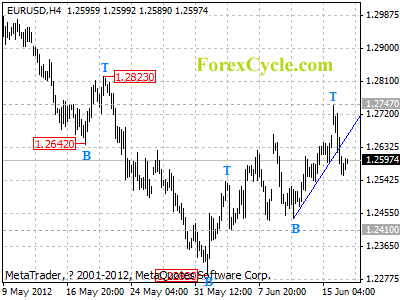
EURUSD breaks below upward trend line

EURUSD breaks below the upward trend line on 4-hour chart, suggesting that lengthier consolidation of the uptrend from 1.2288 is underway. Support is at 1.2500, as long as this level holds, the uptrend could be expected to resume, and another rise towards 1.2800 is still possible. On the downside, a breakdown below 1.2500 will indicate that the uptrend from 1.2288 has completed at 1.2747 already, then the following downward movement could bring price to 1.2000 area.

eurusd

Forex Signals

Central Bank News Link List – June 18, 2012

By Central Bank News

    Here’s today’s Central Bank News link list, click through if you missed the previous central bank news link list.  Remember, if you want to submit links for inclusion in the daily link list, just email them through to us or post them in the comments section below. 

Euro Weakness “Weighs on Gold and Silver”, “Scarcity” of Dollars Expected to Support US Currency, “Funny Money” Behind Hollande Growth Plan

London Gold Market Report
from Ben Traynor
BullionVault
Monday 18 June 2012, 08:30 EDT

THE SPOT MARKET gold price hovered around $1620 an ounce during Monday morning trading in London – slightly below last week’s close – while stock and commodity markets were also broadly flat, after initial rallies that followed yesterday’s Greek election result soon ran out of steam.

The silver price drifted lower to $28.41 per ounce by Monday lunchtime in London – a 1% drop on Friday’s close – while US, UK and German government bond prices all saw gains ahead of the week’s Federal Reserve policy meeting.

The Euro meantime briefly broke above $1.27 for the first time in nearly a month, before dropping by more than one cent by lunchtime.

“There is a downward bias [in gold and silver],” reckons marc Ground, commodities strategist at Standard Bank.

“Euro weakness weighs on precious metals as markets come to the realization that despite the Greek election resulting in a ‘positive’ outcome…the underlying problems facing the Eurozone are still very much present.”

The pro-bailout New Democracy party is seeking to form a coalition government after narrowly beating the anti-bailout Syriza in Sunday’s Greek elections.

“The result showed people want the Euro,” one senior New Democracy official told newswire Reuters.

“But society remains divided. Syriza will be a militant opposition, possibly complicating the new government’s efforts.”

“Will [New Democracy’s narrow victory] be the wake-up call [Eurozone] policymakers have needed to show that their policies are going wrong?” asks Standard Bank currency strategist Steve Barrow.

“Or [will they] see the Greek result a vindication of their approach? Unfortunately, we think it will be the latter and that keeps us bearish of the Euro.”

European stock markets were broadly flat by Monday lunchtime in London following a short-lived rally in early trading.

On the bond markets, Spanish 10-Year bond yields set a fresh Euro-era high this morning, hitting 7.16%. Yields on Italian 10-Year bonds also spiked, climbing back above 6%.

Elsewhere in Europe, French president Francois Hollande – whose Socialists won a majority in yesterday’s parliamentary elections – has sent fellow European leaders plans for a €120 billion ‘growth pact’, French newspaper Le Journal du Dimanche reported Sunday.

The €120 billion would reportedly include €10 billion from the European Investment Bank, whose activities include stimulating small business lending and infrastructure investment. This €10 billion would then be “leveraged”, the report says, to €60 billion of private investment raised on international markets.

“No one has ever explained how €10 billion becomes €60 billion,” says one senior European Union diplomat quoted by the Telegraph.

“This is funny money and risks politicizing an institution [the EIB] that works well because it is independent of the politicians and the dodgy Euro math that has fuelled the crisis.”

Non-Eurozone leaders at the latest G20 summit, which begins today in Mexico, will “make the case” for further European fiscal and political integration as a way of bolstering monetary union, according to David Plouffe, senior adviser to US president Barack Obama.

G20 leaders “should encourage and support efforts made by Europe to resolve [the debt crisis] and send a signal of confidence to the market,” China’s president Hu Jintao said over the weekend.

“We are waiting for Europe to tell us what it is going to do,” added Robert Zoellick, president of the World Bank, speaking on Sunday.

“The danger we’re creating is the danger of policymaking that is increasing uncertainty and making markets more nervous, which has a negative feedback loop.”

On the currency markets, private sector investors are facing a scarcity of US Dollars as a result of heavy buying by central banks aiming to build up their reserves, according to a report from Morgan Stanley.

“The market often assumes that people are long Dollars, but many of those Dollars are held by central banks, which are unlikely to move out,” says Morgan Stanley’s head of European currency strategy Ian Stannard in London.

“That leaves us with the private sector, which is short. In an environment where we see a global slowdown, the Dollar will be well supported.”

The US Dollar Index (DXY), which measures the Dollar’s strength against a basket of major currencies, hit its highest level for nearly two years earlier this month.

On Monday morning, the DXY was trading around 10% higher that it was when the Dollar gold price set an all-time record last September. Over the same period, Dollar gold prices are down around 15%.

Last November, six of the world’s major central banks undertook coordinated action to lower the cost to banks of borrowing Dollars, in order to “provide liquidity support to the global financial system”.

In the US, the Federal Open Market Committee is expected to extend its maturity extension program Operation Twist, which aims to lower longer-term interest rates, when it meets tomorrow and Wednesday, a number of analysts report.

“A short-term extension of Operation Twist is the most likely” says a note from Barclays.
People who buy gold are investing in a “dead asset”, Indian finance minister Pranab Mukherjee told a television awards ceremony over the weekend.

Mukherjee, who has twice announced increases in gold import duties this year, urged India’s financial advisers to “spread financial literacy” and encourage investment in other assets, adding that there is a need for India to develop wider and deeper securities markets.

Over in China, which looks set this year to overtake India as the world’s largest source of private gold demand, property prices in major cities fell for the eighth month running last month, Reuters reports.

Ben Traynor
BullionVault

Gold value calculator   |   Buy gold online at live prices

Editor of Gold News, the analysis and investment research site from world-leading gold ownership service BullionVault, Ben Traynor was formerly editor of the Fleet Street Letter, the UK’s longest-running investment letter. A Cambridge economics graduate, he is a professional writer and editor with a specialist interest in monetary economics.

(c) BullionVault 2011

Please Note: This article is to inform your thinking, not lead it. Only you can decide the best place for your money, and any decision you make will put your money at risk. Information or data included here may have already been overtaken by events – and must be verified elsewhere – should you choose to act on it.


Poor US Data Gives Fed Room Stimulus

By TraderVox.com

Tradervox (Dublin) – Reports from the US show that the economy is halting giving the Federal Reserve room for further stimulus. Data from the Labor Department showed more Americans applied for jobless claims with another report showing consumer prices dropped the most in three years.

Jobless claims unexpectedly climbed to 386,000 last week according to figures released by Labor Department today in Washington. The living cost dropped by 0.3 percent last month with the price of gasoline decreasing by most in three years according to report. These reports have added to speculations that Fed will take more action to spur growth.

The Labor Department report showed that unemployment rate is at 8 percent where it has been since 2009. However, cheaper costs have provided relief for most American as they experience slowing job and wage gains which has resulted to low consumer spending. According to Kevin Logan, who is the Chief IS Economist in New York HSBC Securities USA Inc, said the report will keep the Fed focused on employment and growth outlook as they meet next week. Apart from Fed decision next week, investors are also waiting for Greece election result which is expected to determine the future of the nation in the single currency bloc.

According to Bricklin Dwyer who is an economist at BNP Paribas, the disappointing report from the Labor Department show lack of traction in the labor market hence increasing the need for Fed to do more. The report also indicated that the cost of energy decreased by 4.3 percent from the previous month as gasoline dropped by 6.8 percent, which is the biggest drop since December 2008. With such reports coming from the US data, and pro-stimulus sentiments from Fed Vice Chairman Janet Yellen who signaled scope for more easing, speculation Fed mare add stimulus has increased.

Disclaimer
Tradervox.com is not giving advice nor is qualified or licensed to provide financial advice. You must seek guidance from your personal advisors before acting on this information. While we try to ensure that all of the information provided on this website is kept up-to-date and accurate we accept no responsibility for any use made of the information provided. Opinions expressed at Tradervox.com are those of the individual authors and do not necessarily represent the opinion of Tradervox.com or its management. 

Article provided by TraderVox.com
Tradervox.com is a Forex News Portal that provides real-time news and analysis relating to the Currency Markets.
News and analysis are produced throughout the day by our in-house staff.
Follow us on twitter: www.twitter.com/tradervox

The Senior Strategist: The battle is won but not the war

Investors expressed relief over the projected victory of pro-bailout parties in the Greek elections on Sunday, but they quickly turned their attention to the structural problems in southern Europe that continue to threaten the global economy.

There is still a lot of uncertain factors concerning the future EU debt-structure, Spanish banks and growth slowdown.

This week is shaping up to be a major one. We have the G20-meeting i Mexico and Fed meeting on Wednesday.

Legal information

Video courtesy of en.jyskebank.tv

Euro Sees Gains Ahead of Greek Election

Source: ForexYard

The euro saw gains across the board on Friday, as investors were confident that whatever the outcome of the Greek election being held over the weekend, the international community would actively work to support the euro-zone. The EUR/USD closed the week at 1.2662, up over 70 pips for the day. This week, traders will want to continue monitoring news out of Greece. It is unlikely that a new government will be formed immediately following the election. Therefore, the potential for heavy euro volatility still exists depending on what the makeup is of the new Greek government.

Economic News

USD – Dollar Extends Bearish Trend Following Poor US News

The US dollar took additional losses against its main currency rivals on Friday, following the release of a worse than expected Prelim UoM Consumer Sentiment figure which investors took as a sign that the US economic recovery is stalling. Against the JPY, the dollar dropped 90 pips for the day, reaching as low as 78.60 during early morning trading. The greenback was able to stage a minor correction to close out the week at 78.75. The USD/CHF dropped over 50 pips during evening trading, eventually finishing out the week at 0.9483.

Taking a look at this week, Wednesday may turn out to be a volatile day for the USD, as the FOMC Statement at 16:30 GMT, followed by the FOMC Press Conference at 18:15 are expected to give clues as to any plans the Fed has to initiate a new round of quantitative easing to stimulate the US economy. Any talk of a new stimulus package in the US this week may lead to significant dollar losses, particularly against the safe-haven Japanese yen.

EUR – Greek News Set to Generate Euro Volatility

The euro was able to extend its bullish trend to finish out the week on Friday, as investors were fairly confident that despite the outcome of this past weekend’s Greek elections, the international community would actively work to boost euro-zone economies. In addition to gaining some 70 pips against the US dollar, the euro advanced over 60 pips against the Japanese yen and 50 pips against the Canadian dollar. That being said, the euro was not at fortunate against the British pound. The EUR/GBP dropped close to 100 pips on Friday to finish out the week at 0.8052.

This week, Greece is once again likely to dominate the headlines and create the most market volatility. Depending on what the final makeup of the new Greek government is, the euro could either turn significantly bullish or bearish. That being said, any gains the euro makes could be short-lived. Analysts are warning that even if a pro-austerity government is elected in Greece, economic troubles in both Spain and Italy may continue to weigh down on the euro.

Gold – Gold Continues to Benefit from Global Economic Turmoil

Gold saw additional gains in trading on Friday, following poor US news which caused investors to shift their funds to safe-haven assets. The price of gold increased by over $10 an ounce by the mid-day session, eventually reaching as high as $1632.23. A slight downward correction during evening trading eventually led to gold finishing the week at $1626.55.

This week, gold traders will want to continue monitoring news out of the US. In particular, Wednesday’s FOMC press conference may offer clues as to any plans the Fed has to initiate a new round of quantitative easing to stimulate growth in the US economy. If the Fed does mention any form of monetary stimulus in the coming days, investors may continue shifting their funds to safe-havens, which could cause gold to extend its bullish trend.

Crude Oil – Crude Oil Trades Flat to Finish out the Week

The price of crude oil saw little movement on Friday, as weak economic data out of the US and investor anxiousness regarding the outcome of the Greek election kept the commodity close its recent lows. After reaching as high as $84.75 a barrel during overnight trading, crude oil saw a slight downward correction, which brought the price down to $83.39 during the mid-day session.

Turning to this week, the direction crude oil takes is likely to depend on how investors interpret the results of Greece’s election. Any sign that the results of the election will lead to further euro-zone troubles may cause oil to turn bearish in the coming days. At the same time, should a pro-austerity government be formed in Greece, fears regarding the euro-zone could calm down which could lead to gains for crude.

Technical News

EUR/USD

Long term technical indicators are providing mixed signals for this pair. On the one hand, the weekly chart’s MACD/OsMA seems like it is about to form a bullish cross. On the other hand, the daily chart’s Williams Percent Range is in overbought territory, indicating that downward movement could occur. Taking a wait and see approach for this pair may be the best choice.

GBP/USD

The Williams Percent Range on the daily chart is currently in the overbought zone, indicating that downward movement could occur in the near future. In addition, the Slow Stochastic on the same chart seems like it is about to form a bearish cross. Traders will want to pay attention to this indicator. If it forms the cross, it may be a good time to open short positions.

USD/JPY

The Bollinger Bands on the weekly chart are narrowing, indicating that this pair could see a price shift in the coming days. Furthermore, the Williams Percent Range on the same chart is hovering close to the oversold zone. Traders may want to go long in their positions for this pair.

USD/CHF

A bullish cross on the daily chart’s Slow Stochastic indicates that this pair could see an upward correction in the near future. This theory is supported by the Williams Percent Range on the same chart. Going long may be the best choice for this pair.

The Wild Card

Platinum

The Williams Percent Range on the daily chart is currently in the overbought zone. In addition, the Slow Stochastic on the same chart has formed a bearish cross, while the Relative Strength Index is hovering close to the 70 line. This may be a good time for forex traders to open short positions ahead of a downward breach.

Forex Market Analysis provided by ForexYard.

© 2006 by FxYard Ltd

Disclaimer: Trading Foreign Exchange carries a high level of risk and may not be suitable for all investors. There is a possibility that you could sustain a loss of all of your investment and therefore you should not invest money that you cannot afford to lose. You should be aware of all the risks associated with Foreign Exchange trading.