Fortescue’s Fight Against the State

By MoneyMorning.com.au

Fortescue Metals [ASX: FMG] has today filed documents in the High Court of Australia, accusing the government of breaching section 51(ii) of the Australian Constitution.

What’s that all about? More below…

In 1850, British philosopher and sociologist Herbert Spencer wrote:

‘If every man has freedom to do all that he wills, provided he infringes not the equal freedom of any other man, then he is free to drop connection with the State, to relinquish its protection and to refuse paying towards its support. It is self-evident that in so behaving he in no way trenches upon the liberty of others; for his position is a passive one, and, whilst passive, he cannot become an aggressor.’

Remember that the State is the aggressor in over 99% of cases. The most obvious is the violent way in which it levies taxes against individuals and businesses.

And the way it forces its will on individuals and businesses regardless of whether they approve. If they disagree with the State action they are punished: fined or sent to jail.

Yet if the State infringes on the individual or business, what’s the penalty?

Compensation? Maybe. But most likely, the government will just change the law so it can pursue what the court had previously deemed unlawful.

But what’s this about Fortescue Metals and the Constitution?

Contrary to the Constitution

This morning, Fortescue lodged a constitutional challenge to the government’s Minerals Resource Rent Tax (MRRT). The press release states:

‘Fortescue…today lodged a challenge in the High Court of Australia against the Federal Government’s Minerals Resource Rent Tax (MRRT) on constitutional grounds.

‘Fortescue Chief Executive Officer Nev Power said Fortescue has taken legal advice and is challenging the tax on the grounds that the MRRT:

  • Discriminates between the States contrary to section 51(ii) of the Constitution;
  • Curtains State sovereignty contrary to the Melbourne Corporation principle;
  • Gives preference to one State over another contrary to section 99 of the Constitution; and
  • Restricts a State’s ability to encourage mining contrary to section 91 of the Constitution.’

Hats off to Fortescue for challenging the State. But we don’t fancy their chances. As we say, the State can do anything.

Evidence of that is in a successful challenge in the High Court earlier this week to a different government program. A father of four from Queensland had taken the government to court, claiming the Commonwealth chaplaincy program was unconstitutional.

The court agreed. It meant the government had acted illegally and should stop spending taxpayer dollars on this program.

The government’s response? As you’d expect, according to the Sydney Morning Herald yesterday:

‘Attorney General Nicola Roxon has told reporters in Canberra the government would continue funding the program, despite the landmark ruling.’

In other words, the State can do what it wants. It makes up laws and passes them, so it can do what it wants. Sometimes it doesn’t even make a law, it just goes ahead anyway. If the courts invalidate a program the State ignores the court or passes a law to legalise its previously illegal actions.

It’s a nice power to have, for a megalomaniac.

So while we’re pleased to see someone stand up to the brutality and aggressiveness of the State, we don’t hold out much hope that Fortescue will actually achieve anything…although they may get a moral victory if they win the case.

The fact is, government influence and interference is only going in one direction.

Government Revenge


The BBC reports on a speech given by Alec Ross, a senior advisor to US Secretary of State, Hilary Clinton. In the speech he said:

‘As power is shifting from hierarchies to citizens, and networks of citizens, governments tend to feel overwhelmed. They feel over-run by this change. As governments accelerate; as revolutions increasingly make use of connective technologies; as pieces of legislation with massive corporate backing get shot in the head because of citizen-centred networks, what you should anticipate is a lashing back from government.’

We don’t expect Mr. Ross to stay in work for long with that kind of anti-government, pro-freedom talk.

Even though his main target are unelected dictatorships, what he says holds true for elected dictatorships in so-called democracies, too.

The UK is on the path to allowing the government to monitor all Internet and email usage. The US government is doing goodness knows what to infringe on the liberty of its own citizens (despite having a Nobel Peace Prize winner as President).

And the Aussie government is ploughing ahead with the National Broadband Network, which will inevitably allow the government to snoop on what you read, look at and watch.

Doubtless the Statists will say, ‘If you’re doing nothing wrong, you’ve nothing to worry about.’

That’s hardly the point. Individuals should have the freedom to do as they please without a busy-body bureaucrat snooping over their shoulder.

So, what does any of this have to do with investing and stock markets falling? Directly, not a great deal. But indirectly it is a big deal.

Investors need to get used to creeping socialism. That is, the more you earn the less the government will allow you to keep it, and the more you’ll be expected to fund the lifestyles of those who suck resources from taxpayers via the State.

That means doing as much as you can to control your own life. And doing as much as you can to prevent the government from stealing your wealth.

Make no mistake, the problems you see in the US and Europe (and soon enough in Australia) are a direct result of too much government involvement in national economies. And yet those governments believe they can correct things by getting more involved…hence the socialisation of wealth.

Eventually things will turn around, after governments have over-reached. But until then, expect more of the same…including volatile and risky stock markets.

Cheers,
Kris.

Related Articles

Market Pullback Exposes Five Stocks to Buy

Don’t Let the Fed Fool You, This Isn’t the Time to Abandon the Market

Australian Housing – How to Avoid This Pauper’s Retirement Trap

Fortescue’s Fight Against the State

Why More QE Is Coming

By MoneyMorning.com.au

The outlook is gloomy for investors hanging on for the next QE.

Investors are starting to realise that Sunday’s Greek election result was about the worst outcome they could have ended up with.

If Greece had out-and-out rejected austerity, we’d have had some panic – but we might have had some progress too.

Faced with plunging markets and the threat of an imminent Greek exit, central bankers around the world would have had their fingers poised over the ‘print’ button. Perhaps the Europeans might even have felt a bit of pressure to make something resembling a concrete decision.

As it stands, Greece’s indecision has left markets in limbo. Things aren’t great, but the threat of a Lehman moment has passed. That means central bankers just can’t justify another spending spree.

Federal Reserve chief Ben Bernanke still tried to toss investors a bone. But the market sulkily spat it right back at him…

The Fed hasn’t pressed the emergency button – yet.

Operation Twist – in Place of QE3

Instead of printing more money – QE3 – the Federal Reserve has opted to extend ‘Operation Twist’, which was originally meant to finish at the end of this month.

‘Twist’ involves the Fed trying to keep longer-term interest rates down; it does this by selling short-term debt and using the funds to buy US Treasuries with maturities of six to 30 years.

So “Twisting” doesn’t add more money to the system, it just takes it out of one end and puts it in at another. Trying to suppress interest rates over a longer period should ‘help to make broader financial conditions more accommodative,’ as the Fed puts it – but it doesn’t provide the caffeine jolt of fresh new money that the markets clearly crave.

Investors probably shouldn’t have been as surprised as they were – the fact is, things just aren’t that bad yet.

We seem to have forgotten that quantitative easing (QE) was at one point a potentially deadly monetary experiment – a desperate measure designed to prevent the complete collapse of civil society. Now every time the S&P 500 looks like losing a few points, or a bit of bad economic data comes out, it’s a case of ‘let’s just whack a little more plutonium in the fuel tank’.

The US is certainly slowing down, there’s no doubt about that. Fed officials cut their growth estimates for the US quite sharply: they reckon it will grow at between 1.9% and 2.4% this year, rather than 2.4% to 2.9%. And there are plenty of smart people who think that the US is already in recession and has been for a long time (although this uses a broader definition of recession than the usual ‘two shrinking quarters in a row’ notion).

However, while growth concerns are real, the Fed needs a more concrete panic phase to launch anything as drastic as QE3 – a more rebellious Greek vote, sparking a rush for liquidity and a sharp market plunge, might have done it. As it is, investors have gone from fearing the end of the world last week to being paralysed with indecision.

They’re too afraid to buy in case something nasty happens. And they’re too afraid to be out of the market because if something nasty happens, they think that policymakers will flood the world with money.

With No Sign of QE3 Investors Are Right To Be Nervous

As far as I can see, investors are right to feel indecisive. It’s possible that the US economy doesn’t “need” QE3, but Ben Bernanke will take any excuse he can get to err on the side of caution.

And he’ll probably get that excuse later in the year. The economy is slowing down right across the globe, not just in Europe and the US: China saw manufacturing sector activity shrink for the eighth month in a row in June.

As a result, life is getting tougher for companies. The latest company to warn on profits is US consumer goods giant Procter & Gamble. Some of its woes are self-inflicted, but the wider picture is pretty grim too.

As James Mackintosh notes in his FT column, operating profits globally are ‘now falling at an annual rate of 5%’. That’s similar to the sort of fall seen at the start of recessions in the 1990s and the 2000s.

Combine all this with the potential for an ongoing, rolling panic in Europe, and Ben is bound to come up with a reason to provide more QE.

John Stepek

Contributing Editor, Money Morning

Publisher’s Note: This article originally appeared in MoneyWeek (UK)

From the Archives…

The Problem With the Spanish Bailout
2012-06-15 – Keith Fitz-Gerald

Australian Housing – How to Avoid This Pauper’s Retirement Trap
2012-06-14 – Kris Sayce

Why Warren Buffett is Loading Up on Tungsten
2012-06-13 – Don Miller

China’s Economic Data Statistics: Just Add Salt
2012-06-12 – Dr. Alex Cowie

Why Graphite is One of the Few Places For Savvy Investors to Make Money
2012-06-11 – Dr. Alex Cowie


Why More QE Is Coming

Forget Europe – Japan’s Debt is The Real Threat

By MoneyMorning.com.au

While everyone is focusing on Europe, a far more dangerous debt crisis is developing, says a former adviser to billionaire investor George Soros. Takeshi Fujimaki now runs his own investment company in Japan, but is best known for helping the legendary Hungarian-American investor.

Fujimaki thinks that Japan’s debt situation is far worse than Europe’s: ‘Japan is likely to default before Europe does, which could be in the next five years’, he told Bloomberg.

If Japan’s economy was to default, it would have a huge impact on the world’s financial system. At $10 trillion, the country’s debt pile is the second biggest in the world. Compared to the size of the economy, the situation is even worse. It is 236% of GDP, compared to 153% in Europe’s most-indebted country, Greece.

‘The yen and the JGB [Japanese government bond] market are in a bubble’, Fujimaki said. ‘With the gigantic debt Japan has accumulated, a thin needle, or even a gentle breeze may pop this. Events in Europe can possibly trigger this to blow up.’

His advice? Investors should look for stronger currencies, such as the US dollar, Swiss franc, Canadian and Australian dollars, and even sterling. Fujimaki says that he is already buying dollars ‘in case of an emergency’.

Of course, Japan’s mammoth debt levels are no secret. Until now markets have remained sanguine about default because only about 7% of it is held by international investors. The rest is owned by domestic savers who have remained faithful buyers, keeping yields low.

However, Fujimaki thinks that faith will not last forever. ‘There’s no way out of Japan’s crisis,’ he said. ‘The only option left for Japan is either default or print money into hyper-inflation.’

A Japanese default would rattle investor confidence and almost certainly send stock markets plunging in the short term. But it could also provide opportunities. For example, Fujimaki thinks the value of the yen would collapse, from the current rate of about 80 per dollar to around 500. That would be great for some of the country’s exporters.

James McKeigue
Contributing Writer, Money Morning

Publisher’s Note: This article originally appeared in MoneyWeek (UK)

From the Archives…

The Problem With the Spanish Bailout
2012-06-15 – Keith Fitz-Gerald

Australian Housing – How to Avoid This Pauper’s Retirement Trap
2012-06-14 – Kris Sayce

Why Warren Buffett is Loading Up on Tungsten
2012-06-13 – Don Miller

China’s Economic Data Statistics: Just Add Salt
2012-06-12 – Dr. Alex Cowie

Why Graphite is One of the Few Places For Savvy Investors to Make Money
2012-06-11 – Dr. Alex Cowie


Forget Europe – Japan’s Debt is The Real Threat

A Tradeable Market Move Just Got Stronger

By MoneyMorning.com.au

Our old pal, Slipstream Trader, Murray Dawes made a guest appearance in yesterday’s Australian Small-Cap Investigator weekly update.


In it he wrote:

‘I believe the odds of a huge, eminently tradeable market move just got stronger…
‘This is a stage where a few smart trades could make you an incredible amount of money. That’s the good news.

‘The bad news is that while I’m certain this breakout will happen, the fact that [US Federal Reserve chairman, Ben] Bernanke has kept the helicopter on the helipad means it’s still a waiting game. But it also means you still have time to get the right positions on before the big move happens.’

Last night the Dow Jones Industrial Average fell 250 points, and today the Aussie market is also down in early trade. Is this the big tradeable move Murray is waiting for?

We asked Murray this morning. His reply? ‘No, Thursday night was just a tip-toe through the tulips. It’ll get worse.’

Look out for a special report from Murray over the next few days.

Cheers,
Kris.

Related Articles

Market Pullback Exposes Five Stocks to Buy

Don’t Let the Fed Fool You, This Isn’t the Time to Abandon the Market

Australian Housing – How to Avoid This Pauper’s Retirement Trap


A Tradeable Market Move Just Got Stronger

GBPUSD breaks below 1.5600 support

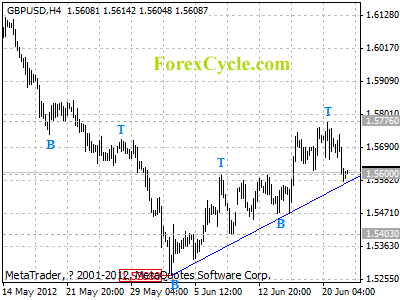
GBPUSD breaks below 1.5600 support, suggesting that a cycle top has been formed at 1.5776 on 4-hour chart. Now the pair is facing the support of the upward trend line on 4-hour chart, as long as the trend line support holds, the fall from 1.5776 could be treated as consolidation of the uptrend from 1.5268, and one more rise to 1.5900 is still possible. On the downside, a clear break below the trend line support will indicate that the uptrend from 1.5268 has completed at 1.5776 already then the following downward movement could bring price back to test 1.5268 previous low support.

gbpusd

Daily Forex forecast

Free Report: 6 Lessons to Help You Find Trading Opportunities in Any Market

Elliott Wave International (EWI) has just released a free report that will teach you how to use your charts to spot trading opportunities in the markets you trade. Created from EWI’s $79 courses, it’s free until July 2. Get your free report.

Have you ever looked at charts of the markets you followed and wondered: How can I look at a chart and find trading opportunities for myself?

How much more successful would you be if you could recognize the high-probability trade setups that are staring you in the face … IF you just knew what to look for and how to capitalize on it?

Now you can. Elliott Wave International (EWI) has just released a free trading resource to help you spot high-probability trade setups: 6 Lessons to Help You Find Trading Opportunities in Any Market.

EWI Senior Analyst Jeffrey Kennedy will teach you how to spot trading opportunities in the charts you’re using every day. Each lesson covers a different aspect of chart analysis that you can begin to apply immediately to the markets you follow.

Created from EWI’s $79 courses, it’s free until July 2. Don’t miss out on this rare opportunity to find opportunities in the markets you follow.

Download Your Free Report: 6 Lessons to Help You Find Trading Opportunities in Any Market.

About the Publisher, Elliott Wave International

Founded in 1979 by Robert R. Prechter Jr., Elliott Wave International (EWI) is the world’s largest market forecasting firm. Its staff of full-time analysts provides 24-hour-a-day market analysis to institutional and private investors around the world.


Central Bank News Link List – June 21, 2012

By Central Bank News
    Here’s today’s Central Bank News link list, click through if you missed the previous central bank news link list. The list is updated during the day with the latest news about central banks so readers don’t miss any important developments.

    If you want to submit links for inclusion in the daily link list, just email them through to us or post them in the comments section below.

Turkey keeps rates steady, monitors economy closely

By Central Bank News
    Turkey’s central bank kept its policy rate unchanged but is closely monitoring the economy during the current global uncertainties and will adjust funding to banks as needed.
    In a statement following a meeting of the bank’s Monetary Policy Committee, the Central Bank of the Republic of Turkey said leading indicators suggested that domestic demand had recovered in the second quarter and exports continued to grow despite the weakening global outlook.

    “The Committee stated that, given the prevailing uncertainties regarding the global economy, it would be appropriate to preserve the flexibility of the monetary policy. Therefore, the impact of the measures undertaken on credit, domestic demand, and inflation expectations will be monitored closely and the funding amount will be adjusted in either direction, as needed,” the bank said.


    The central bank’s policy rate, the one-week repo rate, was kept at 5.75 percent and overnight rates were left unchanged with the borrowing rate at 5 percent and the lending rate at 11.5 percent.
    The outlook for inflation was also favorable but the bank would continue to monitor prices closely as inflation was expected to remain above the bank’s target for some time.

    “Therefore, additional monetary tightening may be implemented along the guidance presented in the April and May committee meetings,” the bank said.
    The bank also said the policy committee had approved an additional increase in the flexibility regarding the allowance to hold Turkish lira reserve requirements in foreign currency and gold in order to support financial stability.

www.CentralBankNews.info

The Making of Kurdistan: Oil, Investment and a Turkish Gamble

As tensions rise among Iraqi Kurds in the country’s north, Sunnis in the south and the Shi’ite-led government in Baghdad over the distribution of natural resources, Turkey is setting its sights on an unconventional alliance with the Kurdistan Regional Government (KRG).

This is a gamble Ankara is willing to take, despite the potential implications it could have for Kurds on its own territory. Indeed, as recently as 2009, Ankara had a very different view on the KRG, going as far as to label its leader, Masoud Barzani, a “bandit” who was turning a blind eye (at best) to Kurdish militants using Northern Iraq as a base to launch cross-border attacks on Turkey. The Kurdistan Workers Party (PKK) has been fighting the Turkish government for more rights for decades.

So when Ankara began announcing a series of bilateral deals with the KRG (deals that went above Baghdad’s head), everyone’s first question was why would Turkey want to align itself with an Iraqi Kurdish leadership that is clearly making a play to create a sovereign Kurdish state?

According to intelligence analysts at Jellyfish, this is not such an unexpected or even illogical development from Turkey’s standpoint. “It is important to understand that Northern Iraq is a major market for Turkish exports and that oil and gas from coming Iraqi Kurdish territory is moved on to worldwide markets through Turkey,” Jellyfish President Michael Bagley told Oilprice.com.

“From a financial and logistical standpoint, an Ankara-Erbil marriage is one of exceptional convenience. From our standpoint, Northern Iraq stands to be one of the next great investment areas in the Middle East, and so far, the KRG has managed to out-play Baghdad in the natural resources and investment game.”

Last October, the KRG signed a highly controversial deal with ExxonMobil to explore for hydrocarbons in Northern Iraq. The deal was signed without Baghdad’s consent, and without even consulting Baghdad, which perceives the deal as illegal. In May, Baghdad attempted to auction off another set of exploration blocks, but none of the big international players bid, balking at (among other things) clauses forbidding anyone to deal exclusively with the KRG.

Also in May, as reported on Oilprice.com, the KRG and Turkey announced plans to build a pipeline connecting Ceyhan, Turkey, with northern Iraq and that this pipeline could carry one million barrels of oil per day and could be completed as early as August 2013. A second addition to the pipeline would connect it directly to the existing Kirkuk-Ceyhan pipeline by 2014. The KRG plans to export crude oil to Turkey, which will be refined in Turkey and re-exported to Northern Iraq.

A highly significant but oddly underreported development that will boost the KRG’s power play for autonomy in Northern Iraq was the expression of support, in early June, by the governor of Ninewa (Ninevah) province for the KRG’s deal with ExxonMobil.

Ninewa province Governor Atheel Nujaifi–from his seat in the provincial capital of Mosul–officially aligned himself with the KRG’s oil rights moves against Baghdad, tipping the balance of power in the KRG’s favour over the issue. The Ninewa seal of approval also bodes well for Exxon as it signifies that there will be less violent opposition from local leaders over its move to court the KRG.

Here again, Baghdad loses out. Ninewa today is one of the last bastions of al-Qaeda in Iraq, and its blessing of the KRG-ExxonMobil deal is significant in terms of security.

Iraq’s oil is Iraq’s oil, as far as Baghdad is concerned, and the KRG does not have the authority to sign any export deals on its own, even if it plans to divert revenues from sales to the Iraqi central authority.

The KRG, however, has a number of major power players behind it–from Ankara to Brussels and Washington, all of whom would very much like to see Iraqi oil and gas find an easy way to Western markets.

In the end, Turkey’s stance on Northern Iraq may seem like a paradox, but it is a logical move on many levels. With Syria in a state of violent upheaval, militant Kurds that threaten Turkey from across that border are no longer a focal point or indeed even a threat by comparison. And Ankara’s burgeoning relationship with the KRG has noticeably softened Kurdish militancy aimed at Turkey in the last couple of years.

Economics has played the greatest role in forging these new relations and Northern Iraq has become a new staging ground for Turkey companies and investment, with Turks owning an estimated 50% of all major businesses operating under the KRG-controlled territory.

Furthermore, the pipeline deal announced between Ankara and the KRG in late May was in part a reaction to pressure to reduce imports from Iran, but it also follows a logical path in the Turkey-Northern Iraq relationship.

Turkey knows that the pipeline deal and other energy deals forged with the KRG will set the stage for the creation of an independent Kurdish state. But in the meantime, Turkey has made such a heavy footprint in Northern Iraq that its level of influence there is and will continue to be immense. As such, Ankara will wield much control over any potential sovereign Kurdish state.

As for the KRG, it shows no signs of backing down in the face of threats from Baghdad, and is hedging its bets that the combination of its natural resource wealth and Western power brokers on its side will give it the advantage. On 11 June, the KRG told a gathering of potential investors at a business convention in the northern capital Erbil that it expected to quadruple oil production in the next three years, and that today’s 250,000 bpd would be up to 300,000 bpd by the end of this year. The KRG is already translating this into a boom for other sectors beyond energy.

Source: http://oilprice.com/Geopolitics/Middle-East/The-Making-of-Kurdistan-Oil-Investment-and-a-Turkish-Gamble.html

By. Jen Alic of Oilprice.com


The Bond Investing Opportunity of a Lifetime?

Article by Investment U

The Bond Investing Opportunity of a Lifetime?

In this market, you have to able to move a little outside your comfort zone to make any real money. It isn’t always pretty, but it’s usually profitable.

“The time to buy is when there’s blood in the streets.”

– Baron Rothschild

These days, home builders have bloodier streets than most.

The problem with this sage advice is that most investors – bond investors included – can’t follow it. It goes against everything we’re made of to buy into anything that’s still bleeding.

But, despite the overwhelming evidence against the average guy buying into a bargain, I will again make another attempt to push you towards where the big boys play.

So let’s take a look at home builders…

Talk about cheap. Especially the bonds!

Unless you believe there are now fewer people who will need a place to live than there were before the collapse, you have to agree housing is an essential commodity.

Not all builders are essential, but having a place to live is. In my thinking, that always gave builders an extra edge.

The other extra edges builders are enjoying now are ultra-low interest rates and four years of pent-up buying pressure. These things pushed their numbers back to bleeding-but-still-breathing.

Still, anything related to real estate investing leaves a bad taste in the mouths of most. That’s why there are still bargains out there.

Take Beazer Homes! Please!

Here’s a badly beaten-up company – Beazer Homes. Nothing went right for a long time, but that’s changing for Beazer and the whole industry.

New home starts and contracts signed are turning upward – not skyrocketing, but improving.

A number of home builders, Beazer included, are snapping up distressed homes, fixing them up and renting them. Almost a no-brainer if you have the cash.

Option activity is pointing to an improvement. This is almost exclusively institutional buying, which is usually a good signal.

We’re approaching almost five years of virtually no new building…

It has to pick up! The surplus of homes from the boom is shrinking in all but the worst hit areas.

What was bad news for home owners for five years is great news for those getting into the housing market. It’s the best buying opportunity of most of our lives. Low interest rates and prices are in the toilet.

This is a huge opportunity if you can get beyond the bad-taste stage of this industry.

A Really Cheap Bond

Beazer currently has a cheap bond that will give you a minimum expected annual return (MEAR) of about 12% for the next six years.

Stop for a second and think about how much 12% per year is. The market is in high gear with its yo-yo imitation. Treasuries are paying nothing and have a very high capital risk at these prices. And forget CDs and savings.

The income component alone on this play has a current yield of 10.56%. That’s about 20 times money market rates.

A whopping 10.56% in income and a MEAR of 12% alone should rinse any bad taste from the past few years, but the capital gains will push you over the top on this one.

This Beazer bond is selling for about 86, or $860. At maturity, it’ll return $1,000 to its holder. That’s a capital gain of $140 per bond if all you do is go to sleep and hold it to maturity.

But the real beauty is there’s a very good chance this bond will run up in price to the par area, $1,000, long before maturity. That means you could be in the enviable position of having to decide if you should hold it for the 10.56% income for the next few years, or sell it and take the quick capital gain.

Throw me in that briar patch!

It gets better! (Don’t you love this?)

There’s a call option on this bond at 104.563, or $1,045.63, on June 15, 2014. That means the company has the right to buy back this bond on that date for 1,045.63 per bond.

If Beazer does call the bond (it isn’t a guarantee, but they could), your annual return goes up to 19.7%.

Assume You’ll Hold Until Maturity

As with all bonds you should always assume you’ll hold to maturity. If things improve faster than we expect, you can take an early exit. But always assume you’ll hold it.

This makes for a more tranquil investing life and allows for all kinds of negative things to happen – short of reorganization – and you still get paid.

At maturity, here’s what your total return looks like.

You’ll receive 12 interest payments of $45.62 per bond for a total of $547.50. Plus, capital gains of $140, for a total of $687.50 from an initial investment of $864 per bond, for a total return of 79.57%.

A return of slightly over 79% from anything is enough for most investors to sit tight and wait to get paid. Most of us held stocks for at least as long and made a lot less.

The big hurdle is can you get by the bad taste of four, almost five years of a bad beating. Not to mention housing took as bad a beating as any I’ve ever seen.

But here’s the trick.

Warren Buffett said in a CNBC interview in the first week of December 2009, you remember when the abyss was right next door, “I love it when things are really bad.”

Now I’m not much a Buffett follower. What he does isn’t magic, in fact it’s usually just good old fashion solid investing. Plus, he also gets a lot of sweet deals you and I will never get in on, but on this point he’s right on the money.

In this market, bonds or stocks, you have to able to move a little outside your comfort zone to make any real money. You have to think like a skilled investor and see a beating to the other guy as an opportunity.

It isn’t always pretty, but it’s usually profitable.

The nice thing about housing is that it already bounced off the bottom. Institutions are moving in for the kill – always a good sign – and the numbers for builders have been improving for several quarters.

This is not the bloody mess it was two years ago.

As always it comes down to an investor’s level of experience and development. Have you reached the point where you see beyond the bad news and move where the big boys are already playing?

Move at your own pace, but move…

Good Investing

Steve McDonald

P.S.  I just noticed the barrage of comments below about the Beazer Homes Cusip so I wanted to clarify.

The bond I mentioned above isn’t necessarily a recommendation, but rather an illustration at how cheap bonds in the housing sector are right now.  For those interested anyways, the CUSIP number  for the Beazer bond is 07556qav7.

For my actual high-quality recommendations you’ll want to check out my new trading service.  We have to cut off enrollment by Monday June 25th though because of the limited inventory of the bonds I’m recommending.

For more information on it, click here.

Article by Investment U