The Interest Rate Banana Your Stocks Will Slip On

By MoneyMorning.com.au

The Australian Bureau of Statistics has done it! That’s an odd statement in itself, but how about this next one: the statisticians have saved us all! How? By completely bungling employment data for the last two years, to the tune of 100,000 jobs. Apparently, the mistake tricked the Reserve Bank into interest rate moves. And now those moves are benefitting, as politicians would say, the working-family-fair-dinkum-Aussie-battler.

Australian house prices jumped a percent last month because of lower mortgage rates. And, according to the papers, it was the inaccurately pessimistic jobs data that made the RBA cut interest rates. Either way, home owners are now 1% richer. Except they still have exactly the same houses. Hmmm.

At least the price jump should offset the recent news in The Age that the, ‘Housing shortage [is] all smoke and mirrors’, and the number of vacant homes is just under a million.

Before you get too optimistic about lower interest rates saving the Australian economy, consider this: The Australian yield curve looks like a banana. That’s a very bad thing.

Australian Government Bond Yield Curve

Australian Government Bond Yield Curve
Source: Bloomberg

Or, if you prefer:

Australian Government Bond Yield Curve
Source: Alex Cowie

Yield curves are supposed to look more like this one, the German one:

German Government Bond Yield Curve

German Government Bond Yield Curve

>

Source: Bloomberg

So what’s bad about a yield curve shaped like a banana? The short answer is that a banana shaped yield curve predicts a recession, or at least a slowdown in growth. If you own shares, you’ll want to factor that into your expectations.

Remember, in 2008 a recession took place on the other side of the world, and Australian stocks halved. Imagine if the recession took place here.

How Interest Rates Signals Time Preferences

To get to the bottom of what the yield curve really means, we’ll begin with former math teacher Angela Lee Duckworth. Angela did an experiment with eighth graders. They ‘were given a choice between a dollar right away or two dollars the following week.’

That’s like offering them an annualised interest rate of around 5200%, or 100% in a week. You’d be a fool not to take it, right?

The New Yorker magazine explains that Angela ‘found that the ability to delay gratification…was a far better predictor of academic performance than IQ.’

Notice how the 5200% per annum interest is the key measure in deciding whether or not to delay gratification. If Angela had raised the bar to choosing between a dollar right away or two dollars fifty next week, more of the eighth graders would have agreed to delay their gratification because they would be getting a higher interest rate (7,800% p.a. or 150% per week). That would sweeten the deal for waiting.

In other words, the interest rate is the price of delaying gratification, or the reward for delaying your gratification. In the financial world, the reward comes about by saving and then lending a dollar for interest.

The interest rate is also what you miss out on for refusing to delay your gratification (by consuming instead of saving and lending). And it’s also the price you pay for using the gratification someone else has delayed (by borrowing their savings).

Putting all those statements together, you realise this: The interest rate is the price of time.

Understanding how the interest rate signals to the economy the state of delayed, present and future consumption is the secret to understanding and predicting the world’s current economic malaise.

So what determines the interest rate? The same factors that determine every other price in the economy: supply and demand. When people save, they increase the supply of money that can be lent. The people who want that money are the borrowers. The interest rate is the price that matches the savers and borrowers. The good they are REALLY dealing in is time — the point in time at which the money gets used.

So what do high and low market interest rates mean? Low interest rates mean there are plenty of people willing to save. They value present consumption only a little more than future consumption, and so are willing to delay it for a cheap interest rate. A high rate means people aren’t willing to delay their gratification unless there’s a large reward — a high rate of interest.

Australia’s Yield Curve

Taking a look at Australia’s yield curve, what do you see?

Probably not much, unless you know what a yield curve is, so here’s an explanation. A yield curve shows the interest rate paid on debt of different maturities. If you can borrow money from the bank for one year at 5%, two years at 6% and three years at 7%, your yield curve would be a straight upward sloping line connecting those three dots on a chart.

Australia's Yield Curve

Because government bonds are risk free (theoretically), the government yield curve is the purest one available for an economy.

Look at Australia’s government bond yield curve. Market interest rates are high for the government to borrow for 3 months, lower for three years and steadily higher after that.

Australian Government Bond Yield Curve

Australian Government Bond Yield Curve
Source: Bloomberg

You could say that, over the next three months, people aren’t that willing to delay their consumption. They want a high reward for saving and lending to the government. But go out three years, and people are quite willing to hand over their cash for a much lower interest rate. They are quite happy to be a saver and lender — a consumption delayer. Go out fifteen years and people want to consume again. They need a high interest rate to part with their money.

Now why would someone be willing to delay their consumption more or less for different time periods? Why might they prefer to save over some periods and borrow over others? Perhaps because they are worried about the state of the economy at certain times in the future. They are happy to spend when times are good and afraid to borrow when they are bad.

With Lower Interest Rates Prepare for a Slowdown

So lower rates show people are worried about the economy — they choose to save more and borrow less. Right now, people are worried about the next two to five years, for example. After that, they expect things to go well and their consumption and borrowing to rise.

We’ve isolated just one factor involved in a yield curve. There are many others. Not all borrowing is for gratification, for example. Some of it is for investing in production. And interest rates reflect other things, like inflation, in the real world. People might just expect inflation to fall for the next few years, which would also reduce rates.

If you focus on the delayed gratification side of things, the banana shaped curve tells you that a significant slowdown in borrowing and consumption is coming to Australia. Is your portfolio prepared for it?

Murray Dawes has spotted another banana skin your stocks are heading for. He’s calling it Big Wednesday, and he’s found a way to profit from it:

‘My technical analysis shows the market is about
to explode out of the long sideways distribution
it’s been tracing for two years.’

But which way? Up or down? Click here to find out.

Nick Hubble
Editor, Money Morning

Related Articles

Market Pullback Exposes Five Stocks to Buy

How Gold Prices Look Set to Climb As Banks Crumble

‘Big Wednesday’ For the Aussie Dollar

The Interest Rate Banana Your Stocks Will Slip On

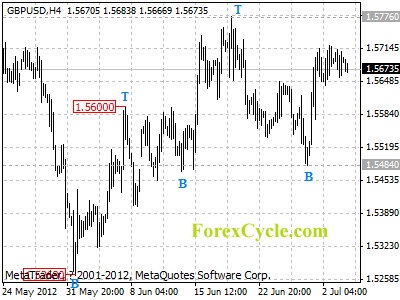
GBPUSD moves sideways in a narrow range

Being contained by 1.5776 resistance, GBPUSD moves sideways in a narrow range between 1.5640 and 1.5720. The price action in a range is likely consolidation of the short term uptrend from 1.5484, another rise to test 1.5776 resistance is still possible after consolidation, and a break above this level will indicate that the longer term uptrend from 1.5268 has resumed, then next target would be at 1.6000 area. Support is at 1.5590, only break below this level could bring price back to 1.5400 zone.

gbpusd

Daily Forex Forecast

Is the U.S Housing Market Seeing a Long Awaited Recovery?

Source: ForexYard

printprofile

With the upcoming Nov.2 -3 FOMC meeting and the speculation of expansion of quantitative easing by the Federal Reserve the main focus of the markets, this week’s economic data is expected to have great effect on investors’ expectations.

The main indicators to watch are the Housing and Consumer Confidence publications. The housing market, which was at the heart of the financial crisis, remains a drag on the economic recovery of the U.S as well the poor consumer confidence, mostly driven by the relentlessly high unemployment rate.

However, some stability may be finally evident in the embattled industry. According to Monday’s report, the sales of U.S. existing homes rose in September by the most on record with purchases increasing 10% to a 4.53 million annual rate from 4.12 million in August. Further indication of a rebound in the housing industry may come from tomorrow’s report of New Home Sales which is also expected to show an increase from the previous month. While the industry’s recovery will likely be dragged as the unemployment rate is forecasted to remain above 9% throughout 2011, it seems that the industry has already hit bottom.

Consumer confidence may also see some recovery this week as the CB Consumer Confidence which was released earlier today, rose more than expected. A similar rise in confidence is expected from the revised UoM Consumer Sentiment report, due Friday at 13:55 GMT. The increase in confidence may coincide with next week’s mid-term elections which are expected to see Democrats losing their majority in Congress.

The USD has been seeing a shaky recovery this week, aided by the positive data releases. A continuation of better than expected data releases throughout the week will likely boost the USD further, mainly by adding greater uncertainty to the quantitative easing expansion speculations. With the FOMC meeting minutes release on Nov. 2nd and the mid-term elections on Nov. 3rd, next week is expected to be very volatile for the USD and its crosses.

Forex Market Analysis provided by ForexYard.

© 2006 by FxYard Ltd

Disclaimer: Trading Foreign Exchange carries a high level of risk and may not be suitable for all investors. There is a possibility that you could sustain a loss of all of your investment and therefore you should not invest money that you cannot afford to lose. You should be aware of all the risks associated with Foreign Exchange trading.

US Home Sales On Tap

Source: ForexYard

printprofile

Today starts with Federal Open Market Committee statement, followed by GfK German Consumer Climate in Europe. The market disregards the European troubles. In the past week, the focus was on the Spanish credit crunch. Nevertheless, the Euro continued recovering, and so did other currencies, that truly enjoy good economies, such the Canadian Dollar.

American figures will dominate the scene today with New Home Sales expected to drop this month reaching 424K after the sharp rise in May’s report. The U.S. Dollar continued its consolidation last week falling against all the major world currencies and down especially against the commodities dollars of Australia, New Zealand and Canada.

Here’s an outlook for the major market moving events this Wednesday.

08:00 GMT EUR Flash Services PMI

Published on Wednesday, starting in France at 7:00 GMT, then in Germany at 7:30 and finally for the whole Euro-zone at 8:00 GMT. All the purchasing managers’ indices have been positive for several months, with the French services sector being the strongest at 61.4. And now, all of them are expected to remain positive, above 50 which mean economic expansion.

Although the Euro fell strongly in the past few weeks it is now stabilizing. Still, the European debt problems continue to loom over the single currency. But in the long term the Euro will resume falling and face more losses. In the meantime, range trading is more probable with the near-term support at $1.2220.

08:30 GMT GBP MPC Meeting Minutes

It’s a detailed record of the BOE MPC’s most recent meeting, providing in-depth insights into the economic conditions in U.K. In his last decision, Mervyn King made no change – he left the interest rate at the historic low of 0.5% and continued dismissing the rising inflation. We’ll now get to hear if any of the 9 member voted to raise the rate. Any outcome which isn’t unanimous will boost the Pound.

14:00 GMT USD New Home Sales

This indicator is expected to be different this time, and drop from 504K to 435K. Note that the impact will be rather muted due to the upcoming to rate decision. Nervous trading is predicted, as the greenback may continue weakening against the yen, pound and franc.

18:15 GMT USD Federal Funds Rate

The Federal Open Market Committee is expected to hold the benchmark interest rate at a record low range of zero to 0.25%. Employment is still problematic in the US, and inflation doesn’t pose a threat. Yet again, the focus won’t be on the Federal Funds Rate, but on the accompanying FOMC Statement. The greenback will likely to move higher after this release. A break down of 1.2220, the next major support line will open a way to 1.2160 & 1.20 in extension.

Forex Market Analysis provided by ForexYard.

© 2006 by FxYard Ltd

Disclaimer: Trading Foreign Exchange carries a high level of risk and may not be suitable for all investors. There is a possibility that you could sustain a loss of all of your investment and therefore you should not invest money that you cannot afford to lose. You should be aware of all the risks associated with Foreign Exchange trading.

Pound Set to Take Losses Ahead of British Housing Report

Source: ForexYard

printprofile

For GBP traders, the release of the Halifax HPI this week promises to inject some volatility into the marketplace. The HPI, a monthly index of home prices financed by the Halifax Bank of Scotland, is a leading indicator of the health of the British housing industry. With England still feeling the effects of the global recession, the changing value in home prices is a sure way for traders to determine where the economy is headed in the month ahead.

Last month, home prices in England rose by 1.4%. That was the 5th month in a row where prices increased by more then 1%, giving investors the impression that the British economy is headed in the right direction. The positive housing news was not able to save Sterling from loosing ground in the forex marketplace, especially against the Dollar.

This month, analysts are predicting a relatively modest figure of 0.6% for the HPI. If the forecasts indeed come true, this would mean housing prices increased marginally in the past month, a troubling sign for the Pound. Any figure below 1% will likely cause GBP to enter a bearish trend. At the same time, if the housing figure turns out to be in line with last month’s results, Sterling may be able to recoup some of its recent losses against the Dollar and Euro.

Don’t forget that you now have the option to trade mini lots of Gold and Crude Oil with a
Standard trading account at ForexYard.
Read more about ForexYard’s latest features
.

Forex Market Analysis provided by ForexYard.

© 2006 by FxYard Ltd

Disclaimer: Trading Foreign Exchange carries a high level of risk and may not be suitable for all investors. There is a possibility that you could sustain a loss of all of your investment and therefore you should not invest money that you cannot afford to lose. You should be aware of all the risks associated with Foreign Exchange trading.

U.S. Housing Market Update

Source: ForexYard

printprofile

Reports on manufacturing and housing this week will probably show evidence that the recession- stricken U.S. economy is bottoming out. The U.S housing recession that triggered the credit crisis and global slump is showing signs of bottoming as sales and construction have stabilized near historically low levels.

A Commerce Department report tomorrow may show housing starts last month rose 5.9% to a 485,000 annual pace, while Building Permits report, used as a predictor of future construction, may show builders began work on more houses as sales steadied and consumer prices rose. The data will be released Tuesday at 12:30 GMT.

In case the Housing Starts and Building Permits data will decrease below the expectations, the U.S dollar may weaken against its major rivals; the EUR and the British Pound. However, if the numbers will come in line with the expectations or higher, traders will see the USD trading become highly volatile.

Forex Market Analysis provided by ForexYard.

© 2006 by FxYard Ltd

Disclaimer: Trading Foreign Exchange carries a high level of risk and may not be suitable for all investors. There is a possibility that you could sustain a loss of all of your investment and therefore you should not invest money that you cannot afford to lose. You should be aware of all the risks associated with Foreign Exchange trading.

Major Events that will Affect the EUR/USD Pair This Week

By TraderVox.com

Tradervox.com (Dublin)  – The euro closed the week on high as EU summit decided to give fund to rescue banks in Spain. However, there has been opposition to this decision from member countries which is raising doubts about the outlook for the region. The Italian and Final Manufacturing PMI for the region lead to a decline of the euro while the unemployment report has been overshadowed by the sentiments from the region that some countries are against the EU leaders’ decision. All these reports were released on Monday, and they have already caused the euro to decline against the sterling pound. However, the US economy has been faltering with ISM Index showing a contraction in the manufacturing industry. Today, the market is waiting for the PPI data. Other events that will affect this cross are as follows.

On Wednesday, the Final Services PMI for the region will be released at 0800 hrs GMT. The services sector has been contracting for the last five months and this time round a small rise to 46.8 is expected. If the data indicate a decline, this will cause the euro to drop further. Another report to be released on this day is the Retail Sales data. It is expected that data will show a small increase of 0.2 percent; however, with disappointing data from Germany, the final number might be lower. The final report to look out for on this day is the Final GDP data which will be released at 0900 hrs GMT. The market is expecting the report to show stagnation as German data showed an expansion of 0.5 percent.

On Thursday, one of the main events will be Spanish bond auction; this will come just hour before ECB rate decision at 1145hrs. Most banks in Spain were downgraded and some analysts are saying that they will on the safe side for now. German Factory Orders report will be published at 1000hrs where the report indicated a drop of 1.9 percent in April; the report is expected to show an increase by 0.2 percent for May. On Friday the main event will be the German Industrial production where a fall of 2.2 percent was registered last time; but an increase of 0.3 percent is expected this time round.

With these reports affecting the euro/dollar pair; it is expected that the pair will be neutral this week.

Disclaimer
Tradervox.com is not giving advice nor is qualified or licensed to provide financial advice. You must seek guidance from your personal advisors before acting on this information. While we try to ensure that all of the information provided on this website is kept up-to-date and accurate we accept no responsibility for any use made of the information provided. Opinions expressed at Tradervox.com are those of the individual authors and do not necessarily represent the opinion of Tradervox.com or its management. 

Article provided by TraderVox.com
Tradervox.com is a Forex News Portal that provides real-time news and analysis relating to the Currency Markets.
News and analysis are produced throughout the day by our in-house staff.
Follow us on twitter: www.twitter.com/tradervox

Using Standard Deviation & Probability to Trade Options

By JW Jones, OptionsTradingSignals.com


I recently discussed the ability to use implied volatility to calculate the probability of a successful outcome for any given option trade. To review briefly, the essential concepts a trader must understand in order to make use of this helpful metric include:

  1. The prices of any given underlying can be considered to be distributed in a Gaussian distribution- the classic bell shaped curve.
  2. The width of the spread of these prices is reflected in the standard deviation of the individual underlying’s distribution curve.
  3. Plus / minus one standard deviation from the mean will include 68% of the individual price points, two standard deviations will include 95%, and three standard deviations will include 99.7%
  4. A specific numerical value for the annual standard deviation can be calculated using the implied volatility of the options  using the formula: underlying price X implied volatility
  5. This standard deviation can be adjusted for the specific time period under consideration by multiplying the value derived above by the square root of the number of days divided by 365


These derived values are immensely important for the options trader because they give definitive metrics against which the probability of a successful trade can be gauged. An essential point of understanding is that the derived standard deviation gives no information whatsoeveron the direction of a potential move.  It merely determines the probability of the occurrence of a move of a specific magnitude.


It is important to note that no trade can be established with 100% probability of success; even boundaries of profitability allowing for a three standard deviation move have a small but finite probability of moving outside the predicted range. A corollary of this observation is that the trader must NEVER “bet the farm” on any single trade regardless of the calculated probability of success. Black swans do exist and have a nasty habit of appearing at the most inopportune times.


Let us consider a specific example of a “bread and butter” high probability option trade in order to see how these relationships can be applied in a practical manner.


The example I want to use is that of an Iron Condor position on AAPL. For those not familiar with this strategy, it is constructed by selling both a call and put credit spread. The short strikes of the individual credit spreads are typically selected far out of the money to reduce the chance they will be in-the-money as expiration approaches.


I want to build an iron condor on AAPL in order to illustrate the thought process.  As I type, AAPL is trading at $575.60.  August expiration is 52 days from today; this is within the optimal 30-55 day window to establish this position. Consider the high probability call credit spread illustrated below:

Best Option Trading Strategies

This trade has an 88% probability of profit at expiration with a yield of around 16% on cash encumbered in a regulation T margin account.


Now let us consider the other leg of our trade structure, the put credit spread.  Illustrated below is the other leg of our iron condor, the put spread:

Best Option Trading Strategy

This trade has a 90% probability of profit at expiration with a yield of around 16% on cash encumbered in a regulation T margin account. As the astute reader can readily see, this put credit spread is essentially the mirror image of the call credit spread.


When considered together, we have given birth to an Iron Condor Spread:

Best Option Trading Iron Condor Spread Strategy

The resulting trade consists of four individual option positions. It has a probability of success of 79% and a return on capital of 38% based on regulation T margin requirements. It has an absolute defined maximum risk.


Note that the probability of success, 79%, is the multiplication product of the individual probabilities of success for each of the individual legs.


This trade is readily adjustable to be reflective of an individual trader’s viewpoint on future price direction; it can be skewed to give more room on either the downside or the upside.


Another characteristic and reproducible feature of this trade structure is the inverse relation of probability of success and maximum percentage return. As in virtually all trades, more risk equals more profit.


I think this discussion illustrates clearly the immense value of understanding and using defined probabilities of price move magnitude for option traders. Understanding these principles allows experienced option traders to structure option trades with a maximum level of defined risk with a relatively high probability of success.


Happy Option Trading!


Looking for a Simple ONE Trade Per Week Trading Strategy?
If So Join www.OptionsTradingSignals.com today with our 14 Day Trial

Jw Jones

This material should not be considered investment advice. J.W. Jones is not a registered investment advisor. Under no circumstances should any content from this article or the OptionsTradingSignals.com website be used or interpreted as a recommendation to buy or sell any type of security or commodity contract. This material is not a solicitation for a trading approach to financial markets. Any investment decisions must in all cases be made by the reader or by his or her registered investment advisor. This information is for educational purposes only.


Dollar Tumbles as Easing Speculation Emerges

By TraderVox.com

Tradervox.com (Dublin) –The greenback dropped against most of its major counterparts as speculation Federal Reserve will embark on a third round of quantitative easing rose in the market. Investors are wary of the disappointing data coming from the world’s largest economy hence they are seeking other safer currencies such as the pound and the Swiss Franc. The buck has dropped against the euro prior to a report projected to show factory orders stagnated in June. This report will confirm speculations that US economy is faltering just hours after the Institute for Supply Management’s Index showed that manufacturing in the US contracted in June.

Further, the US currency fell as safe haven demand was hampered by surge of demand of the Asian stocks which rose for the fifth day. The yen was also affected by the advance by the Asian stocks. This led to an increase in demand for commodity related currencies such as the Australian dollar which rose to within two-months high. Mike Jones of Bank of New Zealand Ltd in Wellington said that the US economy has been slowing down and further negative reports would only add to speculations of further easing which is negative for the greenback.

The greenback dropped by 0.1 percent against the euro to trade at $1.2582 at the start of trading in the Asian Session today. It had advanced by 0.7 percent yesterday. The dollar increased slightly against ht yen, trading at 79.59 from earlier level of 79.51. The euro increased against the yen from previous reading of 100.00 to 100.14; Japanese yen had advanced by one percent against the euro yesterday.

As the MSCI Asia Pacific Index of stocks rose by 0.6 percent, the Australian dollar increased by 0.2 percent against the dollar to trade at $1.0268; it had earlier touched its highest since May 4 of $1.0278.

Disclaimer
Tradervox.com is not giving advice nor is qualified or licensed to provide financial advice. You must seek guidance from your personal advisors before acting on this information. While we try to ensure that all of the information provided on this website is kept up-to-date and accurate we accept no responsibility for any use made of the information provided. Opinions expressed at Tradervox.com are those of the individual authors and do not necessarily represent the opinion of Tradervox.com or its management. 

Article provided by TraderVox.com
Tradervox.com is a Forex News Portal that provides real-time news and analysis relating to the Currency Markets.
News and analysis are produced throughout the day by our in-house staff.
Follow us on twitter: www.twitter.com/tradervox

Real-Forex Daily review- 03.07.2012

Daily Market Analysis by Real-Forex


Tracking the EUR/USD pair


Date: 02.07.2012   Time: 17:53  Rate: 1.2589

Daily chart

The price has stopped at the 1.2436 price level and created a large green candle in the weekend. Breaching the 1.2750 price level will indicate that an uptrend is building up while this level is the neckline of the “Double bottom” pattern which has a target around the 1.3090 price level. On the other hand, if the price will not break the 1.2750 price level and will move downwards under the 1.2436 price level will indicate that the price will descend at first stage to the last low on the 1.2290 price level.


You can see the chart below:


4 Hour chart

Date: 02.07.2012   Time: 18:07 Rate: 1.2586


Last Review

It is possible to see that the price stayed under the Bollinger’s moving average which is used as a dynamic resistance, as long as the price is under this MA it is located in the bearish area of the Bollinger bands. Breaking of the 1.2440 price level will probably lead the price towards the “Wolfe waves” pattern target on the crossing of the price with the line connecting between points 1 and 4 (around the last low at the 1.2290 price level). on the other hand, stoppage at the current area will sign that it is possible to see a correction in size of a third of the last downtrend (blue broken line), meaning the 1.2560 price level.


Current review for today

The price has stopped at the 1.2440 support level, jumped to the 1.2690 price level and stopped at this level while correcting the last move upwards by exactly 38.2%. Stoppage of the price at the current area and its breaking of the 1.2690 price level will probably continue the uptrend while its first target is the last peak on the 1.2750 price level. On the other hand, breaking of the 1.2580 price level will probably continue the correction with targets at the 1.2550 and the 1.2516 price levels.


You can see the chart below:


GBP/USD

Date: 02.07.2012   Time: 18:19  Rate: 1.5690

4 Hour chart


Last Review

It is possible to see that after the price has stopped at the 1.5540 price level for the first time, it made an ascending move towards the trend line connecting the lows (the line connecting between points 2 and 4) and stopped at this area. It is possible to assume that the short move upwards was actually a correction to the last downtrend (red broken line) and as it is written on yesterday’s review, breaking of the 1.5540 price level will probably continue the downtrend towards the “Wolfe waves” pattern target around the 1.5400 price level.


Current review for today

The price went back to the 1.5540 support level and went back to check the trend line which connects the lows (points 2 and 4). Breaching of the 1.5716 price level will indicate that it is possible that the price will check again the last peak on the 1.5777 price level. on the other hand, breaking of the 1.5660 price level will indicate that the price is headed towards the closest support on the 1.5613 price level.


You can see the chart below:


AUD/USD

Date: 03.07.2012   Time: 22:17  Rate: 1.0248

4 Hour chart


Last Review

The price is currently struggling at the 1.0075 price level in its attempt to breach it. Proven breaching of this level will indicate that it is possible that the price will continue towards the last peak at the 1.0224 price level. On the other hand, stoppage of the price at this area and breaking the 0.9980 price level will lead the price towards its first target on the 0.9940 price level, this is the “One in, one out” pattern target (red broken lines). Breaking of this level will probably lead the price towards the 0.9900 price level, this is a 50% Fibonacci correction level of the uptrend described with blue broken line.


Current review for today

The price did break the 1.0075 price level and reached the target of the last review on the 1.224 price level and even passed it. At this point the price is checking whether the resistance level can be used as a support, while breaching of the 1.0278 price level will continue the current uptrend. On the other hand, breaking of the 1.0224 price level will indicate that it is possible that we will see a correcting move towards the 1.0171 price level at first stage, this is a 38.2% Fibonacci correction level of the move upwards )blue broken line).


You can see the chart below:


Daily Market Analysis by Real-Forex