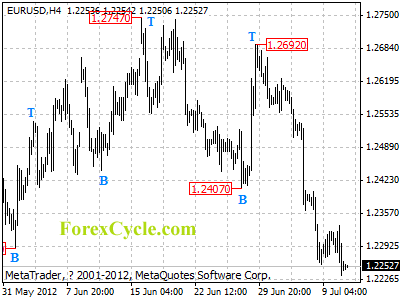
EURUSD continues its downward movement from 1.2692

EURUSD continues its downward movement from 1.2692, and the fall extends to as low as 1.2235. Resistance is now at 1.2335, as long as this level holds, downtrend could be expected continue, and further decline towards 1.2000 is still possible. On the upside, a break above 1.2335 will indicate that lengthier consolidation of the downtrend is underway, then range trading between 1.2200 and 1.2400 could be seen.

eurusd

Forex Signals

Charles Sizemore Discusses His Favorite Beer Stocks on Bloomberg TV by Charles Lewis Sizemore, CFA

By The Sizemore Letter

Crack open a cold one, and watch Charles Sizemore give his thoughts on international beer stocks on Bloomberg TV.


If you cannot view the video, please follow this link to Bloomberg’s site: Playing the World of Beer Stocks

Stocks mentioned: Boston Beer ($SAM), Anheuser-Busch InBev ($BUD), Heineken ($HINKY), Molson-Coors ($TAP)

If you liked this article, consider getting Sizemore Insights via E-mail. 

Related posts:

Whiskey and Beer Better Long-Term Bets than Wine by Charles Lewis Sizemore, CFA

By The Sizemore Letter

It’s not often that a stock with a $5 billion market cap soars by over 20% in a single trading day, but such is the case for Constellation Brands ($STZ), the largest publically-traded wine merchant, and now the sole distributor in the United States of Corona and Grupo Modelo’s other Mexican beer brands.

Constellation was the unexpected winner in the Anheuser-Busch InBev ($BUD) – Grupo Modelo merger, as Constellation was able to buy out Bud’s 50% share of the companies’ Crown Imports joint venture for $1.8 billion.  Under the new deal, Constellation will have complete control of the distribution, marketing and pricing for all of Modelo’s brands in the United States, while AB InBev will act as supplier.

The deal is a major coup for Constellation—kudos to management for pulling it off—but the company remains one of my least favorite stocks in the alcohol and vice sphere for a one critical reason:

Wine is much harder to brand than beer or spirits.  Think about it; when you go to a bar, you can instantly recognize your favorite beer or whiskey on tap or behind the bar.  Outside of, say, Coca-Cola ($KO), beer and spirits are probably the most recognizable and valuable brand names in existence.  Not surprisingly, premium beer and spirits businesses tend to enjoy high margins and high returns on equity relative to their peers.

Stock

Ticker

Operating Marging

Return on Assets

Return on Equity

AB Inbev

BUD

30.19%

7.02%

16.12%

Diageo

DEO

26.12%

10.28%

41.07%

Constellation

STZ

18.33%

6.23%

17.02%


Wine is a different story.  The attractiveness of a given vineyard varies from year to year, and few have national or international brand awareness.  Wine connoisseurs know their favorite vintages, but there is little brand loyalty at the mass-market level.  For a company of Constellation’s size, wine is a much harder business to operate.

This is not to say that I dislike Constellation or would never consider owning it.  “Sin Stocks” are some of my favorite long-term holdings due to their defensive nature and due to their tendency to pay high dividends (Constellation currently pays no dividend), and an argument can be made for making room for Constellation in a diversified vice portfolio.  But I would definitely give a higher weighting to premium spirits groups such as Diageo ($DEO), Jim Beam ($BEAM) and Brown-Forman ($BF-B).

One last thing to note: the Crown Imports deal allows Constellation to get a significant chunk of its revenues and profits from the premium beer segment rather than wine.  This is good news.  But it’s also a source of concern due to a certain provision in the deal.  AB InBev has a “call option” of sorts to buy the Modelo brands back in 10 years at 13 times earnings before interest and taxes.  This price does not at all appear unreasonable, but if exercised Constellation will find itself as purely a wine merchant again.

Disclosures: DEO and BEAM are held in Sizemore Capital accounts.

If you liked this article, consider getting Sizemore Insights via E-mail. 

Related posts:

Central Bank News Link List – July 11, 2012

By Central Bank News

    Here’s today’s Central Bank News link list, click through if you missed the previous link list. The list is updated during the day with the latest news about central banks so readers don’t miss any important developments.

Visa and MasterCard: Underlying Macro Trends Still in Place by Charles Lewis Sizemore, CFA

By The Sizemore Letter

“Gimme what I need, uh, MasterCard or Vi-suh.”

From Wyclef Jean’s “Perfect Gentleman”

The U.S. consumer is in a bit of a pickle.  Jobs are not particularly easy to come by—the June jobs report showed unemployment sticking at 8.2% and only 80,000 new jobs created for the month—and the economy remains sluggish. 

True, the average American family carries less debt than they did a few year years ago, but their net worth hasn’t exactly grown much either. 

In short, the prognosis for the consumer is bleak. 

Retail stocks have held up relatively well, all things considered, though higher-end luxury retail has taken a beating.  Long-time Sizemore Investment Letter recommendation Coach ($COH) is down nearly 30% from its 2012 highs, and competitor Michael Kors ($KORS) is down by over 16%.  Investors fret that a slowing economy—and in particular slowing Chinese and emerging market economies—will lead to a disappointing string of quarters for purveyors of expensive discretionary purchases.

Yet amidst the bearishness towards bling, Visa ($V) and MasterCard ($MA) have been notable bright spots.  Visa is just 1-2 good trading days away from a new all-time high, and MasterCard is not far behind. 

There are a lot of high expectations built into the stock prices of both credit card companies.  Visa sells for 19 times trailing earnings and MasterCard for a lofty 27 times trailing earnings.  Forward estimates put the ratios at a more reasonable 17 and 16 times earnings, respectively, though both are well above the average for the S&P 500.

The optimism is not unwarranted.  Both companies are debt free. Visa enjoys mouth-watering operating and profit margins of 60% and 42%, respectively, and MasterCard’s profitability is only a hair’s breadth lower.   Both also enjoy returns on equity that would be the envy of any company outside of the technology sector.  In short, both companies deserve to trade at a premium to the broader market.

Still, with so much optimism baked into the stock price, a slight earnings miss by either could send shares tumbling in the short-term.  This is always the risk you run when buying a “hot” stock, and I would be wary of it as we enter earnings season.

Any sustained weakness should be viewed as a fantastic buying opportunity.  When I made Visa my pick in InvestorPlace’s 2011 “10 for 2011”stockpicking contest, I noted two durable macro trends that are still very much in place:

  1. The   transition to a global cashless society
  2. The rise of the emerging market consumer

The first point should be obvious.  Even in the United States, where credit and debit cards are ubiquitous, roughly 40% of all transactions are conducted with cash or paper checks.  Not all transactions will ever be captured with credit and debit cards, of course, but with internet commerce growing relative to “bricks and mortar,” you can bet that the percentage will grow. 

Consumers without access to traditional credit or banking services are embracing prepaid cards, branded with the Visa and MasterCard logos, and both companies are experimenting with ways to let consumers pay at retail cash registers using their mobile phones. 

This is a long way of saying that even if overall consumer spending growth is tepid, growth in electronic payments has plenty of room to grow.

The second point is the one I find the most promising, however.  Credit and debit card usage is soaring in virtually all major emerging markets as incomes rise and consumers join the ranks of the global middle class.  Both Visa and MasterCard stand to benefit from this trend, though Visa has the better presence globally.  Visa expects to get more than half of its revenues from overseas by 2015, and the overwhelming amount of this will come from emerging markets. 

Visa is what I call a classic “emerging markets lite” investment.  You get all the benefits of emerging markets growth but without the volatility and headache of investing in emerging markets directly.

Both Visa and MasterCard are due to report earnings within the next month.  I will be curious to see how the management of each addresses the effects of the economic slowdown in China and the rest of the developing world.

I suspect that, once the numbers are sorted, it will be clear that Chinese imports of iron ore and copper are in a protracted decline, but Chinese credit and debit card swiping are healthier than ever. 

In the meantime, I reiterate my recommendation to buy shares of both companies on any protracted weakness.

Disclosures: Sizemore Capital holds shares of Visa and Coach.

If you liked this article, consider getting Sizemore Insights via E-mail. 

Related posts:

Will US Inventories Data Help Crude Oil Reverse Last Week’s Losses?

Source: ForexYard

printprofile

At FOREXYARD, we believe in keeping our clients prepared for potentially significant news events. As such, traders will want to carefully monitor the US Crude Oil Inventories figure, set to be released on July 11th, at 14:30 GMT. Demand in the United States, the world’s leading oil consuming country, tends to have a direct impact on the price of crude. As can be seen in the chart below, the price of oil spiked by almost $1.50 a barrel on June 13th after the US inventories data showed crude stockpiles falling by 0.2 million barrels the week before.

CL

Don’t miss out on another opportunity to capitalize on market volatility!

Should Wednesday’s news show crude oil stockpiles fell again last week, investors may take the news as a sign that demand in the United States is increasing, which may help oil reverse some of its recent losses. This is an excellent opportunity for forex traders to take advantage of potentially significant news, so don’t miss out!

Forex Market Analysis provided by ForexYard.

© 2006 by FxYard Ltd

Disclaimer: Trading Foreign Exchange carries a high level of risk and may not be suitable for all investors. There is a possibility that you could sustain a loss of all of your investment and therefore you should not invest money that you cannot afford to lose. You should be aware of all the risks associated with Foreign Exchange trading.

Loose Policy “Will Mean Strong Demand” for Gold, “No Emergency” in Spain Despite “Contingency Mobilization” of Bailout Funds

London Gold Market Report
from Ben Traynor
BullionVault
Tuesday 10 July 2012, 07:30 EDT

WHOLESALE prices for gold bullion climbed to $1597 an ounce during Tuesday morning’s trading in London – their highest level so far this week – while stock markets also ticked higher following news that Spain should receive some financial assistance for its banks later this month.

Silver bullion also gained, climbing as high as $27.61 per ounce, while other commodities were broadly flat.

US, UK and German government bond prices fell, while on the currency markets the Dollar gave back early gains against the Euro, with the latter rallying back above $1.23.

“Loose monetary policies, with a scope for more aggressive balance sheet use in the US and Europe, will keep real [interest] rates in most reserve currencies low (or negative) during 2012,” says a note from Merrill Lynch analysts today.

“We continue to believe that this will allow investor demand to remain strong and prices to reach our $2,000 an ounce target by the end of the year.”

Spain’s government has been given an extra year to meet its 3% deficit-to-GDP target. Eurozone finance ministers meeting in Brussels Monday agreed that Spain should have until 2014 to meet the target.

“The move hardly offers Spain a reprieve,” says James Nixon, chief European economist at Societe Generale.

“The same painful and sizeable adjustment will now be spread over three years instead of two.”

The Eurogroup of single currency finance ministers also reached a “political understanding” on using Eurozone bailout funds to directly recapitalize Spanish banks once a single European banking supervisor has been set up next year, an official statement said.

Last month, the Eurogroup agreed a credit line of up to €100 billion for Spain’s government to finance the restructuring of the country’s banking sector. Finance ministers agreed yesterday that €30 billion can be used this month.

The €30 billion is “to be mobilized as a contingency in case of urgent needs in the Spanish banking sector,” said Eurogroup president and Luxembourg prime minister Jean-Claude Juncker yesterday.

“There’s no emergency here,” added Luxembourg finance minister Luc Frieden.

“There’s a clear path towards stabilization…the markets have to realize that the money is there, more money than is necessary.”

The loans to Spain will be come from the temporary European Financial Stability Facility, and will later transfer to the permanent European Stability Mechanism “without gaining seniority status,” the Eurogroup confirmed – meaning the ESM would not be a preferred creditor in the event that the full value of the loans are not repaid.

Benchmark yields on Spanish 10-Year government bonds fell back below 7% during Tuesday morning’s trading. Italian 10-Year yields also eased, falling below 6%.

Elsewhere in Europe, Germany’s Constitutional Court today began a hearing today looking at whether the ESM and the fiscal pact, which could see more budgetary powers transferred to Brussels, are in contravention of German law.

The case has been brought by a collection of academics, politicians and members of the public, and could further delay the launch of the ESM, which had been due at the start of this month.

“A considerable postponement…could cause considerable further uncertainty on markets beyond Germany and a considerable loss of trust in the Eurozone’s ability to make necessary decisions in an appropriate timeframe,” warned German finance minister Wolfgang Schaeuble Tuesday.

“Some member states of the Eurozone would end up having further big problems financing themselves.”

The European Central Bank meantime “will do everything that is needed to improve the situation in the Euro area…within the limits of our mandate,” ECB president Mario Draghi told the European Parliament Monday.

Over in the US, America’s economy is “right at [the] edge” of needing further policy stimulus, Federal Reserve Bank of San Francisco president John Williams said Monday.

“If economic data keep coming in below our expectations…then I think we would need more [policy] accommodation,” said Williams. A day earlier, two other Fed presidents said they could see a case for further accommodation measures such as more quantitative easing.

“There’s skepticism that such actions will have a significant impact,” says Standard Bank currency analysts Steve Barrow.

“Many countries are in, or close to, a liquidity trap. In a liquidity trap monetary policy becomes ineffective and fiscal policy is super-effective…if major policymakers get together and really decide to try to grow the global economy they need to co-ordinate fiscal expansion, not monetary expansion.”

In New York, the speculative net long position of Comex gold futures and options traders – calculated as the difference between bullish and bearish contracts – rose 18.6% in the week ended last Tuesday, data released by the Commodity Futures Trading Commission show.

The value of China’s trade balance meantime jumped by nearly 70% to $31.7 billion last month, according to official data published Wednesday. Export growth slowed however, falling from an annual rate of 15.3% in May to 11.3% last month. Growth in imports saw a bigger slowdown, growing by 6.3% in the year to June, compared to 12.7% year-on-year to May.

“[We expect] the government to introduce more policy easing measures to offset the slowdown in export growth,” says Bank of America Merrill Lynch economist Lu Ting in Hong Kong.

“There will be huge stimulus.”

Ben Traynor
BullionVault

Gold value calculator   |   Buy gold online at live prices

Editor of Gold News, the analysis and investment research site from world-leading gold ownership service BullionVault, Ben Traynor was formerly editor of the Fleet Street Letter, the UK’s longest-running investment letter. A Cambridge economics graduate, he is a professional writer and editor with a specialist interest in monetary economics.

(c) BullionVault 2011

Please Note: This article is to inform your thinking, not lead it. Only you can decide the best place for your money, and any decision you make will put your money at risk. Information or data included here may have already been overtaken by events – and must be verified elsewhere – should you choose to act on it.
 

Technical Analysis: USD/CHF

By TraderVox.com

Tradervox.com (Dublin) – The USD/CHF started last week at 0.9498 and declined to 0.9484 before rising to a high of 0.9784 above the resistance line of 0.9783. It then decreased a bit to close the week at 0.9769 more than three cents above. With few Swiss events this week the pair will probably remain on a downward trend.

This week, the Swiss unemployment rate will be released on Monday. This event does not show much movement from month to month. The June reading was at 3.2 percent and it is expected to remain the same for July. The Swiss PPI will be released on Friday at 0715 hrs GMT; the inflation for the country has been below zero for the last two readings which indicates weakness in the manufacturing sector. For July, this trend is expected to change with an increase of 0.3 percent.

Some of the technical lines that are in consideration for the pair include the strongest resistance at 1.0368. The last time for this line to be tested was in August 2010 when the Franc dropped sharply. The next resistance line is at 1.0220 which is followed further down by 1.0136. This line has been firm since September 2010. Next, the November 2010 resistance line at 1.0066 may be tested if the franc weakens.

Parity is the resistance line that has been strong throughout and it gives way to the resistance at 0.9915. The 0.9783 resistance is weak and was tested last week, it has been firm since January but it will be tested again if the dollar continues with its advance.

The 0.9719 has been supportive and has been breached as the pair headed upward. The 0.9584 support has strengthened as the pair is trading at higher levels. The support level of 0.9510 has seen some action in the last two weeks and has turned to a strong support line. Support levels of 0.9412, 0.9317, have been firm in May.

Technical Analysis: USD/CHF

The USD/CHF started last week at 0.9498 and declined to 0.9484 before rising to a high of 0.9784 above the resistance line of 0.9783. It then decreased a bit to close the week at 0.9769 more than three cents above. With few Swiss events this week the pair will probably remain on a downward trend.

This week, the Swiss unemployment rate will be released on Monday. This event does not show much movement from month to month. The June reading was at 3.2 percent and it is expected to remain the same for July. The Swiss PPI will be released on Friday at 0715 hrs GMT; the inflation for the country has been below zero for the last two readings which indicates weakness in the manufacturing sector. For July, this trend is expected to change with an increase of 0.3 percent.

Some of the technical lines that are in consideration for the pair include the strongest resistance at 1.0368. The last time for this line to be tested was in August 2010 when the Franc dropped sharply. The next resistance line is at 1.0220 which is followed further down by 1.0136. This line has been firm since September 2010. Next, the November 2010 resistance line at 1.0066 may be tested if the franc weakens.

Parity is the resistance line that has been strong throughout and it gives way to the resistance at 0.9915. The 0.9783 resistance is weak and was tested last week, it has been firm since January but it will be tested again if the dollar continues with its advance.

The 0.9719 has been supportive and has been breached as the pair headed upward. The 0.9584 support has strengthened as the pair is trading at higher levels. The support level of 0.9510 has seen some action in the last two weeks and has turned to a strong support line. Support levels of 0.9412, 0.9317, have been firm in May.


Disclaimer
Tradervox.com is not giving advice nor is qualified or licensed to provide financial advice. You must seek guidance from your personal advisors before acting on this information. While we try to ensure that all of the information provided on this website is kept up-to-date and accurate we accept no responsibility for any use made of the information provided. Opinions expressed at Tradervox.com are those of the individual authors and do not necessarily represent the opinion of Tradervox.com or its management. 

Article provided by TraderVox.com
Tradervox.com is a Forex News Portal that provides real-time news and analysis relating to the Currency Markets.
News and analysis are produced throughout the day by our in-house staff.
Follow us on twitter: www.twitter.com/tradervox

Major Forex Events This Week

By TraderVox.com

Tradervox.com (Dublin) – Despite the encouraging ADP Nonfarm Payrolls indicator showing an unexpected gain in jobs, the official US Nonfarm Payrolls gained less than the market was expecting. An increase of 80,000 jobs was registered against a market estimate of 90,000 jobs. However, this disappointing result did not raise unemployment rate which remained at 8.2 percent. The BOE and ECB rate decision are other events last week that had the most impact on the market. Here is a look at some of the major events to look out for this week.

Sunday 8

Japan Current Account Index will be released at 2350 hrs where an expansion of 0.42T in surplus is expected. Japanese exports have continued to weaken and it has affected the GDP and balance surplus. However, the domestic demand has given the economy relief as it grows stronger. This will be an event that will affect the yen/dollar pair during as the week starts.

Monday 9

At 1230hrs, the ECB President Mario Draghi will make a speech in Brussels where he is expected to discuss the ECD rate decision and he will also touch on Greece and Spain.

Wednesday 11

The US Trade Balance report will be released at 1230 hours GMT. Previous report in April showed a contraction in US trade deficit to $50.1 billion. This was attributed to the slower imports due to the faltering US economy. Further, exports were also affected by the deteriorating economic conditions in China and Europe. Further contraction to 48.6 billion is expected.

Another report on this day will be the US FOMC Meeting Minutes which will be released at 1800hrs. The last meeting held resulted to extension of operation twist. The minutes are expected to reveal the internal discussions that went on during the meeting and they might provide hints on whether a third round of quantitative easing is possible.

Thursday 12

At 0130hrs, the market will receive the Australian employment data. The Australian economy has been impressive, adding 38,900 jobs in May after it added 7000 in April. However, there has been a sudden increase in the unemployment rate to 5.1 percent. The market expects the data to show a small job increment of 300, and the unemployment rate is expected to rise to 5.2 percent. On the same day, the Japanese rate decision will be known after a two day BOJ meeting which will start on July 11 and end on July 12. It is expected that the rate will remain unchanged. The US Unemployment Claims will be released at 1230 while the US Federal Budget Balance will be known at 1800 hrs.

Friday 13

US Producer Price Index will be announced at 1230 hrs.  The PPI for finished goods dropped in May to 1.0 percent after a 0.2 decline in April. It is estimated that a decline of 0.5 percent will be announced this time. UoM Consumer Sentiments from the US will close the week where a decline to 73.5 is expected.

Disclaimer
Tradervox.com is not giving advice nor is qualified or licensed to provide financial advice. You must seek guidance from your personal advisors before acting on this information. While we try to ensure that all of the information provided on this website is kept up-to-date and accurate we accept no responsibility for any use made of the information provided. Opinions expressed at Tradervox.com are those of the individual authors and do not necessarily represent the opinion of Tradervox.com or its management. 

Article provided by TraderVox.com
Tradervox.com is a Forex News Portal that provides real-time news and analysis relating to the Currency Markets.
News and analysis are produced throughout the day by our in-house staff.
Follow us on twitter: www.twitter.com/tradervox

Real-Forex Daily review- 10.07.2012

Daily Market Analysis by Real-Forex


EUR/USD

Date: 09.07.2012   Time: 19:18  Rate: 1.2311


Daily chart

The price in its breaking of the 1.2346 price level, has reached the last low at the 1.2290 price level and at this point we can see a stoppage of the price. Breaking the low of the last candle will probably lead the price towards the 1.2170 area (more about it in the 4 hour chart review). On the other hand, stoppage of the price at the current area will indicate that it is possible to see a technical correction in size of between a third and two thirds of the downtrends which started at the 1.2670 price level.


You can see the chart below:


4 Hour chart

Date: 09.07.2012   Time: 19:31 Rate: 1.2310


Last Review

The price has corrected the mentioned move upwards (blue broken line) by two thirds (61.8%) by Fibonacci retracement. Breaking of this level will indicate that the price will reach at first stage the closest support at the 1.2440 price level, while its breaking will probably lead the price towards the last low at the 1.2290 price level. On the other hand, stoppage of the price at the current level and breaching the 1.2690 price level will indicate that the price is headed towards the last peak on the 1.2750 price level.


Current review for today

As it was written on the last review, the price did reach the 1.2290 support level and it looks like it stopped in this area. Breaking of the 1.2256 price level will probably lead the price to the line connecting points 1 and 4, which is the “Wolfe waves” pattern target, around the 1.2170 price level. On the other hand, continuation of the uptrend from this area will probably lead the price to a Fibonacci correction in size of between a third and two thirds of the downtrend marked in red broken line, meaning between the 1.2400 and the 1.2485 price levels.


You can see the chart below:


GBP/USD

Date: 09.07.2012   Time: 21:24  Rate: 1.5531

4 Hour chart


Last Review

The price has breached the 1.5650 support level and reached the 1.5576 price level, this is a 61.8% Fibonacci correction level of the last ascending move (blue broken line). Breaking of this level will probably lead the price towards the “Wolfe waves” pattern target on the crossing of the price with the line connecting between points 1 and 4, around the 1.5400 price level, while this will be used as a support level. On the other hand, stoppage of the price at the current area and breaching the 1.5716 price level will confirm that the current correction is over and its target will be the last peak on the 1.5777 price level.


Current review for today

The price has stopped on the 1.5460 price level after the downtrend which started at the 1.5716 price level. Breaking of the 1.5460 level will indicate that we will see the price continues towards the “Wolfe waves” pattern target, meaning the line connecting points 1 and 4. On the other hand, if the price will continue the small ascending move which started now, we will probably see a Fibonacci correction in size of between a third and two thirds of the downtrend marked in red broken line, and its first target is the 1.5560 price level.


You can see the chart below:


AUD/USD

Date: 09.07.2012   Time: 21:59  Rate: 1.0206

4 Hour chart


Last Review

The price has reached the 1.0326 target (minus 6 pips) and went back to the 1.0278 support level. its descend under this level and under the Bollinger’s moving average will indicate that it will perform a correction in size of between a third and two thirds of the last ascending move (blue broken line), meaning between the 1.0195 and the 1.0119 price levels. On the other hand, breaking of the 1.0326 price level will lead the price towards the next resistance on the 1.0474 price level.


Current review for today

The price has corrected exactly 50% of the uptrend marked in blue broken line. Breaching the 1.0326 price level will probably continue the uptrend towards the next resistance on the 1.0474 price level. On the other, stoppage of the price and its way back under the 1.0163 price level will lead it to the 1.0123 price level at first stage, this is a 61.8% Fibonacci correction level of the mentioned uptrend.


You can see the chart below:


USD/CHF

Date: 10.07.2012   Time: 22:08  Rate: 0.9749

4 Hour chart


Last Review

The price has breached the 0.9564 price level and reached the 0.9594 resistance level. Breaking of this level will probably lead the price north towards the next resistance on the 0.9653 price level. On the other hand, stoppage in the current area and its descend under the 0.9513 price level will indicate that the price is headed towards the next support on the 0.9463 price level.


Current review for today

The price has reached the double bottom pattern target on the 0.9700price level (blue broken lines) and reached very closely to the “Wolfe waves” pattern target (crossing of the price with the line connecting points 1 and 4). It is possible to assume that in case the price will continue the downtrend, it will perform a correction in size of between a third and two thirds of the last uptrend which started at the 0.9513 price level. if the price will get back up, it is possible to assume that its first target will be the “Wolfe waves” pattern target.


You can see the chart below:


USD/JPY

Date: 04.07.2012   Time: 16:57  Rate: 79.80

4 Hour chart


Last Review

The price is trying to get support above the 79.80 price level, while breaching of the 80.15 price level will lead the price at first stage towards the last peak on the 80.60 price level. On the other hand, descend of the price under the 78.80 price level will indicate that the price will probably descend to check the last low on the 77.66 price level.


Current review for today

The price still does not have a target, it is ranging between the 80.15 and the 79.00 price levels. Breaching of the 80.60 price level will indicate that the price will continue its move north towards the 81.70 price level at first stage, this is a 61.8% Fibonacci correction level of the downtrend marked in red broken line. On the other hand, descend of the price under the 78.80 price level will indicate that the price will check the last low at the 77.66 price level.


You can see the chart below:


Daily Market Analysis by Real-Forex

Real-Forex offers institutional-level FX trading conditions, for private and corporate investors. We strive to provide our clients with superior technology and exemplary customer service through our live 24/5 online support and with one of the most advanced yet easy-to-use ECN platform on the market: the Real Stream FX platform.