Central Bank News Link List – July 13, 2012

By Central Bank News

    Here’s today’s Central Bank News link list, click through if you missed the previous link list. The list is updated during the day with the latest news about central banks so readers don’t miss any important developments.

Time to Buy Australian Mining Stocks? ‘Not Yet’ Says Top Trader

By MoneyMorning.com.au

The investing world waits.

China: what will today’s economic data show?

An economy slowing nicely…grinding to a halt…or picking up speed again?

Your reaction to this afternoon’s Chinese GDP number will vary depending on who you are and where you’ve invested your money.

For many, betting on China’s economy has already cost them thousands, as we’ll show you today. But markets tend to look ahead and price in the bad news.

So today we ask: is now the time to back Australian mining stocks?


Technical trading guru, Murray Dawes says, ‘Not yet.’ Here’s why…

It takes two to make a market.

For the past two years, Slipstream Trader, Murray Dawes has short sold the big Australian mining stocks – BHP Billiton [ASX: BHP], Rio Tinto [ASX: RIO], and Fortescue Metals [ASX: FMG].

But Murray’s traders can only short sell these Australian mining stocks if there’s someone prepared to buy them. Hence why it takes two to make a market.

Fortunately for Murray there have been plenty of buyers. Chief among them it seems is stock broking powerhouse, Credit Suisse.

Today The Age reports:

‘Australia’s top mining stocks suffered another selloff as investment banks continued to trim forecasts for commodity prices and share prices, with Credit Suisse downgrading its target share price for both BHP Billiton and Rio Tinto.

‘The bank’s target price for BHP was revised from $45 to $35 while Rio Tinto’s was revised from $90 to $70…’

That won’t trouble Murray, because BHP has sunk from a one-year high of $43.91 to today’s price of $30.28. Rio Tinto has hit the skids from $83.33 to just $53.80.

To put that in perspective, the last time BHP traded at this level was mid-2009.

So while Credit Suisse was a happy buyer, Murray’s traders were happy sellers. But that’s in the past. Where are these Aussie mining stocks heading next?

If you believe Credit Suisse, both BHP and Rio are heading for double digit gains from today’s price. If you’re bullish and you like the idea of a big double-digit percentage gain from boring old blue-chip stocks, it could be the time to buy.

But before you do, we’ll offer a few words of caution from the man who has short sold both stocks most of the way down from their 2011 highs…

More Falls For Australian Mining Stocks

The Metals & Mining Index [ASXIndex: XMM] has fallen from 5,400 points in early 2011 to just 3,116 points today.

That’s a drop of 42.3%.

And given that the two big Aussie miners – BHP and Rio – make up the lion’s share of this index…and considering how many investors buy these stocks as ‘safe’ blue-chips, it tells you many investors have taken a whole lot of pain since the start of last year.

It was for that reason, and the fact that the Australian economy is so geared to resources and China, that we asked the big man to cast his keen technical eye over the chart.

And we’re glad we asked him, because it turns out the index is at a key technical level. Here’s what he told us:


‘I don’t often like analysing charts in terms of classical technical analysis. I find the old school way of looking at charts too simplistic and not very effective. But every now and again, for example, a classic head and shoulders pattern will jump out at you and can be difficult to ignore.

‘The current daily chart of the Metals and Mining Index shows a very clear double head and shoulders.

[See chart below…]

Metals and Mining Index
Click here to enlarge

Source: Slipstream Trader

‘The price action has already broken the neckline [blue horizontal line] and as we’d expect, we’ve had the initial impulsive decline from that area.

‘By doing a measured move from the top of the head [H] down to the neckline you can create a target for the XMM all the way down to around 2000 points. This would see the index break below the lows created during the 2008 crash. A move such as this would make sense and I would probably go shopping for some bargains if we saw a false break of those 2008 lows sometime in the next year or so (We might be surprised by how quickly it can get down there).’

When you look at the chart above, that 2008 low isn’t far off.

Bottom line, buying blue-chip stocks because you think they’re safe is the worst advice you can take at the moment.

The Best Way to Profit From the Stock Market This Year

As Murray’s chart shows, although he’s short sold these Aussie mining stocks from the 2011 high, the market hasn’t fallen in a straight line. There have been periods where the market rallied strongly.

On occasions it’s even tested Murray’s resolve about whether he should keep selling the market. But ultimately, his analysis has been spot on.

The stock market is no place for conservative investors right now. You should only buy stocks if you’re prepared to take a punt…and if you’re willing to take losses if the market doesn’t go up.

But aside from that, if you’re not actively looking for opportunities to profit as the market falls, you’re potentially missing out on some of the most profitable action in the market.

Short selling isn’t for everyone, but if Murray’s right it could still be one of the best ways to make money in the market this year.

Cheers,
Kris.

P.S. You can check out more of Murray’s analysis in his latest free report titled, ‘Big Wednesday’.

Related Articles

Market Pullback Exposes Five Stocks to Buy

How to Bet Against China’s ‘Ridiculous’ Economy

How to Survive and Thrive from China’s Bust


Time to Buy Australian Mining Stocks? ‘Not Yet’ Says Top Trader

The Credit Market Debt Bubble and the Role of Gold

By MoneyMorning.com.au

Historical data shows the economy has required increasing amounts of credit to produce a given amount of economic growth.

The chart below shows the total amount of credit market debt owed in the US. Total credit surged to a record high of US$54.6 trillion (in the first quarter of 2012), from close to zero when records began in the early 1950s. Initially credit growth remained subdued. But during the 1970s it picked up…and never looked back.

total credit market debt own

Source: Sound Money. Sound Investments.

I recently read The New Depression, the Breakdown of the Paper Money Economy by Richard Duncan.  What piqued my interest was Duncan’s analytical focus on the major role that credit plays in modern economies.

According to Duncan:

…on average from 1952 to 2007, inflation adjusted credit expanded by 5 percent a year while real GDP expanded by 3.3 percent a year. The ratio of GDP growth to credit growth was thus 66.4 percent over that period.

That ratio has been declining over time; more and more credit has been required to generate economic growth. Between 1981 and 2007, that ratio was 54.5 percent. And between 2001 and 2007, it was only 35.8 percent. This suggests there has been a diminishing return on credit. And, it suggests that a growing amount of credit has been misallocated.

The other observation Duncan makes is that:

‘…there were only 12 years during which credit expanded by less than 2 percent, and in every instance except one, 1970, such weak credit growth was accompanied by a recession, either in the same year or in the following year.’

Please read that sentence again. It’s saying that historically, system credit growth of less than 2% almost guarantees a recession. Now consider the following stats.

In 2010, credit grew 0.4%…

In 2011, credit grew 1.6%…

Based on first quarter 2012 figures, credit grew 0.6%…

Yet the US has avoided recession since the downturn of 2008–09. In 2010, the economy grew 4.2%. In 2011, it was 3.9%. Annualising first quarter 2012 figures, the economy grew 2.3%. (These are nominal figures and therefore do not take inflation into account. All figures from the Fed’s Flow of Funds report.)

How Credit Market Growth is Creating a US Recession

This relationship between credit growth and economic growth is unprecedented. I therefore think it is unlikely to last. The message is that a recession lies ahead for the US economy.

And that’s before we even take into account the ‘fiscal cliff’ the US economy is headed for. The fiscal cliff refers to legislated spending and tax cuts that are due to come into effect in 2013. These legislated fiscal changes will improve the government’s finances by around $560 billion.

If you’ve been paying attention, you’ll know the last thing the US economy needs is for government credit to contract at the same time as the private sector cuts back. If that happens, a very deep recession awaits.

I’m certain most people don’t realise the gravity of the situation, and I’m absolutely certain the Congress, which has the power to change the legislation, doesn’t realise either. The ‘fiscal cliff’ issue is only likely to create more uncertainty and market volatility in the second half of 2012.

Here’s why…

If the tax hikes and spending cuts go ahead, the US falls into a deep recession. If Congress repeals them, the US will quickly come up against the debt ceiling, which currently stands at $16.4 trillion. Total US government debt outstanding is currently around $15.8 trillion.

This means there will be another congressional fight over raising the debt ceiling. After much debate, Congress will raise the ceiling — again — and then the ratings agencies will fall over themselves to reduce the government’s credit rating.

If the situation plays out this way, and I think it will, I’m tipping it will mark the peak in this long, 30-year+ bond bull market. A sharp sell-off need not ensue right away, but with the US government intent on prolonging a broken credit system by throwing more and more debt at it, supply will soon start overwhelming demand…and prices will fall (meaning yields will rise).

The Role of Gold

Where does gold come into play in all this?

Let’s go back to Richard’s Duncan’s book to provide some perspective:

The US credit market can be thought of as an inverted pyramid. Back in 1968, an edifice composed of $1.3 trillion in credit balanced on a small foundation of gold valued at $10 billion. Then in March that year, Congress changed the law so that dollars no longer had to be backed by gold.

Over the decades that followed, no more gold was added to the base, but another $50 trillion of credit was piled on top. In 2008, with nothing real to underpin it, the entire debt superstructure began to collapse upon itself.

As you’ve seen, by creating new debt, the government is trying to avert this collapse. It is my view that the government’s attempts to reinflate the credit markets will result in Duncan’s inverted pyramid becoming top heavy. Seeing the end of the credit based economic system, capital will flee down into the safety of the pyramid’s base. It will fall into gold.

That’s because physical gold is outside the ‘system’. When this happens gold will be worth thousands of dollars an ounce. More accurately, paper based credit will collapse in value when compared to gold.

This will either happen gradually or immediately. By this I mean the physical gold market could freeze up (due to their being no sellers at the prevailing price) which would force a weekend revaluation to a much higher price. A higher gold price would help ‘re-set’ the system by reducing the value of debt.

Gold is the only asset in the financial system that does not have a corresponding liability. It can therefore be re-valued much higher without an offsetting increase in system liabilities.

Greg Canavan

Editor, Sound Money. Sound Investments.

From the Archives…

The Australian Housing Shortage That Never Existed
06-07-2012 – Kris Sayce

Did the European Summit Change the Market Trend?
05-07-2012 – Murray Dawes

Why Government Intervention Hinders Progress and Innovation
04-07-2012 – Kris Sayce

The Big Opportunities in the Oil Market That Will Lead to Profit
03-07-2012 – Dr. Alex Cowie

LIBOR – The Banking Scandal That Could Cause A Riot
02-07-2012 – Dr. Alex Cowie


The Credit Market Debt Bubble and the Role of Gold

Peru holds interest rate steady at 4.25%

By Central Bank News

        The central bank of Peru maintained its benchmark monetary policy rate unchanged at 4.25 percent, saying the economy was expanding at close to its potential growth rate and inflation is expected to continue to decline towards the bank’s target range.
        “High uncertainty is still observed in international financial markets and is being reflected in the decline of terms of trade and in prospects of lower growth in both developed and emerging countries,” the Central Reserve Bank of Peru said in a statement.
        Peru’s central bank has held its reference rate steady since April 2011.

        Inflation in June eased to an annual rate of 4.0 percent with core inflation declining to 3.64 percent, the bank said, adding supply factors that drove up inflation were reversing.
        “Annual inflation is therefore expected to decline in a sustained manner in the rest of the year, with inflation converging to the target range.
        Peru’s central bank targets inflation of 2.0 percent, within a range of plus or minus one percentage point. After expanding by 8.8 percent in 2010, Peru’s growth rate eased to 6.9 percent last year, a rate the central bank considers closer to the rate of potential output.

    www.CentralBankNews.info

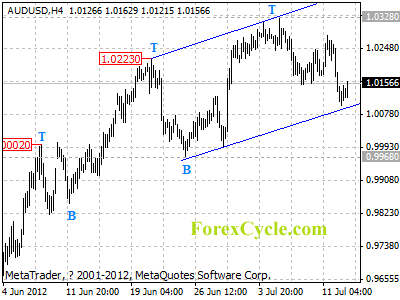
AUDUSD is facing channel support

AUDUSD is facing the support of the lower border of the price channel on 4-hour chart. As long as the channel support holds, the price action from 1.0223 is treated as consolidation of the uptrend from 0.9581 (Jun 1 low), and another rise towards 1.0500 could be expected after consolidation. On the downside, a clear break below the channel support will indicate that lengthier consolidation of the uptrend is underway, then deeper decline to 1.0000 could be seen.

audusd

Forex Signals

Are Equities Really Dead — Again?

By The Sizemore Letter

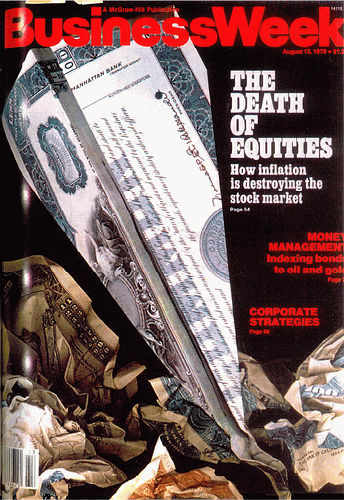
I gave my comments to InvestorPlace’s Jeff Reeves on the new rash of “Death of Equities” sentiment that has taken over the market.  Investor revulsion towards equities is indeed a bullish sign for the medium-to-long term.  But we should also remember that the infamous 1979 BusinessWeek cover–which many consider to be the greatest contrarian buy signal in history–predated the great bull market that started in 1982 by almost three full years.

So, while I feel good about putting long-term money to work at current prices, I realize fully that that a definitive bottom may still be ahead.  Read on:

Investors like to look for that classic “Death of Equities” moment to aggressively get into the market. But widespread negativity among investors does not necessary mean that a new bull market is starting tomorrow.

Still, all else equal, it’s a good sign that the potential upside is much larger than the downside. It’s the classic trader’s argument that “there is no one left to sell.”

Looking at valuations, stocks are relatively cheap by historical standards and absolutely, rock-bottom dirt-cheap when compared to bonds, cash and most commodities. Buying when prices are cheap and sentiment is rotten is a good recipe for long-term gains. And if you buy stocks that pay decent dividends, you’re getting paid to wait out any short-term hiccups.

Just be realistic and acknowledge that prices can get cheaper in the short to medium term. That has certainly been the case for most of 2011 and 2012, as volatility coming out of Europe has caused sentiment to go from bad to worse.

View full article here: Forget Doomsday Talk;  These Three Traders Say “Buy”

Related posts:

No Stimulus from BOJ, Yen Increases

By TraderVox.com

Tradervox.com (Dublin) – After a two-day meeting, the Bank of Japan monetary policy makers decided to refrain from adding stimulus but strengthened the asset purchases fund by fund from a credit loan facility. According to a statement released today, the BOJ has expanded its asset-purchases program by 5 trillion yen to 45 trillion from 40 trillion it had previously. However, the bank also cut one of its loan facilities from 30 trillion to25 trillion. This decision led to a decline in stocks which was further supported by the central bank of South Korea’s decision to lower its borrowing cost. However, there is pressure from the political class as the Japanese Finance Minister urged the central bank to do more to spur economic growth in the country.

The move by the Bank of Japan has been dismissed as a technical move which cannot be referred to as monetary easing by Masaaki Kanno, a Chief Economist at JPMorgan Securities Co, in Tokyo Japan. The yen has continued to strengthen against the dollar and the euro after this decision. At the close of trading in Tokyo, the yen was trading at 79.33 per dollar as the Nikkei 225 Stock Average dropped by 1.5 percent to settle at 8,720.01. The Bank of Japan has been on a tight corner as it failed to attract enough bids for its six-month credit lending operation, this was the 14th time it has failed to do so.

According to the BOJ statement released today after the meeting, the BOJ has promised to increase its short-term bond buying program which is a change from the previous strategy of buying long-term public debt. The bank left its interest rate unchanged between zero and 0.1 percent. The monthly bond purchases will remain at 1.8 trillion yen. The Bank of Japan has also stated that it will buy more treasury bills as well as remove some minimum bidding yield for securities which is expected to smoothen is operations.

Disclaimer
Tradervox.com is not giving advice nor is qualified or licensed to provide financial advice. You must seek guidance from your personal advisors before acting on this information. While we try to ensure that all of the information provided on this website is kept up-to-date and accurate we accept no responsibility for any use made of the information provided. Opinions expressed at Tradervox.com are those of the individual authors and do not necessarily represent the opinion of Tradervox.com or its management. 

Article provided by TraderVox.com
Tradervox.com is a Forex News Portal that provides real-time news and analysis relating to the Currency Markets.
News and analysis are produced throughout the day by our in-house staff.
Follow us on twitter: www.twitter.com/tradervox

Will Unemployment Claims Signal a Further Slowdown in the US Economic Recovery?

Source: ForexYard

printprofile

At FOREXYARD, we believe in keeping our clients prepared for potentially significant news events. As such, traders will want to carefully monitor the US Unemployment Claims figure, scheduled to be released today at 12:30 GMT. As can be seen in the chart below, after the June 28th Unemployment Claims figure, the S&P 500 proceeded to turn bearish.

S&P

Don’t miss out on another opportunity to capitalize on market volatility!

Investor concerns regarding the US employment sector have intensified following a worse than expected Non-Farm Payrolls figure last week. If today’s Unemployment Claims figure disappoints, indices like the S&P 500 could see downward movement. This is an excellent opportunity for forex traders to take advantage of potentially significant news, so don’t miss out!

Read more forex news on our forex blog

Forex Market Analysis provided by ForexYard.

© 2006 by FxYard Ltd

Disclaimer: Trading Foreign Exchange carries a high level of risk and may not be suitable for all investors. There is a possibility that you could sustain a loss of all of your investment and therefore you should not invest money that you cannot afford to lose. You should be aware of all the risks associated with Foreign Exchange trading.

Crude Prices May Be Boosted Tomorrow

Source: ForexYard

printprofile

Crude oil saw an upward spike in overnight trading. This was largely due to the decreasing value of the US dollar as the Fed debates new quantitative easing measures to boost the ailing US economy. Crude is currently trading around the 82.80 level, up over 100 pips from last night. With the first OPEC meeting in seven months set to take place on Thursday, as well as the latest US crude oil inventory figure about to be released, now may be a good time to examine oil a little more closely to determine how long it will be able to maintain its recent gains.

Ahead of Thursday’s meeting, OPEC ministers seemed fairly comfortable with the current level of crude oil output. With analysts forecasting no major announcements regarding output or pricing, oil is likely to stabilize today between 83.50 and 84.00.

Tomorrow’s crude oil inventory promises to generate substantially more volatility. Analysts are predicting a decrease in US stockpiles from last week’s figure of 3.1M. Should tomorrow’s result come in at the forecasted number of 1.5M, oil may see a significant price jump to close out the week. In addition, traders will want to pay careful attention to any fluctuations in the USD. Should the dollar continue to fall, there is a good chance oil prices may rise in tandem.

Forex Market Analysis provided by ForexYard.

© 2006 by FxYard Ltd

Disclaimer: Trading Foreign Exchange carries a high level of risk and may not be suitable for all investors. There is a possibility that you could sustain a loss of all of your investment and therefore you should not invest money that you cannot afford to lose. You should be aware of all the risks associated with Foreign Exchange trading.

“Disappointment” Over Fed Minutes Sees Gold, Silver at 2-Week Lows, But “More QE Ultimately Due”

London Gold Market Report
from Adrian Ash
BullionVault
Thurs 12 July, 07:25 EST

The WHOLESALE BULLION gold price continued to weaken Thursday morning in London, dropping to new 2-week lows beneath $1565 per ounce on what analysts called “disappointment” over the latest monetary policy minutes from the US Federal Reserve.

Asian and European stock markets fell hard, while wheat and corn prices again bucked a further drop in the commodities market.

Following the US Fed minutes – which showed only a “few” policy-makers wanting to expand the central bank’s quantitative easing money creation scheme – the Euro currency today dropped to its lowest level since June 2010 below $1.21.

Silver bullion also gave back the last of July’s rally to date, trading down to $27.75 per ounce.

“We are still confident that the current slide in the price of gold is nothing more than a temporary weakness,” writes Commerzbank’s head of commodity research Eugen Weinbergin Frankfurt today.

“The high levels of uncertainty resulting from the ongoing sovereign-debt crisis in the Eurozone clearly suggest a much higher gold price.”

“We think that $2000 an ounce is sort of the right number,” said Bank of America-Merrill Lynch’s head of global commodity and multi-asset strategy research Francisco Blanch to CNBC on Wednesday, forecasting a further $500 billion of US quantitative easing by year-end.

“We believe that ultimately the Fed will be forced to do quantitative easing. If it happens in September, as our economists expect, we will get a rally sooner in gold.

“Probably we will touch $2000 an ounce sometime next year.”

Longer-term, however, other analysis from Bank of America-Merrill Lynch now recommends selling gold, not buying it, as “a secular contrarian” strategy.

“[You] should be buying equities, European assets, Japan and financial & telecom stocks and selling gold, bonds, emerging markets and resources and consumer staples stocks,” says June’s Longest Pictures report from Michael Hartnett, chief global equity strategist.

Credit Suisse and BMO Research yesterday joined the growing move to cut commodity-price forecasts for 2012 and beyond, with the Swiss investment predicted only “a modest recovery in the second half of the year” and the Canadian financial services firm lopping 10% off its broad prediction for raw material costs.

“The bear market [in mining equities] has intensified with a vengeance,” says BMO Research, adding that late-2012 should see gold trade at $1600 per ounce rather than the previous forecast of $1700.

Even so, “The prevailing economic environment remains supportive for the gold price with the European sovereign debt crisis and wealth preservation demand playing on the upside, while weaker Indian jewelry demand weighs on the downside of the metal.”

Today in Kolkata, “There is a slight pick-up [in demand to buy gold ],” said one jewelry wholesaler to Reuters, “but this will taper off in a few days” unless local prices continue to ease from their recent record highs.

“The strong US Dollar makes local [gold] prices, such as in Indonesian Rupiah, not very attractive,” agrees a Singapore bullion dealer, also quoted by the newswire.

Asian premiums on 1-kilo gold bars – over and above the world’s benchmark London prices – have continued to firm, however, reaching $1 per ounce in Singapore and up to $1.40 in Hong Kong, a rise of more than 50% from the start of July.

China’s 2012 demand to buy gold may reach 900 tonnes, and so account for one ounce in every 5 sold worldwide, says Philip Klapwijk, head of Thomson Reuters GFMS, launching the consultancy’s Chinese language edition of Gold Survey 2012 this week.

“China not only remained the largest gold producer in the world in the first quarter but also became the top gold jewelry market in the world for three consecutive quarters,” notes Albert Cheng, managing director Far East for market-development organization the World Gold Council, also quoted by the People’s Daily Online.

Officially, China’s inflation rate slowed to 2.2% per year in June, and “The falling inflation rate will create more room for policy easing to bolster economic growth and would be positive for gold investment,” reckons senior analyst Su Yanbo at research agency Baiinfo in Beijing.

“Gold prices are expected to rebound in the second half of the year.”

Last week the People’s Bank of China surprised analysts by unexpectedly cutting interest rates in the world’s second-largest economy.

Neighboring South Korea today did the same, taking the Bank of Korea’s target rate down a quarter-point to 3.0% “to help the South Korean economy return to a long-term growth trend,” according to governor Kim Choong-Soo.

Here in London, Barclays Capital meantime cut its US economic growth forecast from 2.5% to 1.5% for the second quarter.

Deutsche Bank has also cut a full percentage point of its GDP forecast for the United States, taking it down to 1.4%.

Adrian Ash
BullionVault

Gold price chart, no delay   |   Buy gold online at live prices

Adrian Ash is head of research at BullionVault, the secure, low-cost gold and silver market for private investors online, where you can buy gold today vaulted in Zurich on $3 spreads and 0.8% dealing fees.

(c) BullionVault 2012

Please Note: This article is to inform your thinking, not lead it. Only you can decide the best place for your money, and any decision you make will put your money at risk. Information or data included here may have already been overtaken by events – and must be verified elsewhere – should you choose to act on it.