How Uncertainty in the Stock Market Can Be Your Friend

By MoneyMorning.com.au

Ever since the press started covering the financial crisis, all we hear is that ‘uncertainty is derailing stock markets‘, says Barry Ritholtz. But the author of influential financial blog The Big Picture says this idea is nonsensical.

Uncertainty is ‘an essential part of markets, and indeed life’, says Ritholtz. ‘The future is by definition unknowable and therefore uncertain.’ Those who complain about it reveal how little they actually understand, not just about investing, ‘but about the human experience’.

For starters, says Ritholtz, markets wouldn’t work if we lived in a certain world. ‘Investing requires there to be differences of opinion. When there is broad agreement as to an asset’s fair value, trading volume falls. Without any uncertainty, who would take the opposite side of your trade?’

If anything, it’s apparent certainty that should worry investors, he says. That’s because whenever humans are certain about something, they are usually wrong.

‘In rare instances, when there is a near-total lack of uncertainty in the market, the outcome is usually a spectacular disaster. Think of the false certainty surrounding the peak of the dotcom bubble (profits don’t matter!), or the nadir in March 2009 (the abyss awaits!) to validate just how true this is.’

Of course, now we face a long list of important uncertainties. A eurozone collapse, the potential for another US recession, and the US election are the main ones. But while they might seem serious, says Ritholtz, they don’t really undermine investing.

‘I do not recall anyone saying investing was difficult due to the uncertainty caused by a potential nuclear conflagration between the US and USSR during the Cold War. Is the Greek situation today more dire and uncertain than the policy of MAD — mutual assured destruction — ever was?’

The fact is, all of the events we are unsure about today will be revealed eventually. That’s how a linear timeline works. Given that’s so obvious, why is everyone so worried about uncertainty at the moment?

The answer, says Ritholtz, is that humans like to live ‘in a happy little bubble of self-created delusion’. We like to rationalise everything we do and think that it all fits into our chosen narrative. But every now and then, reality presses up against us and pierces through that bubble.

The ongoing financial crisis has disturbed the comfortable story we liked to believe. It’s one of those moments when ‘the facade fades, the curtain gets pulled back, the ugly reality becomes known to us. We get a glimmer of understanding our own lack of understanding’.

But don’t worry, Ritholtz doesn’t think it will last long. It’s just one of ‘those all too rare instances when we mortals briefly acknowledge reality. When it passes, we all manage to go back to our previously constructed artificial reality.’

James McKeigue
Contributing Editor, Money Morning

Publisher’s Note: This article originally appeared in MoneyWeek (UK)

From the Archives…

The Credit Market Debt Bubble and the Role of Gold
13-07-2012 – Greg Canavan

How to Survive and Thrive from China’s Bust
12-07-2012 – Kris Sayce

Payday Loans: Why This Lender of Last Resort Isn’t the Bad Guy
11-07-2012 – Kris Sayce

What A Slowing Chinese Economy Means For Pork Chops
10-07-2012 – Dr. Alex Cowie

Late News: Bankers Rig Interest Rates, No-One Fired
09-07-2012 – Dr. Alex Cowie


How Uncertainty in the Stock Market Can Be Your Friend

The Next Major Move in Precious Metals Is Close

By Chris Vermeulen, Gold and Oil Guy

After making new highs about a year ago we have seen Silver and Gold consolidate for roughly the last twelve months.  Technically, it would typically be a bullish scenario with gold from the stand point that the last 12 months’ price action was a sideways consolidation in a bullish pennant formation.  However over the last year we have witnessed a series of lower highs and increasingly tested supports levels around $150 on GLD which raises caution.

  Click Gold Chart for Full Size

With the fed pulling any extensions on further quantitative easing in the form of QE3 or other programs, the bullish case has lately been criticised.  However I am still a firm believer that gold in most respects is a currency, and the only one that can maintain its value.  There are very serious issues looming in Europe and across the world that are far from resolution.  With few tools left in the toolbox to stimulate world economies, further easing can never be ruled out.

Silver, after breaking through strong resistance around $19- $20 in September 2011 went almost parabolic in spring 2011 prior to giving up most of its gains in the last year.  There seems to be significant support around $26 on SLV, however this level has been tested quite frequently over recent months and this again raises caution.  While silver owes some of its moves to its industrial application, the high correlation between the two metals is not to be ignored.

 Click Silver Chart for Full Size

I think the long-term trade will be long in both metals, but I’m waiting to see a significant breakout out of these consolidations on heavy volume to confirm a direction.  I would like to see both precious metals break out of their respective consolidations and ultimately have further confirmation in the USD.  Any major headlines over the next couple months involving Europe or quantitative easing may provide us with the trigger for the next big move.

Get My FREE gold cycles and trading analysis here: www.GoldAndOilGuy.com

Chris Vermeulen


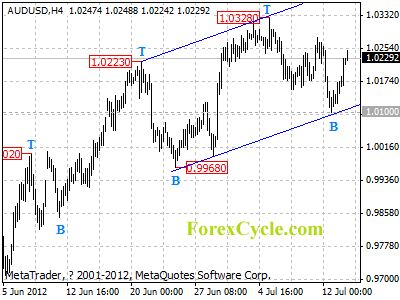
AUDUSD rebounds from 1.0100

Being supported by the lower line of the price channel on 4-hour chart, AUDUSD rebounds from 1.0100, suggesting that a cycle bottom has been formed. Now the bounce would possibly be resumption of the longer term uptrend from 0.9581 (Jun 1 low), further rise to test 1.0328 previous high resistance could be expected, a break above this level will target 1.0500 zone. Key support is now at 1.0100, only break below this level will indicate that the uptrend from 0.9581 is complete.

audusd

Daily Forex Forecast

Why the Australian Property Bubble is Only the Beginning

By MoneyMorning.com.au

There are two things you can’t discuss at the Smith’s extended family gatherings. Religion and politics. And that’s mostly because there’s no talking when those subjects come up, just yelling, fist pumping and table thumping.

And after a recent weekend gathering, we added a third ‘no-go’ topic. After all the noise, thinly disguised name calling and our colour blind electrical engineer uncle setting fire to the dining room table, we decided to never discuss Australian property with them again.

Chances are, we would never have discovered the passion for the Australian property market if it wasn’t for all the media attention toward the deflating Aussie property bubble.

Just this week The Age commented on rising negative equity for homeowners in the outer suburbs.

Many people who bought houses on Melbourne’s fringes in recent years could be facing financial ruin after a slump in prices has left them owing more to the bank than their homes are worth, experts have warned.

But that wasn’t what grabbed our interest. It was further down in the article where a property spruiker changed his tune.

The average plot of land in the outer suburbs is [worth] half what it is in the middle suburbs and it is the land that appreciates, albeit slowly on the fringe. The houses they are building actually depreciate. On top of that, the quality of construction is often cheap. So that’s what’s behind the negative equity.

Say it ain’t so? Aussie homes are built on the cheap? For years property spruikers told you the reason Australian house prices are so high is because of the high quality of Aussie housing.

Six years ago, the Reserve Bank of Australia suggested in a report ‘Australian House Prices’ that the higher quality of new homes added to the overall housing quality in the Aussie property market.

And then in September last year, the Herald Sun repeated something similar:

Higher Australian property prices can also be justified by the higher quality of Australia’s housing stock, with renovations and extensions naturally adding value.

In fact, even as recently as six months ago the spruikers were still claiming Australian housing stock was of a high quality. As Paul Bloxham, an economist at HSBC wrote in The Australian Housing Bubble Furphy report:

‘First, the quality of the housing stock is high. Australia has the largest dwellings in the world, and they are of high quality. Estimates suggest that the average Australian dwelling is 214 square metres, and the real expenditure on new dwellings is now 60 per cent higher than it was 15 years ago, reflecting the increase in both the size and quality of dwellings.’

At the time, Kris Sayce didn’t buy the spruikers talk. He told Money Morning readers in his article Another Housing Market Myth Busted, ‘To our mind Bloxham had confused quantity of housing (the size of houses), with quality of housing (how good they are).

How is it that suddenly Australian houses have gone from being of the highest build quality in the world to cheaply built?

You see, the idea that Aussie homes were of a high quality was just a myth, often used to support overpriced houses. And now those myths and hype are falling apart.

But of course, an Aussie housing crash is nothing compared to another, bigger property bubble…

That’s right, China.

Economics professor Li Daokui from Tingshua University recently told the Financial Times, ‘The housing market problem in China is actually much… much bigger than the housing market problem in the US and UK… It’s more than [just] a bubble problem.’

Yes, We Really Mean Billion

Around 2009, hedge fund firm, Kynikos Associates, CEO Jim Chanos wanted to find out exactly why mining stocks were so profitable during America’s great recession. His team came back with one word: China.

So he started digging deeper. What could China be using all this copper, iron-ore and cement for?

One of his analysts looked into it. He did the math. And checked his figures….three times. During the northern hemisphere summer of 2009, China was building 5.5 billion square meters of high rise space.

Half of the construction space was ‘office/mix use’.

Chanos tried to put the data into perspective. He said: ‘Well gee, that’s 30 billion square feet use for office mix use. And 30 billion square feet is a five foot by five foot office cubical for every man, woman and child in China.’

Using this information, Chanos decided China wasn’t a stable economy.

But that 5.5 billion sqm of high construction was over three years ago. And the construction hasn’t stopped.

Even though both home sales and demand for high rises are slowing, building is still going ahead at a rapid pace.

At the current rate, every five days China completes a new skyscraper. According to a report by Skyscrapers Magazine, by 2016 China will have more than 800 skyscrapers taller than 152 meters. Four times more than the US.

Less than two months ago, Chanos told CNN, ‘We’re bearish on China’s property sector and the credit sector. This is a country that’s in the middle of an epic property bubble and construction bubble that will end at some point and it won’t be pleasant when it ends.

China Going From Boom to Bust


Chanos isn’t the only analyst who’s negative on China.

‘China is now on the other side of its boom,’ says Greg Canavan, editor of Sound Money. Sound Investments.

And the economic growth numbers are just the beginning of a China slow down. Gross domestic product was down to 7.6% for the second quarter, down from the previous quarter’s 8.1%.

Consumer price inflation grew by only 2.2% and the producer price index (PPI) dropped to 2.1%. Since March, the PPI has fallen every month.

I am absolutely certain that combining a credit bubble with a Communist regime was a recipe for disaster. The credit bubble is playing out like they all do — first the inflation, then the deflation. First the boom, then the bust,’ Greg tells me.

The Chinese slowdown is gathering pace. This has major implications for Australia.’

As an Aussie, you can’t stop the Chinese economy from failing, but you can prepare your portfolio.

Greg has detailed insight and information into what he believes is the most important development for Australian investors right now — how to protect your wealth from what he calls the ‘China Bust’.

China’s economy is changing…and fast. If you want to hear what Greg has to say about the coming ‘China Bust’, click here.

Shae Smith

Money Weekend

The Most Important Story This Week…

The reason Australia managed to dodge a recession during the global financial crisis in 2008 was thanks to China.  This was because China spent billions of dollars to stimulate its economy with huge levels of construction. This translated into huge profits for the big Aussie miners.

Thanks to this Australia has managed to avoid the worst of the global recession seen in Europe and the USA.  But just as China has held the Australian economy afloat so far, there is a massive risk that China will cause it to sink.  See what Kris Sayce says in How to Survive and Thrive from China’s Bust.

Other Recent Highlights…

Kris Sayce on Payday Loans: Why This Lender of Last Resort Isn’t the Bad Guy: “But there is one line of business that has resisted the urge to fiddle with interest rates. And not surprisingly, in a world where credit and debt have become dirty words, this line of business is doing very nicely indeed…”

Keith FitzGerald on What I Wish Ben Bernanke Knew About Japan’s Economy: “Ben Bernanke and his central banking buddies think it’s easier to print money than actually stimulate real growth. In doing so, they are re-creating Japan’s “Lost Decades” here at home with years of smouldering, piss-poor growth as our destiny. Yet it doesn’t have to be that way. We can still choose a different path.”

Dr. Alex Cowie on What A Slowing Chinese Economy Means For Pork Chops: “It’s been well over a year since I tipped any stocks in iron ore, coking coal, and copper – commodities tied to Chinese infrastructure and construction…But I’ve steered clear of those commodities for a while, focusing instead on strategic minerals such as graphite and lithium. This strategy is to avoid the effect of the crashing Chinese property construction sector.”

John Stepek on The Sticky Plaster Fix For the Spanish Economy: “There was the prospect of the European bail-out fund buying sovereign debt too. And yet Spanish bond yields soon ran back up to around the 7% mark. So there’s been another emergency discussion session. So here’s the big question: is another eurozone disaster looming? The answer might surprise you…”


Why the Australian Property Bubble is Only the Beginning

Why Jim Rogers is Investing in Farmland

By MoneyMorning.com.au

Legendary Wall Street trader and best-selling author Jim Rogers recently offered this unconventional advice: If you want to get rich, you should be investing in farmland.
Don’t laugh. Rogers is good at what he does. Really good.

Together with George Soros, he founded the Quantum Fund in the 1970s and posted returns of 4,200% over 10 years. Rogers retired in 1980 at the age of 37, but is still active as a private investor.

Back in 1999, Jim Rogers recommended gold when it was trading at $252 and silver at $4. You know what happened after that.

Now Rogers thinks investing in farmland will pay off in a big way.

‘It’s the farmers, the producers, who are going to be in the captain’s seat when the prices go through the roof,’ he told The Australian Financial Review.

Food Demand on the Rise

Consumers in places like China and India – where an emerging middle class suddenly can afford a better diet – are eating more of everything, especially high-protein meat.

But they have a long way to go to catch up to Western levels of meat consumption.

According to Time Magazine, the average American consumes about 250 pounds of meat a year. Meanwhile, the Chinese average roughly 100 pounds a year, while Indians eat less than 10 pounds a year.

As the middle class in these and other emerging markets expand in the coming years, demand for meat will explode.

But to increase meat production, farms will need a lot more grain to feed the livestock. Half of U.S. corn production already goes to feed cattle, pigs and poultry.

A prediction in a recent advertising campaign from Monsanto Co. (NYSE: MON) illustrates the immense demand that’s just around the corner. The company said the world’s farmers will need to produce more food in the next 50 years than farmers have produced in total over the last 10,000 years.

Soaring demand for grain has already affected the market. Monsanto said global grain consumption has exceeded total production for seven out of the last eight years.
‘The world has got a serious food problem,’ Rogers told Time. ‘The only real way to solve it is to draw more people back to agriculture.’

Milking Profits From Farmland

Meanwhile, new technology over the last 20 years has helped U.S. farmers significantly increase production. Redesigned seeds have increased yields and the use of computers has vastly improved planting techniques.

Such changes have pushed corn production from an average of 91 bushels per acre in 1980 to 152 bushels per acre in 2010. That, along with higher prices, is boosting profits and making farmland dramatically more valuable – and farmers richer.

Net farm income is expected to clock in at roughly $97.1 billion in 2012, the second highest on record according to the USDA.

Farmland typically is held for long periods of time and usually comes on the market only when the owner passes away.

But today the average U.S. farmer is 58 years old. The USDA estimates that over one-third of all farmland owners have less than 15 years left to live.

That aging population represents a window of opportunity for investing in farmland.

Investing in Farmland

Over the last 100 years [US] farmland, based on income and capital appreciation, has consistently delivered positive returns – with only three brief periods of negative returns (1930s, 1980s, and 2008).

And as the saying goes, they just aren’t making any more of it. So a severe imbalance is developing in the supply and demand of farmland.

Farmland is also an opportunity to invest in an asset class not directly correlated to stocks and bonds, and one with significantly less volatility.

Jim Rogers believes investing in farmland is ‘in its third inning.’ In other words, there’s still plenty of time to get in.

Don Miller

Contributing Writer, Money Morning
Publisher’s Note: This is an edited version of an article that first appeared in Money Morning (USA)

From the Archives…

The Australian Housing Shortage That Never Existed
06-07-2012 – Kris Sayce

Did the European Summit Change the Market Trend?
05-07-2012 – Murray Dawes

Why Government Intervention Hinders Progress and Innovation
04-07-2012 – Kris Sayce

The Big Opportunities in the Oil Market That Will Lead to Profit
03-07-2012 – Dr. Alex Cowie

LIBOR – The Banking Scandal That Could Cause A Riot
02-07-2012 – Dr. Alex Cowie


Why Jim Rogers is Investing in Farmland

Investing in Emerging Market Dividends

Article by Investment U

Because of lackluster stock returns, rock-bottom interest rates and aging baby boomers hungry for income, investors are rightfully focusing on stocks with a high and rising dividend record.

This is why the timing of Marc Lichtenfeld’s new book, Get Rich with Dividends, couldn’t be better.

I’ve always been impressed with Marc’s versatility as an analyst. He’s a great growth stock picker, and also develops winning income strategies. Marc’s book combines both of these with the proven strategy of buying growth stocks with a rising dividend record. This is a dependable and conservative growth strategy backed up by solid research that shows dividends account for about half of stock returns.

Thinking of Marc’s experience as a ring announcer for world championship boxing, I refer to this as his one-two punch strategy.

You’ll need to buy this book to learn how to execute Marc’s specific strategy, but let me give you a couple of ideas to get started.

Marc dedicates an entire chapter to foreign stocks, which focuses on investing in international dividend payers. Marc rightly points out that international and emerging market stocks often have higher-yield stocks, but have an inconsistent dividend record. And then there are the risks associated with currency conversions…

How can an investor sort through all of these international stocks and pick those with the highest and most consistent dividend record?

A great choice to get started would be Powershares International Dividend Achievers (NYSE: PID). To get into PID’s high dividend basket, international stocks must have a sterling dividend growth record: five consecutive years of dividend increases.

Next, I highly recommend WisdomTree Emerging Markets Equity Income (NYSE: DEM), which is a basket of the highest dividend-paying emerging market stocks. As you might expect, it outperforms in weak markets and underperforms in strong markets. This lower volatility is just what I think most investors are looking for in emerging markets, and the proof is in the pudding.

But in addition to lower volatility, it consistently outperforms the leading emerging market index. Just take a look at the chart below comparing DEM with the most widely used emerging market ETF in the world, iShares MSCI Emerging Markets (NYSE: EEM).

You can see that during the past five years, DEM outperformed and ended in the black while the much larger and famous EEM ended its volatile ride in the red. The index that DEM aims to track has a current dividend yield of 4.07% (actual yield may differ).

Investing in Emerging Market Dividends

DEM has a three-year annualized return of 14.5%, compared with 9% EEM. This performance is attracting assets with DEM seeing net inflows of over $220 million since June 1 with total assets approaching $4 billion.

Stocks in the DEM fund are weighted not by market value but by dividend yield. Importantly, the basket is rebalanced every June. This allows the fund to kick out stocks that have lowered their dividend, as well as more expensive stocks, and add some new companies to the mix.

The recent June rebalance resulted in DEM increasing exposure to China and Russia, two beaten-down markets. The fund currently has 21.2% in Taiwan, 14.2% in Brazil, 14.2% in China and 13.8% in Russia.

Get Marc’s book today and get going on building a dividend rich portfolio. And don’t forget to add some international stocks to the mix; their dividend yields are higher than U.S. stocks and should lead to lower portfolio volatility.

Good Investing,

Carl

P.S. To find out more about Marc’s dividend investing strategy and his new book, click here.

Article by Investment U

How to Get Rich With Dividends

Article by Investment U

When I first got started in the investment business 27 years ago – as a novice stockbroker – I had an awkward conversation with a client.

She was an elderly, income-oriented investor with a substantial sum tied up in an oil stock with a fairly low yield. I suggested that she could do a lot better than the 2.5% dividend she was earning.

“Son,” she replied – I had already come to recognize that it was likely to be a teachable moment, and an embarrassing one, when a more-experienced investor called me “son” – “that stock is paying 2.5% based on what it is selling for now. But for me, the annual dividend is more than my entire original investment.”

Oh.

It was an early lesson in magic of investing in blue-chip companies with steadily rising dividends. To this day, it still astonishes me how many investors – even experienced ones – don’t realize what a powerful opportunity this is – or how cheap dividend payers are right now.

That’s why you should pick up a copy of Oxford Club and Investment U analyst Marc Lichtenfeld’s new book, Get Rich with Dividends: A Proven System for Earning Double-Digit Returns. Here’s why…

Dr. Jeremy Siegel, a professor of finance at The Wharton School of the University of Pennsylvania, has done a thorough historical investigation of the performance of various asset classes over the last 200 years, including all types of stocks, bonds, cash and precious metals. His conclusion? Dividend stocks have outperformed everything else over the long haul – and almost certainly will in the future, too.

In Get Rich with Dividends, Marc explains why – and shows you exactly how to identify the most promising income stocks. He also demonstrates that even during market declines, dividend-paying stocks hold up better than non-dividend-paying stocks, often fighting the broad trend and rising in value. The reason is obvious. These tend to be mature, profitable companies with stable outlooks, plenty of cash and long-term staying power.

Bear in mind, U.S. companies are sitting on a record amount of cash right now, more than $2 trillion. Most corporations are not hiring and they’re not boosting spending. So a lot of this cash is rightfully going back to shareholders. The Dow currently yields more than bonds. And dividend growth among U.S. companies has averaged 10% per year over the last two years, more than double the long-term dividend growth rate.

The current outlook is especially promising. Over the last 50 years, for instance, the highest 20% yielding stocks in the S&P 500 returned 14.2% annually. That’s good enough to double your money every five years – or quadruple it in 10. And if you were even more selective, say investing only in the 10 highest-yielding stocks of the 100 largest companies in the S&P 500, your annual return would have been even better, 15.7%.

Marc makes a strong case that dividend stocks today represent an historic opportunity. Not only are U.S. companies flush with cash, but payouts are less than one third of profits, a historic low.

This is exactly where most investors, especially income-oriented ones, should park their money right now. After all, bonds – which should carry a warning label at the moment– are sporting record-low yields. Money market funds pay almost nothing, less than one-tenth of one percent. But many dividend-stocks are dirt-cheap and will boost their payouts substantially in the months ahead.

In short, if you’re looking for growth, invest in dividend stocks. If you’re looking for income, invest in dividend stocks. If you’re looking to reduce your risk, invest in dividend stocks. And if you’re looking to build your fortune – safely and securely – invest in Get Rich with Dividends. It’s a classic.

Good Investing,

Alex

Article by Investment U

The Best-Performing Sector for the Rest of 2012

Article by Investment U

Yep, it’s officially earnings season.

And Monday afternoon, Alcoa (NYSE: AA) kicked things off announcing a net loss of $2 million and that revenue fell nearly 10%, to $5.96 billion, compared to a year ago.

The largest U.S. aluminum producer did manage to beat analysts’ estimates. However, shares are still down 4% since Monday.

The fact that Alcoa still managed to beat estimates is a testament to how much corporate outlooks have fallen over the past few months. Reuters even reports that growth estimates are now “… at their most negative in nearly four years…”

The Associated Press also says this month’s earnings announcements will likely mean “… the end of record corporate profits.”

I’m an optimist at heart. But news like this is hard to ignore and increasingly frustrating for investors.

Especially when the reasons behind it all are the same old thing:

  • Europe is still a mess.
  • China’s economy keeps slowing.
  • And the United States isn’t close to getting out of the woods.

In times likes these, there’s no use fixating on all of the red ink. Instead, it’s ever more important to focus on areas of the market that are continuing to experience growth.

Because, despite all the gloom and doom, there are certain sectors of the market that are still chugging along.

In fact, since the beginning of April, two industries actually increased their growth forecasts instead of lowering them.

I’m talking about the telecommunications and technology sectors.

Defying the Odds

It doesn’t matter where you live or how much money you have today.

Around the globe, more and more people are becoming reliant on better technologies and ways to communicate.

As an investor, it’s crucial that you pay attention.

For instance, regardless of the global economy going nowhere, shares of major telecom players such as Verizon (NYSE: VZ), AT&T (NYSE: T) and Sprint (NYSE: S) have increased 17%, 13% and 40% so far this year.

In addition, China’s largest mobile provider, China Mobile (NYSE: CHL), is up 12%.

Meanwhile, some of world’s largest technology companies including Apple (Nasdaq: AAPL), Microsoft (Nasdaq: MSFT) and Samsung (KSE: 005930) have ticked up 49%, 12% and 30%.

But I must admit, even though both of these sectors have numerous opportunities to profit, there’s one set to perform much better than the other.

And the Winner Is…

For the rest of this year, don’t be surprised if the telecom sector ends up the best-performing area of the stock market.

The reasoning behind this is actually pretty simple.

In times of uncertainty, investors always look to recession-resistant industries. These industries will have solid cash flows,  and products and services that people can’t live without.

And when it comes to cash flow, according to MarketWatch, revenue in the S&P telecom sector just hit a four-year high last month.

Another big plus, especially among telecom service providers here in the United States and Asia, is that they have very little or no exposure to the Eurozone.

So no matter what happens there, these firms will be the least likely to drop from financial turmoil.

Bottom line: This earnings season, don’t let flailing sectors of the market drag down your portfolio performance.

Instead, pick up a few shares of telecom providers mostly doing business in either Asia or the United States and give yourself a chance to capture some nice gains in what could be the best performing sector for the rest of 2012 – and beyond.

Good Investing,

Mike Kapsch

Article by Investment U

South Pacific Currencies UP on China GDP Data

By TraderVox.com

Tradervox.com (Dublin) – Prior to the Chinese GDP report was released, the south pacific dollars we set for a weekly drop; however, positive reports from China enhance demand for riskier assets pushing the New Zealand and Australian dollar up against most major currencies. China, Australia’s largest trading partner and New Zealand’s second largest, had a Gross Domestic Product growth of 7.6 percent as the market expected according to the National Bureau of statistics in Beijing. The strengthening of the south pacific dollars was also supported by Asian stocks rally after the announcement in China.

According to a currency strategist at Westpac Banking Corp in Singapore, Jonathan Cavenagh, the gross domestic product in China was within the market expectation hence providing support for the commodity related currencies. However, Cavenagh was pessimist about future growth saying that growth is limited hence we might still see some squeeze on the Australian dollar. The data from China showed that the economy increased by 7.6 percent in the second quarter as compared to the 8.1 percent expansion realized on the first quarter. Economists had predicted and expansion of 7.7 percent. The data increased the demand for Asian Stocks, raising the MSCI Asian Pacific Index by 0.5 percent after it had dropped by 0.2 percent earlier in the week.

The data from the National Bureau of Statistics came barely a week after the People’s Bank of China announced its interest cut as it acted to support growth in the country. The Chinese economy is experiencing downward pressure according to Chinese Premier Wen Jiabao who was said the country would intensify its action to shove off the current downward trend in the economy.

After the GDP data in China was released, the Australian dollar increased by 0.2 percent against the dollar to trade at $1.0163 after it had declined by 0.5 percent during trading in Sydney. The currency added 0.2 percent against the yen to exchange at 80.58 yen; it had weakened by 1.7 percent against the Japanese yen yesterday. The Kiwi was up by 0.3 percent against the US dollar to 79.16 US Cents after it had fallen by 0.8 percent.

Disclaimer
Tradervox.com is not giving advice nor is qualified or licensed to provide financial advice. You must seek guidance from your personal advisors before acting on this information. While we try to ensure that all of the information provided on this website is kept up-to-date and accurate we accept no responsibility for any use made of the information provided. Opinions expressed at Tradervox.com are those of the individual authors and do not necessarily represent the opinion of Tradervox.com or its management. 

Article provided by TraderVox.com
Tradervox.com is a Forex News Portal that provides real-time news and analysis relating to the Currency Markets.
News and analysis are produced throughout the day by our in-house staff.
Follow us on twitter: www.twitter.com/tradervox

Pound Tumbles Against the Dollar on Recession Concerns

By TraderVox.com

Trdervox.com (Dublin) – The Europe debt crisis and the declining global economic are some of the reasons casting doubt to the ability of the Bank of Japan and the UK government to pull the country out of recession. Investors are concerned about the country’s ability which has forced the sterling pound to decline to five-week low against the US dollar. These concerns we raised by the PricewaterhouseCoopers LLP after it warned UK businesses to prepare for the possibility of a prolonged recession citing the deepening Europe debt crisis. The sterling pound also fell for the third day against the dollar as ten-year yields were sold at a record low.

According to Lee Hardman, who is a Foreign Exchange Strategist in London at Bank of Tokyo Mitsubishi UFJ Ltd, the optimistic scenario is that the IK recession will not end until next year given the situation in Europe. He predicted that the pound and the euro will weaken as the dollar continues to enjoy safe haven demand as risk aversion creeps back into the market. Some economists have cited Fibonacci analysis, saying that the pound might find support at 61.8 percent Fibonacci retracement of the rally in May 2010 and April 2011 of $1.5192, where it might touch the low of $1.5269 and later $1.5235 which are last month’s low and this year’s low respectively before that.

According to a report by the PWC, the UK economy will probably register zero growth this year as downward pressure increases on the economy. Another report by the Britain’s fiscal watchdog indicated that the country’s public finances cannot be maintained increasing speculation of prolonged recession in the Kingdom. These data has led the sterling pound to drop by 0.5 percent against the dollar to trade at $1.5417 at the close of trading in London yesterday after it had weakened to $1.5394 which is the weakest level it has been since June 6. The Great Britain Pound also fell by 0.2 percent against the euro to trade at 79.06 pence per euro.

Disclaimer
Tradervox.com is not giving advice nor is qualified or licensed to provide financial advice. You must seek guidance from your personal advisors before acting on this information. While we try to ensure that all of the information provided on this website is kept up-to-date and accurate we accept no responsibility for any use made of the information provided. Opinions expressed at Tradervox.com are those of the individual authors and do not necessarily represent the opinion of Tradervox.com or its management. 

Article provided by TraderVox.com
Tradervox.com is a Forex News Portal that provides real-time news and analysis relating to the Currency Markets.
News and analysis are produced throughout the day by our in-house staff.
Follow us on twitter: www.twitter.com/tradervox