Euro Boosted By Speculation of Improved Confidence in Draghi’s Plan

By TraderVox.com

Tradervox.com (Dublin) – The euro gained on Tuesday against the yen as speculation that European Central Bank plan of bond purchases will help solve the debt crisis in the region. Confidence in the euro improved as European Union President Herman Van Rompuy met with German Chancellor Angela Merkel in Berlin as they discussed the debt crisis. World leaders are urging Germany to accept the bond buying program as it might be the only way out of the crisis according to Mario Draghi, the ECB President. The Italian Minister Mario Monti and the French President Francoise Hollande also met in Rome for discussions. Italy and Spain have refrained from asking for aid from ECB, which might lead to a delay in rolling out of the bond buying program.

According to Daisuke Karakama, a Market Economist at Mizuho Corporate Bank Ltd in Tokyo, it would be a good boost for the euro if the European Central Bank were to buy three-year maturity bonds for countries such as Spain and Italy. According to Jean-Paul Gauzes who is a member of European Parliament, Draghi indicated to the parliament that he would be comfortable buying bonds of up to three-year maturity as this does not constitute state financing when he a addressed a closed door session in Brussels on Monday.

As the ECB prepares to hold its policy meeting tomorrow Sept 6, Akira Moroga, a Manger at Aozora Bank Ltd, the euro might experience some short-covering as speculation of bond buying program rises. Economists have indicated that September will be a pivotal month for the euro as it might be the month when the 17-nation currency tumbles or regains market confidence. Further, if Draghi goes ahead with his plan to buy bond from sovereign governments, the euro will be debased and it is likely to fall against major currencies.

The 17-nation currency increased against the yen by 0.4 percent on Tuesday to trade at 98.89 yen during the Tokyo trading session. The shared currency also advanced against the dollar by 0.2 percent to trade at $1.2619.

Disclaimer
Tradervox.com is not giving advice nor is qualified or licensed to provide financial advice. You must seek guidance from your personal advisors before acting on this information. While we try to ensure that all of the information provided on this website is kept up-to-date and accurate we accept no responsibility for any use made of the information provided. Opinions expressed at Tradervox.com are those of the individual authors and do not necessarily represent the opinion of Tradervox.com or its management. 

Article provided by TraderVox.com
Tradervox.com is a Forex News Portal that provides real-time news and analysis relating to the Currency Markets.
News and analysis are produced throughout the day by our in-house staff.
Follow us on twitter: www.twitter.com/tradervox

Market Review 5.9.12

Source: ForexYard

printprofile

The euro saw moderate losses against its main currency rivals last night, as uncertainties regarding ECB plans to lower borrowing costs in the euro-zone led to risk aversion among investors. That being said, losses were limited ahead of tomorrow’s ECB press conference and Friday’s US Non-Farm Payrolls. After falling close to $2 a barrel yesterday due to poor US manufacturing data, crude oil extended its bearish trend last night and is currently trading just above the $95.20 level.

Main News for Today

With no major news events scheduled to take place today, traders will want to continue monitoring any announcements out of the euro-zone which could hint at details of the ECB’s plans to lower borrowing costs in Spain and Italy.

Read more forex news on our forex blog

Forex Market Analysis provided by ForexYard.

© 2006 by FxYard Ltd

Disclaimer: Trading Foreign Exchange carries a high level of risk and may not be suitable for all investors. There is a possibility that you could sustain a loss of all of your investment and therefore you should not invest money that you cannot afford to lose. You should be aware of all the risks associated with Foreign Exchange trading.

Thailand keeps rate steady, economy remains robust

By Central Bank News
    The Bank of Thailand (BoT) kept its policy rate unchanged at 3.0 percent, as expected, saying the domestic economy remained robust despite a higher drag on activity from slower global demand.
    Two of the members of the Monetary Policy Committee voted to cut the policy rate by 25 basis points while three members voted to maintain the rate, which has been unchanged since January, when it was cut by 25 basis points. Last month two members also voted to cut rates.
    The bank’s policy rate hit a recent peak in October last year at 3.50 percent and have been heading lower since November when the first cut in rates came.
    “The MPC viewed that the impact of slower global demand on the Thai economy had increased to some extent. Nonetheless, domestic demand remained robust and current monetary conditions were accommodative enough to support continued economic expansion. Credit growth in some sectors had been rapid and warranted close monitoring,” the BoT said.
    Thailand’s economy expanded by 3.3 percent in the second quarter for an annual growth of 4.20 percent, a sharp improvement from first quarter’s 0.4 percent expansion.

    The Thai central bank, which has been under pressure by the government to cut interest rates, said the domestic economy grew at a faster rate in the second quarter than previously forecast and strong momentum in consumption and investment was likely to sustain the trend, along with the positive contribution of government stimulus measures.

    “Nonetheless, the impact of slowing global demand on Thai exports would become more apparent and it was possible that export growth this year would be lower than expected,” the bank said.
    It added that inflation was expected to moderate further and remain within the bank’s target.
    The inflation rate in Thailand was steady in August at an annual rate of 2.7 percent. The BoT targets inflation of 3.0 percent.

    www.CentralBankNews.info 

Fiji leaves interest rate steady, economy positive

By Central Bank News

     The central bank of Fiji left its Overnight Policy Rate (OPR) unchanged at 0.5 percent as the domestic economy remain healthy despite the softening in the global economy.
     “The global growth outlook remains clouded by underlying problems in the Euro zone and the associated flow-on effects on its trading partner economies. Having picked up in the early months of 2012, growth in the world economy has since softened,” the Reserve Bank of Fiji said in a statement, quoting its governor and chairman, Barry Whiteside.
    “The Board noted that despite the general pick-up in the economy in the year to date and positive sentiments for the near term, it is important that monetary policy remains supportive of the economic recovery,” the bank added in a statement following a board meeting on Aug. 30.
     Fiji has held its OPR unchanged since November last year when it cut the rate by 100 basis points.

     Despite the weak global economy, Whiteside said the domestic economy was generally positive in the first half of the year and consumption remained high while investment was expected to strengthen in the second half of the year, supported by higher government capital projects and private investment.
     “Increased domestic credit to the private sector also augurs well for the economy going forward,” the bank said following a meeting of its board on Aug. 30.
      Consumer prices rose by 4.0 percent in July from the same month last year, slower than inflation in previous months, the bank said, adding that “foreign reserves, at the current level of $1,512.4 million remain comfortable and are sufficient to cover 4.8 months of retained imports of goods and non-factor services.”
     
     www.CentralBankNews.info


Central Bank News Link List – Sept 5, 2012

By Central Bank News
    Here’s today’s Central Bank News link list, click through if you missed the previous link list. The list comprises news about central banks that is not covered by Central Bank News. The list is updated during the day with the latest developments so readers don’t miss any important news.

With Iron Ore Prices Falling Will Fortescue ‘Break the Buck’?

By MoneyMorning.com.au

Breaking the buck is a term used to describe when a money market fund (basically a fund that holds cash) falls below a net asset value (NAV) of $1.

It’s something that shouldn’t happen because the fund fully invests in cash; $1 should be worth $1. But breaking the buck can happen. The last time it happened was in 2008. That’s when it turned out that many money market funds didn’t just invest in cash, they invested in derivatives that mirrored a cash asset.

So when markets froze in 2008, the funds couldn’t value the derivatives and therefore had to mark them down. This caused the NAV to fall below $1, and created a run on these funds as investors scrambled for the exit.

This had a domino effect because it caused the NAV to fall further as the funds had to liquidate assets quickly in order to meet redemption requests.

What does this have to do with Fortescue?

Well, the question for Fortescue Metals [ASX: FMG] investors is whether that company will ‘break the buck’. We mean that both in terms of the share price falling below $1, and the company turning a loss as its costs exceed expenses.

Because as the Australian reported yesterday:

‘Fortescue admitted that it was not profitable at current iron ore price levels but said that the measures would bring the company back to profitability, even if prices stayed low.’

Is this the finally the end of Fortescue’s dream run? And what should you do as an investor? We’ll give you our take on it below…

As recently as 8 June we wrote:

‘The big Aussie miners have already taken a tumble this year. BHP is down 26%, Rio is down 30%, and Fortescue is down 27%.

‘Our bet is all three have much further to fall.

‘And quite frankly, we doubt if there’s a better trade in the world to sell China’s economy than the opportunity Aussie investors have to short sell these three stocks.’

Of course, that wasn’t the first time we had warned you about the Aussie bubble economy, or considered the best way to profit as it bursts.

On 8 May, Shae Smith warned about the dangers of the iron ore bubble. In an article titled, ‘Fortescue Metals: Why This Stock Will Slump When Iron Ore Prices Fall‘, she explained why famous hedge fund investor, Jim Chanos was short-selling Fortescue Metals.

In short, Chanos believed Fortescue could struggle to repay its debt if iron ore prices fell below USD$100.

Today, the iron ore price is USD$89 per tonne, and the Fortescue share price has dropped another 27% since our June article (it’s down 37% since Shae’s May article, and down 46% since the peak in March).

But all that’s history. What about now…

Iron Ore to Bounce…or Not

Only last week, Fortescue Metals CEO, Nev Power told attendees at Sydney lunch that they shouldn’t worry. That the iron ore price would bounce. Here’s how the Age reported Mr Power’s comments:

‘The Fortescue chief executive said he expected the sharp decline in iron ore prices to be followed by a swift rebound, within a couple of months, to $US120 a tonne.’

If that were true, we’d say the company shouldn’t panic. Just hold in there. At worst, put production on care and maintenance for a couple of months, or even keep producing and take the loss on the chin.

After all, if the price bounces, Fortescue should claw back the losses pretty quick.

Oh, how things have changed…in just a few days.

As we mentioned above, yesterday the Australian reported:

‘Fortescue admitted that it was not profitable at current iron ore price levels but said that the measures would bring the company back to profitability, even if prices stayed low.’

So, what are those ‘measures’?

In short, Fortescue will complete development at one of its lower cost mines, while halting development at a higher cost mine ‘until iron ore prices return to more sustainable levels.’

In other words until the iron ore price goes back to USD$120 a tonne.

Hmm. It’s an interesting turn of phrase, ‘until iron ore prices return to more sustainable levels.’ Sustainable for whom?

Sustainable for the iron ore producer, or sustainable for the iron ore consumer?

The Growth is Over

We’d argue that from a consumer viewpoint a lower price is always more sustainable than a higher price. And with the Chinese economy collapsing, there’s absolutely no guarantee the iron ore price will ever return to USD$120.

In fact, we’d argue there’s more chance that it will go lower.

As the Financial Times notes, ‘pretty much all of the projected increase in iron ore demand is expected to come from China’:

Source: Financial Times

But if China’s economy stops growing, or doesn’t grow as fast, it means trouble for iron ore. And if China was the cause of the iron ore boom, doesn’t it make sense that it’s the cause of the iron ore crash?

Make no mistake, the slowing Chinese economy is bad news for Australia and Australian mining stocks. And as we see it, it’s only set to get worse.

And we’d say it’s even worse than Fortescue Metals is letting on. This morning the company announced:

‘Fortescue Metals Group Ltd (ASX: FMG, Fortescue) is pleased to announce the sale of the power station at its Solomon iron ore mine in the Pilbara region of Western Australia to a wholly-owned subsidiary of TransAlta Corporation (TSX: TA, NYSE: TAC, TransAlta) for net proceeds of US$300 million.’

The words ‘fire’ and ‘sale’ spring to mind. Other words that spring to mind are ‘desperation’ and ‘going bust’.

Last week Fortescue said everything was fine. And yet this week the company is laying off jobs, shutting down one expansion and selling off a key power plant. It just doesn’t add up.

So Fortescue’s claim that this sale is all part of the company’s big plan is just hogwash. It’s a clear sign that Fortescue is in big trouble…confirming what we already knew and warned you about months ago…

That is, Fortescue Metals isn’t a viable business at the current iron ore price.

Is This the End for Fortescue?

Fortescue hasn’t sold the power plant to help it finance expansion plans, it has sold the power plant to generate cash flow.

As the Australian reported this week, Fortescue ‘was not profitable at current iron ore price levels’.

You only have to look at the company’s latest financial report to see the problem:

Source: Fortescue Metals

Fortescue’s sales revenue was $6.681 billion. Its cost of sales was $4.015 billion.

But here’s the important part. Fortescue’s cost per tonne shipped is USD$69.03 (actually USD$71.95 per tonne when you divide the cost of sales by the volume shipped).

The average sale price achieved last year was USD$120. As we’ve mentioned, today the iron ore price is USD$89 per tonne.

Deduct tax, financing costs, and expansion costs and Fortescue is in the red.

There’s no doubt the iron ore price drop has put Fortescue in a bind. It’s unprofitable at current prices, which will have a negative impact on its cash flow.

But at the same time, if it has any chance of getting back to profitability it will need to spend more to expand production at its lower cost mines…which will also impact cash flow.

Fortescue’s only hope is that Nev Power is right, that the iron ore price will bounce to USD$120 per tonne. But if he’s wrong and the iron ore price stays where it is, or falls further, there’s a real chance it could be curtains for the company and a financial wipe-out for those who own the stock.

If you own the stock, or you’re thinking about buying or trading it, we suggest you read Slipstream Trader, Murray Dawes’ comments below, first…

Cheers,
Kris

Related Articles

What You Must Do to Survive the Coming China Crash

Take Advantage of the High Australian Dollar While You Can

Why the Australian Economy’s Bet on China Will Fail


With Iron Ore Prices Falling Will Fortescue ‘Break the Buck’?

How to Play the Fortescue Trade

By MoneyMorning.com.au

Fortescue is now stuck between a rock and a hard place.

Investing heavily in expansion at the top of the cycle is a classic resource stock error that we have seen many times in the past. They have $10 billion in debt and at current iron ore spot prices they will have very little cash flow over the next year.

They have halted about $1.5b in capital expenditure and have even started offloading assets with the announcement of the sale of the Solomon power station today.

But the fact is that if iron ore prices stay around current levels for the next year then Fortescue will have to find $2 billion of external funding to pay for their current expansion plans, according to a recent broker report.

And Moody’s is close to downgrading the junk rating on Fortescue’s debt. In other words Fortescue will find it hard to raise debt because of their current debt load and the fact that they will not be cash flow positive.

Also they will dilute their current shareholders massively if they look to raise equity. As we say, they are stuck between a rock and a hard place.

So, what does this mean for the share price? Take a look at the Fortescue price chart:

Source: Slipstream Trader

From a technical analysis viewpoint, Fortescue has turned back down into long term downtrend, as the 35-day moving average has turned back down below the 10-day moving average.

If you look at the chart you can see that it retested the uptrend back in April this year but has since fallen nearly 50% from $6.00.

We shorted Fortescue in Slipstream Trader at $5.75 and took profits on the position at $4.25. The stock is down another $1.00 since then.

If you look at the RSI indicator below the chart you can see that FMG is now looking rather oversold. It has bounced from an oversold RSI level many times in the past. But I would certainly not buy FMG, based on the fact that it is oversold.

Personally I wouldn’t be surprised to see FMG fall to $2.00 or below if things continue to deteriorate in the iron ore market. But you should tread carefully if you’re thinking about shorting FMG at these levels.

I think the horse has bolted on the easy trade, and from here you will need to time your entry with more precision.

Murray Dawes
Editor, Slipstream Trader

From the Archives…

Why There’s No Such Thing as a Floor Price Just the Market Price
31-08-2012 – Kris Sayce

Take Advantage of the High Australian Dollar While You Can
30-08-2012 – Greg Canavan

Smartphone, Dumb Patents
29-08-2012 – Jeffrey Tucker

Find Out if You’re a Speculator, Value Investor or Stock Trader
28-08-2012 – Nick Hubble

Why Green Energy Will Struggle Against a 790,000 Year Habit
27-08-2012 – Kris Sayce


How to Play the Fortescue Trade

The ESM: How the Fate of the Eurozone Could Hinge on a German Court

By MoneyMorning.com.au

The fate of the eurozone may not lie in the hands of national governments, or bond markets, or even European Central Bank governor Mario Draghi.

Instead, it might all hang on the words of eight judges in Germany.

Next week, the German Constitutional Court is due to decide on German membership of the European Stability Mechanism (ESM) – or as we call it, Europe’s big bail-out fund. There is a strong possibility that the court may bar Germany from taking part, or limit its involvement.

Continue reading “The ESM: How the Fate of the Eurozone Could Hinge on a German Court”

The Real Cause of High Oil Prices – An Interview with James Hamilton

By OilPrice.com

Nowadays the energy picture is confusing at best as the more information we are shown the more blurred our vision seems to become. Mixed messages, poor reporting and a media hungry to sensationalize anything it thinks can grab a headline have led to many wondering what the true energy situation is. We hear numerous reports on how the shale revolution will transform the energy sector, why alternatives are just around the corner, why advances in oilfield extraction techniques and new finds will help to lower oil prices. Yet no sooner have we read these rosy reports than we are bombarded with negative news on the Middle East, on why alternatives will never compete, on peak oil and declining oil production.

So where do we really stand? Is our energy future one of falling prices and plentiful supply or should we prepare for declining supply and sky high prices?

To give readers a real understanding of where we are Oilprice.com was fortunate enough to speak with the world’s leading energy economist, Professor James Hamilton. James is a professor in the Economics Department at the University of California, San Diego. He has been a visiting scholar at the Federal Reserve Board in Washington, DC as well as many of the Federal Reserve Banks; and has also been a consultant for the National Academy of Sciences, Commodity Futures Trading Commission and the European Central Bank and has testified before the United States Congress. You can find more of his work on his website Econbrowser

In the interview, James discusses:

*    Why we shouldn’t get too excited with the shale revolution
*    The “Real” cause of high oil prices
*    The incredible opportunity presented by natural gas
*    Why long term oil prices will creep upwards
*    The geopolitical hotspots that could cause an oil price spike
*    Why sanctions could cause Iran to lash out
*    Why speculators and oil companies are not to blame for high oil prices.
*    Changes we can expect to see under a Romney Administration
*    Why Short term oil price forecasts are worthless
*    Peak oil & Daniel Yergin

James Stafford:Oil prices have shot up in the last month. What range do you see oil prices trading in over the next 12 months?

James Hamilton: Oil prices have always been very volatile.  If you look at 12-month logarithmic changes in WTI going back to 1947, you come up with a standard deviation of 0.27.  In other words, 25% moves up or down within a year are fairly common, and 50% moves or greater have also been seen on a number of occasions.

If you look at options prices at the moment, they imply the same level of uncertainty looking forward.  For example, somebody today is willing to pay $2.90/barrel for a NYMEX option to buy oil in September 2013 at $120/barrel, consistent with a standard deviation of annual log changes of 0.26.  The market is saying that prices that high or higher are not that remote a possibility.

And if you look at current fundamentals, it’s not hard to imagine big moves in either direction coming fairly quickly.  The price of oil would surely collapse if we saw a significant economic downturn in China (something nobody can rule out) or if Iraq succeeds in producing even half of its ambitious production targets (though I personally consider the latter unlikely). On the other hand, a military confrontation with Iran could produce a pretty spectacular price spike.  If the Strait of Hormuz were to close, for example, it would represent a shock to world production that in percentage terms would be 3 times as big as the 1973-74 OPEC embargo.

Because the demand for oil is so insensitive to the price over the short run, and because there is little excess capacity in the world at the moment, even small disruptions or additions could produce big price changes.  For this reason, I do not have a lot of confidence in anybody’s near-term oil-price forecasts.

On the other hand, I think we understand pretty clearly the main factors behind the overall increase in oil prices since 2005.  Demand for oil, particularly from the emerging economies, has grown significantly, and we have had a hard time increasing global production.  The single most likely outcome is that both conditions will continue to be with us.  The most likely scenario is that the next decade will look something like the last, with oil prices volatile but exhibiting an upward trend.

James Stafford: For the past century or so, economies have generally been built upon energy. The economies with access to plentiful, cheap energy have developed the most. With the stagnation of oil production growth, how do you suggest economies could continue to grow from here? Should we stop expecting to see constant economic growth as the norm?

James Hamilton: I think this has put a significant burden on the oil-consuming countries.  These economic problems have been compounded by the fact that some of the key manufacturing that once came out of countries like the United States and Japan has now been taken over by the emerging Asian economies.

But there is still a strategy for trying to take advantage of the resources we do have.  The United States has had astonishing success in producing natural gas.  This could be the basis for a renewed manufacturing advantage, a new source of U.S. exports, or an alternative transportation fuel.  We should be looking for regulatory reform and infrastructure investment to encourage consumers and entrepreneurs to adopt alternatives to conventional gasoline-powered vehicles.

James Stafford: Apart from the Iran and Syria situations – are there any other geopolitical risks that could lead to increased volatility in the energy markets?

James Hamilton: The list of oil-producing countries is almost a Who’s Who of world trouble spots.  There is ongoing unrest in Sudan and Nigeria, and it wouldn’t take much to see a major turn of events in Venezuela and Kazakhstan.  Iraq, a key hope for future increases in production, has been a place of conflict for most of the last three decades.  The same forces that disrupted production in Egypt and Libya last year could easily return.  And the key worry about Syria and Iran is the possibility that instability there could spill over into other nations of the region.

James Stafford: Even though many Asian nations have found a way to continue trading with Iran, its economy is still suffering from high inflation and high unemployment. Do you believe that the US Sanctions are having enough of an impact on the Gulf state’s economy to force them into a deal over their nuclear program?

James Hamilton: I was surprised that the sanctions were as effective as they were in preventing Iran from selling all the oil it wanted.  But the other key element of that diplomatic strategy is the assumption that Iran will respond to economic pressure by acceding to U.S. demands.  The other possibility is that, if significantly wounded, the regime would lash out more desperately.  This looks to me like a scary situation.

James Stafford: Whenever oil prices spike politicians are quick to blame speculators and oil companies for manipulating the markets. Are you in agreement with this – are speculators and oil companies to blame? Or are there other factors that are overlooked deliberately or otherwise by the mainstream media?

James Hamilton: The story is pretty simple, and even though politicians may try to distort it, you’d hope that the media would do a better job of reporting the truth than they have.  World oil production was basically stagnant between 2005 and 2008, even though world GDP was up 17%.  With economic growth like that you’d normally expect increased demand, particularly from the rapidly growing emerging economies, and in fact China did increase its consumption by a million barrels a day over these 3 years.  But with no more oil being produced, that meant that the rest of us– the U.S., Europe, Japan– had to reduce our consumption.  It took a pretty big price run-up before that happened.  To those claiming the price is too high, I would ask, how high do you think the price had to go to persuade Americans to reduce oil consumption by a million barrels a day?

James Stafford: Could you let us know your thoughts on the shale revolution. How do you see it playing out and do you think we have been oversold on shale’s potential?

James Hamilton: This is a real success story, and a primary reason that U.S. production is now rising rather than falling.  But there are several key points to keep in mind.  First, it is not cheap to produce oil with these methods– tight oil is never going to be the reason we get back to $50/barrel.  Second, we’re likely to face much steeper production decline rates from individual wells than was the case for conventional oil production.  The same also applies to deepwater production.  So those who think these new technologies will put us back in the world we once knew are in my opinion missing the big picture.

James Stafford: Drilling technology advances, new oil finds and now all the hoopla over shale oil – one would assume we are swimming in the black stuff, yet we have seen no material increase in global annual crude oil production for six straight years. Have we reached a period of peak oil? Or is Daniel Yergin correct in saying that we have decades of further growth in production before flattening out into a plateau?

James Hamilton: I do not think the expression “peak oil” is the most helpful way to frame the question.  Too many people have a knee-jerk reaction as soon as they hear the phrase.  I can’t tell you how many times I’ve seen people assume that it means that we’re “running out of oil”, which straw man they then try to debunk.  I would instead call attention to the basic fact that the annual production flow from any given field shows an initial period of increase followed by subsequent decline.  Anyone who tries to deny that has a serious lack of grip on reality.  Production from the original Oil Creek District in Pennsylvania peaked in 1873, and from the state of Pennsylvania as a whole in 1891.  There’s a long, long list of areas that have exhibited declining production rates for a long, long time.   Global production nonetheless continued to increase for a century and a half, not so much because we got more out of the old fields, old states, old countries, but because we turned to new ones.  But that game is obviously not one we can continue to play forever.

Yes, Yergin today is optimistic about the future.  But I remember that Yergin was also very optimistic in 2005, and the last 7 years have not looked at all like he was predicting they would.  We’ve increased production only a little bit since 2005, despite tremendous incentives to do more.  I think many people are making a mistake if they assume that world oil production is always going to increase, year after year.

James Stafford: What are your thoughts on the Keystone XL Pipeline – is it something that needs to be pushed through after the presidential elections? Or something the country can live without?

James Hamilton: It is ridiculous to see oil selling in Cushing at a $20 discount to the world price and oil in North Dakota selling at a $20 discount to WTI.  Since the 1860s we understood that pipelines were the logical way to transport oil.  Somehow the Keystone pipeline became a symbol of some bigger controversies that in my opinion should be completely separate from the question of the most economically efficient (and for that matter, the most environmentally friendly) way to transport oil.

There are several work-arounds in progress, such as reversal of the Seaway Pipeline and plans to build just the Gulf Coast portion of Keystone.  But I think that given the magnitude of the drop in U.S. demand and success of North American production, we’ll need additional measures.

James Stafford: How would you see energy production changing in the U.S. under a Romney Administration?

James Hamilton: Romney wants to be more aggressive in approving oil exploration and development, and that should make a difference.  But it’s easy for the politicians to overstate how much they can change.  The U.S. is moving ahead with tight oil production, and is going to do so no matter who is the president, because the economic incentives are just too powerful for anybody to stop it.  On the other hand, it’s a big world out there, and anyone who thinks that U.S. production alone is going to make up for declines from mature fields and burgeoning consumption of emerging economies is in my opinion way too optimistic.  The world faces a huge challenge, and I think we need to take that challenge very seriously.

James Stafford: James, thank you for taking the time to speak with us.

Source: http://oilprice.com/Interviews/The-Real-Reason-Behind-Oil-Price-Rises-An-Interview-with-James-Hamilton.html

Interview conducted By. James Stafford of Oilprice.com


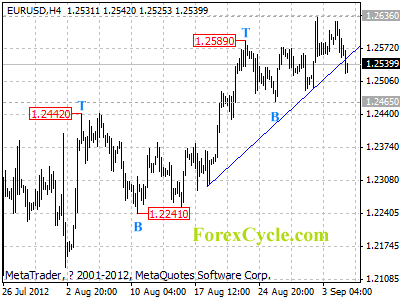
EURUSD breaks below the upward trend line

EURUSD breaks below the upward trend line on 4-hour chart. Further decline to test 1.2465 key support would likely be seen, as long as this level holds, the fall from 1.2636 could be treated as consolidation of the uptrend from 1.2241, and another rise towards 1.2700 could be expected after consolidation. On the downside, a breakdown below 1.2465 will indicate that lengthier consolidation of the longer term uptrend from 1.2042 is underway, then further decline to 1.2400 area is possible.

eurusd

Daily Forex Forecast