By Central Bank News
The Bank of England (BoE) kept its official bank rate unchanged at 0.5 percent, as widely expected, and maintained its current target of purchasing assets worth a total of 375 billion pounds.
The BoE said in a statement following a two-day meeting of its Monetary Policy Committee that it expected to complete its asset purchases, also known as quantitative easing (QE), in two months.
The British economy is currently in recession, with gross domestic product (GDP) shrinking 0.5 percent in the second quarter from the first quarter, following quarterly declines of 0.3 percent in the first quarter and 0.4 percent in the fourth quarter.
The inflation rate in July rose to 2.6 percent from 2.4 percent but the BoE expects inflation to recede toward its target of close to 2 percent by the end of the year.
The BoE has held its key lending rate at a record low 0.50 percent since March 2009, when it also started purchasing assets, such as bonds, by issuing central bank reserves to add further liquidity to the economy.
In July the BoE expanded its QE target by 50 billion pounds to 375 billion. The bank said then that it expected to complete the asset purchases by November.
The BoE launched its QE program because it was worried that inflation would undershoot its target without the extra money that is injected directly into the UK economy, bypassing the banking system.
Under QE, BoE electronically creates new money and uses this to purchase UK government bonds, known as gilts, directly from private investors, such as pension funds, insurance companies or other non-financial firms.
As interest rates are very low, the BoE expects these investors to use the cash they receive for their gilts to purchase other assets, such as corporate bonds or shares. This should lowering borrowing costs for companies and encourage the issuance of new shares and bonds.
In addition to QE, the BoE and UK government started a Funding for Lending scheme in June, making 80 billion pounds worth of cheap loans available to households and businesses.
www.CentralBankNews.info
Pound Maintains Gains on Services Data and ECB Speculation
By TraderVox.com
Tradervox.com (Dublin) – Merkit Economics and the Chartered Institute of Purchasing and Supply continued to boost the pound with more than expected data reports. On Tuesday, a report showed that Manufacturing sector shrunk less than the market was expecting and these positive results were compounded by another report yesterday showing that the services sector expanded more than expectation. These reports have dampened speculation of Bank of England expanding its monetary policy which is projected to increase to 425billion pounds by the end of the year. The pound has maintained yesterday’s gains as speculation about bond buying plan from the ECB increased. European Central Bank is set to meet tomorrow after its President Mario Draghi made a spirited appeal on the need of the program.
Paul Robson, a London-based Senior Foreign Exchange Strategist at the Royal Bank of Scotland, indicated that the UK data released this week is marginally positive for the pound and other European currencies. He pointed that this is as a result of the increased optimism the European Central Bank will move to stabilize nations experiencing high borrowing costs. He made these comments after a report showed that services sector in the UK expanded to 53.7 from 51 in July. This is the highest level it has been in the last five months. The market was expecting an increase to 51.2.
The pound increased against the euro and dollar as it emerged that Draghi’s bond purchasing program involves draining funds from other financial systems. The information was released as concerns about the source of money rose, with skeptics indicating that the ECB was planning on printing more money. Draghi admitted in a closed door session at European Parliament on September 3 that the central bank has lost control of the borrowing costs in the region.
The pound increased against the dollar by 0.3 percent to exchange at $1.5910 at the close of trading in London yesterday. The UK currency had reached a May 16 high of $1.5934 during the day.
Disclaimer
Tradervox.com is not giving advice nor is qualified or licensed to provide financial advice. You must seek guidance from your personal advisors before acting on this information. While we try to ensure that all of the information provided on this website is kept up-to-date and accurate we accept no responsibility for any use made of the information provided. Opinions expressed at Tradervox.com are those of the individual authors and do not necessarily represent the opinion of Tradervox.com or its management.
Article provided by TraderVox.com
Tradervox.com is a Forex News Portal that provides real-time news and analysis relating to the Currency Markets.
News and analysis are produced throughout the day by our in-house staff.
Follow us on twitter: www.twitter.com/tradervox
Loonie Down on Central Bank Decision
By TraderVox.com

Tradervox.com (Dublin) – The Canadian dollar is trading low against most of its major peers after the Bank of Canada indicated that the interest rates may be raised to guard against inflation. Keeping the interest rates unchanged, the BOC Governor Mark Carney noted that modest withdrawal of the current monetary policy may be appropriate. Loonie’s drop against the US dollar was earlier precipitated by speculations that European Central Bank may not spur confidence in the euro zone. In its statement, the BOC projected that the economic growth in the country will pick through next year as consumer spending and business investment increases in the country. The statement also projected a decline in exports as global economic growth slows.
Blake Jespersen, the Managing Director of Foreign Exchange at Bank of Montreal in Toronto, said that the BOC story is consistent with its previous views, which is what everyone was expecting. The increased risk-off mood is pushing the loonie down against major peers. However, technical indicators are showing that the Canadian dollar my breach a four-month high level against the greenback if the Fed and the ECB act on measures to stimulate growth in respective countries. According to Greg Moore, a Currency Strategist at TD Securities, the resistance level at 98.43 is a vital level for the USD/CAD pair. The pair touched this level yesterday and it had previous reached this level on Aug. 21 and 28. Greg predicted that if any of the major central banks moves to make fundamental changes in monetary policy such as monetary easing, the pair could move further down.
The Canadian dollar has failed to drop beyond 99.50 cents per US dollar despite breaking a minor support level at 98.80 after the BOC decision. The currency dropped by 0.5 percent to trade at 99.05 cents per dollar at the close of trading in Toronto.
Disclaimer
Tradervox.com is not giving advice nor is qualified or licensed to provide financial advice. You must seek guidance from your personal advisors before acting on this information. While we try to ensure that all of the information provided on this website is kept up-to-date and accurate we accept no responsibility for any use made of the information provided. Opinions expressed at Tradervox.com are those of the individual authors and do not necessarily represent the opinion of Tradervox.com or its management.
Article provided by TraderVox.com
Tradervox.com is a Forex News Portal that provides real-time news and analysis relating to the Currency Markets.
News and analysis are produced throughout the day by our in-house staff.
Follow us on twitter: www.twitter.com/tradervox
Market Review 6.9.12
Source: ForexYard

Following the release of details regarding the ECB’s plan to lower borrowing costs in Spain and Italy yesterday, the euro was able to extend its gains against most of its main currency rivals during overnight trading. The euro-zone news led to risk taking in the marketplace and boosted other higher yielding assets, including gold. Gold was able to break above the $1700 an ounce level last night, and is currently at its highest level since March 12th of this year.
Main News for Today
US ADP Non-Farm Employment Change- 12:15 GMT
• The figure is considered an accurate predictor of tomorrow’s all-important Non-Farm Payrolls figure
• If today’s news comes in above the forecasted 142K, the dollar could see gains during afternoon trading
ECB Press Conference- 12:30 GMT
• The euro received a significant boost yesterday after details of the ECB’s plan to boost euro-zone growth were announced yesterday
• If additional details are given today, the euro could extend its recent gains
US ISM Non-Manufacturing PMI- 14:00 GMT
• If the PMI comes in below the forecasted 52.5, it may lead to an increase in speculations that the Fed will initiate a new round of quantitative easing in the near future, which could weigh down on the dollar
US Crude Oil Inventories- 15:00 GMT
• The inventories figure is forecasted to come in at -4.9B, which if true, may signal to investors that demand in the US has gone up, which could lead to gains for crude oil
Read more forex news on our forex blog
Forex Market Analysis provided by ForexYard.
© 2006 by FxYard Ltd
Disclaimer: Trading Foreign Exchange carries a high level of risk and may not be suitable for all investors. There is a possibility that you could sustain a loss of all of your investment and therefore you should not invest money that you cannot afford to lose. You should be aware of all the risks associated with Foreign Exchange trading.
Euro Up on ECB Bond Purchase Program
By TraderVox.com
Tradervox.com (Dublin) – The 17-nation currency rose to a two-month high versus the greenback as speculation about the European Central Bank plan to announce an unlimited bond buying program today rose. The so called sterilized bond buying program will involve getting funds from other ECB financial systems to be used in bond purchasing. The euro remained high against the yen as two ECB officials indicated that Mario Draghi, the ECB President, is in favor of such a plan to stem the region’s debt crisis. Draghi had told lawmakers in a closed door session that the European Central Bank’s central mandate compels it to intervene in the bond market to ensure that the euro survives. The euro had dropped on Monday as speculation rose on the decision to be taken by the ECB prior to a court decision over the legality of the ECB’s European Stability Mechanism.
According to Emma Lawson, a Currency Strategist in Sydney at National Australia Bank Ltd, the market looks pleased by the details at hand prior to ECB decision. She also added that the increased optimism is due to the fact that ECB looks set to following through its earlier pledge to do everything within its power to salvage the euro. She predicted that the euro will remain at the current levels, which might extend into the ECB meeting. Under the Monetary Outright Transactions, the ECB blueprint, the central bank is supposed to refrain from making any public cap on yields; as such, the bond-purchases program will only aim at government bonds with maturities of up to three years.
The plan seems to be gaining popularity albeit Germany’s concerns. The German Chancellor Angela Merkel said yesterday that she is willing to accept temporary bond buying plan from the ECB. These sentiments have strengthened the euro which rose by 0.3 percent against the dollar to trade at $1.2606 at mid day trading in Tokyo. The 17-nation currency increased by 0.1 percent against the yen to exchange at 98.83 per euro.
Disclaimer
Tradervox.com is not giving advice nor is qualified or licensed to provide financial advice. You must seek guidance from your personal advisors before acting on this information. While we try to ensure that all of the information provided on this website is kept up-to-date and accurate we accept no responsibility for any use made of the information provided. Opinions expressed at Tradervox.com are those of the individual authors and do not necessarily represent the opinion of Tradervox.com or its management.
Article provided by TraderVox.com
Tradervox.com is a Forex News Portal that provides real-time news and analysis relating to the Currency Markets.
News and analysis are produced throughout the day by our in-house staff.
Follow us on twitter: www.twitter.com/tradervox
Sweden cuts repo rate 25 bps to avoid lower inflation
By Central Bank News
Sweden’s central bank, the Riksbank, cut its benchmark repurchase rate by 25 basis points to 1.25 percent, a decision that was only expected by few economists, to prevent inflation from falling further as economic growth is being hit by Europe’s recession.
The Riksbank, which already cut rates by 25 basis points in February, said the repurchase rate was expected to remain at this level until the middle of 2013, helping boost the economy and get the inflation rate back towards the bank’s target of 2 percent.
“Growth in the Swedish economy is now slowing down after an unexpectedly strong outcome so far this year. During the summer the krona has appreciated faster than expected and productivity has also been unexpectedly high. Inflationary pressures are therefore expected to be lower than was forecast in July,” the Riksbank said in a statement.
The Swedish economy expanded by an annual rate of 2.3 percent in the second quarter, up from 1.5 percent in the first, but the bank forecast that growth for the full year of 2012 would slow to 1.5 percent and then 1.9 percent in 2013. In 2011 Sweden’s GDP expanded by 3.9 percent.
The slowdown is mainly due to lower exports to Europe and this would lead to higher unemployment. But it added that the global economy was “growing at a good pace” and the U.S. economy was continuing to recover.
“The situation in the euro area is still uncertain and could worsen, which could have further negative effects on the Swedish economy,” the Riksbank said.
Sweden’s inflation rate fell to 0.70 percent in July, down from 1.0 percent in June and the krona has appreciated faster than expected and productivity has also been unexpectedly high.
“All in all, this means that inflation will be lower in the coming period, compared with the assessment in July,” the bank said.
The bank forecast that consumer prices would rise by an average of 1.2 percent in 2012 and 1.3 percent in 2013, down from 3.0 percent in 2011. In July the bank forecast 2012 inflation of 1.1 percent and 2013 inflation of 1.7 percent.
“The Executive Board of the Riksbank has decided to cut the repo rate by 0.25 percentage points, to 1.25 per cent, to prevent inflation from being too low in the coming period. The repo rate is then expected to remain at this level until the middle of next year,” it added.
www.CentralBankNews.info
A Slow Burn for the Australian Economy
‘He reminds me that we are playing a long game here, and that change is hard, and change is slow, and it never happens all at once. Eventually we get there – we always do.’ – First Lady, Michelle Obama
US First Lady, Michelle Obama is talking about the advice she receives from hubby, US President, Barack Obama.
Clearly the evening conversation at the White House is a lot more intense than at the Sayce House.
But don’t worry, we’re not about to deliver an anti-Obama essay. Mainly because as with all political contests it doesn’t matter who wins. As Gerald Celente says in his latest newsletter, ‘they’re dangerous. They start wars, kill millions, destroy nations. They steal your money and give it to their friends.’
He says all politicians are ‘freaks’. We agree. So whether it’s Obama or Mitt Romney, it doesn’t matter.
Obama has shown he’s just as capable as George W. Bush of sending young men off to die. And doubtless Mitt Romney will capably follow in both of their footsteps.
But we’re not writing to you about the war-mongers today. We’ll have more on that in this week’s Money Weekend.
The reason we quote Michelle Obama is that you can apply her thought process to anything. In this case, we can apply it to the Australian economy…and not in a good way either. We’ll explain what we mean below…
Most things do take time. You can’t bake a cake in seconds, it usually take an hour or more.
For most people it takes hours of effort and practice to learn how to ride a bike.
And few people get the hang of driving a car in one lesson. That takes time too.
The same is true in financial markets.
Most mainstream commentary suggests the financial meltdown started in September 2008, when Lehman Brothers collapsed. What they forget is that trouble was brewing long before that.
The stock markets had topped out in November 2007. But before that in March 2007, warnings bells sounded when US investment bank, Bear Stearns bailed out two of its own hedge funds to the tune of USD$3.2 billion.
Before that, the start of the subprime lending boom stretched back to the 1980s, when Wall Street ‘invented’ mortgage-backed securities.
And in reality, you can take things back even further, to the genesis of the problem — the end of sound money at Bretton Woods in July 1944.
In short, the 2008 bust was a long game…it was slow…and it didn’t happen all at once. In fact it took more than 60 years to cause havoc.
And now we’re seeing this slow process happen again. Arguably, that’s what makes it all the more dangerous for investors. On their own, the small price drops appear minor.
But when you add them together…boy, it’s a big change. You can see that on the following six-month chart for Fortescue Metals [ASX: FMG]:
But it’s not just a highly leveraged Australian mining stock that’s suffering a slow burn.
The Australian housing market is another leveraged industry slowly burning to the ground. And the same goes for the entire Australian and Chinese economies…
The Circus Arrives
Both are slow burning events.
Each day, week, month and year, the impact appears small.
We often hear comments like this: ‘So what if the Chinese economy is only growing at 7% rather than 10%…it’s still the kind of growth most countries would die for.’
That’s true. Most economies would love 7% growth. But the actual growth number isn’t as important as the changing expectations.
If governments have spent and borrowed…and if businesses and consumers have spent, invested, borrowed and grown based on 10% growth, then a 3% cut in Chinese economic growth will have a big impact.
US contrarian investor, Peter Schiff uses a great analogy to describe this problem…
Imagine a circus comes to town. The people who work at the circus start spending their money in the town…the restaurant is full every night…and goods are flying off the supermarket shelves.
However, not realising that this influx of people is a temporary event, the local restaurant owner decides to expand his business. He buys the shop next door, puts in more tables, and upgrades his kitchen to meet the extra demand.
He’s now ready to feed the hordes. Except no-one comes…not that night, or the next night, or for the rest of the year.
Why? Because the circus has left town. What the businessman thought was a sustainable economic boom turned out to be nothing more than a temporary stimulus. And like all stimulus plans, one day it will end.
This leaves the businessman with a big kitchen and a big restaurant, but no customers. In other words, it was a waste of resources.
This is why economic stimulus plans distort an economy. They fool businessmen and consumers into believing that things are just fine. It’s why so many mainstream economists were surprised when retail sales figures fell.
As the Sydney Morning Herald (SMH) reported this week:
‘Retail sales dropped 0.8 per cent in July to a seasonally adjusted $21.418 billion following a revised 1.2 per cent rise to $21.579 billion in June, according to the Australian Bureau of Statistics, underscoring the ongoing weakness in the sector. A consensus of analysts polled by Bloomberg had tipped a 0.2 per cent rise.’
Now, we’re sure the analysts surveyed aren’t dumb. But for some reason they didn’t realise the previous rise in retail sales was only short-term.
Only after the fact, did they figure it out. As the SMH article notes:
‘”Helped by carbon tax compensation, we saw green shoots of recovery in spending in June but this has not flowed through to July,” said Ms Ell [from Moody’s]. “Until there is a sustained improvement in consumer sentiment, retail spending will keep disappointing.”‘
In other words, thanks to government handouts, the circus came to town for a couple of months. This excited business owners, and so they invested more in their businesses. But now the circus has gone, and those businesses have left-over stock they can’t shift.
This week another Aussie retailer has gone bust, women’s clothing store, Ojay.
The Circus Leaves Town
This isn’t about a two-speed economy. It’s not about the mining sector doing well and the non-mining sector doing badly. This is about the end of the mining boom and the knock-on effect it has on the rest of the Australian economy.
Remember, we explained how this works last week. Dollars coming into Australia go into the banking system, they multiply the deposits and lend it to consumers and businesses. Businesses and consumers then spend this money in the Australian economy.
So when the money stops flowing in from overseas…or it flows slower, it doesn’t just impact the resources companies (such as Fortescue Metals), it impacts the whole economy.
But unlike when a circus leaves town, this isn’t so obvious. You don’t see a caravan of consumers and businesses leaving town with all their wares. The exodus is much quieter, and that’s why you get the slow burn.
The Australian economy has had a dream run for 21 years since the last recession. However, despite the protests of the mainstream commentators and politicians, the dream run is over.
Cheers,
Kris.
Related Articles
What You Must Do to Survive the Coming China Crash
Take Advantage of the High Australian Dollar While You Can
Spanish Banks are in BIG Trouble
I’m sure you’ve heard the quote from Warren Buffett: “You only find out who is swimming naked when the tide goes out.” The tide he refers to is cash. When the cash evaporates, there’s nowhere to hide. Be it an individual, a corporation, or a government – that’s when you are found out. And right now, cash is evaporating from Spanish banks.
This is as serious as it gets. With Europe it’s easy to get complacent. We’re all a little desensitised to the European problem.
But we need to snap back into action. Because Spanish banks are now in deep peril.
Bankia had to take emergency funding this week. And more are sure to follow. Money is flooding out of the country and it will be very difficult for the Spanish authorities to contain this problem themselves.
Money is Flooding Out of Spanish Banks
Spanish banking group Bankia was put together in December 2010. Seven faltering regional banks were rolled into one. It was a classic and ridiculous move that took Spanish banks small enough to fail and rolled them into one, too-big-to-fail institution.
As such, it wasn’t long (May 2012) before the Spanish government was called upon to part-nationalise it, and bung in a load of cash.
And now that the tide is going out on Spain. Cash is flooding out of the country. In July, Spaniards withdrew a record €75bn from their banks — an amount equal to 7% of the country’s total economic output.
That has left Bankia looking highly exposed. This week the government put the patient on a drip – providing €4.5bn in stopgap rescue money.
But as I’ll explain in a moment, the patient is in terminal decline. The drip will be in place for a long time. And the problem is, the Spanish banks are much bigger than the government – Spain has already had to secure €100bn from partner states to help resuscitate this particular patient.
Deutsche Bank suggests that when (not if) Bankia has bled the government for €120bn, the government’s debt-to-GDP ratio will have reached 97%. And that’s just one bank!
And it goes on…
Bankia’s problems come down to bad debts. Specifically mortgages. The Spanish property market is in freefall – particularly the highly leveraged coastal areas.
And with unemployment hitting 25%, it’s not just the second homes market that’s in trouble. Last week I was talking to an old friend who’s just laid his hands on a villa for €175,000 – previously marketed at nearly a million.
That means a lot of individuals will be sitting on big losses. But so will the Spanish banks. Up until now, they’ve been able to gloss over the losses. So long as the banks had cash, they could be forgiving. Spanish banks have been in no hurry to foreclose.
Repossessions would mean putting the properties on the banks’ balance sheets. And to shift the banks’ properties to the banks, they’d have to revalue them to today’s prices. And that would mean big fat losses.
But the tide is going out. Cash is disappearing out of Spanish banks. It’s getting harder for the banks to cover their private parts. And Bankia won’t be the last one to start the long and painful process of admitting its losses…
The Spanish Banks Con is On
Finance is a fascinating game. It’s a confidence game. Back in 2007-2008 when the con was about to be exposed, the authorities were left with a choice.
They could take the Icelandic approach and admit the con. They could let the banks go down, let the currency drop to the floor and let the losers (depositors, bond holders and shareholders) take their medicine.
Or they could keep the con going.
Needless to say, most of the authorities opted for the latter. They bundled the banks into bigger entities, backed them up with state guarantees and then crossed their fingers in the hope that nobody would notice.
In the case of Bankia, they even floated the new mega-bank and raised a load of new cash from fresh victims. Spanish newspaper El Pais cited a purchase form for €6,000-worth of shares signed by an 86-year-old woman’s fingerprint.
Old, illiterate, who cares? Take their money!
Well, it looks like the con may finally be in its last throes – in Spain at least. I suspect that many savers are looking to shift their cash somewhere safer…
The Only Real Savings Vehicle
The tide moves slowly. Almost unnoticed, it ebbs away. Many are busy playing on the beach, eating hotdogs and licking lollies. They don’t notice the naked swimmers frantically groping around for bathing attire.
But some notice the furore in the shallow waters.
In the case of the ebbing cash tide, the astute shift financial assets to real assets. Precious metals for sure. I recommend holding 5-10% of your savings in gold.
In time, the less astute will see the con. An Icelandic-style reset of the system will be painful for them.
Gold is rallying towards $1,700… more and more beachside revellers see what’s going on.
Don’t be the last man in!
Bengt Saelensminde
Contributing Editor, Money Morning
Publisher’s Note: This article originally appeared in MoneyWeek
From the Archives…
Why There’s No Such Thing as a Floor Price Just the Market Price
31-08-2012 – Kris Sayce
Take Advantage of the High Australian Dollar While You Can
30-08-2012 – Greg Canavan
Smartphone, Dumb Patents
29-08-2012 – Jeffrey Tucker
Find Out if You’re a Speculator, Value Investor or Stock Trader
28-08-2012 – Nick Hubble
Why Green Energy Will Struggle Against a 790,000 Year Habit
27-08-2012 – Kris Sayce
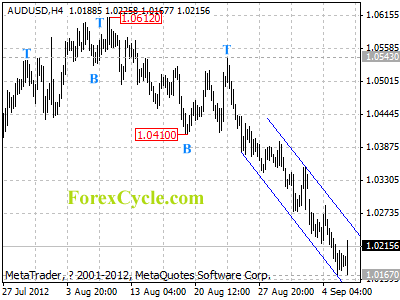
AUDUSD’s downward movement extends to 1.0167
AUDUSD’s downward movement from 1.0543 extends to as low as 1.0167. Resistance is now at the upper border of the price channel on 4-hour chart, as long as the trend line resistance holds, another fall could be expected after a minor consolidation, and next target would be at 1.0100 area. On the upside, a clear break above the channel resistance will indicate that lengthier consolidation of the downtrend is underway, then further rally to 1.0300 area could be seen.

Poland to cut rates if economy weakens, inflation eases
By Central Bank News
The National Bank of Poland (NBP), which earlier today kept interest rates unchanged, will consider cutting interest rates if the economy weakens further and inflationary pressures remain low.
Financial markets have become confident that the Polish central bank is shifting to an easing bias due to a deteriorating outlook. In addition, the bank’s governor, Marek Belka, said last month that the Monetary Policy Council was now discussing rate cuts rather than rate hikes.
“Should the incoming data confirm further weakening of economic conditions, and should the risk of increase in inflationary pressure be limited, the Council will consider adjustment of monetary policy,” the NBP said in a statement following news that the bank kept the reference rate steady at 4.75 percent.
The central bank said the council decided to keep rates unchanged because a slowdown in Poland’s economy would help keep down inflation.
Although inflation eased to an annual rate of 4.0 percent in July from 4.3 percent in June, it remains above the central bank’s target of 2.5 percent.
The bank expects inflation to gradually decline in coming months, but it said households’ inflation expectations remain elevated and a recent rise in global commodity prices poses an upward risk.
In its July forecast, the bank looked for inflation of 3.9 percent in 2012, down from 2011’s 4.3 percent.
The NBP said economic growth in the second quarter – an annual rate of 2.5 percent – was slower than expected and this was accompanied by lower corporate lending along with lower lending to households.
The bank expects Poland’s GDP to expand by 2.9 percent in 2012, down from 4.3 percent in 2011.
The central bank last changed its interest rates in May, when it surprised markets by raising the
reference rate by 25 basis points.
www.CentralBankNews.info