How to Get Rich… and Not Get Taken

Article by Investment U

Last week, the SEC released a wide-ranging report on financial literacy in the U.S. And the conclusion is clear: We’re not there yet. Not even close. Yet the consequences have never been greater.

Corporate pension plans have gone the way of the Passenger Pigeon. And without serious reform, Social Security – according to that agency’s own website – will soon be done in by time and arithmetic. At the very least, the age of initial eligibility is likely to be raised dramatically in the years ahead…

To a great extent, we Americans are on our own. Yet need to understand basic financial concepts – and apply them. Yet the SEC report –and others like it – show that the vast majority aren’t ready.

A 2008 Heath and Retirement Survey concluded that most Americans “lack even a rudimentary understanding of stock and bond prices, risk diversification, portfolio choice and investment fees.” The most common response to most questions in the survey was, “Do not know.”

Ignorance Gets Really Expensive, Really Fast

It’s a shame that even good students graduate from high school today without understanding compound interest, variable-rate mortgages, Roth IRAs, what a bond is or why we have a stock market. Teachers will argue that students suffer from historical or scientific illiteracy, too. But being unable to find Spain on a map or not knowing who Michelangelo was are not going to cost you tens of thousands of dollars over your lifetime.

When it comes to money basics, ignorance gets really expensive, really fast. Yet here are just a few highlights from the new SEC report.

When asked the primary benefit of portfolio diversification, respondents were given three choices: a) risk reduction, b) increased returns, or c) reduced tax liabilities. Only 56% knew the answer was A. Then again, even if they had no idea whatsoever, respondents had a 33% chance of getting it right. The reality is that most participants didn’t even know this most basic piece of financial wisdom.

A Crying Shame…

When asked whether a young investor willing to take moderate risk for above-average growth should invest in a) Treasury bills, b) Money market funds, or c) Balanced stock funds, 63% of respondents chose the wrong answer – and even 49% of fund owners didn’t know the correct answer was C.

When asked whether a traditional IRA, a 401(k), or a Roth IRA offered withdrawals that are tax-exempt, only 44% knew the correct answer was a Roth.

This is a crying shame, especially in a country like ours where citizens are given the freedom and opportunity to pursue financial independence. Instead, too many learn the hard way, falling for the siren song of an expensive insurance agent or transaction-based broker … or committing hari-kari in a discount brokerage account.

What is the solution? Teaching basic financial literacy in every public high school in the country would be a good first step. But education reform is slow and difficult, not least of all because less than 20% of teachers polled said they felt competent to teach saving and investing.

Fortunately, Investment U exists to fill this gap. We cover everything here from the most basic principles to the most advanced strategies – and tie them into what’s happening in today’s stock, bond, currency and commodity markets.

So stick with us. We’re committed to sharing the secrets of investment success. And – since this service is free – the cost is only five minutes of your attention each day.

That’s a pretty modest trade-off for something that can mean the difference between being comfortable and secure … or being a burden to your family or a dependent of the state.

Good Investing,

Alex

P.S. At Investment U, we aim to offer a wealth of investment wisdom for free. But we also offer premium services to our readers. (How could we afford a free eletter if we didn’t?)

For instance, our Investment U Plus service offers the same newsletter you get now, PLUS specific stock recommendations from myself and our other experts along with each daily issue – for just $5. And today, I’ve clued our Plus readers into an excellent REIT paying a healthy yield. Better yet, its CEO has been buying up MILLIONS of dollars in shares, despite the stock hitting new highs. This is the just the kind of insider buying we look for…

If you’re interested in gaining this type of exclusive intelligence with each issue for a minimal cost, click here to learn more.

Article by Investment U
Don’t Expect a Black Wednesday in Denmark

Article by Investment U

George Soros made more than $1 billion in 1992 on the basic premise that something was not right. Specifically, he saw that Great Britain’s currency was about to fall apart.

Black Wednesday refers to the events of September 16, 1992, when the British government had no choice but to withdraw the pound from the European Exchange Rate Mechanism (ERM) when they couldn’t keep the pound above its agreed lower limit. Soros made his $1 billion profit by shorting the British currency.

How, Exactly, Did This Happen?

Two decades ago, England had pegged its currency to Europe’s ERM. “Pegging” is a means of stabilizing a nation’s currency by fixing its exchange rate to that of another currency. The concept for pegging to a single currency becomes more attractive if the peg is to the currency of a trading partner. Usually a pegged exchange rate will have some sort of beginning target exchange rate, and the actual exchange rate will be allowed to move in a specific range around that beginning rate.

The ERM was the predecessor to the euro. It was introduced in 1979 in an attempt to reduce currency inconsistency and achieve monetary stability in Europe.

The peg was set up to create a sense of economic harmony between the island and the continent. However, Soros realized that the peg was unsustainable. The economies of Britain and the European Union were just too different.

As the British government attempted to keep up this fixed rate, the process left Britain with high interest rates and inflation.

Soros saw that maintaining this standard was in fact fighting market forces. So he took up huge short positions against the pound. The government raised its interest rates to double digits to tempt potential investors. Britain was desperate to ease the selling by pumping up buying pressure.

Amazingly, it took a while for the British government to realize that if you raise rates, you pay out more. Britain would lose billions of pounds by artificially propping up the currency. It was left with no choice but to withdraw from the ERM. The pound cracked and Soros’ short bet netted him a cool billion.

I gave you the history lesson because many pundits and investors out there believe that a similar situation is coming to fruition in Denmark. Denmark has pegged the krone to the euro and is doing some peculiar practices to keep it in place.

Extreme Pressure on the Danish Krone

Earlier this summer, the former head of Denmark’s Central Bank voiced concerns that the Danish krone was coming under intense pressure from investors seeking a safe haven currency against the euro. Nils Bernstein, the then governor of the Danish Central Bank, stated that the pressure on the krone is the worst he’s seen over his seven-year tenure as governor.

People “in the know” are aware that holding your cash in the krone is a lot safer than having euros. There’s the obvious fact that Denmark is rated “AAA,” while the Eurozone has to deal with those pesky PIIGS in the South.

These savvy investors also know that the influx of funds flowing into Danish bonds is due to the government’s slim budget deficit and current account surplus. Also, many hedge funds are taking long positions in the currency in case the euro fails.

All of this money pouring into the krone has the Danish government fighting to keep up its very narrow pegged exchange rate with the euro.

Those Crazy Danes…

In order to keep the krone pegged to the euro, Denmark’s Central Bank has been following these two curious procedures:

1) The Central Bank has cut interest rates below zero. That’s right. Interest rates are negative in Denmark to deter investors from using its currency to park money.

2) The Central Bank is selling its own currency and buying up euros. Denmark’s foreign currency reserves have more than doubled over the last four years. They hit record highs the last two consecutive months.

Red flags are being raised because it’s not natural for a nation to have negative interest rates or chose to buy a bad currency with it’s own good one. And some are seeing this as a new possible billion-dollar trade. But they may be a little too ambitious…

What to Expect Going Forward

When you take a look at all factors – especially the large flows of money coming into Denmark from those in Europe and global currency speculators – I think, as well as these investors, that the Denmark Central Bank will not continue to defend its peg to the euro forever.

The more problems the EU will face in the future, the more money that will come Denmark’s way. And it may seem a little more attractive than its fellow European safe havens. Denmark’s currency has been seen by some in the Forex world as less risky than the Swiss franc. The reason is that the Danish government has a true established peg rather than a floor in regards to the euro. This means that there is some protection in the case of a EU recovery

According to Stuart Fiertz, President of the London hedge fund Cheyne Capital, “Just because a peg has been in place a long time doesn’t mean it cannot break. It just means that it’s cheaper… If the euro cracks, the pressure to cut the peg will be overwhelming.”

If it comes to the point where Denmark will have to give up its pegged exchange rate, experts expect the krone to appreciate around 20% to 25%. That will move it in line with the other European “safe havens currencies” – like the Swiss franc and Norwegian krone – outside of the Europe Union.

I hope this shed’s a little light on the situation for you Forex traders out there…

Good Investing,

Jason

Article by Investment U

My “Boom Chip” Blueprint

Article by Investment U

I have carefully studied the success of Pacific Rim tycoons, from the world’s richest woman (from Australia) and Hong Kong’s Li Ka-Shing to Mexico’s Carlos Slim – the richest man in the world.

Some of these tycoons were born into wealth, but many come from modest backgrounds. For example, Li Ka-Shing, after his father’s death, had to leave school at the age of 14 to work 16 hours a day in a plastics factory. Slim is the son of Lebanese immigrants.

But they all share one powerful trait – they grew their fortunes by building and investing in what I call “boom chip” companies…

The best way to describe a boom chip stock is to contrast it with what is in many ways its opposite – blue-chip stocks. Blue chips are large, stable, mature companies based in Western markets with slow sales and profit growth plus dependable dividends.

One widely held blue chip is Johnson & Johnson (NYSE: JNJ). Its international sales have tripled during the past decade, but its stock has performed poorly, with an average annual return of less than 1%!

Another blue chip you’re familiar with is Kraft (Nasdaq: KFT), a bundle of blockbuster brands like Jell-O, Maxwell House, Tang, Miracle Whip and Oreos.

It’s done a bit better than JNJ…

Kraft has 12 brands generating $1 billion each year, and Tang is the most recent addition to this exclusive club. With all these killer brands aimed at emerging growth, Kraft is expected to grow revenue around 3% a year over the next three years. Not bad for a food giant.

While a stock like Johnson & Johnson or Kraft in your core portfolio is a great way to protect and incrementally grow capital, you’ll need to think a bit more boldly if your goal is to build substantial wealth.

“Be an Adventurer…”

You can put some sizzle in your portfolio by following John Train’s advice in his book Preserving Capital:

“Be an adventurer; like the American of a century ago, not his clerkish descendant of today. You must think as a builder, a conqueror.”

One way to do this is by investing in boom chip, home grown multinationals based in Pacific Rim frontier countries. These dynamic “favored” companies benefit from my Boom Chip Blueprint:

  • Durable government backing = key regulatory edge
  • Home court advantage and protected markets = much higher profit margins
  • Allied with blue-chip companies and local tycoons = clear competitive edge
  • Operate in booming markets = high and dependable growth
  • Cost advantages = bigger profits
  • Still at an early stage of their growth cycle = sustainable high growth
  • Are off the radar screen of Wall Street analysts = opportunity for value entry point

In short, “favored” boom chips offer you significant advantages, and this means big upside potential.

Let’s take a closer look at a specific example…

A Mexican Boom Chip

I’ve written before about how Mexico is on its way to replacing China as the premier Pacific Rim global manufacturing platform for selling into North and South American markets.

Why? China’s once huge advantage in labor costs is evaporating…

In 2000, Mexico’s manufacturing wages were 240% higher than in China. Now they’re only 12% higher, and given all the logistical issues and transportation costs that come with shipping parts to China and then bringing the final product back, you can easily see Mexico’s advantage.

About 80% of Mexico’s exports are manufactured goods and trade now represents 60% of GDP – a figure that has more than tripled since 1980. Mexican exports hit a record high in April of this year.

Mexico’s competitive edge is supercharged by a weak peso policy that has pushed the peso down an incredible 1,500% against the dollar since 1987 – though the peso is starting to trend upward.

This is why American, European, Japanese, South Korean and, yes, even Chinese are falling over each other to invest in Mexican production facilities. One example is the recent opening of Italian tire maker Pirelli’s first plant in Mexico.

The Real Key to Mexico’s Growth

Always keep in mind: With Mexico’s geographical edge next to two huge markets and as a Pacific Rim country, it has ready access to all Pacific Rim markets. And take a look at the big picture. While U.S. debt is approaching 90% of GDP, Mexico is at 27%. America’s budget deficit is 8.6% of GDP, while Mexico is at 2.5%.

But the real key is that the Mexican Government sees fostering growth in manufacturing as a top priority to provide employment, political stability, and the carrot to attract significant levels of foreign investment that can supercharge its economy. While the United States is also seeing a revival in manufacturing, it benefits from this shift in Mexico’s favor for strategic reasons.

Late last year, I shared with you my Grupo Simec (AMEX: SIM) boom chip play on this manufacturing trend.

Simec provides the finished steel that goes into manufacturing plants being built hand over fist by global companies taking advantage of Mexico’s edge. In 2011, sales were up 19% and operating income was up 123%. In the first quarter of 2012, Simec posted a 24% increase in net sales and a 145% jump in operating earnings. Sales within Mexico were up 33% as the company exports about half of its production. The stock is trading right around book value, at 75% of sales and at only 3.24 times forward earnings.

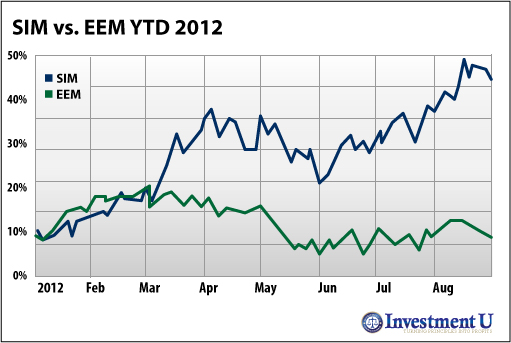
So far in 2012, Grupo Simec is up 48.37% while the Emerging Market Index is as flat as a pancake:

SIM vs. EEM YTD 2012

If you blend in some boom chips with your blue-chip stocks, you’ll have the opportunity to take your portfolio to the next level.

Good Investing,

Carl

Article by Investment U

Major Forex Events This Week

By TraderVox.com

Tradervox.com (Dublin) – US Non-Farm Payrolls and ECB’s bond-buying programs were the biggest market influencers last week. With volatility back into the market, investors will be looking at the US for the QE3 program and Germany as the ruling on legality of European Sustainability Mechanism facility. Here is a brief overview of major events this week.

Tuesday 11

The US Trade Balance will be the first major report this week at 1230hrs GMT. Last month data showed that the US trade deficit declined by most in eighteen months in June, shrinking to $42.9 billion from a May figure of $48 billion. Economists are expecting this figure to rise to $44.2 billion for July when this report is released.

Wednesday 12

There will be two major reports on this day, -the UK employment data and the New Zealand Rate Decision. The previous UK employment report showed a decline in the number of people claiming unemployment, dropping by 5,900; this caused a decline in unemployment rate to 8.0 percent. The market is expecting an increase of 100 claims on this report to reach 6,000. The market is expecting the Bank of New Zealand to keep the current interest rate of 2.50 percent.

Thursday 13

There will be five major events on this day. First, at 0730hrs GMT, the SNB Rate Decision will be announced. With the euro strengthening against the franc, the central bank will have little pressure to defend its cap. The market is expecting the rates to remain between 0.0 percent and 0.25 percent. The US PPI data will be released at 1230hrs GMT where the market expects the index to climb to 1.2 percent from 0.3 increase registered in July. The US Unemployment Claims will be released at the same time where a rise to 370,000 is expected. Staying in the US, the US rate decision will be announced at 1630hrs after the FOMC meeting. While the policy makers in FOMC are expected to consider QE3, extending guidance is a more likely outcome from the Fed. The market will be evaluating Fed Chairman Ben Bernanke’s speech after the meeting.

Friday 14

US data will carry the day of Friday with the first report being the US Inflation Data released at 1230hrs together with US Retail Sales. The consumer prices were unchanged in July. The market had predicted a rise of 0.2 percent which was similar to previous four months result. This time round the market is expecting a rise of 0.5 percent while the core CPI is expected to increase by 0.2 percent. The US Retail Sales is expected to increase by 0.7 percent. Third major report on this day will be the US UoM Consumer Sentiment report which will be released at 1355hrs GMT. The report is expected to show an increase to 74.1 from 73.6 registered last month.

Disclaimer
Tradervox.com is not giving advice nor is qualified or licensed to provide financial advice. You must seek guidance from your personal advisors before acting on this information. While we try to ensure that all of the information provided on this website is kept up-to-date and accurate we accept no responsibility for any use made of the information provided. Opinions expressed at Tradervox.com are those of the individual authors and do not necessarily represent the opinion of Tradervox.com or its management. 

Article provided by TraderVox.com
Tradervox.com is a Forex News Portal that provides real-time news and analysis relating to the Currency Markets.
News and analysis are produced throughout the day by our in-house staff.
Follow us on twitter: www.twitter.com/tradervox

Market Review 10.9.12

Source: ForexYard

printprofile

The euro reversed some of last week’s gains against the US dollar in overnight trading, but remained close to the four-month high it hit following a worse than expected US Non-Farm Payrolls figure. After reaching a one-month low against the Japanese yen at 78.01 on Friday, the USD was able to stage a slight upward during Asian trading and is currently trading at 78.25. Crude oil and gold saw little movement last night, as hopes that the Fed will soon initiate a new round of quantitative easing kept both near their recent highs.

Main News for Today

With no major economic news scheduled to be released today, traders will want to continue monitoring announcements out of the US which may hint at whether the Fed is planning on initiating a new round of quantitative easing when they meet later this week.

Forex Market Analysis provided by ForexYard.

© 2006 by FxYard Ltd

Disclaimer: Trading Foreign Exchange carries a high level of risk and may not be suitable for all investors. There is a possibility that you could sustain a loss of all of your investment and therefore you should not invest money that you cannot afford to lose. You should be aware of all the risks associated with Foreign Exchange trading.

Super Mario Draghi’s Bazooka is a Dud

By MoneyMorning.com.au

Not too long ago I mentioned that whatever European Central Bank President “Super Mario” Draghi delivers, it had better be big.

Because the only way he could hope to shore up the beleaguered euro, wrest control of interest rates from the modern day financial pirates that dominate credit default swaps and break the impasse between skittish investors was with a monetary “bazooka.”

We certainly got one when he announced an unlimited bond purchase program designed to do exactly this.

The S&P 500 shot up 26.13 points while the Dow and Nasdaq both tacked on 216.01 and 62.80 points respectively.

European markets also moved sharply higher on the news as well while Spanish and Italian yields tumbled at maturities of every length suggesting traders relaxed their risk aversion stance considerably.

Under Draghi’s plan, the ECB will be buying unlimited amounts of short-term sovereign debt while also sterilizing that debt – ostensibly to stave off concerns about hyperinflation and further money printing.

Up to now, the ECB has only purchased troubled EU bank bonds as a buyer of last resort. So this is a big change now that Draghi is talking about stepping up as a sovereign debt buyer, albeit also of last resort.

Draghi noted interestingly that the ECB will retain exclusive decision making on when to engage in purchases, the amounts purchased and when to stop. This effectively puts the politicians on notice that further bickering will not be tolerated.

Further, Draghi did not rule out purchases of Greek, Portuguese and Irish bonds when those countries regain practical access to the bond markets.

There are a couple of things that stand out here…

A Cause for Fear, Not Celebration

First, things are so bad that insiders are using euphemisms to describe Draghi’s plan which is officially referred to as a “blueprint” and called “Monetary Outright Transactions.”

I don’t know about you but if it smells like a duck, walks like a duck and quacks like one, too…odds are pretty good it’s a duck.

It doesn’t matter whether you are talking quantitative easing or bond purchasing. The fact that things are so bad that central banks – first the BOJ, then the Fed, now the ECB – have to wade in as lenders of last resort should be a cause for fear rather than celebration.

If not now, than a few years from now, when it all comes back to roost.

Here’s why.

Under Draghi’s blueprint, the ECB is going to be buying bonds from troubled sovereigns. The banks, meanwhile, “sterilize” their debt by investing with the ECB.

The only trouble is that the banks have been borrowing money from the sovereigns all along so the money they are “investing” to sterilize the ECB’s purchases really came from the ECB in the first place.

The money is simply going around in circles – whether that’s like a tornado or a toilet bowl depends on your perspective.

Then there’s the cash itself.

As I understand it, Draghi’s plan presumes that European banks are going to invest it in the ECB as part of the sterilization process. Last time I checked, many European banks are functionally insolvent because they don’t have enough cash to operate let alone invest the excess, especially when it comes to Spanish and Italian banks.

At the same time, banks are deleveraging in order to meet revised capital requirements. They are selling assets and scaling back lending. When you scale back lending you have less credit. And less credit means less growth.

The ECB itself forecasts the economy will expand by 0.5% in 2013 and a deeper economic contraction in 2012 that shows Eurozone GDP dropping 0.4% instead of 0.1%.

In other words, the numbers are already going in the wrong direction – and that’s before any sort of austerity whatsoever. Imagine what happens when somebody actually starts getting serious about spending less.

Second, the plan targets sovereign government bonds with 1-3 year maturities while also including longer dated instruments that have residual maturities within the 1-3 year time frame.

That means there are huge swathes of the credit market that will not be stabilized nor sterilized. It also fails to address corporate and private debt both of which have also reached problematic levels in the EU just like they have here in the United States and Japan.

According to Eurostat long term sovereign debt accounts for between 74.6% and 98.9% of total debt in 23 EU member states. Shorter term levels of less than 5% were recorded in Estonia, Slovenia, Austria, Slovakia and Poland. Only Sweden and Romania presented a significant short term debt ratio which Eurostat defined as greater than 23% according to the latest data.

Source: Eurostat

In other words, by addressing the short term debt (in purple), the ECB is potentially leaving the bulk of the long term market (in yellow) out of the picture.

Third, Draghi’s concept of “unlimited” really bothers me. It’s been a common theme so far because policy wonks want to “send a signal” to the markets that they are serious about fixing this problem.

I don’t know about you, but I am tired of signals.

What I would like to see is governments learning to live within their means and the derivatives traders who have fractured the credit markets, making Draghi’s actions necessary, held accountable for having driven the rest of the world to the brink of financial oblivion.

Granted, Draghi did say that nations requesting purchases will have to apply to the ECB and maintain specific behavior to qualify on a periodic basis, but so what.

EU membership supposedly required strict adherence to the Maastricht criteria which formed the basis of the initial economic and monetary union and that’s been effectively ignored or violated six ways to Sunday since it was signed in 1991.

So Now What?

Draghi’s plan is little more than a fresh shot of intoxicants for stimulus addicted markets. I have no doubt that it will create a “rush” that people enjoy.

How big and how long this “rush” lasts really doesn’t matter – two weeks or two years – I don’t know.

At the end of the day, I’ll take a rally. Right now the world’s investors could use one psychologically and financially. But, get ready for reality.

Once traders and central bankers figure out what unlimited actually means and how expensive Draghi’s bond bazooka will become I have no doubt we’re going to experience the entire doom, gloom and boom cycle all over again.

Keith Fitz-Gerald,
Contributing Editor, Money Morning

From the Archives…

Outright Money Transactions – Why ‘Free’ Money Costs You More
07-09-2012 – Kris Sayce

Spanish Banks are in BIG Trouble
06-09-2012 – Bengt Saelensminde

With Iron Ore Prices Falling Will Fortescue ‘Break the Buck’?
05-09-2012 – Kris Sayce

Brace Your Portfolio for a Hard Landing in China
04-09-2012 – John Stepek

Australian Resources Boom Curse…or Industrial Renaissance?
03-09-2012 – Nick Hubble


Super Mario Draghi’s Bazooka is a Dud

GBPUSD continues its upward movement

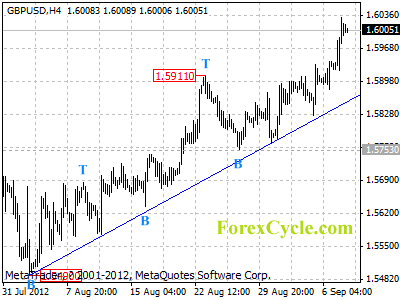
GBPUSD continues its upward movement from 1.5490, and the rise extends to as high as 1.6033. Further rise could be expected after a minor consolidation, and next target would be at 1.6100 area. Key support remains at the upward trend line on 4-hour chart, only a clear break below the trend line support could signal completion of the uptrend.

gbpusd

Forex Signals

Mexico keeps rate steady, warns of hike if inflation rises

By Central Bank News
    The central bank of Mexico left its benchmark interest rate unchanged at 4.5 percent, as widely expected, but warned that it may have to raise rates if inflationary pressures continues to build.
    Banco de Mexico said it still believes the current level of interest rates would ensure that inflation declines towards the bank’s target on a permanent basis, but over the next few months inflation is expected to continue to remain at levels above 4 percent.
     Earlier today, the statistics agency reported that Mexico’s annual inflation rate accelerated to 4.57 percent in August, up from 4.42 percent in July. Inflation has been rising since May due to higher vegetable and fruit prices from drought in northern Mexico and in the United States. An outbreak of avian flu and a recent increase in grain prices has also pushed up prices
    Banco de Mexico targets inflation of 3 percent, plus/minus one percentage point. The bank has left its target for the overnight interbank interest rate unchanged since July 2009.

    The central bank said it still considers the effect of these supply shocks on inflation to be temporary but “given the intensity of the shocks that have affected food prices and the potential remains for further turbulence in international financial markets, it is considered that the risks to inflation in the near term continued to rise.”
    These risks, however, are balanced out by deflationary conditions in most advanced economies and slow growth in most emerging economies, which tends to reduce inflationary pressures, the bank said.
    “Going forward, the Board will continue to monitor developments in all the determinants of inflation, since the behavior of these might make it advisable to adjust upward the benchmark interest rate, Banco de Mexico said in a statement.
    The bank struck a somber tone in its global economic outlook, saying downside risks to global growth have increased due to moderate U.S. growth and uncertainty regarding the fiscal tightening in 2013 along with slowing growth in many emerging markets.
    Slower global growth should lead to lower inflation in 2012 and 2013 compared with 2011 and the bank said there was an underlying deflationary condition in several advanced economies despite the recent rise in some commodities, which is expected to only have a temporary effect on inflation.
     Economic activity in Mexico continues to show a positive trend, the bank said, adding that manufacturing exports and domestic demand continue on an upward trend, which is almost closing the output gap.
    “As for the balance of risks to growth in the Mexican economy, it is considered they continued to deteriorate, reflecting the intensifying downside risks to the global economy and in particular for the U.S. economy,” Banco de Mexico said.
    Mexico’s economy expanded by an annual rate of 4.1 percent in the second quarter, down from 4.5 percent in the first quarter.
    www.CentralBankNews.info

Check What Top Forex Broker Has In Store For You?

Brokerage services ensure that you are in safe hands if your stock trading skills are not polished. The FX broker must be finalized after analyzing their pros and cons for practical result at the end.

Are you looking for brokerage services in the stream of stock trading to ease the pressure while trading? By the end of this article, your every query would be addressed whether it is in terms of features, advantages, tips, etc. To begin with, trading currencies is becoming very popular among trade aspirants in the cyber world. Most of the times, trade enthusiasts are unable to relate to the online forex trading. This brings forex brokers into the picture for their assistance. In simple words, forex trading involves modern technologies wherein, internet plays a crucial role in lending pragmatic results. Currency pairs are purchased by the stock traders and they sell them when the market conditions seem to be favorable for them.  The positioning of currencies is never static, therefore, being a trader, you are highly recommended to buy or sell currency pairs very carefully. Read on, to explore various factors which ought to be analyzed while selecting forex broker.

As a matter of fact, everybody cannot crack the best deal, thus, it is advisable for them to seek guidance. In order to accomplish this task, one can check online database of best forex brokers to finalize the expert of this stream. After you have chosen the FX broker, you can consult with this individual prior to proceeding with the transaction. Secondly, it is worth mentioning that the features offered by the brokers may differ to each other. Hence, it is mandatory for you to check all the facets of brokerage services before actually subscribing for them. In fact, you can compare two or more trading platforms to assess their utility and thereby, draw conclusion which one is best for you!  Besides, you should check for transparency in the services offered by the broker so that, you need not repent later over your decision.  It happens so, many a times
that the users realize after getting subscribed that the selected service provider is not suitable for them.

Thirdly, it is essential for you to understand that the clear and concise definition of top forex broker implicates the trading expert who offers full-fledged services in the sphere of stock trading. In addition, the very broker must be well equipped with the relevant as well as functional trading tools for better experience.  It is often observed that in the wake of rising competition in the market, the FX brokers claim to be the best, but, getting carried away by just reading about them is not justifiable. On a
contrary, a trade enthusiast has to review whether the brokerage services are worth investing on or not. Lastly, with this systematic approach, you can not only
strike the effective deals, but also get maximum exposure to the online trading of currencies. In a course of time, you tend to get prepared for the real time
trade. On a last note, select forex broker wisely after assessing their services and ensuring their profitability in the stock trading market. The whole idea is
to make the most out of brokerage services offered by the selected trading platform.

About Author:

Brown Hazle is an experienced foreign exchange trader and recommends UWCFX.  United World Capital trading platforms are equally suited for top forex brokers.


For more detail about the company:

 Visit: http://www.uwcfx.com/

Monetary Policy Week in Review – Sept 8, 2012: ECB matures, Canada bullish, Sweden cuts, Mexico eyes inflation

By Central Bank News
    The past week in monetary policy saw interest rate decisions by 17 central banks, with 3 banks cutting rates (Sweden, Uganda and Kenya), while the remaining 14 (ECB, Australia, Canada, Poland, Thailand, UK, Malaysia, Peru, Serbia, Mexico, Zambia, Fiji, Egypt and West African States) kept rates unchanged.
     The common theme from central banks was of slower global growth, but solid domestic demand in some countries is helping compensate for lower exports. This includes Canada, Peru, Malaysia, Thailand, Fiji and Mexico, which even raised the prospect of higher rates if inflation continues to rise.
    Sweden surprised most economists by cutting its rate to prevent inflation falling further below the central bank’s target as exports and growth take a hit from Europe’s recession.
     But the main event of last week was the European Central Bank’s ambitious plan to buy an unlimited amount of bonds from any euro zone member state that finds itself in serious financial trouble. 
    Like an adolescent that takes time to grow up, the ECB is gradually maturing into a fully-fledged central bank that will draw on all its resources to protect its family, the 17-nation euro zone. 

   LAST WEEK’S MONETARY POLICY DECISIONS:

COUNTRYNEW RATEPREVIOUS RATERATE 1 YEAR AGO
AUSTRALIA3.50%3.50%4.75%
CANADA1.00%1.00%1.00%
POLAND4.75%4.75%4.75%
THAILAND3.00%3.00%3.50%
EURO ZONE0.75%0.75%1.50%
SWEDEN1.25%1.50%2.00%
UNITED KINGDOM0.50%0.50%0.50%
MALAYSIA3.00%3.00%3.00%
PERU4.25%4.25%4.25%
SERBIA10.50%10.50%11.25%
MEXICO4.50%4.50%4.50%
UGANDA15.00%17.00%16.00%
ZAMBIA9.00%9.00%                  N/A
KENYA13.00%16.50%7.00%
FIJI0.50%0.50%1.50%
EGYPT9.25%9.25%8.25%
W. AFRICAN STATES4.00%4.00%4.25%

   NEXT WEEK:

    The central bank calendar for next week calls for 8 central banks to decide monetary policy, with the global focus squarely on the Federal Reserve’s two-day meeting that ends on Thursday. Expectations are growing that some form of stimulus will be announced following Friday’s weak jobs report.
   The other main event with a potential to rock financial markets is a decision on Wednesday by Germany’s constitutional court on the legality of the euro’s zone’s bailout funds. An unfavourable decision would throw a wrench in policy-makers’ plan to forge a stronger economic union.
    The only central bank that may change interest rates next week is South Korea, where growth is slowing and economists would not be surprised if the Bank of Korea cuts rates again following July’s surprise cut.

 COUNTRY             MEETING                             CURRENT RATE                 RATE 1 YEAR AGO
MOZAMBIQUE12-Sep11.50%16.00%
UNITED STATES13-Sep0.25%0.25%
NEW ZEALAND13-Sep2.50%2.50%
THE PHILIPPINES13-Sep3.75%4.50%
SWITZERLAND13-Sep0.25%0.25%
INDONESIA13-Sep5.75%6.75%
SOUTH KOREA13-Sep3.00%3.25%
CHILE13-Sep5.00%5.25%

www.CentralBankNews.info