EUR/USD: Re-emerging Spanish Concerns Weigh on the Euro

Article by AlgosysFx Forex Trading Solutions

The Euro gave up gains in the previous European trading session as confidence among German investors remained in the negative region, although it improved to -18.2 points in September. The single currency also remained lower than the Greenback as a delay in Spain’s bailout request is expected to make worse the European debt crisis. In today’s European session, the shared currency is expected to extend losses versus the Buck on renewed concerns about Spain.

Spain is facing increasing pressure to request for a full-blown bailout, but Deputy Prime Minister Soraya Saenz de Santamaria said that the government is still considering the terms of the bailout, causing some investors to become impatient. If Spain eventually makes a request, some analysts still believe that it would not be that encouraging for the Euro Zone as the imposition of painful spending cuts is seen to hamper efforts to steer the economy back on track.

Tomorrow, Spain is set to auction 3- and 10-year bonds, which would be a key test of investor confidence. 10-year borrowing costs have declined to 5.9 percent from the Euro-era record of 7.75 percent on July 25, since the ECB revealed its new bond-buying program on September 6 to help lower bond yields. The Euro Zone manufacturing and services PMI reports are also up for release and are expected to show contraction of the sectors as projections are below 50 points. With renewed concerns over Spain, the shared currency is set to drop versus the US dollar. Thus, a short position is suggested in today’s European exchanges.

For more news, analysis, technical charts and candlestick analysis, visit AlgosysFx

EUR Takes Losses despite Positive German News

Source: ForexYard

Despite a better than expected German ZEW Economic Sentiment figure yesterday, the euro took moderate losses over the course of the day, after hitting four-month highs against the USD and JPY earlier in the week. Expectations that the Bank of Japan will soon intervene in the currency market to limit the yen’s recent bullish movement helped the USD/JPY bounce back from a recent seven-month low. Today, a batch of US news is likely to generate substantial volatility in the marketplace. Traders will want to pay attention to the Building Permits and Existing Home Sales figures. If either of them comes in higher than expected, the dollar could see gains against the euro and JPY.

Economic News

USD – US Data Set to Generate Volatility Today

After dropping to a seven-month low against the JPY last week, the US dollar extended its upward correction throughout the day yesterday, as speculations that the Bank of Japan will soon intervene to limit yen growth caused investors to revert back to the greenback. The USD/JPY traded as high as 78.75 during early morning trading, well above last week’s low of 77.13. The greenback also saw bullish movement against the Australian dollar yesterday. The AUD/USD dropped to the 1.0400 level, well below last week’s high of 1.0623.

Turning to today, dollar traders can anticipate substantial volatility in the marketplace following the release of the US Building Permits figure at 12:30 GMT and the Existing Home Sales at 14:00. The greenback may extend yesterday’s upward momentum if either of the economic indicators signals growth in the US economy. At the same time, should any of today’s news come in below their expected levels, the dollar could reverse its recent gains.

EUR – Euro Comes Off Recent Highs

After hitting four-month highs against both the US dollar and Japanese yen earlier in the week, the euro saw bearish movement against several of its main currency rivals yesterday, leading some analysts to speculate that the currency has peaked for the time being. The EUR/USD spent most of the day trading around the 1.3050 level, well below its recent high of 1.3171. Against the JPY, the euro fell more than 50 pips during the first part of the day to trade as low as 102.60.

Today, euro traders will want to pay attention to a batch of US news set to be released during mid-day trading. Should either the Building Permits or Existing Home Sales come in above better than expected, the euro could extend yesterday’s losses against the greenback. Tomorrow, traders will not want to forget to pay attention to several potentially significant pieces of euro-zone news, including manufacturing and services data out of Germany and France, the EU’s largest economies.

Gold – Gold Stages Downward Correction

The price of gold fell over the course of the day yesterday, as investors became concerned that the precious metal was overbought after hitting a near seven-month high last week. Gold spent most of the day trading around the $1755 an ounce level, well below the $1777 level it hit after the Fed announced a new round of quantitative easing in the US on Thursday.

Today, gold traders will want to carefully monitor news out of the US and its impact on risk appetite among investors. Any better than expected news could help the US dollar extend its recent upward movement, which may result in the price of gold falling further. Typically, a strong US dollar causes foreign investors to shift their money away from gold, as it becomes more expensive for them.

Crude Oil – US Inventories Figure Set to Impact Crude

After tumbling more than $4 a barrel earlier in the week, crude oil saw another bearish day yesterday, as investors continued to sell off riskier currencies and commodities. Crude spent much of the day trading around the $96.50 level, well below last week’s high of $100.38.

Today, oil traders will want to pay particular attention to the US Crude Oil Inventories figure, set to be released at 14:30 GMT. Should the indicator come in above expectations, it may signal to investors that demand in the US has gone down, which could result in the price of crude slipping further during afternoon trading.

Technical News

EUR/USD

The Williams Percent Range on the weekly chart has crossed into overbought territory, signaling that a downward correction could occur in the coming days. Furthermore, the Slow Stochastic on the same chart appears close to forming a bearish cross. Going short may be the best choice for this pair.

GBP/USD

A bearish cross on the weekly chart’s Slow Stochastic indicates that this pair could see downward movement in the near future. In addition, the Relative Strength Index on the daily chart has crossed into the overbought zone. Going short may be the best choice for this pair.

USD/JPY

While a bullish cross has formed on the daily chart’s MACD/OsMA, most other long term technical indicators place this pair in neutral territory. Traders may want to take a wait and see approach, as a clearer picture is likely to present itself in the near future.

USD/CHF

The weekly chart’s Williams Percent Range is in oversold territory, indicating that this pair could see upward movement in the coming days. Furthermore, the daily chart’s Slow Stochastic has formed a bullish cross. Traders may want to open long positions for this pair.

The Wild Card

CHF/JPY

The Relative Strength Index on the daily chart has crossed into overbought territory, signaling that a downward correction could occur in the near future. Furthermore, a bearish cross on the same chart’s Slow Stochastic points to possible downward movement. This may be a good time for forex traders to open short positions for this pair.

Forex Market Analysis provided by ForexYard.

© 2006 by FxYard Ltd

Disclaimer: Trading Foreign Exchange carries a high level of risk and may not be suitable for all investors. There is a possibility that you could sustain a loss of all of your investment and therefore you should not invest money that you cannot afford to lose. You should be aware of all the risks associated with Foreign Exchange trading.


Market Review 19.9.12

Source: ForexYard

printprofile

The Japanese yen fell to a one-month low against the US dollar after the Bank of Japan initiated a new round of monetary easing during the overnight session. The USD/JPY is currently trading at 79.13, up from 78.56 at the beginning of Asian trading. The euro saw gains last night against the USD and JPY, but has failed to break past the four-month high it hit earlier this week. After falling more than $1 a barrel during afternoon trading yesterday, crude oil saw a modest upward correction last night but remains well below the four-month high hit last week.

Main News for Today

US Building Permits- 12:30 GMT
• Forecasted to come in at 0.9M, slightly below last month’s 0.81M
• Any worse than expected news could result in the euro extending its recent gains against the greenback

US Existing Home Sales- 14:00 GMT
• Forecasted to come in at 4.57M, which would be an increase over last month’s 4.47M
• Any better than expected news could help the dollar extend last night’s gains against the JPY

US Crude Oil Inventories- 14:30 GMT
• Forecasted to come in at -0.2M, well below last week’s 2.0M
• If the inventories figure comes in as forecasted, investors may take the news as a sign that demand for oil in the US has gone up, which could result in the price of crude turning bullish

Read more forex news on our forex blog

Forex Market Analysis provided by ForexYard.

© 2006 by FxYard Ltd

Disclaimer: Trading Foreign Exchange carries a high level of risk and may not be suitable for all investors. There is a possibility that you could sustain a loss of all of your investment and therefore you should not invest money that you cannot afford to lose. You should be aware of all the risks associated with Foreign Exchange trading.

The Dangerous Standoff in the South China Sea is About to Boil Over

By MoneyMorning.com.au

An already smouldering territorial dispute between China and Japan is threatening to boil over.

Major Japanese firms have ordered shutdowns of their Mainland China operations, and Japanese expatriates living in that country have been ordered to stay indoors as angry protests sparked by the territory disputes have kicked the anti-Japanese sentiment to its highest level in decades.

Last week, Beijing dispatched patrol boats to the five East China Sea islands that are escalating the disagreement between the two Asian heavyweights.

Beijing sent the boats to the Senkaku island region as an angry response to Tokyo’s plan to buy the mostly barren islands.

Over the weekend, well-known Japanese firms such as Honda and Toyota were the focus of demonstrations and violent attacks. And a flotilla of around 1,000 Chinese fishing boats was sailing for the islands.

All of this was prompted by Japan’s announced plan to purchase the five afore-mentioned islands from their private owners.

Chinese Foreign Ministry spokesman Hong Lei said the government would protect Japanese firms and citizens and called for protesters to obey the law.

“The gravely destructive consequences of Japan’s illegal purchase of the … islands are steadily emerging, and the responsibility for this should be born by Japan,” Chinese Foreign Ministry spokesman Hong Lei told reporters at a daily news briefing.

This follows last week’s warning by China’s Foreign Ministry that “if Japan insists on going its own way, it will bear all the serious consequences that follow.”

Although the hottest part of this dispute currently centers upon China and Japan – which generated two-way trade of $345 billion last year – many more Pacific-Region nations are involved.

The Story Behind the Brewing Conflict

The Senkaku islands (known as the Diaoyu islands by China), have been claimed by Japan since 1895. They were taken over by the United States after World War II, and were turned over to Japan in 1972. They are also claimed by Taiwan and Mainland China.

This is just one of several disagreements involving a number of countries over disputed territories in the China Sea.

The Senkaku dispute is focused on the East China Sea.

But the bigger disputes are in the South China Sea.

Those disputes are escalating.

And they’re also confusing – so consider this your program to help you keep the players straight as this news story evolves.

In an area known as the “cow’s tongue,” here are the players – and their disputes.

There’s the Scarborough Shoal, which is claimed by China, and the Philippines and Taiwan.

There’s also the Pratas Islands, claimed by China and Taiwan.

The Paracel Islands are claimed by China, Taiwan and Vietnam.

The Macclesfield Bank is claimed by China, Taiwan, Vietnam and the Philippines.

And the Spratly Islands are claimed by China, Taiwan, Vietnam, Malaysia, the Philippines and Brunei, a tiny “sultanate.”

This region is flush with resources – as much as 213 billion barrels of oil (10 times the proven U.S. reserves) and 900 trillion cubic feet of natural gas (equal to all the reserves held by Qatar). There’s also a rich fishing ground that employs thousands and feeds millions.

Obviously, China wants (actually needs) those resources to continue along its torrid growth path. But Beijing believes that China’s emergence as the dominant player in the region means it should have control over the islands, the seaways that surround them, and the rich resources they would bring.

Beijing has rebuffed all attempts to have this morass of claims negotiated in a “multilateral” setting – like with the Association of Southeast Asian Nations (ASEAN). Instead, it wants any negotiations to take place “bilaterally” – between it and one other nation at a time.

And China has become quite irritated with U.S. efforts to bring about a multilateral negotiation – an effort that U.S. Secretary of State Hillary R. Clinton has been working to pull off.

So as Beijing stiff-arms all attempts to broker an agreement, it’s also elevated its aggressiveness to a whole new level.

This summer, China effectively cordoned off the horseshoe-shaped Scarborough lagoon, making it off-limits to fisherman from the Philippines, just 120 miles away.(In early July, Philippines President Benigno Aquino said he was thinking of asking the United States to deploy spy planes in the South China Sea to help monitor the disputed waters.)

In late July, China also established a prefecture-level city called “Sansha” on Woody (Yongxing) Island, the largest in the Paracel and Spratly group, through which it will “administer” those islands, as well as the Macclesfield Bank.

Soon after, Beijing said it would install a military garrison on that island. Some observers said it was largely an administrative move – more symbolic than substantive – and dismissed any arguments to the contrary as “saber-rattling.”

The Rising Dragon

But American Enterprise Institute (AEI) Scholar Michael Auslin says these were serious, aggressive and carefully considered moves by Beijing.

In fact, in an op-ed piece for The Wall Street Journal, Auslin said that “by unilaterally creating a city government and installing a military garrison on a disputed island in the South China Sea, Beijing has further inflamed tensions and made a negotiated settlement of the Asia-Pacific’s territorial disputes less likely. The decision to emphasize military measures in this ongoing diplomatic quarrel should worry those who argued that the growth of China’s military power in recent decades was non-threatening and the natural action of a rising power.”

With such high odds for the kind of flare-up that can spook markets, you want to make sure hard assets such as gold and silver, natural-resource commodities, and especially energy-related investments are all part of your holdings. Those are the types of investments that can spike in price when the investors panic.

By keeping your head, you’ll reap a windfall when that happens.

William Patalon
Contributing Editor, Money Morning

Publisher’s Note: This is an edited version of an article that first appeared in Money Morning (USA)

From the Archives…

What the Central Banks Are Doing to Your Money
14-09-2012 – Kris Sayce

Luxury Firm Burberry Highlights the Chinese Slowdown
13-09-2012 – John Stepek

Gold Up, but Gold Stocks Up More
12-09-2012 – Dr. Alex Cowie

The ECB is Only Fooling the Gullible
11-09-2012 – Dan Denning

Why This ‘Ludicrous’ Investment Keeps Going Up
10-09-2012 – Kris Sayce


The Dangerous Standoff in the South China Sea is About to Boil Over

Central Bank News Link List – Sept 19, 2012: Fed may not be able to quickly fix job market: Fed’s Lacker

By Central Bank News

Here’s today’s Central Bank News link list, click through if you missed the previous link list. The list comprises news about central banks that is not covered by Central Bank News. The list is updated during the day with the latest developments so readers don’t miss any important news.

BOJ expands asset purchases and plans to continue

By Central Bank News
    The Bank of Japan (BOJ) expanded its asset purchase program by 10 trillion yen to some 80 trillion yen, saying economic growth had leveled off due to a deceleration in the global economy and that it would continue to purchase assets to ensure that financial conditions remain accommodative.
    “The Bank expects that, together with the cumulative effects of earlier policy measures, today’s decision to enhance monetary easing will ensure the return of Japan’s economy to a sustainable growth path with price stability,” the BOJ said in a statement.
    The BOJ held its overnight call rate unchanged at 0-0.1 percent, the level it has been at since December 2008. The bank did not take any specific steps to weaken the strong yen, but noted that “attention should be paid to the effects of financial and foreign exchange market developments on economic activity and prices.”

    The BOJ had been expected to ease policy following the Federal Reserve’s launch of a third program of Quantitative Easing (QE3), which has pushed up the yen agains the U.S. dollar, which hurts exports. Japan’s finance minister has warned markets against pushing up the yen too much.

    Japan’s economy has expanded faster than most other advanced economies this year but deflation has now set in, with consumer prices down 0.4 percent, following a 0.2 percent drop in June.

    Japan’s Gross Domestic Product (GDP) rose at an annual rate of 3.2 percent in the second quarter, up from 2.9 percent in the first, but the BOJ has turned much more pessimistic about growth prospects.
    Last month the BOJ expected Japan’s economy to “recover moderately”, but now it expects the economy to stagnate as “overseas economies have moved somewhat deeper into a deceleration phase” and an earlier fall in oil prices is exerting downward pressure on consumer prices.
    “Against the backdrop of these developments, economic activity is expected to level off more or less and the year-on-year rate of change in the CPI to remain at around 0 percent for the time being,” it said.
    And overcoming deflation and returning to sustainable growth is a critical challenge.
    “Based on this recognition, the Bank has been providing support to strengthen the foundations for economic growth and pursuing powerful monetary easing,” the bank said, adding:
    “It will proceed with the monetary easing in a continuous manner by steadily increasing the amount outstanding of the Asset Purchase Program.”
     Under the expanded asset purchase program, the BOJ said it would purchase about 5 trillion yen of additional Treasury bills and about 5 trillion yen worth of Japanese government bonds (JGBs). The increased purchase will be completed by around the end of 2013, the bank said.
     The BOJ also said it would remove the minimum bidding yield for the purchases of JGBs and corporate bonds – which is currently 0.1 percent – to ensure their smooth purchase.
    www.CentralBankNews.info

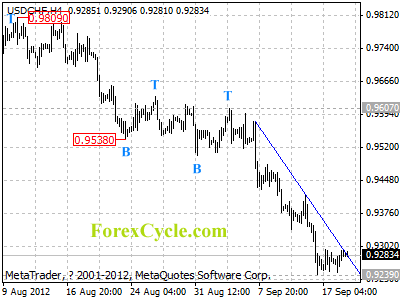
USDCHF is facing trend line resistance

USDCHF is facing the resistance of the downward trend line on 4-hour chart, a clear break above the trend line will indicate that a cycle bottom is being formed at 0.9239, and lengthier consolidation of the downtrend from 0.9607 is underway, then further rise to 0.9400 area could be seen. However, as long as the trend line resistance holds, another fall towards 0.9100 area is still possible, and a breakdown below 0.9239 could signal resumption of the downtrend.

usdchf

Daily Forex Analysis

Learn Forex Trading By Opening Swap Free Account

The foreign exchange market is one of the most popular online money making opportunity. If you are planning to start forex trading, but clueless about what FX trading is
all about. The solution in such a situation is open a free demo forex account and lean about currency trading system.

Most forex brokers online today offer some form of online trading system in real-time currency where traders can trade 24 hours a day in the comfort of their homes.Many agents offer free forex demo account or a business practice that allows you to have an idea of your FX trading platform.You may have the opportunity to learn about forex trading by using these free demo accounts or practice currency trading systems.

A free demo forex account is an account given to all forex brokers in the market for people who sign up for their services.This account is free to join and gives you access to
the currency market in real time, but not with real money. The FX broker will give you some “play money” or effective currency with the account to trade with. This account is free and no one should be charged for. So how do you get one and how it works? For a free demo account all you have to do is select your preferred corridor and sign up for an account.

Forex demo account or practice system currency trading usually gives a sum of “practice” money to start your FX trading activities with real-time quotes and charts in the current market environment. Using a free forex account is the most cost efficient and free way to gain knowledge on currency trading.Using a demo account or currency trading system is twofold practice:

·         First, one can evaluate the trade interface platform trading software or FX brokers provide. You can run and test the software and see if the functionality suits your needs.
You can also determine if the trading system is easy to use, easy to use and provide the necessary tools for successful forex trading. You can attempt a numeral times of currency trading systems to find out which system go well with you best before investing any real money for money trading system and learn forex at the same
time.

·
Second, you can learn how to trade currencies and control their positions by “practice” money given. You can learn to open currency positions and control your risk and know how you can make money with long or short positions, risk-free “practice” of money. It gives you time to understand the entire trading process, including stop loss limits, profit calls, as the benefits are and how to avoid losses. You can also learn to read the cards or use other technical analysis tools provided by the system to sharpen your currency trading skills. Can you conceive own trading signals or strategies or plans and test them with the “practice” of money without risking real money
while learning and leave with a sure win strategy.

Some of these money exchange systems not only let you to trade currency with a number of currency pairs, but also allow you to operate a selection of shares / stocks, financial indexes or commodities.Therefore, you can also learn how to trade other asset classes and figure out how to trade other asset classes can complement your FX
trading with forex demo account risk free.

About Author:

Brown Hazle is an experienced forex broker and recommends UWCFX. Currently she is writing on forex trading, trading platform, swap free account. For more detail about the company Visit: http://www.uwcfx.com/en/demo-accounts.html

Nigeria holds rate steady, concerned over hot money

By Central Bank News
    The Central Bank of Nigeria (CBN) held its Monetary Policy Rate (MPR) steady at 12 percent, citing persistently high inflation and promising growth, but expressed concern over the possible inflow of hot money following easing by the U.S. Federal Reserve and the European Central Bank.
    Despite an inflation rate that remains above the central bank’s 10 percent target, CBN said inflationary pressures appeared to be moderating in the third quarter following its decision to raise the Cash Reserve Requirement (CRR) to 12 percent in July to reduce liquidity in the banking system.
    Inflation in August eased to 11.7 percent from 12.8 percent in July due to lower prices of processed food and farm produce, and the bank said inflation for the whole year is likely to be lower than the current forecast of 14.7 percent. 
    “However, core inflation is still high at 14.7 percent in August. The threat of increased inflow of hot money arising from the actions of the US Fed to further stimulate the economy though its QE3 activities and its capital reversal implications were noted,” the CBN said.
    CBN has held its  kept its policy rate unchanged since October 2011.

    The global economy had showed further signs of weakness in the last three months, due to negative spillover effects from the euro area’s financial market fragilities. 
   “Given developments in the global and domestic economy and the financial markets, the Committee noted that the weak global growth indicies called for cautious optimism by policymakers,” CBN said.
    “Recent macroeconomic data indicates that the economy is performing better than forecasts although growth in the first two quarters of 2012 has remained consistently below the corresponding growth rates in 2011,” it added.
    Provisional data show Nigeria’s real Gross Domestic Product expanding by 6.28 percent in the second quarter, up from 6.17 percent in the first quarter, but down from a 7.6 percent growth rate in the second quarter of 2011.
    The growth forecast for fiscal 2012 has been revised up to 6.77 percent from 6.50 percent previously, but the bank was still concerned that this is lower than the 7.45 percent in 2011.
    The central bank took note of higher crude oil prices, saying this could be due to the recent easing measures by the Federal Reserve and ECB, highlighting “the possible increase in carry trade and the risk of a bubble in the domestic capital market.”
    “Overall, the MPC believes that the current rise in crude oil prices and the tight monetary policy regime presented an opportunity for building reserve buffers in the light of the uncertainties surrounding the global economy,” CBN said.
    www.CentralBankNews.info
    

Apple’s iPhone, Germany, the Fed: Why It’s All Irrelevant to the Market’s Trend

R.N. Elliott’s other major insight: News events do not impact market price patterns
September, 2012

By Elliott Wave International

A lot of people know that R.N. Elliott discovered the Wave Principle.

Yet few are aware that Elliott made another observation during his years of studying the stock market.

As the Wave Principle forecasts the different phases or segments of a cycle, the experienced student will find that current news or happenings, or even decrees or acts of government, seem to have but little effect, if any, upon the course of the cycle. It is true that sometimes unexpected news or sudden events, particularly those of a highly emotional nature, may extend or curtail the length of travel between corrections, but the number of waves or underlying rhythmic regularity of the market remains constant [emphasis added].

R.N. Elliott, R.N. Elliott’s Masterworks, pp. 158-159

What a stunning insight: Even major news does not alter the market’s main wave pattern! This seems to defy logic because most people believe that news and events are the very things that drive the stock market.

Yet, it was barely 100 years ago when most people believed that only birds could fly.

And even then, most people would never believe that a steel-encased object weighing nearly a million pounds (Boeing’s 747) could get airborne and fly at 500 miles per hour.

Yet, natural law is what governs airplane flight, the buoyancy of metal ships, the incandescent light bulb, radio transmission over the air and, yes, the Wave Principle.

Natural law is inherent in the pattern of stock prices. That’s why outside events do not materially influence the pattern’s behavior.

This is particularly relevant today: Recent news covered Apple’s new iPhone, which is expected to boost U.S. GDP; the European Central Bank’s pledge to make “unlimited bond purchases”; Germany’s Supreme Court approving the eurozone’s permanent bailout facility; and the expected Federal Reserve announcement on whether to initiate more quantitative easing.

None of this will have an effect on the market’s overall price pattern.

Charts of the Dow Industrials reveal that changes in interest rates, the deficit, the price of oil, terrorist attacks, Fed announcements and even wars do not change the market’s main trend.

How about government bailouts of troubled financial institutions during the 2007-2009 financial crisis?

Please try to pick out on the chart below when those bailouts occurred.

According to the exogenous-cause model, these historic pledges and bailouts should have had immediate results. … According to the economists’ beliefs, the only rational place for them to have taken place would be at the bottom of the market. The minute the authorities began flooding the market with liquidity is the minute it should have turned up.

[The chart below] shows that in fact these actions took place in the early portion of the biggest stock market decline in 76 years. These actions did not push stock prices back up. The market finally bottomed months later, at a time when nothing along these lines happened.

The Elliott Wave Theorist, March 2010

Now, look at this labeled chart to see how you did.

In the 70 years since R.N. Elliott observed that news does not alter the market’s wave pattern, his insight has been proven time and again.

It’s wise to keep your market eye on what really matters: the Wave Principle.

R.N. Elliott drew a chart by hand 70 years ago and the final label is the year 2012! Amazingly, today’s wave analysis confirms that his decades-ago analysis may be precisely on target.

The herd keeps looking to irrelevant outside events to aid their investing decisions. It’s time to break away from the herd and start investing independently. EWI is here to help …


Learn to Think Independently

You’ll get some of the most groundbreaking and eye-opening reports ever published in Elliott Wave International’s 30-year history; you’ll also get new analysis, forecasts and commentary to help you think independently in today’s tumultuous market.

Download Your Free 50-Page Independent Investor eBook Now >>

This article was syndicated by Elliott Wave International and was originally published under the headline Apple’s iPhone, Germany, the Fed: Why It’s All Irrelevant to the Market’s Trend. EWI is the world’s largest market forecasting firm. Its staff of full-time analysts led by Chartered Market Technician Robert Prechter provides 24-hour-a-day market analysis to institutional and private investors around the world.