Euro Falls against Peers On PMI Speculations

By TraderVox.com

Tradervox.com (Dublin) – The 17-nation currency dropped further against the yen and the dollar prior to today’s report expected to show that manufacturing and services in the region shrunk last month. Speculation that the debt crisis in the region is hampering growth increased causing the euro to fall against its counterparts. It fell against the yen, as Bank of Japan announced an unexpected additional stimulus to prevent the currency from strengthening. Economists and analysts have indicated that the move by the BOJ policy makers will do little to boost economy as China is still struggling with its economy. The Australian dollar dropped against the dollar after a report from China showed that manufacturing sector in the country is declining.

Talking about the euro and BOJ decision, Joseph Capurso, who is a Sydney-based Strategist at the Commonwealth Bank of Australia, said that the euro is a sell at the current levels. He added that past experience have taught investors and analysts that Bank of Japan’s bond buying expansion does not change the trajectory of the yen or the country’s economy. His comments came as the Markit Economics prepares to release a report showing that the euro zone composite index for manufacturing and services remained low at 46.6 from 46.3 in August. Capurso said that Europe’s economy will get worse and with time it will recover as leaders continue to do all they can to solve the debt crisis.

According to Michael Sneyd, today’s Spanish auction will be a major event as investors will be looking at its performance. Ironically, Sneyd said that a poor performance at the auction will be positive for the euro as it would at more pressure on Spain to ask for bailout. The yen advanced against the euro as BOJ added ten trillion yen to its 45 trillion-yen fund for asset purchases.

The euro plunged 0.8 percent against the yen to exchange at 101.5 yen at the close of Asian trading session. The single currency dropped by 0.4 percent against the dollar to trade at $1.2995. The yen strengthened by 0.3 percent against the dollar to trade at 78.13 per dollar after it added 0.6 percent yesterday.

Disclaimer
Tradervox.com is not giving advice nor is qualified or licensed to provide financial advice. You must seek guidance from your personal advisors before acting on this information. While we try to ensure that all of the information provided on this website is kept up-to-date and accurate we accept no responsibility for any use made of the information provided. Opinions expressed at Tradervox.com are those of the individual authors and do not necessarily represent the opinion of Tradervox.com or its management. 

Article provided by TraderVox.com
Tradervox.com is a Forex News Portal that provides real-time news and analysis relating to the Currency Markets.
News and analysis are produced throughout the day by our in-house staff.
Follow us on twitter: www.twitter.com/tradervox

We Buy Gold Because We Don’t Trust Them Not to Meddle

By MoneyMorning.com.au

‘I know why confusion in government is not only tolerated but encouraged. I have learned. A confused people can make no clear demands.’ – John Steinbeck

There’s no doubt that in financial terms the world is in a Twilight Zone.

It’s a world where good news is good news (although sometimes it’s bad news), and where bad news is better news (although sometimes it’s bad news too).


If that’s got you confused, you’re not the only one. Even the US Treasury thinks it’s making a profit, and they’re ‘very proud’ of what they’ve done.

Of course, a profit isn’t really a profit if you ignore the expenses. In this case, the US Treasury has forgotten about the USD$2,045,669,033,179.67 (over two trillion dollars) it has paid out in interest payments since then.

We wonder if they’re as ‘proud’ of that record. Probably not. But what does this have to do with you? It simply shows that we’re a long way from being able to trust governments and central bankers to do anything that’s in the interest of the people. We’ll explain why below…

Last week the Financial Times revealed:

‘The US Treasury has sold most of its remaining stake in AIG in an $18bn offering[…]

‘For the US taxpayer, the sale represents an overall $12.4bn profit on the once-vilified rescue of what used to be the world’s largest insurance group.’

At first glance it seems like a slap in the face for critics of government bailouts. Look, the government can run a profitable business!

Trouble is that it’s not true. Because since 2008 the US Treasury has paid out over USD$2 trillion of interest payments as it has printed money and gone into debt in order to try and prop up the economy and bailout companies like General Motors, Bank of America, Chrysler and…AIG.

To put the number in perspective, the USD$12.4bn profit covers just 0.61% of the interest the US Treasury has paid since 2008.

In fact, based on the average monthly interest costs, the government has already consumed the whopping profit on AIG due to the interest the government owes bondholders.

It’s the equivalent of a gambler losing $1,000 at the casino and then cheering because they’ve won $6.10 on the pokies!

That didn’t stop US Treasury Secretary Tim Geithner saying, ‘To stabilise and then restructure the company with a very substantial positive gain for the American taxpayer is a significant accomplishment.’

But the economic Twilight Zone doesn’t end there. As you know, the US government, via the US Federal Reserve, is now the biggest holder of US government debt.

So a percentage of the interest paid by the government ends up back in government coffers anyway.

Are you still with us?

We wouldn’t blame you if you’re confused. But that’s the whole point of government and central bank interference.

Encouraging Confusion

The idea is to make you so confused by it all that you either lose interest or accept the argument that it’s all too complicated for people like you…that you need to trust those who are in charge.

That way they think they can get away with more and more money printing. And the more they print the more it will have an impact on inflation.

Overnight, the Federal Reserve Bank of Dallas president Richard Fisher told Bloomberg News:

‘I do not see an overall argument for letting inflation rise to levels where we might scare the market. We have seen a sharp rise in inflation expectations. If you let this get out of hand, then I think we will have a market reaction.’

But Mr Fisher also mentioned another point:

‘I question the efficacy of these large-scale asset purchases. What we are doing is not having the impact on employment[…] As we saw this morning, the housing market is on the move.’

The truth is the Fed knows it can’t control the unemployment rate directly. Like any government agency, they aren’t entrepreneurial. They don’t know what it means to start and run a business. The only things they know about are printing money, spending other peoples’ money…and inflating asset bubbles.

As we wrote in last week’s Australian Small-Cap Investigator update:

‘The Fed’s plan is to buy USD$40 billion-worth of mortgage-backed securities each month. The idea is that as institutions sell these mortgages to the Fed they’ll use the proceeds as capital to secure more mortgages, this will increase the odds of banks lending money to home-buyers, which should make it easier to buy a house, which will boost house prices…

‘…and cause another housing bubble.

‘OK. The Fed wouldn’t dare admit to the last bit. But that’s really the name of the game. Most in the mainstream still believe house price growth is positive for the economy, and that if it wasn’t for the subsequent price collapse everything would have been fine.

‘Their aim now is to build another price bubble, but this time try to make sure it doesn’t collapse.’

Make no mistake, that’s what Fed policy is all about – doing what’s easy. For them, doing the easy thing is printing money and hoping house prices go up so people can punt on house prices going up even more, which means the banks get to lend more.

Governments and Central Bankers Prefer ‘Easy’

But the Fed (and governments) isn’t so good at doing what’s hard. What’s hard is thinking of a new idea, starting up a new business, and attracting customers.

We know that’s hard because it’s something your editor is going through now as we look to launch a new eletter service next month. It would be so much easier if like the Fed we could just print money.

That way we wouldn’t have to think of new ideas, organise a new website design, get our back office staff to set up a new database, budget for customer acquisition, and so on.

Media owner Steve Forbes put it well in an interview with Bloomberg News today:

‘You don’t know what the currency is gonna be worth in the future, is it gonna be 20 cent dollars in five years, 10 cents, 90 cents, you don’t get the kind of productive investment that you normally get. So instead we focus on things like, should I invest in gold, should I invest in oil, should I invest in sugar, instead of things in the future, the Microsoft’s and the Apple’s of the future.’

Mr Forbes goes on to express a view we share, that the Fed is pursuing a policy that’s the definition of insanity – doing the same thing over and over, and hoping for a different result.

That’s what it comes down to. We’d love to be able to not own gold as an insurance hedge against government and central bank meddling. We’d much prefer gold and silver to just replace the base metal and plastic notes we carry in our pocket.

We’d rather forget about the meddling by central bankers and instead focus 100% on investing in entrepreneurial and productive businesses…both big and small.

But until then, the meddling prevents us (and many others) from doing so. Because we don’t trust the government not to meddle, we have to withhold part of our wealth from the system.

And until we get a clear signal that governments will stop robbing individuals of their private wealth through taxation, and central banks will stop robbing private wealth through inflation, we’ll continue to hold gold, and we’ll continue to recommend that you hold it too.

Cheers,

Kris
Articles

What You Must Do to Survive the Coming China Crash

Why Does the World Still Trust This Man?

Gold Up, but Gold Stocks Up More


We Buy Gold Because We Don’t Trust Them Not to Meddle

Strange Logic: Solving a Debt Problem with More Debt

By MoneyMorning.com.au

One of the best short-selling ideas I’ve had over the past year or so was in Fortescue Metals (FMG listed on the Australian Securities Exchange). If you’re unfamiliar with ‘shorting’ a stock, it’s essentially a bet that a company’s price will fall instead of rise.

In the case of Fortescue, the company was due for a fall. Fortescue’s only business is digging up iron ore in Western Australia and loading it on ships bound for China. This model is very profitable as long as China keeps growing, and extraction costs in Western Australia are low.

But after extensive boots on the ground last year, I concluded that a slowdown in Chinese construction and steel demand was a near-certainty. Fortescue was a logical candidate to bear the full brunt of that.

Sure enough, over the past several months, this thesis came to fruition. With iron ore piling up at ports across China, spot prices of iron ore have plunged by more than 30%. Fortescue’s stock price fell even more… which means that anyone who shorted the stock made money.

Oh, there’s one more problem. In addition to a slowdown in China, the company has financed its growing expansion with borrowed money. Indeed, Fortescue has taken on so much debt that with spot iron ore prices below $100 per ton, the company couldn’t even pay the interest bill.

Treating Symptoms, Not Causes

So, with his company deep in debt, what did the founder and chairman do? Why, he BORROWED EVEN MORE MONEY, of course. The company this week announced a new $4.5 billion financing package from JP Morgan and Credit Suisse.

As of June 30th, Fortescue already had total debts of $10.4 billion. In August it added $1.5 billion, lifting its total borrowing to $11.9 billion. With the new capacity, the company will add nearly a billion dollars of net debt, taking the total to $12.8 billion.

It seems obvious to most people that you cannot borrow your way out of debt. Yet for some reason, all over the world, from companies such as Fortescue, to nearly every Western government, that’s exactly what is going on.

The accepted wisdom is to borrow more, extend the payback period for your loans, and pretend there’s no problem paying them back.

What’s really crazy is that the market is comfortable with this arrangement- Fortescue’s shares recently surged nearly 20% after this latest Houdini act. This is like assuming that a terminal patient is going to recover just because you give him another shot of morphine.

Treating the SYMPTOMS is the easy way out… but it fixes nothing. It’s clear the world needs people willing to address the underlying CAUSES of the challenges we face.

Unfortunately, there are very few of those people on the horizon. This ‘extend and pretend’ strategy seems to dominate all financial thinking.

Consequently, just as short-selling Fortescue on this recent bounce will still likely to prove to be a profitable strategy in the long run, betting on the eventual collapse of our over-stretched fiat money system still seems to be the right play.

Tim Staermose
Contributing Writer, Money Morning

Publisher’s Note: This article first appeared in Sovereign Man: Notes From the Field

From the Archives…
What the Central Banks Are Doing to Your Money
14-09-2012 – Kris Sayce

Luxury Firm Burberry Highlights the Chinese Slowdown
13-09-2012 – John Stepek

Gold Up, but Gold Stocks Up More
12-09-2012 – Dr. Alex Cowie

The ECB is Only Fooling the Gullible
11-09-2012 – Dan Denning

Why This ‘Ludicrous’ Investment Keeps Going Up
10-09-2012 – Kris Sayce


Strange Logic: Solving a Debt Problem with More Debt

Banks and the $2.6 Trillion Set Up

By MoneyMorning.com.au

Just five years after they played a primary role in engineering the worst financial crisis since the Great Depression, America’s big banks are quietly setting the world up to do it all over again.

Only this go-round the costs will be far higher and the damage much worse. This time the fall could be $2.6 trillion or more.

Let me explain.

It started back in the mid-2000s. Wall Street was busy packaging low-rated subprime loans into securitized offerings that were somehow worth more than the sum of their parts.

In reality, what they were doing was little more than laundering toxic debt while raking in obscene profits along the way.

You know the rest of the story as well as I do. Not long after, the stuff hit the proverbial fan and it was not evenly distributed.

Well here we go again…

Both JPMorgan and Bank of America are quietly marketing a new scheme designed to “transform” sub-par assets into quality holdings that will serve as [US] Treasury-quality collateral needed to meet the new capital requirements that come into effect in 2013 as part of the Dodd-Frank Act.

Wall Street Is Up to Its Old Tricks

This may sound complicated but it’s not. It works like this.

When you trade on margin like these mega-institutions do, you are required to post collateral to offset counterparty risk. That way, if the trade busts and you are unable to deliver on your side of the trade, there is recourse.

If you have a mortgage or a car loan, you know what I’m talking about. Your lender can seize both if you default or otherwise fail to meet your payment obligations.

Trading collateral works the same way. In years past, trading collateral has most commonly taken the form of U.S. treasuries (or other securities) that meet stringent requirements with regard to ratings, liquidity, value and pricing.

However, since the financial crisis began, Treasuries are in increasingly short supply.

Investors and traders who have preferred safety over return are hoarding them.

Consequently, traders like JPMorgan’s London-based “whale,” Bruno Iksil, who want to write increasingly bigger, more sophisticated trades are in bind. They find themselves unable to trade because many times the clients they represent can’t post the collateral needed to “gun” the trades.

As you might imagine, Wall Street doesn’t like that because it means billions in profits and bonuses get lost as trading volumes drop.

So they’ve gone to the unregulated woodshed again and come up with yet more financial hocus pocus designed to circumvent rules in the name of profits.

At the same time, they’re once again hiding the true extent of the risks they are taking – and that’s the outrageous part.

These same banks that have already driven the world to the brink of financial oblivion and been bailed out once may need another $2.6 trillion dollars or more to backstop the unregulated $648 trillion derivatives playground they’ve created for themselves.

And don’t think for a minute that your money isn’t at risk either…

We’re talking about trillions of dollars’ worth of sovereign and agency debt. Think the United States, Japan, Italy, Spain, and Germany here, along with the bets on that debt – all of which has been “backed” by central bankers, effectively removing the risk of failure from the financial markets and specifically from the firms engaged in these kinds of trades.

Of course, Wall Street has just pulled the wool over everybody’s eyes by marketing most of these derivatives as “insurance” against default. In reality, they are king-sized bets levered up to levels so high that they now place entire nations at risk of default, not just individual traders or institutions.

That’s because derivatives allow traders to effectively bet on directional changes in everything from interest rates to markets and currencies. They also allow firms to effectively arbitrage the relative risks between various financial instruments or lock in specific prices on everything from bonds to commodities.

The Biggest Margin Call of All Time

Here’s where we get to the meat of the matter.

As part of new rules driven by the 2010 Dodd-Frank Act, traders will have to drive the majority of privately-traded derivatives contracts through clearing houses like the Chicago based CME or the London based LCH. Clearnet, which was formerly known as the London Clearing House.

Previously they didn’t because upwards of 90% of the derivatives were privately negotiated and therefore exempt from centralized exchange requirements, including margin.

In the process, they’ll have to post additional collateral that can be “perfected,” meaning seized and converted to cash, in the event of a counterparty failure or default.

As reported by Bloomberg, estimates from Morgan Stanley suggest the new requirements could mean the banks trading in derivatives have to come up with $481 billion in top-rated collateral on the low side to $2.6 trillion on the high side, which is what the Massachusetts-based Tabb Group projects.

My own estimate is somewhere in the $4-5 trillion range, because I believe the total value of the derivatives markets is still being understated by banks and trading houses not keen to let skeletons out of the proverbial closet.

And therein lies the problem. Neither the trading firms nor their clients have the additional collateral.

What’s more, they likely won’t be able to get it because the vast bulk of the $33 trillion in worldwide top-tier AAA- or AA-rated debt is already pledged as collateral or otherwise accounted for in separate transactions.

Were these banks and their clients living like the rest of us, they’d simply conclude they were “tapped out” and their resources exhausted because there would be nothing left.

But noooooo……Under the terms of both the JPMorgan and Bank of America programs, clients not meeting the new collateralized quality standards can pledge other less-than-Treasury-quality assets to the bank against a “loan” of Treasuries from the trading firm that’s then posted by the trading firm as collateral acceptable to the clearing houses.

In other words, the trading firms are going to loan Treasuries to clients who are incapable of meeting liquidity requirements while accepting lower grade assets in exchange. Details are hard to come by at the moment with regard to the fees they’ll rake in, but you can bet “transforming” lemons into lemonade won’t be cheap.

This is similar to what happens in the commercial “repo-market” where banks and trading firms temporarily pledge their assets in exchange for cash loans. Nor is it much different than pledging your paycheck at an instant loan store. In both cases, you are pledging assets against transactions that you wouldn’t otherwise be able to conduct.

The fundamental question boils down to this: If we know that billions in improperly assessed risks led to the first blowup in 2007, how on earth could this be any different– especially with trillions now on the line?

You can’t wave your hand over a pile of less-than-Treasury-quality assets and have them suddenly, miraculously become Treasury quality because they are grouped together.

Yet, this is exactly what Wall Street is doing here.

An Unlikely Solution

And just like before, Wall Street’s latest scheme is expressly intended to disguise risk and circumvent the specific rules about to be put in place to prevent excess leverage from potentially destroying the world’s financial system.

Is there a fix?

I can think of one, but it’s from a source you’d never believe in a million years would come out of my mouth: Fed Chairman Ben Bernanke.

Congress can’t balance its checkbook. Our politicians can’t make tough decisions. Our regulators are out-lobbied and outmanoeuvred at every turn. No president can ask his nation to take its medicine regardless of party affiliation.

But Bernanke can. Supposedly – emphasis on supposedly – he’s apolitical.

Acting under the Fed’s dual mandates of maintaining “monetary and credit aggregates commensurate with the economy’s long-run potential,” Chairman Bernanke could bypass the entire political, regulatory and lobbyist morass in one fell swoop by declaring that the United States government will not back any derivatives trades – or any firm that engages in them – worldwide in the event of default.

Not only would this re-introduce the concept of failure into capital markets but it would do what neither Congress nor our regulators have been able to do – put an immediate end to the kind of “profit at all cost regardless of risk behavior” that exemplifies everything wrong with Wall Street.

I can only imagine the disclaimer on one of those Uncle Sam posters more commonly associated with wartime military recruiting. It might read: “Counterparty Beware.”

Until then, it’s investors who should be “aware.”

Keith Fitz-Gerald
Contributing Editor, Money Morning

Publisher’s Note: This is an edited version of an article that first appeared in Money Morning (USA)

From the Archives…

What the Central Banks Are Doing to Your Money
14-09-2012 – Kris Sayce

Luxury Firm Burberry Highlights the Chinese Slowdown
13-09-2012 – John Stepek

Gold Up, but Gold Stocks Up More
12-09-2012 – Dr. Alex Cowie

The ECB is Only Fooling the Gullible
11-09-2012 – Dan Denning

Why This ‘Ludicrous’ Investment Keeps Going Up
10-09-2012 – Kris Sayce


Banks and the $2.6 Trillion Set Up

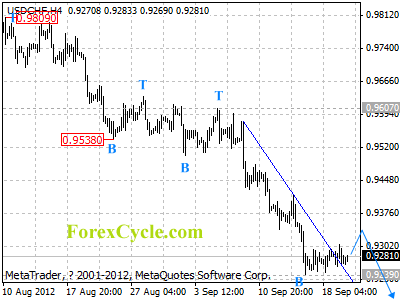
USDCHF breaks above trend line resistance

USDCHF breaks above the downward trend line on 4-hour chart, suggesting that lengthier consolidation of the downtrend from 0.9607 is underway. Range trading 0.9239 and 0.9350 would likely be seen in a couple of days. Resistance is at 0.9350, as long as this level holds, the downtrend could be expected to resume, and another fall towards 0.9000 is possible after consolidation. Support is at 0.9239, a breakdown below this level could signal resumption of the downtrend.

usdchf

Daily Forex Forecast

Australian Dollar Drops Prior To China and Eurozone PMIs

By TraderVox.com

Tradervox.com (Dublin) – The Aussie dropped against most of its peers today prior to reports that are projected to show signs of decline in global manufacturing. The South Pacific dollars dropped before the release of a report on Chinese factory output and a similar report on European purchasing managers’ index by HSBC Holdings Plc and Markit Economics. The Aussie declined to 0.1 percent from a week’s low versus the US dollar while New Zealand dollar’s declines were limited after a report showing the nation’s current account deficit was less that market expectation.

According to Joseph Capurso, a Sydney-based Strategist at Commonwealth Bank of Australia, global sentiments are going to push the Australian dollar down. He indicated that the China and Euro Zone PMIs to be released this week constitute a downside risk for the Aussie. Analysts are predicting that the Aussie will rise by 1.9 percent this quarter while the kiwi is projected to increase by 3.1 percent in the same period. Australia is enjoying good ratings with the Standard and Poor’s as it affirmed its AAA credit rating today. According to a statement to the press, Australia has ample fiscal and monetary flexibility, public policy stability, economic resistance and its financial sector is sound. The country is also highly ranked by Moody’s and Fitch rating companies.

The Australian dollar dropped as speculation that a Euro-Zone composite index for manufacturing and services sector will be at 46.6 this month and another report from Markit and HSBC for China Manufacturing will indicate a reading of 47.6 spurred concerns that global manufacturing is declining. The New Zealand dollar decreased after a report from Statistics Bureau indicated that current account deficit was at 4.9 percent of the country’s GDP less than the market expectation on 5.2.

The Australian dollar declined by 0.3 percent against the US dollar to trade at $1.0430 from its yesterday’s rate of $1.0457. the New Zealand currency was slightly changed against the dollar, exchanging at 82.64 US Cents down from 82.72 cents yesterday.

Disclaimer
Tradervox.com is not giving advice nor is qualified or licensed to provide financial advice. You must seek guidance from your personal advisors before acting on this information. While we try to ensure that all of the information provided on this website is kept up-to-date and accurate we accept no responsibility for any use made of the information provided. Opinions expressed at Tradervox.com are those of the individual authors and do not necessarily represent the opinion of Tradervox.com or its management. 

Article provided by TraderVox.com
Tradervox.com is a Forex News Portal that provides real-time news and analysis relating to the Currency Markets.
News and analysis are produced throughout the day by our in-house staff.
Follow us on twitter: www.twitter.com/tradervox

Yen Advances Prior to BOJ’s Rate Decision

By TraderVox.com

Tradervox.com (Dublin) – The Japanese currency pared its losses before the Bank of Japan policy makers conclude their meeting today. The yen strengthened against the euro as economists speculate a report from the 17-nation trading bloc will indicate that services and manufacturing contracted last month, making it the eighth month in a row. The euro also dropped against the greenback as Spain prepares to sell its bonds in tomorrow’s bond auction. The country is also seen as considering to formally request for bailout from the European Central Bank.

According to Daisuke Karakama, the Bank of Japan is likely to keep the monetary policy unchanged. Karakama is a Economist at Mizuho Corporate Bank Ltd in Tokyo. He added that the move is likely to strengthen the yen further against major currencies. The central bank had increased its asset purchases fund by 5 trillion yen in July, to make a total of 45 trillion yen in asset purchase kitty. Most economists are predicting that the policy makers will change the monetary policy by October, but very few are expecting such a move today. A Nikkei report indicated that the company thinks the bank is likely to act in today’s meeting as they consider the risks to the economy.

According to Emma Lawson, a Currency Strategist in Sydney at the National Australia Bank Ltd, the risk that prevails is that the BOJ may underwhelm the market hence causing the dollar-yen pair to go down below the support level at 78. Marito Ueda, a Tokyo-based Senior Managing Director at the FX Prime Corp predicted that the euro is likely to weaken in the long term, stating that the economic outlook for the euro zone is bleak.

The yen advanced by 0.3 percent against the euro to trade at 102.54 yen per euro at the start of trading in Tokyo today, down from its close in New York. The Japanese currency rose by 0.2 percent against the dollar to exchange at 78.66 yen per dollar.

Disclaimer
Tradervox.com is not giving advice nor is qualified or licensed to provide financial advice. You must seek guidance from your personal advisors before acting on this information. While we try to ensure that all of the information provided on this website is kept up-to-date and accurate we accept no responsibility for any use made of the information provided. Opinions expressed at Tradervox.com are those of the individual authors and do not necessarily represent the opinion of Tradervox.com or its management. 

Article provided by TraderVox.com
Tradervox.com is a Forex News Portal that provides real-time news and analysis relating to the Currency Markets.
News and analysis are produced throughout the day by our in-house staff.
Follow us on twitter: www.twitter.com/tradervox

Russian Dividend Stocks: Not An Investment For Widows and Orphans

By The Sizemore Letter

In case you had any concerns about the safety of Russian stocks, you can now set those fears aside. By Kremlin decree, Russian stocks will now start paying higher dividends.

As the Financial Times reported this week, “One of the reasons why Russian companies trade at a discount to their global peers is their historically low levels of dividend payments. In a bid to raise market valuations ahead of a series of privatizations, the Kremlin has been calling on state companies to share a larger proportion of their profits with investors.”

What a spectacular showing of shareholder-friendly management from the former bastion of international communism. If he wasn’t displayed in a glass coffin in Red Square for all to see, I might assume that Comrade Lenin was spinning in his grave.  Yay, capitalism.

Of course, another reason why Russian companies “trade at a discount to their global peers” is that they are located in Russia.

This is a country that still imprisons capitalists when they no longer toe the Kremlin line.  Mikhail Khodorkovsky, the former Chairman and CEO of oil giant Yukos and once Russia’s wealthiest man, has been rotting in prison since 2005 and is unlikely to see his freedom so long as Vladimir Putin rules the country.  But hey, maybe his wife and kids will appreciate the higher dividend payouts promised to Russian shareholders.

I have written for years about the virtues of dividend investing, and I firmly believe that the regular payment of a cash dividend encourages both honestly and managerial discipline.  It’s a lot harder to cook the books or waste shareholder money by chasing empire-building acquisitions when you are committed to writing a check to investors every quarter.  Furthermore, it guarantees that investors realize a return even during a flat market.

But does any of this apply when we are talking about a country that is effectively ruled by thugs and Mafiosi?

Make no mistake; I’m glad to see Russia encouraging its companies to pay a dividend.  All else equal, this is a step in the right direction.  But would I consider buying Russian dividend stocks for my conservative, income-focused investors?  If I did, I would hope that someone would lock me in a mental institution or, at the very least, strip me of my trading responsibilities.

And this is not to pick on Russia; I have been a buyer of Middle Eastern and African stocks in recent weeks via the iShares MSCI Turkey ETF (NYSE:$TUR) and the MarketVectors Africa ETF (NYSE:$AFK).  But I consider both to be highly-speculative positions that would only be appropriate for the most aggressive portion of a client’s portfolio.  And while I don’t complain about receiving a dividend on either, the dividend is not a major factor in my decision to invest in these regions.

(This ties into a broader theme that I’ve covered recently and that bears revisiting: Investors should NEVER chase yield.) 

In the case of Russian stocks, the payment of a dividend does not mitigate the risks posed by the absence of the rule of law in the country.  Given the risks, investors should only trade Russian stocks with a mind towards short-term price appreciation.

Investors looking for both high current income and emerging market growth should look instead to what I like to call “emerging markets lite.”  Look for established American and European firms with large and growing businesses in the emerging world.

Two I particularly like are Anglo-Dutch consumer products company Unilever (NYSE:$UL) and Dutch megabrewer Heineken (pink:$HINKY).

Disclosures: Sizemore Capital is long AFK, TUR, UL and HINKY.

Related posts:

Bank of Japan “Following Global Trend” for Looser Monetary Policy, Gold Seen Breaching $1800 in Q4

London Gold Market Report
from Ben Traynor
BullionVault
Wednesday 19 September 2012, 07:45 EDT

THE SPOT gold price fell to $1772 an ounce Wednesday morning in London, a few hours after hitting its highest level for nearly seven months after the Bank of Japan became the latest central bank to announce further quantitative easing measures.

“It seems that the stars are now aligned for gold to move higher,” says Anne-Laure Tremblay, analyst at BNP Paribas.

“The next hurdle to overcome will be the $1800 an ounce level, which we expect to be breached decisively in the fourth quarter.”

The silver price fell to around $34.60 an ounce – having hit $35 a day earlier for the first time since March.

Stocks and commodities were little changed on the day by lunchtime, while US Treasuries gained.
Japan’s central bank announced Wednesday that it is increasing the size of its asset purchase program from ¥70 trillion to ¥80 trillion, pushing the deadline for the end of the program to the end of next year.

The Bank of Japan has also abolished the minimum bid yield of 0.1% on JGB and corporate bond issues.

“Japan’s domestic demand is still firm,” BoJ governor Masaaki Shirakawa told a news conference today.

“However, exports and output look weak, and a decline in oil prices is weighing on Japan’s consumer prices…we judged that further monetary easing was necessary now to ensure that Japan’s economy does not slip from a path towards sustained growth with price stability.”

“Further easing is still possible this year because the BoJ is emphasizing uncertainties in its outlook,” says Masamichi Adachi, Tokyo-based senior economist at JPMorgan Securities.

The BoJ’s move follows last week’s announcement by the US Federal Reserve that it will buy $40 billion of mortgage backed securities each month until the US labor market improves “substantially”, as well as the European Central Bank’s unlimited sovereign bond buying program unveiled earlier this month.

“The main message from today’s decision is that the BoJ is following the global trend set by the Fed and the ECB,” says Junko Nishioka, chief Japan economist at RBS in Tokyo.

“Whether central banks intend it or not, there is a competition for loosening monetary policy around the world,” agrees Izuru Kato, chief market economist at Tokyo-based financial consultancy Totan.

“[Shirakawa won’t want to seem] reluctant to compete in the race.”

Shirakawa however denied the BoJ’s move is a direct response to other central banks’ policies.

“I do not think any central bank would act simply because another central bank acted,” he said.

“If it is a question of comparing the BoJ to the Federal Reserve or the European Central Bank, I think the issue is not of methods but of the impact of those methods…. I think monetary conditions are easiest in Japan. I do not think that you could argue that the BoJ is less bold that the Fed or the ECB.”

Shirakawa also denied the move is a response to anti-Japanese protests in China, which have seen some Japanese firms repatriate their staff.

The Yen fell around 0.7% against the Dollar immediately following the BoJ’s announcement, although by lunchtime in London it had regained around half its losses.

The gold price in Yen meantime rose to within 5% of last year’s all-time record, while the gold in Dollars set a new six-month high at just below $1780 per ounce.

“Gold is given a boost on the back of anything that is a form of quantitative easing,” says Bernard Sin, head of currency and metal trading at refiner MKS in Geneva.

“At some point there’ll be some profit taking but we’ll continue to trend higher.”
Here in the UK, the Bank of England’s Monetary Policy Committee voted unanimously to leave its main interest rate at 0.5% and maintain the size of quantitative easing at £375 billion when it met earlier this month, minutes from the meeting published Wednesday show.

“For most members this decision was relatively straightforward,” according to the minutes, “although some of these members felt that additional stimulus was more likely than not to be needed in due course, while others saw the risks to inflation in the medium term as being more balanced around the [2%] target.”

UK inflation as measured by the consumer price index was 2.5% in August – the 33rd consecutive month it has been above the Bank’s target.

Over in Europe, Bundesbank chief Jens Weidmann yesterday warned of the “potentially dangerous correlation of paper money creation, state financing and inflation”, adding that Goethe’s play ‘Faust’ highlights “the core problem of today’s paper money-based monetary policy”, the Financial Times reports.

“The state in ‘Faust Part Two’ is able at first to rid itself of its debts while consumer demand grows strongly and fuels a strong recovery,” Weidmann told an audience in Frankfurt.

“But this later develops into inflation and the monetary system is destroyed by rapid currency depreciation.”

Elsewhere in Europe, €326 billion was withdrawn from banks in Greece, Ireland, Portugal and Spain in the 12 months to the end of July, according to data published by Bloomberg Wednesday.

Ben Traynor
BullionVault

Gold value calculator   |   Buy gold online at live prices

Editor of Gold News, the analysis and investment research site from world-leading gold ownership service BullionVault, Ben Traynor was formerly editor of the Fleet Street Letter, the UK’s longest-running investment letter. A Cambridge economics graduate, he is a professional writer and editor with a specialist interest in monetary economics. Ben writes and presents BullionVault’s weekly gold market summary on YouTube and can be found on Google+

(c) BullionVault 2012

Please Note: This article is to inform your thinking, not lead it. Only you can decide the best place for your money, and any decision you make will put your money at risk. Information or data included here may have already been overtaken by events – and must be verified elsewhere – should you choose to act on it.


USD/CHF Is Sinking Deeper

Introduction
USD/CHF is sinking deeper
For sometime now, the bears have maintained a solid control of the USD/CHF. The pair has been trading lower since early this month. How far will it go?

Factors Affecting
It seems the general dollar weakness, which has been present in the market has also favored the performance of the Swiss Franc. The recently released dovish FOMC statement has ignited risk taking in the marketplace. As such, traders have been avoiding dollar denominated assets. And, with the absence of major economic reports from Switzerland, the appreciation of the Swiss Franc has been propelled by this.

Technical Analysis
As earlier mentioned, Forex technical analysis on the USD/CHF reveals it’s trading in a strong downtrend. If the pair continues with this move, it may encounter support at 0.9140 before moving lower. On the other hand, if the pair starts receding upwards, it may encounter resistance at 0.9400 before moving higher.

Forecast
The pair is on a downtrend. Thus, traders who were short in it should continue holding on to their positions as long as the bearish pressure is still evident.

Open Free demo account to check yours opportunity to profit in the Forex market.

DISCLOSURE & DISCLAIMER:
THE ABOVE IS FOR INFORMATIONAL PURPOSES ONLY AND NOT TO BE CONSTRUED AS SPECIFIC TRADING ADVICE. RESPONSIBILITY FOR TRADE DECISIONS IS SOLELY WITH THE READER.