AUD/USD: Renewed Euro Zone and China Concerns Enhance Flight to Safety

Article by AlgosysFx Forex Trading Solutions

The US dollar is presumed to benefit from risk averse trades to begin the trading week on views that the European leaders’ crisis-fighting measures are encountering another roadblock. Meanwhile, concerns over a slowing Chinese are once again deemed to underscore the dire state of the global economy, deterring demand for the commodity-linked Australian dollar.

German Chancellor Angela Merkel and French President Francois Hollande remained at odds over plans to monitor Europe’s crisis-hit banks, overshadowing an occasion marking Franco-German reconciliation after World War II. Despite affirmation that European unity was the only way out of the debt crisis, they differed over tighter checks on Europe’s banking sector. Hollande is all for banking union, saying that such a framework should be in place preferably before the year ends. For her part, Merkel urged a more cautious approach to ensure success while at the same time refusing to set a target date. Back in June, EU leaders concurred over new bank supervision as part of an agreement to allow the region’s rescue funds to lend directly to struggling banks instead of passing it through countries. Nonetheless, the deadlock outlined once again Germany’s doubts about placing the European Central Bank in charge of bank supervision beginning January 1. Another point of contention is the terms on which struggling countries should request bailout assistance, with German Finance Minister Wolfgang Schaeuble warning against a Spanish application for aid. With European leaders seemingly failing to deliver on their pledge to resolve the crisis, the markets are foreseen to pare risk appetites today.

Meanwhile, a key survey of Chinese manufacturers and retailers reveal that optimism over sales levels are waning and that more are cutting jobs. China’s Beige Book found that 43 percent of manufacturing firms reported higher revenues this quarter, down 20 percent from the previous release. Those expecting higher sales in the next six months dipped 18 points to 53 percent while companies expecting lower sales doubled to 20 percent. Retailing growth is also feeling the pinch as 20 percent reported a drop in sales, almost double the prior figure. The economic slowdown is prompting more companies to reduce jobs and halt hiring. Those cutting employees rose from 13 percent to 20 percent this quarter. The results suggest that the world’s second largest economy slowed for the seventh consecutive quarter to its weakest annual expansion in 22 years this quarter. According to economists, the survey also failed to provide an encouraging sign that a recovery is in the offing. China is Australia’s largest trading partner, and a continued slowdown there is seen to further dampen the outlook for the Land Down Under. Considering these, a short position is deemed viable for the AUD/USD.

For more news, analysis, technical charts and candlestick analysis, visit AlgosysFx


An ETF Portfolio for the 4th Quarter

By The Sizemore Letter

As I wrote late last week, we are in the midst of a monetary arms race in which Fed Chairman Ben Bernanke and ECB President Mario Draghi are tripping over themselves to see who can inject more liquidity into the financial markets.   The result will be a bull run in just about everything: stocks, non-treasury bonds, commodities, real estate.  You name it, and it’s probably going to enjoy a nice finish to 2012.

Through gritted teeth, I would even include gold in the list, though not for the reason most gold bugs would expect.  No, I do not see gold rising as a viable inflation hedge or crisis hedge; I see it rising precisely because it has become a risk asset like everything else (see “A Bad Investment and Getting Worse” for my views on the barbarous relic.  The article is old but the arguments are as valid as ever.)

There are still risks, of course.  Europe could still come unhinged due to political infighting, and the United States is still staring over a fiscal cliff.  China may slow worse than the even the bears expect, and the Middle East could erupt into a full-blown war at any time.

For all of these reasons, investors should stay nimble and be prepared to sell some of their more volatile positions if the need arises.  But in the meantime, it makes sense to be invested as aggressively as your blood pressure will allow to take advantage of the most bullish coordinated monetary easing in modern history.

With this said, how should investors position their portfolios for the remainder of 2012?

For moderately aggressive investors, I would recommend an ETF portfolio that looks something like this:

ETF

Ticker

%

Vanguard Dividend Appreciation

VIG

25

WisdomTree Large Cap Dividend

DLN

20

PowerShares International Dividend Achievers

PID

15

Technology Select SPDR

XLK

10

iShares MSCI Spain

EWP

10

iShares MSCI Turkey

TUR

10

Market Vectors Africa

AFK

5

Cash

5


Sixty percent of the portfolio is allocated to high-quality American and international dividend-paying stocks via the positions in $VIG, $DLN, and $PID.  I would be comfortable holding this segment of the portfolio for the next 12-24 months, come what may in the capital markets.

With the remaining 40% of the portfolio, I recommend taking shorter-term tactical positions in technology shares ($XLK), beaten-down periphery Eurozone shares ($EWP) and select emerging market positions ($TUR and $AFK).

Within the emerging market sphere, I am particularly bullish on the Middle East and Africa.  With all of the investor fascination on the “BRICs” in recent years—and particularly on Brazil and China—Middle Eastern and African markets have been largely off the radar.  This means that there are far fewer disillusioned investors in these markets ready to foreswear them for the “next big thing.”   Furthermore, particularly in the case of Africa, the relative isolation and low economic baseline mean that these markets have been less affected by the fallout from the 2008 meltdown and have the best long-term growth prospects.

A prudent word of warning: this portfolio promises to be volatile, so make sure that you have stop losses in place or some other form of risk control, particularly in the 40% of the portfolio allocated to tactical positions.  I expect this portfolio to finish the year strongly, but the events of the past two years have taught us that it pays to have risk control in place. And as always, the standard caveat applies: this is intended as general information and not as specific investment advice.

Disclosures: Sizemore Capital is long VIG, DLN, PID, XLK, EWP, TUR and AFK in its Tactical ETF Portfolio.  This article first appeared on MarketWatch.

Related posts:

Major Foreign Exchange Events This Week

By TraderVox.com

Tradervox.com (Dublin) – The greenback has regained some of the losses it has encountered since the announcement of third round of quantitative easing with impressive performance against the euro last week. This is the last week of the month and the dollar looks set to consolidate some of the gains it has made last week. Here is a brief overview of the seven major reports this week that will affect the market.

Monday 24

At 0800hr GMT, the market will receive the Euro Zone German Ifo Business Climate report. This has been a much awaited report as it is will set the mood for the week. The report had indicated a drop in the last four months with results in August coming in at 102.3 from 1.03.2 registered in July. With the announcement of the bond buying program and the general progress made by global central banks to avert a possible global economic slowdown, the report is expected to rise marginally to 103.0 this time round.

Tuesday 25

The major event this day will be the US CB Consumer Confidence data which will be released at 1400hrs GMT. The report showed a decline in August, registering 60.6 points from a July level of 65.4. Concerns about the job market are the main driving force of this indicator and currently the job market is not performing as would be expected. The market is predicting an increase to 63.2 this time round.

Wednesday 26

The US New Home Sales report will be the major report. Report for July showed an increase to 3.6 percent to reach 372,000 units after a good showing the previous month where it reached 359k. The housing market is the best performing sector in the US and is providing a ray of hope in the economy plagued by poor job market. The market is predicting a rise to 381k this time round.

Thursday 27

There are three major events on this day, all from the US. The first will be the Unemployment claims which will be released at 1230hrs GMT. People seeking claims dropped in the previous week less than the market had predicted, dropping to 382k claims from 385k the previous week. The market expects a report on this day to show last week’s jobless claims dropped to 377,000. At the same time, the US core Durable Goods order report will be released where a gain of 0.5 is expected. The US Pending Home Sales will be the last major report released at 1400hrs. The market is expecting a decline of 0.4 percent.

Friday 28

At 1230hrs, the market will be waiting for the Canadian GDP report. The previous report had indicated a rise by 0.2 percent in Real GDP in June after it increased by 0.1 percent in May. The gross domestic product is expected to expand by 0.2 percent this time.

Disclaimer
Tradervox.com is not giving advice nor is qualified or licensed to provide financial advice. You must seek guidance from your personal advisors before acting on this information. While we try to ensure that all of the information provided on this website is kept up-to-date and accurate we accept no responsibility for any use made of the information provided. Opinions expressed at Tradervox.com are those of the individual authors and do not necessarily represent the opinion of Tradervox.com or its management. 

Article provided by TraderVox.com
Tradervox.com is a Forex News Portal that provides real-time news and analysis relating to the Currency Markets.
News and analysis are produced throughout the day by our in-house staff.
Follow us on twitter: www.twitter.com/tradervox

Market Review 24.9.12

Source: ForexYard

printprofile

Uncertainty regarding a possible Spanish bailout package led to risk aversion when markets opened for the week, and caused the euro to turn bearish during Asian trading. The EUR/USD fell close to 60 pips last night, eventually reaching as low as 1.2925 before staging a slight upward recovery. The pair is currently trading around the 1.2960 level. Commodities and precious metals also started the week on a downward note. The price of crude oil fell over $1 a barrel last night, and is currently trading just above $92. Gold dropped by more than $16 an ounce to trade as low as $1757.03 before bouncing back to its current level of $1762.

Main News for Today

German Ifo Business Climate- 08:00 GMT
• The indicator is forecasted to come in slightly higher than last month’s
• Anything above the expected 102.6 could help the euro recover some of its losses from the overnight session

Read more forex news on our forex blog

Forex Market Analysis provided by ForexYard.

© 2006 by FxYard Ltd

Disclaimer: Trading Foreign Exchange carries a high level of risk and may not be suitable for all investors. There is a possibility that you could sustain a loss of all of your investment and therefore you should not invest money that you cannot afford to lose. You should be aware of all the risks associated with Foreign Exchange trading.

A Spanish Bail Out is Coming

By MoneyMorning.com.au

Markets are getting edgy again.

The initial burst of euphoria over the latest bout of quantitative easing is starting to wear off. And investors are starting to get jittery about Europe again.

Why? Hasn’t Mario Draghi saved the eurozone?

Not quite yet. He’s said he will help – but the troubled countries have to ask for it. And as we’ll see below, there are some good reasons why they might not want to.

Does this mean we’re heading for another big panic over Europe? I don’t think so. But we might get a decent buying opportunity…

Spain Doesn’t Want to Ask for Help

Spanish prime minister Mario Rajoy is walking a very thin tightrope right now.

To recap: Spain’s basic problem is that it had a massive property bubble, which has well and truly burst. That has devastated banks’ balance sheets, even if they don’t like to admit it. According to the latest figures, nearly 10% of banks’ total loans are in arrears. That’s the worst level on record (in other words, since 1962).

Everyone also knows that the Spanish government doesn’t have enough money to stand behind the banking sector. That’s why this summer, yields on ten-year Spanish government debt soared above the 7% “point of no return.”

That forced ECB boss Mario Draghi to step in. Draghi promised to save the euro, whatever it took. He then said he’d be willing to print money to buy the bonds of troubled countries. The idea is that their borrowing costs would then be capped at affordable levels.

Of course, there would be conditions attached. Any country asking for such help would have to promise to reform itself so that it wouldn’t end up in this trouble again. That would likely involve unpleasant things like austerity cuts and changes to the labour market.

And that’s the problem that the Spanish prime minister is wrestling with. No national politician wants to be forced to make unpopular spending cuts at the behest of an external power. It’s political suicide.

Spain’s situation is made worse by the fact that it also has restive regional governments to contend with. For example, as Reuters reports, in Catalonia, ‘popular momentum for independence has never been stronger.’ The Catalans feel that they pay more in tax than is spent in their region. That’s despite the fact that Catalonia has had to ask Madrid for a €5bn bailout to meet debt repayments.

The mere promise of aid from Draghi has helped to pull down Spain’s borrowing costs. So it’s very tempting to avoid asking for help. After all, the opposition parties would have a field day, blaming him for humiliating Spain.

But investors aren’t entirely stupid. They know that this is exactly what Rajoy is thinking. So the longer he avoids biting the bullet, the higher bond yields will creep.

Forget National Pride – Europe Wants to Stick with the Euro

Sovereign debt consultant Nicholas Spiro tells the BBC’s Paul Mason: ‘We’re in a situation where we finally have a half-credible bond-buying strategy at the ECB but Spain and Italy are loath to make use of it. The whole market rally has been predicated on Spain making use of it.’

So what will Rajoy do?

In the long run, I still find it hard to see how Europe can hold it together. The Catalan example above is just one reason why. Many eurozone members have a hard enough time keeping their own countries intact, never mind building a super-state. What’s the point in winning back power from a loathed national government, only to hand it over to Brussels?

But that of course, is a long-term argument. Europe as an entity has been tottering forwards since well before many of us were born, and we’ll no doubt still be arguing about some form of integration many decades into the future.

We’re talking about the short-term, immediate problem here. That’s about what Spain will do right now. On that point, there’s been a lot of commentary talking of Spanish national pride. Can the nation accept the humiliation?

To that I say: stereotypical tripe.

For an idea of what will happen, just look at Greece. Many people (I was one of them) thought that the Greeks had probably reached breaking point earlier this year.

There was rioting in the streets. The economy was – and still is – in a mess. They felt as if they were being forced into taking painful austerity measures by supercilious outsiders. If anyone was going to vote to throw off the yoke of the eurozone, it was them.

But they didn’t. The Greeks feared leaving the euro more than they feared sticking with austerity. They decided it was better the devil they knew – for now at least.

When push comes to shove, the Spanish will do the same, national pride or no. They might kick out the party in power and swap them for another bunch. But given the choice between keeping the euro or dumping it, they’ll stick with the euro every time.

So I’d treat any pull back in peripheral eurozone shares between now and the bailout request as a buying opportunity.

John Stepek
Contributing Editor, Money Morning

Publisher’s Note: This article originally appeared in MoneyWeek

From the Archives…

In Defence and Praise of ‘Cranks and Crazies’
21-09-2012 – Kris Sayce

We Buy Gold Because We Don’t Trust Them Not to Meddle
20-09-2012 – Kris Sayce

Why Share Trading is ‘Mental’
19-09-2012 – Murray Dawes

A Bear Market Where You Least Expect
18-09-2012 – Greg Canavan

Questionable Easing 3
17-09-2012 – Dr. Alex Cowie


A Spanish Bail Out is Coming

Drill, Baby, Drill: Oil Prices Are Still Headed Higher

By MoneyMorning.com.au

Today I want to focus again on oil prices. It seems that some TV pundits have never heard (with apologies to Alexander Pope) that a little knowledge is a dangerous thing.

Some people on Wall Street believe that by scaring the individual investor they stand to make a greater profit for themselves.

Over the summer, there was a report issued by Credit Suisse that said that oil could hit $50 a barrel. We’ve also seen predictions on CNBC saying $40 a barrel. Others think that oil prices could fall even go further.

What I am telling you now is that these views do not reflect the actual market or the new reality we find ourselves in today.

A lot of this sentiment stems from the idea that we have now increased supplies in the United States. Some political candidates even said that they guaranteed “$2.50″ per gallon gasoline if they were elected.

“Drill, baby, drill” has become something of a national catchphrase.

The problem is that prices are not just reflective of new supplies, either too much or too little. By focusing only on how much is there, these analysts provide a fundamentally distorted view of the oil market.

Yes, the rise of new sources has altered the picture. But so has the rise in demand globally and at a rate much faster than anticipated.

In fact, the impact of unconventional oil (like our huge sources of shale oil) is now projected to be less than expected, even with additional volume coming on line.

And one report issued last week reflects that fundamental view and explains why oil prices are set to rise, not fall in this age of expanded unconventional oil and gas.

The Fundamentals Are What Matter to Oil Prices

I want to introduce you to a company called Bernstein Research.

They are regarded as the top energy research company in the world by their institutional investors. They’re in 40 countries. They win awards every year for having the best analysts in the sectors they cover.

And they are very successful in their forward focus because they emphasize the fundamentals.

Last week, Bernstein Research released a detailed report reflecting the position I have been holding for some time – oil prices are headed higher.

And that’s just the average price. Spikes will carry it much higher.

The report also flatly dismisses the protracted effect some television pundits think is coming from shale oil. While it will have a much more pronounced result in North America, the unconventional will have a more subdued effect on prices elsewhere in the world.

The estimate is that the overall impact of the “new oil” will comprise only 3.2% of worldwide supply at the beginning of the next decade, with most of that being in the U.S. market.

Remember, this is a global market.

Global demand and availability determines price, with that price translated to the market by the dominant benchmarks – Brent and West Texas Intermediate (WTI).

This is not simply a question of how much supply is available. Three more fundamental factors influencing an upward price move.

Three Factors Pointing to Higher Oil Prices

First, demand continues to rise in those parts of the world most directly effecting price. Those areas, as I have noted many times before, are not North America or Western Europe. They are also markets in which unconventional oil will not have an effect for some time.

Second, the presence of shale oil does offset supply concerns in North America. But it also does so by increasing the overall cost of production. The market effect per barrel of shale oil extracted will still increase the price of the crude. The cost of producing that barrel and the associated to-market costs is known as the marginal price of oil.

In fact, Bernstein Research says that the average marginal cost of oil around the world today is $92 a barrel, and is set to rise because it is more expensive to lift, process, refine, and distribute these new sources of crude oil.

Finally, the pricing dynamic is also about the regionalization of supply for both crude and refined oil products. As we move toward 2015 and beyond, the demand curve will dictate pricing premiums for regions where imbalances of supply are present.

The prospect is there for new sources, but the costs being passed down the line are extraordinarily high.

Of course, it still makes sense to one way of looking at oil – the “simple is as simple does” approach.

Simply put, oil prices are on the rise.

Dr. Kent Moors
Contributing Editor, Money Morning

Publisher’s Note: This article originally appeared in Money Morning (USA)

From the Archives…

In Defence and Praise of ‘Cranks and Crazies’
21-09-2012 – Kris Sayce

We Buy Gold Because We Don’t Trust Them Not to Meddle
20-09-2012 – Kris Sayce

Why Share Trading is ‘Mental’
19-09-2012 – Murray Dawes

A Bear Market Where You Least Expect
18-09-2012 – Greg Canavan

Questionable Easing 3
17-09-2012 – Dr. Alex Cowie


Drill, Baby, Drill: Oil Prices Are Still Headed Higher

Central Bank News Link List – Sept 24, 2012: BOJ minutes: may need to up inflation expectations via FX

By Central Bank News
Here’s today’s Central Bank News link list, click through if you missed the previous link list. The list comprises news about central banks that is not covered by Central Bank News. The list is updated during the day with the latest developments so readers don’t miss any important news.

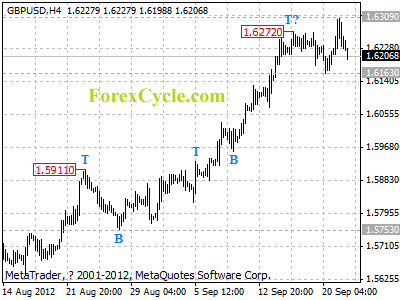
GBPUSD remains in uptrend from 1.5490

GBPUSD remains in uptrend from 1.5490, the price action from 1.6272 is treated as consolidation of the uptrend. Support is now at 1.6163, as long as this level holds, the uptrend could be expected to resume, and a break above 1.6309 could trigger another rise towards 1.6500. On the downside, a breakdown below 1.6163 will suggest that lengthier consolidation of the uptrend is underway, then deeper decline to 1.6050 area could be seen.

gbpusd

Daily Forex Forecast

Forex Fundamental Weekly Market Overview

Forex Fundamental Overview

Bank of Japan announced on last Wednesday that they will actively participate in the market as part of their quantitative-easing efforts. The Japanese central bank will increase their asset-purchase program size by 10 Trillion Yen. As a result expect a negative effect on the Yen as net M3 money supply will grow. However, in the long run quantitative easing often leads to boosting economic activity. We expect all the JPY pairs including USD/JPY, GBP/JPY will be moving upwards as a result of this in coming days.

Get our forex trading basics kit to start trading Forex

In the American market S&P 500 Index gained 0.12% and reached to 1,461.05 last week. However, the housing market recovery in USA is still being driven by “pent-up demand. U.S. housing statistics were disappointing and didn’t come as good as expected. The U.S. Bureau of Census commented that applications for home mortgages actually went down in August 2012. On the other hand, according to U.S. Department of Labor jobless benefit claims fell less than the expected on September 15.It seemed that the labor market is facing more problems in the hiring side compared to layoffs. U.K. retail sales were slow during August compared to the expectation.

Economic conditions are equally gloomy across the pond in the United Kingdom. Markets are expecting that Central Bank of England will be bringing new stimulus plan to boost economic activity. So far GBP 375 billion (USD 610 billion) was raised. According to U.K. Office for National Statistics, retail sales was down -0.2% in August compared to positive 0.3% in July. The British consumer confidence is still very weak. Inflation is expected to grow and go over earning growth potential for next six months. Thus, retail sales may fall further in coming months.

Find out what is the best forex trading platform for beginners

Interesting pairs of the Week

AUD/USD

It has formed a classic Fibonacci retracement pattern on the daily chart. The pair bounced from Fibonacci 38.2% from the previous down move. Based on most of the Technical indicators it is fair to say that it is set for further appreciation. Regardless, our Fibonacci analysis estimates that it has already demonstrated a further down move. Most indicators are likely to be overbought at this point. Based on the market condition it is expected that a strong down move may occur from the current market price.

EUR/JPY

Currently most Technical indicators are signifying its potential appreciation in coming weeks. The forecast is based on the fact that trader’s sentiment on the pair is long based on fundamental aspects of the market. It is to be noted that there are noteworthy resistance up to 102.5 and any appreciation will be choppy at best.

USD/CAD

It is currently residing at the monthly pivot point at 0.9769 after appreciating slightly over the week The pair is in general is in a down trend and the current move should be treated as a retracement. Since there was a very strong down push after it reached the SMA 20 which is halfway of the Bollinger Band, it should continue down the established down trend. To read more about cad / usd rates

This article was written by me, L.Adamski. I am a trader for the past 6 years. If you are a begginer you can start your way with http://www.forextradingbasics.co.uk/ to get the basic knowledge of Forex trading. You can also try your luck with a virtual stock market game


Did You Get Your Permit to Cross the Road?

By MoneyMorning.com.au

There are some things I’d like to write to you about more often than I do…

My publisher has agreed to throw the resources of Port Phillip Publishing behind a new free newsletter service…

Some of the topics I’ll cover include:

  • How to Plan for Retirement Without Government Help
  • Have You Prepared Your Aussie Exit Plan?
  • Do You Have a ‘Workstyle’ Rather Than a ‘Lifestyle’?
  • The Trigger Event that Will Make a Return to ‘Real Money’ a Certainty
  • How to Achieve Freedom from the War and Police State

You’ll be pleased to know that I’m still on track for an October launch.

And since making this announcement three weeks ago, I’ve received over 200 letters of support from subscribers like you, telling me they’d love to sign up for the new free eletter.

That gives me a lot of confidence that I’m doing the right thing.

If you’d like to write to me letting me know your thoughts about the proposed new eletter, please write to [email protected]

(I will publish some responses, so please state if you don’t want your name or comments published. Also sign off your email using the name you’re happy for me to use — real names or initials only, no nicknames. Also note we may edit your letter for clarity and length.)

But what you may wonder is how can you sign up for the new eletter? The good news is it will be a simple process. Within the next two weeks I’ll send you an email giving you all the details.

All you need to do is follow the instructions and you’ll start receiving the new eletter.

I’ll reveal more details next week, including the new website address and the name of the new eletter. So stay tuned.

But that’s for next week. Back to today. In this week’s Money Weekend I’ll show you another example of the nanny state interfering in the free will of individuals.

Before I go on, let me ask you a simple question: How old should you be before it’s safe to cross the road on your own?

It’s not a cryptic question…or a bad ‘chicken crossing the road’ joke. It’s a question that goes straight to the point of who can best care for your welfare, yourself or the government. I’ll explain more in a moment, but first…

Using Chart Signals to Profit

The most famous approach in investing is the ‘value’ method. Value investors try to buy companies for less than they’re worth. US billionaire Warren Buffett uses this style and has for over forty years. Another name for it is the ‘fundamental’ approach.

The second most famous method of investing is technical analysis. Basically, traders use charts and signals to find good entry points into buying (or selling) shares. This is how my old pal Murray Dawes, Slipstream Trader, attacks the market for his subscribers. I’ve asked him to write every Wednesday for Money Morning to give you his insight into technical trading and the market. See what he said this week in Why Share Trading is ‘Mental’

Now, over to the special Money Weekend essay …

Did You Get Your Permit to Cross the Road?

So, have you thought about how old you should be before it’s safe to cross the road?

12. 14. 25, 35 or what about 70?

Actually, there isn’t an age requirement for crossing the road.

Anyone can cross the road at any age. However, what you may not know is that in some instances it’s against the law for you to cross a road. That’s regardless of your age or experience of dealing with traffic.

That in some instances, you may only cross a road once the government gives you express approval to cross the road. If you cross at the wrong time or wrong location, the government will fine you.

Of course, the government doesn’t employ a bureaucrat to stand at the kerbside issuing crossing permits. Instead, it delegates the job to another authority…a machine, a piece of electronic equipment that the government says has more knowledge than you of what is and isn’t safe.

In short, in the eyes of the law, the only thing that matters when crossing the road is whether the government has given you permission to cross the road. If it hasn’t, then look out…

Too Much Government

I know this because on Monday a Victoria Police Officer alleged that I had illegally crossed the road.

The alleged offence involved me allegedly crossing the junction of Fitzroy Street and Acland Street in St Kilda prior to the delegated government machine issuing instructions that it was safe for me to cross (in plain English, crossing before the little green man appeared on the traffic light…allegedly).

Now, before I go on, you may think, ‘Get over it Kris, you’re acting like a petulant child. It sounds like you jay-walked, you got caught, so pay the fine and move on.’

Look, I’ll cop that criticism. But I’ll also make a counter-argument. At what point does government interference in your free will become excessive?

Is it when the government forces you to buy healthcare you don’t need?

Is it when the government forces you to hand over a percentage of your wages?

Is it when the government prevents you from buying a product because the government doesn’t approve of the product?

Is it when the government decides you can’t work for less than a stated minimum wage, even though you would rather work for that wage than not work at all?

Is it when the government insists you must carry a pseudo identity card to travel on a bus, tram or train, and then allows the police to check on your movements?

Is it forcing you to leave your house on a specific day in order to vote for corrupt officials? And if you choose to exercise your free will of not leaving your house on that specific day, the same corrupt officials will insist you pay a fine or go to jail.

Is it when the government decides what you can or can’t read?

Is it when the government plans to monitor every email you send and receive, and every web site you visit?

Or is it when the government says that an inanimate, electronic object on a street corner has more interest in and knowledge of your safety than you?

The correct answer for any freedom-loving person is that all the above are examples of excessive government interference in free will.

Anything where the government denies you the choice of doing something that you would otherwise choose to do is a denial of your natural rights as a person.

Coercive and Violent vs Voluntary and Peaceful

The offence of ‘jay walking’ is merely an example of how governments seek to restrict freedom, and so it’s a useful illustration of why a government can’t possibly know what’s better for you than you.

So even if you think I’m a petulant and childish fool, perhaps you could suspend that belief for a while longer to consider my argument.

Notice how I’m not forcing you to suspend your belief. I’m not even forcing you to read this email. If you’ve read this far, you’ve done so out of your own free will. And if you keep reading (even if you disagree with me) you’re also doing it freely, without coercion.

That’s the important difference between how the government interacts with citizens and how private businesses interact with customers…or how individuals interact with each other.

The first is a coercive and violent relationship. The other two are almost always voluntary and peaceful.

The point I’m making is that when standing at the side of a road, the person best placed to decide if it’s safe to cross the road is the person who intends to cross the road…not a government machine.

I can explain this point simply using the process of reductio ad absurdum (reduction to absurdity).

Imagine this scenario…

Crossing When the Government Says it’s Safe

You’re standing at a pedestrian crossing. The pedestrian signal is red indicating that it’s not safe (according to the government) for you to cross the road, even though there’s no traffic.

You wait for a minute.

As you wait, you see a car approaching at 200km an hour. The car is at a distance of 50 metres. If the lights change, the car couldn’t possibly stop in time.

That second, the traffic lights change to red and the pedestrian lights change to green. According to the government (represented by the traffic lights), it’s now safe for you to cross the road…just as a car hurtles towards the crossing at 200km/h.

If you exercised your own free will, you wouldn’t cross the road, because you would see the danger. But if you’re brainwashed to trust the government…and if you believe the government has your best interests in mind…then maybe you’d obey the government’s little green man and step into the path of the oncoming car.

Of course, some may say the argument is silly. Only an idiot would step into the path of a fast car to face certain death.

But governments force people to do things all the time — I listed a bunch of them earlier in this letter. And most of these things aren’t in the interests of either the individual concerned or the general public. But most people follow the government’s orders anyway.

What I’m saying is, don’t take me literally when I talk about someone walking in front of a speeding car. It’s just an illustration of how and why governments can’t and don’t act in your best interest.

The government is no more able to know whether it’s safe for you to cross the road (even when it delegates the responsibility to electronic traffic lights) than it can protect you in your own home, know whether you need private health insurance or know what books you should be allowed to read.

What I’m arguing is that you are the best person to make decisions that impact you. That’s the beauty of freedom and free markets.

And there’s absolutely no reason for the government to get involved.

This brings me on to the idea of a ‘free market traffic system’.

‘It Looks Terrifying, but Amazing…’

That is, rather than the government delegating traffic flow to flashing lights on the end of a pole, what about the idea of people like you and I managing traffic flow ourselves…without the interference of government.

I know what you’re thinking. ‘That is taking free markets too far.’

It couldn’t work could it? I mean, it would be chaos. There would be gridlock. People would just crash into each other, or run people over. Really? Or would the opposite happen?

When I showed this video to my old pal and colleague, Nick Hubble, his first response was, ‘It looks terrifying, but amazing results.’

Here’s a screen shot of a traffic light controlled junction in Portishead, near Bristol, UK. Each motorist is waiting in line for the government representative (traffic lights) to tell them when it’s safe to move:

As you’ll see on the video, get rid of the traffic lights, and see the amazing transformation in traffic flow. On an hourly basis, it improved traffic flow by 17.6%. No crashes, no gridlock, no running people over or crashing into each other…just orderly and respectful driving.

If you’re still not with me, how about this for a convincer. This video is from closer to home. It’s in Auckland, New Zealand:

The left frame is a junction without traffic lights. The right frame is the same junction, but the next day at the same time. Only this time the traffic lights are operational.

If you watch the video you’ll see just how traffic flow improves when government isn’t interfering.

All up, this is a long way of making a simple point…

Regardless of the scale of the action, government meddling is always wrong and disruptive.

Government actions always work against you rather than for you, and as I wrote last week, it always involves restricting or denying your rights and increasing government, bureaucratic and police power.

So yes, the alleged offence I allegedly committed of allegedly walking across the road in contravention of a government order may seem trivial, and not worthy of a 1,589-word essay.

But the bigger point is that it’s another example of the gradual and relentless chipping-away of freedoms for individuals to act in their own best interest without the meddling of government.

Cheers,
Kris

From the Archives…

What the Central Banks Are Doing to Your Money
14-09-2012 – Kris Sayce

Luxury Firm Burberry Highlights the Chinese Slowdown
13-09-2012 – John Stepek

Gold Up, but Gold Stocks Up More
12-09-2012 – Dr. Alex Cowie

The ECB is Only Fooling the Gullible
11-09-2012 – Dan Denning

Why This ‘Ludicrous’ Investment Keeps Going Up
10-09-2012 – Kris Sayce


Did You Get Your Permit to Cross the Road?