Market Review 25.9.12

Source: ForexYard

printprofile

The euro fell to a one-week low against the US dollar in overnight trading, as investor fears regarding Spain and Greece’s debt situation, combined with a worse than expected German business climate indicator yesterday, led to risk aversion in the marketplace. After trading as low as 1.2885, the EUR/USD was able to stage a slight upward correction and is currently at 1.2910. The price of crude oil saw minor downward movement last night before staging a bullish correction during early morning trading. The commodity, which is currently trading at $92.55 a barrel, has gained close to $1 since European trading began.

Main News for Today

ECB President Draghi Speaks- 13:00 GMT
• Given the recent resurgence in concerns regarding the debt situations in Greece and Spain, investors will be eagerly watching this speech
• If Draghi is able to calm investor fears regarding the pace of the euro-zone economic recovery, the euro could see bullish movement in afternoon trading

US CB Consumer Confidence- 14:00 GMT
• The consumer confidence figure is expected to come in at 63.1, slightly higher than last month’s
• Any better than expected news could help the dollar stage an upward correction against the JPY

Read more forex news on our forex blog

Forex Market Analysis provided by ForexYard.

© 2006 by FxYard Ltd

Disclaimer: Trading Foreign Exchange carries a high level of risk and may not be suitable for all investors. There is a possibility that you could sustain a loss of all of your investment and therefore you should not invest money that you cannot afford to lose. You should be aware of all the risks associated with Foreign Exchange trading.

Weekly Currency Review

After eight weeks of upward progress on the back of the European Central Bank’s “Draghi Plan” to save the single currency the euro ran out of steam. At the beginning of last week investors came to the conclusion that their optimism had been overdone. Whether or not the plan would eventually take effect, it was unlikely to progress from words to action in the near future. With this in mind investors reduced their euro holdings, money transfer are going into the safe-haven yen and US dollar.

The brief panic of ten days ago, when news of a third round of quantitative easing by the Federal Reserve sparked a rash of dollar sales, was forgotten. An announcement that the Bank of Japan would also embark on further QE held the yen back for only a few hours. Perceived safety counted for more than the jam-one-day of a revivified euro system. The euro found itself at the bottom of the heap.

For once sterling was able to avoid the downward drag of the euro. It celebrated its newfound – if perhaps only temporary – freedom by accompanying the US dollar to second place in the week’s chart. Sterling had nothing particularly to brag about; reaction to the week’s few UK economic data smacked more of relief than jubilation. Inflation was a touch lower at 2.5%, retail sales fell by less than expected in Olympics August and at this month’s meeting no member of the Monetary Policy Committee voted for more QE.

Other than the euro’s relapse and sterling’s joint number two slot, it was a fairly dull week. The lead-up to the end of the month threatens to be no less tedious. With no top-tier economic statistics on the agenda it will require unscheduled events or comments to get things moving and increase international payments.

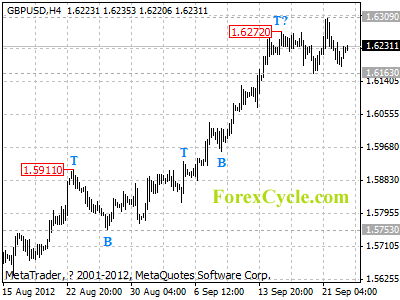
GBPUSD moves sideways in a range between 1.6163 and 1.6309

GBPUSD moves sideways in a range between 1.6163 and 1.6309. The price action in the range is likely consolidation of the uptrend from 1.5490 (Aug 2 low). Support is at 1.6163, as long as this level holds, another rise towards 1.6500 could be expected after consolidation, and a break above 1.6309 could signal resumption of the uptrend. On the downside, a breakdown below 1.6163 will indicate that lengthier consolidation of the uptrend is underway, then the pair will find support around 1.6050 area.

gbpusd

Forex Signals

ETF Play: Access to Africa

By The Sizemore Letter

As I wrote last week, the central bankers of the world are staging a monetary arms race to see who can pump more liquidity into the world economy.  ECB President Mario Draghi and Fed Chairman Ben Bernanke have each taken turns upstaging the other.

Now, it’s Japan’s turn.  The world’s third-most-powerful central bank has joined the fight, launching a fresh round of monetary stimulus of its own.  The Bank of Japan is expanding its asset purchase scheme by another 10 trillion yen to a full 80 trillion—or about $1.02 trillion in US dollars.

I don’t expect this to be the last shot fired.  The ever quotable Guido Mantega, Brazil’s finance minister, has reiterated his claim that the world is in a “currency war.”  He’s also made it clear that Brazil does not plan on losing it, meaning that Brazil will resort to loose monetary policies too in order to prevent Brazil’s currency from getting unmanageably expensive.

What does any of this mean for investors?  In an interview with the Financial Times this week, Mantega said that “risk aversion had fallen and animal spirits have increased.”

I couldn’t have said it better myself.  Until the market shows any real signs of weakening, I recommend that investors maintain an aggressive portfolio.  And right now, this would include frontier markets such as Africa and the Middle East.  I recommend investors pick up shares of the Market Vectors Africa Index ETF ($AFK) and plan to hold for the remainder of 2012.  As always, use a stop loss that is appropriate for your risk tolerance.

This piece originally appeared on Trader Planet.

Related posts:

Joint Forum wants lead supervisor of conglomerates

By Central Bank News
     Countries should pick a supervisor with overall responsibility for an entire financial conglomerate to prevent any supervisory blind spots and coordinate and monitor all  risks, according to a final report on “Principles for the Supervision of Financial Conglomerates” by the Joint Forum.
    The global financial crises highlighted the glaring shortcomings of the supervision of financial conglomerates with their myriad of regulated and unregulated units that span national and industry boundaries. Deciding which supervisory body was responsible for which unit was not always clear.
    In response to the crises, the Joint Forum – set up in 1996 to include banking, insurance and securities regulators – published an initial framework in 1999 for how to avoid such supervisory gaps.
    These principles have now been updated to reflect progress made by the Joint Forum’s parent committees: the Basel Committee on Banking Supervision, the International Organization of Securities Commissions (IOSCO) and the International Association of Insurance Supervisors (IAIS).

    “The 2012 Principles reaffirm the importance of supervisory cooperation, coordination and information sharing, clarifying the importance of identifying a Group-level Supervisor whose responsibility is to focus on group-level supervision and the facilitation of coordination between relevant supervisors,” the report said.
    The principles are aimed at giving national policy makers and supervisors a set of internationally agreed standards that ensure effective supervision of financial conglomerates.
    Among the updated principles is ensuring that supervisors have the necessary legal power and authority to perform a group-wide supervision of financial conglomerates and ensure that these companies have robust capital, liquidity and risk management frameworks.
    “Supervisors should ensure that financial conglomerates develop and follow appropriate policies to  manage capital on a group-wide basis sufficient to help ensure the entity remains able to withstand a period of adverse conditions,”according to the Principles.
   
   www.CentralBankNews.info

Israel holds rate steady, revises up 2012 growth forecast

By Central Bank News
    The Bank of Israel (BOI) held its policy interest rate steady at 2.25 percent and revised upwards its 2012 growth forecast but cut its 2013 forecast due to the fallout from Europe’s economic contraction.
    The Israeli central bank now expects the 2012 Gross Domestic Product to expand by 3.3 percent, up from a June forecast of 3.1 percent.  The bank’s upward revision follows that of Israel’s Central Bureau of Statistics, which revised upwards it forecast for 2012 growth to 3.5 percent after 4.6 percent in 2011.
    But the forecast for 2013 growth was revised down to 3.0 percent, from 3.4 percent previously, due to the impact of Europe’s slowdown.
     The forecast also looks for the central bank to keep interest rates steady until the end of 2013 and the inflation rate to accelerate over the next year due to higher indirect taxes, higher commodity prices and the past deprecation of the shekel. The inflation rate of the next four quarters until the end of the third quarter 2013 is expected to be 2.6 percent, the bank said.
    Inflation in August rose to a higher-than-expected 1.90 percent from 1.35 percent in July, but the bank said this was due to supply side factors. Inflation expectations, however, remained stable.
    The Bank of Israel has cut its interest rate by 50 basis points so far this year, most recently in June.
    The Bank of Israel said the recession in Europe was deepening and signs of slowing in emerging economies persist while it appears that the slowdown in China “reflects real weakness.”
    “The level of economic risk from around the world remains high, and with it the concerns over negative effects on the local economy. Real economic data around the world continue to indicate weakness. Assessments are that the debt crises will continue to be a major risk,” the bank said.

    www.CentralBankNews.info

Mauritius keeps rate steady, cuts growth forecast

By Central Bank News
    The central bank of Mauritius kept its key repurchase rate steady at 4.90 percent, as expected by most economists, and cut its growth forecast amid increasing inflationary pressures.
    The Bank of Mauritius, which cut is repo rate by 50 basis points in March, said it now projects economic growth of 3.3 percent for 2012, down from a previous forecast of 3.8 percent. Mauritius’ Gross Domestic Product rose a real 4.1 percent in 2011, the same rate as in 2010.
    Despite recent measures announced by the European Central Bank and the U.S. Federal Reserve, the central bank said there were significant risks of “prolonged sub-par growth in the main export markets.”
    “Considerable uncertainty remains with regard to the domestic economic outlook,” the bank said in a statement following a meeting of its Monetary Policy Committee.
    It said that upside risks to domestic inflation had risen, partly due to higher global food and energy prices. In August, annual inflation in Mauritius was steady at 3.7 percent, with the annual average down to 4.6 percent from 4.9 percent in July.

    The inflationary risks were: recent rupee depreciation, public sector wage increases expected in upcoming salary review, a possible upward pull from public to private sector wages and the expected change in retail petrol prices.
    “On current trends, y-o-y- inflation could stay at high levels,” the bank said.
    The monetary policy committee discussed a rate cut due to the growth outlook but a majority of the committee members felt there was  need to remain cautious given the global uncertainties, continuing negative real rates of interest on savings and rising corporate indebtedness.

    www.CentralBankNews.info
 

Technical Analysis: EUR/USD

By TraderVox.com

Tradervox.com (Dublin) – The Euro-dollar pair recovered from the losses that started last week but could not break above the resistance level at 1.30. With Greece making some strides towards reaching an agreement with its international creditors, the euro is projected to make some comeback. However, tensions are rising in Spain between the state of Catalonia and the government of Spain. This could be a black spot for the currency which could pull it down during the week.

The pair has started the week with a plunge to 1.2906 on Monday. While the downward trend is not expected to last for long, the intraday trading forecast for the euro-dollar pair remains neutral to bearish. However, the pair is expected to remain above the support level of 1.2816, which is the 38.2 percent retracement of 1.2255 to 1.3171 at 1.2821. An upward breakout from this level is anticipated, where a break above the resistance level of 1.3171 would pave way for 1.3486 resistance level.

The resistance levels to look at today include the resistance level at 1.2936, which has been weak last week. If the pair breaks above this level, the resistance at 1.2951 this paves way for 1.2967. Some of the important support levels in the coming days include support at 1.2905, 1.2889 and 1.2874. The pair is expected to trade at an average of 1.2920 this week. In the medium term, if the pair increases above the 1.3486, this should be an indication of an upward trend which would be limited by the resistance at 1.5. The medium term sentiments for the euro-dollar cross remains bullish as the support level of 1.25 is staying firm.

Some of the EUR/USD sentiments that are in play this week includes the tensions that are rising in Spain over Catalonia and the discussion ranging over the bailout conditions; this is generally negative for the euro. There are also sentiments that Greece is getting closer to a deal with its international creditors. However, the country is seen as failing to meets bailout targets set during its aid discussions. The discussions of a European recession are also spurring fear in the market and investors might avoid the 17-nation currency.

Further, the increasing geopolitical tensions between China and Japan have spurred tension in the global economy. The rising protests in China against Japanese targets have led to closure of some Japanese factories and businesses. The market expects some tension in the UN Assembly as US tries to quell the situation while supporting Japan.

All these global issues coupled with the waning effects of the QE3 and the mixed US data last week and the expected reports this week will affect the movement of the cross.

Disclaimer
Tradervox.com is not giving advice nor is qualified or licensed to provide financial advice. You must seek guidance from your personal advisors before acting on this information. While we try to ensure that all of the information provided on this website is kept up-to-date and accurate we accept no responsibility for any use made of the information provided. Opinions expressed at Tradervox.com are those of the individual authors and do not necessarily represent the opinion of Tradervox.com or its management. 

Article provided by TraderVox.com
Tradervox.com is a Forex News Portal that provides real-time news and analysis relating to the Currency Markets.
News and analysis are produced throughout the day by our in-house staff.
Follow us on twitter: www.twitter.com/tradervox

Gold “Still a Buy” as “Alternative to Money”, Indian Demand Up as Prices Fall

London Gold Market Report
from Ben Traynor
BullionVault
Monday 24 September 2012, 07:15 EDT

WHOLESALE MARKET gold bullion prices dropped to $1757 an ounce Monday morning in London – 1.7% off a seven-month high hit briefly last Friday – as stocks, commodities and the Euro also ticked lower and US Treasuries gained amid signs of ongoing political stalemate in Europe.

Silver bullion dropped to $33.71 per ounce – 4% down from Friday’s high.

Despite the falls, analysts continue to forecast higher prices for gold bullion, while dealers in India report increased physical demand toward the end of last week as local prices came down.

“[There is a] lack of obvious catalysts in the near term to take gold prices higher,” says Deutsche Bank analyst Daniel Brebner.

“But I do think we will likely see over the next quarter or so greater policy action both in Europe and China to support growth within those regions…and that could keep the gold price moving higher. We think we will see $2000-plus gold prices in the first half of next year.”

“I’m not worried at all about gold,” says UBS analyst Dominic Schnider.

“Despite the short-term retracement, gold is still a buy.”

“I think gold should be a portion of every one’s portfolio to some degree because it diversifies the portfolio,” hedge fund boss Ray Dalio, founder of Bridgewater Associates, told CNBC Friday.

“We have a situation now where we have too much debt, and too much debt leads to printing money…[gold] is the alternative to money.”

The world’s biggest gold ETF SPDR Gold Shares (GLD) saw its gold bullion holdings climb to 1317.8 tonnes Friday, their highest level since July 2010.

Silver bullion holdings backing world’s largest silver ETF iShares Silver Trust (SLV) held steady at 9940.7 tonnes, an 11-month high.

The aggregate net long position of gold futures and options traders on New York’s Comex continued to grow more bullish in the week to last Tuesday, weekly data published by the Commodity Futures Trading Commission show.

Palladium prices meantime fell by more than 3.5% this morning, dropping below $640 per ounce, after the world’s largest nickel and palladium miner Norilisk said it plans to cut its investment by 10%, citing a weak outlook for the metal’s price.

Eurozone leaders may allow the new permanent bailout, the European Stability Mechanism, to use leverage to increase its capacity to bail out struggling Euro members, German magazine Der Spiegel reported Sunday.

The ESM, which is expected to come into effect October 8 and will be capitalized with €500 billion, could be augmented with private sector investment to raise its capacity to €2 trillion, the report said.

“If Europe decided to leverage the ESM – and this discussion is going on – we would of course involve the German Bundestag,” Steffen Kampeter, Germany’s deputy finance minister, said Monday.

Last October, European leaders agreed to leverage the ESM’s temporary predecessor, the European Financial Stability Facility, under arrangements that use EFSF money to absorb losses and give private sector investors partial loss protection.

France’s President Hollande and Germany’s Chancellor Merkel meantime failed to reach agreement on the timetable for creating a single European banking supervisor when they met over the weekend.

Hollande said he wants the idea implemented “the earlier the better”, while Merkel said “it has to be thorough…and then we’ll see how long it takes”.

The creation of a single banking supervisor is a prerequisite before ESM money could loaned directly to banks, rather than channeled via governments and added to national debt burdens.

Elsewhere in Europe, Greece should be given more time to hit its deficit target, French prime minister Jean-Marc Ayrault said Sunday. Greece’s budget deficit is double most estimates at €20 billion, according to Der Spiegel, which reports that Greek prime minister Samaras has asked some of the governments creditors to forgive some debt.

The Greek government failed to reach an agreement on spending cuts with the so-called troika of the European Commission, European Central Bank and International Monetary Fund last week, without which Greece will not receive its next tranche of aid. Troika officials are taking a one-week break from negotiations. Payment of the €31.5 billion tranche could now be delayed until November.

Gold buyers in India have benefited from a “golden era” for the metal over the last three years, while “investments in equities have not even given a simple bank interest rate equivalent”, according to a study published by the Associated Chambers of Commerce and Industry of India.

“Net-net, gold has really outdone other asset classes and it is likely to remain an attractive bet as long as uncertainties over the global economy stays,” says Assocham’s secretary-general DS Rawat.

Jewelry dealers in Mumbai’s Zaveri Bazaar meantime saw sales rise by around a fifth during Thursday and Friday trading, as Rupee gold prices fell, India’s Business Standard reports.

“Buying interest is much higher than last week,” added one Mumbai dealer speaking to newswire Reuters.

“[This is] mostly because the Rupee has appreciated substantially.”

Ben Traynor
BullionVault

Gold value calculator   |   Buy gold online at live prices

Editor of Gold News, the analysis and investment research site from world-leading gold ownership service BullionVault, Ben Traynor was formerly editor of the Fleet Street Letter, the UK’s longest-running investment letter. A Cambridge economics graduate, he is a professional writer and editor with a specialist interest in monetary economics. Ben writes and presents BullionVault’s weekly gold market summary on YouTube and can be found on Google+

(c) BullionVault 2012

Please Note: This article is to inform your thinking, not lead it. Only you can decide the best place for your money, and any decision you make will put your money at risk. Information or data included here may have already been overtaken by events – and must be verified elsewhere – should you choose to act on it.