USD/CHF: Positive US Economic Reports to Bring the Dollar Higher

Article by AlgosysFx Forex Trading Solutions

Encouraging signs of improvements in the world’s largest economy are presumed to strengthen the US dollar opposite its safe haven counterpart in the exchanges today. Yesterday, reports indicated that consumer confidence rose to a seven-month high, factory conditions in the central Atlantic expanded, and house prices edged up. Today, the New Home Sales report is once again presumed to underscore that the US housing market has finally turned a corner.

Going by a report from the Conference Board, rising stock prices and a brighter outlook for jobs have incited more optimism from American consumers. The Consumer Confidence index jumped from 61.3 points to 71.3 points in September, its strongest reading since February this year. The outcome exceeded estimates of a modest rise to a grade of 63.1, providing improved prospects for consumer spending which accounts for about 70 percent of the US economy. Better expectations for hiring largely drove the increase, with the percentage of respondents anticipating more jobs to become available in the next six months climbing to its highest level since February. Those who expect incomes to rise likewise increased to its highest level this year.

Stabilization in housing is also playing a key role in the improvement in confidence. Average home prices in July rose 1.2 percent from a year earlier, the largest 12-month increase since August 2010, according to S&P/Case-Shiller data released yesterday. The Federal Housing Finance Agency’s House Price Index also a 0.2 percent inclined in July after 0.6 percent increases in the previous two months. Such trends solidify hopes that after five years of decline, house prices have bottomed out. According to economists, the gain supports the view that even with the broader economic recovery struggling, the housing recovery is sustainable. Such reports follow recent data suggesting home re-sales and groundbreaking on new properties rose in August while business sentiment among  homebuilders hit a more than six-year high this month.

Further optimism for the real estate market is presumed to be delivered by a projected increase in New Home Sales in August. The annualized number of single-family homes sold last month is said to have mounted from 372,000 to 381,000, potentially its highest level in more than two years. Low mortgage rates have likely stimulated buyers to finally enter the housing market. With consumer confidence improving, sales are likely to see continued gains. Amid the foregoing positive developments from the US economy, the Greenback is believed to rise against its fellow safe haven Swissie. Hence, a long position is recommended today.

For more news, analysis, technical charts and candlestick analysis, visit AlgosysFx


Japan Steps Away from Nuclear Power

By OilPrice.com

As Japan and France move away from nuclear energy, is it the endgame for nuclear proponents?

As the world slouches into the 21st century, one of the global economic realities is that more and more developing nations, much less the “First World,” are competing for fossil fuel resources whose production is rising more slowly than demand.

Complicating the picture are the booming economies of two BRIC nations, India and China, a development that ensures that developed nations will be in increasing competition for global supplies of oil, natural gas and coal, whose production is struggling to keep with increasing demand.

An alternative relentlessly pushed by Western corporate interests is nuclear power, whose proponents never cease to remind their potential audience that nuclear power plants (NPPs), unlike those fired by coal or oil, emit no greenhouse gases, no small consideration in the world community worried about global warming.

But the global nuclear power industry has three strikes against it – cost, catastrophes, whether man-made (Three Mile Island, Chernobyl) or natural (Fukushima Daiichi) and the not inconsiderable problem of disposing of nuclear waste generated by NPPs. Despite civilian nuclear programs dating back to the early 1960s, no country has yet developed an environmentally safe means of disposing of NPP’s nuclear by products, and these three issues are forcing a slow but significant worldwide rethink on the viability of nuclear electrical production.

Needless to say, the well-entrenched world nuclear power generation, with trillions of dollars invested and potentially billions more in the form of new NPP contracts, is fighting a furious rear-guard action, but the ultimate outcome of the titanic struggle is anything but clear, given a number of recent events.

The United States has 104 NPPs in operation, France – 58, Japan’s (currently offline)  54, Russia 32, South Korea 20, India 19, Canada 18, Germany 17, China 11, Taiwan six and Pakistan two, while nations with nuclear power reactors under construction include China with 23, Russia – nine, South Korea – six, India four and Taiwan two.

On 14 September, bowing to public opposition, Japan’s government joined Germany and Switzerland in turning away from nuclear power after the March 2011 earthquake unleashed a tsunami that destroyed Tokyo Electric Power Co.’s six-reactor Fukushima Daiichi NPP complex. The decision represents a major about-face by the Japanese government of Prime Minister Yoshihiko Noda, which before Fukushima stated that the nation’s energy policy would increase the country’s share of atomic energy to more than half of the country’s electricity generation. Noda’s government intended to ramp up by 300 percent the country’s share of renewable power to 30 percent of its energy mix. Noda’s decision earlier this year to restart two NPPs to avoid potential summer power outages, flying in the face of public opinion, energized anti-nuclear protests.

Noda’s government’s decision to phase out the country’s NPPs by both refusing to extend nuclear plant operating licenses beyond 40 years and committing to building no new ones provoked an immediate and predictable backlash from Japan’s powerful nuclear energy lobby, which argued that the short sighted decision would boost electricity prices, making industry uncompetitive and complicating efforts to reduce greenhouse gas emissions.

Nearly fifty years ago, when the U.S. led the way in deploying civilian nuclear electricity NPPS, proponents excitedly maintained that soon electricity would be “too cheap to measure.”

But, while this advertising slogan never panned out, a second nuclear power reality overlooked by proponents of its centrality to a nation’s power generation base is the uncomfortable fact that it was in fact born from the stupendously expensive U.S. “Manhattan Project,” which produced the nuclear weapons dropped on Japan in august 1945, which both ended World War Two and inaugurated the Cold War. The nexus between civilian electrical power generation and weaponry have existed uneasily since then, as evidenced by the recent international campaign against Iran.

So, what to make of Japan’s tepid decision to downsize its nuclear energy commitment? Thoughtful analysts might note that Europe’s leading technological powerhouses, Germany and Japan, have apparently decided to pursue energy alternatives to nuclear while France, Europe’s leading user of nuclear energy, is also rethinking its position.

Do Berlin and Tokyo know something that other nations do not? Whatever occurs, expect a vigorous rear-guard action by the global nuclear power industry, as it attempts to preserve its multi-billion dollar industry, starting with them suddenly joining the climate change bandwagon by emphasizing that NPPs generate zero greenhouse gases.

Which, of course, is why former Fukushima residents outside the NPP’s 12 mile exclusion zone breathe so much more easily.


Source: http://oilprice.com/Alternative-Energy/Nuclear-Power/Japan-Steps-Away-from-Nuclear-Power.html

By. John C.K. Daly of Oilprice.com


Concerns Regarding Spain, Greece Weigh on Euro

Source: ForexYard

The euro remained bearish throughout the day yesterday, as ongoing concerns regarding the debt situations in Greece and Spain weighed down on investor confidence in the euro-zone economic recovery. Today, the main piece of economic news is likely to be the US New Home Sales figure, set to be released at 14:00 GMT. Analysts are forecasting that the indicator will come in at 381K, which if true, would be an improvement over last month’s 372K. Any better than expected news could result in the
euro falling further against the USD.

Economic News

USD – Home Sales Data Could Help Boost Dollar

The US dollar saw gains against most higher-yielding currencies yesterday, as investor confidence in the euro-zone economic recovery declined which boosted the safe-haven USD. That being said, against the safe-haven yen, the dollar remained bearish. After reaching as high as 0.9383 during early morning trading, the USD/CHF saw a slight downward correction and spent most of the European session trading around the 0.9370 level. The USD/JPY spent most of the day trading around the 77.75 level, slightly above a recent ten-day low.

Today, dollar traders will want to keep an eye on the US New Home Sales figure, scheduled to be released at 14:00 GMT. A better than expected home sales figure in August gave the greenback a boost against several of its main currency rivals. With analysts predicting today’s news to come in at 381K, higher than last month’s, the USD may be able to recoup some of its recent losses against the yen. Tomorrow, traders will not want to forget to pay attention to the US Pending Home Sales figure to get a better gauge of the how the US retail sector is performing.

EUR – Debt Worries Lead to Further Euro Losses

The euro took additional losses against its main currency rivals yesterday, as concerns regarding Greece’s ability to meet the commitments of its recent bailout agreement and speculations that Spain will soon seek a bailout of its own weighed down on risk appetite. The EUR/USD reversed modest gains it made during Asian trading, and spent most of the day trading around the 1.2900 level. Against the Japanese yen, the common-currency also saw downward movement following a brief spike during overnight trading. The EUR/JPY spent most of the day trading around 100.30.

Today, the main piece of European news is likely to be a German ten-year bond auction. While Germany is the euro-zone’s strongest economy, and German bonds are often thought of as one of the safest investments in the EU, recent data suggests that the country is beginning to feel the effects of the debt-crisis. Should there be any signs of a decrease in demand for German debt, the euro could extend its recent bearish trend.

Gold – Gold Fails to Recoup Earlier Losses

Gold spent most of the day yesterday range trading, as renewed fears regarding the debt situations in Greece and Spain, combined with disappointing German news earlier in the week, resulted in risk aversion in the marketplace. The precious metal spent most of the day trading around the $1765 an ounce level, well below the 6 ½ month high of $1787 it hit last week.

Today, gold traders will want to continue monitoring developments out of the euro-zone, particularly with regards to the situation in Spain. Most analysts agree that Spain will soon have to request a bailout package from the ECB. When it does, investors may shift their funds to riskier assets, which could help gold recoup some of this week’s losses.

Crude Oil – US Inventories Figure Set to Impact Oil

After seeing a modest boost during overnight trading yesterday, crude oil was able to largely maintain its gains throughout the European session. The commodity spent most of the day trading around the $92.40 a barrel level, well above its low of $91.05 from earlier in the week.

Today, oil traders will want to pay close attention to the US Crude Oil Inventories figure, set to be released at 14:30 GMT. The indicator has come in significantly higher than expected for the last two weeks, which was taken as a sign that demand in the US has gone down and resulted in the price of oil falling. If today’s news once again comes in above the forecasted level, crude may give back its recent gains.

Technical News

EUR/USD

A bearish cross on the weekly chart’s Slow Stochastic indicates that this pair may see a downward correction in the near future. Additionally, the Williams Percent Range on the same chart has crossed over into overbought territory. Opening short positions may be the wise choice for this pair.

GBP/USD

The daily chart’s Relative Strength Index has crossed into the overbought zone, signaling a possible downward correction in the near future. This theory is supported by the weekly chart’s Williams Percent Range, which is currently above the -20 level. Traders may want to open short positions for this pair.

USD/JPY

While a bearish cross has formed on the daily chart’s MACD/OsMA, most other technical indicators place this pair in neutral territory. Traders may want to take a wait and see approach for this pair, as a clearer picture is likely to present itself in the near future.

USD/CHF

The Bollinger Bands on the weekly chart are narrowing, indicating that this pair could see a price shift in the near future. Furthermore, the Williams Percent Range on the same chart has crossed into oversold territory, signaling that the price shift could be upward. Opening long positions may be the wise choice for this pair.

The Wild Card

DAX 30

The daily chart’s MACD/OsMA has formed a bearish cross, signaling that downward movement could occur in the near future. Furthermore, the Williams Percent Range on the same chart has crossed into overbought territory. This may be a good time for forex traders to open short positions ahead of a downward correction.

Forex Market Analysis provided by ForexYard.

© 2006 by FxYard Ltd

Disclaimer: Trading Foreign Exchange carries a high level of risk and may not be suitable for all investors. There is a possibility that you could sustain a loss of all of your investment and therefore you should not invest money that you cannot afford to lose. You should be aware of all the risks associated with Foreign Exchange trading.


Philly Fed President Pessimistic of Bond Buying Program

By TraderVox.com

Tradervox.com (Dublin) – Charles Plosser, the Federal Reserve Bank of Philadelphia President, has expressed pessimism in the ability of the bond buying program announce by the Fed to spur economic growth and employment in the country. In a speech yesterday in the district bank in Philadelphia, Plosser said that the program is unlikely to bring much benefit to economic growth or employment. He warned against conveying the message that the asset purchases program will bring substantive impact on labor market and speed up economic recovery as this puts at risk the credibility of Federal Reserve.

The Federal Open market Committee decided to embark of an asset purchases program where the bank will buy $40 billion of mortgage-backed securities per month until the labor market improves substantially. The unemployment rate has been above 8 percent since February 2009, prompting the Fed to shift to unconventional tools to deal with it. Plosser noted that economic research shows that additional asset purchases will not significantly reduce long-term interest rates and if interest rates is lowered by few basis points, the economic recovery pace will not be affected and neither will the hiring. He projected that the US economy will probably grow at rate of 3 percent in 2013 and 2014.

Explaining his opposition to the Fed decision, Plosser indicated that he believes that quantitative easing program is not appropriate for current economic environment. The US stocks dropped sending the S&P 500 index on its biggest loss in three months. Concerns that the current measures taken by global central banks will not yield the expected results have spurred global stock decline. Plosser said that protecting the hard won Fed credibility is important as the confidence in policy makers helps them to make effective monetary policies. He explained that if Americans believe the Fed will delay in raising interest rates, they may construe this as an indication the Fed is willing to tolerate higher inflation, which would spur higher inflation expectations that would force the Committee to act.

Disclaimer
Tradervox.com is not giving advice nor is qualified or licensed to provide financial advice. You must seek guidance from your personal advisors before acting on this information. While we try to ensure that all of the information provided on this website is kept up-to-date and accurate we accept no responsibility for any use made of the information provided. Opinions expressed at Tradervox.com are those of the individual authors and do not necessarily represent the opinion of Tradervox.com or its management. 

Article provided by TraderVox.com
Tradervox.com is a Forex News Portal that provides real-time news and analysis relating to the Currency Markets.
News and analysis are produced throughout the day by our in-house staff.
Follow us on twitter: www.twitter.com/tradervox

Euro Drops Prior to Retail Sales Report

By TraderVox.com

Tradervox.com (Dublin) – The 17-nation currency dropped to the lowest in as weakening economic data and political uncertainty in the currency bloc signaled a worsening debt crisis. The euro dropped to its lowest in two weeks against the yen prior to the release of reports projected to show declines in European consumer confidence and Italian retail sales. The Japanese currency advanced against the US dollar as safety seekers opted for the yen over the US currency. The yen climbed to 0.1 percent from one-week high against the dollar as Mariano Rajoy, the Spanish Prime Minister, faces calls to request for international bailout. This has caused losses in Asian stocks, causing a decline in asset related currencies.

According to Hitoshi Asaoka, a Tokyo-based Senior Strategist at Mizuho Trust & Banking Co. indicated that the recent data coming from Europe suggest that the economy will remain weak in the medium term, adding that the Spanish Prime Minister reluctance to ask for international bailout is weighing on the euro. The decline on the euro also came as the MSCI Asia Pacific Index of stocks fell by 1.2 percent. Further, speculation that the Italian Retail Sales fell by 0.8 percent in July, has led to the euro decline. It is also estimated that the overall consumer confidence in the euro zone fell to negative 25.9 in September. If this figure is confirmed, this will be the lowest since May 2009. This report will be released tomorrow by the European Commission.

Euro zone crisis seems to be compounded by the political tensions in Spain where Catalan President Artur Mas has asked for early elections. This has come at a point when Spain has increased its spending and the tax receipts are reported to decline. Spanish Prime Minister has refused to ask for international bailout saying the country will meet its budget goals.

The euro declined by 0.2 percent against the dollar to trade at $1.2868 after it dropped to its least since Sept 13 of $1.2862. It dropped to 99.97 against the yen, the least since September 13. The currency is trading at 0.4 percent low from its Level during the New York session yesterday.

Disclaimer
Tradervox.com is not giving advice nor is qualified or licensed to provide financial advice. You must seek guidance from your personal advisors before acting on this information. While we try to ensure that all of the information provided on this website is kept up-to-date and accurate we accept no responsibility for any use made of the information provided. Opinions expressed at Tradervox.com are those of the individual authors and do not necessarily represent the opinion of Tradervox.com or its management. 

Article provided by TraderVox.com
Tradervox.com is a Forex News Portal that provides real-time news and analysis relating to the Currency Markets.
News and analysis are produced throughout the day by our in-house staff.
Follow us on twitter: www.twitter.com/tradervox

Market Review 26.9.12

Source: ForexYard

printprofile

The euro tumbled vs. the US dollar in overnight trading, as concerns regarding the Spanish debt situation led to risk aversion among investors. After falling 55 pips to reach as low as 1.2855, the common currency bounced back to the 1.2870 level, where it is currently trading. After staging a mild upward correction at the beginning of the Asian session, the price of crude oil quickly reversed, erasing all of its previous gains. Crude traded as high as $91.31 a barrel before dropping to its current level of $90.75.

Main News for Today

US New Home Sales- 14:00 GMT
• The home sales data is forecasted to come in at 381K, which would represent an improvement over last month’s figure of 372K
• Any better than expected news could help the US dollar bounce back from its recent lows against the Japanese yen

Read more forex news on our forex blog

Forex Market Analysis provided by ForexYard.

© 2006 by FxYard Ltd

Disclaimer: Trading Foreign Exchange carries a high level of risk and may not be suitable for all investors. There is a possibility that you could sustain a loss of all of your investment and therefore you should not invest money that you cannot afford to lose. You should be aware of all the risks associated with Foreign Exchange trading.

Central Bank News Link List – Sept 26, 2012: Low rates may lead to risky behavior, IMF says

By Central Bank News

Here’s today’s Central Bank News link list, click through if you missed the previous link list. The list comprises news about central banks that is not covered by Central Bank News. The list is updated during the day with the latest developments so readers don’t miss any important news.

The Grave Mistake of Telling the Truth

By MoneyMorning.com.au

Overnight we saw the biggest sell-off in the US markets in over two months. US Federal Reserve Bank of Philadelphia President Charles Plosser made the grave mistake of telling the truth. He said that ‘we are unlikely to see much benefit to growth or to employment from further asset purchases.’

Plosser opposed QE3, so it shouldn’t be a surprise to hear him say this. But most market participants have been waiting with baited breath since the QE3 announcement to see whether the sharp rally of the last few months would continue.

The trading over the past week has been decidedly sluggish and after last night’s sell-off we have now retraced most of the rally since the QE3 announcement…

Last week I wrote about the technical set up in the S+P 500 and said that, ‘From where I sit, if the market fails to hold these levels and sells off to a level below the previous high of 1422 made in April this year, then there’s a high chance that we’ll see a sharp correction back towards the 200 day moving average at 1350.’

The intermediate trend is still up in US markets so you have to expect the buying pressure to remain for the moment. But last night’s price action sends an ominous warning that the emperor (US Federal Reserve Chairman, Ben Bernanke) may soon be shown to be wearing no clothes.

Unlike QE1, QE2 and Operation Twist, market participants have been front running the announcement of QE3 for the past three months. There will be plenty of traders scrambling to hit the sell button if the market continues to fall over from here.

Macroeconomic figures worldwide have weakened over the last few quarters so the strong rally is looking more and more like hot air.

Bernanke’s greatest power was in promising to do something in the future. The uncertainty and expectation that this created was enough to keep short sellers at bay while buyers attempted to front run the money printing.

But now that Bernanke has turned expectation into fact the market will focus on whether or not the money printing will actually achieve anything.

That is why Plosser’s comments last night created such a strong reaction. If printing all this money achieves nothing other than keeping mortgage rates close to their all-time historical lows and economic figures continue to worsen, you have to ask yourself why you would buy the US stock market at a yield of 1.8% or so.

Bernanke the Witch Doctor

If the spell is broken on the money printing voodoo there is a long way for the market to fall and I think the announcement of ‘QEternity’, as it’s becoming known, at multi-year highs for the stock market smacks of desperation.

If the market continues to fall from here there isn’t much Bernanke can do, because he has already shown his hand.

As always market tops take time to form and some buying pressure always remains while we are in intermediate uptrend (10-day moving average above the 35-day moving average) so it’s still too early to come out all guns blazing on the short side.

But I think last night’s price action is the first sign of cracks appearing since the announcement of QE3. That means you need to closely watch the trading over the next few weeks.

Another sign that we may be close to a market top is the extremely low volatility of the past few weeks…

Market Warning Signs

I look at the 10 day average true range of the index I’m analysing as a percentage of its price and then I invert the indicator and lay it over the index.

I’ve found this method can give you great early warning signs when the market is ready to turn.

S+P 500 Daily Chart and Average True Range

S+P 500 Daily Chart and Average True Range
Click here to enlarge

Source: Slipstream Trader


(As always it’s advisable to open the above chart in another browser window so you can follow along with my reasoning.)

The blue line chart below the S+P 500 is the ATR indicator. It’s inverted, so a rising line means falling volatility and a falling line means rising volatility. The scale for the ATR indicator is on the left hand side of the chart and you can see that when the ATR indicator hits a level of around 0.8 (meaning the average true range over the past 10 days has been around 0.8% a day) the stock market has been very close to a multi-month top.

The vertical lines show you each time the ATR indicator has come close to that level (I’m not including the Christmas trading period in 2010, which I consider an outlier).

Follow the vertical lines up to the actual S+P 500 chart and you can see quite clearly that the market was very close to a major sell-off each time the volatility fell below the 0.8 level.

Obviously nothing is ever 100% certain in the markets and this may be the one time in the past three years where this indicator gets it wrong. But after explaining the waning post QE3 excitement above I would start to tread very carefully going forward.

An article in the Age yesterday said that:

‘Regulators have vowed to impose a fresh ban on short-selling in shares if markets descended into the kind of chaos seen around the time of the global financial crisis.

‘The Australian Securities and Investments Commission has pledged to impose a ban on the practice should market conditions require it.

I’m sure you remember the last time ASIC banned short selling. It was in 2008 just prior to one of the biggest sell-offs in the market history. I love the way regulators are happy for short sellers to lose money while the market goes up but then when short selling is profitable they decide it’s an evil practice that must be stamped out.

The only outcome from banning short selling last time was that it took away buying volume as the market fell because there were no short sellers covering their positions. Yes they created an initial spike, but when the music stopped the bottom fell out from under the market.

We can always rely on regulators to do the dumbest thing at exactly the wrong moment and to ignore history. So when you see them acting on short selling you should start to get very worried indeed.

I want to make one other quick observation about the ASX 200 before I sign off.

ASX 200 Daily Chart

S+P 500 Daily Chart and Average True Range
Click here to enlarge

Source: Slipstream Trader

The ASX 200 has been in a very clear range between 4100-4300 for over a year now. Whenever the ASX 200 has closed above the 4300 level during this time (the ellipses in the chart) the market has created a high and subsequently sold off sharply to below 4100.

The actual high of the range is 4324 so keep your eye on that level and if it closes below that level this week the chances of another drop to below 4100 increases dramatically.

Murray Dawes
Editor, Slipstream Trader

Related Articles

What You Must Do to Survive the Coming China Crash

We Buy Gold Because We Don’t Trust Them Not to Meddle

The Mission Creep Destroying Wealth Around the World


The Grave Mistake of Telling the Truth

The Only Winner in the Currency Wars

By MoneyMorning.com.au

‘We see gold as an officially recognised form of money for one primary reason: it is widely held by most of the world’s larger central banks as a component of reserves.’

– Duetsche Bank analysts Daniel Brebner and Xiao Fu

Brazil’s finance minister Guido Mantega made headline writers all over the world happy a few years ago when he announced the beginning of the Currency Wars. Mantega made his original comment when the US Fed came out with QE2 in 2010.

Last week, he concluded both the Fed and the Bank of Japan were engaging in currency warfare.

He’s right about that. Currency debasement as a way to boost growth and exports is all central banks have left. It’s also the only strategy they have for pumping asset prices and preventing the large global credit and derivatives bubble from popping. It forces everyone to ‘race to the bottom’.

For Brazil, that may mean taxes on capital coming into the country. That’s the weapon the country employed last time to make the Real a less attractive currency to own. But with the Fed and the BoJ committed to even more debasement, Brazil, like every other emerging market country, will have to get cleverer if it wants to engineer currency weakness.

The Asset to Own During Currency Debasement

About the only winner I can see in the currency wars is gold. The boys from Deutsche Bank seemed to figure that out last week, too. The quotation at the top is from a new research report by analysts Daniel Brenber and Xiao Fu. They make the point that you know gold is money because so many central banks own it. They go on:

‘We would go further however, and argue that gold could be characterised as ‘good’ money as opposed to ‘bad’ money which would be represented by many of today’s fiat currencies.

In describing gold as such we refer to Gresham’s Law – when a government overvalues one type of money and undervalues another, the undervalued money (good) will leave the country or disappear from circulation into hoards, while the overvalued money (bad) will flood into circulation.’

I’ve always thought that Gresham’s Law was the best refutation of Warren Buffett’s silly comments about gold. Buffett complains that gold makes no sense because you dig it up out of the ground in order to put it in a vault. Gold has no yield, no earnings, and isn’t a business.

But the more valuable something is – good money in Gresham’s Law terms – the less likely you are to use it, sell it, or exchange it. You store it for a rainy day and hold on to instead. That’s why central banks keep gold. It’s money, and fiat currencies always die.

With a dearth of quality collateral in the world’s financial system, gold gets more valuable by the day. Rather than trying to ride the Fed’s liquidity wave through stocks, I’m content to accumulate physical gold and silver.

Dan Denning
Editor, The Denning Report

From the Archives…

In Defence and Praise of ‘Cranks and Crazies’
21-09-2012 – Kris Sayce

We Buy Gold Because We Don’t Trust Them Not to Meddle
20-09-2012 – Kris Sayce

Why Share Trading is ‘Mental’
19-09-2012 – Murray Dawes

A Bear Market Where You Least Expect
18-09-2012 – Greg Canavan

Questionable Easing 3
17-09-2012 – Dr. Alex Cowie


The Only Winner in the Currency Wars

GBPUSD continues sideways movement

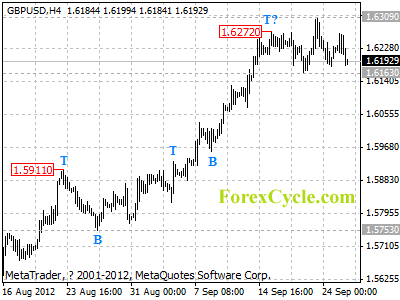
GBPUSD continues its sideways movement in a range between 1.6163 and 1.6309. Initial support is at 1.6163, as long as this level holds, the price action in the range is treated as consolidation of the uptrend from 1.5490 (Aug 2 low), and another rise towards 1.6500 is still possible. However, a breakdown below 1.6163 support will indicate that lengthier consolidation of the uptrend is underway, then deeper decline to 1.6050 area to complete the consolidation could be seen.

gbpusd

Forex Signals