Albania keeps key interest rate unchanged at 4%

By Central Bank News
    The central bank of Albania kept its benchmark refinancing rate unchanged at 4.0 percent, saying monetary conditions were appropriate to ensure that it would meet its inflation target and still provide enough stimulus to support domestic demand and growth.
    The Bank of Albania said foreign demand had supported economic growth in the second quarter with increased exports and lower imports and data show that this positive momentum continued in July.
    But domestic demand and economic growth remains below potential, which is reflected in slow growth in production costs and well-anchored inflation expectations.  The central bank expects these factors to continue to determine inflation in the future.
    “Economic activity in the country is expected to remain low… as a result, inflationary pressures remain low and under control,” the Bank of Albania said in a statement after a meeting of its Supervisory Council on Sept. 26.
    The bank said inflation in August rose 0.1 percent to an annual rate of 2.8 percent. The central bank targets inflation of 3.0 percent.
    The Bank of Albania has cut its rates three times this year, for a total cut of 75 basis points.

    www.CentralBankNews.info
   

Central Bank News Link List – Sept 27, 2012: Chicago Fed president defends central bank moves

By Central Bank News

Here’s today’s Central Bank News link list, click through if you missed the previous link list. The list comprises news about central banks that is not covered by Central Bank News. The list is updated during the day with the latest developments so readers don’t miss any important news.

We Said This Four Years Ago, But Nobody Would Listen

By MoneyMorning.com.au

If you’ve read Money Weekend over the past three weeks, you’ll know that soon we’ll launch a new free eletter.

The eletter will cover some of the topics we’d like to write to you about in Money Morning, but can’t.

The reason is that this is supposed to be a mainly financially based newsletter. So when we go off on a tangent, talking about things like press freedom, personal freedom and the expansion of the police state, some readers don’t like it.

In fact, those tend to be the days when we get the most unsubscribe requests. We get that. You may have signed up for Money Morning to read about financial markets, the world economy and a few stock tips. What you may not have signed up for is our take on non-financial matters.

So, we’ve decided to switch the non-financial commentary to a separate free eletter. We’ll make more details available over the next few days, including how you can subscribe to the new eletter.

In the meantime, feel free to drop us a line to [email protected] to let us know what you think of this idea, and the kind of subjects you’d like us to include.

As for today’s Money Morning, the mainstream press seems shocked that the world’s biggest banks have manipulated interest rates for years. We’d like to know where the mainstream press has been all this time, because interest rate fixing goes to the very top. It implicates some of the most powerful men and women on earth…

Four years ago some labelled us as a crackpot, a nutter and a lunatic (names we consider a badge of honour rather than an insult).

Back then we dared to suggest that the Aussie banking sector was just as fragile and corrupt as the US and European banking sectors.

‘Oh no’, came the frequent reply. ‘Aussie banks have much higher lending standards. They didn’t get involved in sub-prime loans.’

But we knew we were right. That’s why we kept banging on about it. We wanted to make sure Money Morning readers knew the real state of the Aussie economy, the Aussie housing market, and the Aussie banking sector.

Well, four years later and what do you know…

‘A senior National Australia Bank executive expressed grave concerns about the credit market in an obscenity-laden email sent in February 2008, two months before the bank officially recognised a portfolio of sub-prime loans were damaged goods.’ – Age, 17 September 2012

‘Home loans classed as “sub-prime” accounted for about one in 10 of the nation’s mortgages when the global financial crisis hit, with those loans now more than six times as likely to be in arrears as normal loans.

‘The figures reveal that claims Australia was insulated from the worst of the GFC due to vastly superior lending standards, a notion encouraged by many of the biggest banks, are exaggerated.’ – Australian, 27 September 2012

‘America’s subprime mortgage scandal triggered the Global Financial Crisis and the world’s still recovering from it. What’s less known is that Australia too had its own subprime loans scam, the full extent of which is only just emerging.

‘Banks and other lenders abused the system of so-called low doc loans, which are designed for small business people.

‘They were sold by the thousands to pensioners, single mums and people on welfare and many investors are still struggling to pay the price of it.’ – ABC 7.30 Report, 13 August 2012

Good work by the mainstream media. It’s just a shame it took them four years to catch up. It might have been good if they’d backed us up when in 2010 we revealed the secret loans obtained from the US Federal Reserve by National Australia Bank and Westpac.

But no, not a peep. The mainstream was too busy cheerleading for the wonderful Aussie banking execs who had supposedly steered the banking sector through a global crisis. But they forgot to mention the Fed’s secret loans, the first homebuyer’s bailout, and the banking deposit guarantee.

The Aussie banking sector would have been toast without those three direct and indirect taxpayer funded bailouts. Given the fragile and corrupt state of the global banking system, it could still be toast.

Trouble is as always the mainstream press is looking the wrong way. They’re getting their pants in a twist about the wrong thing. Take the latest reporting from Bloomberg News on the Libor scandal.

It’s Not Just the Banks Fixing Interest Rates

The headline runs, ‘RBS Instant Messages Show Libor Rates Skewed for Traders’.

The report notes:

‘Royal Bank of Scotland Group Plc trader Tan Chi Min told colleagues the firm was able to move global interest rates, according to electronic messages the bank is trying to make secret.

‘Transcripts of the internal instant messages were included in a 231-page affidavit filed Sept. 19 by Tan, the bank’s former Singapore-based head of delta trading for Asia, who’s suing Britain’s third-biggest lender by assets for wrongful dismissal after being fired last year for allegedly trying to manipulate the London interbank offered rate, or Libor.

‘”Nice Libor,” Tan said in an April 2, 2008, instant message with traders including Neil Danziger, who also was fired by RBS, and David Pieri. “Our six-month fixing moved the entire fixing, hahahah.”

‘The conversations among traders at RBS and firms including Deutsche Bank AG (DBK) illustrate how the risk of abuse was embedded in the process for setting Libor, the benchmark for more than $300 trillion of securities worldwide. RBS, 81 percent owned by the British government, is one of at least a dozen banks being probed over allegations they colluded to manipulate the rate so they could profit from bets on interest-rate derivatives.’

What a scandal.

Of course, compared to the scale of the real interest rate manipulators, the Libor rate fixing is a storm in a teacup.

Think of it this way. The Royal Bank of Scotland was fined 290 million pounds (AUD$452 million) and fired at least two employees for fixing interest rates.

Now read this extract from the Australian last week:

‘The central bank posted a profit of $1.076 billion last financial year, compared with a loss of $4.889 billion the previous year.

‘Reserve Bank of Australia governor Glenn Stevens said the bottom line rebound was due mostly to the fact that the Australian dollar didn’t repeat the sharp rally it recorded a year earlier.’

Or this from the Daily Beast:

‘So far this year, the Fed, which turns over its profits to the Treasury department, has earned more than $80 billion for the government and over $5 billion just this month.’

How do the central banks profit? That’s right, by fiddling with interest rates. Yes, the Libor scandal may have affected the pricing of USD$300 trillion of securities, but that’s nothing compared to the impact on interest rates caused by the US Federal Reserve.

A Bigger Scandal Than Libor

According to the Bank for International Settlements, the total derivatives market is USD$604.9 trillion.

But that’s not the end of it. According to McKinsey Global Institute:

‘The total value of the world’s financial stock, comprising equity market capitalization and outstanding bonds and loans, has increased from $175 trillion in 2008 to $212 trillion at the end of 2010.’

Already we’re up to USD$816.9 trillion. And that doesn’t even include physical assets such as gold, silver, and owned property. And it doesn’t include bank savings accounts.

In short, don’t worry about what the corrupt banks did with the Libor scandal. It’s nothing. Not when you compare it to the daily interest rate fixing committed by the government backed central banks.

Their actions are much more harmful than anything committed by the Libor banks. Remember the report from last week’s UK Daily Mail:

‘QE [money printing] has the effect of lowering annuity rates, which dictate how much a newly-retired person receives from their pension, to an all-time low.

‘Some 20 years ago a £100,000 pension pot bought £15,650 a year for life – today it’s just £5,800.

‘This, combined with low interest rates on savings and the rising cost of living, has hit pensioners especially hard.

‘[Bank of England governor,] Sir Mervyn expressed “great sympathy” for their plight and said he found the impact on their lives “deeply upsetting.”

‘Millions of elderly have seen the income on their savings accounts disappear with many accounts paying close to zero per cent.’

Make no mistake, it isn’t the Libor banks that have pushed pensioners into poverty. The real criminals are the central banks. They are the ones that control the interest rates covering 1,000 trillion dollars of wealth and speculation.

Your Wealth is the Next Target

The yield on a US two-year government bond is 0.26%. That means investors receive 0.26% in interest each year. The current US price inflation rate is 1.7%.

In other words, the cost of living is rising more than six times faster than the income US retirees can earn from a ‘risk-free’ investment.

And if you go by the unofficial price inflation rate on Shadowstats.com, the real price inflation rate is 5%…or nearly 20 times greater than the return on a ‘risk-free’ investment:

Source: Shadowstats.com

If it wasn’t for central bank meddling, interest rates would be higher. Why? Because in a free market with the current inflation rate, no investor in their right mind would lend money at a rate so far below the price inflation rate.

Bottom line, we’re not saying the banks are innocent, because they aren’t. But don’t trust the mainstream press, governments or central bankers to tell you the truth.

If they did, they would have to reveal the identity of real financial terrorists…themselves.

Those who claim to have the solutions to fix the current global financial mess are the ones who are making things worse.

Unfortunately, it’s directly impacting your current or future retirement. And as we’ll reveal in this week’s Money Weekend (in your inbox on Saturday morning) the government isn’t satisfied with wealth destruction…

After they’ve finished wreaking havoc on your savings, the next step is to rob you of what’s left.

Cheers,
Kris

Related Articles

How to Make Money from the End of the Mining Boom

We Buy Gold Because We Don’t Trust Them Not to Meddle

The Mission Creep Destroying Wealth Around the World


We Said This Four Years Ago, But Nobody Would Listen

Is the World Running Short of Gold?

By MoneyMorning.com.au

In his essays On The Principles Of Population, the English scholar Thomas Malthus argued that the earth’s resources are limited and cannot support unlimited population growth. ‘The power of population is indefinitely greater than the power in the earth to produce subsistence for man’, he said.

In many ways “peak oil” theory is an extension of this notion. There is a finite amount of oil in the world, runs the theory (one estimate puts that number at 75 trillion barrels).

At a certain stage, the point of maximum production will be reached. Thereafter production levels will decline.

The US reached its peak in 1970; the rest of world, it seems, in May 2005 at 74 million barrels per day – though this is subject to a lot of debate.

But what about ‘peak gold‘? Does the Malthusian argument extend to gold?

Are We Really Facing ‘Peak Gold’?

Until last year, it seemed that world gold production had peaked in 2001 at just 2,600 tonnes a year. Despite the rising gold price, by 2008 that number had slid to 2,400 tonnes.

However, we have seen a rally, and 2011 saw a record at 2,818 tonnes. Forecasters seem to concur that will we see something like 2,900 tonnes produced in 2012.

However, annual global demand is considerably more than that. It was about 3,500 tonnes in 2000 and rose to 4,486 tonnes by 2011.

In other words there is a deficit. There has been a deficit since the mid-1970s. This has risen from below 1,000 tonnes in 2000 to 1,668 tonnes last year.

The cumulative effect of that deficit is pretty striking. Chartist and all-round data gobbler, Nick Laird of sharelynx.com, who has produced the chart below, says: ‘Note that since 1950, 133,000 tonnes (over 80% of the gold ever found) has gone into demand with 115,000 tonnes of this having come from production.

This leaves a shortfall of 18,000 tonnes, which has come from central bank sales, stockpiles and scrap’.

That 18,000-tonne shortfall represents about seven years’ worth of total production. Where, I can’t help wondering, given that central banks are now net buyers, will the gold to address future shortfalls come from?

It all points to higher prices – prices at which more people are happy to sell.

Source: sharelynx.com

Miners Have to Work Harder to Find Gold

However, the 2011 production record has come at a cost. Exploration expenditure has gone from $1bn in 2000, to $6bn in 2010, according to data from the Metals Economics Group.

I’ve read other arguments that suggest the figure is closer to $8bn.

And despite this increased expenditure, the number of major discoveries – for major, read a deposit of more than a million ounces – being made is actually falling, as the table below from Minex Consulting shows.

In 1996 there were about 30. In 2002, around five (with gold as the primary metal). By 2006 that number bounced back to 20. 2010 saw about ten. It seems that number will have fallen in 2011, but the data is still incomplete.

Source: Minex Consulting

The exploration sector needs to make discoveries to justify its existence. Part of the reason funding dried up in late 2011 and 2012 must be that so few discoveries were made. There was nothing to get investors excited.

In fact, failure makes them angry. Shareholders are rather more tolerant of their chief executives lording it up at the Savoy if they’ve just made a million ounce discovery.

As well as the number of discoveries declining, it appears the average size of major deposit discoveries is declining too.

In 1970 to 1979, the average was 5.9 million ounces. That declined to 5.6 million ounces in the next decade and to 5.1 million ounces in the decade after that.

Between 2000 and 2009, the average size of a major gold discovery fell to 4.4 million ounces.

The average grade of discovered gold is also declining – in other words, there is less gold in the rock, which means it is more difficult and more expensive to extract.

In short, we are seeing declines in both size and quality. That’s similar to the problem many oil producers face of having to go into more challenging areas, be it geologically, geographically or politically, to get their oil. It’s a reflection of ‘peak oil’ in other words.

The average time from drilling the discovery hole to declaring the maiden resource is 3.7 years. From discovery to an actual mine start-up, takes an average of ten years.

The lack of major recent discoveries points to a further shortfall in production five or ten years down the road. It also suggests that the gap between demand and production will further increase.

So leaving aside the analysis of the subtext of central bank pronouncements, the sheer numbers alone point to higher gold prices ahead.

Dominic Frisby
Contributing Writer, Money Morning

Publisher’s Note: This article originally appeared in MoneyWeek

From the Archives…

In Defence and Praise of ‘Cranks and Crazies’
21-09-2012 – Kris Sayce

We Buy Gold Because We Don’t Trust Them Not to Meddle
20-09-2012 – Kris Sayce

Why Share Trading is ‘Mental’
19-09-2012 – Murray Dawes

A Bear Market Where You Least Expect
18-09-2012 – Greg Canavan

Questionable Easing 3
17-09-2012 – Dr. Alex Cowie


Is the World Running Short of Gold?

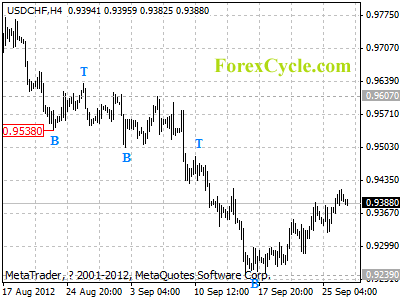
USDCHF continues upward movement from 0.9239

USDCHF continues its upward movement from 0.9239, and the rise extends to as high as 0.9417. Further rise is still possible, and next target would be at 0.9500 area. However, the rise is treated as consolidation of the downtrend from 0.9971 (Jul 24 high), as long as 0.9500 level holds, the downtrend could be expected to resume, and another fall towards 0.9000 is still possible, only break above 0.9500 could signal completion of the downtrend.

usdchf

Daily Forex Forecast

Bull vs. Bear Debate for the 4th Quarter

By The Sizemore Letter

Listen to Charles Sizemore and InvestorPlace’s Jeff Reeves continue their bull vs. bear debate in this audio interview:

If you cannot see the embedded audio player, please click here.  This interview first appeared on InvestorPlace

Related posts:

Georgia holds rate, inflation expected to reach target

By Central Bank News
    The National Bank of Georgia kept its main policy rate, the refinancing rate, unchanged at 5.75 percent as inflation is expected to reach the bank’s target in the medium term and the economy’s output gap is insignificant.
    Georgia’s central bank said Gross Domestic Product growth in the second quarter was 8.2 percent, which the bank described as “quite high.”
    The central bank has cut its policy rate four times this year for a total reduction of 100 basis points.
    Inflation in Georgian fell to an annual rate of minus 0.4 percent in August for an annual average of 0.1 percent, significantly below the bank’s target of 6.0 percent.
    “According to existing forecasts in the coming months inflation will start to moderate and growth will approach its target value in the second half of the next year,” the central bank said in a statement.
    Georgia’s inflation rate fell to 2.0 percent in 2011 from 11.2 percent in 2010.
    It said credit growth had decelerated in the past two months, which is typical ahead of elections, but credit activity is expected to increase in coming months given high liquidity in the banking sector.
   
     www.CentralBankNews.info

Europe Will Be the Best-Performing Market for the Rest of 2012

By The Sizemore Letter

September 18, 2012 was a noteworthy day for students of history.

King Juan Carlos of Spain stepped into the political fray for the first time in more than 30 years, calling on all Spaniards to stick together during the hard times in front of them and to avoid chasing unrealistic pipedreams (those who can read Spanish can view his letter here).

Advising Spaniards not to tilt at windmills since 1975.

The King’s comments were his most direct involvement in Spanish politics since he intervened in 1981 to prevent a mad, machine-gun-toting colonel from taking over the government.

Today, no one is walking into Spain’s parliament building and spraying the ceiling with bullets, but the King’s letter is telling.  Spain—and much of the rest of peripheral Europe—is mired in a cycle of debt-necessitated austerity and economic contraction that has created the worst crisis in decades.  Europe is a mess.

For all of the optimism surrounding Mario Draghi’s “Big Bazooka” moves to stabilize the Eurozone through outright monetary transactions, the crisis still has a long way to go before it is resolved.

And I should be clear—it may never get resolved.

Depending on the political decisions made over the next 3 – 6 months, the Eurozone could emerge from the crisis as a stronger, more durable union.  Or, the entire European project—which has been in the works for sixty years now—could come apart at the seams.

With all of this as an intro, you might be surprised by what I say next: I’m bullish on European equities and maintain an overweight position in them in most of my client portfolios.

Let’s look at some of the bullish arguments:

  1. The ECB doing “whatever it takes” via unprecedented monetary stimulus  – All investors have heard the standard advice: Don’t fight the Fed.   I would argue that, for the first time, the same can be said of the European Central Bank.  Mario Draghi broke long-standing taboos and asserted his authority over the German Bundesbank by launching his program of potentially unlimited outright monetary transactions over the objection of Bundesbank President Jens Weidmann.  Draghi has a bigger bankroll than you, and he’s shown that he’s not afraid to use it, even if it means stretching his constitutional mandate.  This does not by any means suggest that Draghi can create the conditions for a durable bull market; but it does mean that he can stoke the flames of a multi-month rally.
  2. The bailout mechanisms will clear up the uncertainty weighing on the market – Spain has yet to formally request aid from the ECB or the bailout institutions; yet rumors that prime minster Mariano Rajoy was getting close to doing so was enough to send Spanish stock prices soaring last week.  According to leaked news from the parties involved, EU and Spanish officials are working behind the scenes to set out the conditions for a Spanish bailout that Rajoy would accept.  Meanwhile, Der Spiegel reports that talks are underway to allow the Eurozone’s primary bailout fund—the European Stability Mechanism—to be leveraged to 2 trillion Euros if need be.  Suffice it to say, a lot of monetary firepower is being thrown at the Eurozone, and a fair bit of it can be expected to find its way into the Eurozone equity markets.
  3. European stocks are the cheapest in the world – Finally—and most importantly—European stocks are dirt cheap relative to their world peers.  To be sure, some sort of “Europe discount” is appropriate given the macro risk and the unappealing growth prospects for years to come.  But at some point, the stocks are simply too cheap to ignore.   By FT estimates, the French, German and Spanish markets trade for just 14.1, 12.7, and 13.4 times earnings, respectively.  Depressed earnings, I might add.  Each also yields between 3 and 5 percent in dividends.  Compare this to the United States,  which trades for 16.1 times cyclically-high earnings and yields a pitiful 2.1%.  Are European stocks as attractively priced as they were two months ago?  Of course not.  But I still expect them to be among the best performing in the world over the next 6-12 months.

It’s only fair to mention the other side of the coin.  If the bond market loses faith in Mr. Draghi or infighting among Europe’s politicians prevent them from making the institutional reforms needed to make the bailouts credible, then all bets are off.  (Just today it was announced that the German, Finnish and Dutch finance ministers had announced opposition to aspects of the bank bailout….sigh). In the event that the reforms truly break down, investors will want to not only exit their European equity positions but exit all risky assets, as this would mean a return to the risk-on / risk-off volatility we’ve had to endure for much of the past two years.

SUBSCRIBE to Sizemore Insights via e-mail today.

Related posts:

“Buy the Dips” in Gold & Silver Advise Bank Analysts as South Africa’s Mining Strikes Spread

London Gold Market Report
from Adrian Ash
BullionVault
Weds 26 Sept, 08:00 EST

WHOLESALE gold prices in US Dollars dipped beneath $1760 per ounce for the 3rd time this week in London on Wednesday morning, gaining against the Euro and Sterling as those currencies fell faster and rising back towards last week’s new all-time high versus the Swiss Franc.

World stock markets extended Tuesday’s late plunge in US equities, knocking 2.4% off the French CAC40 index as the Euro dropped to a 2-week low beneath $1.2850.

After anti-austerity protesters clashed last night with police in Madrid, a general strike in Greece brought the country “to a standstill” according to BBC reports, with tens of thousands of people gathered outside parliament in Athens.

Commodity prices fell, with crude oil dropping to a 7-week low.

Silver bullion held below $34.00 per ounce, trading just above Tuesday’s 8-session low.

“It’s bullish when gold goes up in other currencies than the Dollar,” Bloomberg today quotes Mitsubishi Corporation’s precious metals strategist Matthew Turner, “because it means it’s a fundamental story rather than a currency issue.

“We’ve been waiting for QE3 in gold for over a year now and now it’s happened.”

US central banker Charles Plosser, president of the Philadelphia Federal Reserve, warned Tuesday that the Fed’s new monthly purchases of $40 billion in mortgage debt are “unlikely to see much benefit to growth or employment.”

“Plosser threw a wet rag on hopes that the Fed’s quantitative easing would stimulate the US economy,” says Marc Ground at Standard Bank in London.

“[But the] accommodative monetary policy stance from the Fed will support precious metals, particularly gold and silver, well into 2013.”

Analysts at Bank of America-Merrill Lynch also “remain secular bulls on gold,” says technical strategist Stephen Suttmeier, adding that “The breakout above the year-long downtrend line completes the correction within the longer-term uptrend.

“Gold prices point to a stronger rally to $2050-2300 and up to $3000 longer-term.”

Last week, Suttmeier’s BAML colleague MacNeil Curry – head of foreign-exchange technical strategy – told CNBC that he sees gold hitting $3000 to $5000 an ounce, but “not in the next few months.”

On the demand side, “Physical demand still remains fairly limp presently,” says today’s note from Swiss refiner and financiers MKS’s Australian dealers, “and there is certainly an increase in scrap this month which is skewing physical flows to the downside.

“The one respite is that typically Q4 shows a bounce back in physical demand following summer holidays [as the] Chinese and Indian gift giving and festival season begins.”

Gold prices in India – where mid-November’s Diwali festival will mark the typical gold buying peak for the world’s #1 consumers – today edged higher by 0.3%, the first such rise in a week according to Bloomberg but only 2.5% off this month’s new record highs.

Central banks “are likely to continue to buy gold for the remainder of this year,” writes Eugen Weinberg, head of commodity research at Commerzbank in Frankfurt today, “thereby stripping supply from the market and contributing to climbing gold prices.”

Gold is “currently also finding support from concerns about supply in South Africa,” says Weinberg of the world’s former #1 producer, still sitting on the biggest underground reserves.

“Strikes [by miners] are now concentrated on the gold industry, while the platinum industry has recently calmed down again.”

The world’s 4th largest gold mining firm, Gold Fields, said Tuesday that workers remained on illegal strike at two of its South African mines, “ignored the agreement reached Friday night,” according to a spokesman.

World No.3 listed miner AngloGold Ashanti said Wednesday morning that illegal strike action at its Kopanang mine had spead to involves “most” of South African workforce.

Holding the world’s second-largest unmined gold reserves, however, Russia could accept tenders to work Siberia’s Sukhoi Log, the country’s biggest untapped gold deposits – “in the near future” said deputy prime minister Arkady Dvorkovich, speaking at Reuters Russia Investment Summit in Moscow Tuesday.

Adrian Ash
BullionVault

Gold price chart, no delay   |   Buy gold online at live prices

Adrian Ash is head of research at BullionVault, the secure, low-cost gold and silver market for private investors online, where you can buy gold today vaulted in Zurich on $3 spreads and 0.8% dealing fees.

(c) BullionVault 2012

Please Note: This article is to inform your thinking, not lead it. Only you can decide the best place for your money, and any decision you make will put your money at risk. Information or data included here may have already been overtaken by events – and must be verified elsewhere – should you choose to act on it.


Pound Up To One-Year High Against the Dollar on Improving Economy Signs

By TraderVox.com

Tradervox.com (Dublin) – The sterling pound increased towards one-year high against the greenback after UK industry report showed that mortgage approval increased last month. Speculation is high that the UK economy is improving hence pushing the pound high against the dollar, euro and yen. The UK currency increased against the Japanese currency as draft guidelines for the European Stability Mechanism showed that the European Central Bank will invest in several assets. Speculations that the debt crisis will affect the UK economy have declined significantly.

Jeremy Stretch, a London-based Foreign-Exchange Strategist at the Canadian Imperial Bank of Commerce, noted that the pound rose as sentiment improved regarding the European Stability Mechanism’s ability to invest is a wide range of assets. He also noted that the UK housing data contributed to the strengthening pound as it was marginally better than the previous readings. According to British Bankers Association report, mortgage approvals in UK increased to 30,533 in August, registering the largest amount of mortgage approvals since April. The figure rose from 28,750 registered in July. Further, signals of UK economy improvement came from the Office of National Statistics report, which showed that the budget deficit ex-government support for banks was at 14.4 billion pounds lower than the market expectation of 15 billion pounds.

The Bank of England said that the financial institutions in the country may be able to borrow an initial amount of 61 billion pound through its new Funding for Lending Scheme. Under this scheme, the BOE intends to avail funds to households and companies as a way to fend off contagion from the debt-stricken euro zone.

The UK currency appreciated by 0.2 percent against the US dollar to exchange at $1.6241 at the close of trading session in London yesterday. The currency had climbed to a high of $1.6309 on September 21, which is the highest level since August 31, last year. The pound rose to 79.37 pence against the euro, its strongest since September 7, before retreating to 79.76.

Disclaimer
Tradervox.com is not giving advice nor is qualified or licensed to provide financial advice. You must seek guidance from your personal advisors before acting on this information. While we try to ensure that all of the information provided on this website is kept up-to-date and accurate we accept no responsibility for any use made of the information provided. Opinions expressed at Tradervox.com are those of the individual authors and do not necessarily represent the opinion of Tradervox.com or its management. 

Article provided by TraderVox.com
Tradervox.com is a Forex News Portal that provides real-time news and analysis relating to the Currency Markets.
News and analysis are produced throughout the day by our in-house staff.
Follow us on twitter: www.twitter.com/tradervox