EUR/USD: Euro Remains Under Pressure

Article by AlgosysFx Forex Trading Solutions

In yesterday’s European trading exchanges, the Euro lost to the US dollar after Spain presented its budget-reform program, a step that many analysts deem as initiatory before it decides to request for a full-blown bailout from its Euro Zone partners. The single currency also got a boost from the decline in Italian borrowing costs to 5.24 percent, from 5.82 percent at August 30’s auction. With doubts whether or not Spain would be able to control government spending because of Catalan’s demand for greater autonomy, the shared currency is seen to weaken versus the Greenback in today’s trades.

In its budget presentation yesterday, Spain announced a fresh round of budget cuts for 2013 that would enable the government to save 13 Billion Euros, with spending down by 7.3 percent. Madrid is said to be having talks with the European Union authorities about the terms of a potential bailout package that would give way for the European Central Bank to intervene and help lower its borrowing costs.

Despite the economic reforms about to be taken by the government, the region remains in trouble. Economic confidence in the currency union fell to the lowest level in three years, according to a survey conducted by the European Union’s Commission. Another challenge for Spain is Catalan, the most indebted region in Spain, as it calls for greater tax autonomy, which Rajoy already rejected. With growing pressure on Spain to seek for financial aid, the shared currency is likely to wane if the country continues to reject calls to request for a bailout. Thus, a sell bias is suggested for the EUR/USD in today’s European trades.

For more news, analysis, technical charts and candlestick analysis, visit AlgosysFx


The Importance of Patience and Persistence in Your Trading

View the lesson learned from a dramatic sell-off in the E-Mini S&P 500 in this educational excerpt
September, 2012

By Elliott Wave International

Enjoy this video clip from Elliott Wave International Senior Analyst Jeffrey Kennedy, as he combines actionable advice that’s easy to understand with a no-nonsense take on trading psychology.

You can get immediate access to additional trading lessons like this one each day when you register for EWI’s Trader Education Week FREE >>

See how patience and persistence allowed Jeffrey to catch a dramatic sell-off in the E-Mini S&P 500.


Announcing Trader Education Week: Learn How to Spot Trading Opportunities in Your Charts

Don’t miss this chance to learn from Jeffrey Kennedy in a daily online video lessons, Sept 26-Oct 3. You’ll learn:

  • How to discover trading opportunities using the Elliott Wave Principle
  • The different types of moving averages and how to interpret them
  • How to use Fibonacci ratios to calculate price targets
  • Candlestick and bar patterns that have proven reliability
  • How to apply Jeffrey’s proprietary channeling technique
  • How to set your protective stops
  • And much more!

Plus, you have immediate access to 4 introductory lessons.

Register for Trader Education Week now >>

This article was syndicated by Elliott Wave International and was originally published under the headline The Importance of Patience and Persistence in Your Trading. EWI is the world’s largest market forecasting firm. Its staff of full-time analysts led by Chartered Market Technician Robert Prechter provides 24-hour-a-day market analysis to institutional and private investors around the world.


Euro Extends Bearish Trend

Source: ForexYard

Concerns regarding Spain and Greece’s ability to tackle their debt issues caused the euro to extend its recent bearish trend throughout the day yesterday. Crude oil saw fairly significant gains during the first half of the day due to an increase in Middle East tensions, but its upward movement was halted following the release of disappointing news out of the US. As markets get ready to close for the weekend, traders should note that a lack of significant news out of the US and euro-zone may lead to erratic price shifts in the marketplace. In addition, any announcements concerning the debt situation in Spain or Greece could lead to heavy volatility.

Economic News

USD – Disappointing US Data Leads to Temporary Dollar Losses

A batch of disappointing US data yesterday caused the US dollar to temporarily reverse its recent bullish trend against several of its main currency rivals. That being said, euro-zone concerns resulted in investors shifting their funds to safe-haven assets, giving the greenback a boost during afternoon trading. The USD/CHF fell more than 30 pips during the first half of the day to trade as low as 0.9371 before bouncing back to 0.9415 toward the end of the European session. The GBP/USD gained approximately 45 pips to trade as high as 1.6234, before a reversal brought the pair to 1.6190 later in the day.

As markets get ready to close for the weekend, a lack of significant US news means that any dollar movement is likely to come as a result of announcements out of the euro-zone. Traders will want to continue monitoring developments in the region to see if risk aversion will continue to dominate market sentiment. Next week, traders should not forget that the all-important US Non-Farm Employment Change is scheduled to be released, and is likely to generate heavy market volatility as a result.

EUR – Spain, Greece Keep EUR near Recent Lows

The euro spent most of the European session yesterday near a two-week low against the US dollar and Japanese yen, as questions regarding the debt situations in Spain and Greece resulted in investors shifting their funds away from higher-yielding assets. The EUR/USD fell close to 60 pips over the course of the day, eventually dropping below the 1.2827 level. Against the JPY, the euro sunk more than 40 pips eventually trading just above the 99.60 level.

Today, euro traders will want to continue monitoring developments out of both Spain and Greece, as the two countries remain the biggest obstacles to the euro-zone economic recovery at this time. Any positive developments could help the common-currency recover from some of its recent losses. Next week, traders will want to remember to pay attention to the EU Minimum Bid Rate and ECB Press Conference, as they are likely to offer important clues as to the current state of the economic recovery in the region.

Gold – Gold Rebounds from 2-Week Low

After hitting a two-week low earlier in the week, gold was able to stage an upward correction yesterday after mixed US news temporarily weakened the USD. Overall, the precious metal gained more than $15 an ounce during mid-day trading, eventually reaching as high as $1768, where it largely remained for the rest of European trading.

As we begin to close out the week, a lack of significant news out of the US means that any change in the price of gold is likely to come from announcements out of the euro-zone. With the debt situations in Spain and Greece still fragile to say the least, gold may have a hard time maintaining yesterday’s gains if there are any signs that the debt crisis in the region is worsening.

Crude Oil – Disappointing US News Causes Oil to Reverse Gains

Supply side fears due to escalating tensions in the Middle East led to a sharp increase in the price of oil during the first half of the day yesterday. That being said, gains were limited after a set of disappointing news out of the US led to speculation that American demand for oil may drop. Oil peaked at $91.71, up around $1.60 a barrel, before staging a slight downward reversal and stabilizing at the $91.30 level.

Turning to today, traders will want to pay attention to announcements out of the euro-zone which could impact risk taking among investors. Any positive developments out of either Greece or Spain with regards to their respective debt issues could cause investors to shift their funds to higher-yielding assets, which may boost the price of oil.

Technical News

EUR/USD

The Bollinger Bands on the weekly chart are beginning to narrow, indicating that a major price shift could occur in the coming days. A bearish cross on the same chart’s Slow Stochastic signals that the price shift could be downward. Opening short positions may be the wise choice for this pair.

GBP/USD

The weekly chart’s Slow Stochastic has formed a bearish cross, indicating that this pair could see downward movement in the coming days. Furthermore, the Williams Percent Range on the same chart has crossed into overbought territory. Traders may want to open short positions for this pair.

USD/JPY

Both the Relative Strength Index and Williams Percent Range on the weekly chart are approaching oversold territory. Traders will want to keep an eye on both of these indicators. If they cross below the oversold line, it may be a sign of impending upward movement.

USD/CHF

While a bullish cross has formed on the weekly chart’s Slow Stochastic, most other long-term technical indicators place this pair in neutral territory. Traders may want to take a wait and see approach for this pair, as a clearer picture is likely to present itself in the near future.

The Wild Card

USD/DKK

In a sign that this pair could see a price shift in the near future, the Bollinger Bands on the daily chart are narrowing. Furthermore, the Williams Percent Range on the same chart has crossed over into overbought territory, indicating that the price shift could be downward. This may be a good time for forex traders to open short positions ahead of a bearish correction.

Forex Market Analysis provided by ForexYard.

© 2006 by FxYard Ltd

Disclaimer: Trading Foreign Exchange carries a high level of risk and may not be suitable for all investors. There is a possibility that you could sustain a loss of all of your investment and therefore you should not invest money that you cannot afford to lose. You should be aware of all the risks associated with Foreign Exchange trading.


South Pacific Dollars Appreciate Prior as Speculation of China Stimulus Rises

By TraderVox.com

Tradervox.com (Dublin) – The Australian dollar advanced against most of its major counterparts as speculation of additional stimulus from Chinese government rose. The Aussie appreciated as China’s export prospects rose. The New Zealand dollar increased against the US dollar after the central bank in China injected $58 billion in the economy pushing the Kiwi to its fourth weekly gain. China, which is Australia’s biggest trade partner and New Zealand’s second largest trade partner, has pledged to increase stimulus to support growth in the country. The demand for south pacific currencies also rose after Spain announced its fifth austerity package hence reducing concerns that it may fail to meet austerity requirements.

The People’s Republic of China has experienced deteriorating economic growth in the recent times forcing Fitch Rating company to lower their forecast for the country. Fitch has indicated that the Chinese economy will grow by 7.8 percent lower than the 8 percent it had indicated earlier. Investors are now looking at the manufacturing and purchasing managers Index to be released on October 1 in China to see if there are any signs of renewed growth. The data is expected to increase pressure on Chinese Premier Wen Jiabao to boost growth in the country ahead of power transfer which will be done this year.

According to Matthew Stanley, the Head of Asia Pacific Sales in Sydney at Velocity Trade Ltd, the figures from China signal to the need for the government to make additional stimulus to spur growth. He added that the news from Spain will support the south pacific dollars during the next trading session. The Australian dollar has increased by 0.2 percent against the dollar to trade at $1.0458 at the close of trading in Sydney after it climbed by 0.7 percent yesterday when it traded at $1.0442. The Aussie is set to increase by 1.3 percent since August and a 2.2 percent for the third quarter. The New Zealand currency increased by 0.3 percent against the dollar to exchange at 83.41 US cents from yesterday. The currency is projected to increase by 3.8 percent this month and 4.1 percent increase in the third quarter.

Disclaimer
Tradervox.com is not giving advice nor is qualified or licensed to provide financial advice. You must seek guidance from your personal advisors before acting on this information. While we try to ensure that all of the information provided on this website is kept up-to-date and accurate we accept no responsibility for any use made of the information provided. Opinions expressed at Tradervox.com are those of the individual authors and do not necessarily represent the opinion of Tradervox.com or its management. 

Article provided by TraderVox.com
Tradervox.com is a Forex News Portal that provides real-time news and analysis relating to the Currency Markets.
News and analysis are produced throughout the day by our in-house staff.
Follow us on twitter: www.twitter.com/tradervox

Market Review 28.9.12

Source: ForexYard

printprofile

The euro bounced back from a two-week low against the US dollar yesterday, after Spain unveiled a new budget which some viewed as the next step before officially requesting a bailout from the European Central Bank. The EUR/USD advanced more than 30 pips during Asian trading to reach as high as 1.2941 before staging a downward correction and dropping to its current level of 1.2925. Both crude oil and gold saw gains from the news as well. In the last 24 hours, crude has gained more than $2 a barrel while gold has advanced over $25 an ounce.

Main News for Today

Canadian GDP- 12:30 GMT
• The Canadian dollar has steadily gained on the USD for the last several days
• Should today’s news come in above the forecasted 0.1%, the USD/CAD could see additional downward movement before markets close for the week

Read more forex news on our forex blog

Forex Market Analysis provided by ForexYard.

© 2006 by FxYard Ltd

Disclaimer: Trading Foreign Exchange carries a high level of risk and may not be suitable for all investors. There is a possibility that you could sustain a loss of all of your investment and therefore you should not invest money that you cannot afford to lose. You should be aware of all the risks associated with Foreign Exchange trading.

Why This Crisis Still Has a Long Way to Run

By MoneyMorning.com.au

When is a cut not a cut?

When it’s an increase.

Sorry to be cryptic, but we laugh when we see presidents, prime ministers and finance ministers talk about ‘austerity’ and ‘slashing budgets’.

Because just like central bank money printing, the markets get excited for about three minutes before they realise what even an idiot can see…


Cut spending isn’t what governments do. For governments, spending only ever goes one way. That’s up.

And that’s why we always turn to one tried and tested asset class in times like these. You know what we’re talking about, but read on anyway…

This morning the papers are going batty on the news that, ‘Spain unveils austerity budget as political turmoil mounts’. So says the Australian newspaper.

According to the Wall Street Journal:

‘The Spanish government presented 13 billion euros ($16 billion) of spending cuts and tax increases for 2013 and said it will place new limits on early retirements as political turmoil heightens investor concerns over Prime Minister Mariano Rajoy’s ability to slash a towering budget deficit and stabilise one of Europe’s largest ailing economies.’

We wish Spain luck. Especially considering the following post to the UK Daily Telegraph‘s blog covering the Spanish budget overnight:

‘Spanish government sees unemployment bottoming out and has predicted an average rate of 24.3pc [per cent] for next year.’

The same blog also reveals:

‘Spanish deficit targets: 6.3pc in 2012, 4.5pc in 2013, 2.8pc in 2014, 1.9pc in 2015.

‘These cuts are aimed at chopping €40bn off Spain’s budget deficit next year.’

Here’s a bit of free advice for Spanish Prime Minister, Mario Rajoy. When your government is announcing welfare cuts, it’s probably best not to be photographed chomping on a cigar in New York:

Source: Independent.ie


But before you start getting too excited about so-called spending cuts, and the positive impact it could have on the world economy, just remember this: when governments cut spending, it doesn’t mean they cut spending.

Not as Good as the Treasurer Claims

It was a bit like the smoke and mirrors from Aussie Treasurer, Wayne Swan. Last week he spun the argument that the Aussie federal budget was $661 million better off than predicted.

The mainstream press fell for it hook, line and sinker. What a great Treasurer they said. What a good boy.

What they didn’t focus on (just as the Treasurer hoped), was that last year the government spent $43.7 billion more than it raised in taxes.

To cover the shortfall the government had to issue more bonds…in other words go further into debt. And with commodity prices collapsing, the Aussie budget position is set to get worse.

It’s the same for Spain. Just because it reduces the budget deficit doesn’t mean the economy or debt position is any better. Last year Spain’s budget deficit was 8.5% of GDP, or about €97.8 billion.

So even if Spain cuts spending by €40 billion, it’s still spending €57.8 billion more than it takes in with taxes.

And that’s assuming the Spanish economy doesn’t get worse, which it probably will given the proposed tax increases.

What we’re getting at is this: it’s nearly five years since the world economy started to fall apart.

The US Federal Reserve has virtually admitted that it’s out of ideas. The only solution it’s got is to print money…even though that’s never worked before.

The Eurozone thinks it can fix its spending problems by keeping on spending and creating a bigger debt problem instead.

And China thinks it can stop its economy from crashing by building more roads, buildings and railways…that no-one can afford to use.

And as for all those in the mainstream media who love the Chinese economy, and fall over themselves to praise it, just remember what we’ve said about China for the past four years – it’s a brutal economy and leadership that sees the Chinese people as a means to stay in power and line their own pockets.

How Chinese Infrastructure Projects Work

Take this news story from the New York Daily News that you won’t read in the compliant, China-loving Aussie press:

‘Stomach-churning photos have surfaced allegedly showing the moment a Chinese protester was crushed by a steamroller while trying to stop government officials from relocating his village to make way for a commercial development.

‘A local government official allegedly ordered the trucks forward, and the man was flattened beneath one six-wheeled hulking behemoth, the report said.’

How are you enjoying your iPhone now? And anything else that’s ‘Made in China’.

All this tells us that those in power are getting desperate. They’ll do anything to make sure the economy doesn’t collapse on their watch.

That means pretending to cut budgets while increasing debts, it means printing money as a last resort, and it means crushing people to death in order to erect a new building paid for with government stimulus money.

Add all this together and it should explain why one particular ‘fear gauge’ (gold) is rocketing back towards record levels.

Even mainstream analysts are getting back on board the gold bandwagon. In the old days (five years ago) we would have worried about the mainstream backing gold. We would have seen it as a sign of a market top.

But not now.

The Best Way to Protect Your Wealth

Now the economy is so bad, the mainstream is finally waking up to reality. As the New York Post reports:

‘Gold has had a good summer, rising more than 9 percent, but that move may be just the start, according to a bullish Citi precious metal analyst.

‘Tom Fitzpatrick believes autumn will be golden in the beginning of a run-up that he says will culminate with the yellow metal hitting $2,500 an ounce in the first quarter of next year. The price now stands at $1,736.’

That report is actually two weeks old. Today gold is at USD$1,776.

But despite the recent gold rally, we’re still happy buyers. And we’ll stay a happy buyer until governments and central bankers understand the solution to the current financial mess isn’t to print money, go into debt, or raise taxes.

Unfortunately, that day appears to be a long way off. We’ll give you more reasons to buy gold in tomorrow’s Money Weekend.

Cheers,
Kris

Related Articles

How to Make Money from the End of the Mining Boom

We Buy Gold Because We Don’t Trust Them Not to Meddle

The Mission Creep Destroying Wealth Around the World


Why This Crisis Still Has a Long Way to Run

The Big Oil and Gas Boom in the USA

By MoneyMorning.com.au

The USA has had a rather rocky relationship with oil. In the 19th century, the discovery of massive reserves of oil set America on course to become a hugely powerful nation. Cities started to flourish. And vast suburbs sprung up as the country adapted to cheap car travel.

More recently, America has had to curb its consumption. The era of gluttonous oil consumption came to an end as the USA became dependent upon imported oil.

The USA began to feel the strain of rising oil prices. When oil spiked during the financial crisis, Americans left their car at home. And industrial oil consumption collapsed.

But now, thanks to two new commercially deployed drilling techniques, the USA is set to free up an abundance of trapped gas and oil. And that could help the US economy back on its feet.

Because, while the glamour boys of the oil industry are heading off to deep waters, and plunging hundreds of millions of dollars down exploratory holes with very uncertain results, plenty of other oil men prefer a low risk play that offers a fast pay-back.

I met one of them last week. Matt Lofgran is chief executive of Nostra Terra Oil & Gas (AIM: NTOG), and before long he was scrawling figures on a piece of rough paper – figures that show just why he is joining the rush for US on-shore assets.

‘An Energy Renaissance’ in America

Make no mistake – America’s energy security has taken a dramatic swing for the better. Goldman Sachs has predicted that America will soon regain its title as the world’s largest oil producer, knocking Russia and Saudi Arabia off the top of the tree.

As I mentioned earlier, this is not down to the USA suddenly stumbling upon new oil fields. No, the real reason is that the ever inventive oil industry has found a way of extracting some of the oil that is known to exist but which has not previously been accessible.

‘America’s renaissance,’ says Goldman Sachs, ‘is down to hydraulic fracturing, or “fracking”. A process that has already significantly changed the gas industry and has been adapted to oil.’

To recap, ‘fracking’ and horizontal drilling are techniques which involve the cracking of rock strata from underground that allows trapped gas or oil to flow freely. Without doubt these methods have significantly changed the gas industry, although not to everybody’s benefit.

The price of gas in the USA has tumbled from over $10/mmbtu to $2.80/mmbtu. This is great news for consumers and is likely to trigger a switch from coal-fired to gas-fired power plants.

But it is not, of course, so good for gas producers and some of these are now in financial difficulties and are off-loading assets at distressed prices.

Targeting a High Oil Price

That sounds like an opportunity for someone, but the easier play today is to apply this same fracking technology to oil rather than gas fields. Although you may think that the gas price and the oil price should move in tandem, in fact they do not. Logistical and other considerations mean that while there is effectively a world price for oil, gas prices are set locally.

Today, the price of gas in the USA is low, but the price of oil is still high so it makes sense to target the latter. Throughout North America from the Red Earth and Swan Hills fields of Alberta, to the Woodbine and Eagleford properties of Texas, old fields are being reworked with the new techniques of fracking and horizontal drilling.

To get an idea of how profitable this can be, Lofgran referred me to the website of SandRidge Energy (NYSE:SD) which has licences in Texas and Oklahoma.

In its ‘Operational Guidance’ Sandridge quotes lifting costs of $15-$17 per barrel of oil; ‘DD & A’ (depreciation, depletion and amortisation) costs of $18.25-$20.20 per barrel; ‘General and Administration’ costs of $5.85-$6.50 per barrel; production taxes of $1.75-$1.95 per barrel; and interest expense of $8.70-$9.60 per barrel.

Add up the mid-point of those numbers and you get a figure of $58.575 per barrel, all in, which leaves a healthy profit margin on each barrel sold for $90 plus.

For separate projects, Sandridge quotes Internal Rates of Return of 62% and 82%, which look highly attractive under any circumstances but especially for what is essentially quite a low risk play.

There Could Be a Stampede

Of course there are a few reasons for caution. Where there is a stampede into a sure thing you can bet that eventually some will overpay for their entry ticket. Depletion, the rate at which the flow of oil subsides, is not entirely predictable. And if the USA finds too much oil, it could just throw the whole world market into imbalance and sink the oil price.

But for the time being the outlook is rosy.

Tom Bulford
Contributing Writer, Money Morning

Publisher’s Note: This article originally appeared in MoneyWeek

From the Archives…

In Defence and Praise of ‘Cranks and Crazies’
21-09-2012 – Kris Sayce

We Buy Gold Because We Don’t Trust Them Not to Meddle
20-09-2012 – Kris Sayce

Why Share Trading is ‘Mental’
19-09-2012 – Murray Dawes

A Bear Market Where You Least Expect
18-09-2012 – Greg Canavan

Questionable Easing 3
17-09-2012 – Dr. Alex Cowie


The Big Oil and Gas Boom in the USA

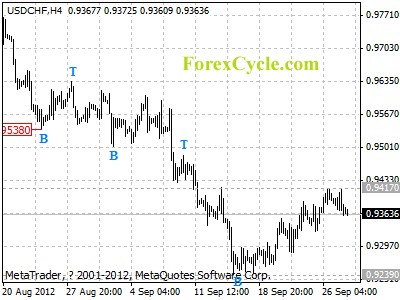
USDCHF may be forming a cycle top at 0.9417

USDCHF may be forming a cycle top at 0.9417 on 4-hour chart. Key support is now at 0.9325, a breakdown below this level will indicate that the rise from 0.9239 has completed, and the longer term downtrend from 0.9971 (Jul 24 high) has resumed, then further decline towards 0.9000 could be seen. On the other side, as long as 0.9325 support holds, the pair remains in short term uptrend from 0.9239, one more rise to 0.9500 area is still possible.

usdchf

Forex Signals

Central Bank News Link List – Sept 28, 2012: China underestimated global slowdown, key to rates

By Central Bank News
Here’s today’s Central Bank News link list, click through if you missed the previous link list. The list comprises news about central banks that is not covered by Central Bank News. The list is updated during the day with the latest developments so readers don’t miss any important news.

Dominican Republic holds rate, eyes economic rebound

By Central Bank News
    The Central Bank of the Dominican Republic kept its monetary policy rate unchanged at 5.0 percent as domestic demand remains below its long-term trend, but the bank expects a rebound in private credit and economic activity as market interest rates decline following two interest rate cuts earlier this year.
    The central bank cut rates in June and August for a total reduction of 125 basis points and the bank said this easing, along with a reorganization of public finances and a new agreement with the International Monetary Fund (IMF), “would help improve the macro economic conditions in the coming quarters.”
    The central bank said in a statement that the decision to keep the rate steady also took into account the latest projections that call for inflation to fall below the lower limit of the bank’s 2012 target, but within the bank’s 2013 target range of 5.0 percent plus/minus one percentage point. The bank has a 5.5 percent inflation target for 2012, also with a 1.0 percentage point range.

    In August inflation in the Dominican Republic rose to an annual rate of 2.16 percent from July’s 1.6 percent, the central bank said.
    “Forecasting models do not show significant inflationary pressures over the monetary policy horizon,” the central bank said in a statement.
    It also said that capital flows to emerging economies were on the rise following the latest policy move by the U.S. Federal Reserve that has “sent a signal of moderate growth and low inflation pressures, which is reflected in a deprecation of the dollar and moderating oil prices.”
    In added there was the prospect of recession in the euro area for the rest of the year and part of 2013.
        www.CentralBankNews.info