Central Bank News Link List – Oct. 1, 2012: Bernanke aims to recapture Fed debate

By Central Bank News

Here’s today’s Central Bank News link list, click through if you missed the previous link list. The list comprises news about central banks that is not covered by Central Bank News. The list is updated during the day with the latest developments so readers don’t miss any important news.

Japan’s Energy Crisis and the Take Away for Aussie Investors

By MoneyMorning.com.au

Japan is caught in a trade deficit trap. Exports to Europe fell by 28% from a year earlier in August, according to data from the Ministry of Finance.

Exports to Germany were down 18% and exports to the UK were down 42%. Exports to China – and this was before all the Toyota bashing – fell 12%.

Exports fell more than imports. The result was Japan’s 18th consecutive monthly trade deficit since the March 2011 earthquake and tsunami. But the big driver of the trade deficit isn’t falling exports. It’s rising energy imports.

This is a structural shift in Japan that has a direct impact on the Aussie LNG industry. Japan needs energy. It has to import almost all of its oil and gas. It used to meet the electricity demands of industry with nuclear power.

But only two of its fifty nuclear power plants are currently online. And there’s a great deal of debate about a plan to phase out nuclear power entirely by 2030.

The Impact on Australia

Japan will face much higher trade deficits for years to come if it’s forced to meet its energy needs with imported LNG. That’s why the trade deficit data was shortly followed by Japanese calls to decouple LNG pricing from the oil price.

Japan pays about four times as much for LNG as it costs in America. A revamp of the LNG pricing system would likely result in lower prices, and a lower trade deficit.

Japan is just one customer for Aussie LNG. But it’s a major one. And doubts about how the product will be priced in the future cast a lot of uncertainty over the industry. How can you decide to proceed with a major project if you’re not sure how much your product is going to cost in the next five years?

The broadside from Japan may have been blunted by a bullish presentation on shale gas by Martyn Eames, the vice president of Asia Pacific for Santos.

Eames told a conference in Darwin that, ‘The Northern Territory government estimates the Territory to have more than 200 trillion cubic feet (tcf) of shale gas resources.’

Eames also included a very handy graphic which I’ve taken the liberty of reproducing below. It shows exactly why Australia is expected to pass Qatar as the world’s largest exporter of LNG, at about 80 million tonnes per year by 2020.

However it also shows how much capital investment is committed to an industry where the price of the product could be in flux.

Source: Santos

The off-shore projects in the Northwest Shelf are likely to go ahead. Most of them have already reached final investment decision and have long-term off-take partners lined up. The same is true for the Darwin-based projects.

It’s the coal-bed methane projects in Queensland that you have to wonder about, although they appear to be going full steam ahead at the moment.

My own view is that the gas market is being internationalised in a way it never has been. It’s always been a regional market, owing to the infrastructure and cost issues of exporting gas across the ocean.

But at least within Asia-Pacific, I expect gas to be traded a lot more, and a pricing system to emerge that encourages more consumption. That will solve the problem of excessive production. Lower prices encourage consumption.

I don’t have any doubt that between the domestic needs and export markets in Asia, Australia’s shale gas industry will have plenty of takers for its product.

Of course you can’t have customers until you have product. But that’s where we’re at right now with the shale industry. Drilling continues. Resources are being proved up. And in the long term, it’s the one industry I think you could make hundreds or even thousands of percent returns on the exploration stocks available.

Dan Denning
Editor, The Denning Report


Japan’s Energy Crisis and the Take Away for Aussie Investors

The State of Economic Freedom

By MoneyMorning.com.au

The great news for humanity: Economic freedom around the world is on the rise.

This means liberation for millions and billions of people. What a change from 20 years ago, when so many lived under despotism and socialist slavery.

These people are freer, and getting freer. More people avail themselves to the global division of labor than ever before. Poverty, hunger, and violence are falling. Technology is linking people as never before. The future is bright.

All of this information comes from one of my favorite ongoing projects: Economic Freedom of the World, an annual index that attempts to quantify what really matters in this world. It tries its best to assemble as much of the data available and keep the quantification methods consistent year by year, so we can gain a better picture of the trends.

This index lists countries by most to least free, using every available objective criterion. Are people free to make contracts, keep what they earn, use a sound currency, rely on some degree of legal stability, trade internationally, associate as they please toward their mutual well-being?

The more people can do this, the higher their countries rank on the scale. The more that government interferes with their lives, the lower on the scale they rank.

The Relationship between Freedom and Prosperity

Here is the executive summary of this point from this year’s report:

  • ‘Nations in the top quartile of economic freedom had an average per capita GDP of $37,691 in 2010, compared to $5,188 for bottom quartile nations in 2010 current international dollars
  • In the top quartile, the average income of the poorest 10% was $11,382, compared to $1,209 in the bottom in 2010 current international dollars
  • Interestingly, the average income of the poorest 10% in the most economically free nations is more than twice the overall average income in the least free nations.
  • Life expectancy is 79.5 years in the top quartile compared to 61.6 years in the bottom quartile
  • Political and civil liberties are considerably higher in economically free nations than in unfree nations.’

What is the relationship between freedom and prosperity? They are directly related. If this index doesn’t prove it to a person’s satisfaction, nothing on this Earth will prove the point.

We think we live in the age of science. Maybe so. But ideology remains more powerful. Otherwise, we would see a gigantic rush the world over to free the market, and fast. It’s the path to prosperity, peace, and human flourishing.

Even if you don’t understand the logic, you can at least look at the numbers. You have to postulate an amazing number of coincidences to come up with any other explanation for why freedom is associated with prosperity and despotism is associated with poverty.

Jeffrey Tucker
Contributing Writer, Money Morning

Publisher’s Note: This is an edited version of an article that first appeared in Laissez-Faire Today

From the Archives…

Why This Crisis Still Has a Long Way to Run
28-09-2012 – Kris Sayce

We Said This Four Years Ago, But Nobody Would Listen
27-09-2012 – Kris Sayce

The Grave Mistake of Telling the Truth
26-09-2012 – Murray Dawes

The Mission Creep Destroying Wealth Around the World
25-09-2012 – Tim Price

He Wobbles, He Flails, He Prints
24-09-2012 – Nick Hubble


The State of Economic Freedom

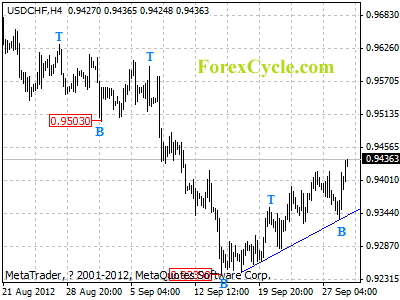
USDCHF continues the upward movement from 0.9239

USDCHF failed to break below 0.9325 key support and continues its upward movement from 0.9239. support is now located at the upward trend line on 4-hour chart, as long as the trend line support holds, uptrend could be expected to continue, and the target would be at 0.9500 area. On the downside, a clear break below the trend line support will indicate that the uptrend from 0.9239 has completed, then the following downward movement could bring price back towards 0.9000.

usdchf

Daily Forex Analysis

Introducing: The Pursuit of Happiness

By MoneyMorning.com.au

It’s pretty serious to accuse someone of tax dodging.

And it’s even more serious to accuse an entire generation of tax dodging.

But that’s the claim made in a letter to the Reserve Bank of Australia (RBA) by Peter Mair, a former RBA official. According to the Age, Mr Mair wrote:

‘If putting it under the bed or in a cupboard means you qualify for the pensioner card, you get discounted council rates, discounted car registration, discounted phone rental – in percentage terms the return is enormous.’

Mr Mair has written to the RBA suggesting the reason there are so many $100 notes in circulation is because old folks are stashing them under the bed…just so they can claim welfare benefits.

Clearly the government needs to string up these old bludgers. Stealing from the public purse is a terrible crime isn’t it? Or is it?

I’ll give you my take on this in a moment, but first…

The Mainstream Four Years Too Late

No doubt you remember the claim that higher lending standards protected Australian banks from the worst of the global financial meltdown.

This week the mainstream press ‘revealed’ that claim as completely bogus. That’s funny because I wrote about this four years ago. I said Aussie banks were just as guilty of targeting ‘subprime’ borrowers as the US banks.

I can only hope I helped some Money Morning readers avoid ruin. There are some terrible stories of single mothers and pensioners left in financial distress.

But there’s an even bigger scandal happening. Read about the threat to your wealth in We Said This Four Years Ago, But Nobody Would Listen.

The Pursuit of Happiness

Today I want to make something completely clear. If you don’t understand and follow what I’ll explain today, then nothing else matters.

If you don’t get it, and don’t do something about it, then you can forget about reaching your goals and living a happy and comfortable retirement.

Remember, whether you know it or not, your personal goal is to achieve happiness. Most people forget that. Most think their goal is to amass a huge personal wealth…or to lead a healthy lifestyle.

But those are merely the means to achieve the end goal.

That’s why I’ve decided to name the new free weekly eletter the Pursuit of Happiness.

I should be able to give you details next week about how you can subscribe for free to the Pursuit of Happiness.

You may have heard of the phrase, pursuit of happiness. It comes from a document many consider to be one of the world’s most important, the US Declaration of Independence.

Written by Thomas Jefferson, the full quote is as follows:

‘We hold these truths to be self-evident, that all men are created equal, that they are endowed by their Creator with certain unalienable Rights, that among these are Life, Liberty and the pursuit of Happiness.

‘That to secure these rights, Governments are instituted among Men, deriving their just powers from the consent of the governed, That whenever any Form of Government becomes destructive of these ends, it is the Right of the People to alter or to abolish it…’

That sums up the new free eletter in a nutshell.

Right now, governments the world over are denying citizens life, liberty and happiness. Instead they are abusing their powers in order to stay in power and buy votes.

That’s the theme of today’s Money Weekend…

The fact is at some point you’ll want to stop thinking about building wealth. You’ll just want to sit back and enjoy the fruits of a lifetime of labour.

You’ll just want to keep your money somewhere safe: a bank, a dividend paying stock, a private business…or under the mattress.

But you can only do that after you’ve laid the groundwork. You have to work at building wealth, just as you have to work at keeping healthy.

Only once you’ve done that can you sit back, content that you’ve done all you can to achieve happiness in retirement.

Trouble is the first stage of building your wealth isn’t always as easy as it should be. In fact, thanks to the meddling of government and central banks, building wealth today is as hard as ever.

The meddling has gone so far that for some people, building wealth will be impossible. They’ll never get to lead an independent lifestyle. And worst of all, they’ll never get to achieve happiness in retirement.

And do you know what? That’s just the way the government wants it.

Buying Votes With Your Money

The last thing any government wants is for you to be independent. The government hates the idea that anyone could financially fend for themselves without needing the support of government.

That’s why they go to such lengths to make sure you don’t have more than your ‘fair share’ of money. At any point in time, governments are looking for ways to deprive you of your hard-earned money.

Whether it’s a tax on your income, a tax on saving, a tax on spending, a tax disguised as something else, the end result is the same – more of your money leaving your pocket and heading into government coffers.

Take the latest report about the Aussie government swiping $850 million from Medibank Private. We’ve always said that compulsory private healthcare is just another tax.

And now we’ve got it right again. As the Sydney Morning Herald reports:

‘The federal government is set to pull more than $850 million in dividends from Medibank Private in just three years, forcing the health insurer to tap into its reserves to make the payments.’

How is private healthcare anything more than a tax when you’re forced to pay money for something you don’t need, so the government can siphon the cash into its own coffers?

I guess the message is, if you don’t want to give the government more money than you have to, don’t use Medibank Private.

Because once the money goes into government coffers, what does the government use it for? There’s no other word to use except ‘bribery’. It takes the money from you so it can bribe others.

A report in the Australian Financial Review (AFR) this week shows exactly how this works.

Trade minister and former union chief, Greg Combet is fighting the release of classified government documents. Mr Combet’s argument is that:

‘”There are very sensitive commercial issues in those documents, very sensitive, that would have a very negative effect,” he said. “The confidence in [companies] sharing their commercial information with government would be severely prejudiced and, not only that, it would have investment and employment consequences.”‘

Of course, as the paper rightly points out, the real reason for the secrecy is completely different:

‘It might also help explain if the $34 million Combet gave to Ford this year to design a new Falcon – one of the least-popular cars in production – was intended to push a decision about the fate of the company’s Australian manufacturing operations beyond the next election. Many of the men and women who make the petrol-guzzling car live in Corangamite, the Geelong-based federal electorate that Labor candidate Darren Cheeseman won in 2010 by 771 votes.’

It’s funny isn’t it? The government refuses to tell taxpayers the reasons for spending taxpayer money…because it’s a secret. Yet you, the taxpayer must tell the government everything, including what you do with the money you’ve earned.

If you don’t they’ll accuse you of fraud and send you to jail.

There’s no getting around it, what you’re living through now is a coordinated and criminal attempt by the Australian government to take your private wealth.

Slowly, Slowly Catching Your Money

But as usually happens with government, it isn’t doing it all at once. It’s a gradual theft.

The first stage happened many years ago when the government claimed that superannuation was a way for people to save for retirement. But as I showed you recently, the real reason for superannuation was to increase trade union power over private companies.

The next step happened three years ago when the government revealed it would expropriate the private superannuation funds of temporary foreign workers who had left Australia.

This gave the government an $800 million boost to its bottom line. The government instructed the Australian Taxation Office (ATO) to tax these funds at 100%. The ATO then transferred the money to the federal government’s consolidated revenue…and they spent it.

But that still wasn’t enough. Next the government instructed all superannuation funds to transfer ‘lost’ super accounts to the government twice a year.

If a superannuation fund can’t communicate with a member for whatever reason, it has to hand the cash over to the government…who then spend it.

But that still wasn’t enough either. Next the government decided to increase the compulsory superannuation guarantee to 12%. This is money your employer has to pay into the superannuation system. That means less money into your pay packet.

Even that wasn’t enough for the central planners. This week the government has let slip that it plans to change the tax rules for super. As the Australian reports:

‘The nation’s superannuation industry has been rated among the best in the world at the same time as the Gillard government is warning the $1.4 trillion sector that it will be the target of billions of dollars in budget savings.

‘Industry sources who have been canvassed by Superannuation Minister Bill Shorten for suggestions on potential savings have been told “nothing is off the table” and that government is looking to raise additional “billions” from the sector.’

Notice who the government consults with? That’s right, not you, even though it’s your money. It consults with ‘Industry sources’ instead.

After forcing employers to put money into superannuation the government is now set to tax it more.

On the one hand you get the baloney about the government wanting people to save more, so it increases the compulsory superannuation guarantee. On the other hand the government taxes the very money it forces you to save.

But it’s not just superannuation money the government has its eye on. It’s targeting all wealth. That explains the leaking of the ‘Mair Letter’.

The Government’s Standover Men

Corrupt governments know people won’t voluntarily give money to them. Because they know the government will only waste it on silly pie-in-the-sky plans.

The only way governments can raise cash is by forcibly taking it from private citizens, also known as taxation.

But with any tax system there will always be the temptation to reduce or avoid taxes. Many people seem to think the money they earn, using their own labour, is their own money.

That’s not how governments see it. To them, the money you work for is their money. It’s just your job to earn it so they can take it from you.

Remember, the government doesn’t make its own money, so it has to take it from others. But it’s not a simple process, for any government it’s crucial that it has two things in place to make the transfer of wealth work…

The first is legal tender laws. That’s to ensure that the only acceptable money is government-created money.

The second is a system of laws that allow the government to bully citizens into keeping their money within the system. Because once it’s in the system, the government can monitor it, control it, and most of all take it.

You see evidence of that bullying every year, just before 30 June. That’s when the ATO reveals which occupations and businesses it will target for harassment…or scrutiny as they like to call it.

The targeted industries change each year. But it’s not random. The ATO does this for a specific reason. By scaring individuals and businesses it ensures taxpayers don’t try to claim back more of their tax dollars than the ATO believes they should.

In other words, it creates an accurate record of what individuals claim on their tax returns. In effect this gives the ATO a ‘control’ year for specific occupations and industries (a control is a benchmark used to compare data in statistical analysis).

So that next year, when the ATO isn’t targeting that industry or occupation, it can catch out those who try to beef up their return. The ATO will compare tax returns against the ‘control’ data from the previous year.

If you claim significantly more than others in your occupation claimed in the ‘control’ year, the system will flag you for an audit.

In short, it’s tax bullying. It’s using the threat of jail or fines to get you to comply with the government’s orders. It’s a legalised version of the Mafia’s standover men.

The Biggest Anti-Wealth Law

Then there are legal tender laws. These laws are one of the biggest threats to personal wealth and sound money. Legal tender laws take the control and regulation of money away from the free market and put it into the hands of the government and its central bank.

When you take the regulation of something as important as money and put it into the hands of corrupt and corruptible people, it’s only a matter of time before they abuse that power.

They abuse it by devaluing the legal tender…by printing ever greater amounts so the government can use the printed money to buy votes and line their own pockets.

Does that sound familiar to you?

Look, what I’m describing to you isn’t hypothetical fear-mongering. What I’m describing is stuff that’s going on right now.

Just see how the paper money of the US, UK and Australia has been devalued by more than 90% over the past 40 years.

It’s not a coincidence that in the week when the RBA leaks a letter about old folks stashing cash under the mattress that news breaks of the RBA’s plan to release a new set of legal tender notes.

As the Age reported:

‘The Reserve Bank of Australia has been working on creating new, “youthful”-looking bank notes for the past five years, according to a report.’

‘A bank spokesman has confirmed the project, saying it was taking place to ensure Australia maintained its “relatively low levels of counterfeiting”.’

Don’t worry about ‘youthful’ notes, just give us notes that the RBA won’t devalue over the next 20 years.

But this is more than just refreshing the range of notes. The turnover of note design is significant for other reasons…

When a bank issues new notes these become the legal tender. The central bank will have a grace period where you can continue to use the old notes, but after a period (maybe two or three years) the central bank will remove the legal tender status of the old notes.

That means no-one is obliged to accept the old notes. The only way to cash them in is to take them to a bank or central bank branch.

Of course, once you do that, you’ve put your savings back in the system. The bank will fill out an AUSTRAC form just in case you’re a money launderer or terrorist, and soon enough every government department will know exactly how much cash you have.

That’s the insidious nature of legal tender laws. And that’s exactly why I advise you to legally hold assets outside the system…

A Globally Accepted Store of Wealth

Legal tender laws are exactly why it’s important to own gold. Gold is the ultimate money of freedom. Gold doesn’t have an expiry date. And the government can’t make gold worthless by decree.

Even if the government banned the private ownership of gold (which it legally has the power to do under Part IV of the Banking Act 1959), gold would still have a ‘black market’ value.

Gold retains value based on consumer demand and the knowledge that it’s a globally accepted store of wealth. And you can bet your last dollar that in a situation where the government wants your gold, it’s not because it suddenly has no value.

But the ultimate goal of government and central banks isn’t just to devalue paper money. The ultimate goal is to eliminate all money…except electronic money.

By encouraging and then forcing you to transact electronically, the government can track every last dollar and cent that goes into and out of your bank account (which it does already thanks to the ATO’s software that dials into the Aussie banking system).

Plus it will know where you spend every last dollar and cent and what you buy with it.

Before I go on, let me make one point. Many think gold is an archaic, anti-technology money. It isn’t. Electronic transactions could still take place with a gold standard.

Just as you have ledger entries transferring electronic and paper money from one account to another, so you could transfer gold ownership from one person to another.

But back to my point. The ultimate aim of central banks and governments is to destroy all physical money. This is revealed in the ‘Mair Letter’:

‘Cards and the internet have delivered a body blow to high-denomination bank notes. They are redundant. There is no longer any point in issuing them except to facilitate tax dodging. The authorities would announce that from, say, June 2015 every $100 and $50 note could be redeemed but no new notes would be issued. After June 2017 every note could only be redeemed at an annual discount of 10 per cent. It would mean that after two years, each $100 note could only be redeemed for $80, and so on.’

I don’t know about you, but I’m sick of people lobbying and giving advice to governments and central banks about the best way to rip money from your pocket.

The ‘Mair Letter’ is an insult to every Aussie who makes an effort to save money. And it’s an insult to anyone who carries cash.

Is that a $50 note in your wallet? You must be a tax dodger. Call the police.

The Illegalisation of Money

But that’s the direction governments and central bankers want to take you. They’ve worked hard for the past 100 years to demonise sound money.

They allowed the banks to corrupt the Gold Standard by allowing them to print more money than they could back with gold. They took precious metals out of the money system and replaced it with base metals.

Then they printed more money and allowed banks to lend out 10-times the money they had on deposit. So that today, for every $100 in bank deposits, Aussie banks only have $4 of physical notes and coins to back it up.

If depositors only withdrew 5% of the savings in the banking system in cash in one day, the entire banking system would collapse. That’s why they want to do away with all forms of physical money completely.

If you think I’m mad, take these examples of the demonization of non-electronic money in the US:

‘What Should I Consider Suspicious? People who always pay cash…’ – US Department of Justice and Federal Bureau of Investigation

‘Motorists can be held indefinitely at toll booths if they pay with large denomination bills, according to a federal appeals court ruling…’ – theNewspaper.com

Or take this from Reuters in 2010, describing new laws for Greece:

‘From 1. Jan 2011, every transaction above 1,500 euros between natural persons and businesses, or between businesses, will not be considered legal if it is done in cash. Transactions will have to be done through debit or credit cards.’

And soon enough, the same laws will arrive in Australia.

If everything is electronic, it’s easier for the central banks to print as much money as they want. And because there’s no physical cash, it’s harder for you to see the terrible impact of inflation.

And if you don’t want to use electronic money? Tough luck, that means you’re a terrorist, a tax dodger…or both.

Don’t Trust the Government With Your Money

In short, what’s good for government and central banks is bad for you.

That’s why it’s important that you do what you can to keep your wealth out of the system. And by that, I don’t mean doing anything illegal. I mean you should put at least some of your money in ‘free market’ money.

I’m sure you know what I mean by that. That’s right, I’m talking about buying gold and silver. After everything I’ve written about precious metals, I hope you already own some.

But if not, don’t worry, there’s still time to buy. At first it will seem weird and you’ll watch the gold price every day…cheering as it goes up, and then panicking as it falls.

That’s why I suggest you only buy small amounts to begin with…until you’re used to owning gold and silver. Because once you’ve got the hang of it, you won’t worry about the price going up or down.

By then you’ll know that governments and central banks and the toadying lobbyists are leading the world economy and money system down the drain, so you won’t care about the gold price.

All you’ll know is that however much gold is worth, it will be worth more than any silly bits of ‘youthful’ coloured paper, and certainly worth more than the government-created computer dollars.

Cheers,
Kris

From the Archives…

In Defence and Praise of ‘Cranks and Crazies’
21-09-2012 – Kris Sayce

We Buy Gold Because We Don’t Trust Them Not to Meddle
20-09-2012 – Kris Sayce

Why Share Trading is ‘Mental’
19-09-2012 – Murray Dawes

A Bear Market Where You Least Expect
18-09-2012 – Greg Canavan

Questionable Easing 3
17-09-2012 – Dr. Alex Cowie


Introducing: The Pursuit of Happiness

Dwarf Bowlers and Muslim Movie Critics Assemble

By MoneyMorning.com.au

Before we get to dwarf bowling, what’s going on in the stock market? A round of central bank intervention in Japan, Europe and the US hasn’t sent the market soaring. In fact, it’s fallen. Why?

Denis Ouellet from News-to-use.com reckons QE may not affect the stock market after all. At least, that it might not be the primary driver. Conventional wisdom reckons money printing is causing share prices to go up. And the charts back up that story. Each time money is printed, shares rise.

But there’s another chart with the same relationship. Corporate profits, or earnings per share, are rising with equity prices too. It might seem blatantly obvious that earnings drive share prices. A business is worth what it makes in profits. But what happens if profits fall while the money printing continues? We may be about to find out.

Ouellet’s third chart shows that sales haven’t risen with the stock market in the same way profits have. By the way, this means you can’t say that inflation is increasing dollar profits at the same time as share prices.

No, the earnings must be coming from somewhere else if sales haven’t risen as fast as profits. Oullet knows where: ‘Cost cutting (mostly labor) and increasing productivity.’

So if you fire your least productive worker you get both.

But that only works for a while. Eventually, sales will limit profits. Suddenly the earnings growth analysts expected based on the past will fail to materialise. And then stocks could fall, money printing or no.

Greg Canavan was onto the story of suspiciously high corporate profits in his August issue of Sound Money. Sound Investments. Of course, not all stocks experience this problem at the same time. Some are even set to benefit as things begin correcting. The secret to how this will happen is in currencies.

And Australian investors are in the perfect position to profit. We’ll reveal how once we’ve whittled down our list of Aussie companies set to increase profits while others fall.

Better than AFL

When you get bored of the grand final, somewhere in the second quarter, why not try the other sport Australia invented – dwarf bowling. In case you haven’t tried it before, you’ll need the following: Baby oil, bowling pins, a rubber sheet and at least one dwarf. But here’s the crucial bit.

The dwarf has to agree to be thrown at the bowling pins. So you’ll probably also need quite a bit of cash, a helmet, and extra baby oil.

In all seriousness, dwarf bowling isn’t a ‘sport’ that appeals to us. But does that mean we have the right to prevent a dwarf from doing it? Can we take away his or her right to agree to such activities? Should the government ban dwarf bowling?

Sure, politicians can make whatever rules they like. So what else can we ban?

What about that movie trailer which sparked riots across the world? The one depicting the Prophet Muhammad doing all sorts of odd things, like talking to a donkey about its love life. We can’t have that; the donkey may have felt embarrassed.

We must ban things that are offensive enough to cause riots and murders. After all, what’s more precious than the human life lost during the riots in Libya? The loss of a dozen CIA operatives and contractors during the riots dealt a massive blow to the region’s peace and stability. Peace and stability, that’s why the CIA was there after all, isn’t it?

On another subject, we’re half way through the popular book 50 Shades of Grey. And, to our relief, it’s is all about why masochistic sex and prostitution should be banned by the government. A rich guy pays the protagonist for her submission.

But prostitution is only ok if you’ve registered with the Australian Office of Regulatory Services (ORS). And pay income tax. Otherwise, it’s so immoral it must be stopped by the police…who aren’t immoral, and who of course don’t accept bribes or favours.

But there is one ban we can all agree on. ‘Child-labour balls’ shouldn’t be given to guests at North Melbourne’s grand final breakfast. Even if they are just AFL balls stitched by child labour. We can’t have children earning money to support their families. Especially in poor countries where they have no other source of income.

So what’s the point of our distasteful rant? It’s all about discovering a world of ideas. It’s designed to make you think…to discard your prejudice about a subject and look at it from the ‘other side’.

The ideas aren’t actually dwarf bowling, masochistic sex or offensive videos. They’re about rights, freedom of speech and the role of government.

Finance and economics is just one part of how we see the world differently to the mainstream. Being different gives us our edge over the mainstream media and finance industry. If you’d like to find out more about contrarian worldviews, then I suggest you attend this special event…

The Mises Seminar is Back!

Defending the Undefendable is a book by Walter Block. It inspired the topics of our controversial discussion above. The title of the book gives away the nature of the content. Walter tests his beliefs about freedom by applying them to the least favourable real world examples.

Do his beliefs hold up? And do your beliefs hold up to his arguments? You can find out in person because Walter is coming to Sydney.

Our friend Benjamin Marks is assembling a collection of speakers who couldn’t get an invite to the politically correct Press Club. The impressive line up will speak on the 1st and 2nd of December at the Establishment Ballroom in Sydney.

Topics up for discussion include: West Australian secession; who would build roads if the government didn’t; and Walter Block will defend the legality of blackmail, ticket scalping and the ‘male chauvinist pig’.

There’s also a particularly subversive and radical speech titled ‘Welcoming Remarks’. We can only guess what it will be about.

If you’re interested, you can find out more here. Speaking of ticket scalping, we’ll sell our ticket for $200.

Nick Hubble
Editor, Money Morning

From the Archives…

In Defence and Praise of ‘Cranks and Crazies’
21-09-2012 – Kris Sayce

We Buy Gold Because We Don’t Trust Them Not to Meddle
20-09-2012 – Kris Sayce

Why Share Trading is ‘Mental’
19-09-2012 – Murray Dawes

A Bear Market Where You Least Expect
18-09-2012 – Greg Canavan

Questionable Easing 3
17-09-2012 – Dr. Alex Cowie


Dwarf Bowlers and Muslim Movie Critics Assemble

Monetary Policy Week in Review – Sept. 29, 2012: Global growth still weak, fresh concern over hot money

By Central Bank News

    The past week in monetary policy saw interest rate decisions by 12 central banks around the world, with three banks (Hungary, the Czech Republic and Trinidad &Tobago) cutting rates, one bank (Uruguay) raising rates, and the remaining 8 (Israel, Georgia, Romania, Mauritius, Sierra Leone, Colombia, Albania and the Dominican Republic) keeping rates unchanged.
    The interest rate cuts were in response to continued weakness in the global economy with Hungary holding out the prospect of further cuts if inflation, which is already above the bank’s target, remains moderate.
    Although Israel and Mauritius kept rates unchanged, both banks cut growth forecasts.
    As last week, the impact on emerging economies from very low interest rates in the United States – flagged to remain close to zero to mid-2015 – is causing concern.
    While the Dominican Republic noted a growing flow of capital to emerging markets, Uruguay took action and raised rates to dampen inflationary expectations before they threaten growth prospects.

    LAST WEEK’S MONETARY POLICY DECISIONS:

COUNTRYNEW RATEPREVIOUS RATERATE 1 YEAR AGO
ISRAEL2.25%2.25%3.00%
HUNGARY6.50%6.75%6.00%
GEORGIA5.75%5.75%7.50%
ROMANIA5.25%5.25%6.35%
CZECH REPUBLIC0.25%0.50%0.75%
MAURITIUS4.90%4.90%5.50%
SIERRA LEONE20.00%20.00%23.00%
COLOMBIA4.75%4.75%4.50%
TRINIDAD & TOBAGO2.75%3.00%3.00%
ALBANIA4.00%4.00%5.25%
DOMINICAN REPUBLIC5.00%5.00%6.75%
URUGUAY9.00%8.75%8.00%
    NEXT WEEK: The central bank calendar next week calls for 7 central bank meetings: Australia, Poland, Iceland, the European Central Bank (ECB), the United Kingdom, Japan and Pakistan.
    Australia and Poland may reduce rates while the ECB and the Bank of England are not expected to change policy. Iceland should raise rates, according to the IMF, while the Bank of Japan is under pressure to weaken the yen. Pakistan is expected to keep rates steady.

COUNTRYMEETING DATECURRENT RATERATE 1 YEAR AGO
AUSTRALIA2-Oct3.50%4.75%
POLAND3-Oct4.75%4.75%
ICELAND3-Oct5.75%4.50%
EURO AREA (ECB)4-Oct0.75%1.50%
UNITED KINGDOM4-Oct0.50%0.50%
JAPAN5-Oct0.10%0.10%
PAKISTAN5-Oct10.50%13.50%

Uruguay raises rate 25 bps, worried over inflation threat

By Central Bank News
    The central bank of Uruguay raised its monetary policy rate by 25 basis points to 9.00 percent, concerned that actual inflation and inflationary expectations were well above the bank’s target range.
    The uncertain global economy and worrying economic and financial situation in several European countries implies that international interest rates will remain extremely low for a considerable period, Banco Central del Uruguay (BCU) said in a statement following a meeting of its Monetary Policy Committee.
    Investors will therefore continue to move towards reserve currencies for safe haven and also seek  profit by investing in the securities of emerging markets. Commodity prices have also risen recently but the recent slowdown in the economic growth of emerging markets cannot offset the inflationary pressures of higher food, minerals and energy prices, the bank added.
    At the same time, the bank said Uruguay’s economy continues to grow at reasonable rates, especially considering the international slowdown, and it is “necessary to avoid a situation in which inflation threatens an otherwise healthy economy.”

    Uruguay’s economy grew by an annual rate of 3.8 percent in the second quarter, down from 4.20 percent in the first.
    The inflation rate in August rose to 7.88 percent from 7.48 percent, well-above the bank’s inflation target of 4-6 percent.
    BCU had held its policy rate steady at 8.75 percent since December 2011 when it was raised by 75 basis points to 8.75 percent.
    www.CentralBankNews.info 


Colombia keeps rate steady, continues to buy FX

By Central Bank News
    The central bank of Colombia kept its benchmark intervention rate unchanged at 4.75 percent, as expected by most economists, saying domestic demand was stronger-than-expected in the second quarter and inflation was close to the midpoint of the bank’s target range.
    Banco de la Republica Colombia also said it would buy a total of foreign currency worth $3 billion through daily auctions of at least $20 million between Oct. 1 and March, 29, 2013.
    “According to the evaluation of the current balance of risks, the Board considered it appropriate to maintain the interest rate at 4.75% intervention,” the central bank said in a statement.
    The central bank raised its policy rate in January and February by a total of 50 basis points, but then cut in July and August, leaving rates at the end-2011 level.
    Colombia’s economy expanded by 1.6 percent in the second quarter for an annual increase of 4.9 percent, exceeding the range estimated by the central bank’s technical team, as domestic demand grew a higher-than-expected 6.4 percent.
    Growth in the third quarter is likely to be lower than in the second quarter, but “for all of 2012, it is likely that economic growth is higher than the midpoint of the estimated range (between 3 and 5 percent),” the bank said.

    Inflation in Colombia rose slightly to an annual rate of 3.1 percent in August from 3.0 percent in July, in the midpoint of the central bank’s 2-4 percent target range.
    The bank said annual inflation expectations remained stable at 3.3 percent.
    After last month’s meeting by the bank’s policy-setting board, the bank said it would buy $700 million by the end of September to help keep down the peso, which rose strongly at the start of the year but has since been stabilized around 1,800 per U.S. dollar, up from 1,9300 in early January.

    www.CentralBankNews.info


Gold in Euros Sets New High as Crisis “Escalates” and Spain “Lays Groundwork” for Bailout

London Gold Market Report
from Ben Traynor
BullionVault
Friday 28 September 2012, 06:45 EDT

U.S. DOLLAR gold prices hovered near seven-month highs above $1780 an ounce for most of Friday morning’s London trading – a few Dollars up on where they started the week – while stocks failed to hold early gains after a analysts interpreted Spain’s budget as “laying the groundwork” for a formal bailout.

Silver prices eased to $34.73 per ounce after failing to breach $35, while other commodities were broadly flat and US Treasury bonds gained.

Euro gold prices meantime remained close to all-time highs hit yesterday.

“The debt crisis in the Eurozone has escalated again,” says today’s commodities note from Commerzbank.

“Gold should therefore remain in high demand as a store of value and alternative currency. Silver has also been pulled upwards in gold’s slipstream.”

Spain unveiled a “crisis budget” Thursday that included a third year of public sector wage freezes and an 8.9% cut in ministry budgets.

“This is a crisis budget aimed at emerging from the crisis,” said deputy prime minister Soraya Saenz de Santamaria.

Olli Rehn, European Commissioner for Economic and Monetary Affairs, said the budget goes beyond what his institution required.

“It’s positive that Spain is laying the groundwork for a bailout,” says Ayako Sera, Tokyo-based senior market economist at Sumitomo Mitsui Trust Bank.

A Spanish bailout would pave the way for the European Central Bank to buy Spain’s government debt on the open market, through its Outright Monetary Transactions program announced earlier this month.

Spain will use a decade-old reserve fund to pay for increases in pension payments, newswire Bloomberg reports.

“The reserve fund is there to be used,” said budget minister Cristobal Montoro, adding that it is “politically very important” to maintain pensioners’ purchasing power.

“Politically, they couldn’t do anything else,” agrees Jose Ramon Pin, professor of public administration at IESE business school.

Tens of thousands of demonstrators have taken to the streets of Madrid this week to protest austerity measures, in scenes that have been echoed in Portugal and Greece.

Ten-Year Spanish government bond yields remained below 6% this morning, after breaching that level earlier in the week for the first time since the ECB announced its OMT program on September 6.

The Euro meantime regained some ground against the Dollar this morning following a week of losses. Euro gold prices meantime remained near yesterday’s record high of €44,377 per kilo (€1380 per ounce) trading in a tight range this morning above the previous record hit last September.

Spain is also expected to publish the result of banking sector stress tests later today, including estimates of likely levels of recapitalization required.

“They have to be seen to be coming clean and being realistic,” reckons Ron D’Vari, former head of structured finance at BlackRock.

“There’s no right answer for how much capital the Spanish banks will need,” adds Madrid-based Nomura analyst Daragh Quinn, “but they at least need to exceed people’s expectations…the real experience of the banks shows that losses just go up to the extent that the economy gets progressively worse.”

Earlier this week, ratings agency Standard & Poor’s said it expects Spain’s economy to shrink by 1.4% next year – a sharper contraction than the 0.7% fall it forecast back in July. Fellow rating agency Moody’s is set to publish its review of Spain’s rating later today, with several analysts predicting it will downgrade Spain to junk status.

Elsewhere in Europe, French president Francois Hollande is expected to unveil France’s toughest budget in three decades as the government attempts to hit its 3% of GDP deficit target for 2013.

Here in London, it was announced today that the British Bankers’ Association will no longer be responsible for the London Interbank Offered Rate (Libor), following the scandal of so-called rate-rigging that has “engulfed more than a dozen institutions on three continetns”, the Financial Times says.

“Today we press the reset button,” Financial Services Authority managing director Martin Wheatley said Friday.

“Libor needs to get back to doing what it is supposed to do, rather than what unscrupulous traders and individuals in banks wanted it to do.”

Libor is used as a benchmark rate and is referenced for more than $300 trillion worth of contracts worldwide, the FT reports.

Ben Traynor
BullionVault

Gold value calculator   |   Buy gold online at live prices

Editor of Gold News, the analysis and investment research site from world-leading gold ownership service BullionVault, Ben Traynor was formerly editor of the Fleet Street Letter, the UK’s longest-running investment letter. A Cambridge economics graduate, he is a professional writer and editor with a specialist interest in monetary economics. Ben writes and presents BullionVault’s weekly gold market summary on YouTube and can be found on Google+

(c) BullionVault 2012

Please Note: This article is to inform your thinking, not lead it. Only you can decide the best place for your money, and any decision you make will put your money at risk. Information or data included here may have already been overtaken by events – and must be verified elsewhere – should you choose to act on it.