Why the US President Has no Position on the Big Banks

By MoneyMorning.com.au

President Barack Obama getting re-elected sets the stage for another credit crisis.

When the president came into office in 2008 he had a mandate to fix the banking system, which consisted of too-big-to-fail banks holding America and its economy hostage to their greedy schemes.

He swept that mandate under the door of Congress and the Federal Reserve.

The president has no position on the big banks, and it seems he likes it that way.

By lightening up on his already watered-down rhetoric about making banks toe the line, he got campaign money from them. So did Congressmen. That money came from the Federal Reserve.

Now that the president has won a second term, he’s not about to fight Congress over their pandering to the big banks, since he’s got other things to fight with them over; rather, he’s going to advocate a lite-touch going forward to allow banks to continue to strengthen their balance sheets so they can fuel an American recovery.

It seems to be all happening under the cover of darkness. And, it’s not going to work.

 Obama Secret

No matter how much money the Federal Reserve feeds banks via QE4-ever, enough so they could pay off their bailout loans, pay themselves big bonuses again, pay trumped-up dividends to entice equity investors, and continue buying Treasuries with no-interest financing, their balance sheets are still laden with derivatives, stale mortgages and sickeningly more government debt that’s about to get downgraded.

This president blew his first mandate and the result is that it’s like déjà vu all over again.

The too-big-to-fail banks are all a lot bigger now than they were in 2008, and none of them are any more stable or less prone to the massive correlation of similar asset mixes and counterparty exposure (namely themselves) that if pierced will trigger another crisis.

With a presumed second mandate that probably encompasses all the agenda items he didn’t finish, or start in his first term, the president isn’t about to take the lead on addressing what’s really wrong with America’s economy.

And what is that? It’s the public’s total lack of confidence in the capital markets and their ability to finance growth where it most needs to be nurtured, close to home.

But, before we all liquidate our portfolios, maybe we should give freshly elected Elizabeth Warren a shot at leading the Senate to the high ground on the future of banking in America.

If Warren champions smaller, better capitalized banks that aren’t too big to destroy us all again, maybe the president’s socialist tendencies, especially when it comes to big banks and the Federal Reserve, will be checked and free markets somehow restored.

In the meantime, someone hand me some sell tickets.

Shah Gilani

Contributing Editor, Money Morning

Publisher’s Note: This article originally appeared in Money Morning (USA)

From the Archives…

 APRA Spins Another Yarn On Australian Banks

9-11-2012 – Kris Sayce

The Secret Return to the Gold Standard

8-11-2012 – William Patalon

Forget the US Election, This Stock Market Event is the One to Watch For

7-10-2012 – Murray Dawes

The Greeks Giving Economists Nightmares

6-10-2012 – Bill Bonner

Super Fund Results: Whoopdeedoo

5-10-2012 – Nick Hubble


Why the US President Has no Position on the Big Banks

Will President Obama Be Able to Stand Up to China?

By MoneyMorning.com.au

The 18th National Party Congress is now underway in Beijing. Attendees are girding for a week of symbolic posturing and speeches, the culmination of which will be a new set of Chinese leaders and a new Chinese President for the next 10 years.

While this is a complicated process when things are running smoothly, this particular Congress is really critical. China is a mess. Recent economic challenges and corruption on a scale that has boggled even the most jaded of insiders are at the top of the “fix it” list.

Outgoing Chinese President Hu Jintao’s replacement and China’s presumptive new leader looks to be a man named Xi Jinping.

At 59 years old, he’s a power player with close ties to the People’s Liberation Army (PLA).

While he’s not a military man per se, as the son of a revolutionary general he currently holds several significant offices that give him wide-ranging and very significant exposure to both the State and Communist Party.

What’s significant about this is that there are three parallel strands in Chinese government structure: the Communist Party, State, and Military.

The Party and State are deeply intertwined, but the military is less so, except at the top levels of leadership. Consequently, China’s new leader is intimately familiar with the Chinese military and also the likely new head of China’s Central Military Commission.

I’m not so sure we’ve ever seen this exact combination before and I think it’s going to challenge President Barack Obama in ways that he hasn’t thought through yet.

China is notoriously secretive about its intentions, but there are a few clues to what President Obama and his advisers will have to contend with.

For example, Mr. Xi spoke in Washington earlier this year at a luncheon for executives and diplomats as part of a five-day tour.

In his remarks, which were viewed as a major policy statement, Xi explicitly said that there should be ‘respect’ for both Chinese and United States interests.

He also noted the need for ‘increasing mutual understanding and strategic trust.’

That sounds innocuous enough if you take his remarks at face value in English. But if you translate them into Chinese diplomatic speak, a very different message was delivered.

China Wants International Respect

I’ve talked about highlighting the cultural context behind key phrases and language delivered by Chinese and Japanese diplomats for international consumption.

And that’s really what Xi’s statement was, a carefully worded, exquisitely postured message. His presumptive appointment is also a warning of sorts.

I say this because the words ‘mutual’ and ‘respect’ are about as loaded as they come, especially when they are used in the same sentence.

Mr. Xi was not playing to the American media nor even leaders. What he was counting on was that his message would be re-translated into Chinese.

He knows that respect in the Chinese sense of the word involves the mutual acknowledgement of position and, more importantly, status.

According to Chuck Gitomer, a policy and political expert who has spent decades studying the Chinese, there’s a sense of victimhood that the Party has cultivated over the decades that China was subject to foreign slights and indignities when they were weak.

In conjunction with the nationalist card, which is recently particularly visible in China’s irredentist position taken over the Diaoyu/Senkaku Islands, Gitomer notes, ‘this demand for respect will be reciprocated only when the foreigners meet that demand.’

I agree.

So, in as much as Mr. Xi made a statement in Washington, what he really did was put Washington on notice that China expects to be treated as an equal on the world’s stage.

Very shortly, we’re going to see what exactly he meant by that.

On the one hand, Mr. Xi and President Obama have a golden opportunity to put the currently strained relations between the United States and China back on track. His remarks were intended to convey his willingness to work with the United States.

On the other, he’s got precisely the wrong background if that’s the case. What China needs is a leader with the authority to make great leaps in progress by taking bold chances to move things ahead, rather than risk being trapped in problematic posturing.

In that sense, Obama’s not the guy, either. He is woefully unprepared to move away from the heat of politics and engage in true bridge building.

Instead, what China appears to be choosing is a man who spent the bulk of his career in the Zhejiang and Fujian provinces fostering industrial relations with Taiwan before moving for a few years to Shanghai’s political structure, then on to Beijing’s political ‘mother hive.’

That means he’s had very little international exposure until becoming Vice President. Evidently, though, in his defense, he’s making the rounds. The New York Times recently reported that Mr. Xi has visited more than 50 countries since becoming Vice President.

Personally speaking, we know relatively little about him.

For example, Mr. Xi apparently loves American movies. He has visited the United States six times. His daughter, Xi Mingze, studies at Harvard under an assumed name. His wife, Peng Liyuan, is a famous folk singer. But that’s about it.

So What Does All This Mean?

I think we’ll see a few things happen.

We will see posturing internally but not a lot of action nor reform. Mr. Xi’s status as a “sent-down” youth is extraordinarily important, notes Gitomer. It buys him significant political capital. His past dealings with high-profile corruption scandals gives him the air of an incorruptible official.

Of course, we know that’s not true since his family has accumulated multiple billions of euros worth of investment holdings, but it makes a nice story domestically, especially when the great firewall keeps the masses from finding out too much.

Expect China to continue to buy global resources companies. China’s growth will continue on a pace that’s faster than the United States, Europe and likely Japan combined. And it needs fuel quite literally to pull that off.

Mr. Xi will aggressively encourage offshore globalization. The nation is anxious to flex its economic muscles.

Unfortunately, China is also anxious to flex its military muscles. That means we’ll also likely see more nationalistic posturing in international trade and politics. The Diaoyu/Senkaku Islands are but a small insight into how mainland China views the world.

Similar disputes with the Philippines, Vietnam and even Korea offer a glimpse into an increasingly hawkish contingent that’s coming to the top with Mr. Xi.

Since China believes it is a rising power while the U.S. is a declining power, the danger is growing that China will actually use military force to protect its interests.

Taiwan is not the prize, as most Westerners believe; being able to engage American carriers in deep water while forcing them to “stand off” is. Long range weapons systems are a top priority at the moment.

In the U.S., this will set off all sorts of alarms in the military industrial complex, not to mention inside the Beltway.

But longer term, it’s probably not worth the worry. When China realizes that international behavioral norms are worth more money, they’ll come to their senses. They’re as pragmatic as any capitalist in that sense.

And finally, pay careful attention to regional economics.

China is openly seeking regional economic domination while courting long-held U.S. alliances with Singapore (wary of the communists), Australia (wary but hopeful of the economic hegemons), and South Korea, (they understand what being forced into vassal state status is about) for example.

Even Japan is viewed as a resource behind closed doors, rather than the enemy, as is commonly perceived by citizens around the world.

In closing, the situation is obviously fluid. However, I’ll do my best to update you on what’s important and what’s new.

I’ll also continue to identify what I believe are the best investment opportunities created by circumstances like this that are not yet understood in the Western world.

Keith Fitz-Gerald
Contributing Editor, Money Morning

Publisher’s Note: This is an edited version of an article that originally appeared in Money Morning (USA)

From the Archives…

APRA Spins Another Yarn On Australian Banks
9-11-2012 – Kris Sayce

The Secret Return to the Gold Standard
8-11-2012 – William Patalon

Forget the US Election, This Stock Market Event is the One to Watch For
7-10-2012 – Murray Dawes

The Greeks Giving Economists Nightmares
6-10-2012 – Bill Bonner

Super Fund Results: Whoopdeedoo
5-10-2012 – Nick Hubble


Will President Obama Be Able to Stand Up to China?
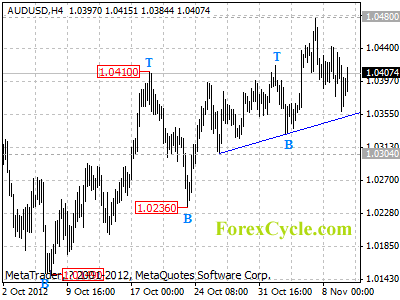
AUDUSD stays above a upward trend line

AUDUSD stays above a upward trend line on 4-hour chart, and remains in uptrend from 1.0236. Key support is at the trend line, as long as the trend line support holds, the fall from 1.0480 could be treated as consolidation of the uptrend, and one more rise towards 1.0500 is still possible after consolidation. However, a clear break below the trend line will indicate that the uptrend from 1.0236 had completed at 1.0480 already, then further decline to 1.0200 area could be expected.

audusd

Daily Forex Forecast

The Art of Money Laundering

Meyer Lansky… one of the most successful money launderers in modern history. He schemed, siphoned and skimmed money from illegal gains in the casino business and filtered $1 billion through Swiss banks, Hong Kong businesses and shell companies in the Caribbean.

He even bought an offshore Swiss bank to launder his money.

He was never caught, and his methods formed what’s considered modern-day laundering. Here’s how he did it.

From Meyer Lansky: The Shadowy Exploits of New York’s Master Manipulator

At first, Meyer funneled much of the money into legitimate and quasi-legitimate businesses in the United States. Many other crime bosses had done the same, more as a front than to hide income from the tax man. Real estate, food processing and distribution, garment production and restaurants were popular choices… None of this was enough; the enormous amount of money coming in outstripped their means to secrete it…

What Meyer did was find a new home for dirty money — the anonymous, numbered Swiss bank account. From there, dirty money could be used as collateral for legitimate bank loans, and the cash from the loans could then be funneled back into investment in the United States.

To be clear, this isn’t a step-by-step guide to breaking the law… It’s actually a case study in how to turn cash into something that actually has value.

Because today’s “money launderers” understand that cash itself is a liability. Today’s launderers take advantage of cheap credit to buy things like real estate.

Take South African billionaire Nathan Kirsh, whose net worth is about $5.1 billion. He spends his time hopping around his 86 Restaurant Depots and 10 Jetro Cash & Carry stores mostly on the East Coast of the United States.

His company’s EBITDA margins are twice that of Costco, and he actually owns most of the land his stores are on.

And here’s how he’s turning cheap cash into real money. From Bloomberg:

He raised $1 billion in a private debt placement in April as yields on U.S. corporate bonds fell and used the proceeds to repay short-term debt and pay a one-time dividend to Jetro shareholders…

The billionaire is using some of the cash to buy property, which he said is a hedge against global inflation. He controls about 70% of the Jetro and Restaurant Depot warehouses, as well as residential and commercial real estate in the U.S., the U.K., South Africa and Australia.

“Our business in the U.S. is a big business that throws off cash, and we strip that cash,” Kirsh said in London. “I just don’t want that money lying around. We are certain that inflation isn’t going away, so it’s smart to be borrowing cheaply and putting it into real assets.”

And he’s not the only one taking advantage of today’s cheap credit. Banks that park their cash with the Federal Reserve can borrow cheaply and turn around and make loans that rake in 10 times the interest.

It’s simple math… low-hanging fruit, if you will. But loans aren’t quite real assets…

But Kirsh has the right idea. Cash that just sits around could lose a lot of its value — especially as the Fed keeps the pedal to the metal with its easing programs.

And there’s always the potential for borrowers to default.

With such cheap credit, though, the risk is small… But turning that cheap credit into something of real value is the best way to hold on to your wealth.

Real assets can be better than a bank full of money, and Kirsh is the perfect example of how to make real assets work for you. His investments in commercial real estate have all been successful, and his 42% stake in Abacus Property Group, an Australian REIT, has increased its value by 50% since 2009.

I’m not telling you to go out and invest in real estate — though if you have the means to borrow cheaply and get into a property with growing returns, that doesn’t sound like a bad deal to me (and I’ll be heading to Nicaragua later this month to find some prime properties that fit that bill).

I’m telling you to start analyzing your portfolio… Your whole portfolio, not just the one you hold with your broker. What does your savings account look like? How much do you own on your home? Did you loan money to your brother for his small business?

Everything counts… and the more you know the real value of your assets, the better off you are when the value of your cash takes a nosedive.

It’s time to start laundering that cash. Find real assets that you can park your wealth in and generate actual returns.

Happy Investing,

Sara

P.S. I recently found 3 unique ways to launder your cash into real assets…and right now a strange glitch keeps these real assets artificially cheap. Here’s the rest of the story…

Other Related Articles

Article brought to you by Inside Investing Daily. 

Monetary Policy Week in Review – Nov. 10, 2012: Uneven global growth in evidence; 2 c.banks cut, 8 banks on hold

By Central Bank News

    Last week in monetary policy 11 central banks decided on interest rates, with two banks cutting rates (Poland and Kenya), eight keeping rates unchanged and Serbia again raising its rate in its quest to beat back inflation.
    The asymmetrical pace of economic growth across the world was striking, with central banks in Asia and South America keeping rates on hold and looking forward to stronger growth, while Europe’s economy continues to decelerate and the outlook is weak.
    The Reserve Bank of Australiasaid recent data on the world economy was slightly more positive, the Bank of Korea saw exports stabilizing while consumption and investment was picking up, and the Central Reserve Bank of Peru said its economy was stable and growing at a rate that is close to its full potential.
     Bank Indonesia reported “buoyant domestic demand,” while Bank Negara Malaysia saw “sustained expansion in domestic activity.” 
    Meanwhile in Europe, the National Bank of Poland said it was now clear that the economy was slowing down considerably and it was increasingly worried about a “protracted economic slowdown.” 
    And the European Central Bank saw no signs of economic improvement the rest of this year and expects next year’s growth momentum to remain weak, with risks still on the downside.
    Even the Bank of Russia, which is eager to defend its inflation-fighting credentials, struck a more dovish tone, saying inflation expectations had now moderated and it was keeping an eye on the impact of its surprise rate hike in September.
    The Bank of England didn’t expand its asset purchase program, probably a reaction to an economic rebound in the third quarter, and possibly a sign that it is less pessimistic about growth prospects.
LAST WEEK’S (WEEK 45) MONETARY POLICY DECISIONS:

COUNTRYMSCI  NEW RATE    OLD RATE    1 YEAR AGO
AUSTRALIADM3.25%3.25%4.50%
POLANDEM4.50%4.75%4.75%
KENYAFM11.00%13.00%16.50%
SOUTH KOREAEM2.75%2.75%3.25%
INDONESIAEM5.75%5.75%6.00%
MALAYSIAEM3.00%3.00%3.00%
EURO ZONEDM0.75%0.75%1.25%
UNITED KINGDOMDM0.50%0.50%0.50%
PERUEM4.25%4.25%4.25%
SERBIAFM10.95%10.75%10.00%
RUSSIA EM8.25%8.25%8.25%
NEXT WEEK (WEEK 46) only five central banks are scheduled to review monetary policy, including Morocco, Sri Lanka, Iceland, Croatia and Latvia.

COUNTRYMSCI   DECISION     RATE    1 YEAR AGO
MOROCCOEM13-Nov3.00%3.25%
SRI LANKAFM16-Nov7.75%7.00%
ICELAND14-Nov5.75%4.75%
CROATIAFM14-Nov6.25%6.25%
LATVIA 15-Nov2.50%3.50%

The Hong Kong Dollar: If This Red Flag Goes Up, Buy it

By MoneyMorning.com.au

History says paper currencies always die.

In today’s Money Weekend we’ll suggest a possible candidate for destruction and why you should keep an eye on it.

If you think we’re talking about the Iranian rial, we’re not. Although the Hanke-Krus Hyperinflation Index recently added the Iranian rial to its hyperinflation list.

Iran is obviously a story at the centre of mainstream news lately.

But we’re actually thinking about something closer to home – the Hong Kong dollar (HKD).

Here’s why…

The Most Expensive Houses in the World

If you think buying a house in Australia is expensive (we do), check out Hong Kong. ‘The Hong Kong government’s toughest efforts yet to curb a growing asset bubble in the city’s property market probably won’t be the last as record-low mortgage rates drive demand for the world’s priciest homes,’ reported Bloomberg last week.

The article quotes a study done last September that puts Hong Kong home prices 65% above Tokyo, the second most expensive place to buy a home in the world.

Hong Kong recently slapped a 15% tax on foreign buyers to try and cool its real estate market. But what Hong Kong really needs to do to snap off its rampant property bubble is to raise interest rates to increase the cost of borrowing.

That’s too bad, because Hong Kong’s monetary policy is determined by the US Federal Reserve.

The Hong Kong dollar is pegged to the US dollar, and has been since 1983. Maintaining the peg amongst the Fed’s policy of ‘quantitative easing’ has unleashed inflation in Hong Kong. If the US Fed drops interest rates and prints money, Hong Kong has to follow suit.

There’s no relief in sight either.

You might remember we mentioned what US Federal Reserve Chairman Ben Bernanke said in Tokyo last month. He was responding to accusations that he was hurting foreign countries. If you don’t remember, here it is again:


‘Of course, an alternative strategy – one consistent with classical principles of international adjustment – is to refrain from intervening in foreign exchange markets, thereby allowing the currency to rise and helping insulate the financial system from external pressures.’

Bernanke wants to cheapen the US dollar relative to other currencies to boost American exports. Bernanke has already said he will keep interest rates at a record low until at least 2014. This helps the American government finance its 16 trillion dollars deficit.

We doubt Bernanke had Hong Kong specifically in mind when he spoke in Tokyo. But a side effect of Bernanke’s money printing is it destabilises other economies like Hong Kong. So how long can the peg between the Hong Kong and US dollar hold?

Probably not long. That means the Hong Kong dollar would start to rise against the US dollar.

Perhaps the Hong Kong Monetary Authority would peg the HKD to something else to stop it appreciating too far. But what? There isn’t much choice.

Switching Teams

It doesn’t take much imagination to work out that Bernanke’s tactics will drive Hong Kong into further integration with mainland China. After all, Hong Kong is a ‘special administrative region’ of the Chinese mainland, and half of Hong Kong’s trade is with China.

The CIA world Factbook says, ‘Hong Kong has also established itself as the premier stock market for Chinese firms seeking to list abroad. In 2011 mainland Chinese companies constituted about 43% of the firms listed on the Hong Kong Stock Exchange and accounted for about 56% of the Exchange’s market capitalization.’

With figures like that, the peg to the US dollar is starting to look pretty outdated.

If the peg breaks, a free-floating HKD would appreciate on the back of Hong Kong’s strong economy.

But it’s not crazy to think at some point the Hong Kong dollar might be abolished completely and replaced with the Chinese remnimbi (RMB). It’s an idea that’s been around for a while, but hasn’t really worked out yet because China has not internationalised the RMB.

But the argument for the Hong Kong dollar as an attractive foreign currency play stands over the long term. If some sort of peg with the RMB is established, the tailwind of a rising remnimbi (when it eventually floats) could take it much higher. If the HKD is abolished completely, it’s a backdoor way to bet on the remnimbi rising.

It’s a gamble of course, but you’d think Bernanke just increased the odds with QE3.

Identify Long Term Trends to Profit

All this tells us the currency market will be much more important for investors to watch for the foreseeable future. Shifting global capital and central bank money printing is bound to cause serious fireworks that effect asset values worldwide.

That means you should be on the right side of the flow of money. The Hong Kong dollar might be a way to profit from this type of trade. There isn’t an ETF for the HKD, so the only way is to open a bank account holding cash.

We know, it sounds complicated and a hassle, but it’s an idea worth exploring.

This is a similar theme to something our mate Nick Hubble wrote in his recent report. His view is that the key to safeguarding a comfortable retirement is to position your portfolio for key money trends that develop over time.

He has plenty of his own ideas worth reading, so check them out. They’re immediately actionable.

But another take is to investigate adding exposure to a foreign currency to your portfolio. It’s a solid diversification move.

You don’t have to open a foreign currency account. You can buy foreign shares, ETFs of foreign stock markets, or even trade commodities. All offer various ways of getting exposure to another currency.

Callum Newman
Co-Editor, Scoops Lane

The Most Important Story This Week…

Most balanced super funds over the last ten years have barely managed to beat the return from a simple term deposit. But with interest rates falling, retirees that rely on fixed income are getting little help from the Reserve Bank. So if cash doesn’t pay, what do you do? Nick Hubble’s job is to solve that problem. As editor of the new Money for Life newsletter, he’s already on the case – see what he says in How to Retire Rich, Happy and Free From Money Worries

Highlights in Money Morning This Week…

Nick Hubble on Super Fund Results: Whoopdeedoo: ‘If all this seems like pointless number fiddling, you’re onto something. After tax and inflation, are you really achieving much with any of these investments? Just like anything in life, you don’t get paid for doing nothing. It just doesn’t make sense. There is one exception though. You can get paid for doing nothing if you own something that does the work for you. And pays you the income it earns.’

Kris Sayce on Tell the RBA to Shove It…Invest Without Taking Big Risks: ‘It’s easy for the RBA to tell investors to take more risks when their own savings are unaffected by lower interest rates. But for you as a regular investor…someone who doesn’t have psychotic dreams of reaching the top rungs of government and bureaucracy…you do have to think about your investments and your returns.’

Murray Dawes on Forget the US Election, This Stock Market Event is the One to Watch For: ‘But what about the idea that the stock market does better depending on which party wins the White House? If you want to trade stocks on the back of the US election outcome then stop. You should keep reading today’s Money Morning before you punt your retirement savings using that strategy…’

Bryon King on What’s Happening in the Real World of ‘Gold and Oil’: ‘Long term, I foresee a very strong “Northern European” currency – deutsche mark redux – backed at least in part by a fortress full of gold. Come to think of it, that’s sort of how Germany looked 100 years ago, just before World War I. Back then, the Germans had a fortress full of gold at Spandau, near Berlin. The gold was literally their “war chest”.’


The Hong Kong Dollar: If This Red Flag Goes Up, Buy it

US delays start of Basel III bank rules, no new date set

By Central Bank News

    The United States has delayed indefinitely the implementation of new tougher banking standards, known as Basel III, beyond the internationally-agreed date of January 1, 2013.
    Under Basel III, banking regulators worldwide would have raised capital charges around three times and imposed stricter supervision, especially on major banks such as Citigroup and JP Morgan Chase, to prevent a repeat of the 2008 global financial crises.
    Although Group of 20 finance ministers and central bank governors, including those from the U.S., agreed to implement Basel III only last week, there has been increasing pressure to delay the start due to the complexity of the rules and the cost to banks at a time of weak global economic growth.
     The Federal Reserve issued its version of the Basel III rules in June and asked for comment. Today it said that many bankers had told it they were concerned they would be subject to the new capital rules “without sufficient time to understand the rule or to make necessary systems changes.”
    “In light of the volume of comments received and the wide range of views expressed during the comment period, the (U.S. federal banking) agencies do not expect that any of the proposed rules would become effective on January 1, 2013,” the Federal Reserve said.

    The Federal Reserve added the U.S. took seriously its commitment to implementing Basel III and was working “as expeditiously as possible to complete the rulemaking process.” It did not give a new target date for implantation.
    Aware of the major impact the new banking rules would have, global banking supervisors had set a rolling timetable for implantation, starting with 2013 when regulations should be in place, through January 2019 to allow banks to slowly meet the standards.
     But it had become increasingly clear that many countries were behind the timetable and this would subject major global banks to an uneven playing field.  
    Some US and UK government officials, including Thomas Hoenig, who retired from the Federal Reserve in April and joined the Federal Deposit Insurance Corp. and the Bank of England’s Andrew Haldane, had called for a delay and redrafting of the Basel rules as they were too complicated.
    On Oct. 31, the Financial Stability Board (FSB), which monitors international financial regulation, said that only eight of 27 countries had issued their regulations, and this meant that it was highly probably that only six of 28 global systemically important banks would be subject to Basel III in January 2013.
   

JCPenney is Toast: Wal-Mart Wins Among Retailers

By The Sizemore Letter

Here is a headline that should come as no surprise to anyone: “JCPenney (NYSE:$JCP) Turnaround in Doubt as Sales Plummet,” CNBC, November 9, 2012.

Big shock.  JCPenney has been a company struggling to find direction for the past twenty years.  The company is a “tweener” that had a hard enough time competing with the likes of Wal-Mart (NYSE:$WMT) and Target (NYSE:$TGT) on the low end and with Dillard’s (NYSE:$DDS) and Macy’s (NYSE:$M) at the mid-range price point before the internet revolution.  But now that the company has to compete with established internet retailers like Amazon.com (Nasdaq:$AMZN) and every up-and-coming online retailer as well.

To put it bluntly, JCPenny is toast.  For a long-term play almost guaranteed to make money, you could consider shorting it and waiting for it to eventually go belly up.  But that’s not what I want to discuss today.  Instead, I want to recommend that readers pick up shares of Wal-Mart.

Consumer sentiment is improving—Reuters reports that it just hit a five-year high—yet with the dreaded fiscal cliff looming in the wake of the presidential election, I expect consumer to be looking for bargains in their Christmas shopping this year.

This is bullish for low-cost internet retailers, of course.  Yet with Amazon.com and other major online players now forced to levy sales taxes, the cost differential with “bricks and mortar” retailers isn’t as wide as it used to be.

And this brings me back to Wal-Mart.  In addition to running the largest chain of retail stores in the world by sales, Wal-Mart is aggressively jumping into Amazon’s territory with an expanded online presence.  It may be years before Wal-Mart is able to effectively compete with Amazon in the online sphere, but Wal-Mart’s massive physical presence does give it one unique advantage over Amazon that I expect to be significant over time: the avoidance of shipping costs.  As an example, I recently dropped several hundred dollars buying my son a tree house.  Wal-Mart’s price was roughly equal to Amazon’s, yet I was able to save nearly $300 in shipping costs due to my option of picking up the boxes at my local store (alas, it has been two weeks and I am still trying to assemble the @#$&ing thing, but that is another story for another article).

Wal-Mart trades for 13 times next year’s expected earnings and yields a reasonable 2.2% in dividends.  I consider this a stock that you can buy and hold for at least the next 1-5 years.

Disclosures: Sizemore Capital is long WMT. This article first appeared on TraderPlanet.

SUBSCRIBE to Sizemore Insights via e-mail today.

The post JCPenney is Toast: Wal-Mart Wins Among Retailers appeared first on Sizemore Insights.

Related posts:

Yen Drops Prior To Japan GDP Data

By TraderVox.com

Tradervov.com (Dublin) – The Japanese currency dropped against most of its counterparts prior to the release of GDP data next week expected to show the country’s economy contracted in the third quarter. This has added to speculations that Japanese economy is lagging behind major economies such as US and China.

The yen pared a two-day gain against the euro after reports from China showed that the country’s industrial production was more than expected. The Australian dollar strengthened as Asian stocks improved in the market. Euro’s advance was limited as European Union officials were reported to have indicated that funds for Greece might take some time before they are made available.

Huns Kunnen, the chief economist in Sydney at St. George Bank Ltd, predicted that the Japanese currency will continue to weaken. He noted that the Japanese economy is troubled and there is no domestic impetus to push the demand for the yen. The market is expecting the Japanese gross domestic product to have contracted by 3.4 percent in the third quarter. The data will be released on November 12.

Masashi Murata, a Tokyo-based currency strategist at Brown Brothers Harriman & Co, the three major currencies, the dollar, euro and yen, are at a stand-off and there might lack a clear gainer as the Japanese economy is on a downward trajectory. Recent data from China indicated that industrial production in the country added 9.6 percent, higher than the market expectation of 9.4 percent. Retails sales also gained more than expectation, coming in at 14.5 in October. The market was expecting a 14.4 gain.

The yen dropped against the euro by 0.3 percent to 101.62 at the close of trading yesterday in London. It dropped by 0.1 percent against the dollar to trade at 79.53 yen. The 17-nation currency advanced against the dollar by 0.2 percent to trade at $1.2777. The Australian dollar advanced by 0.2 percent against the greenback to exchange at $1.0426.

Disclaimer
Tradervox.com is not giving advice nor is qualified or licensed to provide financial advice. You must seek guidance from your personal advisors before acting on this information. While we try to ensure that all of the information provided on this website is kept up-to-date and accurate we accept no responsibility for any use made of the information provided. Opinions expressed at Tradervox.com are those of the individual authors and do not necessarily represent the opinion of Tradervox.com or its management. 

Article provided by TraderVox.com
Tradervox.com is a Forex News Portal that provides real-time news and analysis relating to the Currency Markets.
News and analysis are produced throughout the day by our in-house staff.
Follow us on twitter: www.twitter.com/tradervox