The Surprising Obama Trade: Natural Gas

By The Sizemore Letter

The following is a guest essay by Stan Barton, reproduced with his permission.  I share Stan’s enthusiasm for natural gas and consider the redevelopment of domestic energy to be one of the greatest investment themes of the next decade.  In particular, I see enormous potential for natural-gas-powered cars, something that Stan touches on.

It remains to be seen whether Obama is willing to go against his party’s environmentalist wing and embrace a fossil fuel like natural gas.  But I tend to agree with Stan that, as a second term president, he has more flexibility to stray from the party line.  And what better legacy could a president leave his country than energy independence?  Please enjoy: 

The Surprising Obama Trade: Natural Gas

By Stan Barton

The unemployment rate is unlikely to drop below 7% ever again. That is because neither trickle-down strategies nor big government interventions in the capitalist system can claim success in improving the U.S. economy. Throughout our history, the best spurts of economic prosperity have developed from some revolutionary impetus, most recently the prosperity created by the Internet. There are few influences that can be game-changing for a system the size of the U.S. economy, but the recent discovery that the United States has an abundance of natural gas provides the potential for that impetus. With a champion pushing for a revolutionary change to replace oil as the primary energy source, employment and prosperity can return in full force.

A policy to take advantage of the natural gas abundance will have a “New Deal” type influence on infrastructure construction and manufacturing, and it will provide cheap energy to fuel growth in many sectors. Cheaper than oil per BTU, natural gas would have long-range systemic benefits for inflation control, just as Internet technology created systemic improvement in productivity. This article makes the case why we think that President Obama will focus on centering the U.S. energy policy on natural gas, and how it will help stocks that are in the sweet spots: natural gas exploration, well services, pipelines, fueling stations, vehicles and infrastructure.

The Obama Factor

Actions of the EPA in the first four years of the Obama administration are not indicative of the regulatory flexibility that a natural gas initiative will require. Support for alternative fuel aside, Obama’s record has been comparatively moderate on energy policy. Obama did not stand in the way of the southern section of the Keystone pipeline, and most expect him to approve the Northern portion now that the election is history. He has stumped for clean energy, and protecting the environment is a major part of the Democratic platform. Substituting natural gas would reduce the pollution from burning coal and oil, and that would help him keep his promise and should appeal to the environmentalists. The EPA will take a back seat to jobs, economy and energy independence.

Unfortunately, there are those in his party that cannot see past wind generators, solar panels and algae as solutions to fossil fuels. The president has had to stay close to the ecological segment of his base in his first term. The second term of a president’s administration gives the incumbent a chance to stray from strict party affiliation, and that is why we expect much more leadership from Obama as a proponent of natural gas in a second term. For example, he has ignored the “carbon tax” that some are proposing, and he could afford to stand with GOP lawmakers against that issue to influence their support for the natural gas initiative.

The abundance of natural gas is a result of horizontal drilling and fracturing the substrate with pressurized liquids (fracking) to release the trapped gas. It should be noted that the environmental impact of fracking is not completely known. The technology has been in use for a decade and most consider its effects controllable. There are objections over the amount of water that fracking requires, and the potential pollution of groundwater, among other concerns. The new process has created the potential for jobs through innovation in mitigating these concerns and maximizing production. An example is the well-servicing industry which is shaking out the traditional suppliers, opening doors for companies with the flexibility to take advantage of the new technology and its needs. This is in the infant state and the “wildcatters” are back and they will be developing clever ways to exploit the situation, just like Amazon, Apple and many others were able to get more out of the Internet than anyone originally imagined.

I know that many will say that Romney would have been even better for the natural gas industry. It is true that a Republican administration would be more likely to relax environmental rules, which might accelerate the movement to centering our energy policy on natural gas. However, I think that for businesses, and the public in general, to adopt a new direction in energy with enthusiasm, all political stakeholders need to back the movement. In this polarized environment, only a second-term president will be able to move to center in order to get things done.

There will likely be some push-back from traditional industry proponents of coal and oil. Romney would have been obligated to pay attention to those lobbyists, but any effort by Obama to include them in the new energy policy would be a win-win. It is doubtful a Republican administration could get enough Democratic support for this change. Only Obama can afford to be independent, working with both parties, and I think that an investment based on that premise would be a high-return, contrarian opportunity.

Investment Options

So how do we invest to take advantage of this revolutionary move to natural gas as our main energy source? We normally do not suggest trying to buy the bottoms or predict a change in market direction. It is a contrarian position that companies relying on increased natural gas use will flourish, and most of the stocks we are featuring are currently out of favor. This is mostly because the glut of natural gas is perceived as a negative supply-demand situation. Also, the perception that Obama will not be favorable to fossil fuels is probably pressuring these stocks.

The first consideration is that a stock must be a long-term investment as this transition will take time.  However, stock investing tries to be predictive of future reality, and now is the time to look for the companies that will flourish.

The second consideration is that we should get good value for our money, since we are taking a risk on the movement to natural gas to replace oil and coal in many industries. The stocks we list here are generally selling at attractive multiples to book, sales and next year’s earnings. These factors do not necessarily guarantee that the stock will go up, but they do provide some comfort that the downside is limited.

The third consideration is that the stock should be one that is not completely dependent on a revolutionary movement to make natural gas the energy source of choice. An investment should have the possibility of prospering in a more moderate trend towards this commodity demand.

Following are thumbnails of some stock to watch if Obama supports a game-changing movement to employ natural gas:

Chesapeake Energy Corp. ($CHK) is one of the largest domestic producers of natural gas and owns natural gas resources. The stock has been punished by the gas glut and some executive mistakes, and CHK is selling well below its book value.

Precision Drilling Corp. ($PDS) is a Canadian well driller and service company that has made substantial investments in upgrading its rigs to take advantage of the new exploration and production technology. Like CHK, the stock has been beaten down and sells below book value.

Crosstex Energy LP ($XTEX) is a pipeline operating partnership that has been stagnant due to subdued natural gas prices. It does pay a 9% dividend, so investors can be more patient while collecting an income. The recent massacre of dividend payers in anticipation of a higher tax rate may be overdone considering the low-yield alternatives.

Clean Energy Fuels ($CLNE) is developing a network of natural gas fueling stations. This will be essential in a movement toward use of natural gas in vehicles. Having a market cap of only $1 billion, it is questionable if CLNE has the resources to provide the network needed; however, it does have a head start.

Cummins, Inc ($CMI). is an old name in internal combustion engines and is perfecting engines to operate on natural gas. It has the capacity to produce in volume the equipment necessary for vehicle use of natural gas.

Primoris Service Corp. ($PRIM) is a specialty contractor and infrastructure company that provides a range of construction, fabrication, maintenance services, with a large presence in the petroleum industry. The infrastructure for a natural gas network would create opportunities for this company.

Conclusion

A policy that focuses on the expanded use of abundant natural gas would be good for the U.S. on several fronts: environmental, energy independence and employment. The president ultimately must realize this obvious opportunity and take the lead in pushing such a policy. A second-term president has the opportunity to cross party lines, moderate restrictive party positions and fearlessly push for revolutionary change to cement his legacy.

It is only a matter of time before natural gas vehicles and power plants become the norm rather than the exception, and the stocks in this article stand to benefit from that reality. The question is when Obama or other politicians will push for this initiative. President Obama has the unique opportunity to make this happen in the next four years. Even if it turns out that others take the lead, we think that Obama would side with them.

Stan Barton is the Chief Analyst for Barton Legacy Advisor, LLC, an old-school advisory which is dedicated to helping successful individuals and families build their legacy. To discuss your legacy, contact him at [email protected] or read his articles at www.bartonla.com.

The post The Surprising Obama Trade: Natural Gas appeared first on Sizemore Insights.

No related posts.

Eurozone Enters Recession, Worldwide Gold Demand Down in Q3

London Gold Market Report
from Ben Traynor
BullionVault
Thursday 15 November 2012, 07:30 EST

THE DOLLAR gold price drifted lower to $1720 an ounce during Thursday morning’s London session, around ten Dollars down on the week, as stocks and the Euro also drifted lower following the release of weak economic growth data from the Eurozone.

The silver price dropped below $32.60 an ounce, more-or-less exactly where it started the week, while other industrial commodities edged higher.

“We like the price action of silver and think there is a good chance of another leg up,” says the latest technical analysis from bullion bank Scotiabank.

Prices for longer dated US Treasury bonds meantime ticked lower this morning, as did prices for German bunds, while longer-dated UK gilts saw gains.

The Eurozone fell into recession in Q3, according to official gross domestic product data published Thursday.

Eurozone GDP shrank 0.1% from Q2, a 0.6% year-on-year drop. Germany and France both grew 0.2% quarter-on-quarter, while Italy’s economy shrank by 0.2%. Spain’s economy also contracted, shrinking 0.3% in the three months to end September, while in the Netherland GDP fell by 1.1% during Q3.

Eurozone inflation meantime fell to 2.5% in October, down from 2.6% a month earlier, consumer price index figures published by Eurostat show.

The European Central Bank’s Outright Monetary Transactions program, under which the ECB proposes to buy sovereign debt in the secondary market, “will not lead to inflation”, ECB president Mario Draghi told an audience at the Università Bocconi in Milan this morning.

“For every Euro we inject, we will withdraw a Euro,” said Draghi.

“In our assessment, the greater risk to price stability currently is associated with the possibility of falling prices in some Euro area countries.”

Federal Reserve policymakers meantime discussed the use of using quantitative economic thresholds to communicate their outlook on policy when they met last month, minutes from the Federal Open Market Committee published Wednesday show.

The Fed has said it will buy $40 billion of mortgage backed securities a month until there is a “substantial improvement” in the US labor market, although it has not defined what that means. The Fed is also due to continue with its maturity program known as Operation Twist, which attempts to ‘flatten’ the yield curve for US Treasury bonds, until it expires at the end of this year.

“Looking ahead,” the FOMC minutes say, “a number of participants indicated that additional asset purchases would likely be appropriate next year after the conclusion of the maturity extension program in order to achieve a substantial improvement in the labor market.”

Global gold demand fell 11% in the third quarter compared to the same period last year – an all-time record quarter –although it was up 10% from Q2 this year, according to the latest Gold Demand Trends published by the World Gold Council Thursday.

Demand from India, traditionally the world’s largest market, was up 9% compared to Q3 2011.
“The strong year-on-year performance was partly reflective of price expectations among Indian consumers,” the report says, noting that the Rupee gold price rose to hit new records towards the end of the quarter.

“This fed expectations of further price rises,” the report adds, “which – in a slight departure from historical precedent…encouraged consumers to buy into the rising trend.”

The value of the Rupee measured against the Dollar was on average 20% lower in Q3 2012 than over the corresponding period last year.

In contrast with India, Q3 gold bullion demand from world number two China was down 8% year-on-year, with investment demand for gold bars and coins down 12%.

“The preference among Chinese to buy into a clear rising price largely explains the drop in investment demand, as range bound price action during July and much of August curbed demand,” the Gold Demand Trends report says, adding that slower economic growth also “had a negative impact on consumer sentiment”.

“Since the Chinese economy has stabilized following its poor third-quarter growth,” a note from Commerzbank says, “Chinese gold demand can also be expected to gather pace again.”

Central banks meantime bought 97.6 tonnes of gold bullion during the third quarter, according to the report, which adds that in six of the last seven quarters central bank demand has been around 100 tonnes.

“Gold is beginning to re-establish itself as part of the fabric of the financial system,” says Marcus Grubb, managing director, investment at the World Gold Council.

“Against a backdrop of continued global economic uncertainty and elections in China and the US, it is clear from five year rising demand trends that gold’s fundamental property as a vehicle for capital preservation continues to endure, as evidenced by this quarter’s increase in global ETF investment, up 56% and continued purchasing by central banks, the ultimate long term investors.”

On the supply side, gold mining production was down 1% year-on-year in Q3, according to Gold Demand Trends. The chief executive of world’s largest gold producer Barrick said this week that new gold deposits are being found at a declining rate, despite record exploration spending.

Overall supply down 2% following a reduction in the amount of gold being recycled in industrialized nations. US gold recycling firm Cash4Gold filed for bankruptcy in July.

Ben Traynor
BullionVault

Gold value calculator   |   Buy gold online at live prices

Editor of Gold News, the analysis and investment research site from world-leading gold ownership service BullionVault, Ben Traynor was formerly editor of the Fleet Street Letter, the UK’s longest-running investment letter. A Cambridge economics graduate, he is a professional writer and editor with a specialist interest in monetary economics. Ben writes and presents BullionVault’s weekly gold market summary on YouTube and can be found on Google+

(c) BullionVault 2012

Please Note: This article is to inform your thinking, not lead it. Only you can decide the best place for your money, and any decision you make will put your money at risk. Information or data included here may have already been overtaken by events – and must be verified elsewhere – should you choose to act on it.


Market Trends 15.11.12

Source: ForexYard

printprofile

Hey Everyone,

Listed below are some market trends for today.

Good luck!

-Dan

Gold- May see upward movement today
• Support- 1715.22
• Resistance- 1736.37

Silver- May see upward movement today
• Support- 32.17
• Resistance- 33.24

Crude Oil- May see upward movement today
• Support- 85.63
• Resistance- 87.98

DAX30- May see upward movement today
• Support- 6958.43
• Resistance-7188.69

EUR/USD- May see upward movement today
• Support- 1.2675
• Resistance- 1.2775

Read more forex news on our forex blog

Forex Market Analysis provided by ForexYard.

© 2006 by FxYard Ltd

Disclaimer: Trading Foreign Exchange carries a high level of risk and may not be suitable for all investors. There is a possibility that you could sustain a loss of all of your investment and therefore you should not invest money that you cannot afford to lose. You should be aware of all the risks associated with Foreign Exchange trading.

Market Review 15.11.12

Source: ForexYard

printprofile

The yen dropped to a 6 ½ month low against the US dollar in early morning trading today, after Japan’s opposition party leader, who is now favored to win in elections next month, said that he favored a policy of additional monetary easing. The USD/JPY, which currently stands at 80.83, has gained more than 100 pips in the last 24 hours.

The euro saw very modest gains against the dollar during Asian trading, as investors remained cautiously optimistic that Greece will receive a new round of bailout funds. The pair is currently at 1.2736, up close to 20 pips since last night.

Main News for Today

US Core CPI- 13:30 GMT
• Forecasted to come in at 0.1%
• Any worse than expected news could result in the dollar taking further losses against the euro

US Unemployment Claims- 13:30 GMT
• Forecasted to come in at 372K, slightly higher than last week
• Any higher than expected data may result in dollar losses

US Philly Fed Manufacturing Index- 15:00 GMT
• Forecasted to come in at 1.1, well below last month’s figure of 5.7
• If the figure comes in above expectations, the dollar could extend its gains against the yen

US Crude Oil Inventories- 16:00 GMT
• Forecasted to come in at 2.5M
• A higher than expected figure could result in the price of crude oil falling during evening trading

US Fed Chairman Bernanke Speaks- 18:20 GMT
• Due to speak about the US housing market
• If the Fed chairman speaks optimistically about the US housing recovery, the dollar could see gains

Read more forex news on our forex blog

Forex Market Analysis provided by ForexYard.

© 2006 by FxYard Ltd

Disclaimer: Trading Foreign Exchange carries a high level of risk and may not be suitable for all investors. There is a possibility that you could sustain a loss of all of your investment and therefore you should not invest money that you cannot afford to lose. You should be aware of all the risks associated with Foreign Exchange trading.

Central Bank News Link List – Nov 15, 2012: Housing not yet out of the woods: Bernanke

By Central Bank News
Here’s today’s Central Bank News link list, click through if you missed the previous link list. The list comprises news about central banks that is not covered by Central Bank News. The list is updated during the day with the latest developments so readers don’t miss any important news.)

Central Bank News Link List – Nov 15, 2012: Fed’s Williams says monetary policy getting traction

By Central Bank News

Here’s today’s Central Bank News link list, click through if you missed the previous link list. The list comprises news about central banks that is not covered by Central Bank News. The list is updated during the day with the latest developments so readers don’t miss any important news.)

Jamaica holds rate steady amid anxieties over IMF talks

By Central Bank News
    The central bank of Jamaica held its policy rate steady at 6.25 percent, but said it would have cut its rate if it were not for global uncertainties that that fueled anxieties and lead to a further fall in its international reserves.
    The Bank of Jamaica, which has held its benchmark 30-day certificate of deposit rate steady since August 2011, said negative expectations during the last quarter stemmed from anxieties over talks with the International Monetary Fund (IMF) along with worries over global growth and the euro area’s debt issues.
    “In the absence of these uncertainties, the Bank would have been obliged to consider further reductions in its policy rate,” the bank said in a statement, adding:
    “It is possible that increased geopolitical tensions, adverse weather and stronger than anticipated global growth could lead to higher prices for international commodities and consequently higher domestic inflation.”
    Uncertainties in the domestic economy was reflected in demand pressure in the foreign exchange market and increased investor preference for short term domestic instruments. The Jamaican dollar fell 1.4 percent against the U.S. dollar in the third quarter, following a 1.6 percent decline in the second quarter, despite net sales of $US 214.8 million by the central bank to satisfy pent-up demand for foreign currency to finance trade. 
    The stock of gross international reserves amounted to $2.1 billion, or 14.1 weeks of imports, more than adequate to meet the central bank’s requirements, and the central bank said it was optimistic that an agreement with the IMF would have a positive impact on market confidence and foreign exchange flows.

    The Bank of Jamaica said it was still assessing the impact of Hurricane Sandy and a greater than expected impact could alter the forecast for inflation while the persistence of weak domestic conditions would contribute to a more favourable inflation picture.
    In the third quarter, headline inflation was 2.1 percent and the central bank is forecasting inflation of 3-4 percent for the final quarter with Hurricane Sandy having a net impact of about 0.7 percentage points.
    Despite the higher inflation in the December quarter, the Bank of Jamaica has revised downwards it forecast for 2012/13 to a range of 7.5-9.5 percent from a previous forecast of 10-12.0 percent due to a lower-than-expected pass though of tax measures and lower-than-expected international commodity prices.
    Jamaica’s economy is forecast to have contracted by 0.7-1.7 percent in the December quarter due to the impact of Hurricane Sandy on Jamaica’s economy and on tourism, with visitors from the U.S. East Coast accounting for almost 19 percent of visitors from the U.S.
    “The Bank is expecting a marginal rebound in economic activity in the March 2013 quarter which will contribute to real GDP growth for FY2012/13 being relatively flat in the range of 0.0 to minus 1.0 per cent,” the central bank said.

    www.CentralBankNews.info


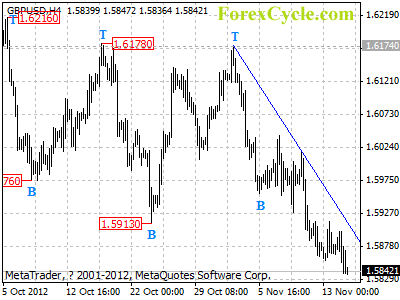
GBPUSD continues its downward movement from 1.6174

GBPUSD continues its downward movement from 1.6174, and the fall extends to as low as 1.5836. Resistance remains at the downward trend line on 4-hour chart, as long as the trend line resistance holds, downtrend could be expected to continue, and next target would be at 1.5800 area. On the upside, a clear break above the trend line resistance will indicate that consolidation of the downtrend is underway, then sideways movement could be seen to follow.

gbpusd

Daily Forex Forecast

Attention Investors: This Market is Worse Than it Looks

By MoneyMorning.com.au

‘Our industry has a long history of letting too many people go at the bottom of the cycle and hiring too many at the top.’ – Lloyd Blankfein, Chief Executive, Goldman Sachs

Mr Blankfein is a guilty man.

Not that we’re accusing him of breaking the law.

And we most certainly wouldn’t question the business practices of Wall Street investment banks like Goldman Sachs.

Rather, we’re saying Mr Blankfein is simply guilty of a common mistake. A mistake made by the CEO’s of big-end-of-town firms, mainstream commentators, most economists, and dare we say it…most investors.

It’s a mistake that guarantees these people and many more will be completely unprepared for the coming decade of economic and financial heartbreak…

In yesterday’s issue of Pursuit of Happiness (your editor’s new free twice-weekly email covering subjects to do with life, liberty and the pursuit of happiness), we mentioned how naïve property investors still didn’t get that things have changed.

They still don’t get it that they aren’t geniuses. They were just lucky to buy a house in the 1960′s or 1970′s and then hold on to it during the biggest and longest credit boom in living memory.

They think Australian housing is just in a bit of a funk. That soon the market will recover, and (laughably) that it will help drive the Aussie economy to more growth.

After all, they still think house prices double every seven years. That’s despite the numbers from the Australian Bureau of Statistics (ABS) that show Aussie house prices in the eight capital cities have gained just 41.2% since 2005. Pathetic.

(To read the full article in full click the following link on buying a house)

But the point of this letter isn’t to take a pop at housing chumps. The point of this letter is to take a pop at banking and business chumps…

Enjoy Those Bonuses While They Last

Like the housing investors, Mr Blankfein is guilty of not getting it. Like most CEO’s who ran businesses leading up to 2008, they thought they were superstars.

They thought only they could possibly succeed by borrowing lots of money, and then using the money to pay exorbitant takeover prices and expand their businesses.

Of course, for the most part it worked…because everyone else did it. Businesses and consumers borrowed and bought, and borrowed more and bought more. How could anything possibly upset this genius strategy?

But something did upset it. Since then things have gone badly wrong. Even so, CEO’s got to keep their seven-figure pay-cheques. And even though things are still bad, the big guys are getting their bread. As the Sydney Morning Herald reported this week:


‘Bank of Queensland’s chief executive was paid $1.8 million, including a half million dollar bonus, in the same year the company made a loss.

‘BoQ posted a loss of $17 million in the year to August 31, the first by a local bank in two decades.

‘The result was caused by $401 million in costs from unrecoverable loans due to BoQ’s exposure to the struggling property market in Queensland, where 60 per cent of its loans are written.’

We suggest Bank of Queensland’s CEO make the most of it. Shareholders may give a CEO their bonus for one year, even though the owners don’t make a bean…but we can’t see that continuing.

At the moment, the financial sector is living in denial. They know how the game works. They even think they know how business cycles work.

Trouble is they’ve never seen a business cycle like this one. They saw mini booms and mini busts within the longer-term bull market. But the busts didn’t last long. And every time the busts turned to booms, investors, businessmen and CEO’s felt smart.

They learned not to panic. They learned to love booms and busts…because busts soon turned to booms.

Not Any Old Recession

That’s why housing investors think the housing market is about to recover (it isn’t). And it’s why Lloyd Blankfein has warned investment banks not to fire too many staff, because he believes the world economy is about to recover (it isn’t).

As our colleagues and we have correctly pointed out over the past four years, this bust is different to anything in recent living memory.

This isn’t a common garden-variety slowdown or recession. You can tell by the scale of the meddling by governments and central banks that this is something different.

In our view, the current problems show that the world economy is going through nothing less than a full-scale depression.

Government bailouts and central bank money printing just give investors the illusion that things are getting better. But the newly printed money is piling up at central banks, because businesses and consumers have already maxed out their borrowing.

And with asset prices staying low, you don’t get the compounding effect of higher debt. In other words, when asset prices rise, investors can borrow more against higher valued assets.

But when asset prices are low, investors can’t use higher valuations to increase the value of their collateral…this means they can’t borrow more money. (Think about how you can increase the value of your home loan if the house price rises. If house prices don’t go up, banks can’t lend more money.)

But that’s only half the story. The other half of the story is how the intentional lowering of interest rates is having exactly the opposite effect to that intended by central banks.

This is a subject we’ll cover in more detail tomorrow…

Cheers,
Kris

From the Port Phillip Publishing Library

Special Report:
Retire Rich, Happy and Free From Money Worries

Daily Reckoning:
Australian LNG Projects Get Pricey

Money Morning:
Avoid the Slaughter: Watch This Key Stock Market Pointer

Pursuit of Happiness:
Thinking of Buying a House? If I Could Give You One Piece of Advice…

Australian Small-Cap Investigator:
How to Make Money From Small-Cap Stocks


Attention Investors: This Market is Worse Than it Looks

Forget the BRICs -These Emerging Markets Will Be the Next Rising Stars

By MoneyMorning.com.au

Savvy investors know there is far more to the markets than sitting on your hands worrying about the fiscal cliff.

The world doesn’t revolve around the United States or the Western world.

In fact, The IMF’s World Economic Outlook projects an emerging markets forecast with growth at 5.6% in 2013. That’s down slightly from 2011 but far ahead of the measly 1.5% growth projected in the “advanced” economies.

That means investors need to focus heavily their investments in emerging markets.

However, there’s one new trick investors will have to learn going into 2013: the BRIC economies (Brazil, Russia, India and China) that have been so fashionable over the years, will all run into trouble next year and should be avoided.

The good news is the world is a big place and there are still emerging markets that offer investors the benefit of the world’s fastest economic growth. My favorites are listed below.

But first you need to understand why the BRICs lost their lustre.

2013 Emerging Markets Forecast

When Jim O’Neill of Goldman Sachs coined the BRICs acronym in 2001 it looked clever since all of them were poised to grow very rapidly and become major factors in the world economy over the next decade.

Of the four, Brazil looked like the weakest member at the time, since it was hovering close to bankruptcy. Meanwhile, Russia had a dynamic new leader, a new “flat tax” and incredible natural resource wealth.

As for the Far East, China was China, even then.

And India had a genuinely reformed its government under Atal Bihari Vajpayee, which helped cause growth to accelerate to very un-Indian levels.

I didn’t trust Russia or Brazil, and China was difficult to buy back then.

With Goldman Sachs (NYSE: GS) recommending them, all these BRICs had to do was keep their governments under control and maintain a reasonable facsimile of free-market policies, and they would be rich within a generation – or even sooner.

Indeed the progress over the intervening decade, in terms of Gross Domestic Product (GDP), has been rapid in all four countries. Yet in the wake of the financial crisis all four stock markets have been pretty disappointing, and now the prospects of the BRICs are nowhere near as bright as they once were.

You can chalk it up to the curse of too much money.

In the last decade monetary authorities worldwide, led by Fed chairmen Alan Greenspan and Ben Bernanke, have kept interest rates too low. Money has flooded into the emerging markets, especially the favored BRICs.

The result has been a surge of corruption in all four BRICs, accompanied by a surge in “malinvestment”, a term beloved of the Austrian school of economists and describing investments, like the Nevada housing market in 2004-06, that is entirely misdirected and a waste of resources.

In China, the economy is slowing and there is a gigantic morass of bad loans in the banking system, perhaps five times the size of the bad loans about which everyone worried a decade ago. A 2008-style banking collapse and government bailout in China seems inevitable – and we know what that does to an economy!

In India the fine Vajpayee government of 1998-2004 was replaced by an ungrateful electorate with a return to the socialist Congress party, which had wrecked India’s economy from 1947-1990.

The budget deficit in India, by both the central and regional governments, is gigantic now and is “crowding out” the private sector from the financial market. We also can expect a surge in inflation and a balance of payments crisis. Fortunately, there’s another election in 2014; we can hope that the Indian voters do a better job than in 2004.

As for Russia, Vladimir Putin has effectively established himself as President for life, and has taken control of the economy’s major sectors. The Rosneft buyout of TNK-BP indicates that the Russian state will use its resources to assert economic control. This is already working poorly, and it will stop working altogether when the price of oil drops.

Finally, Brazil is meddling in its major companies such as Petrobras and Vale, whose results have sharply deteriorated. Public spending is way out of control, mostly through subsidized loans from the state bank BNDES.

Like Russia, Brazil will fairly quickly run into a balance of payments crisis and certainly won’t enjoy its past rapid growth.

Since investors saw BRICs as a bloc on the way up, they will almost certainly panic simultaneously about all four on the way down, and cause a global financial crisis involving all four. That’s if the Eurozone’s problems or Japan’s government debt don’t cause one first.

Three Emerging Markets to Buy

As investors, we can only protect ourselves to a limited extent, and certainly should not “sell at the bottom”, as some unfortunates did in early 2009. Certainly we should not put our money in any of the BRIC trouble spots.

However, there are other emerging markets whose prospects remain excellent. They include Singapore, Chile and the Philippines. Here’s why emerging markets are better bets in 2013:

Singapore is now at European standards of wealth and is projected by the Economist team of forecasters to grow by 4% in 2013 after a slowdown in 2012. It also ranks top or close to it on international indexes of integrity and business-friendliness.

Chile remains the best-run country in Latin America, with high scores on integrity indexes and a strong mineral sector.

The Philippines has been off most investors’ radar screens, but is expected to grow 6.0% in 2013.

So yes, the parts of the world may be troubled right now, but that doesn’t mean investors need to stay on the sidelines. With the right emerging markets, real growth is easier than you think.

Martin Hutchinson
Contributing Editor, Money Morning

Publisher’s Note: This article originally appeared in Money Morning (USA)

From the Archives…

APRA Spins Another Yarn On Australian Banks
9-11-2012 – Kris Sayce

The Secret Return to the Gold Standard
8-11-2012 – William Patalon

Forget the US Election, This Stock Market Event is the One to Watch For
7-10-2012 – Murray Dawes

The Greeks Giving Economists Nightmares
6-10-2012 – Bill Bonner

Super Fund Results: Whoopdeedoo
5-10-2012 – Nick Hubble


Forget the BRICs -These Emerging Markets Will Be the Next Rising Stars