Euro Rebounds despite EU Recession Fears

Source: ForexYard

The euro was able to recover some of its recent losses against both the US dollar and Japanese yen yesterday, despite a report that the EU has slipped deeper into recession. Analysts attributed the bullish movement to disappointing US news and speculations regarding the outcome of an upcoming Japanese election. Today, a lack of significant international indicators means that there may be low volatility in the marketplace. Still, any announcements out of the euro-zone, particularly with regards to the debt situation in Greece, have the potential to generate significant trading activity.

Economic News

USD – Dollar Reverses Gains vs. Riskier Assets

The US dollar reversed some recent gains against its higher-yielding currency rivals yesterday, as fears regarding a slowing down in the US economic recovery weighed down on the greenback. The USD/CHF fell more than 30 pips during European trading, eventually dropping below the 0.9420 level. Furthermore, the British pound was able to gain more than 25 pips against the dollar during afternoon trading. That being said, the news was not all bad for the dollar. Speculations regarding the outcome of an upcoming Japanese election resulted in the USD/JPY reaching a 6 ½ month high during mid-day trading.

As markets get ready to close for the weekend, traders will want to monitor several indicators out of the US which could result in market volatility. The TIC Long-Term Purchases, Capacity Utilization Rate and Industrial Production figures all have the potential to generate additional dollar losses if they come in below their forecasted levels. That being said, any signs that the euro-zone is slipping even further into recession may lead to risk aversion, which could help the greenback.

EUR – Euro Gains May be Temporary

The euro hit a six-day high vs. the US dollar and a two-week high against the yen yesterday, despite news that the EU has slipped deeper into recession. Fears regarding a slowing down in the US economic recovery, highlighted by the upcoming “fiscal cliff”, and speculations regarding next month’s Japanese election were responsible for the euro’s bullish movement. The EUR/USD gained more than 50 pips during the European session to trade as high as 1.2793. Against the JPY, the euro moved up more than 100 pips, eventually reaching as high as 103.95.

Today, analysts are warning that the euro’s recent gains could turn out to be temporary, as uncertainties regarding the next round of Greek bailout funds may generate pessimism in the EU economic recovery. Any announcements from EU officials regarding Greece’s current economic status may lead to heavy volatility for euro pair before markets close for the weekend. That being said, if US data comes in below expectations during afternoon trading, the euro may be able to extend its gains against the dollar.

Gold – Gold Falls following Report on Global Demand

Gold took significant losses during European trading yesterday, following a report which stated that demand for the precious metal dropped during the third quarter of this year. Prices dropped by close to $15 an ounce over the course of the mid-day session, eventually reaching the $1710 level.

Today, gold traders will want to pay attention to what direction the dollar takes over the course of the day. If the greenback is able to regain some of yesterday’s losses against the euro, gold would become more expensive for international buyers, which could result in additional bearish movement before markets close for the weekend.

Crude Oil – Middle East Violence Keeps Oil near 1-Week High

An escalation in Middle East violence kept the price of oil near its recent one-week high during European trading yesterday. Crude traded as high as $87.05 a barrel, up close to $0.60, before once again turning bearish during the evening session and dropping back to the $86.30 level.

As markets get ready to close for the weekend, traders will want to continue monitoring the ongoing military conflict in the Middle East. Any escalation in violence could generate supply side fears among investors, which may drive the price of oil higher. Additionally, if US news comes in higher than expected today, oil cold extend its bullish trend.

Technical News

EUR/USD

Most long-term technical indicators place this pair in neutral territory, meaning that a defined trend is difficult to predict at this time. Traders may want to take a wait and see approach, as a clearer picture is likely to present itself in the near future.

GBP/USD

The daily chart’s Williams Percent Range has fallen into oversold territory, indicating that an upward correction could take place in the near future. Additionally, a bullish cross has formed on the same chart’s Slow Stochastic. This may be a good time for forex traders to open long positions.

USD/JPY

The Relative Strength Index on the weekly chart is approaching the overbought zone, signaling that this pair could see a downward correction in the coming days. Furthermore, the Slow Stochastic on the same chart has formed a bearish cross. Going short may be the wise choice for this pair.

USD/CHF

While a bearish cross appears to be forming on the weekly chart’s MACD/OsMA, most other long-term technical indicators show this pair range trading. Traders may want to take a wait and see approach, as a more defined trend may present itself in the coming days.

The Wild Card

Silver

The Williams Percent Range on the daily chart has crossed into overbought territory, indicating that a downward correction could occur in the near future. Furthermore, a bearish cross has formed on the same chart’s Slow Stochastic. This may be a good time for forex traders to open short positions ahead of a possible downward correction.

Forex Market Analysis provided by ForexYard.

© 2006 by FxYard Ltd

Disclaimer: Trading Foreign Exchange carries a high level of risk and may not be suitable for all investors. There is a possibility that you could sustain a loss of all of your investment and therefore you should not invest money that you cannot afford to lose. You should be aware of all the risks associated with Foreign Exchange trading.


Can China become the world’s largest economy without a globalised currency?

According to a recent OECD report entitled ‘Looking to 2060: long-term growth prospects for the world’, China is forecast to surpass the Euro Area in a year and the United States by 2016 to become the world’s largest economy. The OECD believes China will experience more than a seven-fold increase in its income per capita by 2060. “The extent of the catch-up is more pronounced in China reflecting the momentum of particularly strong productivity growth and rising capital intensity over the last decade. This will bring China 25% above the current (2011) income level of the United States,” the organisation says.

Is it possible for China to become the world’s largest economic powerhouse without fully liberalising its financial markets to allow the Renminbi to become widely accepted internationally?  For those who trade FX, China’s monetary policy is nothing but a paradox. FX traders know only too well that efforts to make the Renminbi more flexible have been painfully slow. In light of the slowdown in its exports, and the subsequent decline of its current account balance, China currently seems reluctant to widen the Renminbi’s trading band. Calls for further currency appreciation have not fallen on deaf ears over the past several years, but have not been answered with the greatest enthusiasm either.

Take a look at Saxo’s infographic on the trade imbalance between China and the US: despite gradual Renminbi appreciation since the fixed peg to the dollar ended in 2005, Chinese exports to the US remain nearly four times greater than US exports to China. The US has accused China of contributing to their bilateral trade imbalance by maintaining the Renminbi at an artificially low level against the USD. Does this mean China has won the currency war? Meanwhile, its current account surplus has allowed it to pile up huge foreign currency reserves…

So what’s the future of the Chinese currency? The supertanker of Chinese Renminbi appreciation has slowed to a crawl and even reversed a little during 2012. This becomes self-fulfilling as the two things that move the currency are trade-related flows – and they have become not so favourable for the Yuan now because of the reduction in the surplus – and speculative flows. It was massively popular to speculate that the currency would strengthen. However, now you could say after a virtually-unchanged year that’s not front-and-centre for a lot of hedge funds. That supertanker could change direction completely if China fell off a cliff, there are rumours of a property collapse, or banks going bust. China could start seeing capital flight if it had an open current account and that’s why it doesn’t – China takes these very gradual steps. So traders who expect the ‘redback’ to soon become the world’s new reserve currency could be disappointed.

To view Saxo’s top experts’ views on the Chinese currency: download Saxo’s free e-book. To access Saxo’s and other traders’ views on other currencies, join the #FXdebates.


Central Bank News Link List – Nov 16, 2012: Fed hawks press their minority case against easing

By Central Bank News

Here’s today’s Central Bank News link list, click through if you missed the previous link list. The list comprises news about central banks that is not covered by Central Bank News. The list is updated during the day with the latest developments so readers don’t miss any important news.)

Market Trends 16.11.12

Source: ForexYard

printprofile

Hey Everyone,

Below are some market trends for today.

Good luck!

-Dan

Gold- May see a downward correction today
Support- 1697.38
Resistance- 1723.70

Silver- May see a downward correction today
Support- 31.81
Resistance- 32.90

Crude Oil- May see a downward correction today
Support- 85.07
Resistance- 86.69

Dax 30- May see a downward correction today
Support- 6864.62
Resistance- 7171.48

EUR/USD May see a downward correction today
Support- 1.2683
Resistance- 1.2799

Forex Market Analysis provided by ForexYard.

© 2006 by FxYard Ltd

Disclaimer: Trading Foreign Exchange carries a high level of risk and may not be suitable for all investors. There is a possibility that you could sustain a loss of all of your investment and therefore you should not invest money that you cannot afford to lose. You should be aware of all the risks associated with Foreign Exchange trading.
Retirees and the Fed Face Off

By MoneyMorning.com.au

Yesterday we left you with a cliffhanger.

Although if you subscribe to one of our paid investment services, and you get the free weekly digest that comes with them, Scoops Lane, you may already know what we were on about.

After 40 years of expanding credit like nobody’s business, and four years of printing money and bailing out zombie banks like it was going out of fashion, the US Federal Reserve has worked out why it’s plan to boost the economy isn’t working.

It’s not because its ideas are bad.

It’s not because it needs more time.

No. The Fed has done its homework. The Fed knows exactly why things aren’t going to plan.

So who or what is at fault? We can only describe them as economic saboteurs…financial terrorists. You’ll read all about these evildoers below…

On Tuesday we sent a Bloomberg News article to our colleagues. We had mixed emotions when we read it.

Our first reaction was to liken it to having a dentist punch us in the mouth and then tell us we need new teeth.

Our second reaction was to laugh…in despair.

Here’s the specific quote that caused our emotions to run hot and cold:

‘Federal Reserve officials say they’re concerned that retirees […] are blunting the impact of record easing aimed at creating jobs. The reason: Older people are more likely to forgo purchases of houses, cars and other big-ticket items that the Fed is trying to encourage with near-zero interest rates. And their numbers are growing, making the Fed’s task ever harder.’

Clearly those retirees are scum…complete dirtbags.

Don’t these filthy retirees understand the Fed is trying to create jobs? The Fed has to reduce interest rates to zero so people can borrow more and spend more.

So what’s wrong with these selfish retirees? So what if interest rates are so low they can’t earn a living from the money they’ve saved during a lifetime of work?

They should keep on spending. What’s that you say? Retirees don’t really need a new house or new car when they’ve retired? Rubbish, they’re traitors.

Seriously, that quote and the rest of the article is probably the most ridiculous thing we’ve read all year…or at least as ridiculous as the last thing we read in the mainstream press.

Retirees Out Smart Bigwigs

But what’s the origin of the Fed’s thinking?

You may be familiar with the so-called Paradox of Thrift. If you’re not familiar with it, it’s a silly Keynesian idea that saved money is dead money. Saved money means that people aren’t spending…and according to Keynesians, that’s bad.

It won’t surprise you to know that the world’s central banks are full of Keynesians. Central banks and governments love Keynesian theory because it gives them the green light to interfere with economies and markets.

The Paradox of Thrift theory is part of the reason why the Fed and other central banks have lowered interest rates.

The idea is that if interest rates are low, savers will either invest in riskier assets that pay a higher income, or they’ll just spend their savings in the belief that inflation will eat away at it…better spend it now while it’s worth something.

That’s the theory. But as we’ve explained many times in these pages, humans are unpredictable creatures. You can’t put human behaviour in a spreadsheet or mathematical formula to spit out answers.

When the Fed and its cohorts smashed interest rates to record lows, they didn’t bank on old folks preserving their capital and reducing their costs. As retiree Grisel Muina told Bloomberg News:

‘I used to spend a lot of money, let me tell you – I was a compulsive buyer. Now I have to watch every penny that I spend, and it’s hard for me. Once you’re used to a certain way of living, it’s hard to reduce.’

This is the impact of central banking policies. This is what people like Dr Ben S. Bernanke, Sir Mervyn King, and Glenn Stevens have done and are doing to retirees’ incomes.

In their rush to bail out banks and keep their buddies in jobs, every day, retirees in the US, UK and Australia are falling into poverty. Just when they should be putting their feet up and enjoying the fruits of 40 or 50 years of work, they’re forced to eat tinned hotdogs and stale bread.

Yet every day the mainstream press hails the central bank chiefs as heroes…they brown nose and call them the world’s best minds.

In a way it’s funny. Old-timers have outsmarted doctors, knights, and the world’s highest paid central banker. Of course, for them it’s a hollow victory, knowing that their income has suffered.

Why You’re One-Up on Overseas Investors

And so, billions and trillions of dollars later, central bankers have failed. Those who rely on income from investments have seen their incomes slashed. And rather than taking the kind of risks the central bankers want them to take, they’ve decided to cut their spending instead.

As we warned yesterday, the condition of the world economy is much worse than stock markets would have you think.

We’re now four years into the Second Great Depression. And like the original Great Depression of the 1930s and 1940s, this one has plenty of years left to run.

For many in the US and UK, it’s too late for them to adjust their retirement plans to take into account zero percent interest rates. But as an Aussie investor, you’re lucky…you’ve got an advance warning of what will soon happen here.

The biggest mistake you can make is to think it won’t happen…that Australia is different. Believe us, it will happen, and to some degree it has already started. Thinking it won’t happen is a dangerous trade. So don’t sit back and let the retirement poverty trap snag you.

Cheers,
Kris

PS. We can’t emphasise this enough. Aussie savers and investors will face the same shock as US investors in the years ahead. Most US investors never had a chance, they just didn’t see it coming. Within four months of the world economy melting down in 2008, the Fed slashed rates and cash deposit rates sunk.

You’ve got an advantage. You’ve had four years to prepare, and it’s still not too late. The only question is: where do you start? Well, we’ve got the answer. Simple. Check out this retirement investing tutorial right away. Grab a note pad and tune in now

From the Port Phillip Publishing Library

Special Report:
Retire Rich, Happy and Free From Money Worries

Daily Reckoning:
Why Banks Won’t Buy Risk Free Gold

Money Morning:
Attention Investors: This Market is Worse Than it Looks

Pursuit of Happiness:
Buying a House? If I Could Give You One Piece of Advice

Australian Small-Cap Investigator:
How to Make Money From Small-Cap Stocks


Retirees and the Fed Face Off

How Government Coercion is Distorting the US Economy

By MoneyMorning.com.au

All government-directed economic activity grows at the expense of the private sector. And the election suggests that government coercion will drive even more US economic activity in the future.

This is a shame, because freely adjusting prices, competition, and innovation elevate living standards. Mandates, price controls, and subsidies – coercive actions – depress living standards. Quality falls. Shortages develop and persist.

Americans are in the midst of a destructive, self-reinforcing political cycle – a cycle that might conclude in a nightmare scenario. A sloppy diagnosis of the financial crisis lies at the root of the destructive cycle.

The free market did not cause the financial crisis; political meddling with interest rates and credit allocation caused it. Without a proper diagnosis, the medicine can be worse than the disease.

In this destructive cycle, the popular response to a financial crisis caused by too much government and central bank influence is ‘Give us more government and crazier central banks!’

Government Distorts Markets

President Obama’s health care law provides an example of how government dipping its toe into a market can start a destructive cycle that ends in even more government control: years after its passage, many of Obamacare’s details remain unknown.

But we know it will demand insurance companies not charge premiums that vary too much for people with different health risks. The insurance companies will receive millions of new (but unprofitable) customers.

It’s easy to imagine price controls and mandates bankrupting many health insurance companies. All the while, politicians would blame the insurers for poor customer service and putting ‘profits over people’.

Before you know it, the political door for a single-payer health care system would be pushed wide open – all because politicians are not interested in honestly discussing the impact of price controls and mandates on markets.

This is not meant to be a political screed. But whether we like it or not, politics are an important part of the investing equation.

It is clearer than ever that the economy will continue getting mauled in a self-reinforcing cycle of more government leading to market failures leading to even more government.

Some of you are disappointed with the results of the U.S. election, some are happy, and some (including those with libertarian views) wonder why any individual or political party would want to preside over a country whose challenges dwarf its opportunities.

Call me a grumpy cynic, but it helps to be a realist when examining this situation. Here’s why: You can’t argue, after thinking about the following four points, that America’s challenges (ignoring individual families or companies) do not outweigh America’s opportunities:

First, the ‘nondiscretionary’ federal budget is set on autopilot, driven by demographics. Political inertia will not allow meaningful reforms. We don’t ‘have the votes’, as they say in Congress, to reform insolvent entitlement programs.

Second, a critical mass of voters demand government services, including health care – health care that remains waiting for bureaucrats to define.

Why Government Security is an Illusion

Tuesday’s exit polls revealed that the popular American characteristic of self-reliance is not so popular anymore. Many voters see a European-style welfare state not as a bankrupting failure, but as a model for the U.S. They’re trading their freedom for the illusion of economic security.

Why is government-provided economic security an illusion? Simple: There is no way to pay for these benefits without raising tax rates to a degree that would destroy both the economy and the financial markets or annihilate the value of the dollar.

Confiscating the income and assets of the ‘rich’ (ignoring the fact that this would put countless people out of work) would make an unnoticeable dent in the budget deficit. This is a fact, not an opinion. Unfortunately, rather than start a factual conversation about the deficit, politicians choose to inflame the toxic emotion of envy.

Third, the next recession – and we are due for one in the not-too-distant future – would push the federal deficit well beyond expectations. Tax receipts would fall, along with incomes, capital gains, and economic activity.

Spending on unemployment programs would rise again. The Obama administration’s predictable response to a recession would be another stimulus plan in which Democrats get more spending and Republicans get more tax cuts.

So in the end, a recession leads to wider deficits, which in turn lead to policies that widen deficits yet again. Paul Krugman and most other economics professors would love it.

Krugman would consider this a worthwhile effort to fill some mythical, immeasurable ‘output gap’, while people with common sense would consider this going down the road to hyperinflation.

There’s No Turning Back on QE

Fourth and finally, the Federal Reserve has boxed itself into a corner. Quantitative easing (QE) is a one-way proposition; there is no practical reversal from QE, as newly printed money has boosted the price level above where it otherwise would have been.

Reversing QE would bring about dreaded ‘deflation‘. Any exit strategy from QE exists purely in academic models. In reality, reversing QE (selling bonds and draining cash from the financial system) would crash all of today’s manipulated financial markets simultaneously.

The Fed’s goals early on in the crisis focused on supporting the banking system at the expense of savers. Now the Fed will be pressured, threatened, and eventually forced to monetize ever more U.S. government debt – all to finance a government budget that the private sector cannot afford.

As a proponent of small, affordable, sustainable – there is a nice buzzword – government, I lament that voters have chosen a government stuck in a destructive, self-reinforcing cycle. Time will tell if this cycle (more government, market failure, more government, market failure…) can be stopped.

The future political environment will multiply the risks facing investors. But there will always be opportunities for contrarian investors on both the long and short sides of the market…

On the long side, look at the best-managed gold and silver mining companies, and companies providing ‘shale fracking’ services and equipment for the American oil boom.

On the short side, look at overindebted companies that, in order to survive, need consumers to continue overspending. Also, look to short companies that pay high prices for raw commodities and resell processed goods into a depressed economy.

Dan Amoss
Contributing Editor, Money Morning

Publisher’s Note: This article first appeared in Laissez Faire Today

From the Archives…

APRA Spins Another Yarn On Australian Banks
9-11-2012 – Kris Sayce

The Secret Return to the Gold Standard
8-11-2012 – William Patalon

Forget the US Election, This Stock Market Event is the One to Watch For
7-10-2012 – Murray Dawes

The Greeks Giving Economists Nightmares
6-10-2012 – Bill Bonner

Super Fund Results: Whoopdeedoo
5-10-2012 – Nick Hubble


How Government Coercion is Distorting the US Economy

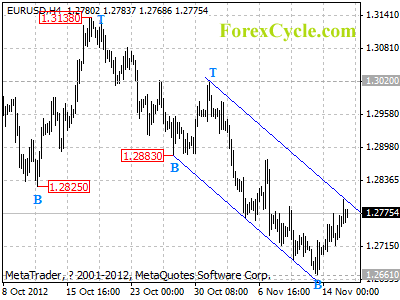
EURUSD’s bounce extends to as high as 1.2801

EURUSD’s bounce from 1.2661 extends to as high as 1.2801, and is now facing the resistance of the upper line of the downward price channel on 4-hour chart. As long as the channel resistance holds, the bounce could be treated as consolidation of the downtrend from 1.3138, and another fall towards 1.2500 is still possible after consolidation, and the downtrend could be expected to resume after touching the channel resistance, only a clear break above the channel resistance will indicate that the downward movement is complete.

eurusd

Forex Blog

How to Invest Using CFDs

CFD trading has grown exponentially in the past few years, and it has proved to be particularly valuable tool for trading stock without the need to buy shares out rightly. Since they are tradable by margins, they come highly recommended to investors willing to venture into higher risk investment. While trading CFDs, you need to pay interest on a daily basis. Rates differ between various brokerages and individual trading specialists.

From the derivatives in equity, CFDs allow investors to speculate on the movement of the shares, without having to own the shares. The use of CFDs started out in the London stock exchange in the early 1990’s and has grown by leaps and bounds since then. They are now available throughout continental Europe’s major companies that include FTSE 350, DAX, and ATX amongst other companies from other parts of the world. They however are not allowed in the United States due to the restrictions placed by the U.S Securities and Exchange Commission that bar over the counter financial transactions.

A wide variety of markets are tradable using CFDs including stocks, forex and bonds.

An example of a CFD Trade

Although CFDs fundamentally fulfil the same role as a share purchase, as we can see, leverage means the original sum of money needed is much less. The following example shows this:

Lesley wants to buy a contract worth $20,000 in the company Blue Widgets PLC that is currently trading at £10 a share.  Her position is the equivalent of 2000 shares although the Contract For Difference broker she uses only has a 10% margin requirement to open the contract.  This means she only needs $2000 to open the position.  If the price of the underlying share rises to £15, she will have made $10,000 (from just a $2000 initial deposit).  This goes to show the power of leverage and the benefit CFD Trading has over many other methods of investment.

Other Points to Note

Contract for Difference or CFDs as they are popularly known are traded over the counter (OTC). These are good trade options as they allow you to leverage your returns. There are both long-term and short-term options for this kind of arrangement. Traditional share trading involved a stockbroker and entailed making payment of the full purchase price. With a CFD however, it is possible to achieve this with less cash involved. How, you may ask. A typical CFD allows you to trade in most markets from only around 1% to 10% margins. Some markets offer 20% and up 50% times the exposure, multiplying the risk involved. This is akin to borrowing to trade; the trick here is to extrapolate the gains or losses by the factor of 10—taking 10% as the operating margin requirement. For instance, a 3% increase in a share price will result in a 20% return on your initial outlay. This is because prices follow the underlying stock quite tightly, so the difference is hard to spot.

CFDs are normally traded between individuals and CFD traders of brokers. There are no universal terms for CFDs as both parties agree on their terms and conditions to apply throughout their transactions. However, they are prevalent practices that cut across most CFD transactions. One of the major benefits in trading Contracts For Differences is that they can be traded on a margin. This means that they can be used to provide the trader with a larger leverage. It involves taking a small deposit and using it as leverage borrows larger equivalent quantity of assets. Say for instance you want to buy shares worth €25,000, and the margin rate for those particular shares is 10%, then all you need is to deposit €2,500 while maintaining the same level of exposure.

Trading CFD like any other trade involves risks. However, risks in this venture are higher compared to normal trade practices. This does not mean they cannot be controlled as several mechanisms have been put into place to cushion the trader from losses including the automatic termination of a contract if it moves below a specified loss making mark. This makes it an attractive option for budding businesses and based on its versatility, it grows your investment quite dramatically especially if used to hedge against the decrease of shares you might actually own. CFD’s are of many types ranging from individual, to index CFDs and finally to currencies, which provides more chances to make a quick buck.

 Article by FinancialTrading.com

Which Works Best — GPS or Road Map? (Part 1)

Trading with Elliott wave analysis
November 15, 2012

By Elliott Wave International

Some of the best stories about global positioning systems (GPS’s) are the weird detours they sometimes recommend to drivers. Just like some of the weird detours that financial markets can make you take when you think they would be better off going in a straight line either up or down, depending on how you’ve positioned your trades.

Not long ago, while taking a trip with my family through Great Smoky Mountains National Park on the way to Gatlinburg, Tenn., I decided to use my GPS to drive around the park’s western boundary. We wanted to visit Fontana Dam and Cades Cove to see the wildlife. We’d do the go-carts, miniature golf and rides the following day.

From Fontana Dam, my old-fashioned map made it look like it would take the better part of the day to drive around the park to Gatlinburg and then head into Cades Cove from the north. But my new GPS unit suggested that Cades Cove was less than 20 miles away. I could have kissed it — my GPS was going to save me hours of travel time! Or so I thought. Little did I know until I got there that the road my GPS suggested for the final few miles was only the remnant of an old wagon trail — and it was a one-way wagon trail, going the wrong way. I had to backtrack and take the much longer path my paper map suggested.

What’s the moral of the story? Sometimes the new-fangled gadget is not much of an improvement over what it’s designed to replace. Although my GPS unit is great when it comes to identifying the quickest and most efficient route from point A to point B, it sometimes fails to take into account some of those necessary nuances, such as whether a street is one way or whether it might be impassable at times. Every so often, the old-fashioned way of doing things is still the best way.

I believe that’s true when it comes to analyzing markets, too. The method I employ every day has been around since the 1930s, and it works as well as, if not better than, any new-fangled technical analysis method for which you must buy some expensive computer software. My method is a form of technical analysis based on the Elliott Wave Principle, which Ralph N. Elliott worked out via hundreds of hand-drawn charts, well before the dawn of charting software. If you like those GPS units that talk you through every turn, you can almost imagine Ralph’s voice explaining where to turn as you follow a market. Those directions — the road map he drew for tradable markets — have withstood the test of time.

As I found during my trip, detours are a fact of life. They are also a part of market trends. For instance, a bull market shows periods of “punctuated growth” — that is, periods of alternating growth and non-growth, or even decline. The patterns then build on themselves to form similar designs at a larger size, and then again at an even larger size.

You’ve probably heard of this idea of repeating patterns on increasing and decreasing levels of scale. This emerging science, which is called “fractal geometry,” is a branch of chaos theory. And it is precisely the model identified by R. N. Elliott more than 60 years ago.

(Stay tuned for parts 2 and 3.)


Who is Jim Martens?
Jim is one of the very few forex Elliott wave instructors in the world, and a long-time editor of EWI’s
Currency Specialty Service. A sought-after speaker, Jim has been successfully applying Elliott since the mid-1980s, including 2 years at the George Soros-affiliated hedge fund, Nexus Capital, Ltd.

Catch up on Jim’s latest thoughts about FX markets and the business of trading them at his Twitter feed.


Download Your Free 14-page eBook: “Trading Forex: How the Elliott Wave Principle Can Boost Your Forex Success”

Here’s some of what you’ll learn:

  1. Which Elliott waves to trade
  2. Which Elliott waves set up your forex trade
  3. When your analysis is wrong
  4. Guidelines for projecting price targets
  5. How to evaluate an Elliott wave structure
  6. How to use the bigger picture to give you perspective on the market’s next major move

Jim also takes you through two real-world trading examples to reinforce what you’ve learned and apply it to your own trading.

All you need is a free Club EWI profile to download this FREE 14-page eBook now >>


This article was syndicated by Elliott Wave International and was originally published under the headline Which Works Best — GPS or Road Map? (Part 1). EWI is the world’s largest market forecasting firm. Its staff of full-time analysts led by Chartered Market Technician Robert Prechter provides 24-hour-a-day market analysis to institutional and private investors around the world.