Market Trends 19.11.12

Source: ForexYard

printprofile

Hey Everyone,

Here are some market trends for today.

Good luck!

-Dan

Gold- May see a downward correction today
Support- 1709.57
Resistance- 1734.41

Silver- May see a downward correction today
Support- 32.18
Resistance- 32.80

Crude Oil- May see a downward correction today
Support- 86.76
Resistance- 88.73

Dax 30- May see a upward correction today
Support- 6902.53
Resistance- 7185.56

EUR/USD May see a downward correction today
Support- 1.2676
Resistance- 1.2862

Read more forex news on our forex blog

Forex Market Analysis provided by ForexYard.

© 2006 by FxYard Ltd

Disclaimer: Trading Foreign Exchange carries a high level of risk and may not be suitable for all investors. There is a possibility that you could sustain a loss of all of your investment and therefore you should not invest money that you cannot afford to lose. You should be aware of all the risks associated with Foreign Exchange trading.

Market Review 19.11.12

Source: ForexYard

printprofile

The US dollar hit a new seven-month high against the Japanese yen during overnight trading, as speculations of additional monetary easing in Japan caused investors to shift their funds to the greenback.

While the euro saw modest gains against the USD last night, analysts were quick to warn that the common-currency could soon turn bearish if euro-zone finance ministers fail to reach an agreement to provide Greece with another round of bailout funds.

The price of crude oil shot up close to $1 a barrel when markets opened for the week, as an increase in Middle East violence led to supply side fears among investors. The commodity is currently trading at $87.66.

Main News for Today

US Existing Home Sales- 15:00 GMT
• Analysts are expecting the indicator to come in slightly above last month’s
• Any better than expected news could help the dollar extend its recent bullish trend against the yen

Read more forex news on our forex blog

Forex Market Analysis provided by ForexYard.

© 2006 by FxYard Ltd

Disclaimer: Trading Foreign Exchange carries a high level of risk and may not be suitable for all investors. There is a possibility that you could sustain a loss of all of your investment and therefore you should not invest money that you cannot afford to lose. You should be aware of all the risks associated with Foreign Exchange trading.

Yen Drops Prior to BOJ Policy Meeting

By TraderVox.com

Tradervox.com (Dublin) – The Japanese currency dropped against the most peers as Bank of Japan officials prepare to hold a two day meeting to discuss the issue of easing. There is increased speculation of additional bond-buying efforts as the country heads to an election in December.

The yen dropped, as Liberal Democratic Party leader Shinzo Abe indicated that he would choose someone who favors easing as the governor of the central bank if elected the president. On the other hand, the 17-nation currency’s demand was limited as European finance ministers prepare to meet to discuss the Greek issue. The ministers had indicated that they will have a decisive report at the end of tomorrow’s meeting. The Australian dollar was advanced as Asian stocks boosted the demand for commodity related currencies.

According to Joseph Caprso, a strategist at the Commonwealth Bank of Australia in Sydney, the Japanese election is the main driver of the yen and this might continue in the near term as political debate heats up in Japan. Capurso noted that the market expects these “knee-jerk reactions” in the medium term for the yen.  The yen has been on decline since the Prime Minister Yoshihiko Noda dissolved the lower house of the Parliament to pave way for the election.

The Japanese currency dropped against the dollar to trade at 81.25 at the close of trading in Tokyo down from its close on November 16th of 81.32. The currency had earlier touched its seven-month low of 81.59, which is the weakest since April 25. Agianst the euro, the yen traded at 103.67 after earlier touching its lowest since October 25 of 104.11 yen per euro.

The yen has declined as opinion polls show that majority favor Abe, the LDP leader. The Japanese election will be held on December 16 later this year. According to Mike Jones, a Currency Strategist in Wellington at Bank of New Zealand, the market is expecting the gains in dollar-yen pair to fade as a result of consolidation.

Disclaimer
Tradervox.com is not giving advice nor is qualified or licensed to provide financial advice. You must seek guidance from your personal advisors before acting on this information. While we try to ensure that all of the information provided on this website is kept up-to-date and accurate we accept no responsibility for any use made of the information provided. Opinions expressed at Tradervox.com are those of the individual authors and do not necessarily represent the opinion of Tradervox.com or its management. 

Article provided by TraderVox.com
Tradervox.com is a Forex News Portal that provides real-time news and analysis relating to the Currency Markets.
News and analysis are produced throughout the day by our in-house staff.
Follow us on twitter: www.twitter.com/tradervox

Picking the Hot Commodity Stocks of 2013

By MoneyMorning.com.au

Bah humbug!

Now I enjoy Christmas as much as the next bloke.

But isn’t it a bit early for the shops to have all their Christmas stuff out already?

And do we really have to listen to Christmas jingles for the next five weeks?!

Of course this also means you can expect the annual end-of-year market reflection – and the big market forecasts for 2013.


Most of this will be entertaining…but totally delusional. The cold fact is that no one has any idea what will happen next year.

Last century, the famous American author, Peter Drucker, explained the limitations of market forecasting better than anyone I’ve heard since:


‘Trying to predict the future is like trying to drive down a country road at night, with no lights…while looking out the back window.’

But we’re simple mammals, with instincts honed by evolution to take risks.

And we just can’t help ‘having a crack’ at predicting the future…

After all this is the reason the global gambling industry is half a trillion dollars in size. Though of course it’s multiples bigger than that if you include investment markets as gambling!

And the reason our risk taking instincts have brought us this far as a species, is that risk taking can pay off.

A perennial market trend in the resource sector that can see this risk pay off, is betting on the ‘hot commodity’ for the following year.

Each year there is a ‘hot commodity‘ that tends to emerge at the start of the year. By picking it early, investors can make huge gains over the following twelve months as all stocks in that sector have a manic run up.

This year it was graphite.

As is the way with hot commodities, the fundamentals were already in place for the commodity. The idea just needed to cross over and reach critical mass amongst investors.

Then suddenly… *BANG* – graphite stocks took off in late January, and rallied hard for four months.

Graphite stocks like Lincoln (LML), Archer (AXE), Talga (TLG), and Syrah (SYR) gained 102%, 163%, 306%, and 660% respectively in just months.

Graphite Stocks Gained up to 660% in Under Five Months

Graphite Stocks Gained up to 660% in Under Five Months
Click here to enlarge

Source: googlefinance

The trick of course was to predict this in advance, and profit from this whole rally. It also means picking the best in the pack to get the best performance.

Now I’ll admit I was a few months later than I would have liked in tipping the graphite story to Diggers and Drillers readers. Though we tipped the ‘best-in-class’ – and have seen this trade almost triple in just six months.

This is of course high risk investing, and is definitely not for everyone!

With all the market volatility in the markets today and risks on all sides – punting on small caps is a ‘hard way to make an easy living’.

Unless you’re OK with insomnia, you might prefer to keep you cash in dividend payers and term deposits (or if you want better capital growth, gold). Finding the best way to earn passively while avoiding risk is a project my colleague and mate Nick Hubble has worked on for three years. You can find out what he’s come up with here

A functional portfolio has some funds allocated to less risky assets, but also some with risk too. Personally I have about half precious metals, and half small cap resources stocks.

Hot Commodities to Watch in 2013

So what’s my bet for the hot commodity of 2013? I’ll explain in a moment. First, a recap of previous ‘hot commodities’…

In 2011 it was potash.

In 2010 is was rare earths.

And in 2009 it was lithium.

In each case there was a trigger factor that pushed the simmering fundamentals to boiling point, triggering a mania phase in the stocks exposed to that commodity.

For example, BHP made a bid for the world’s biggest potash company, and the Chinese reduced exports quotas for rare earths to set the cascade off.

These type of events are unpredictable, so we just have to keep our ears to the ground (or let google alerts do the work for us).

A good starting point to research candidates for next years’ ‘hot commodity’ is in the Royal Geological Society’s risk list.

I’ll keep my final conclusions for Diggers and Drillers readers. But I can give you some insight into my thinking. For a start, my short list would firstly include anything relying on South African mining production. Its mining sector is badly hamstrung by union activity, violence and protests that look set to fester.

So as the leading source of the metals, platinum group metals are right up there on the list. My pal, Dan Denning of The Denning Report, was an early mover on this trade, as he was with Aussie shale gas.

South Africa is also a big producer of vanadium, and a dominant producer of manganese, and fluorine. So I’ll keep a watch on those too.

For hot commodities, the market loves to run with something really exotic sounding, and fluorine would fit the bill. It’s a $2-3 billion market used for fluorocarbons to go into coolants, brakes, and non-stick surfaces.

Another one on the risk list that fits the bill is tungsten. Supply of tungsten is dominated by China, and it looks like another ‘Rare Earths’ type story in the making. A flick of the switch from them to restrain exports, and every stock with a sniff of tungsten will take off.

Tungsten is used for drill bits, and military applications such as bullets. The price has moved with conflicts in the past, so an escalation of violence in the Middle East could be a trigger factor here.

Antimony and Molybdenum are also possible hot commodities. Though for my money, they’re less likely until they change their names to something catchier. Branding is everything, and ‘Tungsten’ sounds much better!

But in the end, this trade is just that: a trade. It comes with a list of risks as long as your arm.

But as anyone who bought Syrah Resources in January will tell you, a 1500% gain may justify a certain amount of risk, and time invested in researching the next year’s hot commodity…

Dr Alex Cowie
Editor, Diggers & Drillers

From the Port Phillip Publishing Library

Special Report:
Retire Rich, Happy and Free From Money Worries

Daily Reckoning:
Why Outsourcing Your Retirement Pension is a Really Bad Idea

Money Morning:
Platinum and Palladium: Two Contrarian Bets in a Risky Market

Pursuit of Happiness:
Buying a House? If I Could Give You One Piece of Advice…

Diggers and Drillers:
Why You Should Invest in Junior Mining Stocks


Picking the Hot Commodity Stocks of 2013

Why the New Chinese Leadership is Bad News for the Global Economy

By MoneyMorning.com.au

One of the big stories of 2012 so far has been China’s slowdown.

Up until this year, China bulls argued that growth would never slow below 8% a year, because the party wouldn’t let it.

Yet the growth target was officially lowered to 7.5% earlier this year, as it became clear the Chinese economy was slowing. And with demand weak across the globe and the Chinese banking system carrying huge bad debts, it could get far worse.

So you might be inclined to feel a bit sorry for Xi Jinping. He’s the new leader of the Chinese Communist Party. He takes over from the previous president, Hu Jintao, just as the Chinese economy faces perhaps its biggest challenges yet.

The bad news is that what China really needs is some radical reform. Unfortunately, it’s not likely to get it under Xi. And that could be grim for the global economy too.

Why China’s Economy Needs Change

Economic reforms in 1979 kicked off China’s boom as the country was able to use its vast supply of cheap labour to grow rapidly. But in recent years, rising wages and soaring transport costs have reduced its cost advantage. Meanwhile, the large numbers of state-run firms are unable to compete with Western rivals on quality.

What’s the solution? More reform would help. A World Bank report suggested earlier this year that the state should stop directly running companies. Over time, subsidies should be reduced, and some firms sold off. Given that the report was prepared with the help of a major Chinese think tank, it looked as though this change might be endorsed.

And some of the most conservative politicians have fallen out of favour. Bo Xilai, who wanted a return to the Mao era, saw his career implode over corruption allegations.

There have even been rumours that the Chinese leadership was planning for China to move much closer to Singapore’s political and economic system. While the Communist Party would still retain power through indirect controls, the hope was that greater openness would cut corruption, while private enterprise would be encouraged.

Why Change Isn’t Coming Anytime Soon to the Chinese Economy

However, these hopes may have been premature. Outgoing leader Hu will still have a large amount of influence, even after the transition is complete in March. So it matters that Hu, in his last speech, put the emphasis on stability, not reform: ‘We must unswervingly follow the path of socialism with Chinese characteristics’. He even suggested that control over the press should be increased.

‘The Party leaders have decided that China’s political system will remain Communist, centralised, disciplined from the top-down and un-Western,’ says John McCreary of KGS Nightwatch. Anyone expecting reform has ‘misread badly the Communist leadership’.

For one thing, Xi played a key role in shaping China’s response to the financial crisis. That involved printing money to spend on infrastructure and subsidies for state firms. So Xi is hardly a big fan of the market economy.

He won’t have a free hand in any case. He will have to get agreement from the Politburo Standing Committee for most major decisions. The most influential of these leaders are opposed to radical change, or have vested interests in keeping the state at the heart of the Chinese economy.

Why What Happens in China Matters to You

China is the second-biggest economy in the world. With the developed world still fragile, many people are pinning their hopes on China to drive growth in future.

But reform is needed if China is to move towards being a consumer-led economy. It can’t keep relying on pumping money into infrastructure, or selling cheap goods overseas. That model is exhausted.

Yet its new leaders don’t look likely to deliver China the kind of change that it needs. That increases the chances of an outright crash. And even if it doesn’t, growth could continue to be disappointing.

A slower-growing Chinese economy will need fewer raw materials. This is bad news for industrial metals producers and commodity intensive countries such as Australia.

Matthew Partridge
Contributing Writer, Money Morning

Publisher’s Note: This is an edited version of an article that originally appeared in MoneyWeek

From the Archives…

Retirees and the Fed Face Off
16-11-2012 – Kris Sayce

Attention Investors: This Market is Worse Than it Looks
15-11-2012 – Kris Sayce

Avoid the Slaughter: Watch This Key Stock Market Pointer
14-11-2012 – Murray Dawes

Why Lithium is Another ‘Rare’ Element on China’s Radar
13-11-2012 – Dr. Alex Cowie

Who Says Gold Doesn’t Pay ‘Interest’?
12-11-2012 – Dr. Alex Cowie


Why the New Chinese Leadership is Bad News for the Global Economy

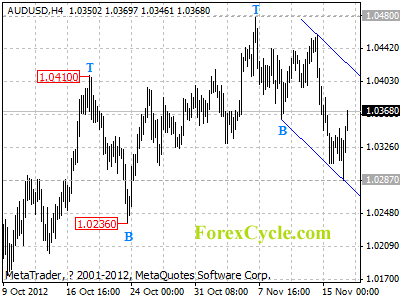
AUDUSD bounces from 1.0287

AUDUSD bounces from 1.0287, suggesting that consolidation of the downtrend from 1.0480 is underway. Key resistance is located at the upper line of the price channel on 4-hour chart, as long as the trend line resistance holds, the downtrend could be expected to resume, and another fall towards 1.0200 is still possible. However, a clear break above the channel resistance will indicate that the downtrend from 1.0480 has completed at 1.0287 already, then the following upward movement could bring price back to test 1.0480 resistance.

audusd

Forex Technical Analysis

Global supervisors aim to limit risks from shadow banking

By Central Bank News

    Shadow banking, the huge but unregulated frontier of the financial world, will soon be subject to bank-like supervision as global policymakers start to hammer out rules that reduce the chances of future crises yet still allow new creative financing models to emerge.
    The Financial Stability Board (FSB), which monitors and coordinates global financial regulation, has proposed an ambitious policy framework and recommendations that it believes are needed to “mitigate the potential systemic risks associated with shadow banking,” and expects to issue final proposals in September 2013 following industry comment.
    The term shadow banking describes the murky world of hedge funds, money market funds and investment vehicles that are often used by major banks to carry out sophisticated financial transactions.
    As these shadow legal entities do not take customer deposits, they don’t need banking licenses and are not subject to supervision.
    The 2008 global financial crises exposed the threat from shadow banking to financial stability, not just because of its vast size but because it was completely interwoven with the supervised banking system; a regulated banking system relied on unregulated entities with a razor-thin capital base.
    Global political leaders, meeting as the Group of 20, decided that the risks from shadow banking – about half the size of the normal banking system – posed too great a threat and asked the FSB to come up with policy recommendations.

    But while the risks are now obvious, it is also clear to regulators that shadow banking provides benefits. Shadow entities, for example, help channel funds from pension funds that have money to invest to those in need of funds, such as a private company.
    The challenge for the FSB, along with the Basel Committee on Banking Supervision (BCBS) and the International Organization of Securities Commissions (IOSCO), has been to devise rules that limit the risks yet retain the benefits and don’t stymie future financial innovation.
    “The objective of the FSB’s work is to ensure that shadow banking is subject to appropriate oversight and regulation to address bank-like risks to financial stability emerging outside the regular banking system while not inhibiting sustainable non-bank financing models that do not pose such risks,” the FSB said.
     The FSB’s policy recommendations come at a time when shadow banking is set to expand even more as tougher Basel III banking rules are being phased in, providing added incentive for banks to shift activities into non-regulated space.
    While off-balance sheet financial entities and various forms of securitization have been around for centuries, the current form of shadow banking first took off in the last decades as banks exploited regulatory gaps and used regulatory arbitrage to minimize cost.
   For every new rule imposed by banking supervisors, mathematical wiz-kids at investment banks quickly figured out how to circumvent the rules, a challenge the FSB was well aware of.
    “The FSB therefore believes that oversight and regulation for shadow banking must incorporate a system of “embedded vigilance” through on-going review and be capable of evolving in response to market changes,” it said.
    In addition to its policy recommendations, the FSB has created a process for monitoring the shadow banking system “so that any rapidly growing new activities that pose bank-like risks can be identified early and, where needed, those risks addressed.”
    By focusing on function and activity, rather than form or names, supervisors will in the future be able to include new legal structures or innovations that create “shadow banking risks.”
    Trying to understand the true size and reach of the shadow banking system, the FSB expanded its mapping system from the previous 2011 exercise to include 25 jurisdictions, including the entire euro area, compared with 11 jurisdictions, bringing the coverage to 86 percent of global Gross Domestic Product and 90 percent of global financial system assets.
    At a time when the traditional banking system has been shrinking, the shadow banking system has expanded by a further $5-6 trillion to $67 trillion by the end of 2011 from the previous study, the equivalent of 111 percent of the aggregate GDP of covered jurisdictions.
    The initial surge in the size of the shadow banking system took place from 2002 to 2007 when it exploded from $26 trillion to $62 trillion, when the global financial crises temporarily halted its growth.
    The mapping system showed that the United States has the largest shadow system with assets of $23 trillion, followed by the euro area’s $22 trillion and the UK’s $9 trillion.  While the U.S. share of the global system eased to 35 percent from 44 percent in 2005, the share of the UK and euro area has risen.
   Jurisdictions where shadow banking are the largest relative to GDP are Hong Kong (520 percent), Singapore (260 percent) and Switzerland (210 percent) – major international financial centres that host foreign-owned institutions.
   Among the policy tools that supervisors should be given to limit the potential damage of shadow entities, FSB recommends limits on assets concentration and leverage, capital cushions to cover potential losses, segregation of client monies from other assets, and redemption fees that would make it costly for investors to bail out during financial unrest.
    Money market funds, which provide short-term deposit funds to the banking system, suffered runs during the global financial crises that only stopped after intervention by the U.S. Treasury. Endorsing IOSCO’s findings, the FSB recommended a series of recommendations, including that money market funds should hold enough liquid assets to avoid fire sales.
    Click to read the FSB’s policy framework and recommendations.
   
    www.CentralBankNews.info

Ceasing to Be Free

In the end more than they wanted freedom, they wanted security. When the Athenians finally wanted not to give to society but for society to give to them, when the freedom they wished for was freedom from responsibility, then Athens ceased to be free.

– English historian Edward Gibbon

Dow down 58 yesterday. No panic. Just hesitation… and worry.

A TV news report this morning said that Congress had only 18 days to solve the “fiscal cliff” issue. Seems like plenty of time.

But it’s no big deal anyway. If we fall off the cliff, the feds will have to jettison a bit of their projected spending increases.

It still leaves them in spending growth mode. It still leaves the zombies with about half nation’s energy, resources and money. The other half is barely able to carry the load – especially since there are so many zombies getting in their way.

Yesterday, we noted that 22 million people had been added to the food stamp and disabled list since President Obama took first office.

At the rate the zombies are multiplying there will not be a single normal person left in the U.S. by 2052. We’ll all be riding in government-provided wheelchairs… and living on food stamps.

Cutting to the Chase

And who will pay for it?

That’s the thing about zombies: They need living flesh. In the coming Zombie Armageddon the last productive citizens will be hunted down and torn to pieces. Then what?

We don’t know. Our guess is that the entire corrupt system of robbing Peter to pay zombies will blow up long before we get to Zombie Armageddon. But we could be wrong.

And since we want to see how this all turns out, we have a proposal: Let’s “cut to the chase,” as they say in Hollywood.

At no additional cost, the feds could turn the whole population into zombies right away. Currently, the Fed is paying holders of agency mortgage-backed bonds – the money center banks – $40 billion per month. Instead of giving it to the fat-cat zombies, why not spread it around to the skinny-cat zombies?

Milton Friedman once spoke of dropping money from helicopters as the ultimate way to beat a debt trap. Why not do it? Just drop the money right into households all across the country.

Of course, we’re speaking metaphorically. There aren’t enough helicopters to pull off a trick like that.

Instead, the Fed could just give the $40 billion to the Social Security Administration. They’re good at handing out other people’s money. They could easily arrange for every family to get about $500 a month just from the Fed’s new cash. It wouldn’t cost Washington a penny, because the Fed creates its money out of thin air.

The Great QE Dud

This way the feds would avoid the blockage in the banking system. As it is, the Fed gives the banks the money. They use it to buy financial assets – notably more U.S. government bonds.

The rich get richer. The poor stay poor.

Only a little of the money ends up in consumers’ hands. So, as far as increasing demand and therefore jobs – which is the stated policy objective – QE3 and all the QEs that preceded it have been duds.

Giving the money directly to consumers, on the other hand, would produce an immediate increase in demand.

Heck, with $500 more a month you can lease a new car. You can upgrade your apartment… or go out to dinner four or five times. You can buy 50 bottles of decent Chilean wine… or 50 packs of cigarettes.

Since most of the money would go to low- and middle-income families it would almost all be spent. With a modest 1.5x multiplier, you could expect that the economy would get a jolt of about $60 billion in extra spending per month.

Since consumer spending is part of the GDP, no matter how stupid and counterproductive it is, this would boost the GDP by $720 billion per year.

Whoa! Now you’re cooking with gas. That’s an increase to GDP of about 5% – bringing the total rate of increase to about 7% per year.

Our plan has a big political advantage too. It gives money directly to the people rather than to the greedy SOBs in the 1%. It creates millions of new jobs. And it reduces the U.S. budget deficit, since the feds will collect taxes on all that additional activity.

And it puts all Americans on more or less even footing. We’ll all be zombies! And we’ll all go broke more or less at the same time as the helicopter money brings our system of fraudulent finance to grief much sooner.


Disclaimer

Article brought to you by Inside Investing Daily. Republish without charge. Required: Author attribution, links back to original content or www.insideinvestingdaily.com. Any investment contains risk. Please see our disclaimer.

Monetary Policy Week in Review – Nov. 17, 2012: Global uncertainty dominates, but domestic demand holding up

By Central Bank News

 Last week in monetary policy seven central banks decided on interest rates with Mozambique cutting its rate, Iceland raising its rate and the other five central banks (Sri Lanka, Latvia, Chile, Ghana and Jamaica) keeping rates unchanged.
   Mozambique continued its aggressive rate cutting campaign, reducing rates for the sixth time this year as inflation drops, while Iceland raised its rate for the fourth time this year as inflation and inflationary expectations remain well above the central bank’s target.
    The main message from the five banks that held rates was that uncertainty and anxiety still dominates the global economic outlook but domestic demand remains solid in most countries, helping counter weaker exports.
    Sri Lanka’s central bank had an interesting comment, saying the global economy could slow further due to the absence of pro-active leadership in the euro area. The bank also raised the prospect of a joint U.S.-euro initiative to boost growth though it didn’t reveal any details and nothing along those lines has been mentioned by other policy makers.
LAST WEEK’S (WEEK 46) MONETARY POLICY DECISIONS:

COUNTRYMSCI NEW RATEOLD RATE     1 YEAR AGO
SRI LANKAFM7.75%7.75%7.00%
ICELAND6.00%5.75%4.75%
LATVIA 2.50%2.50%3.50%
MOZAMBIQUE9.50%10.50%16.00%
CHILEEM5.00%5.00%5.25%
GHANA15.00%15.00%12.50%
JAMAICA6.25%6.25%6.25%
 NEXT WEEK (WEEK 47) five central banks are scheduled to review monetary policy, including Japan, Turkey, Nigeria, Georgia and South Africa.

COUNTRYMSCI DECISION   RATE     1 YEAR AGO
JAPANDM20-Nov0.10%0.10%
TURKEYEM20-Nov5.75%5.75%
NIGERIAFM20-Nov12.00%12.00%
GEORGIA21-Nov5.75%7.00%
SOUTH AFRICAEM22-Nov5.00%5.50%

www.CentralBankNews.info


Our Sick Culture

Our culture is terminally ill. After last week’s election, it is too late to save us.

It’s the little things that destroy nations. Let’s take the great Roman Empire as an example. Historians point to a variety of reasons for its demise.

Some folks simply say all great societies eventually mature and die. Others blame the failure on greed. Or an overzealous government. But one small group of researchers points its finger at lead. They say Rome fell because it was poisoned.

The theory has been widely discredited, but like any good conspiracy, there are still plenty of folks who blame the heavy metal. They say lead pipes, tainted pottery, lead-based sweeteners and even heavy doses of lead in popular types of wine slowly handicapped the grand society.

With each new day… Rome got dumber and dumber. Each generation was sicker than the last.

I like the folks who continue to hang on to the theory even though it is based on few facts. They understand it’s the little things that bring us down. They get the idea that great declines don’t start or end in a single day or even a decade. It takes generations to annihilate a great society.

Like I’ve written many times before… the American culture is sick. And just as with Rome’s problem with lead, the vast majority of us are ignorant to the threat around us.

Our problem is very natural. We value today more than we value tomorrow.

Few folks understand that the world’s most potent force – the power of compounding – transcends the borders of the financial world. Compounding doesn’t just turn our pennies into dollars. It turns our lies into prison terms. It transforms experimentation into addiction. And it turns laziness into failure.

Valuing today more than tomorrow is why we cheat on our spouses. It’s why we go into debt to buy a house we can’t afford. It’s why we speed down the highway when we’re in a hurry to buy a coffee.

But mostly… it is why America has failed.

Last week’s election is a great example. It proves the theory – we’ve reached the cultural tipping point.

On Tuesday, 50.6% of the nation voted for today, while 47.8% of the country voted for tomorrow.

It’s clear an Obama vote was a vote that makes today feel better. It was about giving money to the poor, striking at the rich, rescuing broken companies, and eating a hamburger today that we’ll pay for tomorrow.

A Romney vote, on the other hand, was a vote for tomorrow. If he won the office, today wouldn’t feel so nice. Fewer folks would get handouts. Companies would fail. The rich might even get richer… and the poor would get poorer. But eventually, the Romney voters knew, today would become tomorrow.

That’s what this whole fiscal cliff is about. Tomorrow is knocking at our door… and it is pissed. It wants what it’s owed. But our leaders can only think of today. After all, that’s what we just told them to do – all 50.6% of us.

Bill’s synopsis of the mess is right. Washington will turn this cliff into a waterslide. There will be a lot of screaming and yelling, but in the end we’ll all get soaked.

The problem is we’ll never dry off.

Most folks believe we’ll get soaked with a jump in taxes and a cut in government spending next year. That’s true. January is going to hurt. Wall Street has a lot of shuffling to do.

But the real pain will come later… when the power of compounding comes to get us. Just like each dose of lead made the Romans sicker, each time we push today’s problems into tomorrow, the danger increases exponentially.

Our elected leaders will find a way to push this mess under the rug. After all, all of the deadlines they face are self-imposed. This mess is entirely a political endeavor.

But that will change. Eventually the power of compounding will knock us to our knees.

It is coming. We can’t stop it. Our culture is sick and the majority of us refuse to take the medicine we need.


Disclaimer

Article brought to you by Inside Investing Daily. Republish without charge. Required: Author attribution, links back to original content or www.insideinvestingdaily.com. Any investment contains risk. Please see our disclaimer.