Beware the Bank of England: UK Economy Going Down

By MoneyMorning.com.au

There’s one book that every central banker should read. It’s not by Friedrich Hayek or John Maynard Keynes.

It’s Mary Shelley’s Frankenstein.

In it, Dr Frankenstein has the hubris to believe he can use science to short-circuit nature, and re-animate something that should be dead. The creature he creates goes on to destroy him.

The parallels are striking. Central bankers thought that their audacious experiments in monetary policy could revive dying economic models.

Now Britain is being eaten alive by the monsters they have created.

Unfortunately, we suspect that – rather like Frankenstein – this story won’t have a happy ending…

Why Zombies are Taking Over the UK Economy

It’s easy to understand why the Bank of England acted as it did after the financial crisis.

The autumn of 2008 was crazy. I’d spend my day in the office, running between my desk and the Bloomberg terminal, waiting to see which bank would collapse next.

I’d read so many politicians and City boys shrieking about meltdowns that I’d get off the train home at night and emerge blinking into the street, marvelling that all the buildings were still standing.

You can see why the Bank of England might have thought that cutting interest rates to zero seemed like a good idea.

The trouble is, every action has consequences. Britain is now crawling with zombies, reports the Financial Times.

Low interest rates and quantitative easing (QE) have delayed or prevented the process of creative destruction from taking place. As a result, firms that should have gone out of business are grimly clinging on to a twilight existence, neither bust nor solvent.

One in ten companies are only paying the interest on their debt, according to the insolvency industry’s trade body, R3. They are unable to repay any of the actual loan.

So the firm sits there consuming resources inefficiently, dragging on the UK economy. And the zombies are spreading. Their numbers have grown by 10% over the last four months.

Now R3 is hardly a disinterested observer. It’d be very good for business if someone were to come along and decapitate all these undead companies.

Yet, it’s not just R3 who believes the zombie plague is bad for business.

The Bank of England warned last week that these ‘zombie’ companies were part of the reason why the UK economy is so weak.

The trouble is, a zombie company doesn’t just take up physical space. It takes up valuable bank lending capacity too. Zombies are only just able to pay the interest on their debts. If the banking system were healthier, they’d be put out of their misery.

But as it stands, notes the FT, ‘banks are reluctant to write off those loans…because, among other things, the banks might need to raise additional capital. And because those loans to zombies remain outstanding, banks do not have enough capital to extend to new, viable companies.’

The Bank of England’s Governor Has a Sick Sense of Humour

I’ve always suspected Mervyn King of having a droll sense of humour, but this really is jet-black comedy.

It’s not that I disagree with him.

But for our central bank to complain about zombie companies cluttering up the UK economy is a bit like a James Bond baddie moaning about all the sharks in his swimming pool. Who put them there in the first place?!

Worse still, it’s not as though this plague of zombies is going to change the Bank of England’s policy. King is still trying to dismiss inflation fears and continues to talk up the prospects for more QE.

You can see why. If interest rates were to rise now, it would inflict an awful lot of pain on the UK economy. King isn’t the only one worrying that perhaps banks have been a little too forgiving.

The other day, trade magazine Money Marketing reported that one of the Financial Services Authority’s risk specialists had warned that ‘lenders may have left “hundreds of thousands” of [mortgage] borrowers in a worse position by providing forbearance when they have experienced money problems.’

The point is that if you move someone onto an interest-only loan, you may leave them in a position in the future where they have no hope of ever paying back the original capital. Better to repossess now rather than leave people hanging on as ‘zombie’ households.

Of course, this is exactly what will happen once bank balance sheets have improved enough. Everyone who found their lender nice and accommodating when it was in trouble, will get a nasty shock when its balance sheet has been healed by sufficient injections of QE. It’s only a matter of time.

Unfortunately, this has left us all in rather an unfortunate position. We’re reliant on low interest rates to get by. But the low rate cure is also killing us. One way or another, it’s going to end badly.

John Stepek
Contributing Editor, Money Morning

Publisher’s Note: This article first appeared in MoneyWeek

From the Archives…

Retirees and the Fed Face Off
16-11-2012 – Kris Sayce

Attention Investors: This Market is Worse Than it Looks
15-11-2012 – Kris Sayce

Avoid the Slaughter: Watch This Key Stock Market Pointer
14-11-2012 – Murray Dawes

Why Lithium is Another ‘Rare’ Element on China’s Radar
13-11-2012 – Dr. Alex Cowie

Who Says Gold Doesn’t Pay ‘Interest’?
12-11-2012 – Dr. Alex Cowie

Beware the Bank of England: UK Economy Going Down

2013 Economic Forecast: A US Recession Looms

By MoneyMorning.com.au

Everyone is worried about the damage the “fiscal cliff” might do to the US economy in 2013, but the reality is that’s only one of the potential problems in our 2013 US Economic Forecast.

At present there appears to be four problems – aside from the fiscal cliff – that could throw the US economy into recession in 2013.

These are international problems that include:

  • Brewing trouble in Japan: Japan faces an election next month. More importantly, its government debt is currently 230% of GDP, with that ratio rising by about 10% a year. The current government has increased sales tax in 2014, which may cause a recession and will likely push its debt to GDP ratio even higher.

    The problem is no country has ever survived a debt/GDP ratio above about 250% without defaulting. Britain did succeed with this in 1815 and 1945, but on the second occasion it relied on exchange controls, inflation, and dozy domestic investors, while on the first occasion it had a government under Lord Liverpool far more capable than anything we have seen in the last 185 years.

    The point is, if Japan gets a weak coalition after its election, the market may panic and cause a Japanese government default.

  • More Woe in Europe: The Eurozone mess continues and is getting worse rather than better. Investors are just beginning to wake up to the fact that France, by exceptionally foolish policies of fleecing the rich, has put itself in a position that may well prove worse than those of Italy or Spain.

    The Eurozone crisis is soluble – by the weak sisters leaving the euro – but this solution is unacceptable to the EU political elite, so we may get a crisis, a major default, a European banking collapse and deep recession instead.

  • Troubles in the BRICs: All four of the BRICs are reaching the end of the road in terms of economic growth. Having had the world’s money thrown at them like confetti, they have used it to grow government and reward themselves through an orgy of corruption.

    China’s problems are hidden in its banks’ balance sheets. India needs a government that does not overspend (fat chance!), as does Brazil. As for Russia, its military will soak up all its gigantic oil revenues and its leaders will embezzle any money the Western banking system is foolish enough to lend it.

    These crises will worsen in 2013. At some point they will combine into a gigantic BRIC crash, affecting the whole world economy

  • Iran, Israel, and the Middle East: Either Iran will get a nuclear weapon in 2013 or Israel will go to war to stop it. Either way, it’s bad for the world economy; the only question is how bad.

2013 US Economic Forecast

As for the fiscal cliff, the problem is that the package of “cliff” policy changes involves mostly increased taxes, so they will cause a recession of their own. That would, however, be salutary.

Since we do not currently have a banking crisis and have not levered ourselves up too far, an early recession would be fairly short and uncomplicated, and at the end of it we would more or less have solved the Federal deficit and US debt problems.

So, we should welcome this particular “problem” and hope the politicians don’t manage to avoid it. As I discussed earlier, facing the fiscal cliff would solve 77% of the deficit problem.

Should the politicians avoid the fiscal cliff, most likely by putting taxes up on high incomes while leaving most of the budget deficit in place, the short-term prognostication isn’t all that wonderful.

US economic growth has been held back in the last few years by the blizzard of regulations coming out of Washington, and there’s reason to believe there is an especially heavy storm of them coming in the next few months, having been held up before the election.

Thus, no matter much money Ben Bernanke creates, the US economy is not going back to robust growth in 2013. Creating more money will just increase inflation, and together with the continuing budget deficit will suck capital out of the US towards our creditors such as China and Japan.

In the long run, a recession is coming, like it always was. With bad policies in place worldwide, that recession will almost certainly be less painful if we get it over quickly, and don’t delay it into 2014 or later.

After all, with each year that passes under the current policies, the level of foolish investments in the financial system increases, so a delayed recession might well involve another financial crisis, like 2008 – and we’ve seen how much fun that was.

Overall, 2013 looks like a rough year for the economy. Gold and stocks in well-run emerging markets (of which there are only a few) seem to be the best safe havens.

Martin Hutchinson
Contributing Editor, Money Morning

Publisher’s Note: This article first appeared in Money Morning (USA)

From the Archives…

Retirees and the Fed Face Off
16-11-2012 – Kris Sayce

Attention Investors: This Market is Worse Than it Looks
15-11-2012 – Kris Sayce

Avoid the Slaughter: Watch This Key Stock Market Pointer
14-11-2012 – Murray Dawes

Why Lithium is Another ‘Rare’ Element on China’s Radar
13-11-2012 – Dr. Alex Cowie

Who Says Gold Doesn’t Pay ‘Interest’?
12-11-2012 – Dr. Alex Cowie


2013 Economic Forecast: A US Recession Looms

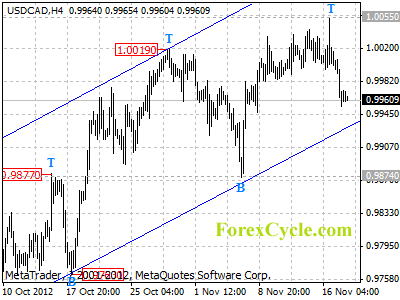
USDCAD breaks below 0.9980 support

USDCAD breaks below 0.9980 support, suggesting that a cycle top has been formed at 1.0055 on 4-hour chart. Further decline would likely be seen, and next target would be at the lower line of the price channel on 4-hour chart. As long as the channel support holds, the fall from 1.0055 could be treated as consolidation of the uptrend from 0.9632 (Sep 14 low), and one more rise towards 1.0100 is still possible after consolidation. Key support is at 0.9874, only break below this level could signal completion of the uptrend.

usdcad

Forex Technical Analysis

Why It’s Time to Pool Your Retirement Accounts

Article by Investment U

Today’s topic is a subject dear to me.

It was 15 years ago when I started in the financial services industry. During the late 1990s, 401(k)s and individual retirements accounts (IRAs) were gaining traction in the American worker’s psyche. For the most part, gone were the days of the actuary and the company’s pension plan.

Your retirement savings were now your responsibility and you needed to know the rules. And it was my job to translate IRS speak and let you know what you could, could not and probably should do.

Now, even more of you participate in these types of retirement accounts and many of you still have questions.

“One-Employer” Days Are Behind Us

The workplace environment has definitely morphed into something new. We all know that the job market has been crazy lately. But are you aware just how crazy it’s been over the last half century?

Changing jobs and careers is now the norm and not the exception, especially if you’re college-educated and born after the latter years of the Baby Boom – stemming from 1957 to 1964. According to the Bureau of Labor Statistics, men with a Bachelor’s Degree or higher held on average over 11 jobs between the ages of 18 and 46. Women on the same educational level held a little over 12 jobs during this same time.

David Wray, President of the Plan Sponsor Council of America, PSCA, has stated,

“Clearly what we have is people entering their fifties, who have three or four accounts, plus their current employer’s one…”


Leaving Money All Over the Place

No one is sure how many people are out there trying to synchronize a bunch of different 401(k)s and IRAs. From the data, we can tell that the number is sizeable.

The Bureau of Labor Statistics tells us in 2009 that nearly 17% of the 72.5 million participants in 401(k)-type retirement left their savings in their old employers’ plans.

Last year a study by Aon Hewitt showed that of all employees let go last year, the following happened:

  • 40% of the employees received a cash distribution.
  • 30% left their money in their former employer’s plan.
  • The last 30% rolled over their money to another qualified plan.

Taking a cash withdrawal from your 401(k) coupled with being under the age of 59 and a half would make you subject to a mandatory 20% withholding on the distribution. This tax obligation could be greater depending upon your tax rate.

When working in the retirement industry, one of the first questions I would ask was, “How much retirement money do you have out there?” If your money is sitting out there in some account that’s not being guided correctly, it’s a waste of your money and you’re likely losing value. Plus, retirement is goal-oriented. The planning process becomes a lot harder when you don’t know what you have and where it’s going.

Make it easy on yourself and consolidate. One of your best options may be to roll that retirement plan into an IRA.

Rolling Funds into a New or Existing IRA

If you’ve seen a number of 401(k)s, you’ll find that most have a limited number of investment options. They may have few offerings and they would specifically be categorized as an equity, bond, or money market mutual fund.

IRAs generally have cheaper costs than 401(k)s. And maybe more importantly, IRAs usually give you the ability to dabble in more of the asset class and financial instrument options we discuss here at Investment U.

Here are a few tidbits to keep in mind if you do rollover your retirement assets in an IRA.

  • You can make IRA contributions up to the April tax deadline of the following year. For example, you can make your 2012 IRA contribution up to April – whatever day the IRS marks as the deadline – 2013. The maximum contribution to your IRA this year is $5,000. For 2013, the IRS upped the max to $5,500.
  • For those investors age 50 and older, the IRS gives you the opportunity to add an extra $1,000 to your contribution limit. It’s called a catch-up provision and the limit remains unchanged from 2012. Those 50 and older can put away $6,000 in an IRA this year and another $6,500 in 2013.

… And if You Still Have a Workplace Plan in Place

Always remember that if you’re currently employed, and contributing to a new 401(k) plan, you may be able to roll old plans into your current one. But there is a chance you may not. A lot of employer sponsored retirement plans are customized and their rules depend upon the company and the underlying financial institution.

But many people have a current 401(k) and a rollover, so don’t neglect what you can do with your workplace retirement plan.

Now, let’s look at two ways you can maximize your current 401(k).

You need to max out your 401(k) plan contributions for 2012 and 2013. You can adjust your salary deferral so that you hit the max. The maximum contribution to 401(k)s for this year is $17,000. The maximum 401(k) contribution is going to go up to $17,500 next year.

Secondly, make sure you contribute enough out of your salary to get the company’s matching contribution. This is very important and it seems that many of us are not taking advantage of this option. A study last year by Fidelity found that nearly 40% of 401(k) employer matching dollars were “left on the table.” That’s basically wasting free money. There’s no way that’s a prudent investment strategy.

Good Investing,

Jason

Article by Investment U

Central Bank News Link List – Nov 19, 2012: BOJ seen defying easing calls as political pressure heats p

By Central Bank News
Here’s today’s Central Bank News link list, click through if you missed the previous link list. The list comprises news about central banks that is not covered by Central Bank News. The list is updated during the day with the latest developments so readers don’t miss any important news.)

Central Bank News Link List – Nov 19, 2012: China’s next step on yuan is convertibility, Zhou says

By Central Bank News

Here’s today’s Central Bank News link list, click through if you missed the previous link list. The list comprises news about central banks that is not covered by Central Bank News. The list is updated during the day with the latest developments so readers don’t miss any important news.)

Gold Starts Week Higher, Deal on Fiscal Cliff “Could Be Agreed Within Weeks”

London Gold Market Report
from Ben Traynor
BullionVault
Monday 19 November 2012, 07:30 EST

SPOT MARKET gold bullion prices hovered close to $1725 an ounce during this morning’s London trading, holding gains made overnight in Asia, as stocks and commodities also recovered some ground lost last week, after news that a deal may be achieved in time to avoid so-called fiscal cliff of US tax rises and spending cuts currently scheduled for the start of 2013.

Silver bullion rallied back above $32.70 an ounce, recovering Friday’s losses, while US Treasury bond prices fell along with the Dollar.

“[Silver] is still respecting its long term uptrend, [but] momentum has been very uninspiring,” says the latest technical analysis from bullion bank Scotiabank.

Congressional leaders and the White House should be able to agree a deal to avoid the fiscal cliff “within several weeks”, US Treasury Secretary Timothy Geithner said Friday.

Negotiations last week produced agreement that reforms are needed to the US tax code and to so-called ‘entitlement’ programs, press reports say.

“If the parties in the US reach agreement, that would remove uncertainty and gold’s safe haven status,” reckons Ole Hansen, head of commodity strategy at Saxo Bank.

“But the low interest rate environment is not going to go away.”

The so-called speculative net long position of Comex gold futures and options traders – measured as the difference between ‘bullish’ and ‘bearish’ contracts – rose in the week ended last Tuesday, having fallen for the previous four weeks running, weekly data published Friday by the Commodity Futures Trading Commission show.

“The positive reaction apparent in these numbers was largely due to the successful re-election of President Obama,” says Marc Ground, commodities strategist at Standard Bank.

“Participants were emboldened by the belief that an Obama win would ensure that the Fed will continue with its accommodative stance. Strong physical demand also helped sustain the upward momentum.”

The volume of gold bullion held by exchange traded funds tracked by Reuters rose to a new record last Friday, at just under 2346 tonnes. Holdings in the world’s largest gold ETF SPDR Gold Shares (GLD) also rose to a new all-time high, ending last week at 1342.6 tonnes.

Net speculative length among silver futures traders also rose last week, like gold breaking a four-week losing run.

“However, the 116.5 tonne increase of the past week appeared even more insipid than was the case for gold,” says Standard Bank’s Ground, “given that silver has seen 1,287.3 tonnes liquidated the previous four weeks.”

For commodities as a whole, Friday’s CFTC data show a six straight decline in net long positioning among managed money, the longest run of weekly falls since 2008, Bloomberg reports.

“I am not bullish on commodities,” says Martin Murenbeeld, chief economist at Canadian wealth management firm DundeeWealth.

“I don’t think we are going to see improvement in the world economy for some time as there are too many problems.”

On the currency markets the Euro rallied against the Dollar, making up most of the ground it lost last Friday.

The Yen meantime fell to its lowest level against the Dollar in seven months this morning, ahead of tomorrow’s Bank of Japan interest rate decision, following the decision by Japan’s prime minister Friday to call a general election for December 16.

The leader of the opposition Liberal Democrat Party, which is ahead in the polls, has called for the BoJ to print “unlimited Yen” and set interest rates below zero if necessary.

“Continued talk and questions over potential changes for the BoJ has weighed on the Yen,” says Audrey Childe-Freeman, head of foreign exchange strategy at BMO Capital Markets.

“It’s most unlikely the BoJ will make major changes this meeting, but the trend seems to be changing.”

Over in Europe, Bundesbank president Jens Weidmann told an audience at Euro Finance Week in Frankfurt that giving the European Central Bank supervisory powers over financial institutions could create a conflict of interest with monetary policy.

“Both areas must therefore be strictly separated,” said Weidmann.

“This separation is doable, but difficult – difficult from an organizational viewpoint and difficult from a legal viewpoint.”

Ben Traynor
BullionVault

Gold value calculator   |   Buy gold online at live prices

Editor of Gold News, the analysis and investment research site from world-leading gold ownership service BullionVault, Ben Traynor was formerly editor of the Fleet Street Letter, the UK’s longest-running investment letter. A Cambridge economics graduate, he is a professional writer and editor with a specialist interest in monetary economics. Ben writes and presents BullionVault’s weekly gold market summary on YouTube and can be found on Google+

(c) BullionVault 2012

Please Note: This article is to inform your thinking, not lead it. Only you can decide the best place for your money, and any decision you make will put your money at risk. Information or data included here may have already been overtaken by events – and must be verified elsewhere – should you choose to act on it.


Dollar Rallies amid Global Economic Fears

Source: ForexYard

The US dollar posted gains against several of its main currency rivals on Friday, as concerns regarding an economic slowdown in the euro-zone combined with speculations that the Bank of Japan will initiate a new round of monetary easing caused investors to shift their funds to safe-haven currencies. This week, news out of the US, Japan and euro-zone is forecasted to generate volatility in the marketplace. Traders will want to pay attention to today’s US Existing Home Sales, the Bank of Japan’s Monetary Policy Statement on Tuesday, a Spanish bond auction on Thursday and finally the German Ifo Business Climate on Friday.

Economic News

USD – US Home Sales Data May Lead to Dollar Volatility

Concerns that the euro-zone may slip deeper into recession, combined with expectations that the Bank of Japan will initiate a new round of monetary easing this week, led to risk aversion in the marketplace and gains for the safe-haven US dollar. Against the Swiss franc, the greenback gained more than 60 pips during the first half of the day, eventually peaking at 0.9490, before dropping back to 0.9454 where it finished out the week. The USD/JPY advanced more than 40 pips during mid-day trading to trade as high as 81.43, just below a recent 7 ½ month high. The pair closed the week at 81.31.

This week, dollar traders will want to pay attention to several potentially significant economic indicators. Today’s Existing Home Sales figure, set to be released at 15:00 GMT, may help the greenback extend its recent bullish trend if it comes in above the forecasted 4.76M. Later in the week, attention should be given to a speech from Fed Chairman Bernanke on Tuesday followed by the weekly unemployment claims figure on Wednesday. Traders will want to note that US markets will be closed on Thursday for the Thanksgiving holiday.

EUR – Greek, Spanish Worries Continue to Weigh on Euro

After posting gains during the middle of last week, the euro once again turned bearish on Friday, as concerns regarding the Greek and Spanish economies led to risk aversion in the marketplace. Specifically, investors are worried that Greece will be unable to secure a new round of badly needed bailout funds. In addition, Spain’s reluctance to request a bailout of its own has led to fears that borrowing costs in the country will remain high.

The EUR/USD fell more than 80 pips during the first part of the day on Friday, eventually trading as low as 1.2689, before bouncing back to 1.2741 where it finished out the week. The EUR/GBP dropped close to 50 pips over the course of the day before closing out the week at 0.8020.

This week, the main pieces of euro-zone news are likely to be Tuesday’s Eurogroup meetings, the German Flash Manufacturing PMI and Spanish bond auction on Thursday, and German Ifo Business Climate figure on Friday. Any increase in Spanish borrowing costs or worse than expected German data could result in the euro extending its bearish trend.

Gold – Gold Takes Slight Losses as “Fiscal Cliff” Looms

Gold saw moderate bearish movement on Friday, as concerns about the US “fiscal cliff”, when automatic spending cuts and tax increases will take place if Congress fails to reach a budget deal by the end of the year, led to uncertainties among investors. After dropping close to $10 an ounce during morning trading, eventually reaching as low as $1705.41, the precious metal was able to bounce back to $1713.42 where it finished out the week.

This week, gold traders will want to continue monitoring the negotiations between congressional leaders and President Obama aimed at avoiding the “fiscal cliff”. Any indication that a deal is closer to being reached may result in the price of gold falling. Conversely, if the negotiations remain deadlocked, risk aversion could send gold higher.

Crude Oil – Oil Prices Spike amid Increase in Middle East Violence

Investor fears that the current round of Middle East violence could disrupt oil supplies caused the price of crude to spike on Friday. The commodity shot up close to $2 a barrel during European trading, eventually reaching as high as $87.32. A slight downward correction brought prices down to $87.10 when markets closed for the weekend.

This week, traders will want to keep up to date with the latest developments in the Middle East, specifically the ongoing conflicts in Israel and Syria. Any escalation in violence is likely to result in supply side fears, which could drive oil prices up further.

Technical News

EUR/USD

In a sign that upward movement could occur in the coming days, the MACD/OsMA on the weekly chart appears close to forming a bullish cross. That being said, most other long-term technical indicators place this pair in neutral territory. Traders may want to take a wait and see approach until a clearer picture presents itself.

GBP/USD

The Bollinger Bands on the daily chart are beginning to narrow, indicating that a price shift could occur in the near future. Additionally, the MACD/OsMA on the same chart has formed a bullish cross. Opening long positions may be the smart choice for this pair.

USD/JPY

The Slow Stochastic on the weekly chart appears close to forming a bearish cross, indicating that this pair could see downward movement in the coming days. This theory is supported by the Williams Percent Range on the same chart, which has crossed into overbought territory. Opening short positions may be a wise choice for this pair.

USD/CHF

Most long-term technical indicators indicate that this pair is range trading, meaning that a definitive trend is difficult to predict at this time. Traders may want to take a wait and see approach, as a clearer picture is likely to present itself in the coming days.

The Wild Card

AUD/JPY

The Relative Strength Index on the daily chart is approaching overbought territory, indicating that a downward correction may occur in the near future. Furthermore, the same chart’s Slow Stochastic appears close to forming a bearish cross. Forex traders will want to keep an eye on these two indicators, as they may soon signal a bearish correction.

Forex Market Analysis provided by ForexYard.

© 2006 by FxYard Ltd

Disclaimer: Trading Foreign Exchange carries a high level of risk and may not be suitable for all investors. There is a possibility that you could sustain a loss of all of your investment and therefore you should not invest money that you cannot afford to lose. You should be aware of all the risks associated with Foreign Exchange trading.


An Elliott Wave Pattern that Signals the Start of Opportunity

The size of the wave will surprise most everyone

By Elliott Wave International

On Monday Oct. 8 I sat down with Elliott Wave International’s senior analyst Jeffrey Kennedy to discuss his favorite wave pattern of all: the Elliott wave diagonal.

Nico Isaac: You say if you had to pick just ONE of all 13 known Elliott wave structures to spend the rest of your technical trading life with, it would be the Elliott wave diagonal. First, tell us what the diagonal is.

Jeffrey Kennedy: The diagonal is a five-wave pattern labeled 1 through 5, in which each leg subdivides into three smaller waves: 3-3-3-3-3. Unlike motive waves, however, diagonals are the only five-wave structures in the direction of the main trend in which wave 4 almost always moves into the price territory of wave 1.

Nico: So, what makes this pattern so darn special?

Jeffrey: As you can see in the above charts, the diagonal is a terminating pattern. They can only occur in waves 5 of impulses or C-waves of corrections. This is why they’re so exciting. Diagonals precede a dramatic change in trend. And, when they end, prices tend to retrace the entire pattern, or more, and fast.

Put simply: If you see a diagonal, you know it’s soon time to “look up above” or “out below!”

Nico: Could you give us a real-world example?

Jeffrey: Sure. Let’s go back to the May 2011 Monthly Futures Junctures. In the “Featured Market” segment of that publication, I presented the following chart of cocoa that showed a complete multi-year ending diagonal wave pattern and wrote:

“Another piece of evidence that forewarns of an acceleration in recent selling is the larger operative diagonal pattern… This suggests that cocoa prices will continue this year’s sell off for many more months.”

Nico: And then what happened?

Jeffrey: Take a look at this AFTER chart: Cocoa prices sold off to a 3-year low as they were nearly cut in half — the sharp manner characteristic of post-diagonal moves:

Nico: Thank you so much for taking the time to explain the ins and outs of your favorite structure, the diagonal.


Learn the Benefits of Elliott Waves, One Pattern at a TimeElliott Wave Patterns — a new FREE educational feature from Elliott Wave International — gives you basic lessons and videos clips which explain individual patterns, their rules and guidelines. Real-life examples show you how each pattern fits into the overall wave structure.New patterns will be added periodically, so check back often. Access your free Elliott Wave Patterns feature now >>

This article was syndicated by Elliott Wave International and was originally published under the headline An Elliott Wave Pattern that Signals the Start of Opportunity. EWI is the world’s largest market forecasting firm. Its staff of full-time analysts led by Chartered Market Technician Robert Prechter provides 24-hour-a-day market analysis to institutional and private investors around the world.