Rescue the Rich!

No group of Americans had more to be grateful for over Thanksgiving than the few people at the top of the pile. Over the past four decades, their wealth has soared… thanks largely to the feds.

In 1971, President Nixon cut the last link between the dollar and gold, creating a pure paper money system. Total credit market debt in the U.S. has risen more than 30 times since then. As a percentage of GDP, debt went up from about 150% to 350%.

In very round numbers, M2 money supply — the category of money supply economists tend to look at to quantify the amount of money in circulation — went up 10 times since the early 1970s (depending on how you measure it). So did the stock market, adding about $14 trillion to the nation’s wealth.

Recklessness, Extravagance and Negligence

Who owns stocks? That’s right: the 1%… the people at the top… the rich.

And who runs these companies? The question demands a little cogitation. It seems obvious that the Fed’s credit bubble raised the tide… and along with it the rich folks’ yachts. But did it also increase executive salaries? Maybe.

The Economic Policy Institute calculates that the typical worker got a real salary increase of 5.9% over the past 30 years. But executive pay rose 127 times as much. Today, execs earn about 206 times as much as the workers.

Are executives really so much more valuable than they used to be? No one knows. But our guess is that as the feds bubbled up stock prices they also made corporate management seem much more important.

If investors thought their stocks would do no better than the economy, they probably wouldn’t have been willing to hand over to professional money managers so much of their cash.

But the prospect of 1,000% in capital gains brought recklessness, extravagance and negligence to corporate compensation. Investors were willing to pay (or at least ignore) outrageous salaries as long as they thought they were getting rich too.

A Stroke of Luck

The trouble was asset prices were not stable. Instead, they were floating on a sea of debt. And when a storm blew up in 2008-09, they began to sink.

In a matter of weeks, U.S. stocks lost about half their value. The rich looked at their balance sheets. Ouch! They had lost $7 trillion in stock value.

But that’s when they really got lucky. The feds quickly began their “Rescue the Rich” program, at a cost of more than $2 trillion. With that new tide of money rushing in, stocks went back up. The rich were saved!

Since the “recovery” began, the top 1% has captured 9 out of every 10 dollars in extra earnings. And with President Obama in the White House for another term… and Bernanke at his post at the Fed… there seems every likelihood that they’ll be about to get the other dollar over the next four years — giving them a clean sweep of all of America’s new earnings.

Yes, dear reader, the rich have never had it so good. There are only a few of them. And they get almost all the new wealth created in the country.

Of course, there are other benefits too. Rich people don’t have to depend on Obamacare or Social Security or student loans. Which is a good thing, since these programs are all running deficits and will sooner or later go broke.

Then the rich will have it even better… because they’ll be the only ones still able to afford healthcare, retirement and university educations.

Something Fishy

But what’s this? Americans used to admire people who made a lot of money. Now, they despise and distrust them.

That was part of the reason Mitt Romney couldn’t win the White House, even with so many Americans out of work. There was something fishy about a guy who had made so much money without getting his hands dirty.

And now, they don’t particularly appreciate the rest of “the rich” either. We turn to a dead economist, John Maynard Keynes, who understood how monetary debasement (the kind the Fed is practicing now) worked.

Governments can confiscate, secretly and unobserved, an important part of the wealth of their citizens. By this method they not only confiscate, but they confiscate arbitrarily; and, while the process impoverishes many, it actually enriches some.

That’s right: It enriches some…

Those to whom the system brings windfalls […] become “profiteers,” who are the object of the hatred […] as the process of wealth-getting degenerates into a gamble and a lottery.

The rich are always objects of envy. Now they’re becoming the objects of hatred too. Ordinary people figure that they must have done something wrong. How else could they have gotten so much money?

Perhaps they recall Maupassant: “Behind every great fortune is a crime.”

But today’s rich, generally, are guilty of no crime other than being in the right place at the right time. They own and run public companies at a time when the feds are pumping cash and credit into the system.

So, give thanks, you lucky SOBs.


Disclaimer

Article brought to you by Inside Investing Daily. Republish without charge. Required: Author attribution, links back to original content or www.insideinvestingdaily.com. Any investment contains risk. Please see our disclaimer.

Albania keeps rate steady, to keep policy stimulative

By Central Bank News
    Albania’s central bank kept its benchmark refinancing rate unchanged at 4.0 percent, saying  monetary conditions were appropriate to ensure that inflation meets the bank’s medium-term target and provides the necessary stimulus to support domestic demand.
    The Bank of Albania, which has cut rates three times this year for a total reduction of 75 basis points, said it expects “to maintain the stimulative nature of monetary policy in the medium term.”
    “In the presence of a stable monetary environment, anchored inflation expectations, as well as a moderate influence of foreign prices and the exchange rate, inflation is expected to remain close to the Bank of Albania’s target in the future,” the central bank said in a statement.
     Albania’s inflation rate eased to 2.4 percent inflation in October from 2.6 percent in September due to lower food prices, which make up some 70 percent of the inflation measure.
    The central bank said it expects inflationary pressures to remain contained due to moderate monetary growth rates, slow economic activity and lower world prices.
    “Domestic demand still appears weak, constrained by the lack of fiscal stimulus and the inertia of consumption and private investment,” the central bank said.
     Albania’s economy is expected to continue to expand but at a low level and below potential due to poor private consumption and investment.
    Albania’s Gross Domestic Product rose by 0.93 percent in the second quarter from the first, for an annual rate of 2.04 percent, up from an annual contraction of 0.2 percent in the first quarter.
    Albania’s central bank targets inflation of 3.0 percent, plus/minus 1 percentage point.

    www.CentralBankNews.info

Charles Sizemore on Planning for Prosperity Radio

By The Sizemore Letter

Listen to Charles Sizemore talk about the fiscal cliff, Grover Norquist, the possible break up of Spain, and the short opportunity of a lifetime in Japan with Dean Barber and Bud Kasper on Planning for Prosperity Radio.

If you cannot view the embedded media player, follow this link: Planning for Prosperity.

Related post: Japan is the Next Shoe to Drop.

SUBSCRIBE to Sizemore Insights via e-mail today.

The post Charles Sizemore on Planning for Prosperity Radio appeared first on Sizemore Insights.

Related posts:

Hungary to mull further rate cuts if inflation, risks low

By Central Bank News
    Hungary’s central bank, which cut its base rate for the fourth time this year, will consider further rate cuts if inflation continues to fall and financial markets remain confident about the country.
    Magyar Nemzeti Bank repeated last month’s statement that it expects inflation to remain well above the bank’s target this year and 2013 but then decline as the disinflationary impact of weak demand dominates and the effect of one-off price level shocks subside.
    The National Bank of Hungary expects inflation to meet its 3.0 percent target in 2014, but cautioned it is crucial that wage increases next year are consistent with productivity improvements so cost pressures can be eased and employment levels can be increased.
    Inflation in Hungary eased in October to 6.0 percent from a year-high of 6.6 percent in September due to lower fuel prices and administered prices. 
    Earlier today the central bank cut its base rate by 25 basis points to 6.0 percent and has now cut the rate by 100 basis points this year.
    “The short-term outlook for inflation improved, mostly as a result of favourable developments in non-core inflation items,” the bank said, adding that a sustained drop in Hungarian risk premia may also help the medium-term inflation outlook.
    Hungary’s economy is in recession and the central bank said there was a “substantial margin of spare capacity” that would help buffer any cost shocks.
     “Expected developments in inflation and financial markets as well as persistently weak demand warrant a lower interest rate level,” the central bank said, adding:
    “The Council will consider a further reduction in interest rates if data becoming available in the coming months confirm that the improvement in financial market sentiment continues and the medium-term outlook for inflation remains consistent with the 3 percent target.”
    Last month the central bank made a similar statement.
    The central bank said it was “crucial” that Hungary’s government and the European Union and International Monetary Fund reach an agreement following S&P’s downgrade of Hungarian debt, which could lead to an increase in the perceptions of the risk of investing in the country.
    An agreement would contribute to a decline in yields and help supporting lending and improve the investment climate.
    Hungary’s economy is first expected to grow in 2013 as export markets recover but the central bank expects output to remain “persistently below its potential level and the labour market will remain loose.”
    Hungary’s Gross Domestic Product contracted by 0.2 percent in the third quarter from the second, the third monthly contraction in a row, for an annual decline of 1.5 percent, up from an annual shrinkage of 1.3 percent in the second quarter.

Email Newsletter

TOP STORIES:

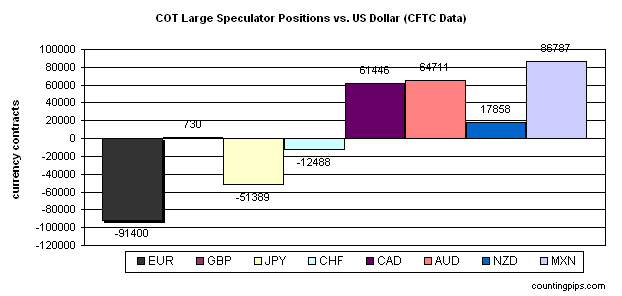
Currency Speculators bet in favor of US Dollar for 5th straight week. Euro positions fall for 5th week

November 27, 2012 – Non-commercial large futures traders, including hedge funds and large speculators, raised their total US dollar long position to a total of $11.2 billion on November 20th from a total long position of $4.72 billion on November 13th…

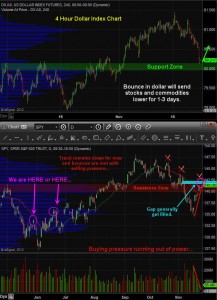
US Dollar tells us Stocks are Likely to Pullback – Simple Analysis

November 26, 2012 – Trading with the trend is not always an easy task. It is human nature to predict and jump to conclusions and usually it’s better to trade with the trend no matter what your emotions are telling you. The current trend is down…


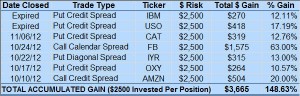
Implied Volatility Crush in AAPL Can Lead to Profits

The recent massive sell off in AAPL stock has presented some interesting opportunities for low risk trades. For long time readers of this column, you may recognize that my portfolio usually contains an AAPL position…


Shale Gas Will be the Next Bubble to Pop – An Interview with Arthur Berman

The “shale revolution” has been grabbing a great deal of headlines for some time now. A favourite topic of investors, sector commentators and analysts – many of whom claim we are about to enter a new energy era with cheap and abundant shale gas leading the charge…


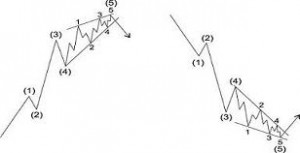
An Elliott Wave Pattern that Signals the Start of Opportunity

The diagonal is a five-wave pattern labeled 1 through 5, in which each leg subdivides into three smaller waves: 3-3-3-3-3. Unlike motive waves, however, diagonals are the only five-wave structures in the direction of the main trend in which wave 4 almost always moves…


 TODAY’S HEADLINES:


Loonie Drops as Carney is Appointed BOE Governor

By TraderVox.com

Tradervox.com (Dublin) – The loonie has dropped from two weeks high against the greenback as the Bank of Canada Governor Mark Carney was appointed to head Bank of England starting July next year. This has sparked speculation over his replacement in Ottawa. The Canadian currency weakened investors went for safety amid concerns that Europe is struggling with the debt crisis. Risk appetite waned as budget deadlock is expected to push US economy into recession. The loonie also dropped as crude oil and stocks fell. According to UK Finance Minister Jim Flaherty, the government is preparing a special committee to recruit Carney’s replacement.

According to Camilla Sutton, who is a Toronto-based currency strategist at Bank of Nova Scotia, Carney’s appointment as the Bank of England Governor creates tremendous uncertainty for Canada. This is due to the fact that nobody knows who will replace him at the BOC. He suggested that the Canadian dollar will weaken off in the near future as such uncertainty takes its toll.

After the news of Carney’s appointment, the implied volatility gauge for 3-month options on greenback against the loonie dropped to 5.6425 percent, the lowest it has been since May 2001. The gauge then rose to 5.8675 percent.  According to Joseph Trevisani, the New Jersey Based market strategist at World Wide Markets Ltd, such volatility is expected to continue in the near future. He noted that there are too many things that can happen over the next three months that will push the Canadian dollar in one way or another.

Mark Carney will be the first foreigner to take charge of the Bank of England since its inception 318 years ago. Peter Gorra, a dealer for BNP Paribas SA in New York suggested that his move to BOE will hurt the Canadian dollar in the long-term but in the short term the dollar-loonie pair may remain at parity level.

The Canadian dollar dropped by 0.3 percent against the dollar to trade at 99.60 cents per dollar.

Disclaimer
Tradervox.com is not giving advice nor is qualified or licensed to provide financial advice. You must seek guidance from your personal advisors before acting on this information. While we try to ensure that all of the information provided on this website is kept up-to-date and accurate we accept no responsibility for any use made of the information provided. Opinions expressed at Tradervox.com are those of the individual authors and do not necessarily represent the opinion of Tradervox.com or its management. 

Article provided by TraderVox.com
Tradervox.com is a Forex News Portal that provides real-time news and analysis relating to the Currency Markets.
News and analysis are produced throughout the day by our in-house staff.
Follow us on twitter: www.twitter.com/tradervox

Comex Options Expiry “Could See Gold Push to $1800”, Markets “Unimpressed” with “Very Ambitious” Greek Debt Deal

London Gold Market Report
from Ben Traynor
BullionVault
Tuesday 27 November 2012, 07:30 EST

THE DOLLAR gold price fell below $1750 an ounce Tuesday morning, though it remained near to where it started the week, as stock markets recovered yesterday’s losses following news of a deal on Greece’s debt burden.

“We continue to be bullish so long as gold holds above the $1705 low from mid-November,” says the latest technical analysis from Scotia Mocatta.

Over in New York, the difference between bullish and bearish contracts held by Comex gold futures and options traders, the so-called speculative net long, rose for the second week running in the week ended last Tuesday, data published last night by the Commodity Futures Trading Commission show.

“Based on the rally across metals last week, that speculative length is most likely to have picked up substantially [since last Tuesday],” says Standard Bank commodities strategist Walter de Wet.
Comex gold options expire later on Tuesday.

“For calls, the bulk of open interest [OI] rests at the $1800 strike, with more than 3.2 million ounces,” says a note from UBS.

“With OI so high, could today be the day that gold gravitates closer to the much coveted $1800 level?”

Over in India, traditionally the world’s biggest source of private gold demand, the Rupee regained some ground against the Dollar Tuesday, but remained near two-month lows, with Rupee gold prices near two-month highs.

“There are no [gold] buyers at these levels,” says Mayank Khemka, managing director at New Delhi bullion wholesaler Khemka Group.

“There are a few investors who are selling and booking profits.”

Silver meantime also edged lower this morning, though it remained above $34 an ounce, as other industrial commodities were broadly flat.

Eurozone finance ministers agreed early on Tuesday to amend the timetable for reducing Greece’s debt-to-GDP ratio. Greece is now expected to bring the ratio down to 124% by 2020, up from the previous target of 120%. An additional target of “substantially lower than 110%” has been set for 2022, while by 2016 Greece should aim for an interim target of 175%.

International Monetary Fund chief Christine Lagarde called previously for there to be no movement in the deadline or target, arguing that instead Greece’s debt burden should be reduced by imposing further losses on creditors.

In addition, a Eurogroup statement referred to the possibility of Greece buying back some of its debt currently trading below par value, a measure Germany has advocated.

“If this is the route chosen,” the statement said, “any tender or exchange prices are expected to be no higher than those at the close on Friday 23 November 2012.”

The deal also included a possible reduction of the interest rate Greece pays on bailout loans, as well as a 10 year suspension of such payments, although these measures are subject to how much progress is made on reforms.

“The Eurogroup expects to be in a position to formally decide on the disbursement [of Greece’s next tranche of bailout funding] by 13 December,” the Eurogroup statement said.

On the currency markets the Euro edged lower against the Dollar Tuesday morning, as gold and silver also eased slightly in Dollar terms.

“Gold does not appear to be particularly impressed by last night’s agreement,” says this morning’s commodities note from Commerzbank.

“The budget balance and economic growth targets set in the program are very ambitious, and it is questionable whether they will actually be achieved. If not, the Greek debt problems could return to the spotlight more quickly than anticipated.”

Greece’s economy will shrink by 4.5% next year, following a contraction of 6.3% in 2012, according to the latest Economic Outlook published by the Organisation for Economic Cooperation and Development Tuesday.

“The monetary policy stance should be further eased in many economies,” the OECD report says.
“Additional easing is required in the Euro area, Japan and some emerging market economies, including China and India… excessive near-term fiscal consolidation should be avoided.”

The OECD has cut its growth forecasts for the UK, predicting a 0.1% contraction for 2012, followed by growth of 0.9% next year – down from 1.9% forecast back in May.

The second estimate of third quarter UK GDP published this morning confirmed the UK economy grew at 1.0% between July and September.

Britain’s chancellor George Osborne meantime unveiled his choice of successor to Mervyn King as Bank of England governor Monday. Osborne has appointed current Bank of Canada governor Mark Carney, describing him as “the best for Britain”. Carney will take over the role next July.

Ben Traynor
BullionVault

Gold value calculator   |   Buy gold online at live prices

Editor of Gold News, the analysis and investment research site from world-leading gold ownership service BullionVault, Ben Traynor was formerly editor of the Fleet Street Letter, the UK’s longest-running investment letter. A Cambridge economics graduate, he is a professional writer and editor with a specialist interest in monetary economics. Ben writes and presents BullionVault’s weekly gold market summary on YouTube and can be found on Google+

(c) BullionVault 2012

Please Note: This article is to inform your thinking, not lead it. Only you can decide the best place for your money, and any decision you make will put your money at risk. Information or data included here may have already been overtaken by events – and must be verified elsewhere – should you choose to act on it.


Hungary cuts base rate by 25 bps to 6.0%

By Central Bank News
    Hungary’s central bank cut its base rate by 25 basis points to 6.00 percent, as widely expected, but gave no further details in its statement.
    Magyar Nemzeti Bank, the National Bank of Hungary, has now cut its base rate by 100 basis points this year.
    Hungary’s Gross Domestic Product contracted by 0.2 percent in the third quarter from the second, the third monthly contraction in a row, for an annual decline of 1.5 percent, up from an annual shrinkage of 1.3 percent in the second quarter.
    Inflation eased to 6.0 percent in October from a 2012 high of 6.6 percent in September, but still twice the bank’s target of 3.0 percent.

    www.CentralBankNews.info

Central Bank News Link List – Nov 27, 2012: OECD cuts global economic forecasts over euro zone risks

By Central Bank News
Here’s today’s Central Bank News link list, click through if you missed the previous link list. The list comprises news about central banks that is not covered by Central Bank News. The list is updated during the day with the latest developments so readers don’t miss any important news.)

US News Expected to Impact Marketplace Today

Source: ForexYard

The marketplace was relatively quiet throughout the European session yesterday, as cautious investors were hesitant to open new positions during a meeting of euro-zone finance ministers discussing a new round of bailout funds for Greece. Furthermore, a lack of progress in negotiations with regards to the US “fiscal cliff” created uncertainty in the current state of the global economy. Today, the US Core Durable Goods Orders and CB Consumer Confidence figures are forecasted to generate market volatility, with any disappointing data likely to weigh down on the US dollar vs. the safe-haven Japanese yen.

Economic News

USD – Dollar May Come Under Additional Pressure Today

The USD/JPY turned bearish yesterday, as concerns regarding the upcoming “fiscal cliff”, a series of automatic spending cuts and tax increases scheduled to take place at the end of the year if Congressional leaders fail to reach a budget agreement, weighed down on the dollar. The pair fell more than 30 pips during the morning session, eventually trading as low as 81.91, before bouncing back to the 82.15 level. The dollar saw little movement against its higher-yielding currency rivals yesterday, as investors spent the day waiting for news regarding a new round of Greek bailout funds.

Turning to today, in addition to developments in the “fiscal cliff” negotiations, dollar traders will want to note several pieces of US news. Both the Core Durable Goods Orders and CB Consumer Confidence figures, scheduled to be released at 13:30 and 15:00 GMT respectively, may cause the greenback to fall against the yen if they come in below their forecasted values. Additionally, traders should pay attention to a speech from Fed Chairman Bernanke at 13:30. If the Fed Chairman’s speech indicates any kind of slowing down in the US economic recovery, the dollar could take losses as a result.

EUR – Euro Trades Flat to Start off Week

The euro saw little movement against virtually all of its main currency rivals during European trading yesterday, as investors were largely hesitant to open new positions before knowing whether a Greek bailout package was approved by EU finance ministers. While the EUR/JPY fell more than 50 pips during early morning trading, eventually trading as low as 106.06, the pair was quickly able to recover and spent most of the day around 106.50. Against the US dollar, the common currency spent nearly the entire day trading around 1.2960.

Today, the euro is likely to see significantly more volatility then yesterday, following the release of a batch of US data. If any of the news indicates progress in the global economic recovery, investors may shift their funds to riskier assets, which would likely help the euro against the safe-haven yen during afternoon trading. Tomorrow, traders will not want to forget to pay attention to an Italian debt auction. Any decrease in Italian borrowing costs could help the euro against its main currency rivals.

Gold – Gold Begins Week at 5-Week High

Gold prices saw little movement during the European session yesterday, as investors chose to wait for any news regarding a new round of Greek bailout funds before opening fresh positions. Still, the precious metal was able to hold onto virtually all of its gains from last Friday, and spent the day trading around $1750 an ounce, a five-week high.

Today, US news is forecasted to impact gold prices. In addition to several potentially significant indicators set to be released during afternoon trading, gold traders will want to continue monitoring the ongoing “fiscal cliff” negotiations between Congressional leaders. If the negotiations remain stalled, risk aversion could lead to additional gains for gold.

Crude Oil – US News Set to Impact Oil Prices Today

The price of crude oil took moderate losses during the European session yesterday, as a lack of progress in negotiations among US Congressional leaders regarding upcoming automatic spending cuts and tax increases, led to fears that demand for oil could drop. The price of crude fell more than $0.50 a barrel, eventually reaching as low as $87.33 toward the end of the day.

Turning to today, oil traders will want to pay attention to a batch of US news, specifically the Core Durable Goods Orders and CB Consumer Confidence figures. If either indicator comes in below expectations, investors may take the news as a sign that demand for oil in the US will drop, which would weigh down on prices during afternoon trading.

Technical News

EUR/USD

The Stochastic Slow on the daily chart is forming a bearish cross, indicating that a downward correction could occur in the near future. Additionally, the Williams Percent Range on the same chart has crossed into overbought territory. Opening short positions may be a wise choice for this pair.

GBP/USD

The Bollinger Bands on the weekly chart are beginning to narrow, signaling that this pair could see a price shift in the coming days. Furthermore, the MACD/OsMA on the same chart has formed a bearish cross, indicating that the price shift could be bearish. Opening short positions may be the smart choice for this pair.

USD/JPY

The Relative Strength Index on the weekly chart is approaching the overbought zone, signaling that this pair could see a downward correction in the coming days. This theory is supported by the same chart’s Williams Percent Range, which has crossed above the -20 line. Going short may be the wise choice for this pair.

USD/CHF

While the weekly chart’s Williams Percent Range has crossed into the oversold zone, most other long-term technical indicators place this pair in neutral territory. Traders may want to take a wait and see approach, as a clearer picture is likely to present itself in the near future.

The Wild Card

USD/NOK

The Relative Strength Index on the daily chart is approaching the oversold zone, indicating that an upward correction could occur in the near future. Additionally, the Slow Stochastic on the same chart is close to forming a bullish cross. This may be a good time for forex traders to open long positions ahead of possible upward movement.

Forex Market Analysis provided by ForexYard.

© 2006 by FxYard Ltd

Disclaimer: Trading Foreign Exchange carries a high level of risk and may not be suitable for all investors. There is a possibility that you could sustain a loss of all of your investment and therefore you should not invest money that you cannot afford to lose. You should be aware of all the risks associated with Foreign Exchange trading.