Markel Indicates Debt Write-off is a Possibility

By TraderVox.com

Tradervox.com (Dublin) – Angela Markel, the German Chancellor, has indicated that she is open to the possibility that Germany may accept a proposal to write-off Greek debt. The policy makers in the euro area met last week to discuss buyback measures that are crucial for the Greek government to receive more funding. The meeting which agreed on lenient terms for the country had indicated that the Greece government had done a lot to secure the funding.

Merkel signaled that the euro leaders are considering writing off debt once the country has a budget surplus. She added that if Greece comes to a point where it relies on its own revenue and does not have to borrow, the leaders would have to reevaluate the situation once again. However, she noted that this will not happen in the coming three years according to the plan that is laid out. According to Carsten Brzeski, a Brussels-based economist at ING Group, Merkel’s remarks shows openness that marks “the end of denial.” He indicated that while this marks a remarkable shift, it is also very obvious, hence making her remarks expected.

European finance ministers agreed last week to give Greece more time to meet its debt targets which has alleviated the situation in euro area. The Spanish bonds made the third monthly gain in a row, with yields declining last week from 5.6 percent to 5.3 percent. The 17-nation currency climbed by 2 percent in two weeks. The Greek buyback measures, which will be financed from an earmarked 10 billion euros from the current rescue package, is at the center of the proposed measures in scaling back Greek debt load to sustainable levels.

According to Wolfgang Schaeuble, the German finance minister, the complex buyback measure accounts for eleven percentage points of the drop from 144 percent of Greece debt, if the measures were not introduced, to 124 percent set by the finance ministers.

Disclaimer
Tradervox.com is not giving advice nor is qualified or licensed to provide financial advice. You must seek guidance from your personal advisors before acting on this information. While we try to ensure that all of the information provided on this website is kept up-to-date and accurate we accept no responsibility for any use made of the information provided. Opinions expressed at Tradervox.com are those of the individual authors and do not necessarily represent the opinion of Tradervox.com or its management. 

Article provided by TraderVox.com
Tradervox.com is a Forex News Portal that provides real-time news and analysis relating to the Currency Markets.
News and analysis are produced throughout the day by our in-house staff.
Follow us on twitter: www.twitter.com/tradervox

Market Trends 4.12.12

Source: ForexYard

printprofile

Hey Everyone,

Below are some market trends for today.

Good luck!

-Dan

Gold- May see upward movement today
Support- 1696.15
Resistance- 1719.45

Silver- May see upward movement today
Support- 32.88
Resistance- 33.83

Crude Oil- May see upward movement today
Support- 87.86
Resistance- 90.30

Dax 30- May see downward movement today
Support- 7233.21
Resistance- 7547.00

EUR/USD May see upward movement today
Support- 1.2952
Resistance- 1.3129

Read more forex news on our forex blog

Forex Market Analysis provided by ForexYard.

© 2006 by FxYard Ltd

Disclaimer: Trading Foreign Exchange carries a high level of risk and may not be suitable for all investors. There is a possibility that you could sustain a loss of all of your investment and therefore you should not invest money that you cannot afford to lose. You should be aware of all the risks associated with Foreign Exchange trading.

Market Review 04.12.12

Source: ForexYard

printprofile

The price of gold fell below $1700 an ounce last night, its lowest point in a month, as concerns over a lack of progress in budget negotiations among US Congressional leaders weighed down on commodities. After dropping more than $18 an ounce, the precious metal was able to stage a slight recovery and is currently trading at $1707.

The ongoing deadlock over US budget negotiations also resulted in the USD/JPY falling close to 30 pips during Asian trading. The pair is currently at 81.92.

Meanwhile, news that Greece is closer to receiving a new round of bailout funds helped the euro continue its advance vs. the USD last night. The common currency gained some 25 pips, and is currently trading at the 1.3060 level.

Main News for Today

Canadian Overnight Rate/BOC Rate Statement- 14:00 GMT
• The Canadian dollar has seen gains against both the euro and USD in recent days
• If today’s BOC statement indicates economic growth in Canada, the CAD could extend its recent gains

Read more forex news on our forex blog

Forex Market Analysis provided by ForexYard.

© 2006 by FxYard Ltd

Disclaimer: Trading Foreign Exchange carries a high level of risk and may not be suitable for all investors. There is a possibility that you could sustain a loss of all of your investment and therefore you should not invest money that you cannot afford to lose. You should be aware of all the risks associated with Foreign Exchange trading.

China Expected to Meet Growth Target as Manufacturing Sector Gains

By TraderVox.com

Tradervox.com (Dublin) – China is expected to maintain an annual economic growth rate of 7.5 percent next year as speculation the leadership of Xi Jinping will not tolerate slower growth rate. The 7.5 percent growth rate is the lowest goal that has been set by the country since 2004. This comes as a boost to the Australian and New Zealand dollars which are the biggest trading partners for China.

According to survey of world economists, most of them expect the Chinese government to keep its target unchanged in 2013. Top economic officials in the country are meeting this month to draft policies that will guide the nation in 2013. The decisions that will be set will be announced in March during the annual session of parliament. Economists have indicated that the 7.5 percent target signals the Xi and Li Keqiang are prepared to expand monetary easing if China economic recovery fails to bring the required results. The sentiments came after a gauge of manufacturing rose to the highest in seven months in November according to the data released on December 1. This signals that growth has rebounded from three-year low.

According to Li Miaoxian, an economist in Beijing at Bocom International Holdings Co, which is an investment banking unit of the Bank of Communications Co, indicated that the manufacturing gauge sends a clear signal from the new leadership that they are willing to do everything to keep economic growth stable. He indicated that changing the target to seven percent would be too low and would cause the market to worry.

China, which is the largest trading partner for Australia and the second largest for New Zealand affect those countries’ currency strength. The improved growth in manufacturing sector has boosted the demand for commodity related currencies. Li said the policy makers in China will ensure a target of 7.5 percent which might lead to increased growth above 8 percent.

Disclaimer
Tradervox.com is not giving advice nor is qualified or licensed to provide financial advice. You must seek guidance from your personal advisors before acting on this information. While we try to ensure that all of the information provided on this website is kept up-to-date and accurate we accept no responsibility for any use made of the information provided. Opinions expressed at Tradervox.com are those of the individual authors and do not necessarily represent the opinion of Tradervox.com or its management. 

Article provided by TraderVox.com
Tradervox.com is a Forex News Portal that provides real-time news and analysis relating to the Currency Markets.
News and analysis are produced throughout the day by our in-house staff.
Follow us on twitter: www.twitter.com/tradervox

Malawi ups rate 400 bps to stabilize kwacha, stem inflation

By Central Bank News
    The central bank of Malawi raised its benchmark bank rate by 400 basis points to 25.0 percent in an “urgent need to stabilize the Kwacha and in order to anchor inflation expectations.”
    The Reserve Bank of Malawi added in a statement that the bank rate was now in line with developments in both non-food inflation and the Treasury bill yield, an important indicator of market expectations.
    Malawi’s central bank, which has now raised rates by 1200 basis points this year, said the risks to the financial system were heightened due to the deteriorating macroeconomic environment and some banks continued to face liquidity problems in October and relied on the central bank’s discount window to make up for their liquidity shortfalls.
    Foreign exchange reserves have also been falling since July and stood at USD142.7 million, or about 0.8 months of import cover, as of end-October. The central bank has been supporting the foreign exchange market through sales of USD258.4 million between May and October.
    Malawi’s inflation rate rose to 30.6 percent in October, up from 28.3 percent in September and up from 9.8 percent at the start of the year. Food price increases account for 83.4 percent of the increase in the inflation rate.

    “Reflecting the decreasing foreign exchange reserves and the increasing inflationary expectations, the Kwacha continued to depreciate faster than anticipated,” the Reserve Bank said.
    The average Treasury bill yield rose to 22.0 percent from 21.34 percent, with the average yield on the 364 days tenor at 24.62 percent in October, way above the 21 percent policy rate, the bank said.

    www.CentralBankNews.info

Australia cuts rate 25 bps, says AUD higher than expected

By Central Bank News
    The Australian central bank cut its benchmark cash rate by 25 basis points to 3.00 percent, as expected by most economists, saying it was appropriate to ease the policy stance further now to help foster sustainable growth in demand and attain inflation that is consistent with the bank’s target.
    The Reserve Bank of Australia said its previous rate cuts were starting to have some of the expected effects on economic activity “though the exchange rate remains higher than might have been expected, given the observed decline in export prices and the weaker global outlook.”
    The Reserve Bank said the full effect of its earlier rate cuts – the bank has cut rates by 175 basis points since September 2011 – are yet to be observed but a return to the very strong growth rates in private consumption is unlikely and investment outside the resources sector is expected to remain relatively subdued while public spending is forecast to be constrained.
    Economic growth in Australia has still been running close to trend, led by strong capital spending in the resources sector, but “looking ahead, recent data confirm that the peak in resource investment is approaching,” the Reserve Bank said in a statement, quoting Governor Glenn Stevens.

    It added that risks to the global economic outlook were still on the downside, largely due to Europe’s debt crises but also due to uncertainty over the course of U.S. fiscal policy.
    Australia’s Gross Domestic Product expanded by 0.6 percent in the second quarter from the first for a n annual growth rate of 3.7 percent, down from 4.3 percent.
    Inflation is expected to rise above the bank’s target over the next couple of quarters due to an introduction of carbon taxes but inflation should then remain consistent with the bank’s target over the next one to two years. In the third quarter, the inflation rate rose to 2 percent from 1.2 percent.
    The Reserve Bank targets inflation of 1-3 percent.
    Last month the Reserve Bank surprised most observers by keeping rates steady, saying the outlook for the global economy was looking a bit more positive.
    But since then it has cut its growth forecast due to a slowdown in investment by mining companies.

The bank expects average growth of 3.0 percent for the fiscal year that ends in June, down from the 3-3.5 percent it forecast in August.
   Last month the Organisation for Economic Co-operation and Development (OECD) forecast that the Reserve Bank would cut its cash rate in December and then early next year, and then keep the rate at an all-time low through 2014.
   The OECD expects Australia’s economy to grow by 3.7 per cent this year, 3 per cent next year and 3.2 per cent in 2014.

    www.CentralBankNews.info

Is There Any Good News to Come from the US Debt Crisis?

By MoneyMorning.com.au

Cast your mind back to mid-2011.

The US debt level had blown out so badly that it reached the debt ceiling.

The US Government legally couldn’t borrow beyond this level. In other words, the US government credit card was well and truly maxed out.

Endless months of negotiation concluded with a deal that allowed the US government a lazy $900 billion extra credit (terms and conditions apply), which took the limit up to $15.194 trillion.

What happened next was where things got really messy.


Then on the back of all this, in early August 2011 Standard & Poor’s ‘rating agency’ downgraded US debt for the first time ever.

Markets crashed.

Stocks had their most volatile week since the 2008 financial crisis, with the Dow Jones Index falling 5.6% in a single day. The ASX200 fell to its low point for the year. And within weeks, gold soared from US$1600 to set a new record high of US$1920.

With the US government just weeks away from reaching the US debt ceiling again, could all this be set to repeat?

A Typical Political Solution to a Debt Problem

It seems to me that in the midst of all the Fiscal Cliff media coverage, the potential for a re-run of 2011′s debt-ceiling car-crash has been lost in the wash.

But fear not! Everything is going to be ok. Boy wonder, Timothy Geithner – the United States Secretary of the Treasury – has a solution.

Seeing as how it couldn’t possibly be the US government’s profligate spending that is the problem…he has decided it’s the debt ceiling that’s the problem.

So he’s come up with a bold new solution – to get rid of the thing.

OK. It’s not quite that simple I admit, but the net result is probably the same. His proposal is more of a shift in power from Congress to the President in determining the debt ceiling. In Geithner’s press conference he said (with my emphasis),


‘The president could request a debt-ceiling increase and Congress could disapprove it; the president could then veto the disapproval, and Congress could attempt to override the veto.’

Without going into too much detail, the short story is that if Geithner gets his way, the President will have the upper hand. Raising the debt ceiling will be a breeze after that.

Put another way, the fat-man would have the keys to the cake cupboard.

For decades, the debt ceiling was a mundane political issue. It would barely merit a mention. But that has changed in recent years. As the chart below shows, Congress has raised the debt ceiling 13 times since 2001, more than doubling the ceiling.

That includes a further increase of $1.2 trillion in early 2012.

So why has it become such a political issue? For one thing the US is the only country (other than Denmark) that has a legislated debt ceiling that, for now, needs government action to increase.

But more importantly, it is a huge issue because US debt is completely out of control. The chart has gone parabolic.

US debt levels – from $6 trillion to 16 trillion in just 10 years

US debt levels - from $6 trillion to 16 trillion in just 10 years

Source: decoded science

This incredible rise in the last ten years has taken the size of the US debt, relative to the US GDP, from 56.1% in 2002 – to above 100% now.

When the total debt level exceeds the size of the country’s economy – something has gone seriously wrong.

And now Geithner wants to clear the way for the President to enact future increases to the debt ceiling. If they get this one past Congress, what would stop Obama from pushing the ceiling from $16.4 trillion straight up to $22 trillion? Or more?

That would stop him having to worry about such mundane tasks as having to, you know…balance the country’s books for the rest of his second term.

The Democrats want to set this up as part of the Fiscal Cliff talks. It’s worth listening out for news on this amongst the general Fiscal Cliff banter.

Back Precious Metals and Growth Assets

Should they get it over the line, it would be enormously bullish for precious metals, and potentially for other growth assets. That’s something Kris Sayce is banking on, as he now has more open stock recommendations than at any point in more than two years.

Gold prices have been closely correlated to the US debt level, and where the debt ceiling goes, the debt level follows. Silver moves with US debt levels as well, though not quite as closely as gold. This is certainly not the only reason to own precious metals, but could be a strong short term driver.

We still need to hear which way things will turn in the fiscal cliff debate. But the stock markets and growth assets would certainly breathe a sigh of relief to get rid of the constant overhang of the debt ceiling. Even if it means the US gets even more hopelessly into debt.

Dr Alex Cowie
Editor, Diggers & Drillers

From the Port Phillip Publishing Library

Special Report: The Big Money Secret of Ironstone Mountain

Daily Reckoning:
The Frontier Way

Money Morning:
Buy Small Caps Now While Investors Are Crying

Pursuit of Happiness:
What if Climate Change Was a Lie?

Diggers and Drillers:
How You Can Use a Bottomed-Out Silver Price to Quadruple Your Returns
Australian Small-Cap Investigator:


Is There Any Good News to Come from the US Debt Crisis?

Financial Repression All Over Again

By MoneyMorning.com.au

Hedge funds that trade in the debt markets ‘have never had it so good’, as Henny Sender noted in the FT last week.

Financial conditions are as loose today as they were in 2007. That’s what Ben Bernanke himself said in a speech last month. As a result, companies are piling into the market to borrow money, and investors are lapping up their debt.


About the same amount of high-yield bonds (‘junk’ bonds) have been issued this year as in 2007. And according to JP Morgan, more of these high-risk loans are being dished out with fewer conditions than ever before. Companies are also borrowing cheap money to fund payment of dividends.

In other words, the Fed’s quantitative easing (QE) policy is working. By printing money to buy government bonds (Treasuries, as they’re known in the US), the Fed has driven down interest rates on US Treasuries. It’s also been buying mortgage debt.

As a result, those who want to make any money in the markets, are being pushed further out the ‘risk curve’, as the jargon would have it. What this means is that they are buying ever-dodgier investments in a desperate hunt for returns.

As James Montier of GMO puts it: ‘Bernanke’s first commandment to investors goes something like this: Go forth and speculate. I don’t care what you do as long as you do something irresponsible.’

There are lots of downsides to this. Not least of all, prices now don’t reflect risk ‘at all’, as Sender notes. ‘Should Philippine government debt really be yielding 3.6%?’ she asks.

This mispricing of risk is exactly what happened before the big bust in 2008. So what happens next?

What Does this Mean for Investors?

That depends. How long can the Fed maintain this policy of ‘financial repression‘?

Financial repression is a strategy for buying time while you heal the underlying problems with your economy. You try to stop the whole thing from having a cataclysmic crash, while allowing bursts of inflation to erode your debts.

It’s basically a massive tax on savers of all kinds. As Sender notes: ‘households cannot earn anything on their savings, pension funds are badly underfunded and insurers cannot generate enough investment income.’

But it’s not an easy tightrope to walk. As Scott A Mather pointed out in a piece for bond fund manager Pimco last year, the danger is that alongside financial repression, you get: ‘asset booms / busts, uncontrollable bouts of inflation, sudden stops in economic activity from loss of confidence, or capital flight.’

Moreover, financial repression might not work as well now as it did following World War II, simply because growth prospects in the developed world aren’t as good as they were then.

So plenty can go wrong. This all sounds very depressing. How do you cope with it as an investor?

Well, the good news is that the answer is the same as it usually is: buy stuff that’s cheap and avoid stuff that’s expensive. Bonds in general are too expensive, as we can see pretty clearly from the above examples. Because of this, you run too much risk of losing money in real terms if you invest in bonds today.

What about stocks? As Montier puts it, GMO ‘don’t like stocks as an asset class compared to what we think fair value should be. However, the alternatives are generally really awful.’

The key is to realise that all along this financial repression tightrope, the markets are still going to ‘swing between irrational exuberance and the depths of despair.’

So if you can buy assets when markets are unfairly neglecting them, and sell them when they are over-priced, you should still be able to make a decent return after inflation.

John Stepek
Contributing Editor, Money Morning

Publisher’s Note: This is an edited version of an article that originally appeared in MoneyWeek

From the Archives…

Now it’s the Turn of These Small-Cap Stocks to Rally…
31-11-2012 – Callum Newman

Why It’s Possible to Buy AND Sell This Market
30-11-2012 – Kris Sayce

William Knox D’Arcy: The Greatest Australian You’ve Never Heard Of
30-11-2012 – Callum Newman

Why I’m Bullish on These Beaten-Down Stocks
28-11-2012 – Kris Sayce

Natural Gas to Rule the World
27-11-2012 – Dr. Alex Cowie


Financial Repression All Over Again

AUDUSD stays in a downward price channel

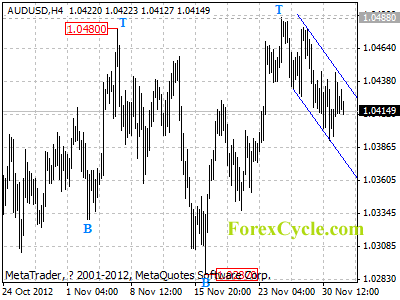
AUDUSD stays in a downward price channel on 4-hour chart, and remains in downtrend from 1.0488. Initial resistance is now at the upper line of the channel, as long as the channel resistance holds, the downtrend could be expected to continue, and the target would be at 1.0350 area. Key resistance is located at 1.0460, a break above this level will indicate that he fall from 1.0488 has completed, then the following upward movement could bring price to 1.0550 zone.

audusd

Daily Forex Forecast

SP 500 Index at a Crucial Crossroad

David A. Banister- www.MarketTrendForecast.com

We had an interesting 131 point SP 500 decline from the summer-fall highs of 1474 to the recent 1344 lows. Interesting because in the work that I do, we focus on crowd behavioral patterns, sentiment, and Elliott Wave Theory. There is no one technical analysis methodology that works all the time, so it’s important to incorporate other elements into your work to help with some clues. Let’s examine the crossroad we are at right now around 1420 on the SP 500 and why the next move may be a “tell” as they say in poker.

The correction from the 1474 highs can be read as a 3 wave correction, which in Elliott Wave Theory is corrective against the major trend, which so far has been up. 3 wave corrections serve to work off over zealousness of the crowd and above average bullish sentiment. To be sure, at the 1474 highs the sentiment surveys were running pretty hot and near 3 year highs, a flag that waved a warning sign for us. The correction though worked off that sentiment and at 1344 was in fact a Fibonacci 61.8% retracement of the rally from 1257-1474 that we witnessed this summer. These type of Fibonacci fractal retracements at 61.8% are common correction patterns in bull cycles.

What we need to see near term on this crossroad then is a clear cut rally over the 1424 area, which now is a 61.8% upwards retracement of the drop from 1474-1344. Why is that important to clear? Because 61.8% also is a common upwards retracement for a wave 2 counter-rally in a downward trend. Clearing that hurdle would indicate that the rally from the 1344 lows is more than just a counter-trend rally, and likely the confirmed start of a solid leg upwards towards highs for this bull market cycle.

This is why we like to draw these lines in the sands and let our subscribers be aware of what to watch and why. See the chart below to get an idea of where we are at in the current cycle:  Consider joining us so we can help you with daily updates on the SP 500 and Gold, stop scratching your head and guessing as to the patterns in the markets today! 33% discount if you go to www.MarketTrendForecast.com and sign up, and or sign up for our free weekly reports.


David A. Banister- www.MarketTrendForecast.com