How the Oil Price Could Affect Saudi Arabia’s Energy Dominance
By MoneyMorning.com.au

Despite the fragile state of the global economy, and growing production in the US, the oil price has remained stubbornly high this year.

The price of a barrel of Brent crude is roughly where it was at the start of the year, at around $110.

Tension in the Middle East over Iran has been one of the biggest issues propping the oil price up.

But a growing number of energy analysts believe that problems in another Middle Eastern country could send the price of crude oil much higher.

We’re talking about Saudi Arabia – the world’s largest oil producer…

 Saudi Arabia’s Oil Production Could be Peaking

 Earlier this year, amid concerns over Iran’s nuclear ambitions, oil prices started to rise, with Brent hitting over $120 a barrel.

Then the Saudis intervened. Oil minister Ali Naimi publicly pledged to raise production and push down prices. He stated that ‘Saudi Arabia has invested a great deal to sustain its capacity, and it will use spare production capacity to supply the oil market with any additional required volumes. We have done it many times before, we will do it again.’

Almost immediately, oil prices started to fall. It also seemed to suggest that the ability of the Saudis to influence the global oil supply was undiminished.

However, a closer look at the figures reveals that it might be tough for them to keep this up in the long term. The problem is that the increase in supply didn’t come from drilling new wells, or even getting a better yield from existing ones.

Instead, it came from bringing wells that the Saudis had previously abandoned back online. These sources have very limited reserves. This means that they are hardly a long-term solution.

Even keeping production at existing levels may be difficult, let alone increasing it. There have been queries about the quality of oil that the Manifa project, due to start pumping in 2014, will produce. And even if it does live up to hopes, the expiry of other wells will mean that overall output remains the same.

There are also big question marks over whether the Saudis are telling the truth about their levels of reserves.

Last year, leaked US diplomatic emails suggested that an ex-head of exploration at Saudi Aramco, the state oil company, privately estimated that the country’s reserves are 30% lower than the official figures. He also suggested that ‘no amount of effort’ by the Saudis will be able to stop ‘a steady decline in output’.

Peaking production is not the only threat to Saudi Arabia’s role as the world’s largest oil producer. The country will increasingly need to keep more of its resources for itself.

According to Citigroup, growth in the population and the economy are drastically increasing energy consumption. If current trends continue, Saudi Arabia will become a net importer of crude by 2030.

 Why the Saudis May Want a Higher Oil Price

 On top of this, Saudi Arabia’s desire to put a cap on oil prices may also start to weaken. Up until now the Saudis have tried to avoid prices rising too high.

This is not out of charity. It’s because Saudi Arabia doesn’t want to give other countries an incentive to invest in alternative energy sources. There’s no point in killing the goose that lays the golden eggs after all. And the fact that Iran, Riyadh’s main rival, is hit far harder by lower prices is an added bonus.

However, the social upheaval of the Arab Spring and beyond may force Saudi Arabia to change its view. Rulers in Jordan and Kuwait, for example, have tried to buy their rebellious populations off with increased social spending.

While this strategy might work in the short term, it’s very expensive. Jordan already has a large deficit, and the International Monetary Fund has refused to lend them any money that isn’t tied to unpopular reforms, such as the removal of price subsidies. This has forced the Gulf states, including the Saudis, to step in.

Saudi Arabia also has its own problems, with unrest in its eastern province, which follows a different branch of Islam than the rest of the country. There is also growing demand for general political reform in what remains one of the most repressive countries in the world.

The frail health of the 87-year old King Abdullah is also another worry. All these factors have led it to increase public spending by $130bn this summer in an attempt to shore up support.

All these spending factors mean that the Saudis may need oil prices to be at least $90 a barrel to balance the state budget. So at the very least, if prices go up again, Saudi Arabia won’t continue to increase production.

 The Good News About Higher Oil Prices

 This might sound like bad news – and it is in the short run. But in fact, the real bad news would be a prolonged plunge in the oil price. Why? Because that would stifle the search for alternatives.

America’s shale oil reserves could see the US replace Saudi Arabia as the world’s top oil producer by 2020, according to the International Energy Agency. However, because shale oil extraction is a more expensive process, the oil price needs to be around current levels to make it worthwhile.

With Saudi Arabia squeezed by its own budget needs, the chances of it deliberately trying to cut prices to scupper competition in the energy sector, are low.

Matthew Partridge

Contributing Editor, Money Morning

 Publisher’s Note: This article originally appeared in MoneyWeek

 From the Archives…

Now it’s the Turn of These Small-Cap Stocks to Rally…

31-11-2012 – Callum Newman

 Why It’s Possible to Buy AND Sell This Market

30-11-2012 – Kris Sayce

William Knox D’Arcy: The Greatest Australian You’ve Never Heard Of

30-11-2012 – Callum Newman

Why I’m Bullish on These Beaten-Down Stocks

28-11-2012 – Kris Sayce

Natural Gas to Rule the World

27-11-2012 – Dr. Alex Cowie


How the Oil Price Could Affect Saudi Arabia’s Energy Dominance

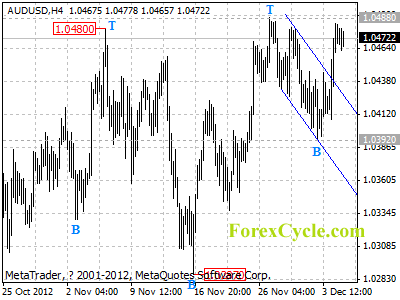
AUDUSD breaks above channel resistance

AUDUSD breaks above the upper line of the price channel on 4-hour chart, suggesting that the fall from 1.0488 has completed at 1.0392 already. The pair is now facing 1.0488 resistance, a break above this level will confirm that the longer term uptrend from 1.0149 (Oct 8 low) has resumed, then further rise towards 1.0550 could be seen. Support is at 1.0435, only break below this level will indicate that lengthier consolidation of the uptrend is underway, then deeper decline to 1.0350 area could be expected.

audusd

Forex Signals

Central Bank News Link List – Dec. 4, 2012: EU finance ministers clash over banking supervisor plan

By Central Bank News
Here’s today’s Central Bank News link list, click through if you missed the previous link list. The list comprises news about central banks that is not covered by Central Bank News. The list is updated during the day with the latest developments so readers don’t miss any important news.)

Email Newsletter 12-4-2012

US Power Grid Vulnerable to Just About Everything

As Washington hunts ill-defined al-Qaeda groups in the Middle East and Africa, and concerns itself with Iran’s eventual nuclear potential, it has a much more pressing problem at home: Its energy grid is vulnerable to anyone with basic weapons and know-how…


(Video) Alcoa and Aluminum: Latest Price Action Suggests 2 Major Opportunities

Mike shows you that, going back to the same 2008-2009 period, AA has followed the price of aluminum very closely. You get a detailed view of Alcoa’s recent drop below a key support price level, plus the analysis of an important trendline…


Large Currency Speculators trim US Dollar bets for first time in five weeks

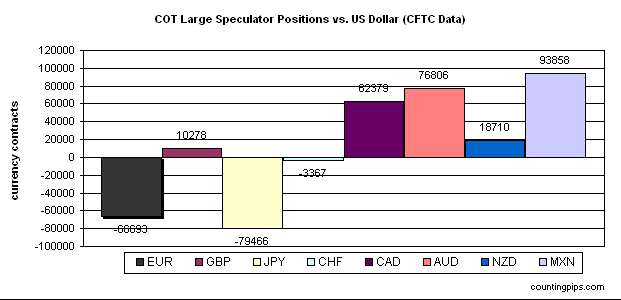
Non-commercial large futures traders, including hedge funds and large speculators, trimmed their US dollar long positions to a total of $8.01 billion on November 27th from a total long position of $11.2 billion on November 20th…


USD/JPY: Lemons into Lemonade

Going into the November 14 low, USD/JPY charts had been showing an impulsive downward Elliott wave pattern. Impulses are 5-wave moves, but on November 13-14, the pattern looked incomplete: the fifth wave down seemed to be missing..


 US Dollar tells us Stocks are Likely to Pullback – Simple Analysis

Trading with the trend is not always an easy task. It is human nature to predict and jump to conclusions and usually it’s better to trade with the trend no matter what your emotions are telling you. The current trend is down…


TODAY’S HEADLINES:

Canada holds rate steady, maintains tightening bias

By Central Bank News
    The Bank of Canada (BOC) held the target for its overnight rate unchanged at 1.0 percent, as expected, and maintained its tightening bias, saying that it will have to raise interest rates at some point to ensure that inflation does not exceed its target.
    “Over time, some modest withdrawal of monetary policy stimulus will likely be required, consistent with achieving the 2 percent inflation target. The timing and degree of any such withdrawal will be weighed carefully against global and domestic developments, including the evolution of imbalances in the household sector,” the bank said in a statement.
    The BOC, which has held its overnight rate steady since September 2010, said the global economy was unfolding broadly as the bank had projected in October with the U.S. economy progressing but also held back by uncertainty over budget talks. Europe remains in recession but China appears to be stabilizing and global inflationary pressures are subdued due to excess capacity.
    “Global financial conditions remain stimulative, though vulnerable to major shocks from the U.S. or Europe,” the BOC said.
    The BOC has maintained since April that it will have to raise rates at some point, a hawkish tone that is in stark contrast to central banks in most other advanced economies that are stimulating economic growth.

    Canada’s economy was weak in the third quarter due to temporary disruptions in the energy sector, and although underlying momentum is “slightly softer than previously anticipated” the bank said it expects the pace of growth to pick up through 2013, driven by consumption and business investment.    Canada’s Gross Domestic Product rose by 0.1 percent in the third quarter from the second for annual growth of 1.5 percent, down from 2.8 percent in the second quarter.
    Housing activity had started to decline from historically high levels and growth in household credit had slowed, but the bank said it was still too early to determine whether this moderation would be sustained.
    “The challenges include the persistent strength in the Canadian dollar, which is being influenced vby safe haven flows and spillovers from global monetary policy,” the bank said.
    Canada’s October headline inflation rate was steady for the third month in a row at 1.2 percent and the bank said it expected the headline and core rates to rise and return to 2 percent over the next 12 months as the economy gradually absorbs the small degree of slack.

    www.CentralBankNews.info
    

Uganda cuts rate 50 bps on subdued inflationary pressure

By Central Bank News
    Uganda’s central bank cut its Central Bank Rate (CBR) by 50 basis points to 12.0 percent as subdued inflationary pressure allows the bank to stimulate economic growth.
    The Bank of Uganda, which has now cut its policy rate by 1100 basis points this year, said headline inflation “rose only marginally” in November and the bank forecasts that core inflation will stabilize around its medium-term policy target of 5.0 percent over the next 12 months as inflationary pressures are “currently subdued and are likely to remain so in the near term because of the negative output gap.”
    The bank said the November headline inflation rose to 4.9 percent from 4.5 percent in October while core inflation eased to 3.8 percent from 4.0 percent. The rise in headline inflation was driven by food crops, energy, fuel and utilities.
    The bank said the prospects for growth in the 2012/13 fiscal year had weakened, with the main constraints weak demand, lack of private sector borrowing, the need to cut government expenditure in response to donor aid cuts and the difficult global economic outlook.
    “With real GDP growth forecast to remain below potential, the negative output gap is expected to persist through 2012/13,” the bank said.
    Uganda’s Gross Domestic Product contracted by 0.16 percent in the second quarter from the first for an annual shrinkage of 0.2 percent, down from annual growth of 2 percent in the first quarter.
    www.CentralBankNews.info

US Power Grid Vulnerable to Just About Everything

By OilPrice.com

As Washington hunts ill-defined al-Qaeda groups in the Middle East and Africa, and concerns itself with Iran’s eventual nuclear potential, it has a much more pressing problem at home: Its energy grid is vulnerable to anyone with basic weapons and know-how.

Forget about cyber warfare and highly organized terrorist attacks, a lack of basic physical security on the US power grid means that anyone with a gun—like disgruntled Michigan Militia types, for instance–could do serious damage.

For the past two months, the US Federal Energy Regulatory Commission (FERC) has been tasked with creating a security strategy for the electric grid and hydrocarbon facilities through its newly created Office of Energy Infrastructure Security. So far, it’s not good news.

“There are ways that a very few number of actors with very rudimentary equipment could take down large portions of our grid,” warns FERC Chairman Jon Wellinghoff. This, he says, “is an equal if not greater issue” than cyber security.

FERC’s gloom-and-doom risk assessment comes on the heels of the recent declassification of a 2007 report by the National Academy of Sciences.

The National Academy of Sciences on 14 November warned that a terrorist attack on the US power grid could wreak more damage than Hurricane Sandy. It could cause massive blackouts for weeks or months at a time. But this would only be the beginning, the Academy warns, spelling out an “end of days” scenario in which blackouts lead to widespread fear, panic and instability.

What they are hinting at is revolution—and it wouldn’t take much.

So what is being done to mitigate risk? According to FERC, utility companies aren’t doing enough. Unfortunately, FERC does not have the power to order utilities to act in the name of protecting the country’s energy infrastructure. Security is expensive, and more than 90% of the country’s grid is privately owned and regulated by state governments. Private utilities are not likely to feel responsible for footing the bill for security, and states may not be able to afford it.

One key problem is theoretically a simple one to resolve: a lack of spare parts. According to the National Academy of Sciences, the grid is particularly vulnerable because it is spread out across hundreds of miles with key equipment not sufficiently guarded or antiquated and unable to prevent outages from cascading.

We are talking about some 170,000 miles of voltage transmission line miles fed by 2,100 high-voltage transformers delivering power to 125 million households.

“We could easily be without power across a multistate region for many weeks or months, because we don’t have many spare transformers,” according to the Academy.

High-voltage transformers are vulnerable both from within and from outside the substations in which they are housed. Complicating matters, these transformers are huge and difficult to remove. They are also difficult to replace, as they are custom built primarily outside the US. So what is the solution? Perhaps, says the Academy, to design smaller portable transformers that could be used temporarily in an emergency situation.

Why was the Academy’s 2007 report only just declassified? Well, its authors were worried that it would be tantamount to providing terrorists with a detailed recipe for attacking and destabilizing America, or perhaps for starting a revolution.

The military at least is preparing to protect its own power supplies. Recently, the US Army Corps of Engineers awarded a $7 million contract for research that demonstrates the integration of electric vehicles, generators and solar arrays to supply emergency power for Fort Carson, Colorado. This is the SPIDERS (Smart Power Infrastructure Demonstration for Energy Reliability and Security), and the Army hopes it will be the answer to more efficient and secure energy.

Back in the civilian world, however, things are moving rather slowly, and the focus remains on the sexier idea of an energy-crippling cyberattack.

Last week, Senator Ed Markey (D-Mass.) urged House Energy and Commerce Committee chairman Rep. Fred Upton (R-Mich.) to pass a bill—the GRID Act–which would secure the grid against cyberattacks.

“As the widespread and, in some cases, still ongoing power outages from Superstorm Sandy have shown us, our electric grid is too fragile and its disruption is too devastating for us to fail to act,” Markey wrote. “Given this urgency, it is critical that the House act immediately in a bipartisan manner to ensure our electrical infrastructure is secure.”

This bill was passed by the House, but has failed to gain any traction in the Senate.

FERC, of course, is all for the bill, which would give it the authority to issue orders and regulations to boost the security of the electric grid’s computer systems from a cyberattack.

But it’s only a small piece of the security puzzle, and FERC remains concerned that authorities are overlooking the myriad simpler threats to the electricity grid. These don’t make for the easy headlines, especially since they are not necessarily foreign in nature.

Source: http://oilprice.com/Energy/Energy-General/US-Power-Grid-Vulnerable-to-Just-About-Everything.html

By. Jen Alic of Oilprice.com


Weakness in Gold “Non-Sustainable”, China, Investors and Central Banks “Happy to Buy on Dips”

London Gold Market Report
from Ben Traynor
BullionVault
Tuesday 4 December 2012, 07:30 EST

SPOT MARKET prices to buy gold rose back above $1705 an ounce during Tuesday morning’s London session, though it remained below where it started the week following falls overnight, while stock markets also edged higher along with the Euro after European leaders welcomed progress on Greece’s debt buyback program.

Silver meantime fell to around $33.30 an ounce, still above last week’s low, as other commodity prices also dipped.

Earlier on Tuesday spot gold fell to $1700 an ounce, its lowest level since the first week of November. Gold priced in Euros meantime fell to its lowest level since mid-August this morning.

“Clearly the situation has eased with respect to the Euro debt crisis, or market players are ignoring it,” says a note from Commerzbank.

“The dip in the price of gold was not accompanied by weaker ETF demand,” Commerzbank adds, noting that Bloomberg data show gold exchange traded funds saw their holdings rise to a fresh record yesterday.

“We therefore view the current price weakness is non-sustainable.”

“The break [lower] probably will not last long,” agrees one trader in Sydney, speaking to newswire Reuters this morning.

“Funds are happy to buy on dips, and so will the central banks and the Chinese.”

Self-directed individual investors are also taking advantage of dips to add to their gold positions, according to the latest Gold Investor Index data published Tuesday.

The Gold Investor Index, which measures investor sentiment towards physical gold by tracking buying and selling activity on online precious metals exchange BullionVault, rose to a six-month high of 56.5 last month, up from 56.0 in October, with a reading above 50 indicating more net buyers than net sellers over the month.

On the currency markets meantime the Euro rallied to a seven-week high against the Dollar Tuesday morning, breaching $1.30.

Following their meeting on Monday Eurozone finance ministers said they confident Greece’s debt buyback program will be a success.

Last week’s Eurogroup statement said single currency finance ministers expected the prices Greece paid to buy back its bonds “to be no higher than those at the close on Friday 23 November 2012”.

Since the buyback announcement however Greek bond prices have risen, and Athens yesterday revealed the maximum price it will pay to be above that 23 November level.

Since the bond buyback announcement, the volume of Greek bonds traded has “increased by the day”, according to Citigroup head of European government bond trading Zoeb Sachee.

“Hedge funds must have bought lower than here.”

“The official sector continues to demonstrate its total misunderstanding of how markets operate,” adds Julian Adams, chief investment officer at Adelante Asset Management in London, whose firm holds Greek debt.

“The whole saga has been a textbook case of how not to do this sort of thing.”

Finance ministers from the 17 Euro member nations also formally agreed Spain’s banking bailout. Back in June, a credit line of up to €100 billion was agreed for Spain’s government to finance the restructuring of the country’s banking sector.

The single currency’s permanent bailout fund the European Stability Mechanism has now authorized the first tranche of payments, worth €39.5 billion.

The ESM was downgraded by ratings agency Moody’s at the end of last week, with its credit rating cut one notch from Aaa to Aa1, following an earlier decision by Moody’s to downgrade France.

Over in Washington meantime, in an open letter to President Obama, Republican House of Representatives speaker John Boehner called yesterday for reforms to Medicare and Medicaid as part of a package aimed at reducing federal spending over the next decade.

Boehner and several other Republicans also called for an additional $800 billion to be raised in revenue, half the amount they say Obama has asked for, as US political leaders continue to disagree over how to address the federal deficit.

“[The Republicans’] plan includes nothing new and provides no details on which deductions they would eliminate, which loopholes they will close or which Medicare savings they would achieve,” said White House communications director Dan Pfeiffer in response to the open letter.

Failure to agree a deal would mean the US will encounter the so-called fiscal cliff of tax rises and spending cuts currently scheduled for the end of this month.

“Drawn-out talks that go down to the wire could potentially hurt equities and drag gold prices down,” says Ed Meir, commodities analyst at INTL FCStone.

“However, one could make an equally convincing case that were the talks to flounder amid general market mayhem, investors could flock to gold as a safe haven.”

Ben Traynor
BullionVault

Gold value calculator   |   Buy gold online at live prices

Editor of Gold News, the analysis and investment research site from world-leading gold ownership service BullionVault, Ben Traynor was formerly editor of the Fleet Street Letter, the UK’s longest-running investment letter. A Cambridge economics graduate, he is a professional writer and editor with a specialist interest in monetary economics. Ben writes and presents BullionVault’s weekly gold market summary on YouTube and can be found on Google+

(c) BullionVault 2012

Please Note: This article is to inform your thinking, not lead it. Only you can decide the best place for your money, and any decision you make will put your money at risk. Information or data included here may have already been overtaken by events – and must be verified elsewhere – should you choose to act on it.


Euro Finds Support as Risk Sentiment Improves

The Euro rose in the previous European session as Greece’s bond buyback plan increased hopes that the indebted country would be able to reduce its debts by 2020. The US dollar declined on the other hand as US lawmakers could not seem to agree on the measures to avert the so-called fiscal cliff. In today’s European trades, the single currency is anticipated to extend gains versus the Greenback supported by positive news coming from Spain and China.

Greece offered to buy back government securities worth 10 Billion Euros, a condition that would give way for the country to receive the next tranche of loan funds. The Greek government said that it would buy back debts in a Dutch action, and private holders of Greek debt have until Friday to register their interest in participating in the bond buying programme. The shared currency is also expected to draw support after Spain requested for a bank bailout to recapitalize its banks: Bankia, Catalunya Bank, NCG Banco and Banco de Valencia. Analysts believe that the common currency would further rise if Spain asks for a government bailout. The recent Chinese data also supported risk sentiment as manufacturing activity in November grew for the first time in 13 months in November, improving the outlook for the global economy. 

In the US, talks to avert a fiscal cliff stalled as the Democrats and Republicans could not seem to agree on increasing taxes on the wealthy. US lawmakers are left with little time before their country hits the fiscal cliff, and the continued want of progress is likely to force the world’s largest economy into another recession. With better news from Greece, Spain and China, the Euro is expected to rise versus the Dollar. Thus, a long position is recommended for the EURUSD pair in the European exchanges today.


Get more news and analysis at AlgosysFx Forex Trading Solutions

Euro Benefits From Positive Global Economic Data

Source: ForexYard

Positive Chinese manufacturing data, along with signs that Greece was closer to receiving a new round of bailout funds, encouraged investors to shift their funds to higher-yielding assets yesterday which boosted the euro against several of its main currency rivals. Today, traders will want to pay attention to the Spanish Unemployment Change figure as well as any developments in the ongoing budget negotiations between US Congressional leaders. Progress in the negotiations is likely to lead to additional risk taking, which could help the euro extend its recent gains.

Economic News

USD – Dollar Falls vs. Riskier Currency Rivals

The US dollar started the week off on a bearish note against its riskier currency rivals yesterday, as several positive global economic indicators led to risk taking in the marketplace. The Australian dollar gained close to 50 pips against the greenback, eventually reaching as high as 1.0445, before a minor downward correction brought the Aussie to the 1.0430 level toward the end of European trading. The USD had slightly better luck vs. the Japanese yen. The USD/JPY was able to advance close to 40 pips during the mid-day session to trade as high as 82.36.

Turning to today, the ongoing “”fiscal cliff” talks between US Congressional leaders may lead to volatility for the dollar. The talks are meant to resolve a budget dispute in order to avoid a set of automatic tax increases and budget cuts that threaten to send the US back into recession. Any progress in the talks may encourage investor risk taking, which could result in the safe-haven dollar taking additional losses against currencies like the euro and AUD.

EUR – Euro Bullish to Start Week

Positive Chinese data combined with signs that Greece is closer to receiving a new round of bailout funds helped the euro against several of its main currency rivals yesterday. Against the Australian dollar, the common-currency advanced close to 70 pips during overnight trading to reach as high as 1.2527. A slight downward correction during the European session brought the EUR to the 1.2500 level. The EUR/USD hit a six-week high at 1.3073 during mid-day trading before staging a bearish reversal and falling to the 1.3040 level.

Today, the Spanish Unemployment Change figure, set to be released at 8:00 GMT, may lead to volatility in the marketplace. Any signs of improvements in the Spanish economy could lead to additional euro gains. In addition, traders will not want to forget to monitor a Spanish bond auction tomorrow and the euro-zone Minimum Bid Rate and ECB Press Conference on Thursday. The indicators will likely illustrate the current state of the euro-zone economic recovery, with positive news set to benefit the euro.

Gold – Gold Trades Flat as Investors Wait for “Fiscal Cliff” News

The price of gold saw minor fluctuations throughout the European session yesterday, as investors remained hesitant to open significant positions before more information is known about negotiations to avoid the upcoming US “fiscal cliff”. After falling slightly more than $6 an ounce during the mid-day session, the precious metal was able to largely recover its losses and spent most of the day trading around the $1719 level.

Today, traders will want to note that any progress in the budget talks between US Congressional leaders may encourage risk taking, which could result in gold turning bullish. Later in the week, the US Non-Farm Employment Change figure is virtually guaranteed to generate volatility for gold, with a better than expected result likely to boost prices.

Crude Oil – Crude Oil Benefits from Chinese Data

A better than expected Chinese manufacturing PMI yesterday led to speculations that the global demand for oil will increase and resulted in the price of crude shooting up close to $1.65 a barrel during European trading. After peaking at $90.30 during mid-day trading, the commodity began falling again to reach as low as $89.55 during the afternoon session.

Today, oil traders will want to pay attention to news out of the US regarding the ongoing “fiscal cliff” negotiations. Any indication that the budget talks between Congressional leaders are closer to being resolved may result in investor risk taking, which could help oil see additional gains.

Technical News

EUR/USD

The Williams Percent Range on the weekly chart has crossed over into overbought territory, indicating that downward movement could occur in the near future. Additionally, a bearish cross has formed on the daily chart’s Slow Stochastic. Going short may be the wise choice for this pair.

GBP/USD

The Bollinger Bands on the weekly chart are beginning to narrow, indicating that this pair could see a price shift in the near future. Furthermore, the MACD/OsMA on the same chart is close to forming a bearish cross. Opening short positions may be the wise choice for this pair.

USD/JPY

The Slow Stochastic on the weekly chart appears to be forming a bearish cross, indicating that a downward correction could occur in the near future. Additionally, the Williams Percent Range on the same chart has crossed over into overbought territory. Opening short positions may be the wise choice for this pair.

USD/CHF

While the Williams Percent Range on the weekly chart is in oversold territory, most other long-term technical indicators show this pair range trading. Taking a wait and see approach may be the best option here as a clearer trend is likely to present itself in the near future.

The Wild Card

USD/DKK

The daily chart’s Relative Strength Index is approaching the oversold zone, indicating that an upward correction could occur in the near future. Furthermore, the Slow Stochastic on the same chart is forming a bullish cross. This may be a great time for forex traders to open long positions ahead of possible upward movement.

Forex Market Analysis provided by ForexYard.

© 2006 by FxYard Ltd

Disclaimer: Trading Foreign Exchange carries a high level of risk and may not be suitable for all investors. There is a possibility that you could sustain a loss of all of your investment and therefore you should not invest money that you cannot afford to lose. You should be aware of all the risks associated with Foreign Exchange trading.