Global bank lending falls in Q2, less interbank credit – BIS

By Central Bank News
    International bank lending fell in the second quarter of this year, mainly due to lower credit to banks in advanced economies and offshore financial centers, underlining the subdued state of international banking since the global financial crises, according to the Bank for International Settlements (BIS).
    Interbank lending fell by 3.1 percent, or $581 billion, in the second quarter from the first, driven by an 18 percent plunge, or $249 billion, in lending to banks in Caribbean offshore centers, the largest-ever fall since the start of BIS banking statistics.
    By contrast, lending to non-banks from banks was relatively stable, increasing by $5.6 billion, or 0.1 percent, while lending to borrowers in emerging markets rose by $6 billion, or 0.2 percent, despite another sharp drop in lending by euro area banks.
    Overall cross-border claims fell by 1.9 percent, or $575 billion, to $29 trillion, the second largest fall since early 2009, reversing a slight increase in the first quarter, BIS said. The final BIS second quarter lending data are largely similar, though more detailed, to preliminary data released in October.
    Claims on borrowers in advanced economies fell 1.4 percent, or by $318 billion, up from a decline of only $16 billion in the previous quarter. Cross-border claims on banks in the UK and US fell the most, by 4.8 percent and 4.5 percent, respectively, the third consecutive quarterly decline.
    The sharp drop in lending to banks in advanced economies was mainly due to a 4.3 percent fall in inter-office positions, the largest fall on record, with lower lending to banks headquartered in the U.S. and euro area accounting for most of the drop.
    The heavy debt and fiscal challenges facing some of the euro area’s 17 member nations continues to dominate the pattern of bank lending.
    BIS data for lending on an ultimate risk basis, which reflects risk transfers and the nationality of banks and not where the transaction is booked, shows a $16 billion, or seven percent, drop in in the exposure of euro-headquartered banks to Greek, Irish, Italian, Portuguese and Spanish public sector borrowers to $201 billion.
    Meanwhile, euro area and especially non-euro area headquartered banks increased their exposure to the public sector in other euro countries, especially Germany and France, continuing a longer-term trend that has accelerated since the debt crises worsened last year.
    The total exposure to euro area sovereigns by banks from the 30 countries that report to the BIS amounted to $1.7 trillion in the second quarter.
    The slight increase in lending to emerging market economies was driven by a 1.9 percent, or $25 billion, rise in claims on borrowers in Asia-Pacific with lending up to both banks and non-banks. However, this was outstripped by a rise in liabilities of reporting banks to Asia-Pacific banks, resulting in a net outflow of $2 billion.
    Cross-border lending to borrowers in Latin America and the Caribbean grew 1.1 percent, or $7 billion, while claims on emerging Europe fell 1.5 percent, or $1 billion.
     The composition of lending to emerging market economies in Asia-Pacific has changed significantly in recent years with banks from the euro area and Switzerland pulling back and being replaced by banks in that region, including Chinese banks. (For further details see accompanying article).
    Overall, lending by euro area banks to emerging markets fell 5.8 percent, or $128 billion, in the second quarter, with lending to emerging Europe accounting for 57 percent of the decline.
    Lending to emerging economies by U.S. banks also fell in the second quarter, by 2.5 percent, but in contrast, lending to emerging economies by Japanese banks rose 2.1 percent.
    Click to read the BIS December quarterly review.

Review: Backstage Wall Street

By The Sizemore Letter

“No one who is currently working in the investment advisory or asset management business will ever say the things I am about to say,” writes Josh Brown in the opening lines of Backstage Wall Street, his exposé of the Wall Street brokerage machine.

Brown may be pushing it when he says “There is no such person as me in all of finance,” but the always irreverent author of the Reformed Broker blog has written an excellent narrative that shares all of your broker’s dirty little secrets.  Much like Michael Lewis’ Liar’s Poker captured the essence of 1980s institutional Wall Street, Brown’s Backstage Wall Street recreates the boiler room retail brokerage culture of the 1990s and early 2000s in vivid color.

And he shares it from a working man’s perspective—what Brown calls “Blue Collar Wall Street.”

“This is not the white-collar world of financial executives and business lunches and client meetings and asset allocation.” This is a world in which 300-pound fat men sweat profusely while giving pep rallies and threaten 20-year-old junior brokers with lines like “Unless I see 10 new accounts opened before lunchtime, not a single one of you losers is leaving this boardroom for lunch.”

It is the world of aggressive cold calling…and of young brokers resembling the cast of The Jersey Shore guzzling Red Bull and chain smoking in alleys to make it through the day.  And most of all, it is the world of generating gross commissions.

Thankfully—and to Brown’s great satisfaction—the world he describes is Backstage Wall Street is dying.  Two major bear markets in a decade, the advent of dirt-cheap internet brokerage and low-cost ETFs, a regulatory crackdown, and general public disgust with Wall Street have all conspired to undermine the traditional brokerage model.

Brown himself escaped the soul-crushing existence of being a retail stock broker and is now successfully practicing as a registered investment advisor (RIA), hence his moniker “The Reformed Broker.” As Brown explains—and as I agree loudly and completely—the RIA model puts a professional on the same side of the table as their client.  The client is no longer a chump to be sold to; he’s a real person who is paying you for legitimate investment advice. This is the direction the industry is moving, as it rightly should.

In his attack on the Wall Street establishment, Brown doesn’t stop with stock brokerage.  He takes on the mutual fund marketing machine, with its multiple share classes and criminally-high sales loads.  He takes on private placements.  He takes on the investment banking business.  And he does it all with a healthy amount of dry humor.

Brown’s preferred investment vehicle is the exchange-traded fund (ETF), and I share his enthusiasm.  The low-fee structure, tax efficiency and lack of sales loads make them preferable to mutual funds in most cases.  But even in the world of ETFs, Wall Street has gone to its characteristic excess: “If you’re looking for a way to play Chinese small-cap footwear retailers whose CEOs were born in April, there’s probably an ETF for that,” Brown writes (mostly) in jest.  “No one ever woke up in the middle of the night worrying about whether or not they had enough exposure to beryllium prices or Brazilian hospital real estate or (fill in the needless opportunity).”

Backstage Wall Street was not written to make you a better investor; it’s not another “how to” book.  But if you are an ordinary investor who depends on the advice of a broker or financial advisor, then it is a book you absolutely must read by a man who has seen it all from the inside.

In the same vein, Backstage Wall Street should be required reading for any undergraduate who dreams of a career in finance.  It will certainly shape the direction their career takes.  (Alas, I’m not sure that some of the semi-literate knuckle-dragging brokers described in the book would even be capable of understanding it.)

Compliments to Josh Brown on a book well written.


SUBSCRIBE to Sizemore Insights via e-mail today.

The post Review: Backstage Wall Street appeared first on Sizemore Insights.

Monetary Policy Week in Review – Dec. 8, 2012: Global economy asynchronous, euro zone the center of vortex

By Central Bank News

    Last week 11 central banks took monetary policy decisions, with four banks (Australia, Uganda, Poland and Azerbaijan) cutting rates, one bank (Malawi) raising rates and the remaining six (Canada, United Kingdom, the European Central Bank, New Zealand, Egypt and Peru) keeping rates on hold.
    Year-to-date, the 88 central banks followed by Central Bank News have cut their policy rates 118 times and only raised them 29 times, i.e. rates have been cut more than four times as often as they have been raised, illustrating the easy policy stance worldwide.
    Central banks in developed markets have cut rates 15 times so for far this year, including last week’s rate cut by the Reserve Bank of Australia, while rates have been cut 30 times by central banks in emerging markets.
    The takeaway from last week’s central banks’ policy statements is that the global economy is stuck in an asynchronous mode with geographical distance still a factor in an age of instant communication, non-stop information and global sourcing.
    The euro zone economy remains in a downward spiral that is sucking in nearby countries, such as the United Kingdom and Poland. The prospect for the euro zone economy next year remains bleak and rate cuts by the European Central Bank (ECB) and the National Bank of Poland look likely.
    Meanwhile, economies that are further afar from Europe and less directly affected – such as Peru, Canada and New Zealand – are still expanding and looking ahead to improving growth in 2013. The Bank of Canada maintained its tightening bias while the Reserve Bank of New Zealand expects growth to accelerate.
    Australia, whose resource-rich economy has been feeding China’s voracious appetite for iron ore, coal copper and other minerals, is now starting to prepare for lower mining investments. Last week’s rate cut last week was an effort to boost non-mining sectors and soften its strong currency.
    Quantitative easing was also in focus last week with the Bank of England choosing not to expand its asset purchase program that was completed last month. This was hardly because the UK economy is in great shape but rather because of the limits of quantitative easing as a way to stimulate growth.
    Minutes from the BOE’s November meeting show that members of the policy committee still believe that asset purchases fundamentally are an effective policy tool. However, its effectiveness depends on the state of the economy and right now the UK economy is not responding to lower interest rates – the dilemma of the zero bound that has been haunting major economies since 2009.
    “At the present time, it was possible that elevated uncertainty and a desire to reduce leverage meant that real activity was less responsive to lower borrowing costs than normal,” the minutes said, adding this situation could suddenly reverse and thus the impact of further asset purchases.
    Quantitative easing will also be in focus next week as the Federal Reserve will decide on whether it wants to extend Operation Twist, which expires at the end of December, or replace it with something else or with nothing. Under the program, the Fed extended the maturity of its assets by selling short-term bonds and buying longer-term bonds to push down those yields.

LAST WEEK’S (WEEK 49) MONETARY POLICY DECISIONS:

COUNTRYMSCI    NEW RATE     OLD RATE       1 YEAR AGO
MALAWI25.00%21.00%13.00%
CANADADM1.00%1.00%1.00%
AUSTRALIADM3.00%3.25%4.25%
UGANDA12.00%12.50%23.00%
POLANDEM4.25%4.50%4.75%
UNITED KINGDOMDM0.50%0.50%0.50%
EURO ZONEDM0.75%0.75%1.00%
NEW ZEALANDDM2.50%2.50%2.50%
EGYPTEM9.25%9.25%9.25%
PERUEM4.25%4.25%4.25%
AZERBAIJAN5.00%5.25%5.25%


NEXT WEEK (WEEK 50) monetary policy committees in 13 central banks are scheduled to meet, including Russia, Indonesia, Mozambique, Sri Lanka, the United States, Iceland, Namibia, Chile, South Korea, Switzerland, the Philippines, Fiji and Serbia.

COUNTRYMSCI      DECISION         RATE       1 YEAR AGO
RUSSIAEM10-Dec8.25%8.00%
INDONESIAEM11-Dec5.75%6.00%
MOZAMBIQUE12-Dec9.50%15.00%
SRI LANKAFM12-Dec7.75%7.00%
UNITED STATESDM12-Dec0.25%0.25%
ICELAND12-Dec6.00%4.75%
NAMIBIA12-Dec5.50%6.00%
CHILEEM13-Dec5.00%5.25%
SOUTH KOREAEM13-Dec2.75%3.25%
SWITZERLANDDM13-Dec0.25%0.25%
PHILIPPINESEM13-Dec3.50%4.50%
FIJI13-Dec0.50%0.50%
SERBIAFM14-Dec10.95%9.75%
   

How the Strong Aussie Dollar is Hiding Small-Cap Opportunities

By MoneyMorning.com.au

The Aussie dollar bears have got it right.

The currency is over-valued, the economy is slowing, and the resources boom is over.

Practically everything they say stands up as an argument…except for one thing: the Aussie dollar isn’t going down.

So here’s an idea for you: although the case for the Aussie dollar going down isn’t playing out in the currency market, it is in the stock market.

That might sound odd at first, but it’s the task of today’s Money Weekend is to see if this holds up – and how you can profit from it.

The Aussie Dollar Smokescreen
Blinding the Truth

Any traders who were short the Aussie dollar might’ve breathed a sigh of relief when the Reserve Bank of Australia (RBA) announced a cut to Aussie interest rates this week. Technically this should weaken the case for holding Aussie dollars and assets.

But it didn’t.

Short traders’ relief wouldn’t have lasted long, because the Aussie dollar didn’t fall. In fact, it started going up.

The general view seems to be that the RBA was trying to knock a bit of stuffing out of the Aussie dollar more than anything. If it was, that’s too bad, because the Aussie is now closing in on US$1.05.

The Australian Financial Review explained it this way on Thursday:


‘Currency experts have been left puzzled by relentless investor interest in the Australian dollar in spite of cuts to the national cash rate, China’s slowdown, and falling prices for key commodities.’

But if we’re learning one thing about the Aussie dollar right now, it’s that money coming into Australia is more powerful than the terms of trade.

The Chinese economy has slowed, iron ore and coal prices are off their highs and interest rates are falling. All this has been going on for over a year. But instead of looking to the dollar, maybe we should look at the stock market.

Now, the stock market and the economy are two different things. (For example, a country can have fabulous GDP growth but stocks go nowhere, or even down.) But one investing adage is that the stock market tries to predict changes in the economy. And another adage says that when investors are fearful, they dump the riskier stocks first.

And that’s exactly what investors have done this year. See for yourself with this chart of the ASX Small Ordinaries Index…

Small Cap Stocks (XS0) Get Squeezed

Small Cap Stocks (XS0) Get Squeezed
Click here to enlarge

Source: Google Finance

Let’s face it: unless you feel optimistic about the future, smaller, riskier companies are less likely to be on your radar.

But even if you think the world’s second biggest economy (China) is slowing, and taking key commodity prices with it, it’s still hard to see Aussie investors dumping Aussie dollar assets and buying foreign markets instead.

So we’ll take a guess and say Aussie investors will stay with what they know. Even so, over the past year, investors have bailed out of the tiny end of the market and moved into the perceived safety of blue-chip stocks (see the performance of the Aussie banks and Telstra this year).

You can argue that the gap between the big end of town and small-cap stocks is a fear measure. Aussie investors have dumped perceived riskier shares because of structural problems within China surfacing and causing a dreaded slowdown.

Here’s a repeat of a chart we showed last week.

Perceived Safety Wins: Six Month Blue Chip Rally

Small Cap Stocks (XS0) Get Squeezed
Click here to enlarge

But that trend could be about to change…

Small Caps on Offer

Diggers & Drillers editor Dr. Alex Cowie has written in Money Morning about the trouble faced by mining companies trying to get financing. For Diggers & Drillers, this has meant switching focus to companies that already have cash on the books.

But there’s more to small-cap stocks than junior miners. There’s technology, health and retail stocks that trade at the small end of the market. Some of these businesses aren’t even remotely correlated to China or commodities.

That means there’s a chance to pick up small-cap stocks trading on a ‘fear’ discount.

All this goes some way to explaining Kris Sayce’s (our small-cap specialist here at Port Phillip Publishing) position that small cap stocks have suffered a silent crash. The main index doesn’t show it because banks and big resource stocks drive the ASX/200.

There are some small-caps that have already delivered tidy gains to investors. For example, Breville Goup Limited (ASX: BRG), Credit Corp Group (ASX: CCP) and Thorn Group Limited (ASX: TGA) are all up at least 20% since the mid-point of the year. Sirtex Medical (ASX: SRX) is up over 100%.

This gives you an idea of the lucrative gains small-cap stocks offer. But according to Kris, there are still plenty of other small-cap stocks left on the bargain counter.

Here’s what Kris told subscribers to Scoops Lane (the free weekly e-letter we send to anyone who subscribes to a paid Port Phillip Publishing service) this week on why he in particular is so bullish on certain small-cap stocks:


‘In many cases those stocks are there for a reason – they are bad businesses. But there’s also a bunch of stocks that don’t deserve to be there. They’re beaten-down stocks that are simply going through a rough patch or they’re stocks that have a great new discovery, product or service that hasn’t yet convinced the market they’ll ever be profitable. Investing in these stocks is risky, and it won’t always pay off.

‘But when it does pay off the reward can be huge. The trick is to try and identify the winners and avoid the losers.’

We don’t know where the Aussie dollar is headed. But we do know the first part of successful investing is finding something that’s trading below its potential value. If Kris is right, there’s plenty of value among small-cap stocks. To us, that means looking at the small-caps first and blue chips second.

Callum Newman
Editor, Money Weekend

The Most Important Story this Week

The fact that the Reserve Bank cut the interest rate this week spells bad news for savers and anyone relying on fixed income. If you can’t get a big enough return on term deposits, how can you earn more money? You could consider Kris Sayce’s strategy to beat the central bankers – see what he says in How to Make Cash-Like Returns Using Shares

Highlights in Money Morning This Week…

Murray Dawes on How Long Can the Market Ignore These ‘Warning Signs’?: ‘Watching markets levitate higher as economic data continues to slide has me scratching my head. Is money printing really the only thing you need to make markets go up? Do fundamentals no longer matter at all? How long can the charade go on?’

Satyajit Das on The Golden Age Redux: ‘As the Global Financial Crisis continues and the cure of easy money proves as dangerous as the disease, the gold price has increased from around $250 per troy ounce in 2001 to a peak of over $1,900 in 2011. It now trades at around $1,750 per ounce. As poet John Milton wrote, ‘Time will run back and fetch the age of gold.”

Merryn Somerset-Webb on Is it Time to Ditch Blue Chip Stocks for Small Caps?: ‘Older readers will remember a time when it was commonly accepted that smaller companies always outperform big companies and that smaller companies should therefore trade at a good premium to big companies. ‘Elephants don’t gallop’, people used to say): it’s easier for a tiny company to double its size – and your money – than for a big one.’

Dr. Alex Cowie on Is There Any Good News to Come from the US Debt Crisis?: ‘Gold prices have been closely correlated to the US debt level, and where the debt ceiling goes, the debt level follows. Silver moves with US debt levels as well, though not quite as closely as gold. This is certainly not the only reason to own precious metals, but could be a strong short term driver.’

From the Port Phillip Publishing Library

Australian Small-Cap Investigator:
Five Simple Steps to Picking Winning Small-Cap Stocks


How the Strong Aussie Dollar is Hiding Small-Cap Opportunities

Templeton’s Ghost: Why Now is a Great Time to Speculate on Cheap Stocks

By MoneyMorning.com.au

One of our favourite investing stories is John Templeton.

If you know anything about Templeton, you may think that’s a strange choice. After all, John Templeton is famous for being a diversified stock investor…he believed you couldn’t beat the market. He believed in buying a portfolio of many stocks to spread risk and profit as the whole economy grows.

But he also believed in an investing basic – buy low and sell high.

That’s right, it’s not rocket science. But it’s something many investors forget when they rush to buy the latest hot and booming stock.

So John Templeton and us wouldn’t see eye to eye on every aspect of investing. But when it comes to buying low and selling high we would completely agree. Yet Templeton’s investing approach isn’t the only reason we mention him to you today.

If you’ve heard of John Templeton (he actually dropped his US citizenship to become a British citizen and earned a knighthood from Queen Elizabeth II) you’ll know he’s famous for two things.

One of those things was his pioneering role in the mutual funds industry. To the extent that in 1992 Templeton sold his Templeton Funds business to the Franklin Group. This created Franklin Templeton Investments, one of the world’s biggest fund managers. The sale of his business was the curtain call on a lifetime’s work.

But before then, the young Templeton (just 26 at the time) made one of the gutsiest trades in stock market history.

Who was John Templeton?

Templeton grew up on a farm near the small town of Winchester, Tennessee (population today of just 8,502), in the deep south of the United States. But coming from a small town didn’t stop his ambition.

He graduated from high school to attend the renowned Yale University. From there he earned a Rhodes scholarship to Balliol College, Oxford. He graduated with a law degree in 1936.

Templeton returned to the US, and in 1938 started a career on Wall Street. By then, he was 26 years old, and not long out of university.

For most twenty-something’s that would be good enough. It would be time to knuckle down and start climbing Wall Street’s greasy pole.

But just one year later, in 1939, with Western Europe heading to war, the 27-year-old former Tennessee farm boy did something extraordinary…especially for someone with just a year of Wall Street experience.

Remember, Herr Hitler had annexed the Sudetenland (current Czech Republic); divided

Poland between Germany and the Soviet Union; and just a few months later, Germany would invade Belgium, France, Luxembourg and the Netherlands.

All wars end up lasting longer than most people think. So perhaps if Templeton knew the war would last until 1945, he wouldn’t have done what he did next. After being in his Wall Street job for a year he approached his boss and asked for a $10,000 loan.

That’s the equivalent of $166,415 today.

What’s more, Templeton intended to invest the money in the stock market. Amazingly, his boss gave him the cash. We’ll say it again, Europe was at war, and no one knew how long the war would last or the damage it would cause. Yet Templeton borrowed $10,000 from his boss…to invest in stocks.

But if that wasn’t ballsy enough, Templeton added an extra degree of risk. He didn’t invest in safe and dependable stocks. He invested in 104 of the New York Stock Exchange’s most beaten down and riskiest stocks.

Templeton wasn’t a momentum investor, buying stocks in a rising market. And he wasn’t a Warren Buffett-style value investor, as a third of the companies he invested in had filed for bankruptcy.

Templeton was a speculator.

What he did was risky, but it paid off because he understood the risk.

Now is a Great Time to Speculate on Cheap Stocks

But there’s one more part to the Templeton story. Note the year: 1939. Did I mention that at that point the US economy was in the eleventh year of the Great Depression?

Well, it was.

Not only had a world war just begun, but also the US economy was still mired in the Great Depression.

Of course, 1939 was also the year that many believe the Great Depression ended…but again, Templeton couldn’t possibly have known that at the time.

It’s like today. The world economy is now into the fourth year of a worldwide recession – arguably, a depression – and stock markets are at their most volatile in living memory.

Add to that the constant threat of war in the Middle East; the chances of civil unrest in Europe; the fall of one super power in the West (US); the rise of a new super power in the East (China); attacks on freedom in the United States and elsewhere; and governments and central banks that have no ideas about achieving economic growth other than printing money.

Put in that context, it’s not hard to see that the world economy is in just as bad shape today as it was in 1939. That’s why we’re convinced that now is a great time to speculate on beaten down stocks.

It’s also why we’ve got more stocks on our recommended buy list than we’ve had for more than two years.

However, this is where our strategy differs from John Templeton’s. He bought 100 shares in 104 different beaten down companies. But unlike 1939, we’re not convinced you’ll see a broad market rally over the next five years.

For a start, the Aussie stock market is concentrated in two key sectors: resources and banking. So you don’t have the broad market diversity that Templeton had when he made his ballsy punt.

Second, we’re a stock picker. In the long-term we believe it’s possible to beat the market averages, simply by selecting the stocks you believe have a better chance of succeeding than others.

We believe you’ll see an uneven market where some stocks rise, others fall, but the broad market index stays roughly the same. In short, we believe there’s a better and lower risk way to bet on rising stock prices.

That is, rather than investing in a diversified share portfolio, you should allocate most of your savings to cash, four or five dividend paying stocks and gold, and then you should put what’s left over (say, 5-10% of your savings) into speculative stocks.

And when we say speculative, we mean it. We’re talking about the potential for these stocks to rise 200%, 300% or more…not just the low double digit percentage gains you can expect from most blue-chips stocks.

Kris Sayce,
Editor, Money Morning

From the Archives…

Now it’s the Turn of These Small-Cap Stocks to Rally…
31-11-2012 – Callum Newman

Why It’s Possible to Buy AND Sell This Market
30-11-2012 – Kris Sayce

William Knox D’Arcy: The Greatest Australian You’ve Never Heard Of
30-11-2012 – Callum Newman

Why I’m Bullish on These Beaten-Down Stocks
28-11-2012 – Kris Sayce

Natural Gas to Rule the World
27-11-2012 – Dr. Alex Cowie


Templeton’s Ghost: Why Now is a Great Time to Speculate on Cheap Stocks

FOREX: USD/CHF Price Update 5 PM ET ‘2012.12.07 17:00:00’

By CountingPips.com

At the 5pm New York close of business, the USD/CHF Currency Pair’s current and high low prices for the trading day are:

USD/CHF Current Forex Prices:

Bid (Buy) Price = 0.93442

Ask (Sell) Price = 0.93492

Today’s USD/CHF High Low Levels:

Today’s High = 0.93820

Today’s Low = 0.93205

The Most Important Thing…

Nothing much to report from Wall Street. Nothing much going on in Washington either. Stocks up and down. Politicians too.

Columnists are worried that the “fiscal cliff” will cause a recession. Pundits tell us how to avoid it.

But they’re all missing the point. Here’s the important thing:

It’s a bust we need, not a boom.

What? Huh? What the heck are we talking about?

Here is a typical worrier, giving us reasons not to worry. From Pedro da Costa at Reuters:

Is the U.S. on the road to Greece, as some politicians have proclaimed?

Most economists say the comparison is nonsense. At a towering $15 trillion, the U.S. economy is not only the world’s largest, it is also more than 50 times the size of Greece’s. This gap makes any type of comparison difficult — it would be like analyzing trends in Maryland in relation to the entire euro zone.

Another key difference: Unlike Greece, the U.S. actually controls its own currency. That means a debt default is effectively impossible. This reality, coupled with strong monetary stimulus from the Federal Reserve, helps explain why U.S. bond yields remain near historic lows despite larger deficits.

Mark Weisbrot, co-director of the progressive Center for Economic and Policy Research in Washington, says a country’s interest burden is far more important than its total debt levels in determining the government’s ability to service it. He argued in a recent editorial:

Contrary to popular nonsense about America “ending up like Greece,” the U.S. doesn’t even have a public debt problem. Net interest on the federal debt is currently less than 1 percent of our national income, the lowest it has been in more than 60 years. And it’s the interest burden that matters, not the big numbers like $16 trillion that are thrown around in scare stories.

But here is where it gets interesting. We don’t have to worry, says Mr. da Costa, because we “owe it to ourselves”:

[T]hat’s why Japan has no problem even though its gross debt is about 220% of GDP. About half is owed to the central bank. What this means is the interest on that debt goes back to the Treasury. Our Treasury now receives about $80 billion annually from debt held by the Fed.

Running Out of Gas

Is this fellow out of his mind?

Nah… He’s got a good point. As long as the central bank finances deficits you don’t have to worry about borrowing costs. We can continue on our merry way!

But sometimes a bust is better than a boom

Greece is running out of gas. It has out a roadmap. It has turned on the GPS. It aims to go where many other nations have gone in the past. It aims to continue spending more than it can afford for as long as it can.

But the poor Greeks have the Germans on their backs. They can’t just print up more currency to help them on their way. They don’t have their own central bank. They use the euro… which is still dominated by German bankers.

So, if the poor Greeks are going to go further into debt, it will only be with the complicity of lenders… who are growing wary. Greece is broken down in bust territory.

The Land of No Return

The U.S. doesn’t have those troubles. America is not Greece. It will be able to get where it is going… thanks to its very own central bank and the delusions of lenders everywhere.

As long as the Fed will print money, America can stay on course, stepping on the gas and driving further and further into the land from which no one returns solvent.

Lenders won’t stop it. Germany won’t stop it. The “fiscal cliff” will only slow it down momentarily.

The U.S. will go all the way, we predict, all the way to the jaws of Hell.

Disclaimer

Article brought to you by Inside Investing Daily. Republish without charge. Required: Author attribution, links back to original content or www.insideinvestingdaily.com. Any investment contains risk. Please see our disclaimer.


Azerbaijan cuts rate 25 bps with inflation at optimal level

By Central Bank News
    The central bank of Azerbaijan cut its benchmark refinancing rate by 25 basis points to 5.0 percent to stimulate economic growth as inflation was at an “optimal level.”
    The Central Bank of the Republic of Azerbaijan said the exchange rate of the manat currency had remained stable, money supply was in line with the bank’s inflation target and inflation was at a single-digit level with the average annual inflation rate far below that of its trading partners and this tended to reduce average interest rates on loans.
    “To enable interest rates to decline further and support economic growth in the non-oil sector given the optimum level of inflation, the management board of the central bank took the decision to shift the refinancing rate to 5% from 5.25% from December 10 2012 onward,” the central bank said in a statement.
    Azerbaijan’s inflation rate fell to 1.3 percent in October from September, a new low for the year. The  central bank’s main target for 2012 was single digit inflation and inflation has been declining since hitting a 2011 high of 9.6 percent in March 2011.
    The central bank has held its rate steady since June 2011 when it was raised to reduce inflation.
    Azerbaijan’s economy has been relatively unaffected by the global financial crises and the bank said the country’s non-oil economy was driving the country’s growth with a 10.4 percent rise in the first 10 months of the year. Internal and external demand was supporting growth and employment.

    www.CentralBankNews.info

Short the Yen

By The Sizemore Letter

Architect of the Fiscal Cliff Doomsday Machine

Another week goes by without a resolution to the fiscal cliff crisis, but to adapt a line from Dr. Strangelove, investors have learned to stop worrying and love the cliff.

Statements from the White House and the House of Representatives have stopped moving the market, and investors have gotten back to their usual routine of fretting over economic news releases.  This morning, U.S. non-farm payrolls came in above expectations at 146,000 jobs, and the unemployment rate dipped to 7.7 percent.

In the convoluted logic of the markets, this can be either good or bad.  It’s clearly good that the job market is improving, but not necessarily good for the stock market if it means that the Fed might put the brakes on its quantitative easing.  But for now, I wouldn’t worry too much about that.  We’ll still at least a year away from a change in policy by the Fed.

In recent weeks, I’ve  recommended that investors get more aggressive with exposure to emerging markets (see “China is a Buy”) and in technology (see “Ride the Bull Move in Tech”).  Apple’s (Nasdaq: $AAPL) recent sell off has dragged the tech sector down a little, but I still believe that more aggressive, cyclical sectors are the place to be right now (and so does Warren Buffett, for that matter).

But today, I want to discuss trading opportunities on the short side.  I wrote recently that Japan is a dead man walking, and the yen looks particularly weak to me right now.  Over the next several years, I see the yen going the way of a banana republic currency (as in paying for a cup of coffee with a 10 trillion yen bill), but even in the short term I see decent downside potential.  The yen has already been sinking for three primary reasons:

  1. It was grossly overvalued to begin with
  2. Its value as a “safe haven,” which was always ludicrous in my mind, is diminished with Europe stabilizing
  3. Investors worry that the new Japanese government will unleash unprecedented quantitative easing in an attempt to restart inflation and lower the value of the yen.

The trend is already in place, but I believe it has a lot longer to run.

Action to take: Buy the ProShares UltraShort Yen (NYSE: $YCS).  This is a leveraged fund, and I expect of 30-50% over the next 12-18 months to be a real possibility.  But in the event I’m wrong and Japan’s day of reckoning is postponed, use a 15% trailing stop.

Disclosures: Sizemore Capital has no position in any security mentioned. This article first appeared on TraderPlanet.

SUBSCRIBE to Sizemore Insights via e-mail today.

The post Short the Yen appeared first on Sizemore Insights.

What the VIX Term Structure is Saying About the Fiscal Cliff

JW Jones – www.TradersVideoPlaybook.com

The past few weeks have been full of a constant barrage of press conferences and public statements from the charlatans in Washington D.C. Politicians cannot pass up a chance to get in front of the cameras and the media has used the “fiscal cliff” as a mechanism to scare average Americans further about their future.

Interestingly enough, amid all of the nonsense that has been going on stocks have remained resilient. I think sometimes its important to just step back away from the media’s noise and just look at some price charts for more clarity. The S&P 500 Index has been trading in a relatively tight range now for over 6 trading sessions as shown below.

As can be seen above, the S&P 500 is struggling to breakout of the 1,400 – 1,420 price range. It is not mere coincidence that the Volume by Price indicator is illustrating the most trading volume having occurred in and around that price range. So what does the recent action mean in light of the supposedly pending fiscal calamity?

Everyone that is looking for this monster move when the announcement is finally made may be waiting for a while. It is without question that the broader marketplace is clearly aware of the fiscal cliff. It would make sense that Mr. Market may have priced in some of the uncertainty. Furthermore, if there was significant concern we would be seeing prices starting to sell off by now.

Markets do not like uncertainty. However, what is certain is that during the end of the year the bulls usually have the upper hand. The reasons are fairly simple, but they usually hold sway most years. Due to the holiday season, many traders take vacations and leave their trading desks. Because traders are largely absent, volume levels start to decline as the holiday season approaches. Typically volume levels do not normalize until January of the new year.

Low volume levels typically synch up with low volatility levels. When those two forces align together the bulls will almost always have the upper hand. Is it any wonder that this time of year the financial media begins discussing a “Santa Claus rally”? Of course not, but Santa Claus is really just light volume levels and low volatility levels in this case.

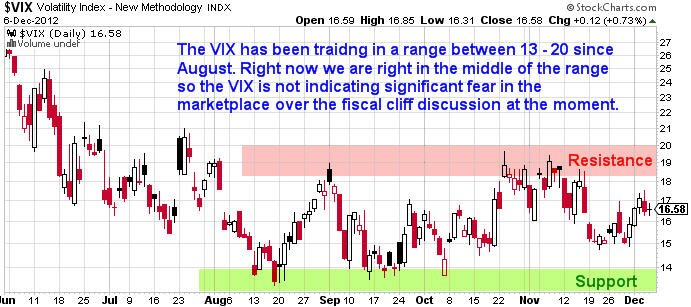
Recently volatility has been pretty choppy, but the Volatility Index is not showing considerable fear regarding the fiscal cliff in the near term. In fact, the VIX is trading in the middle of its recent range as shown below.

At first glance, this chart does not appear to be warning us about fear at the moment. However, certain aspects of the Volatility Index (VIX) are largely unknown to the retail investor. The VIX is a guide for volatility in the present, but it does a poor job of projecting future volatility. Simply looking at the VIX’s current price is not the appropriate way to gauge market volatility expectations in the future..

The Volatility Term Structure is a better way of understanding what the Volatility Index is saying about the future. Wikipedia lists the following definition for volatility term structure:

“Volatility term structures list the relationship between implied volatilities and time to       expiration. The term structures provide another method for traders to gauge cheap or expensive     options.”

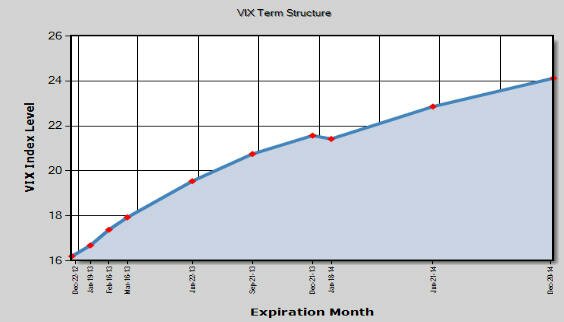
The current Volatility Term Structure chart is shown below courtesy of www.cboe.com:

As can be seen above, the forward Volatility Term Structure indicates that volatility is expected to go higher in the future. This is not all that uncommon, but I think what is more important is the rate of change in the near term.

When we look at this chart, the term structure indicates that Volatility levels roughly 4 months  out (March 2013) are nearly 13% higher than they are today. By June of 2013, volatility’s rate of change is well over 20% higher than it is today.

It is important to understand that volatility does not necessarily mean risk. Volatility typically increases when equity prices are falling, however volatility levels can rise for a variety of reasons. Uncertainty about the outcome of an event like hitting the debt ceiling could push volatility levels higher without sending equity prices sharply lower. The point is the term structure just provides clues as it is not the holy grail about looking in the future.

What the Volatility term structure does tell us is that the marketplace expects a significant increase in overall volatility in the next 3 – 6 months. What I think the Volatility Term Structure is conveying presently is that decisions regarding the fiscal cliff and the debt ceiling will impact market prices, However the real impact may not be felt until later in the 1st or 2nd Quarters of 2013.

Most economists believe that if we do go over the fiscal cliff and taxes go up for everyone that the U.S. economy will be in recession within 6 – 9 months. Clearly as shown above, the Volatility Term Structure likely agrees with the economists assessments and the economic conditions in the next 6 to 7 months could possibly turn for the worse.

All we can hope for is that the politicians can compromise on a plan that will remove uncertainty from the marketplace without compromising the economy. Something tells me that is not likely to happen, but here is to hoping that I’m wrong!

Happy Trading!

Risk-FREE 30-Day Trial

only $1 for the first 30 days!

JW Jones
www.TradersVideoPlaybook.com


This material should not be considered investment advice. J.W. Jones is not a registered investment advisor. Under no circumstances should any content from this article or the TradersVideoPlaybook.com website be used or interpreted as a recommendation to buy or sell any type of security or commodity contract. This material is not a solicitation for a trading approach to financial markets. Any investment decisions must in all cases be made by the reader or by his or her registered investment advisor. This information is for educational purposes only.