No Agreement Between Boehner And Obama Over Fiscal Changes

By TraderVox.com

Tradervox.com (Dublin) – U.S. house speaker John Boehner and president Barrack Obama haven’t reached to a conclusion with three weeks left to avert more than $600 billion in spending cuts and tax increases. Obama insisted on the high income tax rate for high earners, while Boehner insisted on the spending cuts.

Boehner called it a wasted week  after talks and didn’t rule out the possibility of accepting a maximum  tax rate between the current 35 percent and the 39.6 percent Obama wants for top earners. Obama believed there are possibilities to put the revenue but the speaker opposed the tax rate increases believing to cost American jobs.  

The speaker reinstated that the agreement won’t be possible if Obama insisted on his position but Obama’s administration didn’t respond. The president went forward to meet house minority leader Nancy Pelosi, a California democrat; at the White House yesterday to discuss a variety of issues including the budget. Pelosi didn’t rule a compromise on top tax rate but insisted that it is about the money.

Earlier this week Boehner made a request to the president to include $800 billion in new revenue from revisions that would eliminate unspecified tax breaks. The president rejected the proposal which will rise the medical eligibility age and slow social security cost of living increases. Boehner told the president to go back with a counteroffer if he is serious to get a solution for this problem.

U.S.stocks rose, the standard and poor’s index rose 0.3 percent to 1418.07, the highest level since nov.6, while the Dow Jones industrial average gained 81.09 points, to 13,155.13, extending its weekly advance to 1 percent for a third week ,the longest winning streak since august. According to New York Times, treasuries fell for the first time in four days while ten year note yields rose four basis points 0.04 percent to 1.62 percent. 

In a television interview this week Obama signaled to make concessions on entitlement programs, which include Medicare but was not expecting republicans to agree to any plan where they’re just betting on the outcome.

Disclaimer
Tradervox.com is not giving advice nor is qualified or licensed to provide financial advice. You must seek guidance from your personal advisors before acting on this information. While we try to ensure that all of the information provided on this website is kept up-to-date and accurate we accept no responsibility for any use made of the information provided. Opinions expressed at Tradervox.com are those of the individual authors and do not necessarily represent the opinion of Tradervox.com or its management. 

Article provided by TraderVox.com
Tradervox.com is a Forex News Portal that provides real-time news and analysis relating to the Currency Markets.
News and analysis are produced throughout the day by our in-house staff.
Follow us on twitter: www.twitter.com/tradervox

The Long, Drawn Out Retreat in Australian House Prices

By MoneyMorning.com.au

When a country’s citizens buy more adult nappies than kids’ nappies, it’s time to ask questions.

In particular – what does it mean for house prices?

Let me explain…

Statistics in Japan now reveal that because of its ageing population, the country’s seniors create more demand for nappies than the country’s infant population.

Japan is an extreme example of what happens when a country ages. It has the oldest population of any country in the world, with a median age of 44.6 years.

That’s unless you include the tiny Principality of Monaco, inhabited by its ageing billionaire playboys (who bring the median age up to 48.9).

Australia is a sprightly 37.5 years in comparison.

The changing demographics of a country’s population are one of the biggest drivers of long-term economic trends, particularly house prices.

When an army of baby-boomers spend a generation working productively, and investing in property, prices tend to steadily rise over those decades.

But when that generation ages and it comes time to sell and downsize – what happens then?

The results were shocking when this process began in Japan.

To start with, the Japanese property market peaked when its retirees begun to outnumber its workforce.

And since then property prices have HALVED.

Is Australia Turning Japanese?

Now it looks like Australian house prices are about to go through the same process.

You can see what happened in Japan clearly in a recent chart from Citi. It shows how closely real estate prices (light blue, LHS) have followed the ‘dependency ratio’ (dark blue, RHS, inverted)…

Japan – Property Pulled Down by Retirees Selling for Twenty Years

Japan - Property Pulled Down by Retirees Selling for Twenty Years

Source: Citi

The dependency ratio calculates the ratio of those outside the workforce (mostly retirees, but also children) against those of working age.

In Japan, the dependency ratio clearly turned around at the same time as property prices, and has followed the 20-year long downtrend ever since.

If you look at this data for the United States, the United Kingdom, Ireland and Spain, they all tell a similar same story.

The only difference is the story has only been going for the last five years, not twenty like in Japan.

But in demographics, it’s possible to accurately forecast where population trends will run over the coming decades. That means, assuming no war or plague in that period, you get a pretty good idea of where the dependency ratio will be, all the way to 2030.

The bad news for Aussie property owners is that in Australia, our dependency ratio turned a few years ago.

And it’s no coincidence that this happened exactly the same time that Australian property prices peaked.

It gets worse. The demographics project that over the next two decades at least, the growing army of Australian retirees will increasingly outnumber Aussie workers.

In other words, for the next twenty years, there will be more baby boomers every year looking to sell property as they rationalise their assets for retirement.

If Japan, the US, UK, Spain and Ireland are any kind of precedent, could the weakness in Australian house prices over the last eighteen months just be the start of a long, drawn out retreat in the great Australian property market?

Aussie Property to Slowly Retreat as the Country Ages?

Aussie Property to Slowly Retreat as the Country Ages?

Source: Citi

Demographics aren’t the only thing driving house prices of course. Any number of factors, from interest rates, to employment rates, and good old-fashioned supply and demand, are critical in the short or medium-term.

But this shift in balance from workers to retirees is a slow tectonic force. It will gradually increase supply of housing over years and decades, gradually taking the edge off Australian house prices unless a greater force emerges.

As an extreme illustration of the relationship between demographics and property, Detroit in the US is hard to ignore.

The Detroit population halved as the city’s main employment, the motor industry dried up. This has left an unmanageable oversupply of property, from homes to schools, to hospitals.

This huge overhang has brought Detroit property prices down from around $100,000 to less than $13,000 today. To see just what Detroit looks like as the city’s buildings decay, click here.

This is a drastic example of course, but it shows what can happen to a housing market in the face of powerful demographic changes.

Watch out Australia.

Dr Alex Cowie
Editor, Diggers & Drillers

From the Port Phillip Publishing Library

Special Report: The Fuse is Lit

Daily Reckoning:
The Nailhouse Shock Coming From China’s Collateral Crisis

Money Morning:
How the Strong Aussie Dollar is Hiding Small-Cap Opportunities

Pursuit of Happiness:
NDIS: Will the Government Use the Disabled to Raid Your Retirement Savings?

Diggers and Drillers:
Why Invest in Junior Mining Stocks? And Why Now?


The Long, Drawn Out Retreat in Australian House Prices

Investor Beware: Capital Controls Get the Green Light

By MoneyMorning.com.au

The IMF is up to no good again.

They released a new report on international capital flows which relaxed its opposition to exchange controls.

By doing so, the IMF has now made emerging market investments more risky, especially for retail investors.

What’s more, they likely imposed a major new cost on the global economy.

The irony is that the IMF is trying to solve a problem that was caused by foolish global monetary policies. Relaxing its opposition to capital controls is just more of the same.

Removing Federal Reserve Chairman Ben Bernanke and his world-wide sympathizers, and restoring a true free global capital market would work much better.

The IMF does correctly note that capital flows have vastly increased in recent years. That’s where the initial problem comes from. It’s the solution that’s dangerous.

Why Capital Controls Pose a Problem for Emerging Market Investors

Official foreign exchange reserves have increased to $10.5 trillion in the second quarter of 2012 from $2.2 trillion a decade earlier, a compound growth rate of 17% per annum – when nominal world GDP has grown at less than 6%.

And it’s not all official reserves, either – the money in hedge funds, fast-trading schemes, private equity funds, sovereign wealth funds and other pools of fast money have increased much faster than output has.

Naturally, with all this money sloshing around, it can spill into and out of small countries’ currencies in overwhelming amounts, making even a relatively large economy like Brazil unable to control its capital accounts and subjecting it to huge swings in capital availability.

Meanwhile, small, relatively poor countries like Vietnam and Mongolia have proved entirely unable to cope with massive foreign money swings, which have played havoc with their ‘real’ economies and caused double-digit inflation.

So now to solve this problem, the IMF proposes to allow countries to engage in ‘capital flow management’ both of ‘inflow surges’ and ‘disruptive outflows’.

But that poses a great danger to investors in emerging markets, not only small ones like Vietnam and Mongolia, but also huge markets like Brazil that are popular destinations for emerging market investment.

Why Governments Like to Use Capital Controls to Trap Your Money

If controls are instituted, investors may not be able to buy these markets now without paying an artificial premium. More dangerous, their money may become trapped in the market, with a provision like that imposed by Chile in the 1990s, forcing the money to remain there for a year before being able to exit.

Capital controls are even more damaging if you live in the country that is imposing them. I have bad memories in that regard. My own native country of Britain had severe capital controls from World War II until 1979.

As a result the British middle class had no alternative but to invest in their own moribund economy. Currently, since I don’t like U.S. economic policies, I have most of my money invested in precious metals and Asian ETFs – with capital controls I would be unable to invest in either.

With the money trapped, the British government was able to run an inflationary monetary policy from 1947-79 that ruined many families.

My great-aunt Nan, for example, invested her retirement savings in British government War Loan in 1947. By the time she died in 1974, War Loan was trading at 30% of its 1947 price – and its value had been eaten away even further by the fivefold rise in British prices over the period.

Being able to get your money out of a country is a key civil liberty, and an important check on looter governments, of which there are all too many.

It’s not surprising that the IMF fails to recognize the civil liberties aspect of its recommendations, or to see that anti-democratic governments like China violate their citizens’ rights by imposing capital controls, trapping money in the shaky Chinese banking system.

It is, however, no way to operate in a supposedly global economy of free peoples. The problems of excess capital flows cited by the IMF are real. However, the solution is not more regulations and restrictions on the activities of ordinary investors (which the rich can almost always evade).

Instead, the printing press policies pursued by Fed chairmen Greenspan and Bernanke must be ended, and their counterparts in the European Central Bank, the Bank of England and the Bank of Japan must be equally thrown out of their jobs. Interest rates must be restored to a level safely above inflation.

When this is done, you can expect a huge caterwaul from Wall Street and the big international banks, and a lot of hedge funds and funny money operations will go out of business. There may be short-term pain for the global economy, but in the long run these giant pools of speculation will not be missed.

Capital controls are simply not the answer.

Martin Hutchinson
Contributing Editor, Money Morning

Publisher’s Note: This article first appeared in Money Morning (USA)

From the Archives…

How You Can Use Small-Cap Stocks to Leverage Your Share Returns
7-12-2012 – Kris Sayce

How to Make Cash-Like Returns Using Shares
6-12-2012 – Kris Sayce

How Long Can the Market Ignore These ‘Warning Signs’?
5-12-2012 – Murray Dawes

Is There Any Good News to Come from the US Debt Crisis?
4-12-2012 – Dr. Alex Cowie

Buy Small Caps Now While Investors Are Crying
3-12-2012 – Dr. Alex Cowie


Investor Beware: Capital Controls Get the Green Light

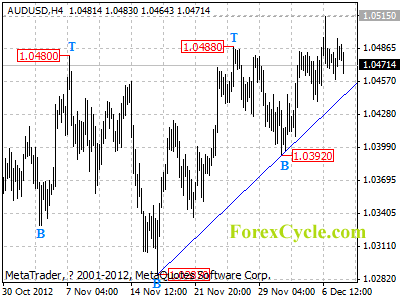
AUDUSD stays above a upward trend line

AUDUSD stays above a upward trend line on 4-hour chart, and remains in uptrend from 1.0287. As long as the trend line support holds, the uptrend could be expected to continue, and further rise to 1.0550 area is still possible. On the downside, a clear break below the trend line support will suggest that a cycle top has been formed at 1.0515, and the uptrend has completed, then the following downward movement could bring price back to 1.0000 zone.

audusd

Forex Signals

Why the Federal Reserve is Socialism’s Insidious Tool

By MoneyMorning.com.au

If you think for one second that the Federal Reserve System is a Godsend that backstops America’s banks and economy in times of trouble, you’d be right for that one second.

But if you take any time to learn how the Fed really works and in whose interest they operate, you’d make yourself sick for a long, long time.

The truth about the Federal Reserve is that it’s a dangerous, insidious socialist tool.


Rather than allowing free markets to function as a ‘clearing mechanism’ that rewards success and punishes failure, the Fed fosters underdevelopment of third-world nations, props up corrupt governments, protects the greedy, self-serving banking constituency it serves, and by design promotes socialism to further its mandate to enrich its masters.

I’m sick of the Fed and their control over the U.S. Congress, the American economy, and the world order.

It’s about time the American public revolted against the Fed and pandering Congressmen who pimp for it, abrogated their Constitutional duties to it, and get rich off it, all the while pretending they control it and it’s some kind of Constitutional safeguard.

The Untold Story About The Federal Reserve


You see, the Fed was the brainchild of a bunch of the world’s most powerful bankers and a few greedy U.S. Congressmen who were not surprisingly in the employ of banker backers.

The history of the Fed is a fascinating story about American politics and power-broking bankers. The undisputed truth about the creation and mandate of the Federal Reserve System is laid bare, beautifully I might add, in G. Edward Griffin’s ‘The Creature from Jekyll Island’.

I thought I knew a lot about the Fed, and it turns out I do. But there is so much more that I didn’t know, and it’s all laid out in the book, with all the accompanying references and proof.

It chilled me to my very core.

If the assignation of JFK was the end of the age of innocence, the end of Camelot, reading ‘The Creature from Jekyll Island’ will end all your illusions about banks and governments, forever.

Please read the book and tell everyone you know to read it, and make sure they do.

If you want to know how banks control Congress, read the book. If you want to know how banks control you, read the book.

If you want to know how banks use the Fed to protect themselves, buy legislators, finance dictators, subjugate foreign countries and make their banker masters filthy rich in the process, read the book. If you want to know who killed JFK, read the book.

Once you’ve read the book, nothing will ever be as it was. You will know things you never dreamed were happening. You will understand why things are the way they are.

And, most importantly, you will be able to see into the future because what’s happening in the world is planned. It’s part of a plan to make money. It’s always about money
Forget power. Power is nothing but a means to acquire money. Money is the prime motivator.

You know it. You see it every day. How else is it possible that a lot of (literally) criminals get into Congress with no money, but have to spend millions to get elected (guess where it comes from?) and come out of the other side multimillionaires?

You and I would have a very hard time turning about $175,000 a year after as little as four years into about $7.5 million, about the average net worth of Congressmen and women when they stop serving the public.

I just want to vomit.

Anyway, I’m bringing all this up because I just read the FDIC’s Quarterly Banking Profile.

And wouldn’t you know it, the banks are flush again. Gee, I wonder how that happened?

Seems like just yesterday they were all insolvent.

Oh, they were. That is until the Fed propped them up, coddled them, protected them and liquefied them with manna from heaven. That would be printed money and quantitative easing par infinitum.

How does the Fed promote socialism, why does it promote socialism? Think about it.

What’s so destructive about the Fed is that it can only serve its banker masters, who readily lend to umpteen insolvent governments (including our own) and get paid back in spades one way or another, if they lend so much that the only way to ever get paid back is to socialize countries so their collective debt is the responsibility of all its citizens.

Socialism is a slave-making system. There are no physical chains, but there sure are economic chains.

Ask the Greeks.

Shah Gilani
Contributing Editor, Money Morning

Publisher’s Note: This is an edited version of an article that first appeared in Money Morning (USA)

From the Archives…

How You Can Use Small-Cap Stocks to Leverage Your Share Returns
7-12-2012 – Kris Sayce

How to Make Cash-Like Returns Using Shares
6-12-2012 – Kris Sayce

How Long Can the Market Ignore These ‘Warning Signs’?
5-12-2012 – Murray Dawes

Is There Any Good News to Come from the US Debt Crisis?
4-12-2012 – Dr. Alex Cowie

Buy Small Caps Now While Investors Are Crying
3-12-2012 – Dr. Alex Cowie


Why the Federal Reserve is Socialism’s Insidious Tool

Live Flesh

Yesterday’s newspaper told us that the feds have come down on the side of gas producers rather than gas consumers. It was a rare victory against the zombies.

America is producing a lot more gas than it used to. The drillers want to liquefy the stuff, put it in tankers and ship it overseas… to be sold to the highest bidder. But large consumers want to keep the price low… but prohibit export. And the feds reserved the right to decide.

The Prohibition Economy

Yes. The U.S. economy is so zombified that you can no longer sell your output to whomever you choose. You have to ask permission.

In this instance, the feds agreed with the producers. But only after a “study” showed that it would be better for the economy to export it rather than keep it within U.S. borders.

Everywhere else, the zombies are gaining. A report in The Wall Street Journal confirmed what we already knew: Zombies don’t work very hard.

The Bureau of Labor Statistics has been compiling detailed data on how people use their time. Rather than just ask them… or just rely on how many hours people say they work… the researchers kept track themselves.

They tracked how many hours people slept, ate, watched TV and worked. And guess what? They found that federal government employees put in 3.8 fewer 40-hour weeks than employees in the private sector. If they were forced to work the same hours as people in the private sector, the government would save $130 billion a year.

Imperial Ambitions

Meanwhile, over in the Pentagon, R. Jeffrey Smith has his eye on the zombies too. From The Washington Post:

Of the many facts that have come to light in the scandal involving former CIA director David H. Petraeus, among the most curious was that during his days as a four-star general, he was once escorted by 28 police motorcycles as he traveled from his Central Command headquarters in Tampa to socialite Jill Kelley’s mansion.

Although most of his trips did not involve a presidential-size convoy, the scandal has prompted new scrutiny of the imperial trappings that come with a senior general’s lifestyle.

The commanders who lead the nation’s military services and those who oversee troops around the world enjoy an array of perquisites befitting a billionaire, including executive jets, palatial homes, drivers, security guards and aides to carry their bags, press their uniforms and track their schedules in 10-minute increments. Their food is prepared by gourmet chefs. If they want music with their dinner parties, their staff can summon a string quartet or a choir.

The elite regional commanders who preside over large swaths of the planet don’t have to settle for Gulfstream V jets. They each have a C-40, the military equivalent of a Boeing 737, some of which are configured with beds.

And then… even after they retire… the zombies keep feeding on the live flesh of the productive sector. From a report by the Center for Public Integrity:

Updating a 2010 Boston Globe report that documented the practice, Citizens for Responsibility and Ethics in Washington found that over the last three years, 70% of the 108 three- and four-star generals and admirals who retired “took jobs with defense contractors or consultants.”

As Sen. Claire McCaskill, D-Mo., put it during a 2009 hearing on Obama’s nomination of former Raytheon executive William Lynn to become the deputy secretary of defense, “It’s an incestuous business, what’s going on in terms of the defense contractors and the Pentagon and the highest levels of our military.”

If the Shoe Fits…

And on the letters page of the WSJ was another zombie at work… one who works in the private sector. Mr. Marc L. Fleischaker is the Trade Counsel for the Rubber and Plastic Footwear Manufacturers Association in Washington. Mr. Fleischaker is apparently concerned about the effect of the proposed Affordable Footwear Act.

We’re developing an uncontrollable chuckle as we write. You’d think there would be plenty of people in the shoe trade competing on price already. Apparently, there are Congressional staffers who are scratching their heads and fretting about it too. They say they’re eager to preserve affordable footwear in the U.S.

How will they do so?

Reading the letter in the WSJ, we are left with the knowledge that manufacturers working in low-wage companies in China and Vietnam satisfy 90% of America’s footwear needs. This should reassure the footwear worriers; we’re already getting shod at the lowest prices possible.

Instead, it seems to be a source of even more anxiety. Mr. Flieschaker thinks that something must be done. He writes:

As a nation, we do need to maintain significant tariffs on competitive imported footwear in order to somewhat balance the playing field and not lose the rest of manufacturing base.

We don’t understand how you balance the playing field by tilting it against importers.

But there is much more we don’t understand. How does prohibiting free trade make shoes “affordable?” Why is it important to keep people making shoes in the U.S.? Have cheap shoes become a strategic commodity; are we afraid of being cut off? Why is it any business of the politicians where people buy their shoes?

Dear reader: What has happened to America? The nation stands on the edge of an $86 trillion financial hole… and the hacks in Congress debate flip-flops!


Disclaimer

Article brought to you by Inside Investing Daily. Republish without charge. Required: Author attribution, links back to original content or www.insideinvestingdaily.com. Any investment contains risk. Please see our disclaimer.

Liquidity rule may alter monetary policy operations – BIS

By Central Bank News
    A new liquidity rule to be imposed on banks by global regulators will not fundamentally impair central banks’ ability to conduct monetary policy but may alter the way they carry out their operations, the Bank for International Settlements (BIS) said.
    The liquidity Coverage Ratio (LCR), which requires banks to hold enough liquid assets to survive 30 days of customer withdrawals and a credit squeeze, forms a critical part of the new Basel III banking regulations and is set to be introduced in 2015.
    But the new requirement, which has been agreed by global political leaders but recently run into headwinds from Europe, fundamentally affects monetary policy because central bank reserves form a major portion of banks’ liquid assets.
    Many central banks, for example the Federal Reserve, carry out monetary policy by setting a target for the interest rate at which banks lend to each other, typically reserves held in their accounts at the central bank, on an overnight and an unsecured basis.
    As these reserves are part of a bank’s portfolio of highly liquid assets, along with public and highly rated non-financial corporate bonds, the liquidity rule will potentially change the demand for those reserves and thus the relationship between market conditions and the resulting interest rate, BIS said.
    “The key takeaway from our analysis is that, while the LCR will not impair central banks’ ability to implement monetary policy, the process whereby this is done may need to adjust,” BIS said in a special feature in its December quarterly review.
     “In certain circumstances, central banks may choose to adjust their operational frameworks to better fit the new environment. At a minimum, they will need to monitor developments that materially affect the LCR of the banking system – just as they have traditionally monitored other factors that affect reserve markets,” it added.
    Reserves borrowed by banks from the central bank’s lending facility often perform a double duty: they are part of the banks’ required high-quality liquid assets (HQLA) and can also be applied towards the bank’s reserve requirements.
    This creates a direct link between the liquidity rule and the implementation of monetary policy. Banks that meet the liquidity rule without using central bank reserves are not affected while banks that rely on their reserve holdings to satisfy the LCR could be in trouble if there was a sudden payment outflow late in the day.
    The Basel Committee on Banking Supervision, the body of global supervisors that proposed the liquidity rule in 2010, is currently reviewing the rule’s impact on bank lending following criticism that it could harm Europe’s struggling economy.
    While some of the rule’s calculations may be tweaked, the main thrust of the rule looks to remain intact. Last month Basel Committee Chairman Stefan Ingves said several countries, including Sweden, were already applying the rule and there were no signs that monetary policy or the interbank market had been affected.
    The liquidity rule is part of a major reform of global financial regulations that aim to improve the banking sector’s ability to absorb financial shocks and reduce the impact on the real economy.
    The critical role of liquidity surfaced during the global financial crises that began in 2007 when many banks encountered a shortage of cash despite adequate capital levels.
     It became clear that sudden stress in financial markets could quickly lead to an evaporation of liquidity, requiring the central banks and authorities to support markets and institutions.
    In addition to the liquidity rule, the Basel Committee has also developed the Net Stable Funding Ratio (NSFR), which has a time horizon of one year and aims to ensure that banks fund their activities with stable sources.

    www.CentralBankNews.info
 

Easy policy didn’t boost emerging market currencies–BIS

By Central Bank News

   A further easing of monetary policy by major central banks in recent months, especially by the U.S. Federal Reserve and the Bank of Japan, has not triggered another burst of hot money into emerging markets or raised the value of their currencies as in previous years, according to the Bank for International Settlements (BIS).
    The Federal Reserve’s September announcement of unlimited purchases of mortgage-backed securities and its intention to keep rates at close to zero until mid-2015, along with Japan’s expansion of its asset purchases, was greeted with fresh accusations of protectionism and warnings of “currency wars”, especially by Brazil’s finance minister.
    The phrase was first used in 2010 after the U.S. Federal Reserve embarked on a second round of quantitative easing, which lowered the value of the dollar – which helps U.S. exporters and makes it harder for their competitors – and triggered an inflow of funds in search of higher yields in emerging market economies.
    “Yet this time the U.S. dollar appreciated in the three months from the beginning of September, both against a number of individual emerging market currencies and on a trade-weighted basis,” the BIS said in a special feature in its latest quarterly review, adding:

    “Softer growth prospects in emerging markets partly explain why their currencies and capital flows reacted differently to monetary easing in advance economies.”

    Several emerging markets also reacted to the Federal Reserve’s easing by policy measures, with Brazil’s central bank intervening in currency markets, and foreign exchange traders were under the impression that other central banks in Latin American and East Asia were also in the markets.
    In Europe, the Czech central bank said it may consider intervening and South Korean authorities investigated banks foreign currency positions and tightened limits on their exposure to currency derivatives.
   “All these measures were generally associated with more stable currency values, as evidenced by option implied volatilities,” BIS said.

China helps fill hole left by euro area banks in Asia – BIS

By Central Bank News
    A pullback by Swiss and euro area banks from Asia-Pacific has been countered by an expansion of local banks, including Chinese and offshore centers, resulting in a continuous rise in international credit to the booming region, the Bank of International Settlements (BIS) said.
    Fears of a lack of funding in Asia-Pacific due to the retrenchment of European banks after the global financial crises and the euro area’s debt crises thus never materialized.
    “The composition of international credit to emerging market economies in Asia-Pacific has shifted significantly in recent years. While banks from the euro area and Switzerland have pulled back, banks in the region have largely filled the gap,” said BIS, which tracks international bank lending.
    Foreign lending to Asia Pacific rocketed by 41 percent, or $613 billion to total outstanding claims of $2.1 trillion by mid-June 2012 from mid-2008, just before the collapse of Lehman Brothers, BIS said in its December quarterly review.
    This expansion is in stark contrast to a drop in international lending to emerging Europe of 14 percent, or $230 billion, and a more modest increase in lending to Latin America of 24 percent, or $254 billion, in the same period.
    In Asia Pacific, the total claims of euro area banks shrank by an estimated 30 percent, or around $120 billion, between mid-2008 and mid-2012 and their share of foreign lending fell from 27 percent  to 13 percent by mid-2012, BIS said.
    The decline was mirrored by a rise in the share of lending by banks from other countries to 37 percent from 27 percent.
    “These include banks headquartered in Asian offshore centres and Asia-Pacific countries that report in the BIS international banking statistics and also non-reporting banks, which most likely are predominantly Chinese,” BIS said.
    The estimated intraregional lending accounted for 36 percent of total international claims on emerging Asia-Pacific by mid-2012, up from an estimated 22 percent a few years ago.
    The overall share of U.K., U.S. and Japanese banks of total foreign claims on Asia-Pacific was relatively stable since the start of the global financial crisis in 2008 at around 23 percent, 16 percent and 11 percent, respectively.
    Incomplete data made it hard for BIS to pin down the exact origin of all lending to Asia-Pacific, but it includes a rise in foreign claims on that region by banks headquartered in Asian offshore centers (Hong Kong SAR and Singapore) to $225 billion by mid-2012 from $119 billion in mid-2008.
    Banks headquartered in Asian countries that report to the BIS (Taiwan/Chinese Taipei, India and Malaysia) doubled their intraregional foreign claims to $111 billion while Australian banks’ claims on the region have risen almost threefold since mid-2008, to $54 billion.
   But BIS lending data also indicate rapid growth in cross-border credit provided by banks that are not headquartered in one of the BIS reporting countries and BIS said it is likely that banks headquartered in the region account for the bulk of these other claims.
    Drawing on other sources, such as Bankscope, BIS found that the unconsolidated total assets of Chinese banks’ foreign offices in Asia (excluding Singapore) grew by $135 billion, or 74 percent, from 2007 to 2011.
    And based on data from Dealogic, BIS learned that Asian banks, including those from Hong Kong and Singapore, increased their syndicated loans to emerging Asia Pacific by 80 percent, or $223 billion, from 2007 to 2001. Asian banks’ share of total signings rose to 64 percent from 53 percent.
 

BIS not worried by U.S. delay of Basel III bank rules

By Central Bank News
    The Bank for International Settlements (BIS) is looking forward to full implementation of the new Basel III banking regulations and is not worried by the United States’ delay in applying the global rules.
    BIS Economic Adviser Stephen Cecchetti said “some jurisdictions are having small technical problems on meeting the exact timetable to which they have committed so there are modest and immaterial delays.”
    Last month the United States said it had delayed indefinitely the implementation of Basel III beyond the internationally-agreed date of January 1, 2013 due to the high volume of comments received and the range of views that were expressed.
    The delay raised fears that other countries could backtrack on their commitments to implement the new tougher banking rules following criticism by both U.S. and UK officials that the Basel III rules were too complex and should be redrafted.
    But Cecchetti said the Basel III rules had been agreed by global leaders and were now in the process of being implemented.
   The Financial Stability Board (FSB), which monitors the implementation of global financial rules, said in October that only eight of 27 countries had issued their new banking rules so it was highly likely that only six of 28 global systemically important banks would be subject to Basel III in January.
    Although the U.S. Federal Reserve did not give a new date for the implementation of Basel III, it said it was working as hard as possible to complete the rule-making process.
    Despite the delay, U.S. banks in fact already exceed Basel minimum capital requirements and will be subject to stress tests early next year that reflect Basel III requirements.
    Swiss-based BIS, also known as the central bankers’ bank, houses the Basel Committee on Banking Supervision, the body of global supervisors that agreed on Basel III in 2010, along with the FSB and other global financial institutions.
    The Basel III rules and timetable have been endorsed many times by global political leaders, most recently by the Group of 20 finance ministers and central bank governors in Mexico last month.
    Apart from the delays in implementing Basel III, Cecchetti said other jurisdictions had inconsistencies with the rules and these had to be addressed so implementation could proceed.
    “The earlier we incorporate the new standards into national legislation, the easier will be the transition, the lower the costs of regulatory uncertainty and the sooner we will start to benefit from stability and a solid foundation of the system,” Cecchetti told reporters in a telephone conference.

    www.CentralBankNews.info