Namibia holds rate, rate help cushion slow global growth

By www.CentralBankNews.info     Namibia’s central bank held its benchmark repo rate steady at 5.50 percent, saying low interest rates should be maintained to cushion the impact of slower growth in many trading partners.
    Despite fragile global growth and the uncertain outlook, the Bank of Namibia said domestic growth remained relatively strong and inflation “remains at tolerable levels” although it was rising.
    In August the central bank cut its rate by 50 basis points to counter the weak global outlook.
    A rise in inflation to 7.1 percent in October from 6.7 percent was mainly due to higher food and beverage prices and given the almost 30 percent weighting of food items in the inflation basket, this alone can influence the direction of headline inflation, the central bank said.
    “The majority of food inflation experienced in Namibia remains driven by external cost-push factors, which are out of Namibia’s control,” the bank said in a statement, adding that transportation also pushed up inflation.
    Namibia’s economic growth is expected to ease to 4.6 percent this year from 2011’s 4.8 percent, with growth mainly driven by mining activities.

    Namibia’s Gross Domestic Product expanded by 1.6 percent in the second quarter from the first for annual growth of 8.9 percent, up from 3.7 percent in the first quarter.
    The bank said credit extended to the private sector rose by an annual 16.6 percent in October – “which illustrates sustained demand for credit as a result of the accommodative policy stance” – the highest level of credit growth in 5-1/2 years, driven by credit to businesses which rose 21.1 percent annually.
    Credit to individuals eased to 14 percent in October from 14.7 percent, but the bank said this was still an elevated level. It noted that instalment credit growth had slowed to 15.2 percent from 19.5 percent and if this trend was sustained, it could help stabilize the high level of individual debt.
   
    www.CentralBankNews.info

Central Bank News Link List – Dec. 12, 2012: Fed set to expand its monetary stimulus

By www.CentralBankNews.info     Here’s today’s Central Bank News link list, click through if you missed the previous link list. The list comprises news about central banks that is not covered by Central Bank News. The list is updated during the day with the latest developments so readers don’t miss any important news.)

“Scope for Gold at $2400” as US Monetary Policy “Designed to Weaken the Dollar”

London Gold Market Report
from Ben Traynor
BullionVault
Wednesday 12 December 2012, 07:30 EST

THE SPOT gold price climbed back above $1715 an ounce Wednesday morning, around ten Dollars up from last week’s close, as stocks, commodities and the Euro also edged higher and US Treasuries dipped, ahead of today’s Federal Reserve policy announcement.

Silver meantime edged above $33.20 an ounce this morning, a slight gain on where it started the week.

Several analysts have predicted the Fed will today announce open-ended Treasury bond purchases worth $45 billion a month. In September the Fed announced it will buy $40 billion of mortgage-backed securities a month, while its maturity extension program Operation Twist, through which it sells shorter-dated bonds to buy longer-dated ones, ends this month.

“We have a six-month [gold price] target of $2000 an ounce, but see scope as well for prices to rise to $2400 an ounce by the end of 2014,” says the 2013 outlook from Bank of America Merrill Lynch metals strategists this morning, in contrast with the Goldman Sachs gold forecast for 2014 made last week.

“These targets reflect our view that the Fed will maintain mortgage purchases until the end of 2014 and will move to buy Treasuries following the end of Operation Twist in December 2012.”

“Quite clearly the US wants a lower Dollar and its monetary policy is certainly geared to deliver it,” says currency strategist Steve Barrow at Standard Bank in a note this morning.

“If policy is geared to weaken the Dollar even more, through further monetary easing today, it won’t stop any short-term safe haven demand for the Dollar that might arise out of fiscal cliff, but it could impair the ability of the Dollar to continue any such strength into the longer term.”

President Obama and House of Representatives speaker John Boehner exchanged new proposals on how to reduce the US deficit yesterday, press reports says, as part of ongoing negotiations aimed at avoiding the so-called fiscal cliff of tax rises and spending cuts currently due at the end of the month unless Congress passes legislation to prevent them.

Obama has reduced his request for additional tax revenue over the next decade from $1.6 trillion to $1.4 trillion, Associated Press reports, but has not changed his call for top income tax rates to be raised.

“I’m pretty confident that Republicans would not hold middle-class taxes hostage to trying to protect tax cuts for high-income individuals,” Obama told ABC News Tuesday.

The two sides are yet to reach an agreement.

In Toronto meantime Bank of Canada governor Mark Carney, who takes over at the Bank of England next year, suggested Tuesday that central banks might consider adopting nominal gross domestic product targets as an alternative to inflation targeting.

Under NGDP targeting, a central bank would aim to promote economic growth by targeting a given level of economic output in a given year.

“Adopting a nominal GDP-level target could in many respects be more powerful than employing thresholds under flexible inflation targeting,” Carney said.

“This is because doing so would add ‘history dependence’ to monetary policy. Under NGDP targeting, bygones are not bygones and the central bank is compelled to make up for past misses on the path of nominal GDP.”

Greece concluded its debt buyback program Tuesday, with unnamed official sources reporting it has received bids to sell bonds with €31.8 billion face value – above the €30 billion needed to secure Greece’s next tranche of bailout funding.

The average price paid for the bonds was however slightly above that targeted, meaning Greece’s debt to GDP ratio was reduced by 9.5 percentage points rather than the 11 targeted, according to the source.

The Euro extended yesterday’s gains against the Dollar Wednesday, climbing back above $1.30.
China, the world’s biggest gold producer and the second-biggest source of private demand last year, produced 34.6 tonnes of gold in October, China’s Ministry of Industry and Technology said today.

October’s production brings the total for the first 10 months of 2012 to 322.8 tonnes, an 11% increase on the same period last year.

Over in India, which imports most of its gold and is traditionally the world’s number one source of demand, efforts should be made to reduce imports of gold and so lower the current account deficit that has risen to record levels, the All India Gems & Jewellery Trade Federation said Wednesday.

Lending 10% of the gold held with temples and householders to jewelers would provide three years’ worth of supply, according to federation chairman Bachhraj Bamalwa.

“The only way India can reduce its dependence on imports is to tap the gold lying with individuals and temples,” agrees Kishore Narne, head of commodity and currency at Mumbai broker Motilal Oswal.

“By doing this, the country can reduce influx of gold at these high prices. Appetite for gold is never going to diminish.”

Ben Traynor
BullionVault

Gold value calculator   |   Buy gold online at live prices

Editor of Gold News, the analysis and investment research site from world-leading gold ownership service BullionVault, Ben Traynor was formerly editor of the Fleet Street Letter, the UK’s longest-running investment letter. A Cambridge economics graduate, he is a professional writer and editor with a specialist interest in monetary economics. Ben writes and presents BullionVault’s weekly gold market summary on YouTube and can be found on Google+

(c) BullionVault 2012

Please Note: This article is to inform your thinking, not lead it. Only you can decide the best place for your money, and any decision you make will put your money at risk. Information or data included here may have already been overtaken by events – and must be verified elsewhere – should you choose to act on it.


Iceland holds rate steady, changes depend on wage rises

By www.CentralBankNews.info     The Central Bank of Iceland kept its benchmark seven-day collateralised lending rate steady at 6.0 percent, as expected, and said future interest rate changes would depend on the outcome of wage negotiations.
    The central bank, which has raised rates five times this year, said economic developments had been in line with its November forecast, the exchange rate was stable and inflation as expected.
    Iceland’s inflation rate rose to 4.5 percent in November from 4.2 percent the previous month and the central bank said preliminary data showed that economic output had expanded by 2.0 percent in the first three quarters of the year, slightly below the bank’s 2.1 percent forecast.
    The bank’s interest rises since August and the fall in inflation had withdrawn “a considerable amount” of the accommodative monetary stance and the degree to which further normalisation of the stance happens will “depend on future inflation developments, which in turn will depend to a large extent on exchange rate movements and wage-setting decisions,” the bank said in a statement.

     “Whether the Bank’s nominal interest rates remain unchanged in the near term will depend, among other things, on whether the outcome of the forthcoming wage settlement review at the beginning of next year is consistent with inflation declining to the target,” the bank added.
    Iceland’s central bank targets inflation of 2.5 percent. The central bank has raised its benchmark rate by 125 basis points this year and inflation has been coming down from over 6 percent in the first half.
    The central bank had been expected to keep rates unchanged after the governor last week said the bank was likely to keep interest rates steady in the short term but warned they could rise further if wage increases exceed the inflation target.

    Iceland’s Gross Domestic Product rose 3.5 percent in the third quarter from the second for annual growth rate of 2.1 percent, up from 0.5 percent. The unemployment rate rose to 5.2 percent in October from September’s 4.9 percent.
    The central bank has forecast 2012 growth of 2.5 percent, in line with 2011’s revised growth of 2.6 percent.

    www.CentralBankNews.info

AUD/USD: Aussie Rises Over Greenback on Fed Expectations and Iron-Ore Forecast

The markets have been pricing in continued weakness for the US dollar today opposite its riskier major counterparts, including the Australian dollar, on speculations that the Federal Reserve will announce an expansion of its asset purchases program today. Demand for risk is fueling the financial markets and higher-yielding assets are expected to yield gains.

A risk rally has been directing market movement as economists anticipate the Fed will add Treasury purchases to an existing program that buys $40 Billion in mortgage bonds each month. Reports that Athens was able to meet its bond buyback target are also pushing the demand for risk. Further, a jump in German investor confidence this December has likewise provided support for the increase in the demand for higher-yielding investments.

A Bloomberg survey of economists states that the Federal Open Market Committee will announce a decision to amplify record accommodation in monthly Treasury buying that will push its balance sheet to almost $4 Trillion. The central bank is scheduled to end Operation Twist this month. The program swaps $45 Billion of short-term Treasuries each month for longer-term government debt, keeping the total size of the balance sheet unchanged. The monetary policy panel pledged in October to continue that plan until the labor market improves “substantially.”

While these speculations have spurred the Aussie to rise to a two-month high, a lift in iron-ore price forecast for 2013 is perceived to further aid the appreciation. The Australian Bureau of Resources and Energy Economics stated in a report today that prices will average A$106 a metric ton in 2013, compared with a September estimate of A$101 a ton. Prices are set to average A$128 a ton in 2012 from A$126 a ton forecast in September, and Australia could likely ship 481 million tons in 2012 and 543 million tons in 2013, from 483 million tons and 528 million tons predicted in September. Expectations that infrastructure projects and stimulus spending by China, the world’s biggest buyer of iron-ore and Australia’s primary trade partner, will boost demand led to the forecast revision.

With these in mind, a buy bias can be considered for the AUDUSD today. Technical price corrections are likely, especially as the price index is already signaling an overbought position.

For more news, analysis, technical charts and candlestick analysis, visit AlgosysFx Forex Trading Solutions.

Are Indian Stocks a Buy ?

By The Sizemore Letter

In terms of generating raw frustration among investors, India is a hard country to beat.  It has the second-largest population in the world, but unlike number one China, it also has a young, English-speaking workforce.  The country has a large and successful diaspora scattered across the globe and old trade ties that date back to the British Empire.  It’s democratic…and has an Anglo-Saxon common law legal system.

I could go on all day, but it wouldn’t matter.  Despite all of India’s selling points, the country can’t seem to get out of its own way.   Since independence from Britain, India’s economic growth has so badly trailed that of China and several other East Asian economies that economists derisively called it the “Hindu rate of growth.”  In the early days of the Indian republic, the country copied the worst aspects of British bureaucracy and Soviet central planning and melded the two into a unique Indian “self sufficiency” model that virtually guaranteed economic stagnation.

Even in more recent times, India has appeared downright hostile to foreign investment.  Earlier this year, India’s Supreme Court invalidated the licenses of several foreign telecom operators.  The Court claimed—and probably with justification—that the licenses were granted illegally by a corrupt government minister, but the incident made many Western firms rethink their decision to invest in India.  A deal isn’t a deal there.

Some of India’s “wins” are actually losses in disguise.  For example, India has embraced the information revolution better than any other major emerging market and has used the falling price of communications to create a thriving outsourced services sector.  But one of the reasons that India was so quick to jump into the information revolution is that the country’s “old economy” infrastructure (everything from roads to its sewage system) is so horrendously bad that competition with China in manufacturing is an impossibility—even though Indian wages are significantly cheaper than Chinese wages.

I give credit to India’s entrepreneurs.  They operate in an environment that would cause most Western businessmen to lose their hair or drop dead of a heart attack as they look for creative ways to leapfrog the regulatory monster known as the Indian state.

But lest anyone think that I am a perma-bear on India, not all news is bad.  Prime Minister Manmohan Singh appears to have rediscovered the reforming zeal of his earlier years and has pushed through a much-needed reform of the Indian retail sector.  He tried opening the retail sector to foreign retailers once before, only to back down at the first sign of protest. Perhaps the prime minister has rediscovered his backbone as well as his talent for economic reform.

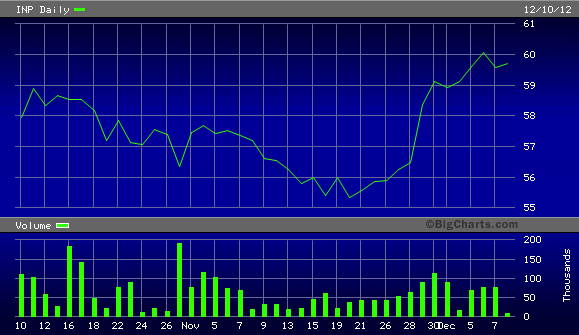
Investors have taken note.  Indian stocks, measured here by the iPath India Index ETN (NYSE: $INP) have spent most of the past two years in a bear market but have had a nice run since late November.

Are Indian stocks a buy at current prices?  That’s harder to say.  At 17 times earnings see (FT estimates), Indian stocks are far from cheap, particularly when you compare them to Chinese and other emerging market averages.  Chinese stocks are trading hands for just 8 times earnings, and Brazilian stocks just 14.

It’s hard to get wildly enthusiastic about Indian stocks based on valuations, but that doesn’t mean that they can’t have a nice run as investors rediscover the joys of emerging markets.  I’m bullish on emerging markets in general over the next 6-12 months, and I expect to see India participate in the rally.

Just don’t fall in love with Indian stocks, or they will break your heart.  If you decide to buy India, use a trailing stop to lock in your profits for the next time the Indian government does something characteristically impulsive and causes investors to lose interest again.

Disclosures: Sizemore Capital has no positions in any security mentioned. This article first appeared on InvestorPlace  

The post Are Indian Stocks a Buy ? appeared first on Sizemore Insights.

Sri Lanka cuts rate 25 bps to 7.5% as inflation seen easing

By Central Bank News

The Central Bank of Sri Lanka cut its benchmark repurchase rate by 25 basis points to 7.50 percent, saying an expected decline in inflation by the second quarter of 2013 would allow it to ease monetary policy and support the economy so the growth potential can be reached in 2013 and following years.
The central bank, which raised rates twice earlier this year to limit credit growth, also said it would let the ceiling on rupee credit that can be extended by banks expire by year end as it had “served its purpose and such a policy measure may not be required in the near future.”
Sri Lanka’s inflation rate rose to 9.5 percent in November, equalling this year’s high in August, from 8.9 percent in October, mainly due to increases in administered prices and recent tariff adjustments while adverse weather caused high prices of fresh food items.
“Going forward, although the Monetary Board is satisfied that domestic aggregate demand has been contained to moderate levels, it is likely that y-o-y headline inflation could remain somewhat elevated in the immediate months due to supply side factors,” the bank said in a statement.
However, the bank added that inflation is expected to moderate toward the second quarter of 2013 and stabilize thereafter due to the strong demand management policies at the start of the year.
    The central bank said the rate hikes earlier this year to curtail excessive credit growth and limit demand for imports had helped reduce imbalances in the economy, reduce the monetary expansion and future demand pressures. The bank had also expected a modest slowdown in economic activity, reflected in growth forecasts for 2012 being revised down to 6.8 percent from 2011’s 8.3 percent.
Growth of credit to the private sector from banks has continued to decelerate, reaching an annual rate of 23.5 percent in October, down from over 35 percent prior to March.
“This growth is expected to decelerate further to around 19 percent by end 2012,” the bank said.
The trade deficit has also declined for the second consecutive month and this trend is expected to continue under the current flexible exchange rate regime.
Sri Lanka’s Gross Domestic Product expanded by an annual rate of 6.4 percent in the second quarter, down from 7.9 percent in the first.
The bank expects the economy to expand by 7.5 percent in 2013.

www.CentralBankNews.info

W.African central bank holds rate, sees stable inflation

By Central Bank News     The Central Bank of West African States (BCEAO) left its benchmark marginal lending rate unchanged at 4.0 percent and said economic activity in the West African Monetary Union (WAMU) continues to improve and inflation is expected to slow down in the fourth quarter.
    The central bank, which cut its rate by 25 basis points in June, said inflation should slow to 2.5 percent by the end of December due to a better supply of grain and inflationary expectations are broadly in line with the bank’s price stability objective.
    “Average annual inflation is expected to be 2.3 percent in 2012 against 3.8 percent in 2011. In a  horizon of 24 months, the rate is projected at 2.4 percent,” the bank said in a statement issued following the monetary policy committee’s fourth meeting of the year on Dec. 7.
    The annual inflation rate rose to 2.7 percent end-September from 2.1 percent in June due to an upward adjustment in fuel prices and some member states raised prices of cereals and fish products.
    The bank said economic activity continued to strengthen, especially in secondary and tertiary sectors, with industrial production up 3.0 percent in the third quarter after a rise of 3.2 percent in the second.
    Monetary conditions were also favorable with the weekly weighted average interbank transactions rate at 4.13 percent in the third quarter, down from 4.24 percent in the second quarter.
    The central bank implements the monetary policy of the West African Monetary Union, which comprises Senegal, Burkina Faso, Guinea Bissau, Ivory Coast, Mali, Niger, Togo and Benin.

    www.CentralBankNews.info

Global Monetary Policy Rates – Nov. 2012: Interest rates continue to fall, average global rate down to 5.9%

By Central Bank News

    (NOTE TO READERS: Central Bank News is introducing a new feature under the title of Global Monetary Policy Rates (GMPR). GMPR replaces and expands the previous feature titled Global Interest Rate Movements. GMPR will be issued monthly and reviews the monthly changes in official interest rates worldwide.)
   
    Global monetary policy interest rates were cut by 470 basis points during November to an average 5.91 percent from October’s 5.96 percent, strengthening this year’s trend of falling interest rates.
    Benchmark interest rates at the 88 central banks followed by Central Bank News have been declining steadily all year, from an average of 6.42 percent in the first quarter to 6.31 percent in the second and 6.11 percent in the third quarter of 2012.
    In the month of November, eight central banks cut policy rates compared with three banks (Iceland, Serbia and Bulgaria) that raised rates, boosting the number of rate cuts in the first 11 months of this year to 114 compared with 28 rate increases.
    November’s notable rate cuts were by the Czech Republic, Colombia, Poland and Mozambique.
    The Czech Republic joined the exclusive club of central banks that have cut rates to essentially zero; Colombia and Poland have now reversed earlier rate rises to bring rates below their level at the start of the year; Hungary cut further despite high inflation, and Mozambique cut for the sixth time this year but looks like it may have won its battle against inflation.
    More than half of the world’s central banks have cut rates this year, with 45 of the 88 banks followed by Central Bank News cutting in the January-November period compared with 11 central banks that have raised rates. Thirty-two central banks have left rates unchanged in the same period.

        Emerging market central banks were again the most active in loosening their policy in November, with four banks cutting rates while all developed market central banks kept rates on hold.
    The average policy rate in developed market central banks was 1.1 percent in November compared with the 4.8 percent average rate among emerging market central banks, illustrating the limited scope for further rate cuts by central banks in advanced economies.
   In the first 11 months of the year, emerging market central banks have cut rates by a total of 1,026 basis points compared with cuts of 325 basis points by developed market banks.  

    Two-thirds of all emerging markets central banks have cut rates this year while just under half of central banks in developed markets have cut.
    But the true extent of policy easing by developed markets central banks is not fully reflected in these figures as they do not capture the quantitative easing that major central banks have undertaken. Policy rates at the Federal Reserve, the Bank of Japan, and the Bank of England have been at effectively zero since 2009.
    Central banks in frontier markets have been the most aggressive in cutting rates this year, with policy rates cut by a total of 1,523 basis points in the first 11 months, lead by Kenya which cut by 200 basis points in November for a reduction of 700 basis points year-to-date.
    Countering the global policy easing are total rate rises of 1,570 basis points by all central banks in the first 11 months of this year. More than half of this increase is accounted for by Malawi’s total rate hike of 800 basis points – 400 basis points in November alone – as the country struggles with falling foreign exchange reserves and roaring inflation.
    In 2011 the average global monetary policy rate of the 88 central banks followed by Central Bank News was 6.0 percent. This compares with the 2010 average policy rate of 4.3 percent, 5.2 percent in 2009, 7.4 percent in 2008, 6.9 percent in 2007 and 6.2 percent in 2006.
 INTEREST RATE CUTS, YEAR-TO-DATE IN BASIS POINTS, NOVEMBER 2012:

COUNTRY     YTDCOUNTRY     YTDCOUNTRY     YTD
BELARUS-1500HUNGARY-100SOUTH AFRICA-50
UGANDA-1050LATVIA-100SOUTH KOREA-50
KENYA-700MONGOLIA-100SWEDEN-50
MOZAMBIQUE-550PHILIPPINES-100THAILAND-50
VIETNAM-500ALBANIA-75ANGOLA-25
MOLDOVA-400ISRAEL-75CHILE-25
BRAZIL-375ROMANIA-75COLOMBIA-25
TAJIKISTAN-330CZECH REPUBLIC-70EURO AREA-25
GAMBIA-200CHINA-56INDONESIA-25
KAZAKHSTAN-200DENMARK-50MACEDONIA-25
PAKISTAN-200INDIA-50MOROCCO-25
DOMINICAN REPUBLIC-175KUWAIT-50NORWAY-25
CAPE VERDE-150MAURITIUS-50T&T-25
GEORGIA-125NAMIBIA-50W. AFRICAN STS.-25
AUSTRALIA-100POLAND-50BULGARIA-18

Ukraine Crushed in $1.1bn Fake Gas Deal

By OilPrice.com

Certainly the folks at Gazprom are having a good snicker, reveling in the mockery that has been made of what should have been a landmark Ukraine-Spain gas deal that would have loosened Russia’s gas grip on Kiev.

Everyone wondered how Russia would respond to Ukraine’s attempt at gas independence. But this is what happens when you mess with Gazprom.

It was a horrible moment for Ukraine last Monday—all the more horrible because the whole event was televised—when the historical $1.1 billion deal it was about to sign with Spain’s Gas Natural Fenosa turned out to be fake.

Why was the deal historical? It would have secured $1.1 billion in investment for the construction of Ukraine’s first liquid natural gas (LNG) terminal on the Black Sea and a pipeline connecting the country’s vast gas network to the terminal.

More to the point, this would enable Ukraine to import by tanker up to 10 billion cubic meters of European gas at a price 20% cheaper than Gazprom. Even more to the point, it would be a major first step toward reducing Ukraine’s dependence on Russia.

The deal was that investors had apparently signed agreements through a newly formed consortium for the construction of the $1.1 billion LNG terminal.

Here’s how the ill-fated signing ceremony went down:

While Ukrainian Prime Minister Mykola Azarov and Energy Minister Yuriy Boyko were cutting the ribbon on the construction of the terminal in a live televised ceremony, the country’s investment chief, Vladislav Kaskiv, was attending the official investment signing ceremony elsewhere, also via live video feed. This is where walls caved in very suddenly.

Signing on behalf of Fenosa was one Jordi Sarda Bonvehi. At the 11th hour, Fenosa let it be known that they have no idea who Bonvehi is and that he certainly does not represent the company in any way. Fenosa apparently had no idea it was signing a landmark agreement with Ukraine.

Kiev was necessarily taken aback, and Bonvehi remained conveniently silent at the signing ceremony once the news broke out.

Of course, what no one knows is how Ukrainian authorities were led to believe—during multiple rounds of negotiations—that Bonvehi was a Fenosa representative.

The story being bandied about by authorities in Kiev is now that Bonvehi was under the impression that Fenosa would sign the deal with Ukraine and that he would be given the authority to sign the deal retroactively.

But Fenosa denies it has ever considered such a deal and continues to deny any relationship at all with Bonvehi.

So where does that leave us? It leaves Ukraine in the lurch. There is no way it can fund this terminal on its own, despite its claims to the contrary. We probably don’t have to look much further than Gazprom and the Ukrainian oligarchy to find where this beautifully crafted charade was hatched.

In the meantime, Bonvehi—if such a person of that name even exists—remains elusive. No one knows who he really is or who he really works for.

More than anything, it’s an advertisement for due diligence.

Source: http://oilprice.com/Energy/Natural-Gas/Ukraine-Crushed-in-1.1bn-Fake-Gas-Deal.html

By. Jen Alic of Oilprice.com