How the Global Oil Grab Affects You…

By MoneyMorning.com.au

How much oil does it take to be part of the modern world?

Today, per capita oil use in the U.S. is about 22 barrels per year and 24 barrels in Canada. That’s how we get our so-called ‘non-negotiable standard of living’.

In Europe, with its famously high fuel taxes, cold apartments in winter and wonderful passenger rail system, per capita oil use is about 10 barrels per year. I suppose that in Europe, their standard of living is slightly more negotiable. Wimps, right?

By comparison, in still-developing China, per capita oil use is about 2.5 barrels per year. In even less-developed India, per capita oil use is just over one barrel per year. This doesn’t even hint at the mountainous disparity in energy access between the (few) wealthy people and (multitudes of) poor people.

Think this through. If you’re a North American, using 22-24 barrels of oil per year, will you scale back and use less if the price goes up? Will you negotiate your non-negotiable standard of living? Probably yes, because, after all, you’ve got a lot of room on the downside of your demand. (Look at how those poor Europeans schlep by on 10 barrels per year.)

The bottom line is that the average North American can surrender a barrel or two of oil use.

But if you’re Indian or Chinese and using under three barrels of oil per year per capita, what will it take for you to cut back on use?

The answer is that you won’t cut back, and you certainly won’t give up your barrels just because of higher oil prices. Indeed, if (actually, when) the price of oil rises, the better-off Chinese and Indians are likely to suck it up and pay what it takes to lay hands on that extra marginal barrel. After all, they want to be modern.

In other words, as the forces of economics unfold, it’s far more likely that average U.S.-Canadian and European oil use will decline than will Chinese or Indian oil use.

Indeed, it stands to reason that the ‘average’ Chinese or Indian will pay much more to get one of those annual barrels away from a Westerner. That’s exactly what the numbers show!

Auto Anxiety?

Along these lines, the changing demand scenario – wealth and demand shifting from West to East – appears to be playing out. That is, in the established ‘Western’ world, oil consumption in Europe and North America has declined in recent years.

For example, and for a variety of reasons, Europeans and North Americans are driving fewer miles and flying fewer airline flights.

Let’s look at data in North America. According to the U.S. Department of Transportation, Americans drive fewer miles today than six years ago. Adjusted for population, U.S. drivers are racking up about one-sixth fewer miles since 2006. There are fewer registered vehicles, as well. Here’s the long-term chart for miles driven.

The mileage numbers clearly indicate a structural shift in the U.S. economy. Contrary to one pervasive political myth, Americans don’t just drive more cars with better mileage. They’re driving fewer absolute miles, and in the process burning less fuel. That is, U.S. drivers have changed behavior due to high fuel prices.

What’s happening? We’re competing for the ‘same’ underlying oil barrels – in a world of flat output – against people from developing nations in the Middle East, Asia, etc.

Culturally, we in the U.S. like to think that ours is a ‘rich’ country. Yet in the oil pits of the planet, we’re actually getting outbid by developing nations for the world’s marginal barrels of oil.

While I’m on the subject, I should note that other forms of technology account for some of the driving mileage decline, as well.

For example, according to the Bureau of Labor Statistics, over 5 million U.S. workers now ‘telecommute’ between a home office or remote site and their ‘official’ place of work. This saves fuel, although it adds a new psychological and social twist to working. In other words, modern workers had better enjoy being around their home and family.

It’s also accurate to say that the recent decline in miles driven reflects the lingering economic recession in the U.S. economy. Many people aren’t driving much anymore because they have nowhere they really need to go, and not a lot of money to pay for gas. It’s what happens when a ‘rich’ nation gets poor.

Grounded America

The decline in fuel use isn’t just confined to cars and trucks. Aviation industry data reflect a major contraction in available flights and overall airline fuel usage.

According to the Federal Aviation Administration (FAA), total airline departures fell over 13% in the U.S. between 2007 and 2011. That is, in 2007, the FAA logged over 10.5 million scheduled airline departures. By 2011, the number had declined to about 9.1 million departures, due to airlines cutting back on routes and trimming their schedules.

It’s interesting that the decline in airline departures didn’t hit too heavily at major hubs, like New York, Chicago, Atlanta, Dallas, Los Angeles, etc. Major hub departures fell from just over 6.2 million in 2007 to 5.9 million in 2011. That’s a pullback of under 5%.

But for medium and small cities with airports? Their departure numbers crashed, so to speak. In 2007, medium and small hubs had well over 3.3 million departures. By 2011, that number was down to 2.5 million, a decline of over 24% – which continued all through 2012, although statistics aren’t out yet.

Indeed, across the U.S., many small towns lost almost all – if not all – scheduled airline service. They’re now virtually cut off from regular commercial air access.

One Decline Didn’t Lead to Another

The bottom line for the U.S. is that the country’s daily oil demand has declined between 2007 and now from about 21 million barrels per day to about 18 million barrels per day. Any number of politicians brag about how the U.S. economy is ‘conserving energy’ and becoming ‘more efficient’.

Actually, it’s equally arguable that the numbers reflect a nation in long-term economic decline.

There’s another angle to this, as well. While U.S. fuel usage has declined for cars, trucks and airliners, over the past five years, lower U.S. demand has not translated into lower global prices for oil. Why not? Doesn’t the U.S. set the world price for oil? Well, no, not anymore. It gets back to that oil production plateau that I discussed, yesterday.

For every barrel of oil that the U.S. isn’t using, other nations are buying it and burning it in their cars, trucks and airplanes. Outside the U.S., global demand for oil is strong, and even rising. The developing world leads the charge.

Six Yankee Stadiums Every Day

Looking ahead, is there enough oil to go around? That question gets us back to the crude oil story. How much is 84 million barrels of oil, the amount that the world uses up every day?

Did you ever visit the old Yankee Stadium in New York? Here’s an aerial shot of the place from the 1920s, on a day when a full house was rooting for the home team. Yankee Stadium was pretty big, right?

Now imagine Yankee Stadium filled to the brim with crude oil, instead of baseball fans. In fact, imagine six Yankee Stadiums filled to the brim with crude oil.

That is, if you filled six Yankee Stadiums with crude oil, you’d have about 84 million barrels, which is about the amount of oil that the world uses up every day in recent years.

When you add it all up, at the end of every day, the world has about 84 million barrels to go around – six Yankee Stadiums. Then, all this oil moves by tanker, pipeline and truck to refineries, to be turned into product that keeps the engines turning.

When the clock strikes midnight – at least, in a figurative sense – the world has to do it all over again the next day. It’s all day, every day, and quite an industrial process.

The Middle East Problem

Could it all just stop one day? Could the world’s oil supply and refining system just shut down and everything seize up like an overheated engine? No, it won’t work that way.

But you should anticipate that world oil production will have a hard time increasing upward from the current 84 million barrel daily plateau, due to all manner of technical and capital cost issues – EROI foremost among them.

More worrisome, it’s quite possible that overall, daily world oil output could decrease from 84 million barrels, even with an all-out fracking push in the U.S. Uh-oh.

Looking ahead, it’s pretty much written that oil exports to everywhere will decline from suppliers in the Middle East. Middle East demand is growing much faster than new supply additions. (Iraq might offer a bright spot, but that place has its own issues, as I’m sure you know.)

Here we are getting back to that Peak Oil argument. We’re dealing with an idea – and at root, it’s a mathematical tool – to demonstrate that mankind has found and exploited the largest conventional oil fields, with the ‘easiest’ oil already drilled up. (Of course, it’s never truly been ‘easy’ to find and recover oil!)

Looking ahead, the world oil industry is all but destined to find smaller, more isolated fields in more remote locales. All while demand is rising.

Getting back to that Peak Oil idea, one reader emailed, ‘I don’t so much discount Peak Oil as it’s just depressing when you talk about it.’

Really? Don’t be depressed. There are a lot of hydrocarbon molecules out there. And here’s the good news: the whole thing is investable.

Byron King
Contributing Editor, Money Morning

Publisher’s Note: This article originally appeared in Daily Resource Hunter

From the Archives…

How You Can Use Small-Cap Stocks to Leverage Your Share Returns
7-12-2012 – Kris Sayce

How to Make Cash-Like Returns Using Shares
6-12-2012 – Kris Sayce

How Long Can the Market Ignore These ‘Warning Signs’?
5-12-2012 – Murray Dawes

Is There Any Good News to Come from the US Debt Crisis?
4-12-2012 – Dr. Alex Cowie

Buy Small Caps Now While Investors Are Crying
3-12-2012 – Dr. Alex Cowie

Diggers and Drillers:
The Three Oil and Gas Stocks Making Money in a Market Crash

South Korea holds rate, wants lower inflation expectations

By www.CentralBankNews.info     South Korea’s central bank held its base rate steady at 2.75 percent, as expected, and said it would continue to lower inflation expectations and ensure the country’s growth potential is not eroded.
    The Bank of Korea, which has cut its rate twice this year by a total of 50 basis points to counter weak demand for its exports, said the country’s economic growth was still weak with exports improving but domestic demand still sluggish.
    “Going forward, the Committee anticipates that the negative output gap in the domestic economy will persist for a considerable time, due mostly to the prolongation of the euro area fiscal crises and to the delay in the recovery of world economic growth,” the bank said after a meeting of its monetary policy committee.
    South Korea’s Gross Domestic Product expanded by only 0.1 percent in the third quarter from the second for an annual rate of 1.5 percent, down from the second quarter’s 2.3 percent expansion.
    “The Committee expects the global economy to exhibit a modest recovery going forward but judges the downside risks to growth to be large, owning chiefly to the euro area fiscal crises and to the fiscal consolidation issue in the US,”the bank added.

    The central bank forecasts growth of 2.4 percent this year, down from 2011’s 3.6 percent, and 3.2 percent in 2013.
    South Korea’s inflation rate fell to 1.6 percent in November from Octobers’s 2.1 percent, mainly due to lower farm and petroleum prices.
    “The committee forecasts that inflation will remain low for for the time being, owing primarily to the easing of demand-side pressures,” it said.
    The central bank forecasts average 2.7 percent inflation in 2013 and targets inflation of 2.5-3.5 percent for the 2013-2015 period.
   
    www.CentralBankNews.info

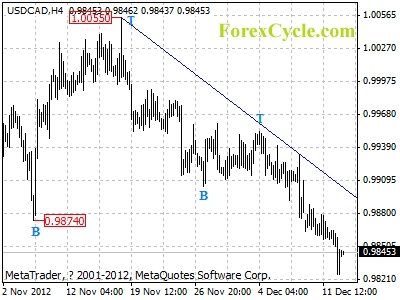
USDCAD stays below a downward trend line

USDCAD stays below a downward trend line on 4-hour chart, and remains in downtrend from 1.0055, and the fall extends to as low as 0.9844. Further decline could be expected after a minor consolidation, and next target would be at 0.9800 area. Initial resistance is at 0.9880, and the key resistance is located at the downward trend line, only a clear break above the trend line resistance could signal completion of the downtrend.

usdcad

Forex Signals

Federal Reserve trims growth and jobless rate forecasts

By www.CentralBankNews.info     The Federal Reserve trimmed its forecast for U.S. economic growth this year, but kept its 2013 forecast unchanged from September, and expects the unemployment rate to fall faster.
    The U.S. central bank cut its forecast for 2012 Gross Domestic Product growth to 1.7-1.8 percent from its previous forecast of 1.7-2.0 percent. The forecasts for 2014 and 2015 were also trimmed.
    The unemployment rate this year is expected to end with an average rate of 7.8-7.9 percent in the fourth quarter, down from its previous forecast of 8.0-8.2 percent.
    In 2013 the jobless rate should fall to 7.4-7.7 percent, a downwards revision but remain above 6.8 percent in 2014 before declining to between 6.0 and 6.6 percent in 2015.
    The forecast for personal consumption inflation this year was trimmed to 1.6-1.7 percent from 1.7-1.8 percent, but should remain below the Federal Reserve’s target of 2.0 percent through 2015.
   
   
    www.CentralBankNews.info

Is the Bull Market in Gold Over?

Most mainstream pundits seem to think the economy is recovering.

The worriers can stop worrying, they say. The U.S. has plenty of cheap oil. Unemployment levels are falling. The housing market is recovering.

This is not time to buy gold, they say. The world is not going to end. You won’t need it.

All year long, we’ve heard analysts tell us that the bull market in gold was over. Most recently, Goldman Sachs’ top commodity man announced that gold will go down next year, as real interest rates once again turn positive.

Gold was a nice thing to hold when the world was in a financial crisis, goes the argument. But now, the trouble is behind us.

Markets have stabilized. Europe has figured out how to manage its sovereign debt issues. China is not going to blow up anytime soon. And the U.S. is on the road to a sustained recovery, thanks in large measure to huge new oil and gas output.

Who needs insurance in a world where nothing goes seriously wrong?

And yet, gold holds above $1,700 an ounce. It’s up about $150 an ounce from the beginning of the year. Let’s see… That’s nearly a 10% increase. Not too shabby for an insurance policy.

Central Banks Are Still Buyers

And now comes word in the Financial Times that Americans are buying so many gold coins the U.S. Mint can barely keep up.

Silly fellows. Don’t they know there’s nothing to worry about?

And what’s this? Apparently, foreign central banks are being silly too. Here’s another FT report:

In 2009 […] China announced that it had been buying gold and India purchased 200 tons from the International Monetary Fund.

Since then, Thailand, South Korea, Sri Lanka and Bangladesh have all bought significant quantities for the first time in years, making Asian central banks the driver of official sector purchasing.

Now the gold bug appears to be catching in Latin America.

Why are these central banks buying gold? Don’t they know that gold holdings don’t earn them any money? Don’t they know they’d be better off with U.S. Treasurys? Don’t they know the dollar is as good as gold?

Apparently not.

“Pulling a Gono”

And we’re not so sure either…

If the U.S. really were in a recovery we’d soon see interest rates rise… and consumer prices go up too. You would expect gold to go up along with everything else.

Then things would get interesting. The Fed would have to choose: either back off from its EZ money policies or risk runaway inflation.

If the Fed were to “pull a Volcker,” it would be time to sell gold. But 2013 is not 1979. And Ben Bernanke is no Paul Volcker.

More than likely, Bernanke will “pull a Gono.”

Gideon Gono is the governor of the Reserve Bank of Zimbabwe, and was responsible for the hyperinflation there between about 2005 and 2008, when the value of the Zim dollar didn’t just go down — it disappeared completely. (Toward the end of 2008, the rate of inflation reached 89,700,000,000,000,000,000,000%!)

Zombie Watch

And now, a new feature… something I call “Zombie Watch.”

First, from Bloomberg:

$822,000 Worker Shows California Leads U.S. Pay Giveaway

Among the largest states, almost every category of worker has participated in the pay bonanza. Britt Harris, chief investment officer at the Teacher Retirement System of Texas, last year collected $1 million — including his $480,000 salary and two years of bonuses — more than four times what Republican Governor Rick Perry received.

Pension managers in Ohio and Virginia made up to $678,000 and $660,000, respectively, according to the data, which Bloomberg obtained using public-record requests. In an interview, Harris said public pension pay must be competitive with the private sector to attract top investment talent.

Psychiatrists were among the highest-paid employees in Pennsylvania, Ohio, Michigan and New Jersey, with total compensation $270,000 to $327,000 for top earners. State police officers in Pennsylvania collected checks as big as $190,000 for unused vacation and personal leave as they retired young enough to start second careers, while Virginia paid active officers as much as $109,000 in overtime alone, the data show.

The numbers are even larger in California, where a state psychiatrist was paid $822,000, a highway patrol officer collected $484,000 in pay and pension benefits and 17 employees got checks of more than $200,000 for unused vacation and leave. The best-paid staff in other states earned far less for the same work, according to the data.

And from The Center for Public Integrity:

Officials in central Indianapolis thought deeply a few years back about what equipment they needed to defend against a local attack involving weapons of mass destruction, such as chemical arms or a nuclear bomb, and their answer was (ba dum, ba dum) a hovercraft!

Luckily, the city didn’t even have to foot the $69,000 bill. The funds instead came from a Federal Emergency Management Agency program known as the Urban Area Security Initiative, which has so far spent more than $7 billion trying to make about five dozen of America’s cities safe from the threat of terrorism.

When officials in Louisiana calculated how they could best deal with the terrorism threat in their own backyard, their answer in part was — yes, really — a teleprompter and a lapel microphone, again purchased with funds from the FEMA initiative. Similarly, Oxnard-Thousand Oaks officials in California deliberated and decided to buy new fins and snorkels for their dive team.

But the City of Clovis in that state was even more creative: They used a $250,000 FEMA grant to buy an armored vehicle known as the BearCat, which wound up being used to patrol at an Easter egg hunt and other public events.


Disclaimer

Article brought to you by Inside Investing Daily. Republish without charge. Required: Author attribution, links back to original content or www.insideinvestingdaily.com. Any investment contains risk. Please see our disclaimer.

Mozambique holds rate, confident inflation hits target

By www.CentralBankNews.info     Mozambique’s central bank held its benchmark interest rates unchanged, saying it was confident that inflation would meet the central bank’s 5.6 percent target for 2012.
    The Bank of Mozambique (CPMO), which has cut the rate on its standing lending facility six times this year for total reduction of 550 basis points, said it would maintain this rate at 9.50 percent along with the standing deposit facility rate at 2.25 percent.
    It would also continue to intervene in the interbank market to ensure that the monetary base expands to a maximum 40.5 billion meticais by the end of December.
    The central bank said Mozambique’s inflation rate accelerated to 2.94 percent in November from October’s 2.33 percent, reflecting worsening price levels in the three main cities.
    Provisional data showed that the monetary base would reach 38.39 billion meticais at the end of November, an increase of 11.9 percent from December 2011.
    Mozambique’s Gross Domestic Product rose 0.4 percent in the second quarter from the first quarter for annual growth of 8 percent, up from 6.3 percent.
 
    www.CentralBankNews.info

Market Trends 12.12.2012

Source: ForexYard

printprofile

Hey Everyone,

Below are some market trends for today.

Good luck!

-Dan

Gold- May see upward movement today
Support- 1702.68
Resistance- 1729.53

Silver- May see upward movement today
Support- 32.86
Resistance- 33.68

Crude Oil- May see upward movement today
Support- 85.33
Resistance-87.05

Dax 30- May see downward movement today
Support- 7466.42
Resistance- 7665.50

EUR/USD May see upward movement today
Support- 1.2896
Resistance- 1.3085

Read more forex news on our forex blog

Forex Market Analysis provided by ForexYard.

© 2006 by FxYard Ltd

Disclaimer: Trading Foreign Exchange carries a high level of risk and may not be suitable for all investors. There is a possibility that you could sustain a loss of all of your investment and therefore you should not invest money that you cannot afford to lose. You should be aware of all the risks associated with Foreign Exchange trading.

Market Review 12.12.2012

Source: ForexYard

printprofile

The US dollar remained largely bearish during overnight trading, amid expectations that the Fed will announce a new round of monetary stimulus today. The EUR/USD, currently trading above the psychologically significant 1.3000 level, has gained more than 70 pips in the last 24 hours.

The price of gold was able to capitalize on the dollar’s bearish movement last night to gain close to $6 an ounce. The precious metal is currently trading just below the $1715 level. Crude oil advanced slightly higher than $0.30 a barrel during the Asian session and is currently trading at $86.10 level.

Main News for Today

US Crude Oil Inventories- 15:30 GMT
• Forecasted to come in at -2.6M, slightly below last week’s reading of -2.4M
• A lower than expected figure today would be a sign of increased demand in the US, which could result in gains for oil prices

US FOMC Statement- 17:30 GMT
• Analysts are forecasting the FOMC to announce an expansion of the current US monetary easing program
• If such an announcement takes place, the USD could extend its bearish trend during evening trading

Read more forex news on our forex blog

Forex Market Analysis provided by ForexYard.

© 2006 by FxYard Ltd

Disclaimer: Trading Foreign Exchange carries a high level of risk and may not be suitable for all investors. There is a possibility that you could sustain a loss of all of your investment and therefore you should not invest money that you cannot afford to lose. You should be aware of all the risks associated with Foreign Exchange trading.

Diageo: Sometimes, You Just NEED Tequila

By The Sizemore Letter

Sometimes, you just need tequila.  It’s not really a matter of wanting it.

Perhaps it’s due to an inner self loathing, or perhaps it has something to do with the naughty fun involved with grabbing a slice of lime off the navel of a perfect stranger at a bar with your teeth.  Whatever your reason might be, when you need tequila, you need tequila.

Right now, Diageo (NYSE: $DEO), needs tequila.

badgesThe world’s largest seller of premium spirits pulled out of negotiations to buy Jose Cuervo, the world’s top-selling tequila brand.  Diageo currently has a distribution deal in place with Cuervo, but it is scheduled to expire in June of 2013.

So, shortly after the next Cinco de Mayo, Diageo is going to find itself without a major tequila brand.  For a global conglomerate looking to maintain and expand its presence in promising emerging markets like Mexico, that is distinctly no bueno.

Diageo’s shares reacted badly to the news, but it is Berkman family, the owners of the Cuervo brand, that are likely to be the real perdedores here.  Cuervo sells a single product—tequila—that is only popular in Mexico and in the United States.  And within the United States, its popularity is limited mostly to margarita cocktails in Tex-Mex restaurants and to college frat parties.

Demographics are also moving against the fermented cactus juice.  The Baby Boomers and my own Generation X moved beyond the tequila-drinking stage of their lives years ago, and today’s young drunken louts tend to prefer vodka-based drinks.

What’s more, for a mega-distiller of Diageo’s size, Cuervo  was barely a drop in the bucket, accounting for barely 3% of company sales.  The bulk of Diageo’s business is scotch whisky and vodka.

This is a long way of saying that Cuervo needs Diageo more than Diageo needs Cuervo.

Still, Diageo’s product portfolio is incomplete without a major tequila brand.  This has led to speculation that Diageo might make a move on Beam, Inc. (NYSE: $BEAM), the maker of its namesake Jim Beam Straight Kentucky Bourbon and of the world’s number two tequila by sales, Sauza.

I wrote about a possible Diageo-Beam merger last month (see Whiskey Stocks to Burn the Throat) and noted that the possibility of being acquired by Diageo was one of the reasons that Beam and rival Brown-Foreman Co (NYSE: $BF-B) traded at a premium earnings multiple.

But Beam would be a hard acquisition for Diageo to digest.  We’re talking about a stock with a $10 billion market cap (the Jose Cuervo deal that fell through was reportedly worth only $3 billion).  Even for a $74 billion company like Diageo, that’s a lot of pesos for tequila market share.  (If Diageo did decide to make a bid for Beam, tequila wouldn’t be the primary motivation.  Beam’s bourbon brands are far more valuable.)

Diageo isn’t left completely  high and dry in the tequila war.  It still owns the Don Julio brand, which competes with Patron at the premium level where margins are higher.

But with Cuervo slipping away and a Beam merger unlikely at this time, Diageo may simply have to be content with wearing a smaller sombrero for now.

Disclaimer: Sizemore Capital is long DEO and BEAM. This article first appeared on InvestorPlace.

SUBSCRIBE to Sizemore Insights via e-mail today.

The post Diageo: Sometimes, You Just NEED Tequila appeared first on Sizemore Insights.