Market Review 14.12.12

Source: ForexYard

printprofile

After hitting a nine-month high at 83.90 during the beginning of Asian trading, the USD/JPY saw a minor downward correction and is currently trading around the 83.75 level. The pair’s recent bullish movement has largely been due to speculations that the Bank of Japan will initiate a new round of monetary easing in the near future.

A worse than expected German Flash Manufacturing PMI earlier today caused the EUR/USD to give up most of its gains from the overnight session. The pair fell close to 30 pips following the release of the indicator and is currently trading at 1.3080.

Main News for Today

US Core CPI- 13:30 GMT
• Analysts are forecasting the indicator to come in at 0.2%
• A better than expected result today could help the dollar extend its gains vs. the yen and may also boost crude oil prices

Read more forex news on our forex blog

Forex Market Analysis provided by ForexYard.

© 2006 by FxYard Ltd

Disclaimer: Trading Foreign Exchange carries a high level of risk and may not be suitable for all investors. There is a possibility that you could sustain a loss of all of your investment and therefore you should not invest money that you cannot afford to lose. You should be aware of all the risks associated with Foreign Exchange trading.

Why Small-Cap Stocks Could Be Your Best Investment in 2013

By MoneyMorning.com.au

Is it a bad time to buy stocks?

Our answer may surprise you. Bizarrely, although it could be bad news for stocks in general, it won’t be bad news for all stocks.

The next twelve months will continue the trend from the last twelve months. It will continue to be a stock-pickers market. But rather than investors picking blue-chips for yield, the action will come in the small-cap sector.

The Split in Australian Stocks

Yesterday we showed you the chart of the Emerging Companies Index against the financial stocks index. Here it is again:

Emerging Companies Index Against the Financial Stocks Index

Source: CMC Markets Stockbroking


Over the past six months dividend-paying financial stocks have taken off in anticipation of falling interest rates. At the same time investors ditched small-cap stocks and most other growth stocks.

But now that investors have got their yield play, what’s next?

Interest rates are low, and they’ll stay low for the foreseeable future. The knock on effect is lower dividend yields.

Most investors don’t realise that. Most investors look back to the 6%, 7% and 8% dividend yields of the 2000′s and think those days are still here.

They’re not. Just as the days of high-interest bank accounts are over (for the foreseeable future) so are the days of high dividend yields.

Why is that?

It’s a simple fact of investing that all investments trade relative to other investments. Put simply, if one income producing investment is riskier than another income producing investment, then the riskier investment should provide a higher income.

The higher income is your reward for taking on more risk.

But dividend yields aren’t static. They change as the market changes. So when bank deposit rates fall, investors look for higher returns elsewhere. This can result in investors buying shares, which pushes up the share price and therefore lowers the dividend yield.

You’ve seen that same scenario play out in the bond market as investors looked for the safety of bonds, which drove up bond prices and drove down bond yields (bond prices move inversely to bond yields).

We believe things are about to change. As dividend yields reach their new ‘norm’ investors will start looking at growth assets. And one of the biggest beneficiaries of this change looks set to be the biggest growth assets – small-caps.

Why Small-Cap Stocks Will Rise in 2013

But here’s the thing, large-cap stocks and small-cap stocks have reacted differently on the Aussie market than on the US market.

Look at the above chart again. There’s a 30 percentage point difference between large and small-cap stocks over the past year. Now look at the relationship between large and small-cap stocks in the US over the same period.

Below is a chart of the US Dow Jones Industrial Average (blue line), and Dow Jones US Small-Cap Index (red line):

a chart of the US Dow Jones Industrial Average and Dow Jones US Small-Cap Index
Click here to enlarge

Source: Google Finance

Of course there are a whole bunch of reasons why Aussie small-caps haven’t done as well as US small-caps.

The strong Australian dollar doesn’t help small-cap exporters, and because most resources are priced in US dollars it means fewer Aussie dollars when companies repatriate revenues and profits.

Another reason is that Aussie interest rates stayed higher than interest rates elsewhere in the world. Australia is also more affected by what happens in China…and for most of this year the Chinese economy has been on the ropes.

All of that has contributed to investors skipping growth stocks and heading into safer dividend stocks.

But despite these factors, companies tend to adapt. That’s the nature of capitalism. Companies that can’t adapt soon fail. Companies that can adapt replace them.

And because investors have ditched growth assets so savagely, it has created a sea of beaten-down, under-valued, and risky stocks.

It’s our bet that as investors look to boost their returns this is the end of the market they’ll look at. In anticipation of this, we have more open positions on the Australian Small-Cap Investigator buy list than at any point over the past two years.

And it’s not just the typical stocks you’d expect to find in a small-cap portfolio. Yes, there are resources stocks, but less than half of them are in energy or raw materials.

The others are in property, finance, media and technology. Some pay dividends, some are growth, and a couple of them offer a mixture.

Right now we believe small-caps have hit rock-bottom, and that as we head into 2013 a combination of the fabled Santa Rally and investor recognition of extremely cheap valuations will see growth assets (especially small-cap growth assets) begin to recover.

As we always tell our small-cap subscribers, it’s not risk free, but if things go as we expect there could be some spectacular returns in the coming months.

Cheers,
Kris

From the Port Phillip Publishing Library

Special Report: The Fuse is Lit

Daily Reckoning:
Why the Australian Dollar is Not as Strong as You Think

Money Morning:
Central Bank Prints More Money – No One Cares

Pursuit of Happiness:
The One Industry Where the State and Government Excels

Australian Small-Cap Investigator:
Why Invest In Small-Cap Stocks? And Why Now?

Government Budget Surplus or Deficit? Why it’s a No-Win Situation

By MoneyMorning.com.au


‘Economists believe the federal government can ditch its much promised budget surplus without damaging its triple-A credit rating.

‘Treasury reportedly has advised the government to dump its commitment to a surplus, warning a slump in nominal economic growth poses a threat to revenue.’ – AAP

Don’t say we didn’t warn you.

Get ready for Australian government debt to take off…whoever wins next year’s federal election.


It already stands at $259 billion. That’s about 65% of Aussie government spending. That’s right, 65%. Most people still think the Australian economy is different to every other economy.

But look, don’t get us wrong. We’re not in favour of surpluses either. We look at government budget deficits and surpluses this way…

A surplus means the government is taxing too much.

A deficit means the government is spending too much.

And a balanced budget means the government is doing both.

As far as we’re concerned, the best government is no government. But we’ll leave that theme for our twice weekly eletter, Pursuit of Happiness.

But it’s not just the rising debt levels to look out for.

The economists in the AAP report clearly believe that government stokes the economy.

But that’s not true.

As we explained yesterday, it’s private enterprise that makes the economy tick. Yet the more the government borrows and spends, the less money there is for private enterprise to invest in their businesses.

Cheers,
Kris

From the Port Phillip Publishing Library

Special Report: The Fuse is Lit

Daily Reckoning:
Why the Australian Dollar is Not as Strong as You Think

Money Morning:
Central Bank Prints More Money – No One Cares

Pursuit of Happiness:
The One Industry Where the State and Government Excels

The US Fed’s Dangerous Inflation Experiment

By MoneyMorning.com.au

The Federal Reserve embarked on QE ‘infinity’ earlier this year.

That was when it committed to keep printing a set amount of money each month until unemployment fell to a level it was comfortable with.

It announced – let’s call it QE ‘infinity and beyond’. Fed chief ‘Buzz’ Bernanke is taking experimental monetary policy to a whole new level.

Not only will the Fed keep printing more money for now. It’s also written itself a licence to print whatever it takes to get the US economy growing strongly again. In short, you shouldn’t expect US rates to rise again until inflation has gone beyond the point of being a clear and present danger.

The market had been pricing in at least some sort of action from the Fed. So stocks in the US, for example, ended up flat as investors fretted over the fiscal cliff.

A Licence to Print Money

The Fed declared it would print an extra $45bn a month to buy Treasury bonds (US government debt). This replaces the existing ‘Operation Twist’ program that’s about to end.

That’s on top of the $40bn a month in mortgage-backed bonds it began buying in September. So the Fed is now printing $85bn a month.

That was all expected. But the Fed went even further.

[The] Bank of England has an explicit inflation target. We all know by now that it couldn’t give two hoots about this target. But in theory, it’s meant to keep the consumer price index (CPI) rising at a rate of about 2% a year.

The Fed has never had any such explicit target. There was always a vague notion that it would keep inflation at a similar 2% level, but nothing set in stone.

Until now, that is.

The Fed has said it’ll keep the main US rate (the Federal Funds rate) at between 0% and 0.25% until and unless one of two things happens.

Either unemployment has to fall to 6.5% or lower. Or inflation ‘between one and two years ahead’ has to be projected to be no more than 2.5%. The Fed doesn’t expect either of these things to happen until 2015.

This is a pretty big move. For one thing, that’s a very loose inflation target. It’s a full half-percentage point above the Fed’s ‘longer-run’ goal of 2%. It’s also based on ‘projections’. We all know how little projections are worth.

You can project whatever you want to project. Mervyn King constantly justifies the Bank of England’s lack of action on inflation using those wonderful fan charts that cover just about every eventuality, yet always seem to have the Bank being bang on target within two years’ time.

So the Fed is setting an official inflation target that gives it an awful lot of leeway for ignoring inflation as long as it can pretend that it’s ‘temporary’.

Meanwhile, it’s also given itself a licence to print more money at any point that the employment rate looks like faltering. As long as the jobless rate is sitting at above 6.5%, the Fed can justify any amount of money printing it wants. All it needs to do is to say that employment isn’t growing fast enough for its liking.

The Rising Threat

What does this all mean? It means the Fed is fully committed to doing whatever it takes to get the US economy going again. QE isn’t an emergency measure anymore. It’s standard monetary policy as far as the Fed is concerned. If the economy isn’t chugging away fast enough, pump a bit more money into the tank.

This attitude makes it even more likely that it’ll do something stupid and let inflation get out of control. The Fed will be so scared of derailing any recovery, that it won’t react quickly enough to tackle inflation when it arises.

James Ferguson – who in the past rightly argued that the initial bouts of QE would not lead to rampant inflation – wrote earlier this year about why he thinks the Fed is now on dangerous ground with QE.

With the economy no longer on the brink of a deflationary collapse, there’s a serious risk that QE could be highly inflationary. Yet now the Fed is doing even more of the same.

In any case, what does this mean for your money? Well, you should hang on to gold. It’s the best way to insure yourself against a potential currency catastrophe.

John Stepek
Contributing Editor, Money Morning

Publisher’s Note: This is an edited version of an article that first appeared in MoneyWeek

From the Archives…

How You Can Use Small-Cap Stocks to Leverage Your Share Returns
7-12-2012 – Kris Sayce

How to Make Cash-Like Returns Using Shares
6-12-2012 – Kris Sayce

How Long Can the Market Ignore These ‘Warning Signs’?
5-12-2012 – Murray Dawes

Is There Any Good News to Come from the US Debt Crisis?
4-12-2012 – Dr. Alex Cowie

Buy Small Caps Now While Investors Are Crying
3-12-2012 – Dr. Alex Cowie

Central Bank News Link List – Dec. 14, 2012: European officials agree to central oversight of banks

By www.CentralBankNews.info     Here’s today’s Central Bank News link list, click through if you missed the previous link list. The list comprises news about central banks that is not covered by Central Bank News. The list is updated during the day with the latest developments so readers don’t miss any important news

JPY Tumbles on Japanese Banking Plan

Source: ForexYard

printprofile

The JPY tumbled on Tuesday against most of its main currency counterparts on renewed plans for a Japanese banking stimulus and U.S. housing data. Firstly, U.S. housing data showed better-than-expected results. This led to a drop in demand for safe-haven currencies, such as the JPY and USD. Additionally, forex traders are dissuaded on putting big sums of money in the Japanese currency as Japan’s economy is scheduled to shrink by 13.1% this quarter. T

he Bank of Japan (BoJ) concludes their 2 day meeting later today, and it is expected that they are going to unveil an aggressive plan to tackle the Japanese recession. This is in coordination with Japan’s government, which is scheduled to push through the 3rd stimulus through Japan’s parliament of over $2 billion for Japan’s banks.

The leaks from the BoJ yesterday that it will continue lending large amounts of money to banks led to a rally in Japan’s stock market. This was also spurred by the stock market rally on Wall Street. These events led to a higher risk appetite in Japan, and therefore a bearish Yen. The Yen closed down 14 pips against the USD at 98.44. This is significant, considering both currencies are safe-haven and usually show little volatility when trading against each other. The JPY rose against the Pound, as traders preferred the Japanese currency over the unstable British economy. However, against the EUR, the JPY closed down about 60 pips at 128.44. Today, Traders are advised to make their trading decisions in regards to the Yen on the conclusion of the BOJ Press Conference.

Forex Market Analysis provided by ForexYard.

© 2006 by FxYard Ltd

Disclaimer: Trading Foreign Exchange carries a high level of risk and may not be suitable for all investors. There is a possibility that you could sustain a loss of all of your investment and therefore you should not invest money that you cannot afford to lose. You should be aware of all the risks associated with Foreign Exchange trading.

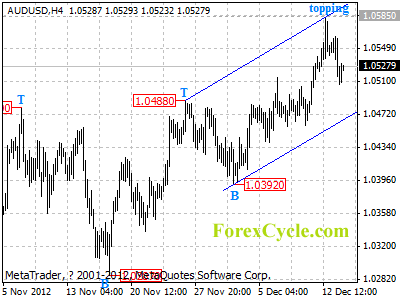
AUDUSD pulls back from 1.0585

Being contained by 1.0624 (Sep 14 high) resistance, AUDUSD pulls back from 1.0585, suggesting that a cycle top is being formed on 4-hour chart. Range trading between 1.0500 and 1.0585 would likely be seen in a couple of days. As long as the channel support holds, the fall would possibly be consolidation of the uptrend from 1.0287, and another rise to test 1.0624 resistance is still possible. On the downside, a clear break below the channel support will suggest that the uptrend from 1.0287 has completed at 1.0585 already, then the following downward movement could bring price back to 1.0000 zone.

audusd

Daily Forex Forecast

Chile holds rate steady, Q3 economy better than forecast

By www.CentralBankNews.info      The Central Bank of Chile kept its policy rate steady at 5.0 percent, as widely expected, saying domestic output and demand expanded above forecasts in the third quarter but inflation expectations are in line with the bank’s target.
    Banco Central de Chile, which has held rates steady since a 25 basis point cut in January, said global financial conditions were better than a month ago, but risks from the euro zone’s fiscal and financial situation are still high and the risk of a sharp fiscal adjustment in the United States is still present.
    Economic growth remains weak in developed economies while more positive signs have been seen in some emerging economies, the bank said in a statement.
    Chile’s Gross Domestic Product expanded by 1.4 percent in the third quarter from the second for an annual rise of 5.7 percent, up from a second quarter rate of 5.5 percent.
    The inflation rate fell by a larger-than-expected 0.5 percentage points in November to an annual rate of 2.1 percent, down from October’s 2.9 percent, but the bank said the fall was due to one-time factors.
    Chile’s central bank targets annual inflation of 3.0 percent and reiterated its commitment to conduct monetary policy “with flexibility” so it achieves this target.

    www.CentralBankNews.info


WRAPUP 1-Surprise Chile CPI drop gives monetary policy a breather

Fri Dec 7, 2012 10:42am EST

* Key interest rate seen holding at 5 percent in coming
months
* CPI surprisingly fell 0.5 percent in November
* Consumer price fall is steepest monthly decline in 3 years
* Inflation in 12 months to November is 2.1 percent
* Chile has first trade surplus after four monthly deficits


By Antonio De la Jara and Anthony Esposito and Felipe
Iturrieta
SANTIAGO, Dec 7 (Reuters) - Chile's consumer price index
unexpectedly fell 0.5 percent in November, far below market
expectations, prompting Finance Minister Felipe Larrain to say
on Friday it allows for "tranquility" in terms of monetary
policy.
The key interest rate has stayed on hold at 5.0
percent since a cut in January largely because the world's No. 1
copper producer has shown better-than-expected resilience to
slowing demand from top trade partner China and fallout from the
euro zone's crisis.
"We have a particularly positive situation and I think that
allows for more tranquility in terms of monetary policy,"
Larrain told reporters after the monthly CPI posted
its steepest decline in three years.
The CPI dropped chiefly due to lower prices for transport,
food and non-alcoholic beverages, the INE statistics agency
reported earlier Friday.
November's tumble in consumer price was steeper than
forecast by all of the 11 analysts and economists surveyed in a
Reuters poll. The range of their estimates went from a fall of
0.3 percent to an increase of 0.4 percent, with the median
estimate at zero.
Easing inflation comes as a relief for the bank after a
surprisingly high 0.6 percent rise in October CPI and
stronger-than-expected 0.8 percent increase in September, which
were fueled in part by robust domestic demand.
"This drop in the monthly CPI confirms the central bank's
neutral monetary policy stance and makes an interest rate hike
more unlikely for now," said Hernan Jimenez, analyst at Forex
Chile in Santiago.
Worldwide, standard monetary policy is for a central bank
to raise interest rates to cool inflation but lower them to spur
economic growth, if the latter takes priority over inflationary
concerns.
Chile's central bank is seen holding its rates at 5.0
percent again at its monetary policy meeting on Dec. 13, and it
is seen at that level in three and six months, the bank's last
fortnightly poll of traders showed.
Strong domestic demand and investments have also boosted
Chile's economic growth. Larrain said on Wednesday he expected
the small, export-dependent economy to expand about 5.5 percent
this year, adding he doesn't see it overheating.


Core inflation, which excludes fruits, fresh vegetables and
fuel, was minus 0.2 percent in November, the biggest decline
since a 0.2 percent decline in August. In October the core CPI
rose 0.2 percent.
Overall, consumer prices rose 2.1 percent in the 12 months
to November, well below the 3.0 percent midpoint of the central
bank's policy inflation target range.
Annual inflation will likely end the year around 2 percent,
Larrain said, echoing central bank president Rodrigo Vergara's
comments in an interview with local newspaper El Mercurio
published on Sunday.
Nearby, Brazil's inflation accelerated more than expected in
November after transportation and electricity prices spiked,
suggesting the central bank ran out of leeway to further cut
borrowing costs.

FIRST TRADE SURPLUS IN FIVE MONTHS
Chile posted its first monthly trade surplus in November
after four consecutive deficits, as lower imports countered a
drop in key copper export revenue, central bank data also showed
on Friday.
The surplus grew to $562 million in November
after a downwardly revised $411 million deficit in October and
$287 million surplus in November 2011, according to central bank
data. The bank had previously reported a $70 million surplus for
October.
Exports totaled about $6.674 billion in November, while
imports were about $6.112 billion. Both figures were down
compared with October and November 2011.
"The external situation is affecting us and that is
reflected in exports. The value (of exports) have fallen in some
cases because export prices have dropped, but volumes have as
well," Larrain said.
Exports are closely monitored in Chile, which is largely
dependent on sales of copper, wood pulp, fruit and salmon.
Chile accumulated a $2.702 billion trade surplus in the
January to November period, central bank data showed. The
country ended 2011 with a $10.792 billion surplus.

COPPER EXPORT REVENUE DOWN
Chile's copper export revenue totaled $3.859
billion in November, versus a previously reported $4.440 billion
in October, the central bank said.
Export revenue from the metal was $3.712 billion in November
of last year.
Copper prices rose to their highest level in more
than five weeks in late November, supported by a weak dollar and
growing confidence in the economic outlook for top consumer
China.
Chile, which produces roughly a third of the world's copper,
is struggling with stubbornly dwindling ore grades in many of
its aging, tired deposits though new and expanded deposits have
helped increase output this year.

WRAPUP 1-Chile central bank only mulled rate hold in Nov-minutes

Wed Nov 28, 2012 7:25am EST

* Rate hold was unanimous decision
* Cenbank members highlight strong demand, activity
* Rate seen on hold in coming months, hiked in 2 years

SANTIAGO, Nov 28 (Reuters) - Chile's central bank only
considered keeping its benchmark interest rate on hold as an
option in November, when it held it steady at 5.0 percent for a
10th consecutive month, as expected, minutes of the meeting
showed on Wednesday.
The rate remains within a neutral range and the five-member
central bank board unanimously decided to keep the rate steady,
the minutes of the Nov. 13 meeting said.
Globally, in standard central bank parlance, a neutral
interest rate, in theory, should neither spur nor curb economic
growth, all other factors being equal.
Rates have stayed on hold since a cut in
January largely because the world's No. 1 copper producer has
shown better-than-expected resilience to slowing demand from top
trade partner China and fallout from the euro zone's crisis.
"Domestically, all of the board members highlighted the
strength shown by domestic demand and activity," the minutes
said.
Chile's small, export-dependent economy expanded 5.7 percent
in the third quarter from a year earlier, the bank
reported last week. It grew a
seasonally-adjusted 1.4 percent in the third quarter versus the
second quarter, slowing from an upwardly revised 2.0 percent
expansion in the second quarter from the first quarter.


"Regarding inflation, all the board members agreed that
total and core inflation remained in line with the inflation
target's tolerance range, despite increased dynamism of activity
and demand," minutes added.
Chile's consumer price index rose by double
what the market expected in October, though inflation in the 12
months to October was 2.9 percent, just below the 3.0 percent
midpoint of the central bank's policy horizon target.


RATE HIKE SEEN IN TWO YEARS
The central bank is seen holding its key interest rate at
5.0 percent again at its monetary policy meeting on Dec. 13, and
it is seen at that level in three and six months, the bank's
fortnightly poll of traders showed separately on Wednesday.
But traders now see the rate inching up to 5.25 percent in
24 months time.
The bank's last poll of traders published earlier this month
saw the rate at 5.0 percent in three and six months. It did
not, however, see a rate hike on the horizon.
On inflation, the expectations in Wednesday's poll were that
consumer prices would fall 0.1 percent in November, according to
the median forecast of 58 traders. Inflation in 12 months is
seen at 2.8 percent, still a whisker below the bank's target.
Chile's peso currency is seen trading at 480 per
U.S. dollar in seven days and three months, the poll said. The
peso was trading at 481.60 per dollar in early Wednesday trade.

Technical Trades Of the Week – SPX, US Dollar, Nat Gas

By Chris Vermeulen, www.TheGoldAndOilGuy.com

Yesterday’s price action was very bearish yet again and we are patiently waiting for a counter trend pullback to happen. While three are some good looking plays out there I really do not want to get long until the market clears the air with a bout or three of strong selling. Remember 3:4 stocks follow the market and the odds of picking a commodity or ETF that bucks the trend is unlikely. If you are interested in powerful stocks & ETFs the buck the trend check out my FREE Trading Ideas live Go Here: https://stockcharts.com/public/1992897

SP500 / Broad Stock Market:

We have seen a bug run up in stocks this month and things are looking a little long in the teeth. A large number of stocks are trading above their upper Bollinger band and the broad market is testing that key resistance level also. Typically when a Bollinger band is reached we see price reverse for a couple days at minimum.

While the equities market is in a new uptrend as seen by the moving averages I pullback seems imminient. The last two days has formed reversal candles and are pointing to lower prices.

Dec12SPY


Dollar Index Hourly Chart:

This chart shows a possible bottom forming in the dollar pointing to a 3-8 day pullback in stocks.

Dec13DXBottom


Gold Futures Hourly Chart:

Dec13Metals


Natural Gas Hourly Chart:

Dec13NatGas


Morning Trading Conclusion:

Looking at the charts on several different time frames, not all shown here, technical analysis shows a pullback in stocks is highly likely. This is what we are currently positioned for.

The US dollars downward momentum is slowing and if it can find a bid today it should trigger strong selling in both stocks and commodities. Gold and silver are down sharply along with miners.

We have been watching natural gas for a few months and know that it has been trading inverse to what stocks do. This bodes well for a bounce in natural gas if stocks start a sell off. That being said, natural gas is trading at a key tipping point that could spark a very fast and hard drop. This knife can fall at a speed that will take a slice out of your trading account if not traded and managed properly (tiny position and use of a stop). I actually like natural gas the more it moves down and could issue a buy alert on it today or this week. I would like to see volume decline at this level showing the momentum is slowing…

Get My ETF Trade Alerts Now: www.TheGoldAndOilGuy.com

Chris Vermeulen


Central Bank News Link List – Dec. 13, 2012: EU close to deal on bank capital rules, curbing bonuses

By www.CentralBankNews.info     Here’s today’s Central Bank News link list, click through if you missed the previous link list. The list comprises news about central banks that is not covered by Central Bank News. The list is updated during the day with the latest developments so readers don’t miss any important news.)