Has Correction on Dollar Ended?

EURUSD
At the beginning of the trading week, the EUR/USD fond itself under pressure and fell to 1.3020 level. Here the pair found support and began restoring, through which could rise to the level of resistance around 1.3140. So, we got quite logical downward correction to the 30th figure, followed by reduction to an important resistance. Now, further dynamics of euro/dollar depends on the ability to get up and consolidate above resistance area 1.3140-1.3170. If this happens, then a pair of oxen may be able to count on growth to 1.3260 at least. Otherwise, bears will return the rate to 1.3020-1.3000. Loosing of the 30th figure aggravate the situation of the single currency and lead to fall to 1.2900-1.2880.

eurusd08.01.2013


GBPUSD
In GBP/USD pair is seen a picture similar to the picture in euro/dollar. As part of a downward correction British pound fell to 1.6008, where it found a good support that allowed the pair to recover to now resistance at 1.6129. Theoretically bears may try again to test 60th figure, passing of it will decrease the British perspective. But if we are seeing the resumption of upward trend, the resistance has been passed and the pound will rush towards 1.6180-1.6200. Therefore, the behavior of market participants on the current levels will determine future pair dynamics.

gbpusd08.01.2013

USDCHF
Upward correction in dollar/franc pair has helped the U.S. Currency to recover to 93rd figure above which the dollar could not to rise. Yesterday the pair tested the 0.9286 mark and began to decline towards 0.9200 level, where it found support. If the dollar can consolidate above support, it will be able to continue upward momentum and get back to 0.9300 level, passing of which significantly improve the outlook. Otherwise, falling of the U.S. Currency will continue, and it would mean the completion of upward correction.

usdchf08.01.2013

USDJPY
Despite the continuing negative against the Japanese currency, bulls on the USD/JPY pair did not find strength to rise above resistance at 88.40 mark, which has led to some profit taking. Thus, the pair is now trying to develop a downward correction and it dropped to 87.23 so far, on which the pair faced an attempt to resume growth. But at 87.80 sellers again made an actions, and the pair is slowly returning to the current support. The scale of pair growth give reason to expect that bears will not be limited by falling to 87.23, it means that dollar’s decline may be more impressive. The nearest goal of the bears is 86.76-86.63 support, next – 86th figure. In the absence of fresh incentives rise above the current maximum seem to be unlikely.

usdjpy08.01.2013

Provided by IAFT


Central Bank News Link List – Jan. 8, 2013: Tokyo, BOJ mull setting job growth as common goal: paper

By www.CentralBankNews.info

Here’s today’s Central Bank News link list, click through if you missed the previous link list. The list comprises news about central banks that is not covered by Central Bank News. The list is updated during the day with the latest developments so readers don’t miss any important news.

Dealers Report “Very Strong” Gold Demand from China, Indian Interest “Significant”

London Gold Market Report
from Ben Traynor
BullionVault
Tuesday 8 January 2013, 12:30 EST

WHOLESALE gold bullion prices ended Tuesday morning in London at $1655 per ounce, regaining ground lost yesterday to climb back to where it started the week, with dealers reporting signs of strong demand from India and China, the world’s two biggest gold buying nations.

Silver climbed to $30.40 an ounce, slightly up on the week so far, while stocks and commodities also edged higher and US Treasuries fell.

The Shanghai Gold Exchange Monday reported record trading volumes equivalent to 19.5 tonnes for its Au9999 contract, which represents gold bullion of 99.99% purity. Tuesday’s Au9999 volume fell to just under 9.3 tonnes, still significantly above the last year’s daily average.

“Physical [gold] demand is very strong,” one Beijing trader told newswire Reuters this morning.

“It’s a combination of the attraction of lower prices as well as pre-holiday demand.”
China celebrates Lunar New Year on 10 February this year.

Official customs data from Hong Kong meantime shows China imported 90.7 tonnes of gold from Hong Kong in November, a 91% increase from the previous month. The volume of gold flowing the other way rose 23% to 27.7 tonnes. Hong Kong is widely regarded as the major conduit for Chinese precious metals imports.

Premiums on gold bullion shipments to India hit a two-month high Tuesday, with dealers blaming a rush to buy gold before an expected import duty hike.

Gold shipped to India traded between $2 and $3 an ounce above London prices, dealers reported.

By comparison, premiums in Singapore this morning were around $1-$1.20 an ounce.

“Our physical desk has already noted significant interest from Indian clients looking for gold, which could push up imports until the tax in announced,” says a note from Nick Trevethan, senior commodity strategist at ANZ.

“Nothing is available readily,” adds one dealer at a bullion importing bank in Mumbai, adding that some shipments are taking up to a week to arrive.

Western investors  meantime continued to add to their gold positions in December, according to data from BullionVault.

The Gold Investor Index, which tracks buying and selling on the world’s largest online precious metals exchange, rose to a 12-month high in December.

Over in Japan, investment by pension funds in gold exchange traded funds could more than double over the next two years, according to Itsuo Toshima, pension fund advisor  and former regional director Japan/Korea at the World Gold Council.

“Bullion’s role as an inflation hedge, long ignored by Japanese fund operators, has come under the spotlight thanks to [Japan’s prime minister Shinzo] Abe’s economic policy,” said Toshima Tuesday.

Following his election victory last month, Abe said the Bank of Japan should adopt a 2% inflation target, double the current targeted level, having previously called for unlimited quantitative easing during the election campaign.

“Gold may be a standard asset-class in the portfolio of Japanese pension funds as Abe’s target is realized,” said Toshima.

Over in Europe, the Eurozone unemployment rate rose to a record 11.8% last month, figures published Tuesday show. Spain had the highest unemployment rate of any Euro member at 26.6%, while Austria’s rate was the lowest at 4.5%.

“The Eurozone needs easier monetary policy,” says Standard Bank currency analyst Steve Barrow.

“This can happen through lower policy rates…[as well as] the activation of the [European Central Bank’s] Outright Monetary Transactions program, although the ECB would claim that this is not equivalent to monetary easing.”

The OMT program, announced last September, would see the ECB commit to buy sovereign bonds in whatever quantity needed to prevent borrowing costs rising too far above those of other Euro members. A condition of the OMT is that a beneficiary government has accepted a bailout program and its attached conditions.

“A move to negative deposit rates [also] seems very possible in our view,” adds Barrow, “and we would not even rule out the possibility that the ECB will have to undertake quantitative easing of its own.”

The ECB announces its latest policy decisions this Thursday.

Deutsche Bank meantime cut its average gold price forecasts for 2013 and 2014 Tuesday.

Deutsche’s 2013 forecast is down 12.1% to $1856 an ounce, while next year’s forecast is down 5% to $1900 an ounce.

“The whole debt situation remains a major challenge, and accommodative monetary policy is very much seen as a way to minimize the negative repercussions of that,” says Daniel Brebner, the bank’s head of metals research.

“So I don’t believe the gold story is over, but certainly, the market is likely to continue to pause.”

Shares in London-listed African Barrick Gold meantime fell 20%this morning after the state-owned China National Gold ended talks to buy the 74% stake in African Barrick owned by parent Barrick Gold.

Ben Traynor
BullionVault

Gold value calculator   |   Buy gold online at live prices

Editor of Gold News, the analysis and investment research site from world-leading gold ownership service BullionVault, Ben Traynor was formerly editor of the Fleet Street Letter, the UK’s longest-running investment letter. A Cambridge economics graduate, he is a professional writer and editor with a specialist interest in monetary economics. Ben writes and presents BullionVault’s weekly gold market summary on YouTube and can be found on Google+

(c) BullionVault 2012

Please Note: This article is to inform your thinking, not lead it. Only you can decide the best place for your money, and any decision you make will put your money at risk. Information or data included here may have already been overtaken by events – and must be verified elsewhere – should you choose to act on it.


EUR/GBP: Euro deemed to continue outclassing its British counterpart

The Euro is deemed to continue outclassing its British counterpart today after European Commission President Jose Manual Barroso declared yesterday that the threat to the Euro has been overcome, providing a positive outlook for the region this year. Meanwhile, elevated fears that the UK economy is headed for a triple-dip recession this year are presumed to continue weighing on the Sterling.

At a diplomatic conference in Portugal, Jose Manuel Barroso asserted that the Euro has been saved and that the Euro crisis is a thing of the past. “I think we can say that the existential threat against the Euro has essentially been overcome. In 2013, the question won’t be if the Euro will, or will not, implode,” he said. Barroso believes that the turning point was last September’s pledge by the European Central Bank to buy unlimited amounts of Euro Zone states’ debts. Further, he said investors now understood that EU leaders had committed themselves to the currency’s survival. Echoing his remarks, a report yesterday revealed that investor confidence in the bloc is on the mend. The Sentix Investor Confidence index rose from -16.8 points to -7.0 points in January, exceeding forecasts of a modest improvement to -13.7. The January figure is the highest since February 2011, suggesting vastly improved investor moods toward the Euro Zone.

Today, the single currency is deemed to receive support from an encouraging Retail Sales report for November. In a positive indication that Euro Zone states ramped up their spending leading to the holiday season, Eurostat is seen to report that sales inclined by 0.3 percent in November, rebounding from the 1.2 percent dip in October. Although the region remains mired in recession, the report is deemed to provide optimism that improving consumer confidence could carry the region on track for a recovery. On the contrary, the German Bundesbank is awaited to report that factory orders in Germany declined in November. Purchase orders placed with German manufacturers are projected to have tumbled by 1.4 percent, a stark contrast from the 3.9 percent jump in October. Nonetheless, there is reason to hope as the strong German Retail Sales report released last Friday could result to a better figure.

Meanwhile, anxiety that the UK is headed for a triple-dip recession have ignited after a closely-watched gauge of the services sector showed output shrank for the first time in two years in December. The contraction in services, which account for three-quarters of Britain’s economic output, signifies that the UK economy shrank in Q4. Markit estimates that overall, the economy contracted by 0.2 percent in the December quarter. If output declines again this quarter, the UK will then fall into its third recession in five-years. On a grim outlook for the economy, the Sterling is apt to decline, warranting a long position for the EUR/GBP trades today.

For more news, analysis, technical charts and candlestick analysis, visit AlgosysFx Forex Trading Solutions

Why a U.S. Credit Rating Downgrade is On the Way

By MoneyMorning.com.au

It’s been 18 months since Standard & Poor’s lowered the U.S. credit rating, and now Moody’s Corp. (NYSE: MCO) and Fitch Ratings look ready to do the same.

That’s because even after the fiscal cliff deal, the country’s biggest financial problems still remain: the debt ceiling debate, the uncertainty over the delayed sequester cuts and the failure to address the escalating long-term national debt.

And there’s little confidence in Congress to reach an effective long-term deficit-reduction agreement by the February deadline.

“It’s a fait accompli, actually,” Money Morning Chief Investment Strategist Keith Fitz-Gerald said of a credit rating downgrade. “We are the most indebted nation on the face of the planet, spending has ground to a halt, lending is not happening.”

Signs a U.S. Credit Rating Downgrade is Near

Standard & Poor’s became the first of the “Big Three” ratings agencies to downgrade the U.S. credit rating when it did so on Aug. 5, 2011. Now Moody’s and Fitch could downgrade the ratings one notch from AAA to Aa1 and AA, respectively.

One of the biggest reasons to expect a downgrade is that the government has continuously failed to cut money from the bloated budget. The fiscal cliff deal did nothing to resolve our spending problem.

“The recent package mitigates part of the fiscal drag on the economy associated with the fiscal cliff but does not eliminate it,” Moody’s said. “It does not … provide a basis for meaningful improvement in the government’s debt ratios over the medium term. The debt trajectory resulting from this [ongoing] process is likely to determine whether the AAA rating is returned to a stable outlook or downgraded.”

And Fitch said in a report last month, “If the negotiations on the fiscal cliff and raising the debt ceiling extend into 2013 and appear likely to be prolonged with adverse implications for the economy and financial stability, the U.S. sovereign rating could be subject to review, potentially leading to a negative rating action.”

This fiasco is exactly what S&P predicted when it downgraded the U.S. credit rating.

In 2011, Congress bickered and squabbled over raising the debt ceiling until the last minute, almost forcing the U.S. to default on its debt.

S&P said at the time “political brinksmanship” in the debt ceiling debate had made the U.S. government’s ability to manage its finances “less stable, less effective and less predictable.”

When the ceiling was ultimately raised and a deficit-reduction plan was passed, S&P said the bipartisan deal that was reached fell short of what was necessary to tame the nation’s debt over time, and presciently stated that leaders would not be likely to achieve more savings in the future.

Dangers of a U.S. Credit Rating Downgrade

A U.S. credit rating downgrade would likely lead to an increase in all interest rates, raising the cost of borrowing for the government and everyone else.

That, in turn, would make it more difficult and expensive for consumers to acquire mortgages and credit cards and for companies to acquire business loans.

Higher interest rates could also cause homeowners to default on mortgage payments, weakening the housing recovery just as the industry is showing signs of a rebound.

States and municipalities that have their economies tied to the federal government and could also see their credit ratings in jeopardy, as well as could face higher borrowing costs for schools, roads, hospitals and other projects.

Markets will likely tumble after a downgrade. In 2011, from Aug. 5 to Aug. 19, the S&P 500 fell about 6.3% and the Dow Jones Industrial Average slipped 5.5%.

Even speculation of a ratings change could cause a sharp sell-off in equities. The S&P 500 fell 10.8% in the two weeks prior to Standard & Poor’s announcing its change to the U.S. credit rating. The Dow fell 9.7% in the same period.

And the market hit could be more severe this time if not just one but two or all three of the big ratings agencies deliver a downgrade.

“In the absence of a grand bargain in the next two months, it is likely that the U.S. is downgraded,” analysts led by Tom Porcelli, RBC’s chief U.S. economist, wrote in a note Jan. 3.

BEN GERSTEN
Contributing Writer, Money Morning US

Publisher’s Note: This article originally appeared in Money Morning (USA)

From the Archives…

The Talisman of Fear: Why Gold Remains the Foundation of Wealth
4-1-2013 – Kris Sayce

We Got it Wrong With Dividend Stocks…And Investors Still Made Money
3-1-2013 – Kris Sayce

A Contrarian Investment Prediction for 2013
2-1-2013 – Greg Canavan

The Rockers and Shockers of 2012
31-12-2012 – Kris Sayce

Will 2013 Show Us Up?
29-12-2012 – Callum Newman

How the ‘China Money’ Could Push Silver 58% Higher in 2013

By MoneyMorning.com.au

If the mainstream perceives gold investors as cranks, they see silver investors as the real nutters out there.

Yet this scorn is misplaced. In the space of just one decade, silver has quietly gained 233% – and that’s even factoring in the rising Aussie dollar.

This 233% gain means that if an Aussie investor had bought A$15,000 of silver in 2003, it would be worth A$50,000 today.

The gains have come in fits and starts – as is the way with silver. However the average gain for Aussie dollar silver has been 16.3% per annum, which puts it well ahead of Aussie dollar gold at 11.6% per annum.

The trick is to maximise your gain by timing your entry.

And the good news is that after two slow years for silver, it now looks more than ready for its next big rally.

In 2012, silver notched up just 5.4% (I’ll refer to all gains in Aussie dollar terms). This was a pretty disappointing year for silver, particularly as it was sitting above 20% as recently as late November.

And back in 2011 (a nightmare year for silver investors) it finished the year with a loss of 10.8%.

So silver has had a couple of years in the wilderness now.

And this could pave the way for a big 2013. Take a look at this chart I’ve put together for you below to show how wildly silver’s performance has varied in the last ten years.

Aussie dollar silver: slow years followed by a few big years
Source: Money Morning Australia

The pattern with silver is very much one of a few slow years followed by a few big years. For example, after a dismal 2007-2008, silver went on to gain 15.8% in 2009, then an epic 58% in 2010.

So after enduring a very weak 2011-2012, the chances are now much higher that we see some real action from silver in 2013. Another year like 2010, in which we see silver gain 58% is entirely possible from here.

Technical set says: now is a good time to buy

Looking at annual performance statistics is a bit misleading of course. Using the 1st of January and 31st of December as start and end-dates respectively is totally arbitrary.

A slightly different picture may emerge if we used May the 7th as our start date, for example. The silver price is dancing to a beat that has little to do with when we celebrate the New Year, after all. An ever increasing amount of silver is bought by China, which observes a totally different New Year.

So looking at annual performance is just a starting point. Taking a step back and looking at a ten-year, weekly silver chart gives a more comprehensive view, as well as a good idea of where we are in the rally.

Aussie Dollar silver up 233% in a decade – and trend intact

Aussie Dollar silver up 233% in a decade - and trend intact
Source: stockcharts

Over this time, the 200-week moving average (red line) has been remarkably steady. This strong trend is still very much intact, and has driven Aussie dollar silver to a 233% gain over the last decade.

Even in the chaos of 2008, 2009 and 2010, the price rarely broke below this 200-week level. It has given excellent support. And buying at, or close to, this level has proven to be good timing, and a great opportunity.

And it’s one I think we are looking at again right now.

After slipping in December, the silver price is A$28.70 today, just a few bucks from the current 200-week level of A$26.50.

Last time silver got this close to the 200-week was back in July last year. Without first reaching the level, the silver price took off like a stung cat and soared 28% in a few months.

So I think silver looks like a great entry level around these prices.

Silver has really got close to the 200-week moving average in the last ten years, so it’s hard to see it falling much further. However, if it does fall a few more dollars further to reach A$26.50 (the current 200-week level) then that would be the clearest buying signal for three years.

Silver sailing on the same strong winds

Projecting the trend to continue like this of course assumes that the macro forces that have pushed silver up in the last ten years are still active.

This is absolutely the case.

Investor demand is still raging, and record sales from major mints keep hitting the headlines. Institutional demand for silver is just as active, with institutions now owning around 50-60 million ounces of silver in the silver ETF, ‘SLV’.

Some big silver bets went on when Obama was voted in for a second term, as silver was the best performing commodity during his first term. Investors are betting that his second term will see just as much money printing and debt accumulation as his first.

With QE3 underway, and QE4 to commence presently, they made the right bet. And with Japan now pumping out the Yen too, there will be no shortage of paper, while the global silver inventory is relatively steady – and small too at just A$50 billion in value.

A real game changer the market hasn’t caught onto yet is Chinese silver demand. Although China has a huge silver mining industry, it can no longer meet rapidly growing domestic demand. And in the last few years, it has gone from a serious exporter to a significant importer of silver. This changes the dynamics of the market completely.

You can see the red bars below under the axis (which show China exporting silver) gradually decrease, and then swing above the grey bars (which shows China net importing silver).

China: the new silver elephant in the room

China: the new silver elephant in the room
Source: world gold charts

 
It’s a familiar story. We saw China become a huge importer of gold in recent years as its demand overtook its domestic production. Now China is steadily buying gold on all the price dips, and the same is also now true of silver.

The black line in the chart shows the amount of silver potentially held in China. The rocket-like trend shows no sign of slowing! So, assuming no big jump in domestic production, I’d expect Chinese silver imports to explode very soon.

After a few tough years for silver, including getting beaten up twice in 2011, and a few false starts in 2012, we are now looking at a very cheap entry – and this year looks good for silver to shine brightly again.

Dr Alex Cowie
Editor, Diggers & Drillers

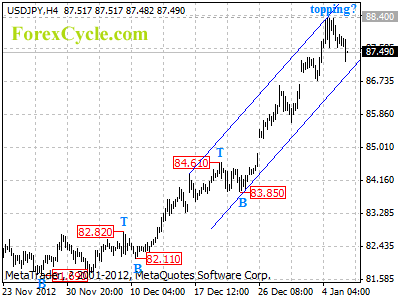
USDJPY may be forming a cycle top at 88.40

USDJPY may be forming a cycle top at 88.40 on 4-hour chart. Pullback to the lower line of the price channel would likely be seen. As long as the channel support holds, the fall is treated as consolidation of the uptrend from 82.11, and another rise towards 89.00 is still possible. On the downside, a clear break below the channel support will indicate that lengthier consolidation of the longer term uptrend from 77.14 (Sep 13, 2012 low) is underway, then deeper decline to 86.00 area could be seen.

usdjpy

Forex Signals

Sizemore Capital to Move to Active Bond Allocation

By The Sizemore Letter

The following was a memo to Sizemore Capital clients:

Given the historically low yields present across the yield curve and Sizemore Capital’s view that bonds are risky investments at current prices (see Grantham is Dumping Bonds), Sizemore Capital has opted to substitute the actively-managed Pimco Total Return ETF (NYSE:$BOND) for our traditional bond index exposure via the iShares Core Total US Bond Market ETF (NYSE:$AGG) in the Sizemore Capital  Strategic Growth Allocation.

Additionally, we will reduce our current allocation to the iShares Barclays TIPS Bond ETF (NYSE:$TIP) by 2.5%, with the remainder being allocated to BOND.  The total portfolio allocation to bonds will remain 15%, but will consist of a 10% allocation to BOND and a 5% alloction to TIP.

Our rationale is easy enough to understand.  At current prices and yields, a “buy and hold” bond portfolio offers no realistic opportunity for returns, particularly after inflation.  Rather than a “risk-free return,” we are now offered a “return-free risk.” 

But at the same time, bonds do offer value as a “shock absorber” and can play a valuable role in a dynamic rebalancing strategy.

We chose BOND as an alternative because its manager–the legendary “Bond King” Bill Gross–takes a tactical approach to bond investing.  Gross is also willing and able to short sectors of the bond market he considers at risk.

Gross is not infallible, and he has trailed his peers in recent years.  And in a broad sell-off of bonds, his fund would take losses along with its peers.  But in choosing BOND, we hope to get the benefits of a bond allocation–its low correlation to the equities markets–with the additional possibility of at least modest capital gains via Gross’ active management.

Disclosures: Sizemore Capital is long BOND and TIP.

SUBSCRIBE to Sizemore Insights via e-mail today.

The post Sizemore Capital to Move to Active Bond Allocation appeared first on Sizemore Insights.

Daimler: Ride in Style in 2013

By The Sizemore Letter

This piece orginally appeared on InvestorPlace as Charles Sizemore’s submission for the 10 Best Stocks of 2013 contest.

The auto industry is a truly wretched business to be in.  You have high labor costs and the constant threat of labor unrest.  You have vicious competition among existing competitors.  And perhaps worst of all, you have enormous capital expenditure needs coupled to a highly cyclical business that is prone to booms and busts.

So, you might be surprised to see that Daimler AG (OTC:DDAIF)—the maker of the iconic Mercedes-Benz—is my recommendation for the InvestorPlace Best Stocks of 2013 contest.

Normally, I hate the auto sector and would refuse to touch an auto stock.  But right now, I believe that Daimler may be one of the best opportunities in the world at its current price.  As a cyclical auto stock—and one based in crisis-wracked Europe, no less—Daimler has gotten no love from investors in recent years.  But their timidity is our opportunity.

Whenever I think of Daimler’s flagship brand Mercedes, I will always think of the “Indiana Jones of Finance,” Jim Rogers.  In a road trip across six continents chronicled in his book Adventure Capitalist, a customized Mercedes was Rogers’ vehicle of choice.  Why?  Because “every dictator and mafioso in the world drives a Mercedes…even in countries with no roads to speak of.”  Rogers knew that if he had car trouble anywhere in the world, he would be able to find a mechanic who could work on a Mercedes.

Rogers wasn’t joking about that.  Mercedes is the premier global luxury automobile.  And it is a fantastic way to get “backdoor” exposure to emerging markets, which I expect to enjoy a nice rebound in 2013.  Daimler gets well over a third of its sales from emerging markets, with China being a major contributor.  China is already the world’s largest consumer of the high-end S-Class, and China accounted for 10 percent of Daimler’s revenues in the first three quarters of 2012—and this despite a marked slowdown in the Chinese economy.

And Mercedes cars are by no means Daimler’s only product; Daimler is also a world leader in industrial trucks, which make up more than a quarter of revenues.  And as you might expect, emerging markets are a major source of demand.  Approximately half of Daimler truck sales come from Asia and Latin America. 

China appeared to hit bottom in late 2012, and I expect a rebound in Chinese demand to benefit high-end luxury firms in general and high-end autos in particular.  Even in a “bad” year (if you can call 7.5% GDP growth in 2012 “bad”) China was a major contributor to Daimler’s success.

Investors fret that 34 percent of Daimler’s revenues come from Western Europe, where unemployment is high and overall consumer demand is weak.  This does not particularly worry me.  Daimler’s high-income customers are less at risk of financial distress than the average European, and sales have remained stable throughout the crisis.

But let’s say I’m being too optimistic about the Eurozone and that the atmosphere of austerity makes a large delayed dent in European sales in 2013.   Even so, the stock price offers more than a sufficient margin of safety.  The shares trade for less than 8 times earnings and yield over 5 percent in dividends.

Yet none of this tells the full story about how cheap this company is.  Daimler trades at accounting book value and for just 0.39 times sales.  It also has €46 billion in cash short-term investments, and receivables—and a market cap of just €44 billion.  Yes, the cash in the bank and receivables are actually worth more than the entire company at current prices.

Daimler is simply too cheap to pass up.  This is the maker of the premier global luxury car trading at prices that would suggest the Mayan calendar was correct about the world ending in 2012.

Action to take: Buy shares of Daimler AG at market.  Daimler could easily double in the 12-18 months.  And if we’re a little early in getting into this stock, we’re getting paid handsomely to ride out any unexpected volatility.

Disclosures: Sizemore Capital is long DDAIF.

Note: Charles Sizemore won the 2011 Investor Place Best Stocks contest with a monster 44% return on his recommendation of Visa (NYSE:$V) and was runner up in the 2012 Best Stocks contest with a 37% return on his recommendation of Turkcell (NYSE: $TKC).

The post Daimler: Ride in Style in 2013 appeared first on Sizemore Insights.

Romania says inflation may reach target range end-2013

By www.CentralBankNews.info      Romania’s central bank, which earlier held its policy rate steady, said the rising trend in inflation had been halted and the economy was slowly recovering amid the euro area recession.
    The National Bank of Romania, which held its policy rate steady at 5.25 percent, said the “prospects remain favorable for the annual inflation rate to return inside the target bank by the end of the year, but risks and uncertainties related to the developments in the external environment, capital flows, administered prices and some volatile prices still persist.”
    The central bank’s 2013 target for annual inflation is 2.5 percent, plus/minus one percentage point, and in November the inflation rate fell to 4.56 percent from a September peak of 5.33 percent “thereby confirming the gradual fading of the inflationary effect coming from supply-side factors,” the bank said in a statement.
    Weak industrial production and retail trade, along with the protracted euro area recession that limits Romanian exports, suggests that the negative output gap will persist, the bank said.

    Romania’s Gross Domestic Product contracted by 0.5 percent in the third quarter from the second quarter for an annual drop in GDP of 0.6 percent, down from growth of 1.7 percent in the previous quarter.
    The central bank’s current forecast calls for inflation to decline to 3.5 percent in the 2013 fourth quarter and then continue to slowly fall next year to 3.0 percent in the third quarter of 2014.
    Last year the central bank cut its policy rate by 75 basis points and the bank said its policy decisions were “aimed at resuming and consolidating disinflation, whose outlook is further marked by risks and uncertainties related to domestic developments, including the persistence of structural rigidities across the Romanian economy as well as the euro area and global economic recovery.”

    www.CentralBankNews.info