Euro Takes Losses Following Disappointing EU Data

Source: ForexYard

The euro took losses against several of its main currency rivals yesterday, following the release of worse than expected EU retail sales and German factory orders data. The news also led to bearish movement for other riskier assets, including the British pound and crude oil. Today, euro-zone news is once again forecasted to impact the market. Traders will want to pay attention to the German Industrial Production figure, set to be released at 11:00 GMT. If the figure comes in below its forecasted level, the euro could take further losses during mid-day trading.

Economic News

USD – Risk Aversion Leads to Dollar Gains

The safe-haven US dollar saw moderate bullish movement against several of its higher yielding currency rivals yesterday, after worse than expected euro-zone data, specifically retail sales and German factory orders figures, led to risk aversion in the marketplace. The USD/CHF advanced close to 50 pips during mid-day trading to eventually reach as high as 0.9250. The GBP/USD fell close to 60 pips during the middle of the day to trade as low as 1.6047 by the end of the European session.

A lack of significant news out of the US today means that dollar movement is once again likely to come as a result of euro-zone data. Traders will want to pay attention to the German Industrial Production figure. Analysts are forecasting the indicator to come in significantly higher than last month’s which, if true, is likely to generate risk taking in the marketplace and cause the greenback to give up yesterday’s gains. Later in the week, dollar traders will want to pay attention to the US Unemployment Claims and Trade Balance figures, both of which are forecasted to generate volatility for the greenback.

EUR – Euro-Zone Data Once Again Expected to Drive Markets Today

News that the euro-zone unemployment rate went up last month, combined with a drop in German factory orders, resulted in the euro taking moderate losses against safe-haven currency rivals yesterday. The EUR/USD fell some 65 pips during the mid-day session to trade as low as 1.33068, before a slight upward correction brought the pair up to 1.3090. Against the Japanese yen, the common-currency lost more than 60 pips during the middle of the day to trade as low as 114.23.

Today, euro-zone news is once again forecasted to dictate the direction markets take. Specifically, traders will want to focus on the German Industrial Production figure, scheduled for 11:00 GMT. As the biggest economy in the EU, German economic news tends to have a significant impact on the euro. With analysts forecasting the indicator to come in higher than last month’s, the euro could recover some of its recent losses today.

Gold – Increase in Chinese Demand Boosts Gold Prices

An increase in Chinese demand for gold caused the precious metal to reverse its recent bearish trend during the European session yesterday. Gold prices advanced more than $11 an ounce over the course of the day, eventually reaching as high as $1658.66 before falling back to the $1656 level.

Today, gold traders will want to pay attention to euro-zone news and its impact on the US dollar during mid-day trading. If the German Industrial Production figure comes in above its forecasted level, the USD could take losses, which would make gold more affordable for international buyers and possibly boost prices further.

Crude Oil – US Inventories Data Set to Impact Oil Prices Today

After gaining more than $0.70 a barrel during early morning trading, crude oil turned bearish after worse than expected euro-zone data led to risk aversion in the marketplace. The commodity fell close to $1 during mid-day trading, eventually reaching as low as $92.73 by the end of the European session.

Turning to today, oil traders will want to pay attention to the US Crude Oil Inventories figure, scheduled to be released at 15:30 GMT. If the figure comes in below its forecasted level, it will likely be taken as a sign that demand for oil in the US has gone up, which would cause the commodity to turn bullish during afternoon trading.

Technical News

EUR/USD

The Bollinger Bands on the weekly chart are beginning to narrow, indicating that a price shift could occur in the coming days. Furthermore, the MACD/OsMA on the same chart appears close to forming a bearish cross, signaling that the shift in price could be downward. Opening short positions may be the smart choice for this pair.

GBP/USD

The daily chart’s Slow Stochastic appears close to forming a bullish cross, indicating that this pair could see upward movement in the near future. Additionally, the Williams Percent Range on the same chart has dropped into oversold territory. Traders may want to open long positions for this pair ahead of a possible upward correction.

USD/JPY

The Relative Strength Index on the weekly chart is currently in overbought territory, indicating that a downward correction could occur in the coming days. This theory is supported by the Slow Stochastic on the same chart, which has formed a bearish cross. Opening short positions may be the smart move for this pair.

USD/CHF

The Williams Percent Range on the daily chart has crossed into overbought territory, indicating that a downward correction could occur in the near future. Furthermore, the Slow Stochastic on the same chart has formed a bearish cross. Opening short positions may be the smart move for this pair.

The Wild Card

USD/NOK

The Williams Percent Range on the daily chart has crossed over into overbought territory, indicating that a downward correction could occur in the near future. This theory is supported by the Slow Stochastic on the same chart, which has formed a bearish cross. Going short may be the wise choice for forex traders today.

Forex Market Analysis provided by ForexYard.

© 2006 by FxYard Ltd

Disclaimer: Trading Foreign Exchange carries a high level of risk and may not be suitable for all investors. There is a possibility that you could sustain a loss of all of your investment and therefore you should not invest money that you cannot afford to lose. You should be aware of all the risks associated with Foreign Exchange trading.

Market Trends 09.01.2013

Source: ForexYard

printprofile

Hey Everyone,

Below are some market trends for today.

Good luck!

-Dan

Gold- May see downward movement today
Support- 1652.15
Resistance- 1673.49

Silver- May see downward movement today
Support- 29.82
Resistance- 31.09

Crude Oil- May see downward movement today
Support- 92.18
Resistance-93.77

Dax 30- May see upward movement today
Support- 7624.01
Resistance- 7850.00

EUR/USD May see downward movement today
Support- 1.2995
Resistance- 1.3163

Read more forex news on our forex blog

Forex Market Analysis provided by ForexYard.

© 2006 by FxYard Ltd

Disclaimer: Trading Foreign Exchange carries a high level of risk and may not be suitable for all investors. There is a possibility that you could sustain a loss of all of your investment and therefore you should not invest money that you cannot afford to lose. You should be aware of all the risks associated with Foreign Exchange trading.

Market Review 09.01.2013

Source: ForexYard

printprofile

The US dollar was able to correct some of its recent losses against the Japanese yen during the overnight session, as renewed speculations that the Bank of Japan will initiate a new round of monetary easing in the near future weighed down on the JPY. The USD/JPY advanced more than 80 pips during Asian trading and is currently trading at 87.60.

A slow news day yesterday resulted in the EUR/USD, crude oil and gold seeing little movement during overnight trading.

Main News for Today

German Industrial Production- 11:00 GMT
• Analysts are forecasting the figure to come in at 1.1%, significantly higher than last month’s -2.6%
• Better than expected news could result in gains for the euro during mid-day trading

US Crude Oil Inventories- 15:30 GMT
• Analysts are forecasting today’s figure to come in at 0.9M, which if true, may be taken as a sign of weakened demand in the US and could lead to a drop in oil prices during afternoon trading

Read more forex news on our forex blog

Forex Market Analysis provided by ForexYard.

© 2006 by FxYard Ltd

Disclaimer: Trading Foreign Exchange carries a high level of risk and may not be suitable for all investors. There is a possibility that you could sustain a loss of all of your investment and therefore you should not invest money that you cannot afford to lose. You should be aware of all the risks associated with Foreign Exchange trading.

Thailand holds rate but eyes risks from high credit, debt

By www.CentralBankNews.info     Thailand’s central bank kept its policy rate steady at 2.75 percent, as expected, but cautioned that it was keeping a close eye of risks that could develop from persistently high credit growth, rising household debt and volatile capital flows.
    The Bank of Thailand (BOT) said last year’s accommodative policy – the BOT cut rates by 50 basis points in 2012 –  had “significantly shored up private sector confidence, supported post-flood recovery, and helped cushion the economy from the global economic headwinds.”
     Although the global economy continued to recover, led by the US and China, the central bank said it was still appropriate to maintain a policy stance that sustained growth momentum, given the remaining uncertainties in the global economy and that inflation was forecast to be within target.
    “The MPC will, however, continue to closely monitor financial stability risks that may arise from persistently high credit growth, rising household debt, and volatile capital flows,” the BOT said in a slightly hawkish statement after a meeting of its Monetary Policy Committee.
    The BOT said the recent political agreement in the United States to avert the fiscal cliff had helped bolster global financial market sentiment but the euro zone and Japanese economies remained weak and a “resolution of their structural problems would likely take time.”

    But the economic performance of most Asian economies had turned more positive, helped by strong domestic demand and “modestly improving exports.”
    The BOT’s slightly hawkish tone was a bit firmer that its surprisingly upbeat statement in November when it said downside risks to economic growth were starting to subside and it expected exports to recover in the first half of this year.
    In December the BOT raised its forecasts for growth in 2012 and 2013 and the bank said this growth revision was based on its expectation that the Thai economy likely expanded more than previously expected in the the fourth quarter.
    In the third quarter, Thailand’s Gross Domestic Product rose by 1.2 percent from second for annual growth of 3.0 percent, down from 4.4 percent in the second but well above the first quarter’s 0.4 percent as the country slowly began to recover from flooding in 2011.
   Growth continues to be driven by private consumption and investment that is supported by “consumer and business confidence, favourable household income, full employment as well as accommodative monetary conditions with continued high rates of credit growth,” the bank said.
    It added that the export sector showed incipient signs of a broad-based recovery while the service sector and tourism expanded robustly.
    The BOT said inflationary pressures remained stable but “the impact of the second-round minimum wage increase warranted monitoring.”
    Thailand’s headline inflation rate jumped to a 2012-high of 3.6 percent in December from 2.7 percent in November but core inflation, which excludes fresh food and energy prices, eased to 1.78 percent from 1.85 percent.
    The BOT targets core inflation of 0.5 to 3.0 percent.
    In December the central bank raised its 2012 GDP forecast to 5.8 percent from a previous 5.7 percent and its 2013 forecast to 4.7 percent from 4.6 percent.
    Economists had widely expected the BOT to hold rates steady this month but are starting to pencil in rate rises in the second half of this year if inflation starts to rise.
   
    www.CentralBankNews.info
       

Downside in the Yen: Shinzo Abe and the Three Bears

By MoneyMorning.com.au

Japanese Yen

While everyone has been focused on the outcome of the fiscal cliff negotiations there has been a far more interesting development occurring in Japan. I believe this development has had a greater impact on the direction of markets over the last couple of months than most people appreciate.

Shinzo Abe, the new Prime Minister of Japan, has made it very clear that he supports more money printing and a weaker Yen. The lead up to his election saw a very sharp move to the downside in the Yen and this strong trend has continued after the election.

Japanese Yen Monthly Chart


Japanese Yen Monthly Chart
Click here to enlarge


The reason why I find this so fascinating is that the monthly chart of the Japanese yen in US dollars is now looking quite scary indeed.

The chart above goes all the way back to 1979. You can see quite clearly that the highs made in 2011 have now created a double top or ‘false break’ of the high made all the way back in 1995. The uptrend from 2007 has also been clearly broken now.

From the look of the chart above and the determination of the Prime Minister to attempt to print his way to prosperity, we may still be at the very beginning of a large move to the downside in the Yen.

This new development is worth keeping an eye on because the Yen has been a favourite amongst the ‘carry trade’ set for many years. The last few years saw a switch from the Yen to the US dollar as the borrowed currency. But we may now be witnessing a return to the old ‘Yen carry trade’ game.


If you’re not familiar with the term, a carry trade is when an investor borrows money in one currency and then sells that currency and invests the money offshore. While the borrowed currency weakens and asset markets rise elsewhere this trade can reap incredibly huge rewards for those able to borrow large sums at very low rates. ie. the banks and hedge funds of the world.

If the Prime minister of the country has made it clear that he has your back and will keep printing money and weakening the currency, why wouldn’t you borrow in that currency and invest elsewhere? It’s a no-brainer that the Yen will continue weakening, so half of your risk has been taken of the table and if anything will ultimately add to the profits.

We have all heard of the risk on/risk off mentality of markets. A good proxy for this risk on/risk off idea is the Euro/Yen and the AUD/Yen cross rates. You’ll often see quite a high correlation between these two currency crosses and equity markets.

Euro/Yen vs ASX 200


Euro/Yen vs ASX 200
Click here to enlarge


It’s sometimes hard to get your head around, but looking at a chart of the Euro/Yen and the ASX 200 shows a striking correlation. There is no doubt they will both diverge at different times but ultimately the relationship comes back into play and the divergence between the two can often be a great hint about future direction.

It’s obvious from the above chart that the rally in the Euro/Yen over the past few months has been amazingly strong. Could the 10% rally we’ve seen in the ASX 200 over the past month be due to this ‘Yen carry’ effect rather than anything else? I think so.

AUD/Yen vs ASX 200


AUD/Yen vs ASX 200
Click here to enlarge


It makes more sense that there is an even higher correlation between the AUD/Yen and the ASX 200. There have been times in the past few years when the AUD/Yen and the ASX 200 have walked side by side with a correlation of almost 1.

That high correlation broke down in early 2012 but the last few months have seen the relationship return.

AUD/Yen vs ASX 200 since 2001


AUD/Yen vs ASX 200 since 2001
Click here to enlarge


Just to make the point that there is a lasting relationship between the AUD/Yen and our equity market I thought I should include a longer term chart of the two.

You can see from the above chart that over the last 13 years there has been an incredibly close link between the two, even if there are periods of a year or so when the two moved in opposite directions.


So it appears that the decisions of the new Prime Minister in Japan have far more influence over the direction of our equity market than most would imagine. If he is really determined to trash the Yen does that mean our market will continue rallying? Perhaps.

But as always there are unintended consequences to the actions of our fearless leaders. They are determined to defy all of the laws of economics in their quest to ‘fix’ the economy.

One interesting development in Japan is the little wiggle in the tail of the Japanese government bond (JGB) market.


Japanese government Bond (JGB) yields since 2009

Japanese government Bond (JGB) yields since 2009
Click here to enlarge


Source: FXthoughts.com


You can see from the above chart that the 30 year JGB’s have sold off since the middle of 2012. The move has seen yields rise from 1.75% to just over 2%. A yield of 2% is of course still incredibly low, but the fact is a 25 basis point move from 1.75% is not negligible.

You can also see from the above chart that the 10 year bond yield is also starting to move higher over the last couple of months.

Could the bond market be sniffing the possibility of inflation down the track?

What happens to the finances of Japan if the bond yields continue to rise?

Well they have about 240% debt to GDP and an article on CNBC.com stated that:


            ‘Andy Xie, an independent economist, agrees that Japan’s debt situation is not sustainable and that the country is becoming increasingly reliant on foreign capital flows. Even though the yield on 10-year JGBs is less than 1 percent, the interest expense is expected to top 22.3 trillion yen ($280.6 billion) in the current fiscal year, Xie said.

‘”This is one-quarter of the budget,” he added. “If the bond yield rises to 2 percent, the interest expense would surpass the total expected tax revenue (this year) of 42.3 trillion yen.’


Wow.

So we can now see that the new Japanese Prime Minister is playing with fire.

He has to tread very carefully if he is to print enough money to weaken the Yen and increase exports, but not so much that he scares the bond market and brings the whole house of cards tumbling down on his head.

In other words, he has to get things ‘just right’.

If anyone needed to ask the advice of Goldilocks it’s the new PM of Japan Shinzo Abe. And I assure you when the music stops it will be more than three bears chasing him into the woods.

Murray Dawes
Editor, Slipstream Trader

 
From the Port Phillip Publishing Library

Special Report: The Fuse is Lit

Daily Reckoning:
A North Korean Investment Opportunity

Money Morning:
How Central Banks Are Letting Inflation Get Out of Control

Pursuit of Happiness:
Are You Brave Enough to Break From Technology?

China’s Economy is Still Heading for a Hard Landing – Here’s a Better Bet

By MoneyMorning.com.au

China hard landing

Early last year, the idea that China’s miracle economy might finally have sprung a leak started to gain some acceptance by even the biggest China bulls.

After all, it was pretty hard to keep arguing that growth could never fall below the magic 8% level when even the Chinese government said it come in at around 7%.

Yet the sight of a few bits of perkier economic data now have everyone declaring a ‘soft’ landing. The stock market is ticking higher, and the China bulls are back in force.

I still wouldn’t touch it with a ten-foot bargepole…

The one sure predictor of a mega-bust –
a mega-boom

As Edward Chancellor points out in an excellent column for the FT’s funds supplement this morning, there is one predictor of financial crisis that is unmatched: “reckless credit expansion”.

Chancellor quotes from a paper by Claudio Borio at the Bank for International Settlements. Borio tries to highlight the importance of the credit cycle (in other words, how tight or loose lending is) to understanding macro-economics. He observed that “economic hard landings often followed periods of strong credit growth and house price inflation”.

This shouldn’t be a controversial topic, but it is. Maddeningly, the people in charge still argue that the financial crisis came out of nowhere. You can see why: it gets them off the hook. But it’s entirely wrong. “We have forgotten the basic law that every credit boom… contains the seeds of its own demise.”

Borio’s point is that the credit boom years are an aberration: “Reckless credit expansion spurs unsustainable growth and results in the misallocation of capital.” In other words, money gets thrown at projects and investments that can’t ever pay for themselves.

When the bust comes, the best thing to do is let the bad investments unwind and go bust. If you instead try to get back to the boom years by using ultra-loose monetary policy, all you do is “delay the resolution of economic imbalances and even generate new asset price bubbles”. That’s what Alan Greenspan did after the tech bubble burst, and it’s what Ben Bernanke is trying to do now.

By this measure, which country currently looks most vulnerable to a hard landing? China, of course. As Chancellor reminds us, China’s ratio of debt to GDP rose by 60 percentage points in the five years to 2012.

By itself, that probably doesn’t mean much to you. So to put it in perspective, that’s “a much larger increase than that experienced by either the US prior to 2008 or by Japan in the second half of the 1980s”.

In other words, China’s economy has ‘geared up’ more dramatically than either the US or the Japan did right before two of the most devastating economic collapses in living memory. And despite government attempts to cool the property bubble, credit has gone on expanding. “Last year, China’s non-financial credit expanded by a staggering 33%.”

As for ‘malinvestment’, Michael Pettis, a professor at Peking University, flags up an International Monetary Fund paper which investigates just how mad China has gone with its infrastructure investment.

 
In short, China has used its citizens’ savings to subsidise huge levels of investment in infrastructure. This can’t carry on. If it does, says Pettis, “overinvestment will contribute to further financial fragility leading, ultimately, to the point where credit cannot expand quickly enough and investment will collapse anyway”. But China’s growth meanwhile has become so dependent on this level of investment, that any slowdown or adjustment will hit growth hard.

So either way the country is in trouble. While I’m bearish on China, I wouldn’t be at all surprised to see a strong market bounce from here if investors decide they are back in ‘risk-on’ mode. But I won’t be buying in. As Chancellor points out, “nobody can tell when China’s financial cycle will peak. We can say the longer this boom lasts, the harder the landing will be”.

Another risky country that might be a better bet than China

And if you’re tempted to invest in China because the stock market looks cheap, I’d suggest that you consider Russia instead. The country is still too dependent on energy prices, but it certainly hasn’t experienced a credit bubble.

Now, the truth is, I’m not keen to invest in either country. I am not an especially risk-averse investor (the amount of my own pension invested in Japan is a testament to that). But there is simply too much political risk in both China and Russia for my liking.

What concerns me most is the apparent attitude that private ownership of an asset is a right granted to you by the government, and which can be rescinded at any time the state wants the asset back. Forget understanding company fundamentals – being a successful investor in that environment depends mainly on knowing which backs to scratch, and that’s not something you can divine from even the most transparent balance sheet.

John Stepek
Contributing Writer, Money Morning

Publisher’s Note: This article originally appeared in MoneyWeek

From the Archives…

The Talisman of Fear: Why Gold Remains the Foundation of Wealth
4-1-2013 – Kris Sayce

We Got it Wrong With Dividend Stocks…And Investors Still Made Money
3-1-2013 – Kris Sayce

A Contrarian Investment Prediction for 2013
2-1-2013 – Greg Canavan

The Rockers and Shockers of 2012
31-12-2012 – Kris Sayce

Will 2013 Show Us Up?
29-12-2012 – Callum Newman

Central Bank News Link List – Jan. 9, 2013: BOJ may ease again, double inflation target – sources

By www.CentralBankNews.info Here’s today’s Central Bank News link list, click through if you missed the previous link list. The list comprises news about central banks that is not covered by Central Bank News. The list is updated during the day with the latest developments so readers don’t miss any important news.

USDJPY rebounds from 86.82

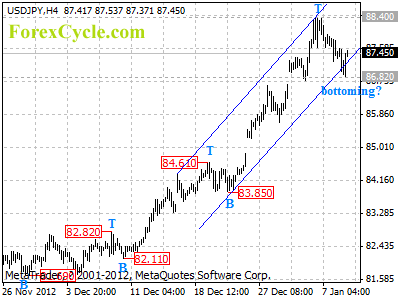
After touching the lower line of the price channel on 4-hour chart, USDJPY rebounds from 86.82, suggesting that a cycle bottom is being formed. Further rise could be expected, and next target would be at 88.00 area. Support is now at 86.82, only break below this level could indicate that lengthier consolidation of the uptrend from 77.14 (Sep 13, 2012 low) is underway, then deeper decline to 86.00 area could be seen.

usdjpy

Daily Forex Forecast

My Favorite Tobacco Stock is…Intel?

By The Sizemore Letter

Yes, you read that correctly.  My favorite “tobacco stock” is Intel Corp (Nasdaq:$INTC).

Lest you think I’ve lost my mind, I am aware that Intel does not sell or market cigarettes or other tobacco products. Intel is the world’s premier designer and manufacturer of computer processors.

But while Intel is not a tobacco company, it most certainly is a tobacco stock, or at least it shares many of their characteristics.

This requires a little explaining.  If you’ve read some of my past posts, you are probably familiar with my reasons for liking tobacco stocks over the long haul, even if I recommend avoiding them at current prices (see The Price of Sin and Time to Stop Bogarting Cigarette Stocks).  Because of the social stigma associated with vice investments like tobacco, alcohol and firearms, many institutional investors shun them, either by choice or by socially-responsible investment mandate.  This causes sin stocks to be priced as perpetual value stocks, with the low valuations and fat dividends that this entails.

Well, I admit, in this particular respect Intel has nothing in common with tobacco stocks (even if it is priced like one at the moment).  It’s hard to find a scale by which Intel would be considered socially irresponsible. But let’s take a look at some of the other characteristics that make tobacco stocks—and Intel—interesting.

Tobacco companies have gargantuan barriers to new competition—what Warren Buffett might call an unassailable moat.   Given the legal and political risk and the size and scale needed to deal with both, it would be next to impossible to start a new tobacco company now.  You would need infinitely deep pockets and decades’ worth of political connections. As a result, Big Tobacco has become an entrenched oligopoly in which a handful of players—such as Altria (NYSE: $MO), Reynolds American (NYSE:$RAI) and Lorillard (NYSE:$LO)—completely dominate.

But even if you could start a new tobacco company, why would you?  It’s not exactly a business with a bright future.  In the developed world, tobacco is a business in steady but terminal decline.

This brings me back to Intel.  I’m actually in the minority among investors at the moment in that I see a bright future for Intel.  No, they haven’t figured out mobile yet, but they will.  As mobile devices become more and more sophisticated, they will need the power than only Intel can provide.  And there is also the server business, which accounts for roughly a quarter of Intel’s revenues.  Ironically, while Intel has yet to really break into mobile, its server business has benefitted handsomely as the mobile revolution has created greater demand for cloud services.

Yet this is not how the market views Intel right now.  No, Intel is a company resigned to gentle decline, as its core PC market inevitably shrinks.  From the way Intel bears talk, PC users are disappearing from polite company faster than smokers, forced to type on their physical keyboards in alleys behind buildings or in doorways.

For the sake of argument, let’s assume they’re right.  Intel would still be a buy at current prices.

As the Big Tobacco has proven for decades, companies in declining industries can make excellent investments under the right conditions.  If you have a dominant market position (think back to Warren Buffett’s “moats”), a conservative balance sheet, and have ample cash flow for share repurchases and dividends, you can do quite well by your investors even in a shrinking market. It’s worked for Big Tobacco investors, and it will work for Intel investors as well.

At just 9 times earnings, Intel is priced significantly cheaper than any major tobacco stock, and its dividend is competitive at 4.3%.  I might add that Intel’s dividend has risen by over 40% in the past two years and that its dividend still only accounts for 37% of (depressed) earnings.

Buy Intel and reinvest your dividends.  If I am right, Intel will regain its place among America’s most reputable growth stocks.  But even if I’m wrong, Intel is positioned to offer “tobacco like” returns for the foreseeable future.

Note: The “Intel is a tobacco stock” concept was conceived during a podcast interview with InvestorPlace Editor Jeff Reeves in which we each discussed our picks in the 10 Best Stocks of 2013 contest.  Jeff’s choice was Intel; mine was German luxury carmaker Daimler (OTC:DDAIF).

Disclosures: Sizemore Capital is long INTC and DDAIF

SUBSCRIBE to Sizemore Insights via e-mail today.

The post My Favorite Tobacco Stock is…Intel? appeared first on Sizemore Insights.

Don’t Fall for the Shale Boom Hype – Chris Martenson Interview

Interview by James Stafford, Editor Oilprice.com – the No.1 source for oil prices

We are in the midst of an amazing energy boom, but by sweeping the idea of peak oil under the rug we are ignoring a significant fact: the relationship between hydrocarbon reserves and flow rates are not the same as they used to be—reserves have increased but flow rates are not as high or sustainable.

Perhaps the most important thing we need to pay attention to is net energy returns, on which we run society. Massive new discoveries are only netting a fraction of the returns compared to earlier decades.

While we must proceed into the energy future with caution—and the knowledge that analysts may be overselling the shale boom—there are also, as always, major opportunities in this story and they can be found in the wider trends related to improving energy efficiency.

Looking at our energy future in more detail we were fortunate to speak with the well known economist and author of the Crash Course Chris Martenson. You can find out more about Chris and the Crash course at his website Peak Prosperity.

In part 1 of our exclusive 2 part interview Chris discusses:

  • Why we shouldn’t talk about energy independence
  • What the media is failing to report about the “massive” Shale discoveries
  • How oil analysts are getting the economics wrong
  • Why we could see $200 a barrel Oil in the Near Future
  • The relationship between energy and the economy
  • Why peak oil is not a defunct theory
  • Why electric vehicles are the future
  • Why natural gas should be a bridge to a new energy future
  • Why Washington just doesn’t get it

Interview by James Stafford of Oilprice.com

James Stafford: You’re well-known for talking about the dangers of peak oil. But are you more optimistic about the future now that we find ourselves in the middle of an energy boom—thanks to improved extraction methods like fracking and other technologies, which have opened up massive oil and gas plays once thought to be unreachable or too expensive to get to market?

Chris Martenson: Good question. The relationship between energy and the economy is the most important thing that anyone can, and should, work to understand. In the past, we’ve always had whatever amounts of oil we wanted to support the sort of economy we operate, and that happens to be an economy that grows exponentially. The rate of growth that seems to work best at about 3% real and 6% nominal growth.

Now, between the 1960s and the 1980s, the world saw roughly a 6% per year growth in oil output. From 1980 to 2000, roughly 1.5%. And since then, almost flat, maybe a .1% growth in oil output.

So shale oil discoveries may be massive in terms of the total number of barrels of oil–but what they lack are high and sustained flow rates. And there’s a lot of confusion out there in the press right now, with several analysts that should know better, waving their hands at increasing reserves and then making the utterly wrong conclusion that peak oil is a defunct theory.

Now, to illustrate this, imagine we just found a trillion barrels 40,000 feet down. Yeah, that would awesome, right? No more peak oil, at least for a long time, right? Well, what if due to technological considerations, we could only get a few wells installed, and the max flow rate we could get from that reservoir was 100,000 barrels per day. Oh, that’s it? Well, that’s nice, but it doesn’t really help the overall situation, where we’re experiencing roughly 4,000,000 barrels per day,per year declines in existing conventional crude oil fields. That is, reservoir size and flow rates were well-correlated several decades ago, because the stuff just flowed out of the ground so easily, but now that we have to drill tens of thousands of feet to achieve a single well flow rate on the order of 100 barrels per day/per well in the shale plays, or we even have to scoop up tarry sand in giant machines and then power wash the bitumen off of it, oil just don’t quite flow quite like it used to.

There’s a new relationship between reserves and flow rates, and it’s a fraction of the old rate. And it’s an entirely new world, and this has been missed by the less insightful analysts and commentators out there. I am optimistic about the new reserves and flows but not because I happen to think they allow us to forget about the challenges and snap back to ‘how things used to be.’ We’re in a new regime of higher oil prices and that alone sets today well apart from the past.

James Stafford: In your crash course, you make an interesting point that America imports 10 million barrels of oil per day, which represents the same power equivalent as 750 nuclear plants. With the new oil fields opening up in the US, is it realistic to think that America could become energy independent?

Chris Martenson: Energy independence is another confusing term that’s recently, and I think regrettably, been introduced in the conversation. The various forms of energy are simply not interchangeable at this time. We have to consider them separately.

I’ve never thought that the US has an energy shortfall. We have a lot of coal, for example, but we do have a liquid fuel predicament. Right now, we move almost nothing from point A to point B using anything other than liquid fuels derived from petroleum. Together, electricity and natural gas account for perhaps 1% of everything that moves. I believe that we could and we should work very hard towards using electricity to move things, but to do so will require many trillions of dollars in investment in infrastructure, vehicles, storage technology.

I also believe we should use our remaining natural gas as a bridge fuel to get us to a new energy future that’s durable and provides us with a high quality of life. If we were on a path towards using electricity and natural gas to move things around, then I would be willing to entertain the idea of energy independence as a useful concept, because then the various fuels would be swappable. However, we’re not on any such path at all at this point in time, at least not meaningfully so.

We will not ever become energy-independent with respect to liquid fuels in the US unless demand absolutely craters due to an economic calamity of some sort.

James Stafford: Obviously making a change would take serious political will. Do you think that will exists at this point in time, or is it something that’s going to happen when people get a nasty shock?

Chris Martenson: I think we’re going to have to go with the nasty shock at this point. The political will just isn’t there. Recent events have really confirmed for me that Washington, D.C. just doesn’t get it. They really want to believe in the story that the US is a new energy powerhouse; just don’t want to look at the complexities that are actually involved in the story at this point in time.

So will we change through pain or insight? Those are the two main avenues of change, either at the individual or cultural level. I truly believe that pain is probably the most likely way we’re going to change in this story. Maybe not – hope springs eternal – but from a betting standpoint change will follow pain.

James Stafford: What do you see happening with the oil market in the coming, say, three to five years?

Chris Martenson: Despite all of the hoopla about tight oil, which I think has been oversold by the way, I remain focused on the fact that for whatever reasons, world oil production has been effectively flat for six years running despite a tripling in the price of oil. Brent crude remains solidly over 100 a barrel, and 2012 will be the highest yearly oil price on record for global oil.

So my ideas here are that oil’s an utterly non-negotiable necessity of modern life. Demand for it is going to grow further on the world stage. New oil discoveries all have a marginal cost of production that ranges from 60 bucks on the low end per barrel to 100 dollars per barrel on the high end. What this means is that my new floor, for the price of oil, is somewhere in the vicinity of $70 to $80 a barrel. That’s my low end target.

On the upper end, so much depends on whether the world economy finally recovers, which is looking increasingly unlikely, or whether there are further geopolitical difficulties in the few remaining productive oil basins, notably West Africa and the Middle East. Should either or both of those regions see their oil production shut in for any length of time, I can easily see the price of oil doubling from here to $200 a barrel, with very dire effects on the struggling world financial system.

James Stafford: What are your thoughts on the situation we are seeing with declining net energy returns?

Chris Martenson: This is really the important part of this conversation. I think it’s a subtle idea, but it’s actually the most important one here, and that is that net energy returns are what we run our society on. And the net energy returns we’re getting from these new finds are a fraction of those that we enjoyed in prior decades. So that surplus energy left over after exploring and extracting energy, that’s the stuff on which our complex, just-in-time economy runs.

With less surplus or net energy, there’s just less left over to do other things with, such as growing our debts–at nearly double the rate of underlying economic growth, which is what we’ve done for the past four decades. Or shipping billions of economic items tens of thousands of miles from low cost labor markets to high profit consumer markets. Those activities require net energy, and that’s the part of this story that’s really missing, that even if we have these large finds, the tight oil shale plays, the heavy oils, the ultra-deep water finds, the net energy we’re getting back from those is just a fraction of what we used to get.

Continued in part 2.

In Part 2 Chris talks about:


  • How tight oil is being oversold
  • An idea for solving the storage and Battery problem
  • How price, not technology, has unlocked boom reserves
  • Why it’s about conservation now, not new technology
  • Why we should be concerned about another financial meltdown
  • Future opportunities for investors
  • Why exporting natural gas is a terrible idea

· Why Governments should help renewable Energy innovation

  • Why net energy returns are the MOST important thing


Source: http://oilprice.com/Interviews/Dont-Fall-for-the-Shale-Boom-Hype-Chris-Martenson-Interview.html


Interview by. James Stafford, Editor Oilprice.com – the No.1 source for oil prices